


Search results
Search for "gas sensing" in Full Text gives 82 result(s) in Beilstein Journal of Nanotechnology.
Synthesis and acetone sensing properties of ZnFe2O4/rGO gas sensors
Beilstein J. Nanotechnol. 2019, 10, 2516–2526, doi:10.3762/bjnano.10.242
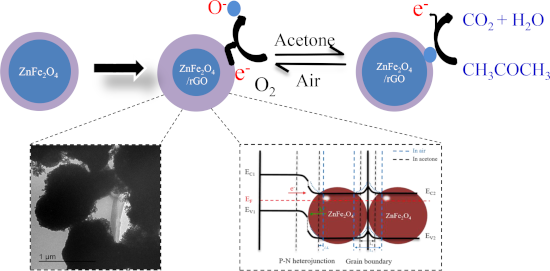
- about 600–1000 nm. The gas sensing test revealed that the introduction of rGO improved the performance of the sensing of acetone to low concentration, and the ZnFe2O4/rGO composite gas sensor containing 0.5 wt % of rGO exhibited a high sensitivity in sensing test using 0.8–100 ppm acetone at 200 °C. The
- amounts of acetone still need to be enhanced. As a dual metal oxide, AB2O4 spinel materials received much attention in the field of gas sensing [13][14]. With a unique spinel structure and a narrow bandgap width (≈1.94 eV), zinc ferrite (ZnFe2O4) has remarkable properties and shows good potential in the
- field of gas sensing. It was reported that small, well-dispersed ZnFe2O4 nanoparticles showed a good selectivity to acetone at 200 °C, but the detection limit was only 5 ppm [15]. Porous ZnFe2O4 double-shell microspheres showed a response to acetone at 206 °C, which is mainly ascribed to their unique




High-temperature resistive gas sensors based on ZnO/SiC nanocomposites
Beilstein J. Nanotechnol. 2019, 10, 1537–1547, doi:10.3762/bjnano.10.151
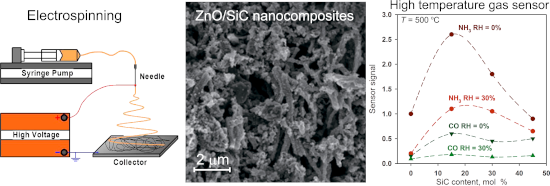
- (XPS). The electrophysical and gas sensing properties of the materials were investigated by in situ conductivity measurements in the presence of the reducing gases CO and NH3 (20 ppm), in dry conditions (relative humidity at 25 °C RH25 = 0) and in humid air (RH25 = 30%) in the temperature range 400–550



Selective gas detection using Mn3O4/WO3 composites as a sensing layer
Beilstein J. Nanotechnol. 2019, 10, 1423–1433, doi:10.3762/bjnano.10.140

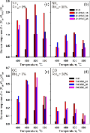
- Abstract Pure WO3 sensors and Mn3O4/WO3 composite sensors with different Mn concentrations (1 atom %, 3 atom % and 5 atom %) were successfully prepared through a facile hydrothermal method. As gas sensing materials, their sensing performance at different temperatures was systematically investigated for gas
- detection. The devices displayed different sensing responses toward different gases at specific temperatures. The gas sensing performance of Mn3O4/WO3 composites (especially at 3 atom % Mn) were far improved compared to sensors based on pure WO3, where the improvement is related to the heterojunction formed
- door for potential applications in gas recognition and detection. Keywords: Mn3O4/WO3 composites; heterojunctions; working temperature; gas sensing; selectivity; Introduction Tungsten oxide (WO3) is a highly stable, classical transition metal oxide. When synthesized, WO3 usually presents a yellowish


Gas sensing properties of individual SnO2 nanowires and SnO2 sol–gel nanocomposites
Beilstein J. Nanotechnol. 2019, 10, 1380–1390, doi:10.3762/bjnano.10.136
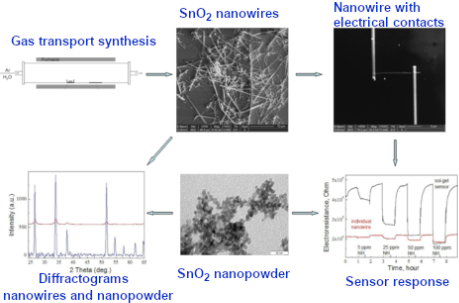
- selectivity to target gases. The aim of this work is the comparison of gas sensing properties of tin dioxide in the form of individual nanowires and nanopowders obtained by sol–gel synthesis. This comparison is necessary because the traditional synthesis procedures of small particle, metal oxide materials
- surface-to-volume ratio of gas sensing materials an important parameter in determining their gas sensitivity. Traditionally, quasi-0-dimensional (i.e., spherical) nano-objects have been used in order to create highly porous materials. In gas sensors, agglomerates of nanoparticles with a high specific area
- platinum, following a process described elsewhere (Figure 3) [29]. The electrical measurements were performed using a Keithley 2400 source meter unit (SMU). For gas sensing experiments, the devices were placed in a Linkam chamber with an integrated heater; the gas flow (≥99.999% purity) was regulated by




Hydrophilicity and carbon chain length effects on the gas sensing properties of chemoresistive, self-assembled monolayer carbon nanotube sensors
Beilstein J. Nanotechnol. 2019, 10, 565–577, doi:10.3762/bjnano.10.58

- chain and its hydrophilicity on the gas sensing properties of SAMs formed on carbon nanotubes are studied, and additionally, the gas sensing mechanisms are discussed. Four thiols differing in the length of the carbon chain and in the hydrophobic or hydrophilic nature of the head functional group are
- response and selectivity. This would make the detection of polar and nonpolar gas species employing low-power gas sensors easier, even under fluctuating ambient moisture conditions. Keywords: carbon length chain; gas sensing mechanism; hydrophilicity; hydrophobicity; multiwall carbon nanotubes (MWCNTs
- , pristine carbon nanotubes (CNTs) present some limitations for gas sensing. For example, carbon nanotube gas sensors often suffer from slow recovery, especially when operated at room temperature, which eventually results in baseline and response drift. For that reason, it is usually necessary to heat up the


Advanced scanning probe lithography using anatase-to-rutile transition to create localized TiO2 nanorods
Beilstein J. Nanotechnol. 2019, 10, 412–418, doi:10.3762/bjnano.10.40
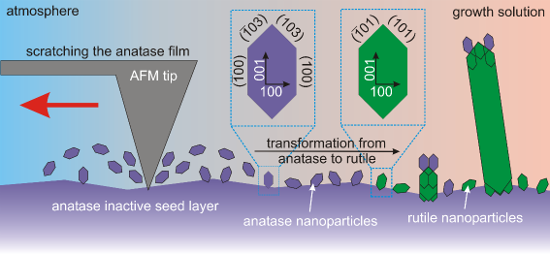
- optoelectronic characteristics. The fabrication of nanostructured TiO2 is inexpensive and hence employed in many applications such as photodetectors [2], photovoltaics [3][4][5][6], photocatalysis [7][8][9][10][11], surficial disinfection [12], biosensing [13], gas sensing [14][15][16], dewetting [17][18][19


Sub-wavelength waveguide properties of 1D and surface-functionalized SnO2 nanostructures of various morphologies
Beilstein J. Nanotechnol. 2019, 10, 379–388, doi:10.3762/bjnano.10.37
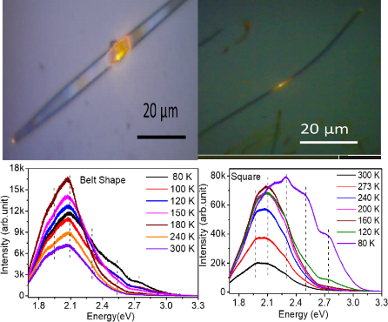
- nanoparticles [18] have been reported in our previous studies. We have also deciphered strong correlations of various defects in SnO2 NSs for chemical gas sensing [13] and wettability properties [19]. The growth of metal oxides with controllable dimensions is an important area for technological applications. In


Wet chemistry route for the decoration of carbon nanotubes with iron oxide nanoparticles for gas sensing
Beilstein J. Nanotechnol. 2019, 10, 105–118, doi:10.3762/bjnano.10.10
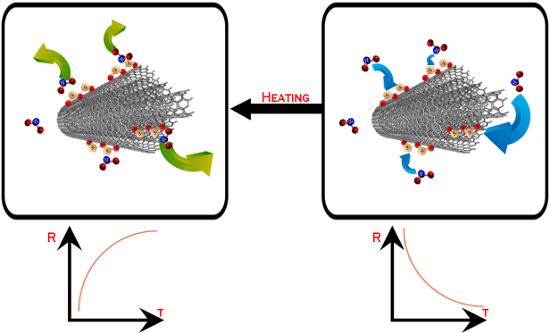
- by selecting the appropriate ratio of carbon nanotubes/iron salt, while nanoparticle size can be modulated by controlling the calcination period. Pristine and iron-decorated carbon nanotubes were deposited on silicon substrates to investigate their gas sensing properties. It was found that loading
- with iron oxide nanoparticles substantially ameliorated the response towards nitrogen dioxide. Keywords: benzene detection; doping; gas sensor; metal nanoparticle decoration; multiwalled carbon nanotubes; NO2 detection; room temperature gas sensing; surface modification; Introduction Carbon nanotubes
- properties [2][3]. In particular, they have been extensively researched in gas sensing applications because of their high thermal and chemical stability, high adsorption capacity and suitability for being functionalized, which enables tailoring (to some extent) their sensitivity and selectivity to the




Graphene-enhanced metal oxide gas sensors at room temperature: a review
Beilstein J. Nanotechnol. 2018, 9, 2832–2844, doi:10.3762/bjnano.9.264
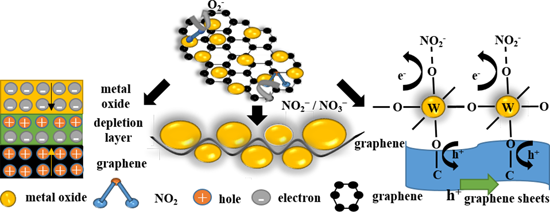
- semiconductors (MOS) are widely used as materials for gas sensing. Usually, MOS gas sensors have some common shortages, such as relatively poor selectivity and high operating temperature. Graphene has drawn much attention as a gas sensing material in recent years because it can even work at room temperature
- easily affected by the adsorption of gas molecules at room temperature. Thus, graphene has a promising future in the application in gas sensors. Schedin et al. [2] studied the gas sensing performance of graphene for the first time in 2007 and claimed that the adsorption of gas molecules caused a gradual
- of MOS gas sensors. Modifications of composition and surface, and light illumination of MOS are effective ways to improve their gas-sensing performance. MOS composites with graphene or its derivatives can reduce the operating temperature and yield outstanding sensing performance surpassing that of



Improved catalytic combustion of methane using CuO nanobelts with predominantly (001) surfaces
Beilstein J. Nanotechnol. 2018, 9, 2526–2532, doi:10.3762/bjnano.9.235

- shows high reactivity due to the high ratio of lowly coordinated oxygen – a feature that has been employed for gas sensing and Li-ion batteries [21]. Now we turn to the experimental validation, starting with the synthesis of CuO nanowires (NWs) and CuO nanobelts (NBs) comprised of predominantly (001


Electrospun one-dimensional nanostructures: a new horizon for gas sensing materials
Beilstein J. Nanotechnol. 2018, 9, 2128–2170, doi:10.3762/bjnano.9.202
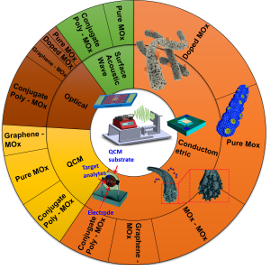
- , Hawthorn, VIC 3122, Australia 10.3762/bjnano.9.202 Abstract Electrospun one-dimensional (1D) nanostructures are rapidly emerging as key enabling components in gas sensing due to their unique electrical, optical, magnetic, thermal, mechanical and chemical properties. 1D nanostructures have found
- important active materials for gas sensing applications. Such highly sensitive and selective elements can be embedded in sensor nodes for internet-of-things applications or in mobile systems for continuous monitoring of air pollutants and greenhouse gases as well as for monitoring the well-being and health
- integration flexibility. To date, many different gas sensing technologies have been developed. The predominant approaches to utilization are based on changes in the electrical conductance, optical properties, electrochemical potential or resonant frequency of the device [12][13][14][15][16][17][18][19][20][21






Free-radical gases on two-dimensional transition-metal disulfides (XS2, X = Mo/W): robust half-metallicity for efficient nitrogen oxide sensors
Beilstein J. Nanotechnol. 2018, 9, 1641–1646, doi:10.3762/bjnano.9.156
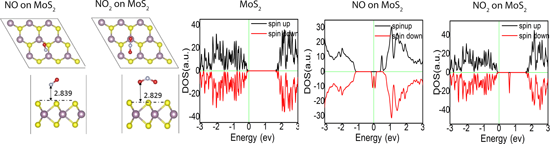
- ]. Besides, the corresponding binding position and energy of NO adsorbed on single-layer MoS2 [23] and WS2 [28] were analyzed from a theoretical point of view. Even though the gas-sensing properties involving NO and NO2 are well studied, few studies [29] have been carried out to explore the difference in
- spin-polarized gas-sensing between NO and other gas molecules. A completely spin-polarized current flow can be achieved in a half-metallic material [30][31][32][33]. Half-metallic materials exhibit semiconducting behavior in one spin channel and metallic behavior in the opposite spin channel, which
- , GaSe, SnS, SnSe, WSe and Bi2Se3 (Figure S1, Supporting Information File 1). To the best of our knowledge, our work is the first to propose a NO sensor by detecting spin transmission, which may probe a new prospect for gas sensing. Computational Methods The spin-polarized calculations for NO, NO2, and


Surface-plasmon-enhanced ultraviolet emission of Au-decorated ZnO structures for gas sensing and photocatalytic devices
Beilstein J. Nanotechnol. 2018, 9, 771–779, doi:10.3762/bjnano.9.70
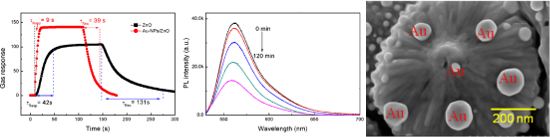
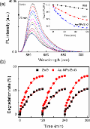
- improved response (τRes = 9 s) and recovery time (τRec = 39 s). The enhanced gas sensing performance and photocatalytic degradation processes are suggested to be attributed to not only the surface plasmon resonance effect, but also due to a Schottky barrier between plasmonic Au and ZnO structures
- . Keywords: Au-decorated ZnO; carrier dynamics; gas sensors; photocatalyst; SPR effect; Introduction Inorganic transition metal oxide sensor devices have attracted attention in particular for improving gas sensing, energy conversion, electronics, photocatalysis and optoelectronic devices [1][2][3][4]. Among
- them, ZnO nanostructures have particularly attracted attention for use in gas sensors due to their stability and relatively high sensitivity to target gases such as NO2, NO, CO, n-propane (C3H8), and NH3. In general, gas sensing devices based on ZnO structures are evidenced to be influenced by many




Sensing behavior of flower-shaped MoS2 nanoflakes: case study with methanol and xylene
Beilstein J. Nanotechnol. 2018, 9, 608–615, doi:10.3762/bjnano.9.57

- process is known as one of the scalable methods to synthesize MoS2 nanostructures. In this study, the gas sensing properties of flower-shaped MoS2 nanoflakes, which were prepared from molybdenum trioxide (MoO3) by a facile hydrothermal method, have been studied. Material characterization was performed
- using X-ray diffraction, Brunauer–Emmett–Teller surface area measurements, elemental analysis using energy dispersive X-ray spectroscopy, and field-emission scanning electron microscopy. The gas sensing characteristics were evaluated under exposure to various concentrations of xylene and methanol vapors
- the most suitable candidates to use in gas sensing devices [14][15]. There are few reports on gas sensing properties of MoS2. Cantalini et al. [8] reported the response of few layer MoS2 films to NO2 at sub-ppm concentrations and reasonable sensitivity to 1 ppm NO2 with fast and reversible response at



Gas-sensing behaviour of ZnO/diamond nanostructures
Beilstein J. Nanotechnol. 2018, 9, 22–29, doi:10.3762/bjnano.9.4
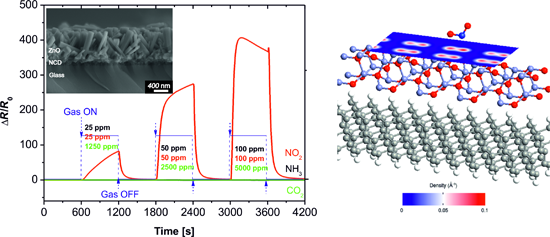
- electron microscopy, X-ray diffraction measurements and Raman spectroscopy. The gas sensing properties of the sensors based on i) NCD films, ii) ZnO nanorods, and iii) hybrid ZnO NRs/NCD structures were evaluated with respect to oxidizing (i.e., NO2, CO2) and reducing (i.e., NH3) gases at 150 °C. The
- , materials with hybrid components have become more popular in the field of sensing because the hybridization and synergic effect of organic or inorganic materials could enhance the gas sensing properties. For example, Wang et al. fabricated a ring-like PdO–NiO composite with a lamellar structure and showed a
- ) in order to investigate their gas sensing properties for nitrogen dioxide (NO2), ammonia (NH3) and carbon dioxide (CO2) at different concentration ranges of 25–100 ppm or 1250–5000 ppm. For this purpose we developed three different gas sensor devices based on i) NCD thin films, ii) ZnO nanorods, and


Functional materials for environmental sensors and energy systems
Beilstein J. Nanotechnol. 2017, 8, 2015–2016, doi:10.3762/bjnano.8.201

- scientific community, policy makers and social networks. The topics of this Thematic Series, based on 23 peer-reviewed articles, includes works on advanced gas sensing semiconducting materials, hybrid materials and nanocomposites for chemical sensing, catalytic sensing materials, metal oxides for chemical
Effect of the fluorination technique on the surface-fluorination patterning of double-walled carbon nanotubes
Beilstein J. Nanotechnol. 2017, 8, 1688–1698, doi:10.3762/bjnano.8.169

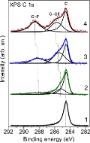
- onto the inner shell too [4]. Although fluorinated CNTs are generally expected to be insulating, one-dimensional structures with a conducting shell surrounded by an insulating layer from the fluorinated carbon could find potential application in nanoelectronics and gas sensing [5]. The ability to



Metal oxide nanostructures: preparation, characterization and functional applications as chemical sensors
Beilstein J. Nanotechnol. 2017, 8, 1205–1217, doi:10.3762/bjnano.8.122
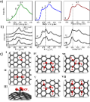
- process due to the desorption of gases, heat diffusion and mechanical stress. To reduce this effect as much as possible and thus have a stable baseline, we thermally stabilized (8 h) the samples at a selected target temperature prior to gas-sensing measurements. Different concentrations of target chemical


Study of the correlation between sensing performance and surface morphology of inkjet-printed aqueous graphene-based chemiresistors for NO2 detection
Beilstein J. Nanotechnol. 2017, 8, 1023–1031, doi:10.3762/bjnano.8.103

- chemiresistor have been analysed upon NO2 exposure at standard ambient temperature and pressure. Moreover, as comparison, inkjet-printed sensors have been manufactured on standard insulating substrates, namely alumina (Al2O3), and silicon dioxide (Si/SiO2). They have been characterized through gas sensing and
- printed materials onto different substrates on the gas sensing behavior. Inkjet-printed paper-based devices exhibited poorer performances with respect to those on standard substrates in terms of conductance variation. This can be ascribed to the peculiar arrangement of the deposited material


CVD transfer-free graphene for sensing applications
Beilstein J. Nanotechnol. 2017, 8, 1015–1022, doi:10.3762/bjnano.8.102
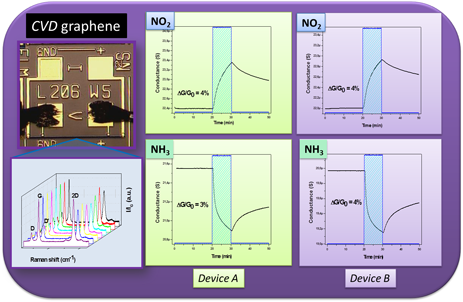
- techniques, following a completely Si-technology-compatible approach. Chemiresistive devices have been realized by shaping the sensing layer in form of rectangular strips. In order to probe the gas-sensing capabilities of the fabricated devices, three standard pollutants have been chosen, namely NO2, NH3 and
- . 3.5). In our case the estimated I(D)/I(D′) value is around 4.4, indicating that defects in the material are reasonably ascribed to the boundaries. Gas-sensing study In order to investigate the reliability of the fabrication process in terms of gas-sensing behaviour, two identical devices have been


BTEX detection with composites of ethylenevinyl acetate and nanostructured carbon
Beilstein J. Nanotechnol. 2017, 8, 982–988, doi:10.3762/bjnano.8.100
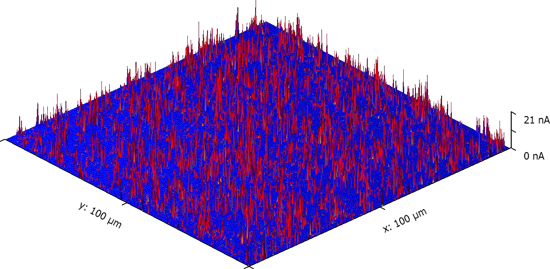
- ethylenevinyl acetate copolymer and carbon black (EVA–CB) were synthesized for sensing BTEX (benzene, toluene, ethylbenzene and xylene) vapours. The composites were characterized using atomic force microscopy (AFM) in an electroconductive mode. Gas sensing results show that EVA-CB can reproducibly detect BTEX
- and that the response increases linearly with vapour concentration. Compared to gas-sensing measurements of gasoline vapours, the responses with toluene and ethylbenzene are different and can be explained by varying side chains of the benzene ring. Keywords: benzene detection; polymer–nanostructured
- polymer-based nanostructured composite filled with electroconductive nanoparticles. Compared to gas sensors based on metal oxides this type of sensor ensures a much easier usage because polymer-based composites do not require high operating temperatures and work at room temperature. The gas-sensing


Gas sensing properties of MWCNT layers electrochemically decorated with Au and Pd nanoparticles
Beilstein J. Nanotechnol. 2017, 8, 592–603, doi:10.3762/bjnano.8.64
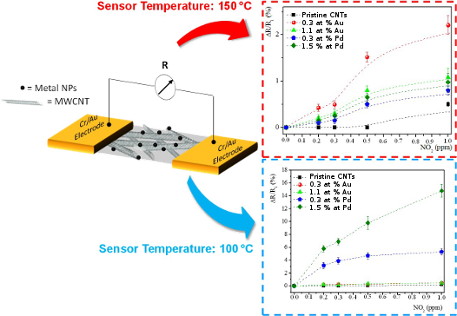
- operating temperature range of 45–200 °C. The gas sensing results were related to the presence, type and loading of metal NPs used in the MWCNT functionalization. Compared to pristine MWCNTs, metal-decorated MWCNTs revealed a higher gas sensitivity, a faster response, a better stability, reversibility and
- repeatability, and a low detection limit, where all of these sensing properties were controlled by the type and loading of the deposited metal catalytic NPs. Specifically, in the NO2 gas sensing experiments, MWCNTs decorated with the lowest Au content revealed the highest sensitivity at 150 °C, while MWCNTs
- with the highest Pd loading showed the highest sensitivity when operated at 100 °C. Finally, considering the reported gas sensing results, sensing mechanisms have been proposed, correlating the chemical composition and gas sensing responses. Keywords: Au nanoparticle; chemiresistive gas sensor


Graphene functionalised by laser-ablated V2O5 for a highly sensitive NH3 sensor
Beilstein J. Nanotechnol. 2017, 8, 571–578, doi:10.3762/bjnano.8.61
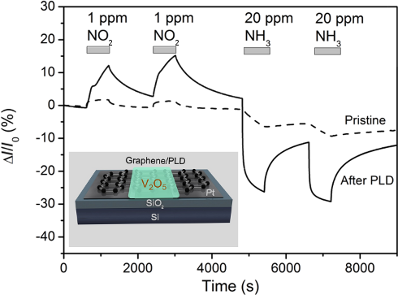
- Margus Kodu Artjom Berholts Tauno Kahro Mati Kook Peeter Ritslaid Helina Seemen Tea Avarmaa Harry Alles Raivo Jaaniso Institute of Physics, University of Tartu, W. Ostwald Street 1, EE50411 Tartu, Estonia 10.3762/bjnano.8.61 Abstract Graphene has been recognized as a promising gas sensing
- between deposited V2O5 and graphene. Keywords: ammonia; electric conductivity; gas sensor; graphene; pulsed laser deposition; UV light activation; vanadium(V) oxide; Introduction Graphene, being a thin (semi)conducting material, is a promising gas sensing system. Highly sensitive response, down to
- single molecule resolution, has been demonstrated with graphene-based devices under laboratory conditions [1][2][3]. However, in order to develop gas sensing applications working under real conditions, much effort has been dedicated to modification of graphene for improving its gas sensing


Thin SnOx films for surface plasmon resonance enhanced ellipsometric gas sensing (SPREE)
Beilstein J. Nanotechnol. 2017, 8, 522–529, doi:10.3762/bjnano.8.56
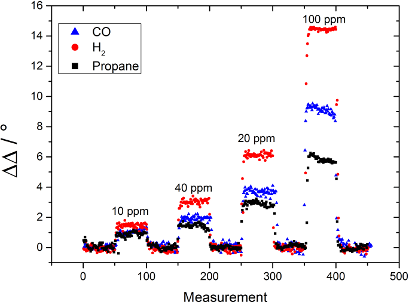
- fields like gas monitoring, safety and environmental applications. In this approach, a new gas sensing concept is investigated which combines the powerful adsorption probability of metal oxide conductive sensors (MOS) with an optical ellipsometric readout. This concept shows promising results to solve
- adsorption on the surface. Conclusion: The gas sensing selectivity can be enhanced by tuning the properties of the thin film overcoating. A relation of the binding sites in the doped and undoped SnOx films and the gas sensing abilities for CO and C3H8 was found. This could open the path for optimized gas
- sensing devices with different coated SPREE sensors. Keywords: doped tin oxide; ellipsometry; gas sensing; surface plasmon resonance; thin films; transparent conductive oxides; Introduction Gas sensors are an important tool for example in the fields of process monitoring, workplace safety or


Role of oxygen in wetting of copper nanoparticles on silicon surfaces at elevated temperature
Beilstein J. Nanotechnol. 2017, 8, 425–433, doi:10.3762/bjnano.8.45
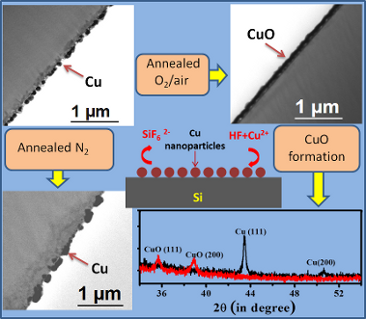
- been observed in composite CuO–carbon nanotube and CuO–graphene systems [8][9]. CuO nanostructures find promising application in many other fields such as gas sensing, catalysis, and arsenic (As) removal in water purification [10][11][12]. Such differently shaped CuO nanostructures have been





