


Search results
Search for "organometallic" in Full Text gives 76 result(s) in Beilstein Journal of Nanotechnology.
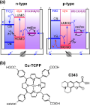
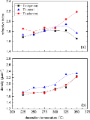
Comparing a porphyrin- and a coumarin-based dye adsorbed on NiO(001)
Beilstein J. Nanotechnol. 2019, 10, 874–881, doi:10.3762/bjnano.10.88
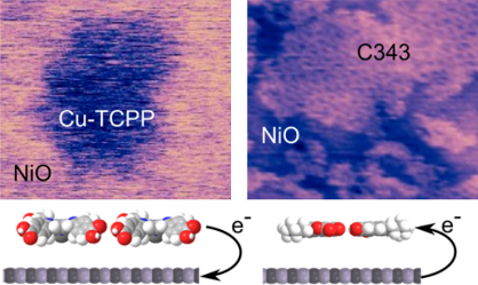
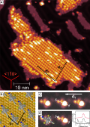
- of organometallic complexes on surfaces at the nanoscale. Using this method, the CPD between the surface of NiO and the different molecular islands was measured. Depending on the tip, it has been observed, that the absolute CPD values recorded on NiO can vary by roughly ±100 mV. Therefore, in order



Biocompatible organic–inorganic hybrid materials based on nucleobases and titanium developed by molecular layer deposition
Beilstein J. Nanotechnol. 2019, 10, 399–411, doi:10.3762/bjnano.10.39
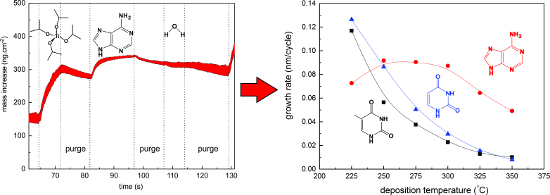
- refraction. Keywords: ALD; bioactive materials; hybrid materials; MLD; nucleobases; Introduction There is an ever-increasing interest in organometallic compounds in the field of medicinal chemistry. Organometallic complexes are now being developed as anticancer agents, radiopharmaceuticals for diagnosis
- realized that the mode of action of this drug is due to coordinative bond formation of the metal ion with nucleobase donor atoms in DNA. This led to an upsurge in interest in organometallic compounds containing nucleobases [5][6][7]. For instance, attempts have been made to bind adenine to dirhodium




Nanoporous water oxidation electrodes with a low loading of laser-deposited Ru/C exhibit enhanced corrosion stability
Beilstein J. Nanotechnol. 2019, 10, 157–167, doi:10.3762/bjnano.10.15
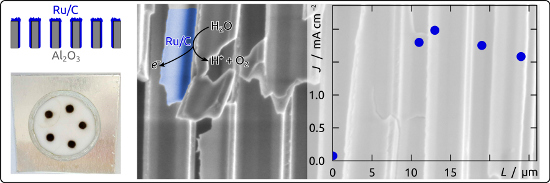
- address this goal with the synthesis of metal/carbon composites via the laser-induced deposition method already described for carbon-encapsulated Ag/Au nanoparticles (AgAu/C) [31][32][33]. This practically appealing one-step technique bases on the photo-induced decomposition of a dissolved organometallic
- complex and the subsequent self-organization into hybrid metal/carbon nanostructures with controlled composition and morphology [32]. With the appropriate choice of laser wavelength and solvent, which both need to be adjusted to the absorption behavior of the organometallic complex, metal/carbon
- high activity (current per mass of noble metal) for electrocatalytic water oxidation. Results and Discussion Laser-induced deposition of planar hybrid Ru/C films According to previous studies on the one-step laser-induced deposition method of AuAg/C composite, the choice of organometallic precursor




Zn/F-doped tin oxide nanoparticles synthesized by laser pyrolysis: structural and optical properties
Beilstein J. Nanotechnol. 2019, 10, 9–21, doi:10.3762/bjnano.10.2
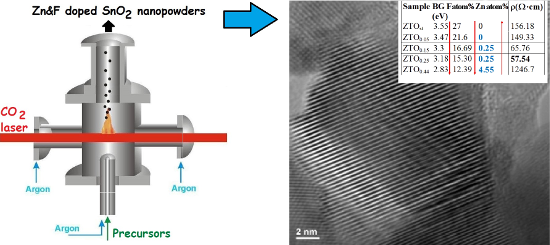
- presence of carbon in the powder is minor and is derived from the decomposition of methyl and ethyl radicals released by volatile organometallic compounds. This fact can be explained by an insufficient (less than stoichiometricly required) quantity of oxidant for the total oxidation of alkylmetallic



Charged particle single nanometre manufacturing
Beilstein J. Nanotechnol. 2018, 9, 2855–2882, doi:10.3762/bjnano.9.266
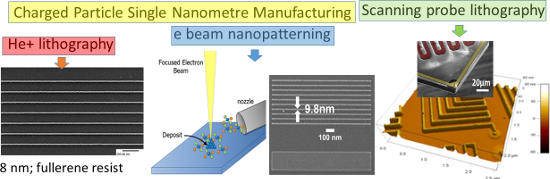
- van Oven et al. [65] using the organometallic precursor trimethyl(methylcyclopentadienyl)platinum(IV) (MeCpPtMe3). A combination of low beam current, low working distance and multiple pass patterning, synchronised with the 50 Hz disturbances, resulted in the successful fabrication of 3 nm Pt/C lines


Synthesis of rare-earth metal and rare-earth metal-fluoride nanoparticles in ionic liquids and propylene carbonate
Beilstein J. Nanotechnol. 2018, 9, 1881–1894, doi:10.3762/bjnano.9.180
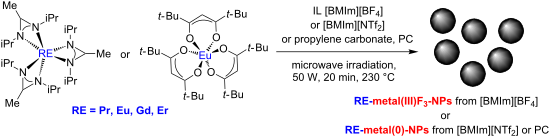
- study the catalytic properties of the obtained intermetallic M/RE-NPs in extension of our previous work on Ni/Ga nanophases derived from organometallic precursors by co-thermolysis in ILs and PC [59]. Experimental All synthesis experiments were carried out with Schlenk techniques under nitrogen or argon


Electronic conduction during the formation stages of a single-molecule junction
Beilstein J. Nanotechnol. 2018, 9, 1471–1477, doi:10.3762/bjnano.9.138
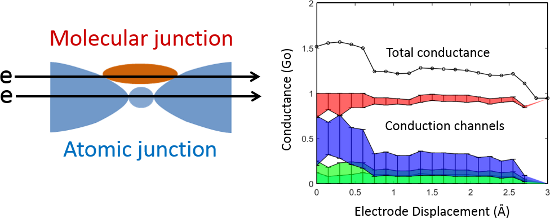
- form two electrode apexes. In some cases, a molecule is trapped between the electrodes, forming a single-molecule junction (Figure 1b). For more than two decades, the electronic transport properties of single-molecule junctions based on organic or organometallic molecules were explored in numerous of
- molecules [4][5][6]. Here, we use conductance measurements, inelastic electron spectroscopy, and shot noise analysis to identify the formation of a single-molecule junction based on an organometallic vanadocene molecule (Figure 1, inset) in parallel to a single atom silver (Ag) junction. The interplay


Semi-automatic spray pyrolysis deposition of thin, transparent, titania films as blocking layers for dye-sensitized and perovskite solar cells
Beilstein J. Nanotechnol. 2018, 9, 1135–1145, doi:10.3762/bjnano.9.105
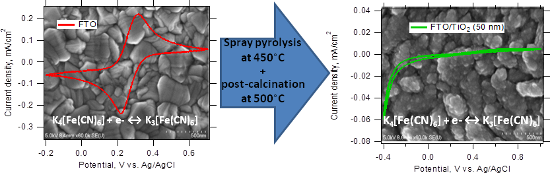
- anchoring of TiO2 to FTO. This hypothesis is rationalized by the well-known chelating effect of acetylacetone on both organometallic complexes and on oxidic surfaces. The optimization through compositional variation is limited by the growth of complicated species, particularly if the acetylacetone


Electron interactions with the heteronuclear carbonyl precursor H2FeRu3(CO)13 and comparison with HFeCo3(CO)12: from fundamental gas phase and surface science studies to focused electron beam induced deposition
Beilstein J. Nanotechnol. 2018, 9, 555–579, doi:10.3762/bjnano.9.53
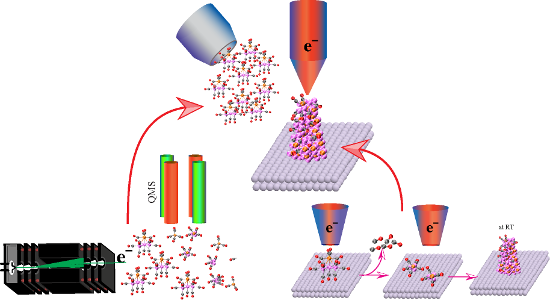
- based on chilled substrates [61]. Successful deposition of Ru containing structures has been demonstrated from an organometallic precursor leading to RuC9 and required oxygen co-feeding to remove carbon resulting in RuO2 [61]. Reports on a heteroleptic Ru carbonyl precursor suggest that the carbonyl
- through the polynuclear nature of these organometallic compounds providing a dense band of occupied, primarily metal-based orbitals (d-orbitals) and the high number and different nature of the carbonyl ligands (bridging and terminal) providing high density of unoccupied ligand CO π* orbitals. Along with


Comparative study of post-growth annealing of Cu(hfac)2, Co2(CO)8 and Me2Au(acac) metal precursors deposited by FEBID
Beilstein J. Nanotechnol. 2018, 9, 91–101, doi:10.3762/bjnano.9.11
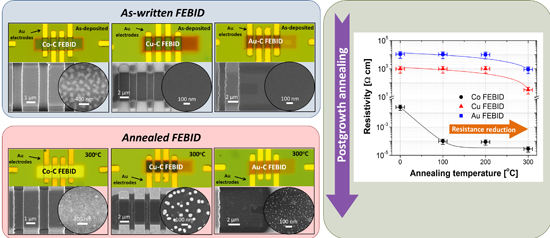
- capable of defining 3-dimensional metal deposits at nanometre scale for above applications. However, codeposition of organic ligands when using organometallic precursors is a typical problem that limits FEBID of pure metal nanostructures. In this work, we present a comparative study using a post-growth
- incomplete dissociation of organometallic precursor adsorbate molecules usually leads to codeposition of organic compounds into the metal deposits [3][8][12][32][33][34][35]. This unwanted deposition degrades the electrical transport properties of the deposit, thus limiting the applicability of the FEBID
- (up to 95 atom % relative to carbon) were obtained by means of impact-enhanced desorption of residual organic ligands using a supersonic argon carrier gas jet to deliver the organometallic precursor [45]. Other works suggest the autocatalytic deposition of carbonyls, such as Fe(CO)5 [46][47] and Co2


The rational design of a Au(I) precursor for focused electron beam induced deposition
Beilstein J. Nanotechnol. 2017, 8, 2753–2765, doi:10.3762/bjnano.8.274
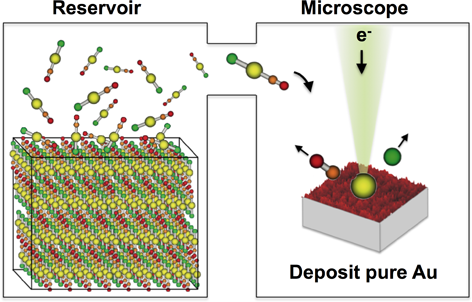
- ’ Applied University, Salt, Jordan Stratingh Institute for Chemistry, University of Groningen, 9747 AG Groningen, Netherlands Inorganic and Organometallic Chemistry, Friedrich-Alexander Universität Erlangen-Nürnberg, Egerlandstr. 1, 91058 Erlangen, Germany Department of Inorganic and Physical Chemistry
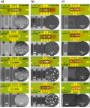
- properties? In this paper we present a thorough study of organometallic gold precursors for FEBIP. Three Au(I) complexes, ClAuCO, ClAuPMe3 and MeAuPMe3, are characterized using scanning electron microscopy. The crystal structure of MeAuPMe3 was determined using single crystal X-ray diffraction and compared
- small crystals sitting on a supporting material, the reliability of quantitative EDS is limited. It is also known that crystals of such organometallic complexes can be sensitive to electrons [12]. However, in these experiments we do consider EDS to be very useful. Firstly, the EDS measurements are


Interactions of low-energy electrons with the FEBID precursor chromium hexacarbonyl (Cr(CO)6)
Beilstein J. Nanotechnol. 2017, 8, 2583–2590, doi:10.3762/bjnano.8.258
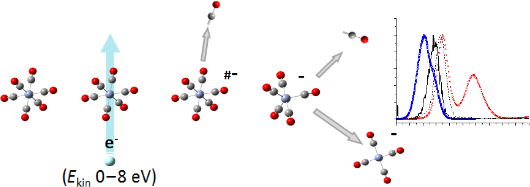
- ; dissociative electron attachment; electron ionization; FEBID; metastable decay; Introduction Organometallic compounds have been extensively studied since they are used for a broad field of applications. Among the variety of applications, nanotechnologies have caught special attention since organometallic
- deposition (FEBID) can be considered an assisted chemical vapour deposition (CVD) technique. However, in the former case the organometallic precursor is not fragmented by thermal energy but instead by a high-energy electron beam. The precursor molecules are delivered to the substrate in the gas phase and
- well as to minimise the adverse or unwanted effects, such as non-pure metal deposition resulting from the co-deposition of ligands. In order to improve the quality of metallic deposits, LEE interactions with organometallic precursors have been studied. Several studies have been reported, e.g., DEA



Comparing postdeposition reactions of electrons and radicals with Pt nanostructures created by focused electron beam induced deposition
Beilstein J. Nanotechnol. 2017, 8, 2410–2424, doi:10.3762/bjnano.8.240
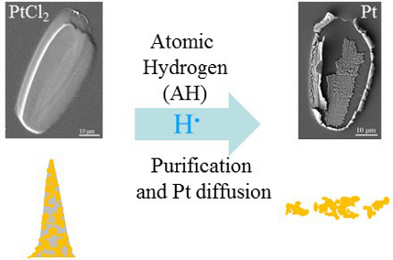
- demonstrated great potential in the field of nanostructure fabrication [1][2][3][4]. In FEBID, a volatile organometallic precursor is introduced into a vacuum chamber (typically a modified scanning electron microscope (SEM)) and irradiated by a focused electron beam [2][3]. The precursor decomposes under
- postdeposition purification strategies capable of removing halogen atoms, despite the presence of halide ligands in many organometallic precursors. Compared to carbon, contaminant halogen atoms in FEBID structures present a different challenge when it comes to purification strategies as they cannot be removed by
- etch substrates or equipment. The use of electrons was motivated in part by previous ultrahigh vacuum (UHV) surface science studies which showed that for 1–2 monolayer (ML) thin films of organometallic precursors with halide ligands, the halogens can be removed [29][31]. The importance of halogen




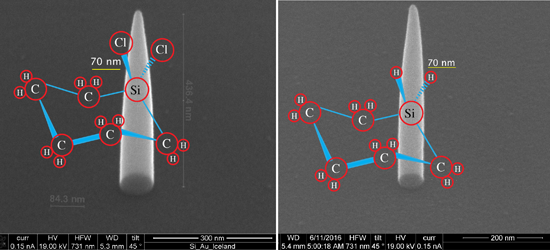
Electron beam induced deposition of silacyclohexane and dichlorosilacyclohexane: the role of dissociative ionization and dissociative electron attachment in the deposition process
Beilstein J. Nanotechnol. 2017, 8, 2376–2388, doi:10.3762/bjnano.8.237
- into applicable design criteria for superior FEBID precursors. In this context a considerable number of gas-phase studies have been conducted, mainly on DEA and DI of different organometallic FEBID precursors. Complementary surface science studies have been carried out to better relate the gas-phase





Dissociative electron attachment to coordination complexes of chromium: chromium(0) hexacarbonyl and benzene-chromium(0) tricarbonyl
Beilstein J. Nanotechnol. 2017, 8, 2257–2263, doi:10.3762/bjnano.8.225
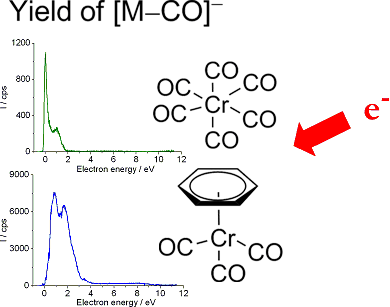
- ; dissociative electron attachment; gas phase reactions; mass spectrometry; Introduction Organometallic compounds are a large class of compounds with numerous applications such as homogeneous catalysts for the synthesis of fine chemicals or even enantiomerically pure products used in the pharmaceutical industry
- [1][2][3]. However, they also play an important role in nanotechnology. In fact, a number of organometallic complexes, originally designed for chemical vapor deposition (CVD) purposes, have also been recognized as promising precursors for focused electron beam induced deposition (FEBID), a process to
- primary beam. To date there have been several papers devoted to the studies of the interaction of low energy electrons with gas-phase organometallic complexes. Particular attention has been paid to the compounds containing monodentate (e.g., carbonyl [12][13][14], trifluorophosphine [11][15], chloride [16
Electronic structure, transport, and collective effects in molecular layered systems
Beilstein J. Nanotechnol. 2017, 8, 2094–2105, doi:10.3762/bjnano.8.209
- development of further devices. Examples were demonstrated for a wide variety of applications including molecular spin filters [1], single-molecule or thin-film-based field-effect transistors [2][3][4], as well as potential candidates for memory devices utilizing organometallic complexes of


![[Graphic 29]](/bjnano/content/inline/2190-4286-8-209-i41.png?max-width=637&scale=1.18182) between the occupations nA and nB of the two checkerboard sublattices for a) asy...
between the occupations nA and nB of the two checkerboard sublattices for a) asy...

![[Graphic 30]](/bjnano/content/inline/2190-4286-8-209-i42.png?max-width=637&scale=1.18182) per site for a) asymmetric tunneling, Γtop/Γbottom = 0.5, and b) symmetric tunneli...
per site for a) asymmetric tunneling, Γtop/Γbottom = 0.5, and b) symmetric tunneli...
Near-infrared-responsive, superparamagnetic Au@Co nanochains
Beilstein J. Nanotechnol. 2017, 8, 1680–1687, doi:10.3762/bjnano.8.168
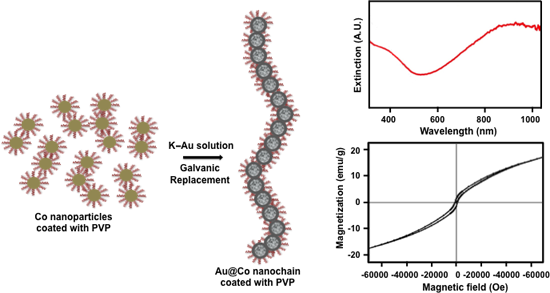
- nanoparticles [25] by reducing an organo-gold compound onto a cobalt seed with a weak reducing agent in toluene. These particles showed superparamagnetic behavior and a strong optical extinction at ca. 680 nm. Similarly, Wetz and co-workers prepared hybrid Co–Au nanorods via decomposition of an organometallic


Investigation of growth dynamics of carbon nanotubes
Beilstein J. Nanotechnol. 2017, 8, 826–856, doi:10.3762/bjnano.8.85
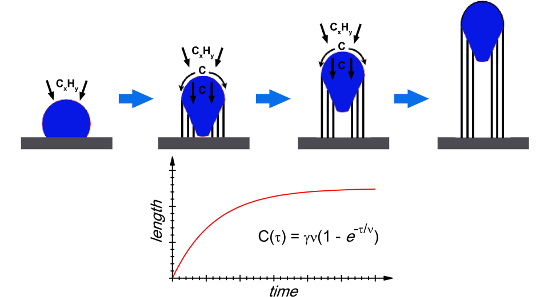
- summarized. Finally, the growth properties of inner tubes inside SWCNTs filled with fullerene and organometallic molecules are considered. Synthesis of carbon nanotubes The SWCNTs can be synthesized by the arc-discharge, laser ablation and chemical vapour deposition (CVD) techniques. A detailed overview of
- ]. The study of the growth process of inner tubes inside the host SWCNTs facilitates understanding the growth mechanism of nanotubes. SWCNTs filled with organometallic molecules represent a unique system for the investigation of the growth mechanism of nanotubes. They are


3D Nanoprinting via laser-assisted electron beam induced deposition: growth kinetics, enhanced purity, and electrical resistivity
Beilstein J. Nanotechnol. 2017, 8, 801–812, doi:10.3762/bjnano.8.83
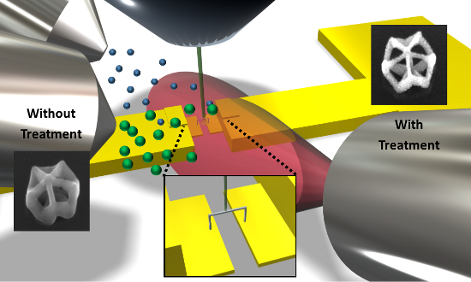
- deposition (IBID) with a great degree of success, albeit at slightly larger dimensions [39]. A well-known disadvantage of EBID is the incorporation of carbonaceous byproducts due to the use of organometallic precursors with relatively large carbon atomic fractions. The resulting deposit typically consists of


Performance of natural-dye-sensitized solar cells by ZnO nanorod and nanowall enhanced photoelectrodes
Beilstein J. Nanotechnol. 2017, 8, 287–295, doi:10.3762/bjnano.8.31
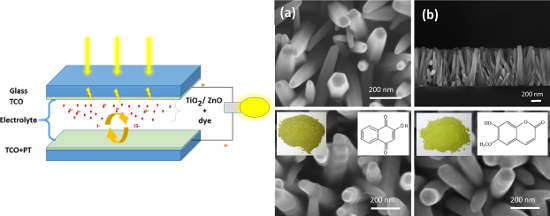
- complete the reaction [2][10]. Different high-raked commercial dyes, such as N719 or N3, have been widely studied in the literature and their performance has been proven. Because these organometallic dyes contain environmental pollutants, such as heavy metals [6], recent studies have focused on finding a
- metal-free organic dye with high performance [8][11][12][13]. Indeed, several studies were carried out using natural dyes, such as spinach and red turnip as a sensitizer. However, their efficiency is lower than that of commercial organometallic dyes. In this work, we investigate two different natural


Flexible photonic crystal membranes with nanoparticle high refractive index layers
Beilstein J. Nanotechnol. 2017, 8, 203–209, doi:10.3762/bjnano.8.22
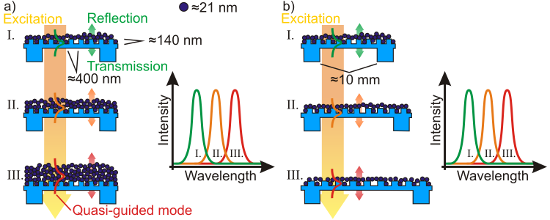
- is non-toxic, biocompatible and may be used for mass production in medical applications [17][18]. The mixture is cured by an organometallic cross-linking reaction that is promoted by heat resulting in an amorphous network of polymer chains. The random PDMS coils are 0.7 nm in diameter and have a


Phenalenyl-based mononuclear dysprosium complexes
Beilstein J. Nanotechnol. 2016, 7, 995–1009, doi:10.3762/bjnano.7.92
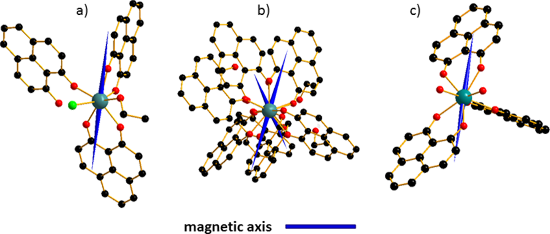
- ] and known organometallic compounds such as [Li(THF)4][(Ph2PNPh)4Dy] and [Dy{N(PPh2)2}3] [15], Dy-(N(SiMe3))3 [16] and [{Cp’2Dy(µ-SSiPh3)}2] (Cp’= η5-C5H4Me) [17], [Dy(1,4-(Me3Si)2-C8H6)2] [18], and [Dy(COT’’)2Li(THF)(DME)] (COT’’ = 1,4-bis(trimethylsilyl)cyclooctatetraenyl dianion) [19] showing
- -workers [22]. Upon deposition of these molecules onto a ferromagnetic surface, a hybridized organometallic supramolecular magnetic layer can be formed. This interface layer exhibits a spin-dependent resistance leading to an interface magnetoresistance (IMR) effect. These findings suggest that phenalenyl


Rigid multipodal platforms for metal surfaces
Beilstein J. Nanotechnol. 2016, 7, 374–405, doi:10.3762/bjnano.7.34











The role of low-energy electrons in focused electron beam induced deposition: four case studies of representative precursors
Beilstein J. Nanotechnol. 2015, 6, 1904–1926, doi:10.3762/bjnano.6.194
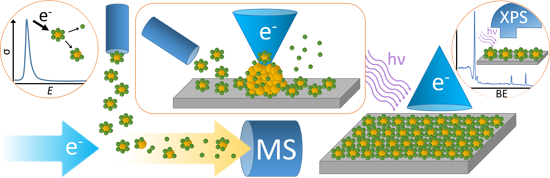
- induced deposition (FEBID) is a single-step, direct-write nanofabrication technique capable of writing three-dimensional metal-containing nanoscale structures on surfaces using electron-induced reactions of organometallic precursors. Currently FEBID is, however, limited in resolution due to deposition
- the electron beam and the vertical dimensions are controlled through variation of the dwell time. Precursor molecules used for depositing metal-containing nanostructures are typically organometallic compounds with a central metal atom and ligand architectures that lend the compounds the following
- has been verified both by simulations [11] and by experiments [12]. In recent years, it has motivated a number of gas phase studies focusing on the energy dependence of the branching ratios and cross sections for various low energy (0–100 eV) electron-induced reactions with organometallic precursors








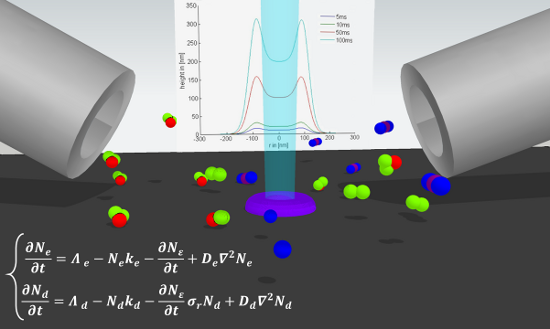
Continuum models of focused electron beam induced processing
Beilstein J. Nanotechnol. 2015, 6, 1518–1540, doi:10.3762/bjnano.6.157
- the reservoir at a temperature that is lower than or equal to that of the capillary walls. However, some organometallic molecules can spontaneously decompose in contact with the wall material and thus provide a surface for continuous autocatalytic decomposition through successive molecule–wall
- etch and deposit precursor molecules, adsorbate–adsorbate interactions, and whether the etch precursor can volatilize all or only some fraction of the deposited material. A specific example of this is H2O-mediated FEBIE of deposits formed from organometallic precursors, where only the deposited carbon


![[Graphic 37]](/bjnano/content/inline/2190-4286-6-157-i117.png?max-width=637&scale=1.18182) and chemisorbed
and chemisorbed ![[Graphic 38]](/bjnano/content/inline/2190-4286-6-157-i118.png?max-width=637&scale=1.18182) adsorbates versus pressure, calcul...
adsorbates versus pressure, calcul...





