Search results
Search for "surface structure" in Full Text gives 142 result(s) in Beilstein Journal of Nanotechnology.
Conjugated photothermal materials and structure design for solar steam generation
Beilstein J. Nanotechnol. 2023, 14, 454–466, doi:10.3762/bjnano.14.36
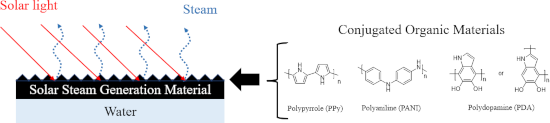
- depends on the number of layers, which was caused by the surface structure of the multilayer PPy nanosheets. The high roughness and sharp local curvature of the multilayer PPy nanosheets were retained and incident light was effectively redistributed. In other words, transmitted light is confined in the
- spectrum (Figure 7b). The average absorbance (weighted by the AM1.5G solar spectrum) of the p-PEGDA hydrogel from 200–2500 nm was about 75.5%, whereas that of solid PEGDA is only 32.6%. The higher absorption capacity of p-PEGDA is due to its rough and porous surface structure, which promotes multiple
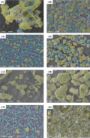
- films. Optical microscopy was employed to observe the surface structure of the films (Figure 10a–d). Figure 10a shows the filter paper. In the photothermal films, the filter paper is the supporting layer. The filter paper is indeed suitable for this purpose because the cellulose fibers are randomly


Dry under water: air retaining properties of large-scale elastomer foils covered with mushroom-shaped surface microstructures
Beilstein J. Nanotechnol. 2022, 13, 1370–1379, doi:10.3762/bjnano.13.113
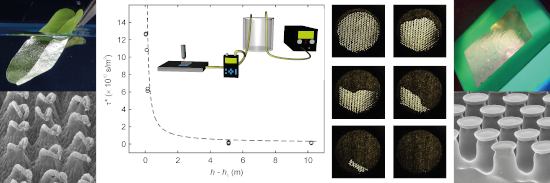
- , the silvery shine indicates the kept air. c) SEM image of the surface structure of the Salvinia leaf. d) SEM image of the MSM. Confirmation of the persistence of the air layer in low water depth and analysis of the shape of the air–water interface by confocal laser scanning microscopy (CLSM


Straight roads into nowhere – obvious and not-so-obvious biological models for ferrophobic surfaces
Beilstein J. Nanotechnol. 2022, 13, 1345–1360, doi:10.3762/bjnano.13.111
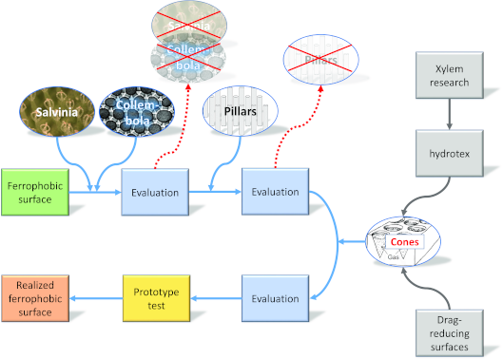
- granules may be present, which constitute an additional layer of structuring between the bristles and the combs (Figure 3d). Depending on systematic group and habitat, the surface structure is highly variable without changes of the basic pattern [21][23]. These specific surface structures are remarkable in


Growing up in a rough world: scaling of frictional adhesion and morphology of the Tokay gecko (Gekko gecko)
Beilstein J. Nanotechnol. 2022, 13, 1292–1302, doi:10.3762/bjnano.13.107
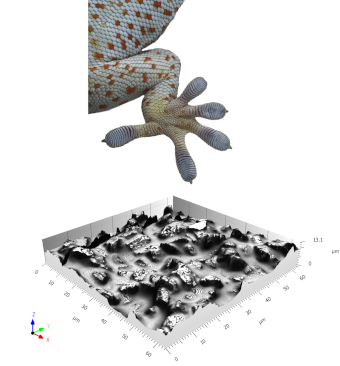
- that shear adhesion was significantly reduced (up to 95% reduction of force produced on acrylic glass) on surfaces where the surface structure was close to matching the animal’s adhesive structure, highlighting the importance of considering length-scale and the impact it has on gecko adhesion when
- sandpaper grits and carried out adhesion trials over a large size range of G. gecko. This research is significant given that most studies are limited to using 2D profiles, missing an entire axis of surface structure variation. Additionally, no study to date has quantified the effect of body size on adhesive


Laser-processed antiadhesive bionic combs for handling nanofibers inspired by nanostructures on the legs of cribellate spiders
Beilstein J. Nanotechnol. 2022, 13, 1268–1283, doi:10.3762/bjnano.13.105
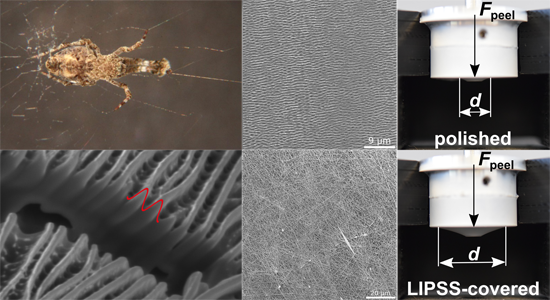
- special fingerprint-like surface nanostructure. In this work, we present a theoretical model of the interaction of linear nanofibers with a sinusoidally corrugated surface. This model allows for a prediction of the adhesive interaction and, thus, the design of a suitable surface structure to prevent
- center spider). Its fingerprint-like outmost surface structure has an approximately sinusoidal cross section with a periodicity of 200–300 nm and a height (amplitude) of approx. 200 nm. During the combing process, the nanofibers are pulled orthogonally over these nanoripples. It was shown that the
- interaction and, thus, the design of a suitable surface structure to prevent sticking of an artificially nonwoven of nanofibers. Similar to the description of the Lotus effect [20][21][22][23], where the wettability of the hierarchical surface structure of the lotus leaf can be described with an energy






Studies of probe tip materials by atomic force microscopy: a review
Beilstein J. Nanotechnol. 2022, 13, 1256–1267, doi:10.3762/bjnano.13.104
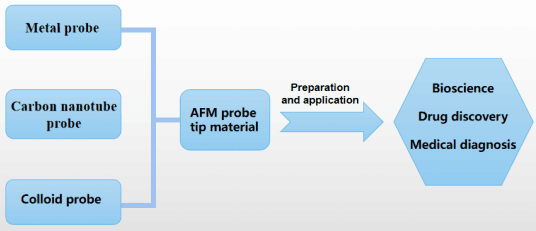
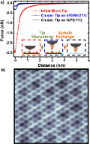
- , including the length, width, and thickness of the colloidal fibers. In addition, high-temperature calcination can increase the interaction force between particles, thus enhancing the mechanical properties of colloidal fibers. Due to the rough surface structure of colloidal fibers, we made them into surface
- , providing new opportunities for many fields. In practical applications, due to the surface structure of colloidal fibers, these fibers can be used as SERS sensor detection for trace detection of BPA. Although colloidal probes have many excellent properties, there are some problems in calibrating such probes
Interaction between honeybee mandibles and propolis
Beilstein J. Nanotechnol. 2022, 13, 958–974, doi:10.3762/bjnano.13.84
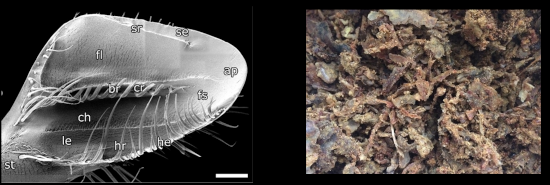
- “propolis bees”. Imaging and structural studies Bee mandibles were prepared and subsequently examined with binoculars, a scanning electron microscope (SEM), and a confocal 3D laser scanning microscope in order to identify anatomy and surface structure. Anatomy of the honeybee mandible Mandibles of all
- adhesion, replicas of bee mandibles were made using a two-step moulding method [26][28]. The method allows one to replicate the surface structure with nanometre precision. Replication substitutes chemical complex and heterogeneous biological surfaces with a well-studied epoxy surface. In this way the
- ]. More alkanes have been found on the bodies of forager bees compared to nursing bees [47]. Effect of the mandible surface structure on adhesion In some cases, it has been described that microstructures can reduce adhesion by decreasing the contact area [48][49]. The trochanter of ants (Camponotus


Bioselectivity of silk protein-based materials and their bio-inspired applications
Beilstein J. Nanotechnol. 2022, 13, 902–921, doi:10.3762/bjnano.13.81


A non-enzymatic electrochemical hydrogen peroxide sensor based on copper oxide nanostructures
Beilstein J. Nanotechnol. 2022, 13, 424–436, doi:10.3762/bjnano.13.35
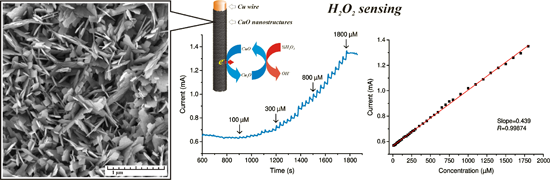
- nanostructures were obtained by a one-step hydrothermal oxidation method. The resulting coating is uniform and dense and shows good adhesion to the wire surface. Structure, surface, and composition of the obtained samples were studied using field-emission scanning electron microscopy along with energy-dispersive




The effect of metal surface nanomorphology on the output performance of a TENG
Beilstein J. Nanotechnol. 2022, 13, 298–312, doi:10.3762/bjnano.13.25
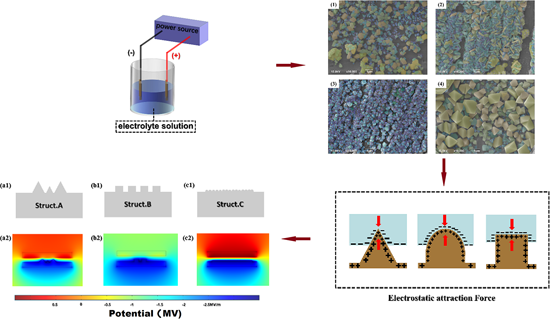
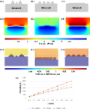
- image that when a pressure of 3 MPa is applied to the PTFE surface at the top of the Cu nanoparticles, the surface structure of the PTFE polymer is bent (Figure 11). The large nanostructures on both edges are in contact with the polymer surface, but the small nanostructure in the middle is not in




The effect of cobalt on morphology, structure, and ORR activity of electrospun carbon fibre mats in aqueous alkaline environments
Beilstein J. Nanotechnol. 2021, 12, 1173–1186, doi:10.3762/bjnano.12.87
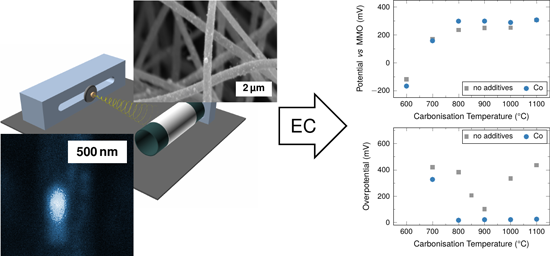
- formation of significant amounts of turbostratic carbon, leading to a mesopore-like surface structure, seems to add to the performance, as does, of course, the inherent catalytic activity of the employed cobalt species. Electrode stability testing In applications, performance is important, but electrode


Interface interaction of transition metal phthalocyanines with strontium titanate (100)
Beilstein J. Nanotechnol. 2021, 12, 485–496, doi:10.3762/bjnano.12.39
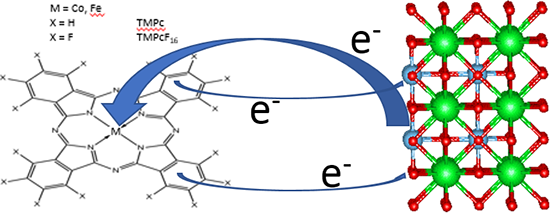
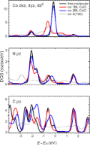
- ) layer. In contrast, the top layer of SrO-terminated STO in Figure 1b contains Sr2+ (green) and O2− (red) ions, only. The length of the cubic lattice vectors is 3.91 Å [28] for both terminations. Due to the same symmetry of the surface structure, unfortunately, we cannot distinguish between different
- terminations by LEED. It might be expected that the presence of the different metal ions on the substrate surface (Sr or Ti) affects possible interactions with deposited organic molecules. We note that the surface structure in the topmost layer of TiO2-terminated STO significantly differs from most rutile TiO2
- , we will apply two different, well-characterized preparation procedures. For preparation I, the STO single crystal was cleaned in vacuo as described above. Routinely, the cleanliness is checked by X-ray photoelectron spectroscopy and the quality of the surface structure by LEED. Examples of LEED


Reconstruction of a 2D layer of KBr on Ir(111) and electromechanical alteration by graphene
Beilstein J. Nanotechnol. 2021, 12, 432–439, doi:10.3762/bjnano.12.35
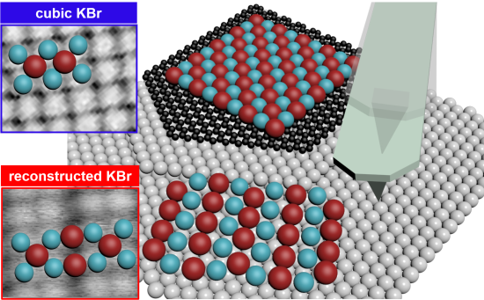
- a new surface structure, different from the one on other metal substrates such as Cu(111) [42]. Now, the question arises if this structure is a moiré lattice (lateral relaxation) induced by an alternating strength of interaction forces or a new reconstruction of the KBr layer. To search for this
- surface structure (e.g., cubic or stripe-like) and, with this, also to a strong change in physical surface properties, such as the work function. The in-depth understanding of such processes might allow us to tune and build up more complex 2D layered systems and adapt them to a specific application


PTCDA adsorption on CaF2 thin films
Beilstein J. Nanotechnol. 2020, 11, 1615–1622, doi:10.3762/bjnano.11.144
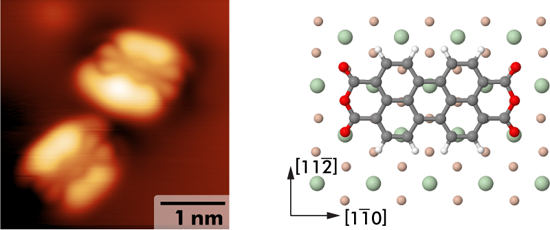
- calculated molecular orbital shapes with the experimental STM data suggests a strong influence of the LUMO in filled-state STM imaging on the CaF1 interface layer. Instead, the absence of long-range order on the CaF2 films is explained by a mismatch of the common PTCDA motifs with the CaF2 surface structure


Adsorption and self-assembly of porphyrins on ultrathin CoO films on Ir(100)
Beilstein J. Nanotechnol. 2020, 11, 1516–1524, doi:10.3762/bjnano.11.134
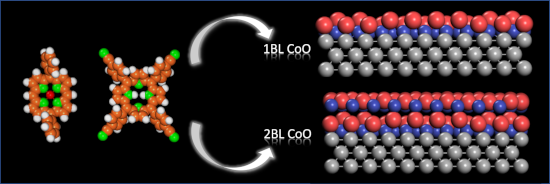
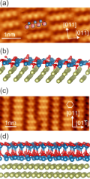
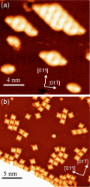
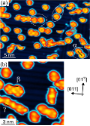
- we imply that the surface is oxygen-terminated and shows a wurtzite-type of surface termination [19]. This has been confirmed by surface X-ray diffraction analysis of the 2BL film [21]. Although the 2BL film is structurally close to a c(10 × 2) surface structure it may be considered as a flat, quasi




Atomic-resolution imaging of rutile TiO2(110)-(1 × 2) reconstructed surface by non-contact atomic force microscopy
Beilstein J. Nanotechnol. 2020, 11, 443–449, doi:10.3762/bjnano.11.35
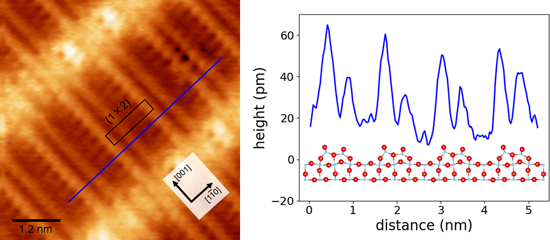
- force microscopy; (1 × 2) reconstruction; rutile; surface structure; titanium dioxide (TiO2); Introduction Titanium dioxide (TiO2) is a well-known photocatalyst and has been studied for applications in water splitting and the coating of materials [1]. To optimize the photocatalytic function, it is
- not the periodic (1 × 2) surface is a symmetric structure. The determination of the surface structure is crucial to understand the surface phenomena, such as adsorption, absorption, and decomposition in photocatalytic reactions. In this study, we characterized the periodic structure of the rutile TiO2
- -AFM and tunneling current for STM), the surface structure sometimes results in different contrasts in both images. In Figure 3, white squares and circles indicate line defects and protrusions, which are considered to be adsorbates or contamination. A line defect was imaged as a likely vacancy by STM


Understanding nanoparticle flow with a new in vitro experimental and computational approach using hydrogel channels
Beilstein J. Nanotechnol. 2020, 11, 296–309, doi:10.3762/bjnano.11.22
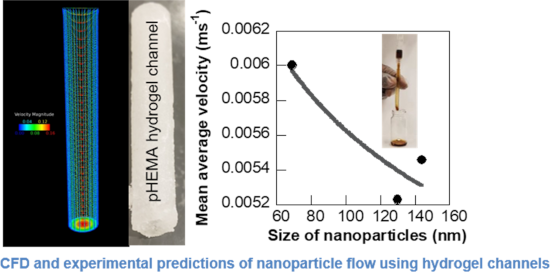
- showed the smoothest surface of all gel formulations. The gels prepared with 1.5 mL DI water showed a distinctly porous surface structure. Therefore, the 1.3 mL DI water hydrogels were most suitable for making flow channels of negligible friction to resemble the vascular microenvironment. The hollow 3D


An investigation on the drag reduction performance of bioinspired pipeline surfaces with transverse microgrooves
Beilstein J. Nanotechnol. 2020, 11, 24–40, doi:10.3762/bjnano.11.3
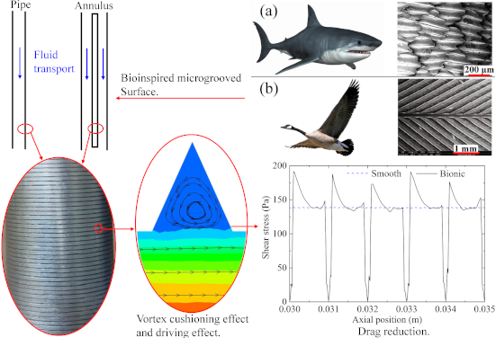
- the drag [12]. It is well known that organisms found in nature provide substantial inspiration for solving engineering problems. Bionic research has found that some natural organisms form a specific surface structure with antidrag [13], antiwear [14][15], and hydrophobic [16][17] performance through


Ion mobility and material transport on KBr in air as a function of the relative humidity
Beilstein J. Nanotechnol. 2019, 10, 2084–2093, doi:10.3762/bjnano.10.203
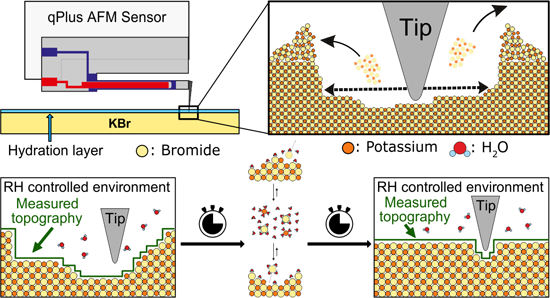
- additional layer forming by increasing RH to 60% and further growth of the water film up to 2.7 nm (ca. 10 monolayers) thickness at higher humidities [1]. On the atomic level, water and adsorbed molecules can arrange according to the surface structure and form ordered hydration layers that are also referred


Tuning the performance of vanadium redox flow batteries by modifying the structural defects of the carbon felt electrode
Beilstein J. Nanotechnol. 2019, 10, 1698–1706, doi:10.3762/bjnano.10.165
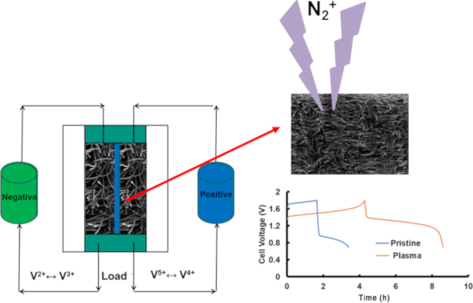
- (NHE)) reaction is very close to HER (0 V vs NHE). To minimize the HER, the negative electrode surface structure should be tuned in such a way that it tends to preferably bind V3+/V2+ ions over H+ ions. Creating oxygen functional groups on the surface of the anode is one way to achieve this [5][6


Hierarchically structured 3D carbon nanotube electrodes for electrocatalytic applications
Beilstein J. Nanotechnol. 2019, 10, 1475–1487, doi:10.3762/bjnano.10.146
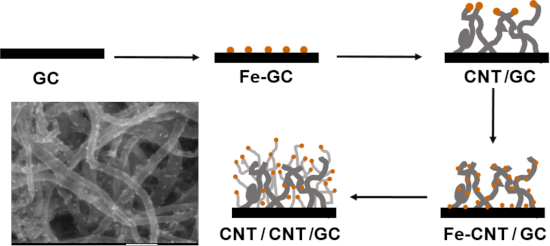
- -oxidation of COad compared to Pt-CNT/GC The reason for this improved poisoning tolerance is not known to us at the moment. However, it is known from literature that methanol as well as CO oxidation are very sensitive to Pt surface structure. It might be that a defect-rich structure of our Pt nanoparticles





Photoactive nanoarchitectures based on clays incorporating TiO2 and ZnO nanoparticles
Beilstein J. Nanotechnol. 2019, 10, 1140–1156, doi:10.3762/bjnano.10.114
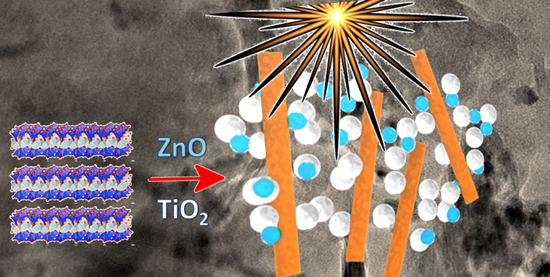
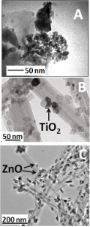
- embedded in the interlayer space of the organoclays or dispersed on its external surface. These nanomaterials can be applied as antibactericide. It has been observed that they destroy the cellular surface structure of Microcystis aeruginosa, and also inhibit the physiological activity of M. aeruginosa



Porous N- and S-doped carbon–carbon composite electrodes by soft-templating for redox flow batteries
Beilstein J. Nanotechnol. 2019, 10, 1131–1139, doi:10.3762/bjnano.10.113
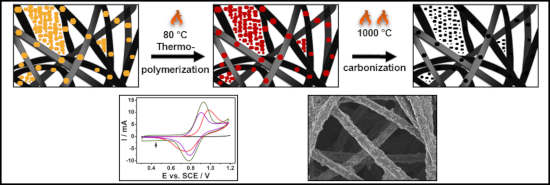
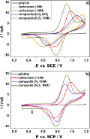
- Supra 55VP, Carl Zeiss SMT Ltd.) with an acceleration voltage of 5–10 kV and an in-lens detector was utilized to obtain details of the surface structure. High-resolution images (Figure 2) were captured at several magnifications to investigate features at the microscale and the nanoscale. Energy



Concurrent nanoscale surface etching and SnO2 loading of carbon fibers for vanadium ion redox enhancement
Beilstein J. Nanotechnol. 2019, 10, 985–992, doi:10.3762/bjnano.10.99
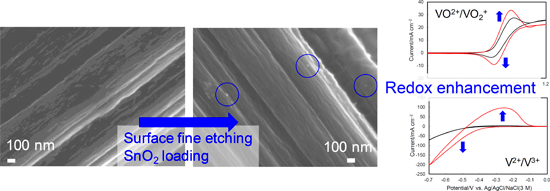
- demonstration of this surface-structure change is difficult through FESEM observation only, Raman spectroscopy and electrochemical measurements can show clear differences as described below. The degree of the surface etching depends on the temperature of the thermal oxidation (Figure 1e and Figure S2
- drastic change in the surface structure was attributed to a temperature-dependent catalytic effect of the tin-oxide nanoparticles on the carbon surface oxidation leading to fine etching. A significant enhancement of the activity for the V2+/3+ redox reactions was also observed at TGP-CSnPc-550Air. The
- TGP-CSnPc-TAir. For comparison, the heat treatment of TGP without CSnPc was also performed in air at 550 °C for 1 h (TGP-550Air). Characterization of carbon fiber surface A field-emission scanning electron microscope (FESEM, JSM-6700F, JEOL) was used to observe the surface structure. The Raman spectra



Ultraviolet patterns of flowers revealed in polymer replica – caused by surface architecture
Beilstein J. Nanotechnol. 2019, 10, 459–466, doi:10.3762/bjnano.10.45
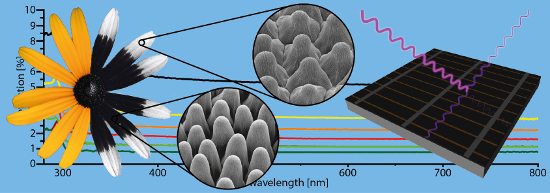
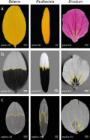
- replication technique, we transferred the petal surface structure onto a transparent polymer. Upon illumination with UV-light, we observed structural-based patterns in the replicas that were surprisingly comparable to those of the original petals. For the first time, this experiment has shown that the
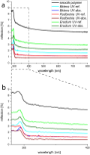
- parameters of the surface structure lead to an enhancement in the amount of absorbed UV-radiation. Spectrophotometric measurements revealed up to 50% less reflection in the UV-absorbing regions than in the UV-reflecting areas. A comparative characterization of the micromorphology of the UV-reflecting and UV
- -absorbing areas showed that, in principle, a hierarchical surface structure results in more absorption. Therefore, the results of our experiments demonstrate the structural-based amplification of UV-reflection and provide a starting point for the design of bioinspired antireflective and respectively