Search results
Search for "wastewater treatment" in Full Text gives 38 result(s) in Beilstein Journal of Nanotechnology.
One-step nonhydrolytic sol–gel synthesis of mesoporous TiO2 phosphonate hybrid materials
Beilstein J. Nanotechnol. 2019, 10, 356–362, doi:10.3762/bjnano.10.35
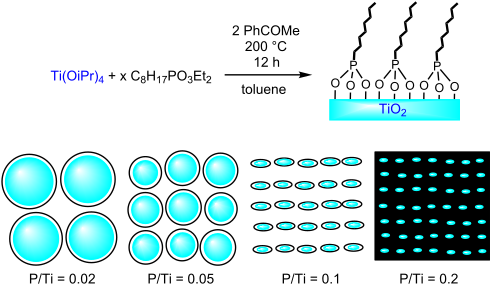
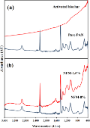
- ) and in aqueous wastewater treatment. Experimental Titanium(IV) isopropoxide (Ti(OiPr)4, 97 %), and acetophenone (99%) were obtained from Sigma-Aldrich. Diethyl 1-octylphosphonate (C8H17PO3Et2, 98%) was purchased from Sikémia. Toluene was dried over a Pure-Solve MD5 solvent purification system (H2O <10


Nanocellulose: Recent advances and its prospects in environmental remediation
Beilstein J. Nanotechnol. 2018, 9, 2479–2498, doi:10.3762/bjnano.9.232
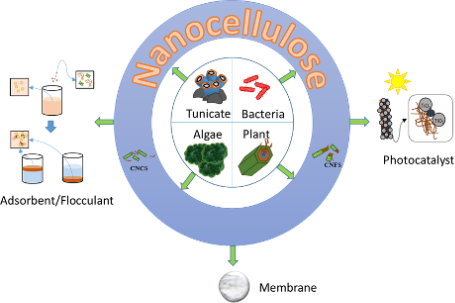
- ] and wastewater treatment [15], biomedical engineering [16], and energy production [17]. Different types of nanocellulose were first mentioned in articles by Ranby [18] and Turbak et al. [19], not only as a concept for scientific theoretical discussion, but also to report actual new cellulose products
- adsorbent for wastewater treatment due to its adsorption affinity towards organic pollutants. Unlike micrometre-sized cellulose, the nanometre-sized counterparts are relatively smaller in dimensional size but also possess a larger surface area with improved porosity, which limits internal diffusion and
- the surface [93]. Therefore, an overabundance of –OH groups can produce an opposing effect, which is not ideal for wastewater treatment. Among the hydrophilic functional groups, the functionalization of nanocellulose with carboxy groups through carboxylation can improve its adsorption performance for


Hierarchical heterostructures of Bi2MoO6 microflowers decorated with Ag2CO3 nanoparticles for efficient visible-light-driven photocatalytic removal of toxic pollutants
Beilstein J. Nanotechnol. 2018, 9, 2297–2305, doi:10.3762/bjnano.9.214
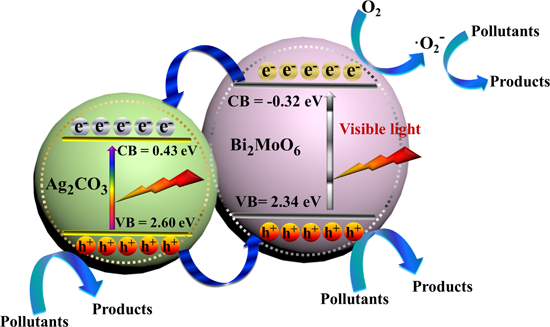
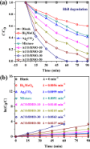
- candidate for wastewater treatment. Keywords: antibiotic removal; Bi2MoO6; heterojunction; silver carbonate (Ag2CO3); Introduction Industrial pollutants, such as industrial dyes and antibiotics, in wastewaters pose a huge threat to the environment [1][2]. Thus, many methods for pollutant removal have been




Synthesis of a MnO2/Fe3O4/diatomite nanocomposite as an efficient heterogeneous Fenton-like catalyst for methylene blue degradation
Beilstein J. Nanotechnol. 2018, 9, 1940–1950, doi:10.3762/bjnano.9.185
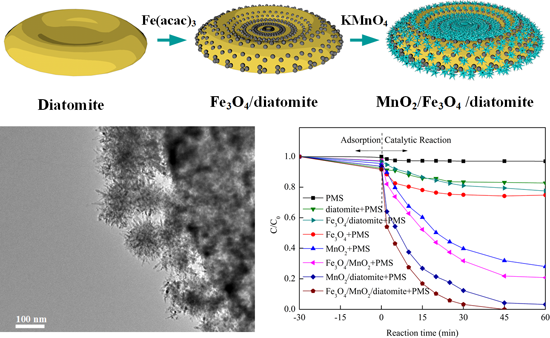
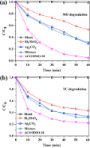
- .9.185 Abstract Heterogeneous Fenton-like catalysts with the activation of peroxymonosulfate (PMS), which offer the advantages of fast reaction rate, wide functional pH range and cost efficiency, have attracted great interest in wastewater treatment. In this study, a novel magnetic MnO2/Fe3O4/diatomite
- practical applications [15][16][17]. In addition to stability, separability is an extremely crucial factor for the recycling of catalysts. Magnetic separation is very attractive in the field of wastewater treatment as it provides a convenient and cost-effective way for catalyst collection. Fe3O4 is a very


Uniform cobalt nanoparticles embedded in hexagonal mesoporous nanoplates as a magnetically separable, recyclable adsorbent
Beilstein J. Nanotechnol. 2018, 9, 1770–1781, doi:10.3762/bjnano.9.168
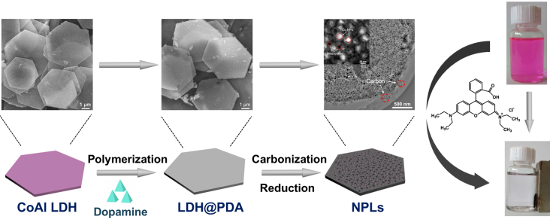
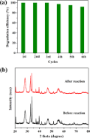
- Information File 1), which suggests that the unavoidable residual RhB molecules still exist in the NPLs-2.5-800 sample after the desorption process. Easy regeneration and good reusability make the hexagonal magnetic mesoporous NPLs potentially suitable for low-cost wastewater treatment. Conclusion In summary


Cr(VI) remediation from aqueous environment through modified-TiO2-mediated photocatalytic reduction
Beilstein J. Nanotechnol. 2018, 9, 1448–1470, doi:10.3762/bjnano.9.137
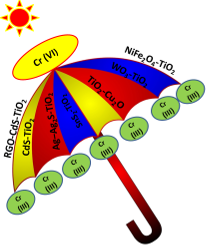
- their extraction. Hence, removal of toxic heavy metal ions from wastewater is considered as one of the most important environmental issues worldwide. Among the toxic heavy metals, chromium has been a major environmental concern in wastewater treatment. It exists in various oxidation states starting from
- CdS and SnS2 are considered as potential candidates for harvesting light in the visible region due to their narrow band gap and are being used as visible-light-responsive photocatalysts in wastewater treatment for degradation of pollutants [188][189][190][191]. These can also act as promising



Development of adsorptive membranes by confinement of activated biochar into electrospun nanofibers
Beilstein J. Nanotechnol. 2016, 7, 1556–1563, doi:10.3762/bjnano.7.149
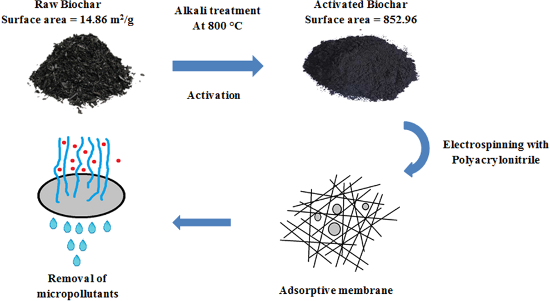
- concentration in feed stream was set to 200 ppb since the reported values for the influent and effluents of wastewater treatment plants ranged from 1.2 ppb in municipal wastewater to 32 ppm in pharmaceutical wastewater [32][33][34]. Therefore, the studied concentrations were reasonably in the relevant




Impact of ultrasonic dispersion on the photocatalytic activity of titania aggregates
Beilstein J. Nanotechnol. 2015, 6, 2423–2430, doi:10.3762/bjnano.6.250
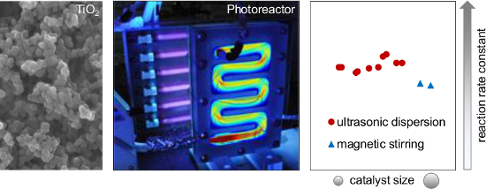
- significant obscuration. Keywords: AOPs; reaction rate constant; turbidity; ultrasonic energy; wastewater treatment; Introduction Advanced oxidation processes (AOPs) form a group of modern chemical technologies that rely on the generation of radical species and are considered to have high prospects for the


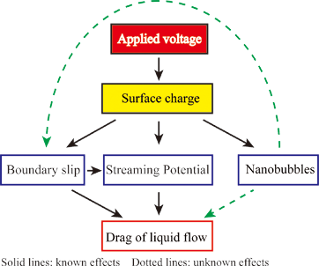
The study of surface wetting, nanobubbles and boundary slip with an applied voltage: A review
Beilstein J. Nanotechnol. 2014, 5, 1042–1065, doi:10.3762/bjnano.5.117
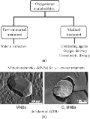
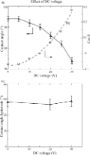
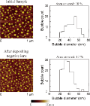
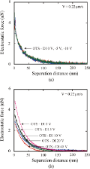
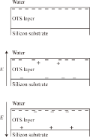
- ][47][48][49][50][51]. Figure 1a shows some applications of oxygenated nanobubbles, and Figure 1b shows an example, the transmission electron microscopy (TEM) images of oxygenated micro/nanobubbles which are applied for wastewater treatment. Furthermore, nanobubbles at the interface of solid and liquid










Pyrite nanoparticles as a Fenton-like reagent for in situ remediation of organic pollutants
Beilstein J. Nanotechnol. 2014, 5, 855–864, doi:10.3762/bjnano.5.97
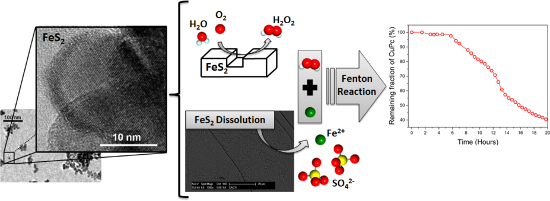
- The Fenton reaction is the most widely used advanced oxidation process (AOP) for wastewater treatment. This study reports on the use of pyrite nanoparticles and microparticles as Fenton reagents for the oxidative degradation of copper phthalocyanine (CuPc) as a representative contaminant. Upon
- alternative to conventional Fenton procedures for use in wastewater treatment, avoiding the potential risks caused by the release of heavy metals upon dissolution of natural pyrites. Keywords: copper phthalocyanine; Fenton-like reagent; hydrogen peroxide; nanoparticles; pyrite; Introduction There has been
- degrade organic compounds involves the iron (Fe2+ and Fe3+) catalysed decomposition of H2O2; this transformation is known as the Fenton reaction [6]. A major drawback of conventional Fenton chemistry for wastewater treatment is that it requires a continuous supply of H2O2 under strict pH control, to limit


Applicability and costs of nanofiltration in combination with photocatalysis for the treatment of dye house effluents
Beilstein J. Nanotechnol. 2014, 5, 476–484, doi:10.3762/bjnano.5.55
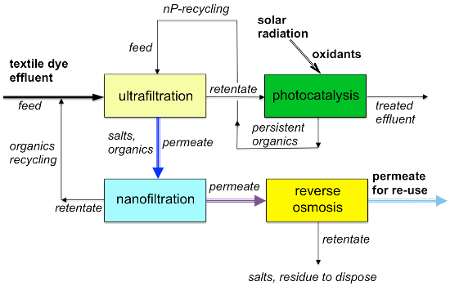
- , a schematic overview of possible pre-treatment steps is displayed and it can be recognised that pre-treatment plays an important role but will also be costly when membranes are applied in the wastewater treatment. In the nanofiltration permeate, which constitutes the bigger part of the treated
- replacement that is associated with these applications. Membrane costs in industrial applications are in the range of 10 to 20% of the total equipment costs. In wastewater treatment the maximum affordable membrane replacement costs (MRC) are, as a rule, less than 10% of the equipment costs. The annual
- combination with certain pre-treatment steps, are applied in some textile works, but those nanofiltration applications do not yet reflect the state of the art, and are not yet adopted as standard techniques in the dye industry [5]. However, the major drawback of applying membrane processes in wastewater


Energy transfer in complexes of water-soluble quantum dots and chlorin e6 molecules in different environments
Beilstein J. Nanotechnol. 2013, 4, 895–902, doi:10.3762/bjnano.4.101
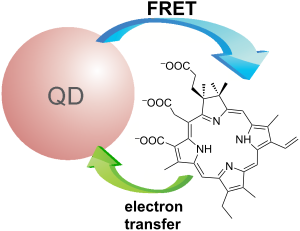
- investigated [1][2][3][4]. The interest in complexes based on tetrapyrrole compounds has been sparked by their ability to generate singlet oxygen [5]. The singlet oxygen is used in different applications such as photodynamic therapy, blood plasma sterilization and wastewater treatment. In QD/tetrapyrrole


Enhanced visible light photocatalysis through fast crystallization of zinc oxide nanorods
Beilstein J. Nanotechnol. 2010, 1, 14–20, doi:10.3762/bjnano.1.3
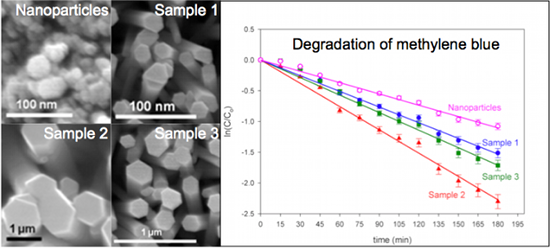
- , polypropylene, steel, cotton, amongst others, through proper seeding and hence is suitable for a large number of applications, e.g., wastewater treatment, etc. that is scalable for practical uses. Experimental Materials used Zinc acetate dihydrate [(CH3COO)2Zn·2H2O, Merck], sodium hydroxide [NaOH, Merck], zinc