Search results
Search for "CIS" in Full Text gives 60 result(s) in Beilstein Journal of Nanotechnology.
Characterization and photocatalytic study of tantalum oxide nanoparticles prepared by the hydrolysis of tantalum oxo-ethoxide Ta8(μ3-O)2(μ-O)8(μ-OEt)6(OEt)14
Beilstein J. Nanotechnol. 2014, 5, 1082–1090, doi:10.3762/bjnano.5.121
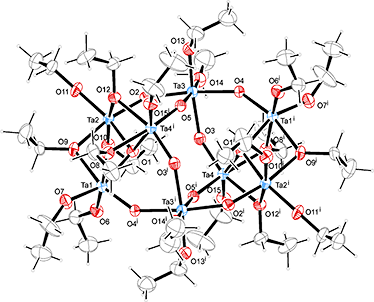
- cis pairs of terminal OEt ligands, single terminal OEt ligands and μ-OEt groups. Crystal structure Compound 1 was found in the monoclinic space group P21/n with Z = 2. The molecular structure (Figure 1) consists of a centrosymmetric unit of formula Ta8(μ3-O)2(μ-O)8(μ-OEt)6(OEt)14 (1). Each molecule
- has two Ta3(μ3-O)-(μ-OEt)3(OEt)5 units linked with two Ta(μ-O)4(OEt)2 moieties by four μ-oxo ligands. All of the tantalum atoms display distorted octahedral configurations. Six tantalum atoms are bonded to cis pairs of terminal ethoxy ligands and the other two are bonded to single ethoxy ligands. The


Optical modeling-assisted characterization of dye-sensitized solar cells using TiO2 nanotube arrays as photoanodes
Beilstein J. Nanotechnol. 2014, 5, 895–902, doi:10.3762/bjnano.5.102
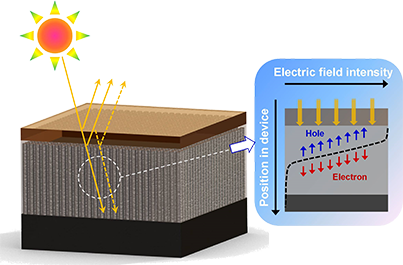
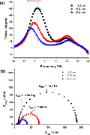
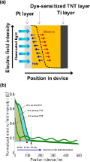
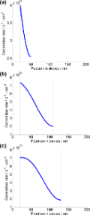
- reheated to 450 °C for 30 min if not immediately used. For N719-DSSCs, the TNT array was soaked in 0.3 mM N719 (cis-diisothiocyanato-bis(2,2′-bipyridyl-4,4′-dicarboxylato)ruthenium(II) bis(tetrabutylammonium)) dye solution in anhydrous acetonitrile for 18 h. N719 compound was purchased from Sigma-Aldrich



Optical and structural characterization of oleic acid-stabilized CdTe nanocrystals for solution thin film processing
Beilstein J. Nanotechnol. 2014, 5, 881–886, doi:10.3762/bjnano.5.100
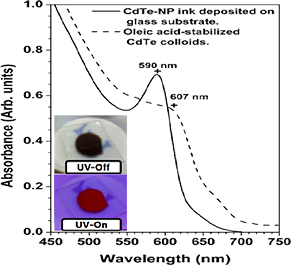
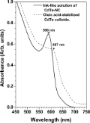
- dispersion chemistry and on the required thin film optoelectronic properties, post-deposition complex processes are needed. Guo et al. [23] deposited CuInSe2 (CIS) thin films for solar cells starting from oleylamine-stabilized CIS nanocrystals. An additional annealing at 500 °C was needed to obtain suitable
- CIS films for photovoltaic applications. Jasieniak et al. [24] deposited photovoltaic cadmium telluride (CdTe) thin films by using pyridine-capped CdTe nanocrystals. In their approach, CdTe nanocrystals were deposited from solution by a layer-by-layer process with subsequent annealing per layer at 300


Adsorption of the ionic liquid [BMP][TFSA] on Au(111) and Ag(111): substrate effects on the structure formation investigated by STM
Beilstein J. Nanotechnol. 2013, 4, 903–918, doi:10.3762/bjnano.4.102
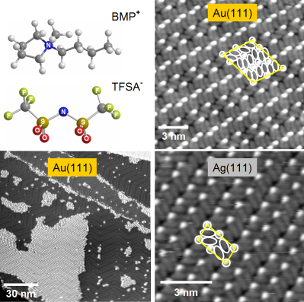
- that the anion adsorbs in a cis-conformation, with the SO2-groups pointing to the surface and the CF3-groups pointing towards the vacuum. The same adsorption geometry for the anion was also proposed by Sobota et al. [29] for [BMIM][TFSA] (B = butyl) adsorbed on a thin alumina film grown on NiAl(110
- ] ion pairs on Ag(111) [26]. Details on the calculations can be found elsewhere [26]. According to those calculations, the ring of the cation lies flat on the surface and the butyl group points upwards. The anion adsorbs in a cis-configuration (both SO2-groups are positioned on the same side of the




Template based precursor route for the synthesis of CuInSe2 nanorod arrays for potential solar cell applications
Beilstein J. Nanotechnol. 2013, 4, 868–874, doi:10.3762/bjnano.4.98
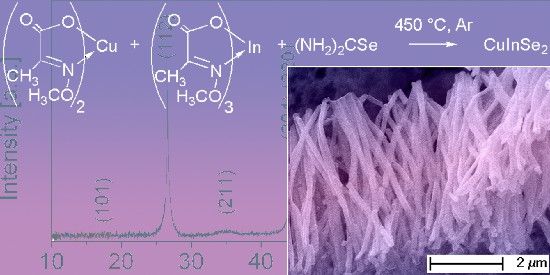
- purity and crystallinity, and a stoichiometric composition of the CISe ternary semiconductor compound. Keywords: CIS; light absorption; nanocasting; nanorod arrays; precursor synthesis; Introduction Polycrystalline heterojunction solar cells with a columnar morphology of the photovoltaic active layer
- VLS synthesis of CuInSe2 nanowires (by Cu impregnation of In2Se3 nanowires) and the construction of a single-nanowire CIS/CdS core–shell device [4]. However, the authors estimated the efficiency of their solar cell to be below 1%, and the construction of a larger scale device with this approach still


New hybrid materials based on poly(ethyleneoxide)-grafted polysilazane by hydrosilylation and their anti-fouling activities
Beilstein J. Nanotechnol. 2013, 4, 671–677, doi:10.3762/bjnano.4.75
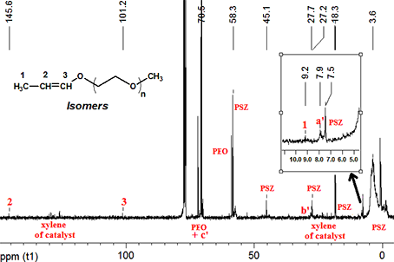
- of two new peaks increase with reaction time. These two peaks have been verified to match the =CH− protons of the cis- and trans-isomers, respectively, of the propenyl ether group, which results from the isomerization of allyl-PEO [25] (Figure 4). In the 13C NMR spectrum (Figure 2), the position of
- the conversion of allyl-PEO associated with hydrosilylation (%CAP,hydro) were calculated according to the following equations: in which ICH2=(0) is the integral of the CH2= resonance in the 1H-NMR spectrum of the initial mixture and ICH2=(t), ICH,cis(t) and ICH,trans(t) are the integrals of the CH2
- =, cis-CH=, and trans-CH= resonances at time t, respectively. The density (δ) of grafted PEO molecules onto the PSZ chain expressed by the amount of PEO attaching to 10 equiv of initial S−H has been calculated according to The conversions of all three types of allyl-PEO in the different reactions during





Continuous parallel ESI-MS analysis of reactions carried out in a bespoke 3D printed device
Beilstein J. Nanotechnol. 2013, 4, 285–291, doi:10.3762/bjnano.4.31
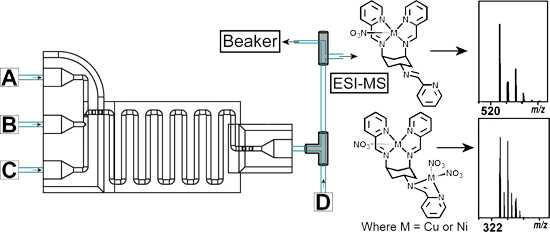
- , mixing points, inlets and outlets, et cetera [4]. Herein, we show that we can carry out complex supramolecular chemistry in milliscale reactionware, in which cis,trans-1,3,5-tris(pyridine-2-ylmethylene)cyclohexane-1,3,5-triamine (ttop) forms complexes with a number of metals, such as copper(II) and
- idle, and vice versa) (see Table 2 for flow rates). Results and Discussion The ttop ligand (L, C24H24N6) used in this investigation was produced by the reaction of cis,trans-1,3,5-triaminocyclohexane (trans-tach) with pyridine-2-carboxaldehyde (see Scheme 1). The ring-flip capability of the cyclohexane


Reduced electron recombination of dye-sensitized solar cells based on TiO2 spheres consisting of ultrathin nanosheets with [001] facet exposed
Beilstein J. Nanotechnol. 2012, 3, 378–387, doi:10.3762/bjnano.3.44
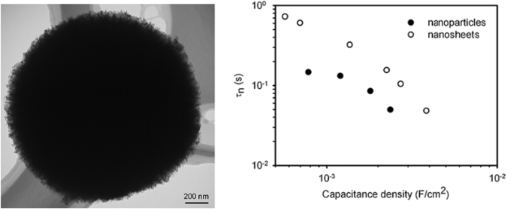
- resintered at 450 °C for 30 min. The geometrical area of the TiO2 film was 0.25 cm2. The TiO2 film (with or without TiCl4 treatment) when it was still warm (around 80 °C) was immersed in a dye solution containing 0.25 mM cis-bis(isothiocyanato) bis(2,2´- bipyridyl-4,4´-dicarboxylate) ruthenium(II) bis


Dipole-driven self-organization of zwitterionic molecules on alkali halide surfaces
Beilstein J. Nanotechnol. 2012, 3, 285–293, doi:10.3762/bjnano.3.32
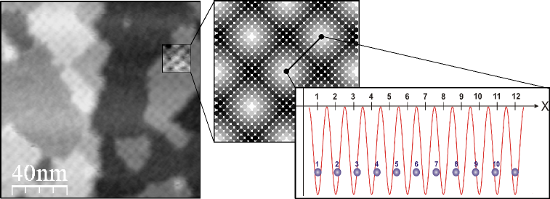
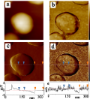
- composed of a sulfonato endgroup (SO3−), which carries a negative charge and which is linked via an alkyl-chain to a pyridinum ring carrying a positive charge (N+). MSPS molecules adopt two main conformations corresponding to the cis/trans isomerization of the C–C double bond. Cis (agraffe-like) and trans
- (scorpion-like) are described in Figure 1. However, only the scorpion-like isomer is obtained after the synthesis, because it is more stable than the cis isomer. The permanent electric dipole of the trans isomer is 16.8 D, the total length of this isomer is 1.28 nm. Due to the isomerization of the C–C
- double bond, the cis isomer is shorter than the trans isomer (0.53 vs 1.28 nm). The ionic single-crystal substrates (MaTecK GmbH, Jülich, Germany) were cleaved ex situ and annealed in situ (UHV conditions) to 150–250 °C in order to obtain clean terraces and well-defined step edges. The molecules were


Direct monitoring of opto-mechanical switching of self-assembled monolayer films containing the azobenzene group
Beilstein J. Nanotechnol. 2011, 2, 834–844, doi:10.3762/bjnano.2.93
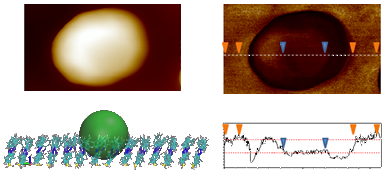
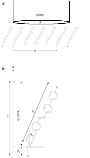
- Support, Rehovot Israel 10.3762/bjnano.2.93 Abstract The potential for manipulation and control inherent in molecule-based motors holds great scientific and technological promise. Molecules containing the azobenzene group have been heavily studied in this context. While the effects of the cis–trans
- show that the modulus of the cis-form is approximately twice that of the trans-isomer. Quantum mechanical and molecular dynamics studies show good agreement with this experimental result, and indicate that the stiffer response in the cis-form comprises contributions both from the individual molecular
- through a facile cis↔trans isomerization that is controlled by UV and visible light. The forces involved in this transition have been characterized by a number of techniques. For instance, changes in the stiffness of azobenzene-containing films were monitored by nanoindentation [1], by quartz-crystal