


Search results
Search for "STEM" in Full Text gives 301 result(s) in Beilstein Journal of Nanotechnology. Showing first 200.
Directed growth of quinacridone chains on the vicinal Ag(35 1 1) surface
Beilstein J. Nanotechnol. 2024, 15, 556–568, doi:10.3762/bjnano.15.48
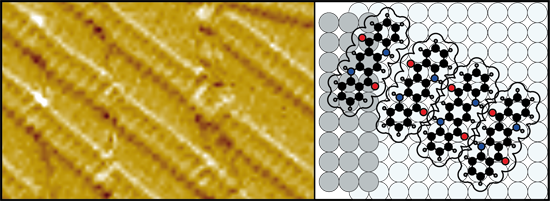
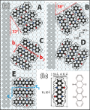
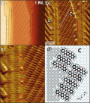
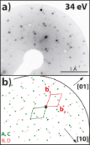
- conclude that these stem from domains of several parallel chains of orientation E, which have formed either on large terraces or even extend across the steps over several neighboring terraces. However, the spots given by the vector are still more smeared out (broader by 25%) than those from the α-phase


Insect attachment on waxy plant surfaces: the effect of pad contamination by different waxes
Beilstein J. Nanotechnol. 2024, 15, 385–395, doi:10.3762/bjnano.15.35
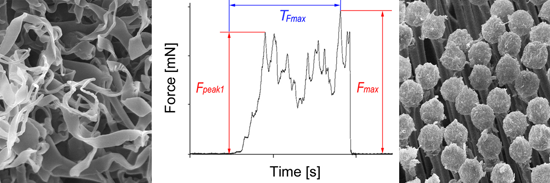
- , they may wholly detach from it and, consequently, easily cause heavy pad contamination. Moreover, according to [35], such wax structures may also readily brake during contact formation with insect pads and contaminate them. Interestingly, it has been previously reported that the A. negundo stem surface
- , experiments with all waxy plant surfaces (d.f. = 44) and (2) data obtained from five test insects on each plant surface separately (d.f. = 4). Scanning electron microscopy (SEM) micrographs of waxy plant surfaces in the young stem of Acer negundo (a) and adaxial (upper) leaf sides of Aloe vera (b), Aquilegia
- glass gl2 (performed immediately after the test on plant) (c). Here, results for beetle no. 3 tested on an Acer negundo waxy stem are presented. Fmax, maximal traction force; Fpeak1, value of the first peak of the traction force; TFmax, time needed to reach the Fmax value. Maximum traction force Fmax (a




Comparative electron microscopy particle sizing of TiO2 pigments: sample preparation and measurement
Beilstein J. Nanotechnol. 2024, 15, 317–332, doi:10.3762/bjnano.15.29
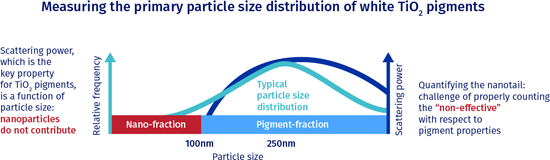
- the fresh suspension were transferred on copper grids. The excess acetone evaporated within a few seconds, and the preparations were mounted directly to the STEM detector. TEM analyses were performed at a voltage of 30 kV, with the beam intensity level set to 4, mostly at a magnification of 50,000× in
- , equipped with a LaB6 cathode, using the SE and STEM detectors, and VEGA3 control software version 4.2.26.0, build 1344. BET SSA measurement The SSA measurements of the E171 samples were originally performed according to an internal procedure inspired by the ISO 9277 standard as mentioned in [11]. To


Vinorelbine-loaded multifunctional magnetic nanoparticles as anticancer drug delivery systems: synthesis, characterization, and in vitro release study
Beilstein J. Nanotechnol. 2024, 15, 256–269, doi:10.3762/bjnano.15.24
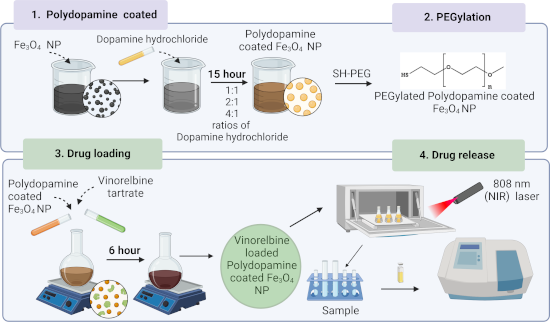
- -resolution analytical electron microscope (FE-SEM, Thermo Scientific, Apreo 2S LoVac) and a scanning transmission electron microscope (STEM, Phillips XL, 30 ESEM-FEG/EDAX) operating at 120 kV acceleration voltage. The structure of the nanoparticles was analyzed by X-ray diffraction (XRD, PANalytical, Xpert
- a solvothermal technique in a stainless steel reactor at 200 °C for 6 h. According to the results of FE-SEM and STEM examinations, the Fe3O4 NPs are spherical, as depicted in Figure 1a–c. When examining the STEM size distribution, it was observed that Fe3O4 NPs were efficiently synthesized with an
- with dual-targeting capabilities for the synergistic treatment of cancer via photothermal and chemotherapy, demonstrating excellent application prospects in the future. (a) FE-SEM images of Fe3O4 NPs. (b) STEM images of Fe3O4 NPs at 200,000× magnification. (c) STEM images of Fe3O4 NPs at 800,000


Berberine-loaded polylactic acid nanofiber scaffold as a drug delivery system: The relationship between chemical characteristics, drug-release behavior, and antibacterial efficiency
Beilstein J. Nanotechnol. 2024, 15, 71–82, doi:10.3762/bjnano.15.7
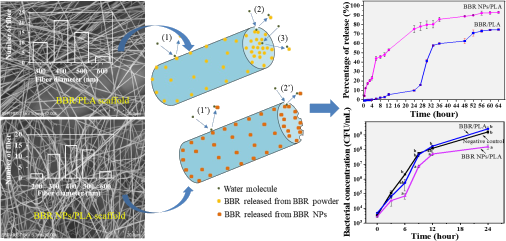
- 21 days and inhibited the growth of Staphylococcus aureus and Escherichia coli bacteria. Human bone marrow mesenchymal stem cells were well attached and proliferated on the surface of the LAP/AMX functionalized PLA scaffolds, which provided a bacteria-free environment for bone differentiation in the


TEM sample preparation of lithographically patterned permalloy nanostructures on silicon nitride membranes
Beilstein J. Nanotechnol. 2024, 15, 1–12, doi:10.3762/bjnano.15.1
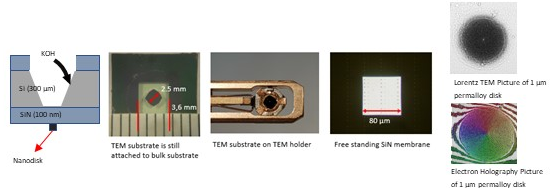
- Lorentz microscopy and electron holography, along with simultaneous structural and chemical characterization techniques such as electron diffraction, 4D STEM, and energy-dispersive X-ray (EDX) and electron energy loss spectroscopy (EELS), enable a correlative characterization to investigate magnetic


A combined gas-phase dissociative ionization, dissociative electron attachment and deposition study on the potential FEBID precursor [Au(CH3)2Cl]2
Beilstein J. Nanotechnol. 2023, 14, 1178–1199, doi:10.3762/bjnano.14.98
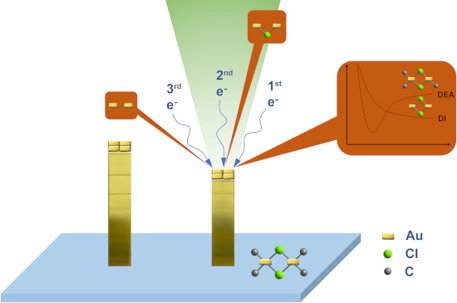
- ]. The image after the background subtraction is shown in Figure 1d, where the particles can be more clearly distinguished. After background subtraction, some of the deposited nanoparticles appear facetted; however, the majority are spherical. HAADF-STEM on FEBID (SiO2 (500 nm)/Si(111)) As a next step
- , high-angle annular dark-field scanning transmission electron microscopy (HAADF-STEM) was performed to analyze the morphology of the deposited nanoparticles. For this purpose, several FEBID structures were prepared on the SiO2 substrate with the size of 4 × 4 µm2 and an electron dose of 7.80 C/cm2. For
- the HAADF-STEM measurements, a lamella was prepared with a thickness of approx. 100 nm and a width of approx. 4 µm (Supporting Information File 1, Figure S1). In Figure 2a, the HAADF-STEM image of deposited nanoparticles is shown, revealing a nearly uniform spatial distribution of nanoparticles with a



Hierarchically patterned polyurethane microgrooves featuring nanopillars or nanoholes for neurite elongation and alignment
Beilstein J. Nanotechnol. 2023, 14, 1157–1168, doi:10.3762/bjnano.14.96
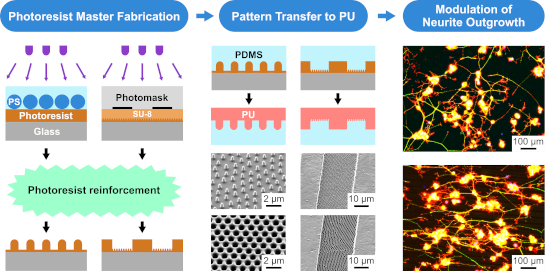
- cues that promote nerve cell survival, neural stem cell recruitment and differentiation, and axonal guidance and regeneration [3]. The ability of topographical features to guide axons is particularly important in peripheral nerve regeneration, where unidirectional continuous micro-/nanostructures, such
- microenvironment. While several of these focused on stem cell differentiation [9][10], a couple of studies explored their effects on axonal guidance. Lee et al. [11] found that nanorough microridges composed of laser-patterned Al/Al2O3 nanowires increase cell attachment and effectively guide dorsal root ganglia


Sulfur nanocomposites with insecticidal effect for the control of Bactericera cockerelli
Beilstein J. Nanotechnol. 2023, 14, 1106–1115, doi:10.3762/bjnano.14.91
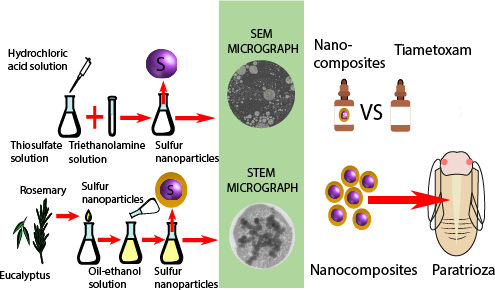
- ]. Those studies reported that the size of the SNPs increased with an increasing concentration ratio between acid and sulfur source during the synthesis [33][34]. Nanocomposites An analysis of morphology and size using STEM revealed that the NCMPs with eucalyptus and rosemary oils had spherical shapes
- processes that involve classical nucleation, aggregation, and/or Ostwald ripening [38]. Figure 6 shows a STEM micrograph of the nanomicellar structure of a rosemary NCMP composed of two immiscible phases, that is, (a) the aqueous phase formed by the sulfur nanoparticles and (b) the oily phase formed by
- from Sigma-Aldrich. The chemical insecticide thiamethoxam (C8H10ClN5O3S, CAS number 153719-23-4, concentration 0.25%) was acquired from Syngenta. Distilled water was obtained in the laboratory. Essential oil extraction A total of 2 kg of rosemary leaves and stem and 2 kg of eucalyptus leaves were


Density functional theory study of Au-fcc/Ge and Au-hcp/Ge interfaces
Beilstein J. Nanotechnol. 2023, 14, 1093–1105, doi:10.3762/bjnano.14.90
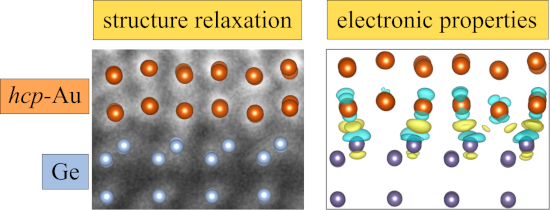
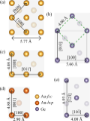
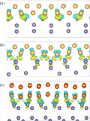
- , stable hcp nanoislands were obtained under controlled annealing conditions on the germanium substrate [23]. After initial crystallization of the fcc gold phase, the hcp phase grows from the eutectic Au/Ge liquid. The atomically resolved STEM-HAADF measurements as well as electron backscatter diffraction
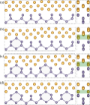
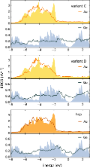
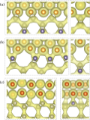
- order of magnitude as in other considered interfaces. Experimentally observed heterostructures In this section we present our results of ab initio calculations for the Au/Ge interfaces observed in experimentally grown gold nanoislands on a germanium substrate [23]. Available STEM-HAADF images
- rumpling parameter of the Ge layer up to 0.49 Å. The interface energy of variant B is higher than that of variant A by 0.23 J/m2. These findings confirm that structures with some Au atoms located directly above the Ge atoms tend to be energetically expensive. Atomically resolved STEM-HAADF images of gold





Dual-heterodyne Kelvin probe force microscopy
Beilstein J. Nanotechnol. 2023, 14, 1068–1084, doi:10.3762/bjnano.14.88
- in the existence of additional modulated component of the electrostatic force (or sidebands) at frequencies ω0 ± ωac. They stem from higher harmonic components in the capacitance term [16][18]: If we restrict ourselves to the first harmonic (n = 1), electrostatic force components emerge (we just




Exploring internal structures and properties of terpolymer fibers via real-space characterizations
Beilstein J. Nanotechnol. 2023, 14, 1004–1017, doi:10.3762/bjnano.14.83
- -performance paracrystalline fibers are nearly an order of magnitude lower than those of their constituent molecules and crystallites, so other structural factors play a considerable role in limiting fiber properties [22]. To this end, the more consistent strength values of Technora® appear to stem from two






Isolation of cubic Si3P4 in the form of nanocrystals
Beilstein J. Nanotechnol. 2023, 14, 971–979, doi:10.3762/bjnano.14.80
- significant variation and closely resemble the HAADF-STEM images of the corresponding sample regions (Figure 7b). The two elements are, thereby, viewed as strongly associated and distributed rather homogeneously in the NPs. When the particle agglomeration is not as severe (border regions of Figure 7e), the O
- . (a) Bright-field TEM image and (b) electron diffraction of the sample SP550. TEM studies of the sample SP550. (a) High-resolution TEM image; (b) HAADF-STEM image; EDX elemental maps for (c) Si Kα, (d) P Kα, and (e) O Kα. The scale bar in images (b–e) is 30 nm. Synthesis conditions and results of X


Carboxylic acids and light interact to affect nanoceria stability and dissolution in acidic aqueous environments
Beilstein J. Nanotechnol. 2023, 14, 762–780, doi:10.3762/bjnano.14.63
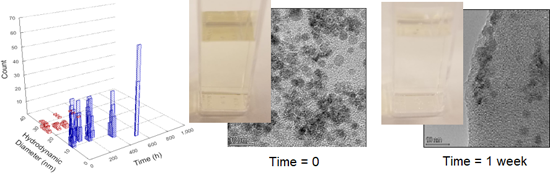
- these fine features may be associated with a complex of cerium and hexamethylenetetramine. However, as evident from the STEM EDS mapping analysis (Figure S3, Supporting Information File 1), the features include sodium, likely from sodium nitrate. From these results, it also appears that the 15–25 nm
Plasmonic nanotechnology for photothermal applications – an evaluation
Beilstein J. Nanotechnol. 2023, 14, 380–419, doi:10.3762/bjnano.14.33
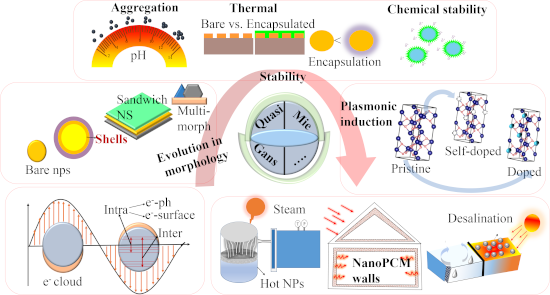
- absorbance due to changes morphology stem predominantly from changes to the directionality of the LSPR (due to changing curvature and dimensionality of the nanoparticle) and changes to the dynamics between the restoring and exciting forces of the plasmons, such as the mean free path, the relative




Recent progress in cancer cell membrane-based nanoparticles for biomedical applications
Beilstein J. Nanotechnol. 2023, 14, 262–279, doi:10.3762/bjnano.14.24
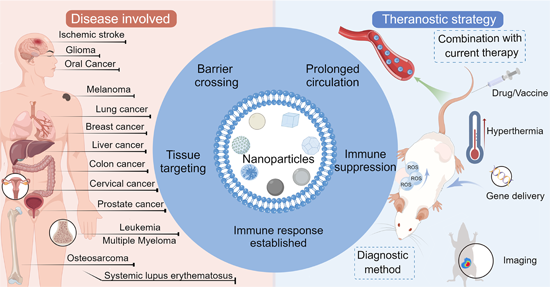
- tumor-targeting ability of stem cells [12], immune cells [13], and cancer cell membranes [14]. In vitro and in vivo studies have demonstrated that cell membrane-coated nanoparticles exhibit higher potency, longer retention, and more significant accumulation than bare nanoparticles in the tumor
- membranes have been exploited for the development of novel membrane NP-based therapies, such as erythrocytes [10], platelets [11], cancer cells [14], stem cells [12], immune cells [13], central nervous system-derived cells [17], bacterial outer membrane vesicles [18], and extracellular vesicles [19]. Cancer


A novel approach to pulsed laser deposition of platinum catalyst on carbon particles for use in polymer electrolyte membrane fuel cells
Beilstein J. Nanotechnol. 2023, 14, 190–204, doi:10.3762/bjnano.14.19
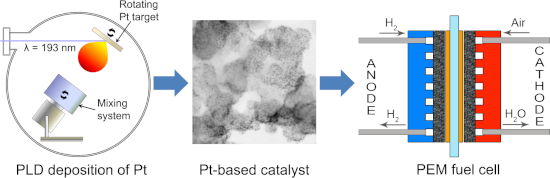
- the HAADF-STEM images, it can be concluded that the distribution of PtNPs (white dots on images) is heterogeneous and that their sizes within one sample are very similar (samples A, B, and C). However, because the carbon particles are irregular 3D structures, the PtNPs appear larger and agglomerated
- 60000 does not translate into noticeable differences in the PtNP dimensions. Based on the HAADF-STEM images, only a slight increase in the density distribution of the PtNPs is visible. The differences in the size of the PtNPs are better visible only between the samples prepared using 10000 and 60000
- at the Biological and Chemical Research Centre, University of Warsaw, Poland, on the TALOS F200X (Thermo Fisher Scientific, United States) equipped with a four-detector windowless Super X-EDS system. The EDX measurements were performed in STEM (scanning transmission electron microscopy) mode with a



Structural, optical, and bioimaging characterization of carbon quantum dots solvothermally synthesized from o-phenylenediamine
Beilstein J. Nanotechnol. 2023, 14, 165–174, doi:10.3762/bjnano.14.17
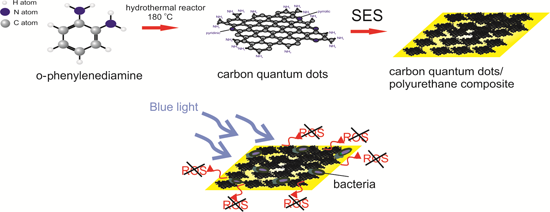
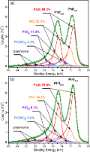
- CQDs, FTIR, UV–vis, and PL spectra were measured. A FTIR spectrum of the CQDs is presented in Figure S2a (Supporting Information File 1). The spectrum contains many peaks associated with the following bonds: Peaks at 3634 and 3448 cm−1 stem from O–H stretching vibrations. A peak at 3367 cm−1 could be
- bending vibrations, respectively. The peaks at 1521 and 1061 cm−1 stem from N–O stretching and C–O stretching vibrations, respectively. The peaks at 961, 815, and 759 cm−1 could be assigned to C=C bending, C-H bending, and C=C bending vibrations, respectively [30]. An et al. reported that XPS analysis of
- and 1015 cm−1 stem from C=C bending vibrations [30]. All other peaks identified in both neat PU and CQDs/PU composite samples originate from PU. Figure 2b shows a UV–vis spectrum of the CQDs/PU composite sample. The first peak at 317 nm is due to the π–π* transition of C=C. A peak at 350 nm is due to


Combining physical vapor deposition structuration with dealloying for the creation of a highly efficient SERS platform
Beilstein J. Nanotechnol. 2023, 14, 83–94, doi:10.3762/bjnano.14.10
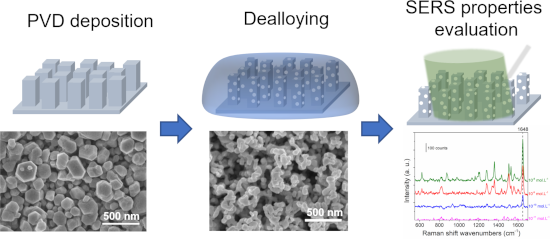
- 20 min to stop the dealloying process and to ensure a good cleaning of the samples. Characterization Scanning electron microscopy micrographs were recorded using a HITACHI STEM-FEG with an acceleration voltage of 5 kV. The images were treated with the ImageJ software [58] to assess the size of the




Hydroxyapatite–bioglass nanocomposites: Structural, mechanical, and biological aspects
Beilstein J. Nanotechnol. 2022, 13, 1490–1504, doi:10.3762/bjnano.13.123
- , voltage (mV), and temperature (°C). The precision of the pH measurement was 10−2. MTT assay The MTT assay was performed on mesenchymal stem cells (MSCs) previously isolated from six-months-old Wistar rat bone marrow, cultured in HiMesoXL™ mesenchymal stem cell expansion medium (HiMedia, India) and stored
- at −80 °C in FBS (Lonza, Belgium) with 10% DMSO (Alchimia, Italy). The ethical approval, as well as the protocol used for the isolation of the mesenchymal stem cells is described in the Annex. After thawing, cells from the third passage were cultured in DMEM/Ham F12 (Sigma, Germany) cell culture
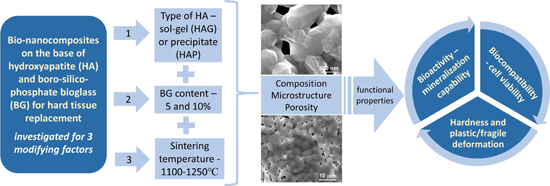
- results of a preliminary biological study performed by MTT assay regarding the relative viability of the bone marrow STEM cells exposed to HAP- and HAG-based composites. As a control, HAP and HAG ceramics sintered at 1200 °C without glass addition (labeled as HAP-1200 and HAG-1200, respectively) were
LED-light-activated photocatalytic performance of metal-free carbon-modified hexagonal boron nitride towards degradation of methylene blue and phenol
Beilstein J. Nanotechnol. 2022, 13, 1380–1392, doi:10.3762/bjnano.13.114
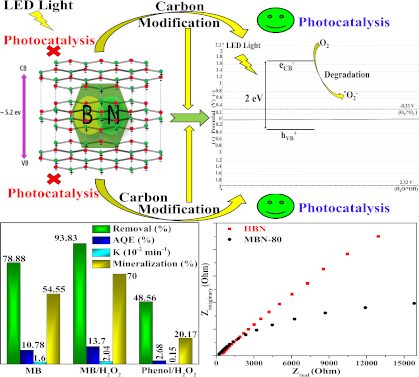
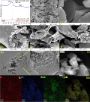
- -light-driven photocatalytic activity of MBN-80 over the nonresponsive photoinactive HBN. (a) HR-XRD plots for HBN and MBN-80, (b–d) SEM images for HBN, MBN-25, MBN-50, and (e, f) MBN-80. HRTEM images for (g, h) MBN-80 nanosheets, (i) HAADF STEM image, and (j–m) elemental mapping of B, N, C, and O in MBN


Straight roads into nowhere – obvious and not-so-obvious biological models for ferrophobic surfaces
Beilstein J. Nanotechnol. 2022, 13, 1345–1360, doi:10.3762/bjnano.13.111
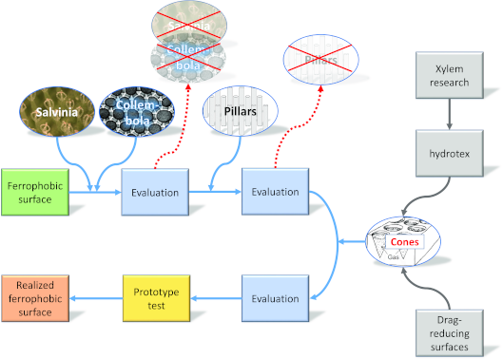
- network flow of water molecules is formed whose upper end is fastened within the leaves where transpiration takes place at the living leaf cells. From there it “hangs down” through twigs, trunks, stem and roots into the ground water. The stability of this transport mechanism relies on the comparatively
- as in [23]. Basic structure of the xylem, the water transport tissue of plants. The xylem consists of elongated conduits, which are arranged parallel to the long axis of the plant stem, and which are connected to each other by pores termed “pits”. Panel (a) shows a sketch of two adjacent conduits cut


Laser-processed antiadhesive bionic combs for handling nanofibers inspired by nanostructures on the legs of cribellate spiders
Beilstein J. Nanotechnol. 2022, 13, 1268–1283, doi:10.3762/bjnano.13.105
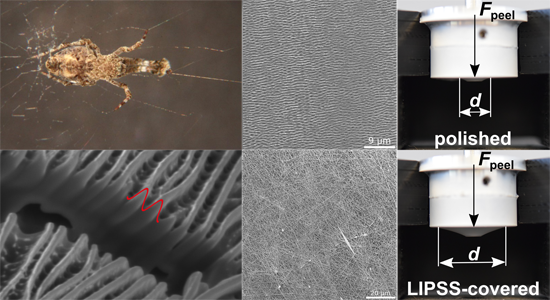
- gold-sputtered (S150B, Edwards). The metatarsi were examined using a focused ion beam scanning electron microscope (FIB-SEM) tomography (Strata 400 STEM, FEI Company, Oregon, USA) at the Central Facility for Electron Microscopy at the RWTH Aachen University. Measurements were performed using the






Recent advances in green carbon dots (2015–2022): synthesis, metal ion sensing, and biological applications
Beilstein J. Nanotechnol. 2022, 13, 1068–1107, doi:10.3762/bjnano.13.93
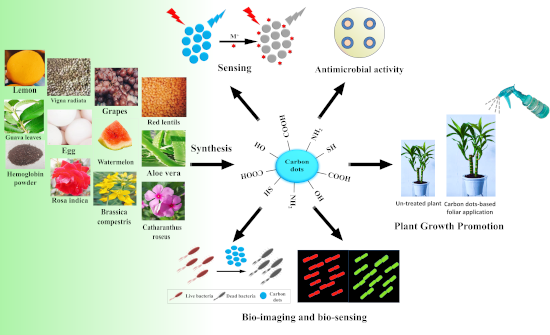
- availability. It is thus environmentally friendly and advantageous [51][52]. Plant parts such as roots, stem, leaves, fruits, flowers, and seeds have been used for the production of CDs. Several low-value plant materials can also be converted into functional materials with excellent biocompatibility by
- obtained by Vasimalai et al. using various spices, such as cinnamon, red chili, turmeric, and black pepper, for a simple hydrothermal method. They found that black pepper yields CDs with the highest QY up to 43.6% [62]. Vandarkuzhali et al. also obtained a very high quantum yield of 48% using pseudo-stem




Biomimetic chitosan with biocomposite nanomaterials for bone tissue repair and regeneration
Beilstein J. Nanotechnol. 2022, 13, 1051–1067, doi:10.3762/bjnano.13.92
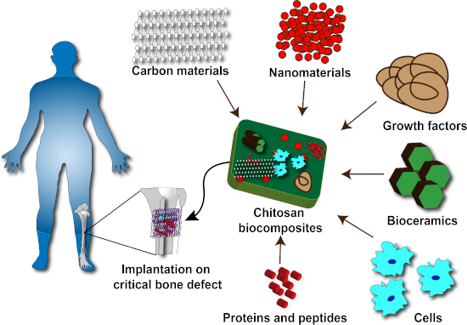
- . The rough surface of the materials at the nanoscale helps cellular peptide adhesion for better stem cell growth and differentiation [12][13]. Nanomaterials have several advantages such as high surface area, increased mechanical strength, and induction of several important genes for bone tissue repair
- and regeneration [14]. Nanomaterials such as silver [15], gold [16][17], titanium oxide [18], zinc oxide [19][20], carbon nanotubes [21][22], graphene [23] and biosilica have been studied in terms of their osteogenic potential in stem cell differentiation. Chitosan materials are often combined with
- , osteoblasts generate a membrane that includes alkaline phosphatase, which cleaves phosphatase groups and causes calcium and phosphate precipitation, resulting in the formation of natural bone minerals with a ratio of 1.67 [27]. Osteoblasts have been predominantly derived from mesenchymal stem cells, which



