


Search results
Search for "Young’s modulus" in Full Text gives 155 result(s) in Beilstein Journal of Nanotechnology.
Graphynes: an alternative lightweight solution for shock protection
Beilstein J. Nanotechnol. 2019, 10, 1588–1595, doi:10.3762/bjnano.10.154
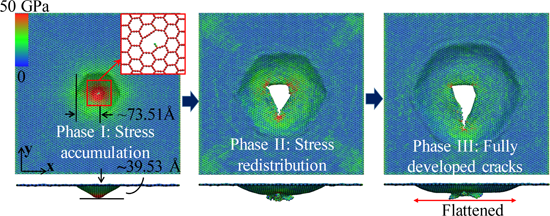
- propagation of cracks. Tracking the atomic von Mises stress distribution, it is found that its cumulative density function has a strong correlation with the magnitude of the Young’s modulus of the GYs. For nanosheets with a higher Young’s modulus, it tends to transfer momentum at a faster rate. Thus, a better
- ][13][14]. Based on in silico molecular dynamics (MD) tensile tests, the recorded failure strength values for different types of GYs range between 32.48 and 63.17 GPa [2][15][16]. According to a first-principle study, the failure strain of GY reaches 20% [17]. A high Young’s modulus of 532.5 GPa is
- distribution function (CDF) of the von Mises atomic stress in each GY before the initiation of the crack is analyzed. According to Figure 5, the profile of CDF shows a strong correlation with the magnitude of the Young’s modulus (see Section 3 of Supporting Information File 1). In detail, α-GY has the smallest




Development of a new hybrid approach combining AFM and SEM for the nanoparticle dimensional metrology
Beilstein J. Nanotechnol. 2019, 10, 1523–1536, doi:10.3762/bjnano.10.150
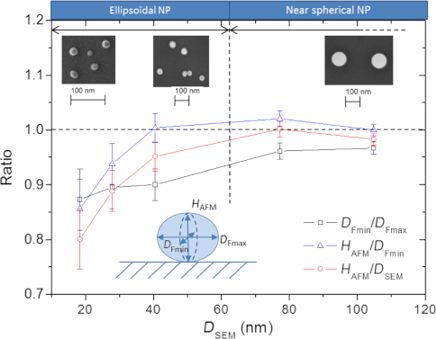
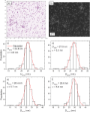
- the substrate in a way similar to the PSL NPs. However, the mechanical properties of silica are different than those of PSL even at the nanoscale. The Young’s modulus of PSL NPs has been found to be equal to 8.0 GPa for 60 nm particles [29]. In comparison, the Young’s modulus of silica NPs with
- defined by: where K the equivalent elastic modulus of the NP and the substrate defined by: where Ei and νi are the Young’s modulus and the Poisson’s ratio of the sphere and the half space. The depth of indentation δ, i.e., the elastic displacement is defined by: In the case of silica NPs deposited on a Si




Nanoscale spatial mapping of mechanical properties through dynamic atomic force microscopy
Beilstein J. Nanotechnol. 2019, 10, 1332–1347, doi:10.3762/bjnano.10.132
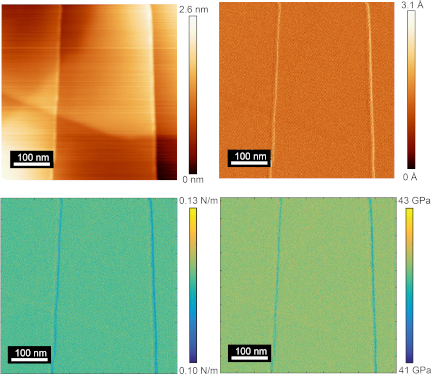
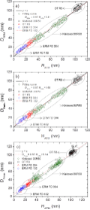
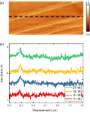
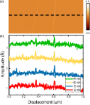
- measurements. An effective analytical molecular mechanics model of a graphene sheets [44] was employed in [41] that calculates Young’s modulus of single-walled carbon nanotubes, which extends the model for graphite platelets under infinitesimal deformation. In another study, an elastic modulus of 39.5 GPa was




Multicomponent bionanocomposites based on clay nanoarchitectures for electrochemical devices
Beilstein J. Nanotechnol. 2019, 10, 1303–1315, doi:10.3762/bjnano.10.129
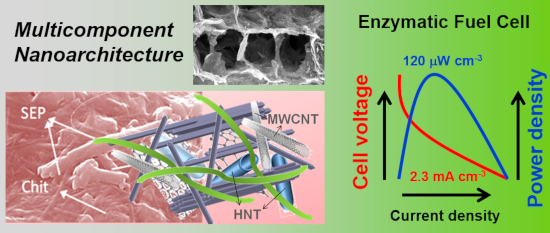
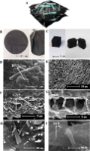
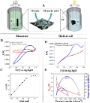
- Young’s modulus of the films (Figure 4A) increases with the clay nanofiller content from 5 GPa for pure chitosan up to 11 GPa for the sample Film-4, which contains 40% of clay components. These findings are in good agreement with the mechanical properties of similar composite materials based on sepiolite
- conferring robustness to these systems as the Young’s modulus of 0.2 MPa for a foam without chitosan (with the composition of 1:1:1:0.3 in HNTs/SEP/GNPs/MWCNTs) increases to 3.5 MPa after incorporation of the biopolymer (45 wt %). This increase can be correlated to the strong interaction between the chitosan



On the relaxation time of interacting superparamagnetic nanoparticles and implications for magnetic fluid hyperthermia
Beilstein J. Nanotechnol. 2019, 10, 1280–1289, doi:10.3762/bjnano.10.127
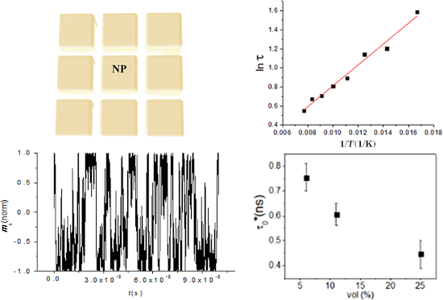
- uniaxial anisotropy) has been provided by Néel under the assumption that the particle macrospin behaves as a gyroscopic system [27]: In Equation 2, τ0N is a time characteristic depending slightly on temperature and other material parameters such as magnetization, gyromagnetic ratio, Young’s modulus, etc



Mechanical and thermodynamic properties of Aβ42, Aβ40, and α-synuclein fibrils: a coarse-grained method to complement experimental studies
Beilstein J. Nanotechnol. 2019, 10, 500–513, doi:10.3762/bjnano.10.51
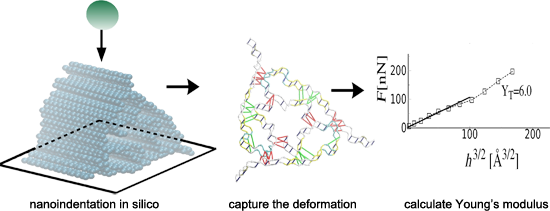
- be determined during experimental measurements. As a result, big discrepancies are found when comparing Young’s modulus values measured with macroscopic techniques and nanoscopic ones such as AFM. This is because a nanoscopic exploration of biological systems reaches molecular resolution and the
- [28][29]. On one hand, AFM in contact mode has been used to provoke the mechanical deformation of fibrils obtaining the Young’s modulus (here denoted as YT) [30][31][32]. On the other hand, the experimental determination of the tensile Young’s modulus (YL) is nontrivial at the nanoscale [33], due to
- , it determines the smallest convex polygon containing all the given points. Then, we monitor the elementary area of this polygon during the simulation [54]. From the stress–strain plot one can derive the corresponding tensile Young’s modulus, YL. Shear deformation The experimental techniques employed


Gold nanoparticles embedded in a polymer as a 3D-printable dichroic nanocomposite material
Beilstein J. Nanotechnol. 2019, 10, 442–447, doi:10.3762/bjnano.10.43
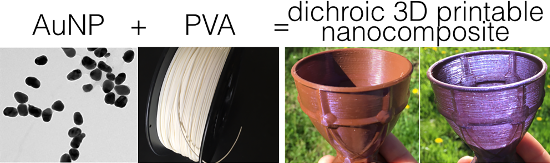
- envision a drastic change in the mechanical properties between pure PVA and AuNP–PVA. To test this, we 3D-printed dog-bone-shaped strips of plastic (2.5 × 0.4 × 0.1 cm) and tested the elastic modulus (Young’s modulus) using dynamic mechanical analysis (DMA). The pure PVA and the AuNP–PVA, as expected, did
- the dichroic AuNPs (blue) and AuNP–PVA film (green) which shows a red shift probably due to a lack of solvent. When the AuNP–PVA film is dissolved in water, the AuNPs show again the same characteristic plasmon resonance band (yellow). c) Young’s modulus of the AuNP–PVA compared to pure PVA. 3D-printed



Pull-off and friction forces of micropatterned elastomers on soft substrates: the effects of pattern length scale and stiffness
Beilstein J. Nanotechnol. 2019, 10, 79–94, doi:10.3762/bjnano.10.8
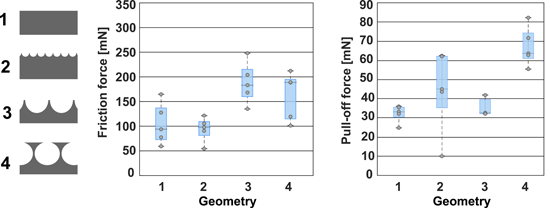
- off a micropattern from a soft substrate, the substrate deforms, and the detachment of neighboring pillars is no longer independent [24]. Accordingly, the pull-off force of mushroom-pillar micropatterns on a soft elastic substrate (Young’s modulus E = 200 kPa) has been found to be lower than on a
- rigid glass substrate [24]. On very soft substrates (Young’s modulus E ≈ 10 kPa), the indentation depth of microscale features is determined by a balance between the elastic properties of the substrate and the substrate–micropattern adhesion effects [25]. The length scale at which these adhesion effects





Contact splitting in dry adhesion and friction: reducing the influence of roughness
Beilstein J. Nanotechnol. 2019, 10, 1–8, doi:10.3762/bjnano.10.1
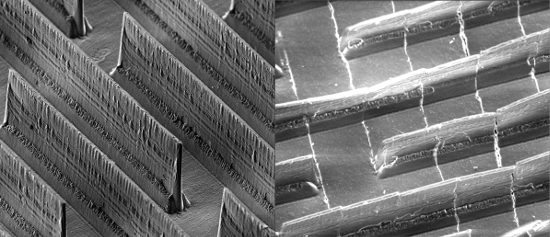
- is the Young’s modulus, and R is the fracture energy. Plotting the peel strength, which is the peeling force normalized by the film (flap) width, gives the curves shown in Figure 4c when the film (flap) thickness is 5 µm, the Young’s modulus is 3 MPa, the fracture energy is 0.2 N m−1, the peeling
- (Figure 1a,b) were molded from PVS (Coltène Whaledent, Altstätten, Switzerland; Young’s modulus of about 3 MPa [45]) against a laser micro-machined grid (Oxford Lasers, Shirley, MA, USA) using a procedure described elsewhere [36]. Rectangular samples of 2.5 × 5 × 1 mm in size were cut out of the mold, so


Hydrogen-induced plasticity in nanoporous palladium
Beilstein J. Nanotechnol. 2018, 9, 3013–3024, doi:10.3762/bjnano.9.280
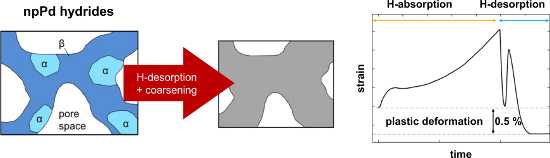
- recently [60], is where Δεe denotes the change in elastic strain, α is the specific surface area A/V, K the bulk modulus, Δf the change in surface stress, and Enp the Young’s modulus of the nanoporous structure. Δf can be linked to the change in surface charge density Δq via electrocapillary coupling


Friction reduction through biologically inspired scale-like laser surface textures
Beilstein J. Nanotechnol. 2018, 9, 2561–2572, doi:10.3762/bjnano.9.238
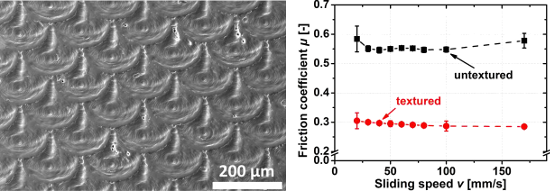
- a decrease in apparent contact area when roughness increased. We did not observe this effect in our data, but it should be noted that we did not systematically change the roughness of one contacting material. The Young’s modulus of the ceramic and the steel making up the contact tested here is
- larger than the Young’s modulus of the epoxy resin and the glass ball that were paired by Baum et al. [22]. This could be another factor explaining this apparent difference. For the lubricated contact, the frictional behaviour is similar compared to what was discussed above for the steel-on-steel contact
- additionally be explained by the minimal influence of (micro) hydrodynamic effects at low sliding speeds. Together with the high hardness and Young’s modulus of Al2O3 and 100Cr6, this probably results in a small true contact area and therefore large effective contact pressures. These effects manifest


Nanocellulose: Recent advances and its prospects in environmental remediation
Beilstein J. Nanotechnol. 2018, 9, 2479–2498, doi:10.3762/bjnano.9.232

- advantage over conventional cellulose fibres due to its higher surface area, aspect ratio, and Young’s modulus [87]. The versatility of cellulose-based materials has opened up doors for its use in a wide range of applications. In this section, an overview on the recent advanced applications of cellulose


Evidence of friction reduction in laterally graded materials
Beilstein J. Nanotechnol. 2018, 9, 2443–2456, doi:10.3762/bjnano.9.229
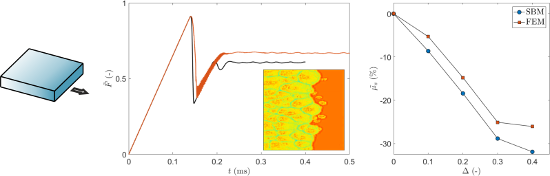
- frictional and adhesive behaviour can also be achieved by exploiting a grading of the material properties. In this paper, we investigate this possibility by considering the frictional sliding of elastic surfaces in the presence of a spatial variation of the Young’s modulus and the local friction coefficients
- of the indentation of materials with an exponential or power law variation of the Young’s modulus through the depth [20][21]. Giannakopoulos and Pallot then extended the analysis to 2D [22]. Graded substrates have also been considered in elastohydrodynamic lubrication problems [23]. More recently
- exponential or a power law variation of the Young’s modulus, i.e., E(z) = E1eαz or E(z) = E2zβ, respectively, where z is the depth coordinate and E1, E2, α and β are constants. The first extension to a lateral elastic gradient, to the best of our knowledge, was by Dag et al. who studied the problem both


![[Graphic 5]](/bjnano/content/inline/2190-4286-9-229-i10.svg?max-width=637&scale=1.18182) as function of time for the non-graded material: SBM solution for dif...
as function of time for the non-graded material: SBM solution for dif...


Adhesive contact of rough brushes
Beilstein J. Nanotechnol. 2018, 9, 2405–2412, doi:10.3762/bjnano.9.225
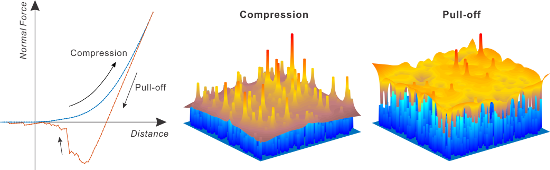
- elastic modulus, E is Young’s modulus, ν is Poisson’s ratio, γ is the work of separation (work of adhesion) per unit area, and is an effective radius of the square, defined so that the area of a cylinder with the radius a0 is equal to the area of the square. Note that the maximum adhesive force for a flat


Electrostatically actuated encased cantilevers
Beilstein J. Nanotechnol. 2018, 9, 1381–1389, doi:10.3762/bjnano.9.130
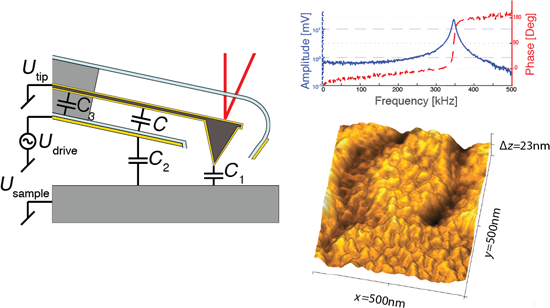
- E = 169 GPa is the Young’s modulus in the <110> direction of silicon [31] and ρ = 2330 kg·m−3 is the density of silicon. In our geometry, the tip significantly contributes to the total mass of the resonator. Therefore, a tip-mass-corrected frequency fcorr is applied [32]. We solve for length with




Tuning adhesion forces between functionalized gold colloidal nanoparticles and silicon AFM tips: role of ligands and capillary forces
Beilstein J. Nanotechnol. 2018, 9, 660–670, doi:10.3762/bjnano.9.61
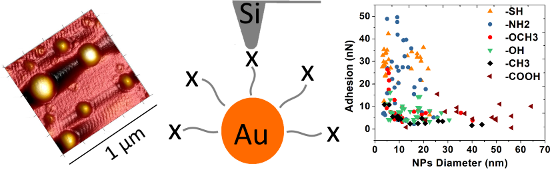
- between tip and sample surface, Young’s modulus (according to either DMT or Sneddon model), deformation and energy dissipation along with the surface topography (Supporting Information File 1). Etched silicon probes RTESPA-300 with a nominal spring constant k ≈ 40 N/m for QNM were provided by Bruker. All


Single-step process to improve the mechanical properties of carbon nanotube yarn
Beilstein J. Nanotechnol. 2018, 9, 545–554, doi:10.3762/bjnano.9.52
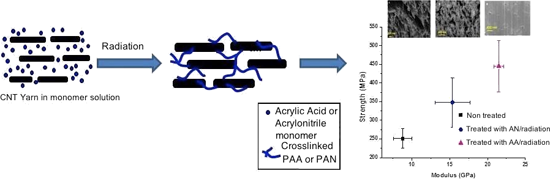
- electrical properties (Young’s modulus of 1 TPa, tensile strength above 100 GPa), carbon nanotubes (CNTs) are promising materials for various advanced technologies, including CNT-reinforced polymer composites [1][2]. Although many investigations have been carried out with these materials, it still remains a




Review: Electrostatically actuated nanobeam-based nanoelectromechanical switches – materials solutions and operational conditions
Beilstein J. Nanotechnol. 2018, 9, 271–300, doi:10.3762/bjnano.9.29
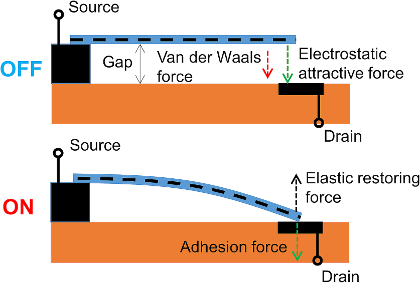
- approximately 104 switching cycles operating at 1 V drain voltage in a 3T configuration with 100 nm gap between the beam and the drain electrode [19]. Choice of material for the NEM switching element The material properties (Young’s modulus, free surface energy, electrical conductivity, melting temperature
- size depends on elastic properties: (1) increase in the Young’s modulus of metallic nanowires relative to the bulk value of the metal, as their diameters are reduced (e.g., Ag and Pd [107][108][109] nanowires); (2) decrease of Young’s modulus with decreasing size, for example, for Cr nanocantilevers
- [110]; (3) Young’s modulus shows almost no dependence on the diameter of metal nanowires, for example, for Au [111]. The change of the Young’s modulus can be explained by an increased influence of the surface atoms on the overall elastic behaviour of the nanostructure at sizes below a few nanometres


Liquid-crystalline nanoarchitectures for tissue engineering
Beilstein J. Nanotechnol. 2018, 9, 205–215, doi:10.3762/bjnano.9.22
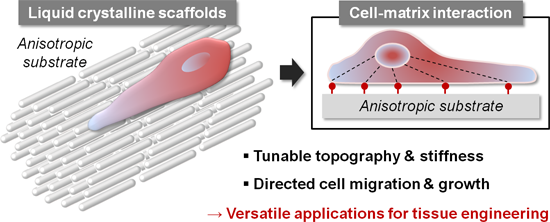
- exhibited a high stiffness (570 kPa of Young’s modulus). Optical transparency of the dense collagen film in the visible spectral range could be maintained after formation of an epithelium of human corneal epithelial cells in vitro [87]. The cornea-like 3D plywood cholesteric organization of the collagen


A robust AFM-based method for locally measuring the elasticity of samples
Beilstein J. Nanotechnol. 2018, 9, 1–10, doi:10.3762/bjnano.9.1
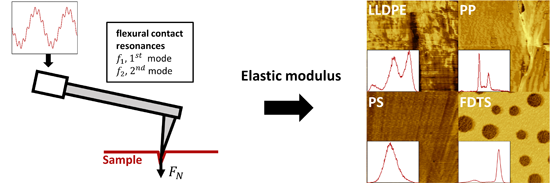
- elastic modulus from Δf22/Δf1. The method was used to give an estimate of the Young’s modulus of the FDTS thin film. Keywords: atomic force microscopy; contact resonances; elastic modulus; 1H,1H,2H,2H-perfluorodecyltrichlorosilane (FDTS); polymers; Young’s modulus; Introduction Knowledge of the local
- ]. In physics, the band gap size of nanocrystals and the presence of planar defects on nanotubes are a function of the Young’s modulus [2][3]. Probing local elasticity requires an instrumentation capable of operating with high resolution and under different conditions, such as variable temperature
- , pressure or humidity. Since its invention, the atomic force microscope (AFM) [4] has confirmed its value for locally determining nanomechanical properties, such as the Young’s modulus, of the sample surface. Initially, the measures were done qualitatively, with the cantilever operated in intermittent



Dry adhesives from carbon nanofibers grown in an open ethanol flame
Beilstein J. Nanotechnol. 2017, 8, 2719–2728, doi:10.3762/bjnano.8.271
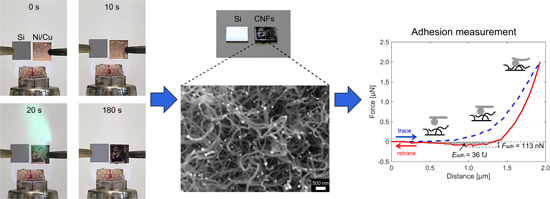
- ]. Additionally, they are not applicable under conditions of high radiation like in outer space. Carbon nanotubes, however, benefit from excellent thermal stability up to 750 °C in air and 2800 °C in vacuum [29], alongside a high mechanical strength with a Young’s modulus of 0.8 TPa and a tensile strength of 150


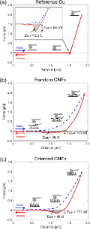
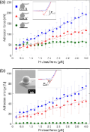
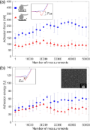
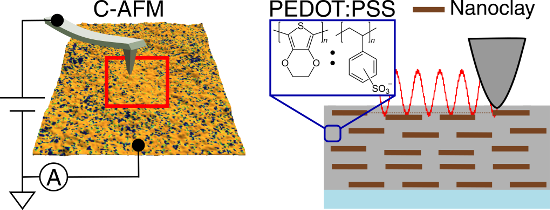
High-stress study of bioinspired multifunctional PEDOT:PSS/nanoclay nanocomposites using AFM, SEM and numerical simulation
Beilstein J. Nanotechnol. 2017, 8, 2069–2082, doi:10.3762/bjnano.8.207
- -resonance frequency and quality factor are often referred to as mechanical parameters. Although, there are methods to approximately calibrate for the Young’s modulus, they require a standard reference sample with similar properties to the unknown sample, and this includes the surface properties [51
- ]. Despite the extensive use of PEDOT:PSS, only few mechanical property investigations have been performed [40], which have mostly dealt with microscale film thicknesses [55][56]. Films with nanoscale thickness have shown lower Young’s modulus, E, compared to thicker reported values [40]. The decrease in E
- and for particles with random orientation, among others. Since the calculation of the Young’s modulus with AFM methods is not reliable (as also discussed above) [51], the strain is measured instead and related to the peak imaging forces. The increased force obtained from bimodal AFM for increasing


Nanotribological behavior of deep cryogenically treated martensitic stainless steel
Beilstein J. Nanotechnol. 2017, 8, 1760–1768, doi:10.3762/bjnano.8.177
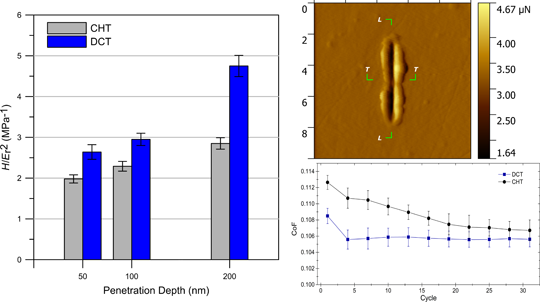
- relative elastic modulus, defined as Es and νs are Young’s modulus and Poisson’s ratio of the sample, and Ei and νi are Young’s modulus and Poisson’s ratio of the indenter (Ei = 1140 GPa, νi = 0.07). This approach does not allow for the simultaneous determination of E and H, but several researchers [33][34


Miniemulsion copolymerization of (meth)acrylates in the presence of functionalized multiwalled carbon nanotubes for reinforced coating applications
Beilstein J. Nanotechnol. 2017, 8, 1328–1337, doi:10.3762/bjnano.8.134
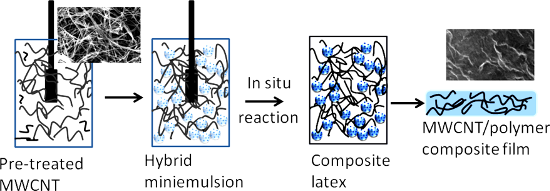
- of the films was performed at 25 ºC and at 60 ºC (Figure 5). At 25 ºC, the addition of MWCNTs led to a substantial reinforcement of the polymer with significant differences between blends and in situ composites. Whereas the blends showed a high Young’s modulus followed by a softening after the yield
- point, the in situ components presented a lower Young’s modulus with a gradual transition from elastic to plastic behavior. In addition, they had a much higher stress at break. The differences between blends and in situ composites were more acute in the tensile tests carried out at 60 ºC, where the in


Preparation of thick silica coatings on carbon fibers with fine-structured silica nanotubes induced by a self-assembly process
Beilstein J. Nanotechnol. 2017, 8, 1145–1155, doi:10.3762/bjnano.8.116
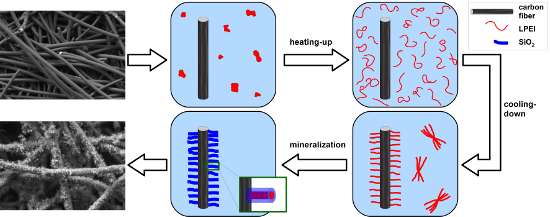
- ; Introduction Carbon fibers are widely used as reinforcement in ceramic, metal matrix and carbon composites because of their outstanding properties, such as high specific strength, a high Young’s modulus, low expansion coefficient and relative flexibility [1]. For the application in adsorption processes, carbon





