


Search results
Search for "anisotropic" in Full Text gives 246 result(s) in Beilstein Journal of Nanotechnology. Showing first 200.
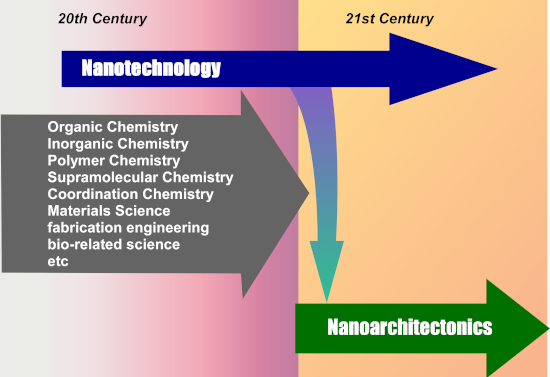
Molecular nanoarchitectonics: unification of nanotechnology and molecular/materials science
Beilstein J. Nanotechnol. 2023, 14, 434–453, doi:10.3762/bjnano.14.35
- and Gong discuss the organization of gels [103]. Specifically, they outline a unique anisotropic hydrogel consisting of uniaxially aligned lamellar bilayers in an amorphous gel matrix. This gel organization exhibits a beautiful structural color that is sensitive to mechanical and chemical stimuli. The





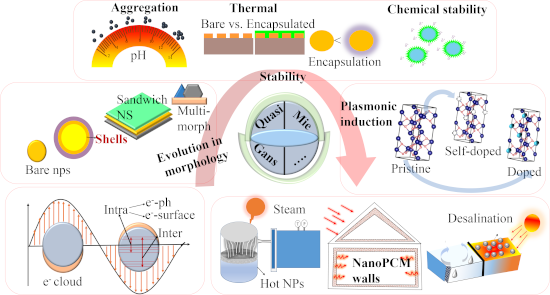
Plasmonic nanotechnology for photothermal applications – an evaluation
Beilstein J. Nanotechnol. 2023, 14, 380–419, doi:10.3762/bjnano.14.33




New trends in nanobiotechnology
Beilstein J. Nanotechnol. 2023, 14, 377–379, doi:10.3762/bjnano.14.32

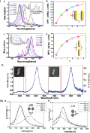
- thematic issue covered topics related to new concepts and ideas pertaining to the design and development of nanobiotechnology. These works include “The role of deep eutectic solvents and carrageenan in synthesizing biocompatible anisotropic metal nanoparticles” [4]. This review sheds light onto significant
- reduction methods which use surfactants, and explores the in vitro and in vivo cytotoxicity of the synthesized anisotropic nanoparticles. A portion of the work looks into the possible integration of nanotechnology in deep eutectic solvent extractions and also the use of carrageenan as a safe stabilizing
Bismuth-based nanostructured photocatalysts for the remediation of antibiotics and organic dyes
Beilstein J. Nanotechnol. 2023, 14, 291–321, doi:10.3762/bjnano.14.26
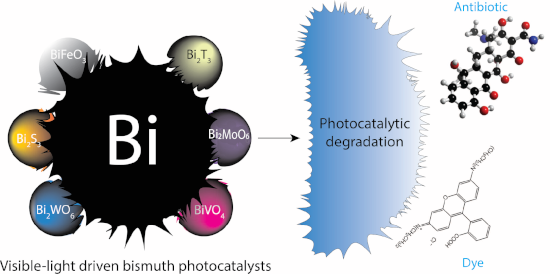
- [71], and environmental remediation via photocatalysis [25]. Bi-based semiconductors, in particular, are thought to be able to surpass the limitation of the solar light-harvesting capacity of TiO2-based photocatalytic materials because of their smaller bandgaps. Because of its highly anisotropic Fermi
- important for electronic transport and semimetal-to-semiconductor transition, as well as its highly anisotropic Fermi surface (with an electron and hole Fermi energies of 27.2 and 10.8 meV, respectively), which results in an extremely low carrier density of around 3 × 1017 cm−3 [78] and very little overlap


The influence of structure and local structural defects on the magnetic properties of cobalt nanofilms
Beilstein J. Nanotechnol. 2023, 14, 23–33, doi:10.3762/bjnano.14.3
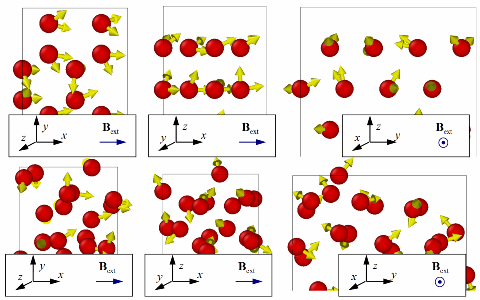
- . As noted in [40], the function J is a symmetric radial function. Due to its symmetrical representation, only isotropic phenomena and processes in materials can be described using the J function. At the same time, anisotropic effects are of great interest, since they often affect the most prospective


Density of states in the presence of spin-dependent scattering in SF bilayers: a numerical and analytical approach
Beilstein J. Nanotechnol. 2022, 13, 1418–1431, doi:10.3762/bjnano.13.117
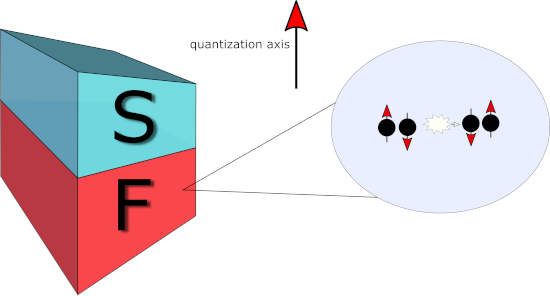
- rotational symmetry around the axis, that is, τx = τy. We consider the possibility of anisotropic magnetic scattering times. These can occur in ferromagnetic superconductors where magnetic disorder can be characterized by two scattering times τx = τy and τz [82]. The Usadel equations employed in this work
- case of a ferromagnetic ordering in which disorder is anisotropic (one axis is special), the spin-flip rates in the directions along the ferromagnetic axis and perpendicular to it may be different. In this case, as we mentioned earlier, two scattering times would be necessary. In the S layer, the


Nonlinear features of the superconductor–ferromagnet–superconductor φ0 Josephson junction in the ferromagnetic resonance region
Beilstein J. Nanotechnol. 2022, 13, 1155–1166, doi:10.3762/bjnano.13.97
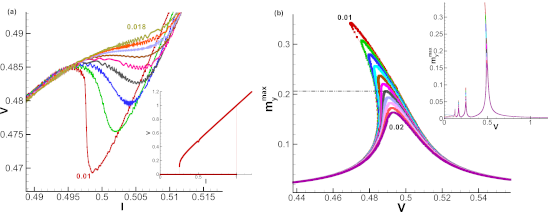
- –orbit interaction, K is the anisotropic constant, and is the volume of the F layer. The effective field for LLG equation is determined by where ΩF = γK/M0 is the frequency of the ferromagnetic resonance and determines the ratio between Josephson energy and magnetic energy. In order to describe the


![[Graphic 14]](/bjnano/content/inline/2190-4286-13-97-i38.svg?max-width=637&scale=1.18182) at differ...
at differ...


![[Graphic 18]](/bjnano/content/inline/2190-4286-13-97-i42.svg?max-width=637&scale=1.18182) (V) on α in the damping parameter interval [0.001–0.12]....
(V) on α in the damping parameter interval [0.001–0.12]....

Interaction between honeybee mandibles and propolis
Beilstein J. Nanotechnol. 2022, 13, 958–974, doi:10.3762/bjnano.13.84
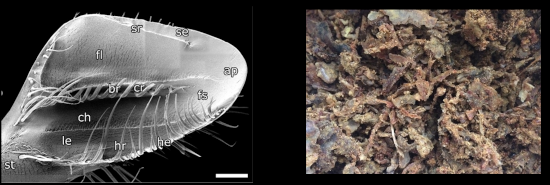
- the same height as the bristles and hairs. The outside of the mandible is covered with hairs evenly. Surface structures on bee mandibles SEM micrographs also revealed that bee mandibles are covered with anisotropic scale-like micropatterns (Figure 4). Most of the scales on the medial surface of the
- . Stiff bristles spike the centre ridge. These hairs could play a role in cleaning as they could help to brush off contamination. Surface structures on bee mandibles Microstructures were found on the medial surface of honeybee mandibles. These anisotropic structures looked like scales and their
- morphology of the mandibles, as all examined mandibles had this characteristic. Anisotropic structures are also present on other animals such as snakes and were proposed to support anisotropic properties, for example, anisotropic friction [34]. The scales on bee mandibles are mostly oriented towards the apex


Bioselectivity of silk protein-based materials and their bio-inspired applications
Beilstein J. Nanotechnol. 2022, 13, 902–921, doi:10.3762/bjnano.13.81
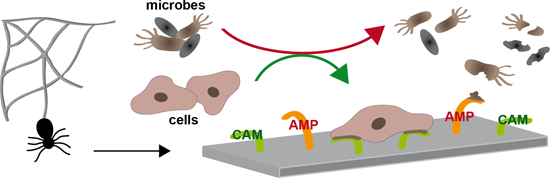
- blocks of (GAGAGS)n, which are responsible for the anisotropic β-sheet-rich nanocrystals [108]. Sericins are based on glue-like serine-rich glycoproteins with rubber-elastic properties [110]. In addition, a further small protein group named seroins was discovered in lepidopteran silk and is known to


Efficient liquid exfoliation of KP15 nanowires aided by Hansen's empirical theory
Beilstein J. Nanotechnol. 2022, 13, 788–795, doi:10.3762/bjnano.13.69
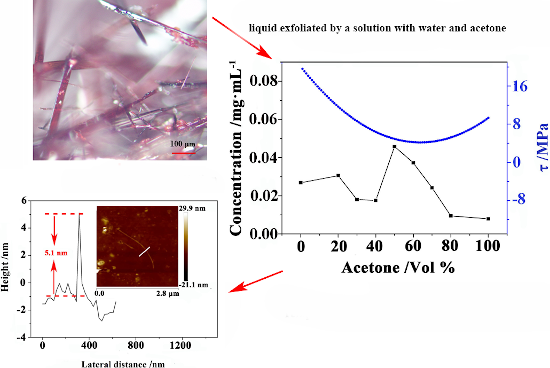
- mobility (1000 cm2·V−1·s−1), and highly anisotropic properties [11]. The photodetectors prepared with KP15 have a fast response time and are ideal materials for photovoltaic applications [12]. Based on our previous studies, KP15 is also a one-dimensional material with a defect-free surface [13][14]. This


Recent advances in nanoarchitectures of monocrystalline coordination polymers through confined assembly
Beilstein J. Nanotechnol. 2022, 13, 763–777, doi:10.3762/bjnano.13.67
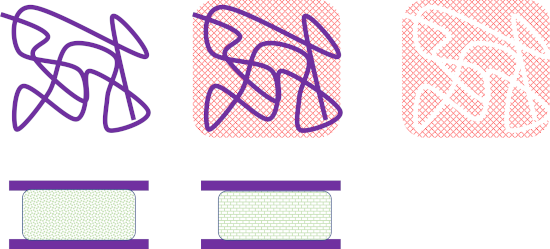
- /reflection of photons [57][58]. Assembly of nanometer-sized monocrystalline materials with anisotropic shapes is of particular importance because the interactions between the crystals can be stronger than among quasi isotropic crystals [59][60][61][62]. However, spontaneous assemblies of anisotropic crystals
- realized, showing an anisotropic alignment of fluorescent guest molecules and directional fluorescence [122]. To match with the lattice structure, the grown coordination polymer sometimes may rotate to find the best lattice match with the substrate [123]. In most cases, the lattices of the substrate and
- particles were squeezed by ice in a 2D space, forming nanosheets. 2D monocrystalline coordination polymers are anisotropic and, thus, very suitable to enhance inter-crystal interaction by forming laminar stacking superstructures. This concept was earlier demonstrated by applying a solution-based layer-by




Effects of substrate stiffness on the viscoelasticity and migration of prostate cancer cells examined by atomic force microscopy
Beilstein J. Nanotechnol. 2022, 13, 560–569, doi:10.3762/bjnano.13.47
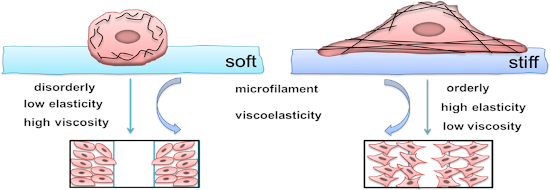
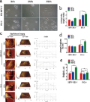
- different stiffness. FibrilTool, an ImageJ plug-in, was used to quantify the fibrillar structure in the original cytoskeleton images. Anisotropy (score between 0 and 1): 0 for no order (purely isotropic arrays) and 1 for perfectly ordered arrays (i.e., parallel fibrils, purely anisotropic arrays); “ns



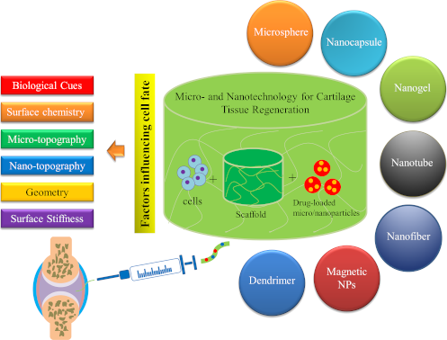
Micro- and nanotechnology in biomedical engineering for cartilage tissue regeneration in osteoarthritis
Beilstein J. Nanotechnol. 2022, 13, 363–389, doi:10.3762/bjnano.13.31
- hierarchical structure of articular cartilage from its surface to the subchondral bone shows a depth-dependent transition and anisotropic integrity composed of four distinct zones; namely, superficial, middle, deep, and calcified cartilage [11][12] (Figure 2). The arrangement, composition, and content of the


Controllable two- and three-state magnetization switching in single-layer epitaxial Pd1−xFex films and an epitaxial Pd0.92Fe0.08/Ag/Pd0.96Fe0.04 heterostructure
Beilstein J. Nanotechnol. 2022, 13, 334–343, doi:10.3762/bjnano.13.28
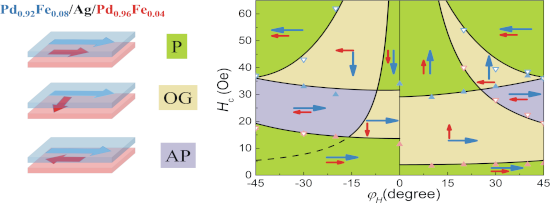
- . Its magnetic configuration diagram has been constructed and the conditions have been determined for a controllable switching between stable parallel, orthogonal, and antiparallel arrangements of magnetic moments of the layers. Keywords: anisotropic magnetoresistance; magnetization reversal; Pd–Fe
- Pd0.92Fe0.08 film at different in-plane orientations of the magnetic field was studied by measuring the anisotropic magnetoresistance (AMR) using the four-probe method. For this purpose, the Pd0.92Fe0.08 film was cut with a diamond saw into stripe-like pieces. In the first sample the current flowed along the
- [25]. The difference in resistances ρx and ρz (magnetic field perpendicular to the current) is usually associated with the geometrical size effect [26]. A detailed study of the size effect for the Pd0.92Fe0.08 film is beyond the scope of this study. In addition to the anisotropic magnetoresistance


Theoretical understanding of electronic and mechanical properties of 1T′ transition metal dichalcogenide crystals
Beilstein J. Nanotechnol. 2022, 13, 160–171, doi:10.3762/bjnano.13.11
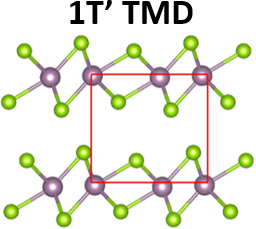
- 1T′ structural polytype are systematically investigated by means of first-principles density functional theory (DFT) calculations. Our results demonstrate that the anisotropic mechanical properties of 1T′ TMD materials are greatly affected by their anions. They also show different properties in
- Figure 4, all the TMDs are brittle. The diselenides are more brittle through the comparison. It is worth noting that all mechanical properties of TMDs are anisotropic. To provide a comprehensive understanding of the influence of the different structural polytypes, the 2D and 3D plots of Y and G of 1T
- more brittle. (2) The mechanical properties of 1T′ TMDs are anisotropic, which is more significantly affected by the TM–X covalent bonding strength within the xy-plane. (3) 1T′ TMDs are softer and less rigid than their 2H counterparts. (4) The weak interlayer vdW interactions can lead to the different



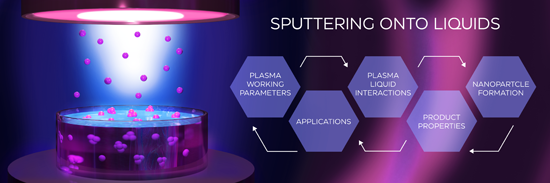
Sputtering onto liquids: a critical review
Beilstein J. Nanotechnol. 2022, 13, 10–53, doi:10.3762/bjnano.13.2






Polarity in cuticular ridge development and insect attachment on leaf surfaces of Schismatoglottis calyptrata (Araceae)
Beilstein J. Nanotechnol. 2021, 12, 1326–1338, doi:10.3762/bjnano.12.98
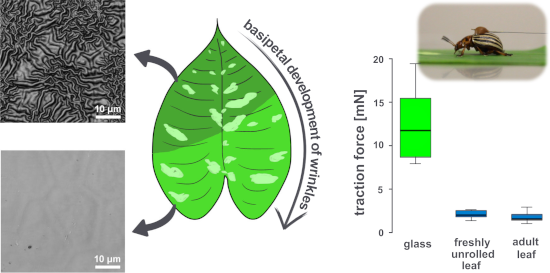
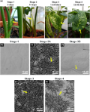
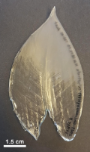
- rolled) during growth and their interaction with the external environment. Mechanically, when the strain in the cuticle (induced by the simultaneous isotropic production of the cuticle and anisotropic expansion of the underlying cells) increases beyond a critical strain value, ridges start to develop [37




A review on slip boundary conditions at the nanoscale: recent development and applications
Beilstein J. Nanotechnol. 2021, 12, 1237–1251, doi:10.3762/bjnano.12.91
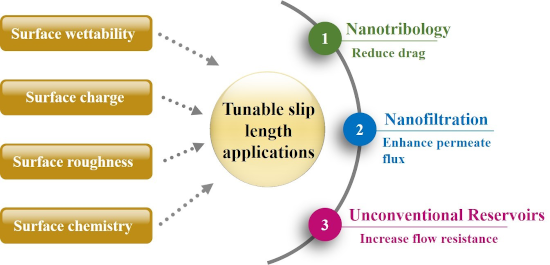
- and varies with the external driving force. In addition, depending on whether there is a true slip length, the amplitude of surface roughness has different influences on the effective slip length. The composition of surface textures, including isotropic and anisotropic textures, can also affect the
- review here include isotropic and anisotropic textures. In addition, we also summarize the influence of gas bubbles on the liquid slippage, which is a common phenomenon in most experimental or numerical investigations. 2.4.1 Isotropic textures. Investigating how effective slip lengths emerge from
- summarized in Table 1. 2.4.2 Anisotropic textures. It is of great interest and importance to study and design directional structures owing to many potential applications, such as functional superwettable materials [103], water harvesting [104], and smog removal [105]. The directional structures induce a


An overview of microneedle applications, materials, and fabrication methods
Beilstein J. Nanotechnol. 2021, 12, 1034–1046, doi:10.3762/bjnano.12.77
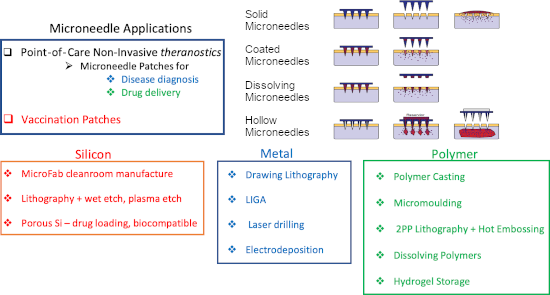
- etchants for either isotropic etch (the etch rate is the same in all directions) or anisotropic etch in which the etch rate differs for different crystal planes [74][85]. Anisotropic etching cannot form cylindrical microneedles, since the etch exposes selective crystal planes which produce instead faceted
- pyramid microprotrusions. In both isotropic and anisotropic cases, a hard mask layer of silicon nitride is first patterned using optical lithography. Isotropic etching uses a highly corrosive HNA solution containing hydrofluoric, nitric, and acetic acids. This produces undesirable undercutting of the etch
- mask which must be compensated for in the pattern design. Anisotropic etching uses either EDP (ethylenediamine pyrocatechol), hydrazine-based solutions or, most commonly, potassium hydroxide solution. Deep reactive ion etching of silicon is an increasingly common process, performed in a low-pressure


Revealing the formation mechanism and band gap tuning of Sb2S3 nanoparticles
Beilstein J. Nanotechnol. 2021, 12, 1021–1033, doi:10.3762/bjnano.12.76
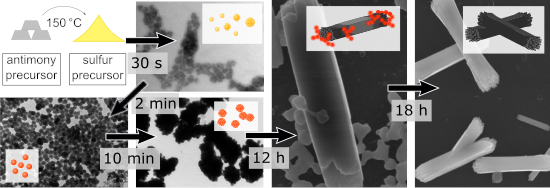
- anisotropically, i.e., preferentially in the longitudinal direction, as shown by the changing aspect ratio from ≈4–5 to ≈6 after 12 h and 16 h, respectively. This observation agrees with the findings of authors who had described a growth along the c-axis of Sb2S3 nanomaterial [26][27]. This anisotropic growth


The role of deep eutectic solvents and carrageenan in synthesizing biocompatible anisotropic metal nanoparticles
Beilstein J. Nanotechnol. 2021, 12, 924–938, doi:10.3762/bjnano.12.69
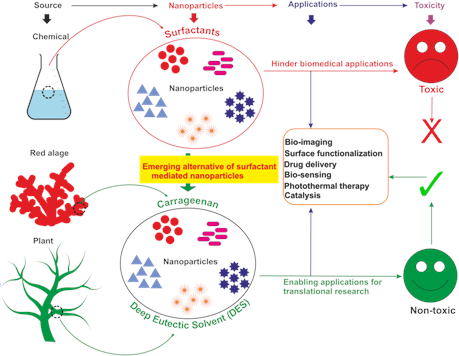
- ), Ghaziabad 201002, India 10.3762/bjnano.12.69 Abstract Plasmonic metal nanoparticles are widely used for many applications due to their unique optical and chemical properties. Over the past decade, anisotropic metal nanoparticles have been explored for imaging, sensing, and diagnostic applications. The
- utilizing safe nanomaterials for advanced biomedical and clinical applications. Keywords: anisotropic nanoparticles; carrageenan; cytotoxicity; eutectic solvents; surfactants; Review Introduction Plasmonic metals such as gold and silver, upon achieving nanoscale dimensions, exhibit unusual physicochemical
- and smartphone-based sensing applications [3][4][5]. Several other advanced sensing applications have emerged, such as battery-free and wireless devices, providing on-site results [6][7]. NIR absorption is exclusively exhibited by plasmonic anisotropic nanoparticles, enabling diagnostic imaging within


Electromigration-induced formation of percolating adsorbate islands during condensation from the gaseous phase: a computational study
Beilstein J. Nanotechnol. 2021, 12, 694–703, doi:10.3762/bjnano.12.55
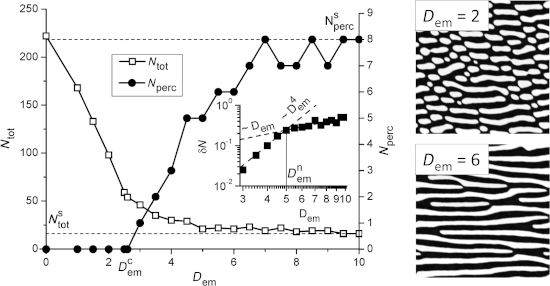
- . The electron wind force, which arises during the transmission of the momentum by the conduction electrons, pushes the ions in the direction of the electron flow. As a result, the diffusion processes in the material become anisotropic and directed. This results in the exchange of atoms and the
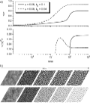
- elongated in the direction of the applied electrical field. In order to construct the isotropic model of the adsorptive gas–condensate system we will proceed in a manner similar to our previous works [50][59][62][63][64]. The novelty of the present work lies in the introduction of the anisotropic surface




![[Graphic 29]](/bjnano/content/inline/2190-4286-12-55-i36.svg?max-width=637&scale=1.18182) on the adsorption coefficient α ...
on the adsorption coefficient α ...

Interface interaction of transition metal phthalocyanines with strontium titanate (100)
Beilstein J. Nanotechnol. 2021, 12, 485–496, doi:10.3762/bjnano.12.39
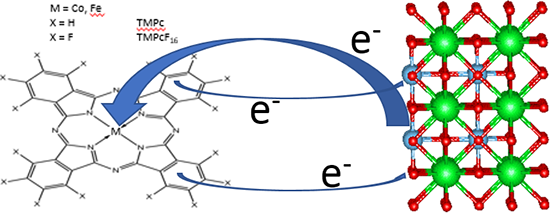
- metal atom at a reactive substrate site is different and the probability is higher in the case of CoPc. A clear template effect of anisotropic substrates is also observed for related strong interacting interfaces [68]. Alternatively, one might speculate that the Co ion of CoPc is able to interact also


Rapid controlled synthesis of gold–platinum nanorods with excellent photothermal properties under 808 nm excitation
Beilstein J. Nanotechnol. 2021, 12, 462–472, doi:10.3762/bjnano.12.37
- , especially those with anisotropic structure, such as AuNRs, Au nanocages [5][6], Au nanostars [7][8], Au nanospheres [9][10], and Au nanoshells [11][12], show great potential as PTAs. Particularly, AuNRs, with a high inherent absorption–scattering ratio, simple and controllable synthesis, and high PCE [13
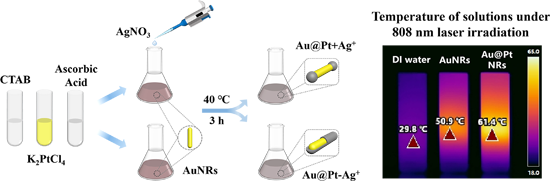
- peak at around 778 nm, as shown in Figure 1d and Table 1. Effect of Ag+ on the preparation of Au@Pt NRs In this section, we first discuss the anisotropic growth of Pt-coated AuNRs with or without Ag+ in the reaction solution. Then, we investigate the effect of the Ag+ concentration on the morphology
- AuNRs, as shown in Figure 1c. This deposition pattern resulted in an anisotropic growth of the products (Au@Pt+Ag+), increasing the length to 29.2 ± 2.8 nm. The width at the middle of 6.8 ± 0.6 nm did not increase significantly. However, the width of the tips increased to 10.6 ± 1.5 nm. This is


A review on nanostructured silver as a basic ingredient in medicine: physicochemical parameters and characterization
Beilstein J. Nanotechnol. 2021, 12, 440–461, doi:10.3762/bjnano.12.36
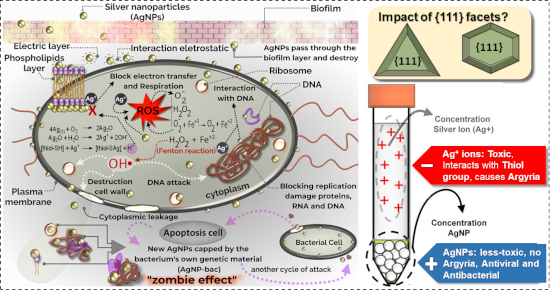
- dispersion) as the incident light and does not depend on the angle (Rayleigh scattering). However, when the particle size is greater than 63 nm, then the Rayleigh dispersion is no longer valid and it is replaced by the Mie anisotropic dispersion theory, in which the scattered light energy is different from





