Search results
Search for "interaction force" in Full Text gives 68 result(s) in Beilstein Journal of Nanotechnology.
Exploring the complex mechanical properties of xanthan scaffolds by AFM-based force spectroscopy
Beilstein J. Nanotechnol. 2014, 5, 365–373, doi:10.3762/bjnano.5.42
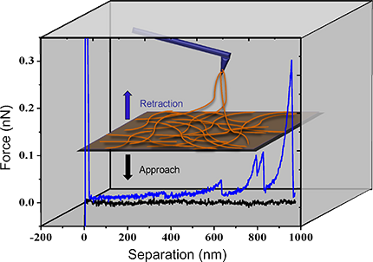
- three different structures show a similar trend, although the rupture length distributions are distinctive for each measurment. The rupture forces (Figure 3C) range from 50 to 400 pN, indicating the value of the nonspecific interaction force between the AFM tip and a single xanthan fibril. However, the
- a large peak indicating a single fibril was pulled away from mica substrate. Type 2 is characterized by a tiny peak corresponding to the separation of two overlapping fibrils. The rupture force of around 33 pN is the interaction force between two fibrils. Type 3 is characterized by two continuous


Manipulation of nanoparticles of different shapes inside a scanning electron microscope
Beilstein J. Nanotechnol. 2014, 5, 133–140, doi:10.3762/bjnano.5.13
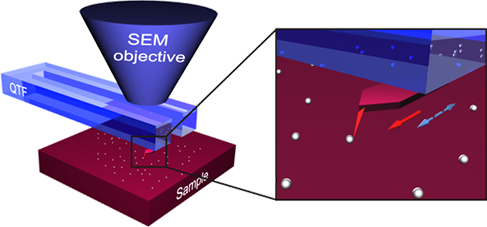
- their trajectory, in order to distinguish between continuous and abrupt motions (jumps), and to correlate the movement of the NPs with the measured tip–NP interaction force. The first series of measurements was carried out with 19 Au NPs. Figure 5 represents a typical manipulation experiment with Au NPs
- jump of a few hundred nanonewtons, and in doing so released the potential energy accumulated during loading. From (c) to (e) the particle moved smoothly in the direction that is indicated by the arrows while only a small tip–particle interaction force was exerted. The static friction in the series was
- jumping motions and correlating them with the interaction force between tip and NPs. The contact areas were calculated from geometrical considerations for polyhedron-like NPs. For sphere-like NPs the contact areas were calculated by using DMT-M and frozen droplet models. The recorded static friction force


Peak forces and lateral resolution in amplitude modulation force microscopy in liquid
Beilstein J. Nanotechnol. 2013, 4, 852–859, doi:10.3762/bjnano.4.96
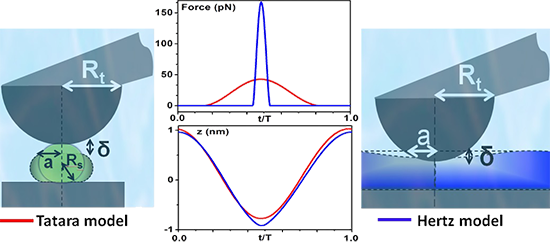
- ]. In AM-AFM, a sharp tip is attached at the end of a microcantilever that oscillates at or near its resonant frequency. When the tip is in close proximity to the sample, the amplitude and the phase shift of the oscillation change with the strength of the interaction force. The determination of the tip
- –sample interaction force is a major issue in dynamic AFM because the force gives access to the materials properties of the sample; nonetheless the force is not a direct observable. Therefore, several methods have been proposed to reconstruct the force in dynamic AFM [12][13][14][15][16][17][18]. However
- [19][20][21][22][23]. An analytical scaling law has been deduced to calculate the peak forces in air [21]. This method has been applied to determine the force on viral capsids in liquid [24]. However, the above expressions are often constrained to a specific interaction force model, such as Hertzian


Multiple regimes of operation in bimodal AFM: understanding the energy of cantilever eigenmodes
Beilstein J. Nanotechnol. 2013, 4, 385–393, doi:10.3762/bjnano.4.45
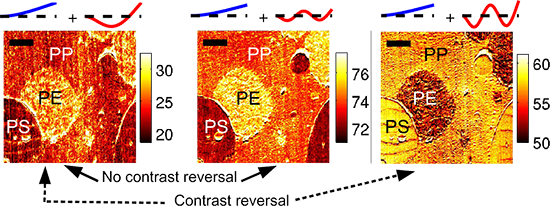
- , and a tip–sample interaction force where E, I, ρc, A, w, x, t, Fhydro, Fts, Fdrive and δ are the cantilever Young’s modulus, area moment of inertia, density, cross-sectional area, deflection, axial coordinate, time, hydrodynamic force, tip–sample interaction force, driving (excitation force), and
- second excitation. In this work, we take Ω1 = ω1 and Ω2 = ω2 to simulate bimodal driving of the 1st and 2nd eigenmodes. The tip–sample interaction force Fts(d) is described by a modified DMT model that includes a term for surface energy hysteresis. In other words, the force when the tip is approaching


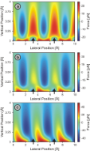
![[Graphic 3]](/bjnano/content/inline/2190-4286-4-45-i5.png?max-width=637&scale=1.18182) . In the top row (a, b) the first eigen...
. In the top row (a, b) the first eigen...


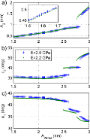

Bimodal atomic force microscopy driving the higher eigenmode in frequency-modulation mode: Implementation, advantages, disadvantages and comparison to the open-loop case
Beilstein J. Nanotechnol. 2013, 4, 198–207, doi:10.3762/bjnano.4.20
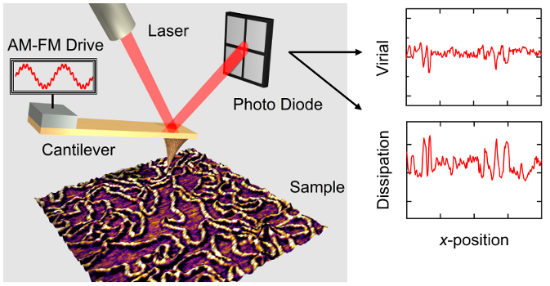
- the dimensionless time, k is the cantilever force constant (stiffness) and Fts is the tip–sample interaction force. We have also used the approximation A ≈ A0 = F0Q/k [22], where F0 is the amplitude of the inertial excitation force, and have grouped the damping and excitation terms together in
- spectroscopy without “jumps”, straightforward reconstruction of the tip–sample interaction force and the ability to operate with constant response amplitude, thus ensuring uniform sensitivity across the sample. Although generalized comparisons are not possible and it remains a challenge for the experimentalist


High-resolution dynamic atomic force microscopy in liquids with different feedback architectures
Beilstein J. Nanotechnol. 2013, 4, 153–163, doi:10.3762/bjnano.4.15
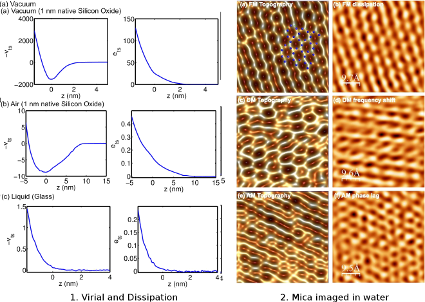
- -varying deflection x(t) of the probe tip in the presence of tip–sample forces given by where ω0, Q0 and k are the unperturbed natural frequency, quality factor and stiffness of the probe, respectively, and F is the excitation force [19]. Fts is the tip–sample interaction force, which depends explicitly on


Towards 4-dimensional atomic force spectroscopy using the spectral inversion method
Beilstein J. Nanotechnol. 2013, 4, 87–93, doi:10.3762/bjnano.4.10
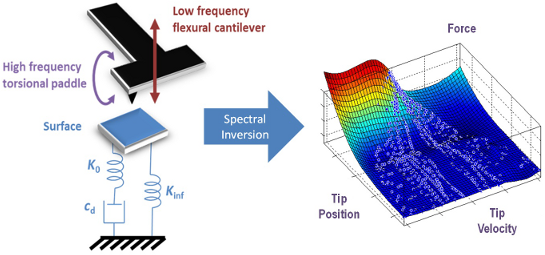
- force microscopy (AFM) is the measurement of probe–sample interaction force curves (force spectroscopy), generally based on contact and frequency-modulation methods [1][2][3][4][5][6]. The procedure is generally time-consuming because the acquisition of the force curve for each (x,y) location on the
- interaction force as a component of the driving force acting on the cantilever and was demonstrated with standard cantilevers, although the low signal-to-noise ratio of certain regions of the spectrum limited its accuracy. In 2007, Sahin and co-workers [8] introduced a T-shaped cantilever with an off-centered
- on it is the time-dependent tip–sample interaction, fd(t) = Fts[zc(t) + zp(t)], which generates a torsional response that can be linearized in the z-direction, zp(t). Here Fts is the tip–sample interaction force, which is a function of the distance between the tip and the sample (tip position). The


Characterization of the mechanical properties of qPlus sensors
Beilstein J. Nanotechnol. 2013, 4, 1–9, doi:10.3762/bjnano.4.1
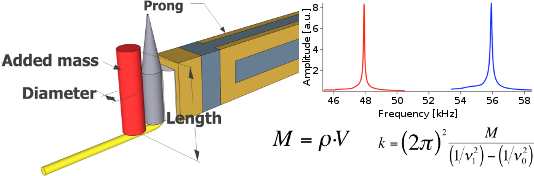
- affect experimental force measurements. The force can be expressed by using the Sader formula [35] as follows where Δν is the frequency shift, νr is the resonant frequency, k is the stiffness of the sensor, A is the amplitude of oscillation, F is the tip–surface interaction force, x is the tip–surface


Probing three-dimensional surface force fields with atomic resolution: Measurement strategies, limitations, and artifact reduction
Beilstein J. Nanotechnol. 2012, 3, 637–650, doi:10.3762/bjnano.3.73
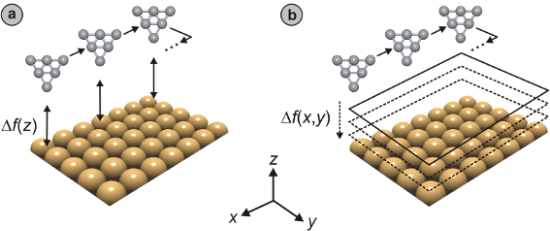
- , Germany Department of Chemical and Environmental Engineering, Yale University, New Haven, CT 06520, USA 10.3762/bjnano.3.73 Abstract Noncontact atomic force microscopy (NC-AFM) is being increasingly used to measure the interaction force between an atomically sharp probe tip and surfaces of interest, as a
- all images is cut out and forms the basis for the ∆f(x, y, z) array that is later converted to interaction-force and energy data (Fn(x, y, z) and E(x, y, z) arrays, respectively). With a sufficiently dense dataset consisting of images separated by only a few picometers in the z direction, gradual
- sample surface. This is because these deformations cause the tip apex to be at a different location than we assume it to be, which results in a distortion of the recorded force field. The extent of this distortion depends on the local strength of the tip–sample interaction force as well as on the lateral




Mapping mechanical properties of organic thin films by force-modulation microscopy in aqueous media
Beilstein J. Nanotechnol. 2012, 3, 464–474, doi:10.3762/bjnano.3.53
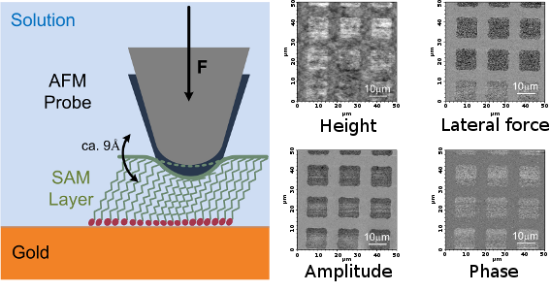
- determines the interaction force from which the contact stiffness can be calculated (Equation 2). The amplitude of the first harmonic is used to analyze the elasticity of the substrate surface in FMM and it is thus essential to relate the first harmonic with the contact stiffness experimentally. Meanwhile



Repulsive bimodal atomic force microscopy on polymers
Beilstein J. Nanotechnol. 2012, 3, 456–463, doi:10.3762/bjnano.3.52
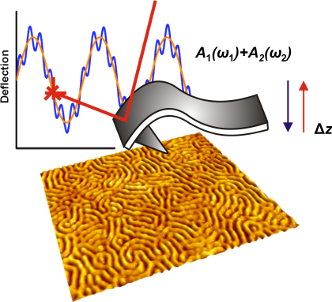
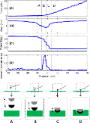
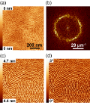
- establishing a method to separate attractive and repulsive contributions to the interaction force. To this end, it has to be proven whether such low setpoint ratios lead to stable imaging conditions. Bimodal APD curves may also give further insight into the various modes of energy dissipation because bimodal



Combining nanoscale manipulation with macroscale relocation of single quantum dots
Beilstein J. Nanotechnol. 2012, 3, 324–328, doi:10.3762/bjnano.3.36
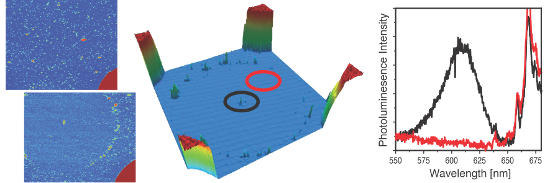
- performed a contact mode sweep in the area covered by the bitmap. The bitmap defined the areas in which the contact mode setpoint was high, i.e., an increased tip–sample interaction force is present. Figure 2b shows the regions of high contact force and the direction of travel of the AFM probe. Areas for
- around the QD is cleared leaving only two QDs in the centre of the cell. The final QD is removed by nudging the QD with the AFM tip in contact mode with a high tip–sample interaction force. The approximately parallel lines seen in each of the images are atomic step edges on the sapphire substrate. (a) A


Graphite, graphene on SiC, and graphene nanoribbons: Calculated images with a numerical FM-AFM
Beilstein J. Nanotechnol. 2012, 3, 301–311, doi:10.3762/bjnano.3.34
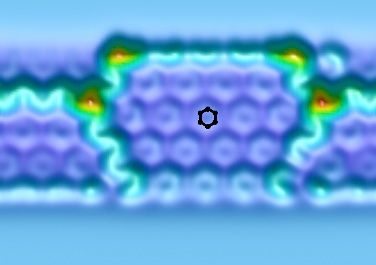
- surface in the frozen-atoms mode and at constant height, Hset = 4.3 Å, where H is the distance between the topmost surface plane and the terminating atom of the tip apex. At this distance, the tip oscillates in the attractive part of the tip–surface interaction force curve. This is the reason why the
- , and the corresponding image is shown in Figure 2b. Notice that the input parameters are the same as those previously used, but now the frequency shift is positive. Because the slope of the curve of the interaction force is much more abrupt in the repulsive part than in the attractive part, the maximum
- = −13 Hz, the result in the frozen-atoms mode is shown in Figure 2c. Here too, the tip explores the attractive range of the tip–surface interaction force with H around 4.58 Å and the tip experiences a minimal force of about −0.5 nN. One can see a contrast inversion compared to the previous cases in the


Simultaneous current, force and dissipation measurements on the Si(111) 7×7 surface with an optimized qPlus AFM/STM technique
Beilstein J. Nanotechnol. 2012, 3, 249–259, doi:10.3762/bjnano.3.28
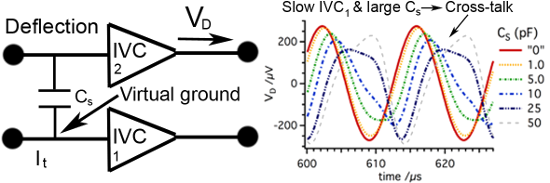
- tuning fork was shortened in order to reach higher sensitivity (charge produced by deflection) [35], which allows us to reach lower amplitudes. The interaction force between the tip and surface atoms was calculated from the measured frequency-shift data by means of the Sader formula [36]. The tunneling
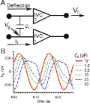
- -shift maps (z) and simultaneously recorded average-tunneling-current maps (
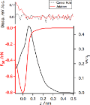
). The frequency-shift setpoints for topographic imaging are (A) −35 Hz, (B) −40 Hz and (C) −45 Hz. Two typically observed profiles of the dependence of the short-range interaction force (FSR) and the tunneling current (It
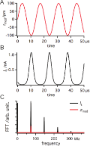

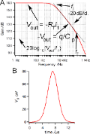

![[Graphic 7]](/bjnano/content/inline/2190-4286-3-28-i11.png?max-width=637&scale=1.18182) can...
can...


Modeling noncontact atomic force microscopy resolution on corrugated surfaces
Beilstein J. Nanotechnol. 2012, 3, 230–237, doi:10.3762/bjnano.3.26
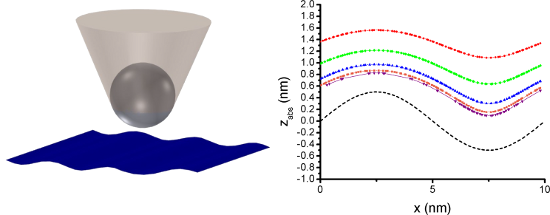
- shifts Once the tip–surface interaction potential Wt–s is obtained, the interaction force Ft–s is found straightforwardly by differentiation with respect to z. We then compute the frequency shift using the following expression [28], which is exact to 1st order in classical perturbation theory: with


Theoretical study of the frequency shift in bimodal FM-AFM by fractional calculus
Beilstein J. Nanotechnol. 2012, 3, 198–206, doi:10.3762/bjnano.3.22
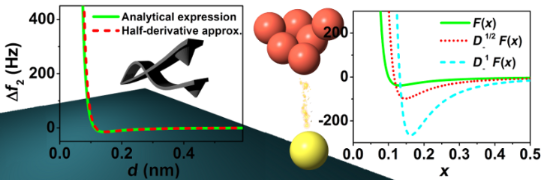
- method enables the simultaneous recording of several material properties and, at the same time, it also increases the sensitivity of the microscope. Here we apply fractional calculus to express the frequency shift of the second eigenmode in terms of the fractional derivative of the interaction force. We
- first mode. Here, we propose a theoretical approach to determine the frequency shift in bimodal FM-AFM in terms of a fractional differential operator of the tip–surface interaction force. The frequency shift of the second mode is related to a quantity that is intermediate between the interaction force
- and the force gradient. This quantity is defined mathematically as the half-derivative of the interaction force. This approach does not make any assumptions on the force law, and it explains the advantages of bimodal FM-AFM with respect to conventional FM-AFM whenever the amplitudes of the first mode


Effect of the tip state during qPlus noncontact atomic force microscopy of Si(100) at 5 K: Probing the probe
Beilstein J. Nanotechnol. 2012, 3, 25–32, doi:10.3762/bjnano.3.3
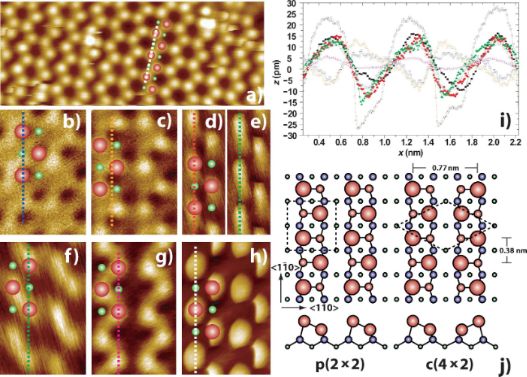
- forces between different scans, as this occurs at a reasonably well-defined tip–sample interaction force. Force spectroscopy In order to further elucidate the differences in interaction between different apices, we performed experiments to measure the frequency shift versus z (i.e., Δf(z)) with a number


Tip-sample interactions on graphite studied using the wavelet transform
Beilstein J. Nanotechnol. 2010, 1, 172–181, doi:10.3762/bjnano.1.21
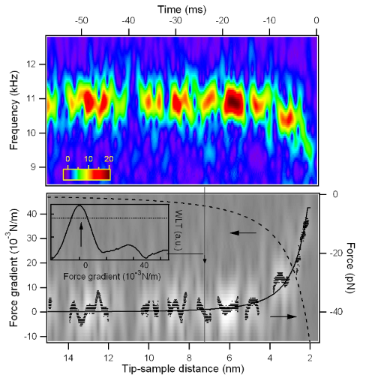
- distance) to the measured frequency shift of the first flexural mode as a function of the tip-surface separation (red circles). The dashed line is the interaction force obtained by integration. Comparison between the Fourier transform and the wavelet transform analysis. a) The time signal, a cosine