


Search results
Search for "silicon oxide" in Full Text gives 89 result(s) in Beilstein Journal of Nanotechnology.
Anodization-based process for the fabrication of all niobium nitride Josephson junction structures
Beilstein J. Nanotechnol. 2017, 8, 539–546, doi:10.3762/bjnano.8.58
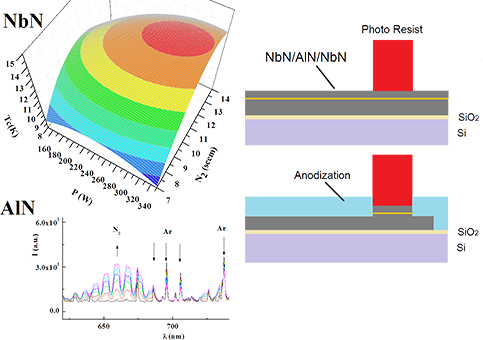
- the superconductive films grown over “cold” amorphous silicon oxide. Improvements of this recipe could substantially enhance the ease of fabrication and lead to noticeable progress in the scientific and technical usefulness of all-NbN tunneling devices. Conclusion A viable method to optically monitor


Methods for preparing polymer-decorated single exchange-biased magnetic nanoparticles for application in flexible polymer-based films
Beilstein J. Nanotechnol. 2017, 8, 408–417, doi:10.3762/bjnano.8.43
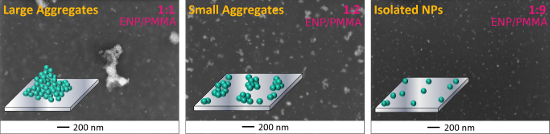
- applications. Phosphates and phosphonates are suitable for functionalizing iron and silicon oxide surfaces [29][30] through covalent bonds, in mono-, bi- or tridentate modes; but to date, they have not been used for cobalt oxide and ferrite surfaces. In the case of PMMA, we followed two routes: the first one


Colorimetric gas detection by the varying thickness of a thin film of ultrasmall PTSA-coated TiO2 nanoparticles on a Si substrate
Beilstein J. Nanotechnol. 2017, 8, 229–236, doi:10.3762/bjnano.8.25
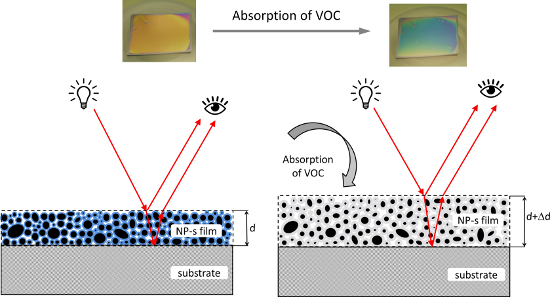
- films were examined in air under ambient conditions. The optical constants given here are those measured at 633 nm wavelength. Using ellipsometry, the refractive index of the film was modelled between 1.2–4.5 eV at a wavelength of 633 nm. The three-layer stack (silicon substrate/silicon oxide/TiO2 film


Influence of hydrofluoric acid treatment on electroless deposition of Au clusters
Beilstein J. Nanotechnol. 2017, 8, 183–189, doi:10.3762/bjnano.8.19
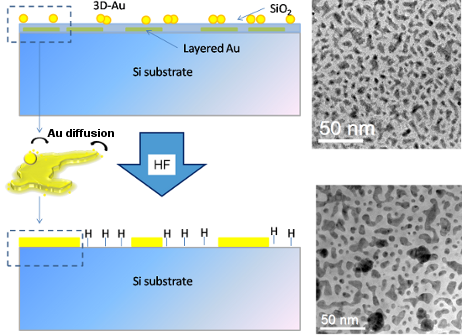
- that the HF dissolves the silicon oxide layer formed on top of the thin flat clusters and promotes the partial atomic rearrangement of the layered gold atoms, driven by a reduction of the surface energy. The X-ray diffraction investigation indicated changes in the crystalline orientation of the flat


Localized surface plasmons in structures with linear Au nanoantennas on a SiO2/Si surface
Beilstein J. Nanotechnol. 2016, 7, 1519–1526, doi:10.3762/bjnano.7.145
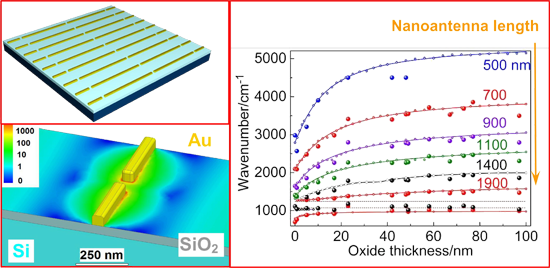
- fabricated on a 3 nm thick natural silicon oxide layer. This phenomenon is interpreted in terms of the coupling between the antenna's, plasmon resonance and surface phonon–polariton excitations [26]. Similar results were obtained for a thermal SiO2 layer having the thickness of 106 nm, for which the SO
- are presented in Figure 6. As one can see from the figure, the IR spectrum of the structure with the thickness of a natural silicon oxide layer of 0.8 nm reveals a pronounced minimum at 700 cm−1 corresponding to the LSPR mode. A weaker feature located between the TO (1075 cm−1) and LO (1250 cm−1


Effect of tetramethylammonium hydroxide/isopropyl alcohol wet etching on geometry and surface roughness of silicon nanowires fabricated by AFM lithography
Beilstein J. Nanotechnol. 2016, 7, 1461–1470, doi:10.3762/bjnano.7.138
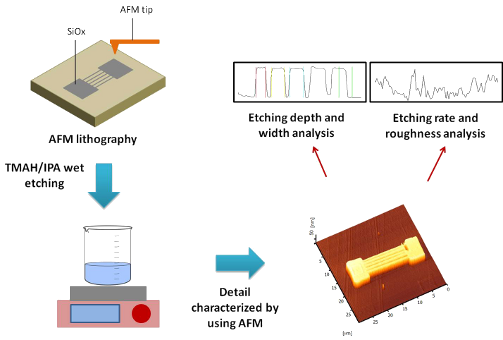
- out using FESEM and EDX. Pattern of silicon oxide nanowire with left and right square pads prior to etching. AFM images of silicon nanowire after wet etching using (a) 25 wt % TMAH (b) 25 wt % TMAH with 10 vol % IPA (c) 25 wt % TMAH with 20 vol % IPA (d) 25 wt% TMAH with 30 vol % IPA at 65 °C for 30 s




Polystyrene-block-poly(ethylene oxide) copolymers as templates for stacked, spherical large-mesopore silica coatings: dependence of silica pore size on the PS/PEO ratio
Beilstein J. Nanotechnol. 2016, 7, 1454–1460, doi:10.3762/bjnano.7.137
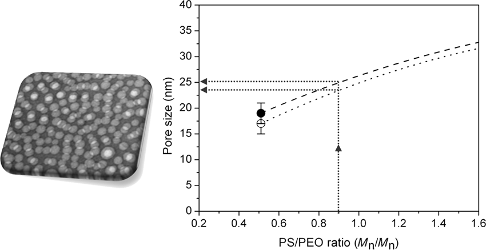
- narrow pore size distribution and high porosity have been obtained by a sol–gel reaction of a silicon oxide precursor (TEOS) and using polystyrene-block-poly(ethylene oxide) (PS-b-PEO) copolymers as templates in an acidic environment. PS-b-PEO copolymers with different molecular weight and composition


Manufacturing and investigation of physical properties of polyacrylonitrile nanofibre composites with SiO2, TiO2 and Bi2O3 nanoparticles
Beilstein J. Nanotechnol. 2016, 7, 1141–1155, doi:10.3762/bjnano.7.106
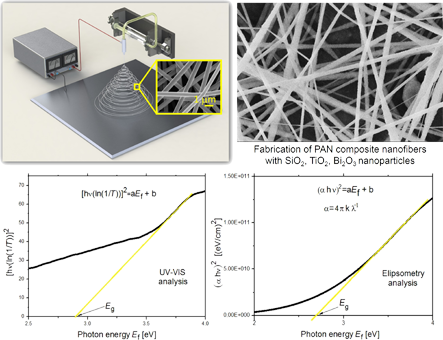
- diameters in the range from 80 to 200 nm belonged to the bismuth oxide powder (Figure 3). For titanium oxide the obtained particle diameters ranged from 18 to 50 nm. The lowest measured diameter values were registered for silicon oxide nanoparticles, the particle sizes of which were in the range from 8 to
- obtained composite mats, reinforced with silicon oxide, are a promising starting material that can be used to produce carbon anodes, which are used in lithium-ion batteries, after their subsequent treatment by carbonisation and chemical removal of the reinforcing phases in order to increase the porosity of



Fabrication and properties of luminescence polymer composites with erbium/ytterbium oxides and gold nanoparticles
Beilstein J. Nanotechnol. 2016, 7, 630–636, doi:10.3762/bjnano.7.55
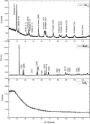
- mass ratio of 1:2, embedded in silicon oxide powder, the mass of which is twice as high as that of the REO. This corresponds well to the desired composition. No crystalline phases were detected in this powder (see Figure 3), however, it is possible that the sample contains crystals with sizes of 3–4 nm
- nanoparticles should be located around the silicon oxide nanoparticles, which prevents their agglomeration up to 0.15 wt % of content and the plasmon resonance absorbance spectra are observable in the polymer nanocomposite. The measurement with a laser scanning microscope (pump wavelength of 488 nm) has shown
- further developed two routes [9] for the preparation of rare earth oxides (Er and Yb) (REO), using silicon oxide nanoparticles (SiO2 NPs) during the synthesis or not. The process was the following: The mixture of erbium and ytterbium chlorides in proportion 1:2 was dissolved at 100 °C in glycerin (RE


Controlled graphene oxide assembly on silver nanocube monolayers for SERS detection: dependence on nanocube packing procedure
Beilstein J. Nanotechnol. 2016, 7, 9–21, doi:10.3762/bjnano.7.2
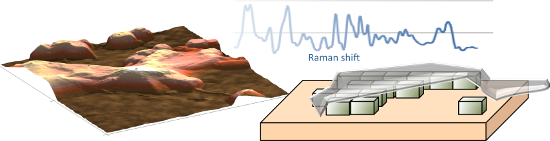
- has received much less attention [30][31][32] due to the lack of direct monitoring of the assembly process in situ. In this work, we followed the formation of an adlayer of AgNCs on silicon oxide surfaces by means of a quartz crystal microbalance with dissipation monitoring as a function of time and
- monolayers of AgNCs transferred on silicon oxide, reported in Figure 1a, shows that as the transfer surface pressure increases, the particle density and the average size of the nanocube clusters increase, until a near-continuous monolayer is established around 15 mN/m. Images of the sample collected at 20 mN
- results support our findings that a larger interparticle distance and higher aggregated fraction occur as transfer surface pressure is increased in the case of procedure A. Procedure B. Controlled assembly of AgNCs by spontaneous adsorption on the surface Spontaneous self-assembly of AgNC on silicon oxide


Observing the morphology of single-layered embedded silicon nanocrystals by using temperature-stable TEM membranes
Beilstein J. Nanotechnol. 2015, 6, 964–970, doi:10.3762/bjnano.6.99

- these membranes that also withstand the high temperature annealing that is needed to induce phase separation and crystallization of the Si NC layers. In contrast to the above mentioned ion implantation, deposition processes allow for sharp interfaces between two confining silicon oxide (SiO2) layers


A surface acoustic wave-driven micropump for particle uptake investigation under physiological flow conditions in very small volumes
Beilstein J. Nanotechnol. 2015, 6, 414–419, doi:10.3762/bjnano.6.41
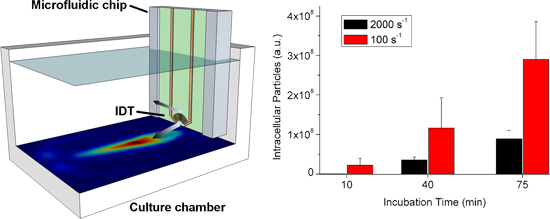
- with an interdigital distance of 15 μm. The structure is fabricated by thermal evaporation of 50 nm gold on a LiNbO3 substrate (128°–Y–cut). For the sake of chemical and electrical isolation, the whole chip was covered with a 200 nm thick silicon oxide layer by thermal evaporation of SiO. The micropump


Nanoporous Ge thin film production combining Ge sputtering and dopant implantation
Beilstein J. Nanotechnol. 2015, 6, 336–342, doi:10.3762/bjnano.6.32
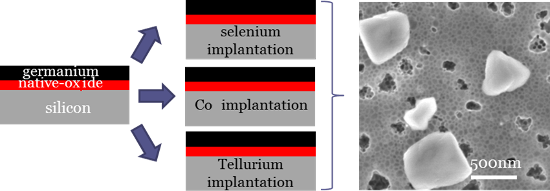
- on the native silicon oxide of a (001) silicon wafer by magnetron sputtering in a commercial set up with a deposition chamber exhibiting a base pressure of ≈10−8 mbar. The first thermal annealing executed after Ge deposition was performed in a commercial Jetfirst 600 Rapid Thermal Annealing furnace


Boosting the local anodic oxidation of silicon through carbon nanofiber atomic force microscopy probes
Beilstein J. Nanotechnol. 2015, 6, 215–222, doi:10.3762/bjnano.6.20
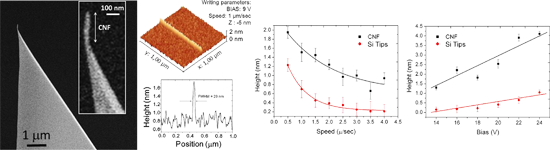
- logically concerned silicon, as it is the ubiquitous material of modern electronics [6][7]. The application of an electric field between a conductive tip and a silicon substrate under ambient conditions can generate the local anodic oxidation (LAO) of the silicon surface very precisely; intrinsic silicon
- oxide (SiOx) patterns are in the single/double-digit nanometer-range [8]. The principle of LAO-AFM is the following: A water meniscus is formed in humid air when the tip comes to close proximity to the surface due to capillary condensation. The formation of the water meniscus can be triggered in non


Electrical contacts to individual SWCNTs: A review
Beilstein J. Nanotechnol. 2014, 5, 2202–2215, doi:10.3762/bjnano.5.229
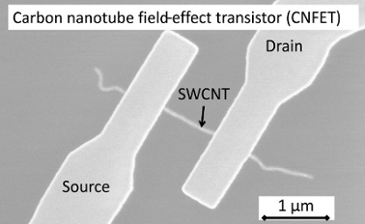
- orders of magnitude, owing to the chemical change at the metal–SWCNT–silicon oxide interface as well as the structure change of the Ti metal. Further annealing at a higher temperature has also been explored to form TiC by quenching the Ti contacts at 800–850 °C [76]. Thus, the conductance of ambipolar


Hydrophobic interaction governs unspecific adhesion of staphylococci: a single cell force spectroscopy study
Beilstein J. Nanotechnol. 2014, 5, 1501–1512, doi:10.3762/bjnano.5.163
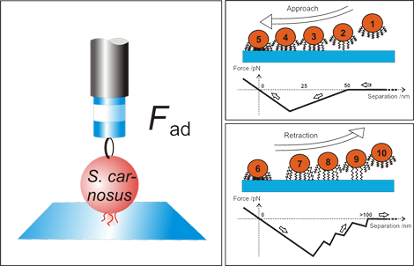
- cell wall components) and test their dependency on the ‘adhesion history’ the cell has experienced before. Experimental Preparation of the substrates The hydrophilic substrates used in this study are silicon wafers with a native silicon oxide layer (d = 1.7(2) nm) (the number in parentheses denotes the
- probes (30–50 bacteria), we learned that on hydrophilic silicon oxide surfaces, the adhesion force is roughly an order of magnitude lower than on OTS-Si wafers [13]. Hence, the adhesion force of a single bacterium on a hydrophilic surface is expected to be below the experimental resolution (about 50 pN


Electron-beam induced deposition and autocatalytic decomposition of Co(CO)3NO
Beilstein J. Nanotechnol. 2014, 5, 1175–1185, doi:10.3762/bjnano.5.129
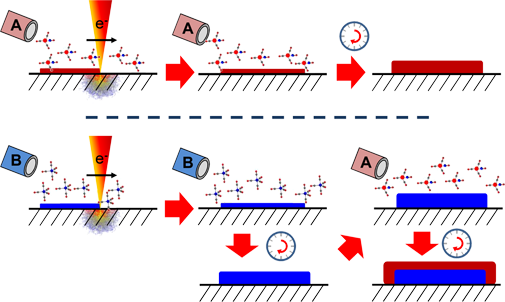
- precursor for the fabrication of nanostructures by using EBISA on silicon oxide surfaces. An alternative approach could be to use different substrates for EBISA: It was shown recently by our group that it is possible to activate thin layers of large organic molecules (2H-tetraphenyl porphyrin) on metal




Nanocavity crossbar arrays for parallel electrochemical sensing on a chip
Beilstein J. Nanotechnol. 2014, 5, 1137–1143, doi:10.3762/bjnano.5.124
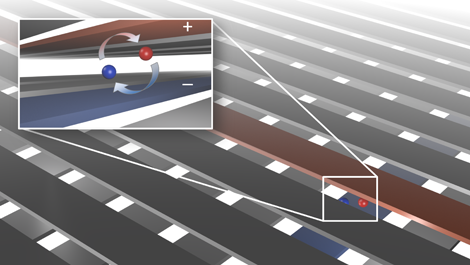
- of a sacrificial layer followed by an isotropic etch. The full device is stabilized by a silicon oxide/silicon nitride stack that covers the full device and is solely opened trough access holes above each crossbar intersection. Since the whole device is covered by the passivating layer, electrodes


The study of surface wetting, nanobubbles and boundary slip with an applied voltage: A review
Beilstein J. Nanotechnol. 2014, 5, 1042–1065, doi:10.3762/bjnano.5.117
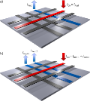
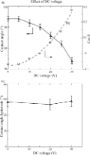
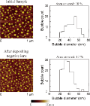
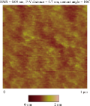
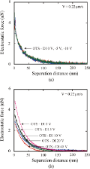
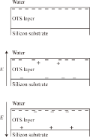
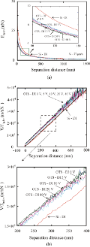
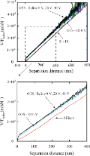
- surface was prepared as coating on a p-type boron doped silicon wafer (1–20 Ω·cm, Silicon Quest International) substrate, which was coated with a 300 nm thick silicon oxide layer. Before coating the PS film on the substrate, the wafers was cleaned in a sonication bath of acetone first, and then cleaned in
- dielectric layer in this work has two layers, one is the 300 nm thick silicon oxide layer, and the other is the PS film. Then the equivalent capacitance of the system can be expressed as [76]: where C1, C2 are the capacitances of silicon oxide layer and PS film, ε1, ε2 are the relative dielectric constants
- of the silicon oxide and PS, d1, d2 are the thickness of silicon oxide layer and PS film, respectively, and ε0 is the dielectric constant of the vacuum. Combining Equation 1 and Equation 2, one gets Here we define an electrowetting coefficient k for this work, Then the equation can be expressed as










En route to controlled catalytic CVD synthesis of densely packed and vertically aligned nitrogen-doped carbon nanotube arrays
Beilstein J. Nanotechnol. 2014, 5, 219–233, doi:10.3762/bjnano.5.24
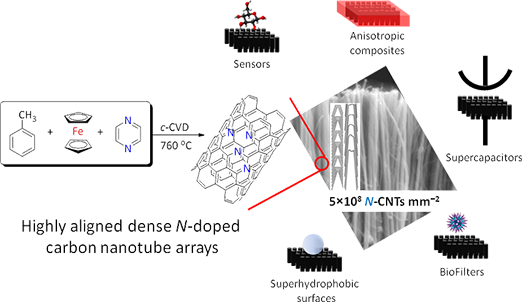
- growth of nanotubes and mainly carbon diffusion through the metal particle. The particle at the base (growth substrate) of the nanotube is likely to be iron silicon carbide and iron silicon oxide since it was in the contact with the silica quartz substrate. In the nitrogen-assisted growth of nanotubes


Cyclic photochemical re-growth of gold nanoparticles: Overcoming the mask-erosion limit during reactive ion etching on the nanoscale
Beilstein J. Nanotechnol. 2013, 4, 886–894, doi:10.3762/bjnano.4.100
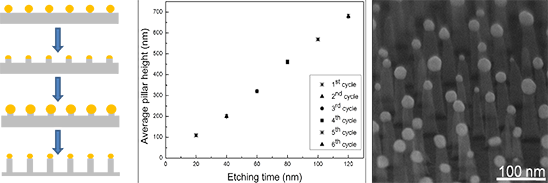
- compensating for the erosion due to the previous cycle. As a result of this mask repair method, arrays of silica nanopillar with heights up to 680 nm and aspect ratios of 10:1 are fabricated. Based on the given recipes, the approach can be applied to a variety of materials like silicon, silicon oxide, and


Preparation of electrochemically active silicon nanotubes in highly ordered arrays
Beilstein J. Nanotechnol. 2013, 4, 655–664, doi:10.3762/bjnano.4.73
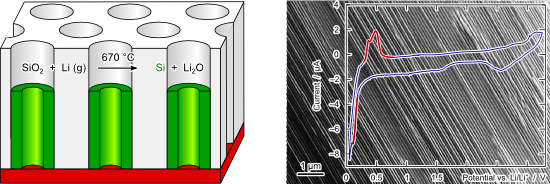
- thermal reduction of silicon dioxide to silicon by lithium vapor. The lithium oxide byproduct is removed subsequently. The reduction, performed under argon at 670 °C, is quantitative, homogeneous and well-behaved, in that the product contains neither remnants of silicon oxide nor any lithium silicide, as





Mapping of plasmonic resonances in nanotriangles
Beilstein J. Nanotechnol. 2013, 4, 588–602, doi:10.3762/bjnano.4.66
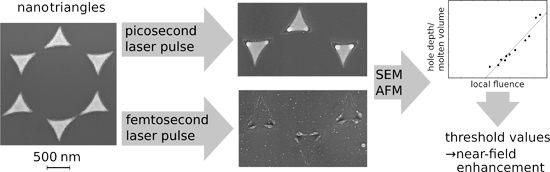
- been removed by the laser pulse (see, e.g., Figure 5, which will be discussed in detail below). The electron-beam lithography samples were prepared on a silicon (Si) wafer with a native silicon oxide (SiO2) layer with a thickness of 2.4 nm (measured by ellipsometry), for the wafers used for colloid
- preparation and ablation have been removed with aqua regia. Here, the volume of the material deposited in the rim appears to be distinctly larger than the volume of the crater hole. This is due to a change in composition (the rim consists mostly of silicon oxide), and partly also due to the fact that the AFM


Polynomial force approximations and multifrequency atomic force microscopy
Beilstein J. Nanotechnol. 2013, 4, 352–360, doi:10.3762/bjnano.4.41
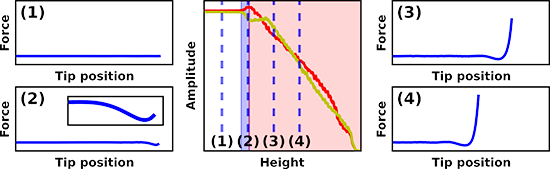
- for experimental data. Polynomial force reconstruction during slow surface approach To demonstrate the capabilities of the polynomial force reconstruction we perform an ImAFM approach measurement on a silicon oxide surface. In this measurement two drive frequencies close to resonance result in a beat
- matrix in Equation 16 are not required. To validate the equivalence of polynomial force reconstruction on spectral and force quadrature data, we consider the ImAFM approach measurement on silicon oxide described above. From the tip motion at a z-piezo extension of 25.6 nm we compute the FI(A) curve and
- polynomial force reconstruction will be a useful method for many scientists and that new data-representation schemes will inspire innovative analysis methods. Experimental The silicon oxide sample was cleaned in an oxygen plasma before measurements were perfomed in a Bruker Dimension 3100 AFM system. The

![[Graphic 19]](/bjnano/content/inline/2190-4286-4-41-i45.png?max-width=637&scale=1.18182) matrix (a) and its pseudo-inverse (b). Only rows with non-zero elements are d...
matrix (a) and its pseudo-inverse (b). Only rows with non-zero elements are d...


Selective surface modification of lithographic silicon oxide nanostructures by organofunctional silanes
Beilstein J. Nanotechnol. 2013, 4, 218–226, doi:10.3762/bjnano.4.22
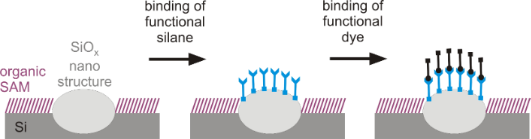
- functionalization of silicon oxide nanostructures prepared by AFM-anodization lithography of alkyl-terminated silicon. Different conditions for the growth of covalently bound mono-, multi- or submonolayers of distinctively functional silane molecules on nanostructures have been identified by AFM-height
- investigations. Routes for the preparation of methyl- or amino-terminated structures or silicon surfaces are presented and discussed. The formation of silane monolayers on nanoscopic silicon oxide nanostructures was found to be much more sensitive towards ambient humidity than, e.g., the silanization of larger
- coverage of the dye molecules on length scale that is not accessible by standard AFM measurements. Keywords: AFM lithography; amino-functionalization; local anodic oxidation; octadecyl-trichlorosilane; silicon oxide nanostructures; Introduction Local anodic oxidation (LAO) nanolithography is a reliable


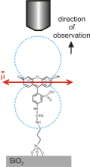
![[Graphic 2]](/bjnano/content/inline/2190-4286-4-22-i2.png?max-width=637&scale=1.18182) (red arrow) of FITC bound to a SiO2 surface.
(red arrow) of FITC bound to a SiO2 surface.



