Search results
Search for "nanofabrication" in Full Text gives 127 result(s) in Beilstein Journal of Nanotechnology.
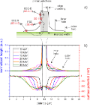
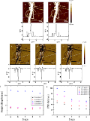
Comparing postdeposition reactions of electrons and radicals with Pt nanostructures created by focused electron beam induced deposition
Beilstein J. Nanotechnol. 2017, 8, 2410–2424, doi:10.3762/bjnano.8.240
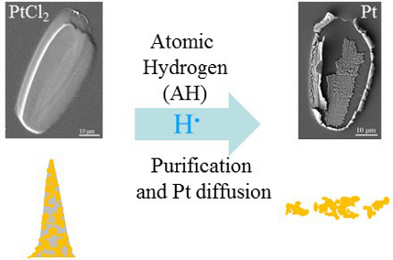
- nanostructures to be fabricated. Despite the significant advantages of a process that can direct write nanostructures without the need for resists or masks [2][3], FEBID has several challenges preventing its wider implementation as a robust method for nanofabrication. One of the biggest issues is deposit purity




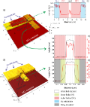
Increasing the stability of DNA nanostructure templates by atomic layer deposition of Al2O3 and its application in imprinting lithography
Beilstein J. Nanotechnol. 2017, 8, 2363–2375, doi:10.3762/bjnano.8.236
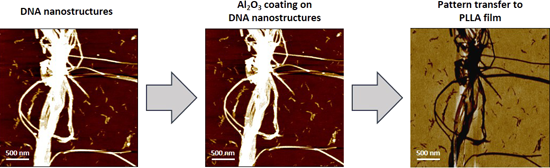
- resistive to UV/O3 oxidation. The ALD-coated DNA templates were used for a direct pattern transfer to poly(L-lactic acid) films. Keywords: aluminium oxide (Al2O3); atomic layer deposition; DNA nanostructure; nanofabrication; nanoimprint lithography; pattern transfer; polymer stamp; replica molding
- complex features. Therefore, self-assembled DNA nanostructures are considered to be an ideal template for nanofabrication because it is easy to control their structural complexity and diversity at the nanoscale. Many approaches have been developed to use DNA nanostructures as templates to pattern a wide
- system by Norman Gottron in Nanofabrication Facility at Carnegie Mellon University (Ultratech/CNT, Waltham, MA, USA). Chamber and substrate heaters were set to 200 °C. Total Ar gas flow was at 260 sccm and 200 mTorr. Trimethylaluminum (TMA) and H2O were used as precursors and one ALD cycle consisted of a



Suppression of low-energy dissociative electron attachment in Fe(CO)5 upon clustering
Beilstein J. Nanotechnol. 2017, 8, 2200–2207, doi:10.3762/bjnano.8.219
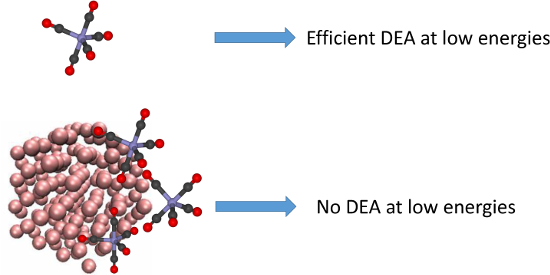
- electron attachment in isolated Fe(CO)5. Keywords: aggregation effects; dissociative electron attachment; FEBID; iron pentacarbonyl; long-range interactions; Introduction In recent years a number of gas-phase studies on molecules that are commonly used as precursors in electron-induced nanofabrication


Charge transport in organic nanocrystal diodes based on rolled-up robust nanomembrane contacts
Beilstein J. Nanotechnol. 2017, 8, 1277–1282, doi:10.3762/bjnano.8.129
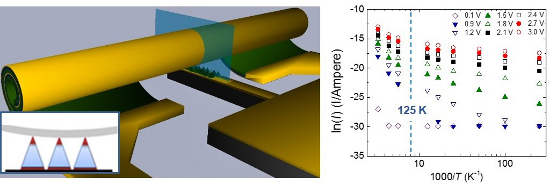
- our previous reports [19]. The fabrication yield of the devices contacted by rolled-up electrodes on the single chip can achieve more than 95% owing to the reliable parallel nanofabrication when the whole process is carefully performed. To study the charge transport properties of the crystalline


A top-down approach for fabricating three-dimensional closed hollow nanostructures with permeable thin metal walls
Beilstein J. Nanotechnol. 2017, 8, 1231–1237, doi:10.3762/bjnano.8.124
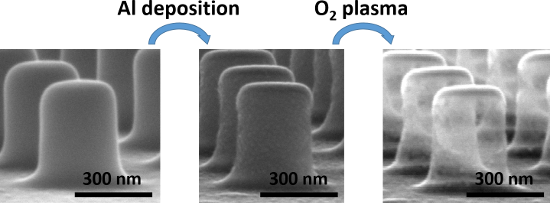
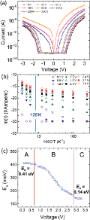
- flexibility and controllability offered by top-down nanofabrication techniques opens the door to the possibility of massive integration of these hollow 3D nano-objects on a chip for applications such as nanocontainers, nanoreactors, nanofluidics, nano-biosensors and photonic devices. Keywords: nanocages
- ; nanocontainers; nanofabrication; nanophotonics; nanoreactors; optical devices; plasmonics; top-down techniques; Introduction Nanocages, or nanocontainers, are nanostructures with a hollow interior and walls of nanometric thickness, typically designed for housing a specific material (load) and/or to increase


Assembly of metallic nanoparticle arrays on glass via nanoimprinting and thin-film dewetting
Beilstein J. Nanotechnol. 2017, 8, 1049–1055, doi:10.3762/bjnano.8.106
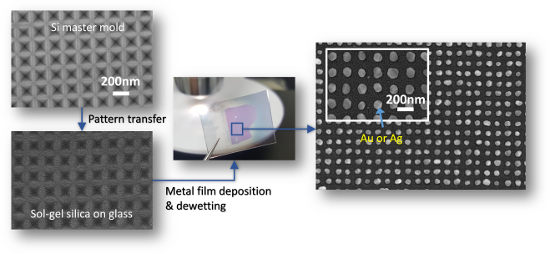
- Sun-Kyu Lee Sori Hwang Yoon-Kee Kim Yong-Jun Oh Department of Advanced Materials Science and Engineering, Hanbat National University, 125 Dongseo-daero, Yuseong-gu, Daejeon 305-719, South Korea 10.3762/bjnano.8.106 Abstract We propose a nanofabrication process to generate large-area arrays of


Nanoantenna-assisted plasmonic enhancement of IR absorption of vibrational modes of organic molecules
Beilstein J. Nanotechnol. 2017, 8, 975–981, doi:10.3762/bjnano.8.99
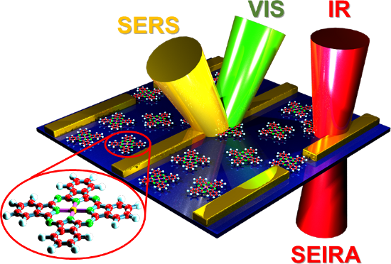
- width, height, and the spacing between nanoantennas were assumed as imposed by the nanofabrication technology. Except for the fundamental LSPR mode, the third-order resonance centered at about 2400 cm−1 occurs in the IR spectra. A weaker feature near 1200 cm−1 is assigned to the surface optical mode



Near-field surface plasmon field enhancement induced by rippled surfaces
Beilstein J. Nanotechnol. 2017, 8, 956–967, doi:10.3762/bjnano.8.97
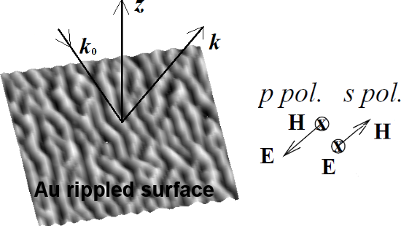
- materials ranging from metals to transparent glasses and crystals [16]. As a consequence, the interest in the optical properties of rippled surfaces has a long history [17]. On the nanoscale, nanofabrication techniques, such as conventional lithographic methods or scanning probe techniques, allow for the
- production of predesigned rough surfaces, where simple and prescribed shapes can be easily produces such as rectangular or sinusoidal shapes, for example. Random surfaces, on the contrary, are stochastic and are a result of a (or several) random process(es). Nanofabrication techniques based on growth


3D Nanoprinting via laser-assisted electron beam induced deposition: growth kinetics, enhanced purity, and electrical resistivity
Beilstein J. Nanotechnol. 2017, 8, 801–812, doi:10.3762/bjnano.8.83
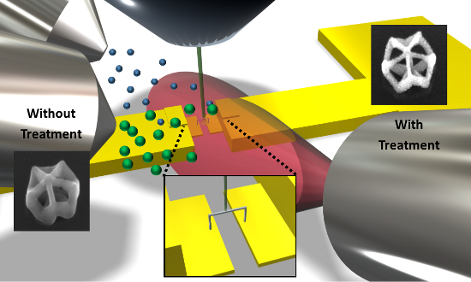
- : additive manufacturing; beam induced processing; 3D printing; direct-write; electron beam induced deposition; microscopy; nanofabrication; pulsed laser; purification; rapid prototyping; Introduction The first fully incorporated 3D transistor logic was reported in 2012 [1]. Further 3D device concepts and
- was created using conventional nanofabrication methods in order to measure the electrical resistivity of freestanding nanoscale bridges. Geometric constraints (the freestanding nature of the nanobridge) necessitated a two-point probe configuration over the standard four-point measurement. A


Computing the T-matrix of a scattering object with multiple plane wave illuminations
Beilstein J. Nanotechnol. 2017, 8, 614–626, doi:10.3762/bjnano.8.66
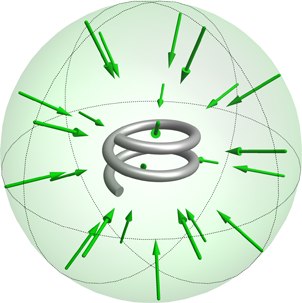
- nanofabrication technology made the creation of large volumes of particles with complicated geometries possible [1][2][3][4][5][6]. The latter constitute the base for nanomaterials with advanced properties [7]. This also triggered the need for efficient computational tools to back up experimental findings with


Nano- and microstructured materials for in vitro studies of the physiology of vascular cells
Beilstein J. Nanotechnol. 2016, 7, 1620–1641, doi:10.3762/bjnano.7.155
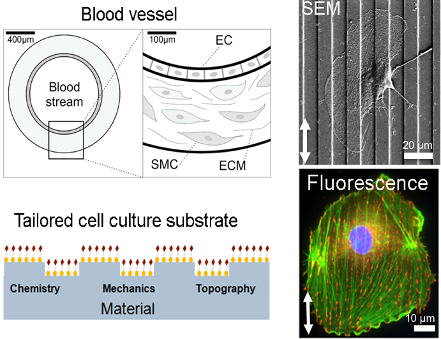
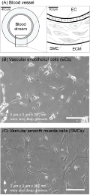
- . Thus, in vitro studies using modified artificial surfaces to induce biological responses in these cells are an important experimental model in vascular cell biology and biomaterial research (Figure 3). In this review, we provide an overview of materials and important micro- and nanofabrication
- development of micro- and nanofabrication techniques has permitted the manufacturing of precise surface topographies of materials surfaces. Samples with specific surface features haven been widely used for in vitro cell biology studies either to manipulate cell adhesion and resulting cell responses or to give
- methods [55] process polymeric material and are also applied to fabricate cell culture substrates. However, the substrates resulting from these fabrication methods are in most cases (irregularly) porous, foam-like 3D structures rather than (symmetrical) surface-patterned substrates. 1.3 Nanofabrication



Localized surface plasmons in structures with linear Au nanoantennas on a SiO2/Si surface
Beilstein J. Nanotechnol. 2016, 7, 1519–1526, doi:10.3762/bjnano.7.145
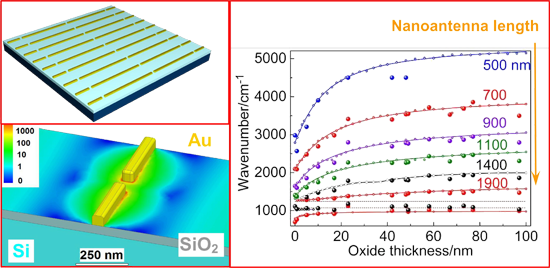
- nanofabrication. The nanoantennas were assigned to have rounded edges with a fillet radius of 15 nm. The thickness hSiO2 of the SiO2 layer was a variable parameter ranging within 0–100 nm. The transverse pitch gy of the nanoantennas was fixed as 5000 nm, while the nanoantenna lengths l of 500, 700, 900, 1100


Dealloying of gold–copper alloy nanowires: From hillocks to ring-shaped nanopores
Beilstein J. Nanotechnol. 2016, 7, 1361–1367, doi:10.3762/bjnano.7.127
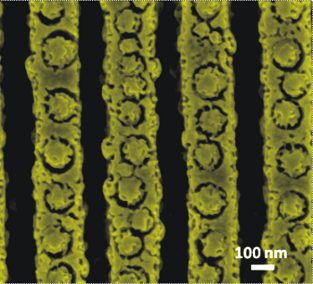
- nanofabrication approaches, which allows for producing nanostructures with complex shapes and morphologies not possible to achieve using classical routes [1]. Physical vapor deposition (PVD) is a very simple and efficient process usually used for the growth of thin films finding application in a wide range of


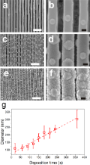


Experimental and simulation-based investigation of He, Ne and Ar irradiation of polymers for ion microscopy
Beilstein J. Nanotechnol. 2016, 7, 1113–1128, doi:10.3762/bjnano.7.104
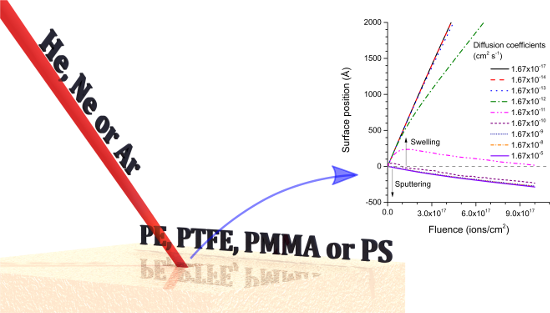
- HIM has been developed for high resolution electron microscopy and nanofabrication using the He+ or Ne+-emitting atomic level ion source (ALIS) [4]. Compared to cluster ion bombardment, the use of monoatomic primary ion species (such as Cs+, O−, Ga+) for imaging in SIMS allows significantly higher


Highly compact refractive index sensor based on stripe waveguides for lab-on-a-chip sensing applications
Beilstein J. Nanotechnol. 2016, 7, 751–757, doi:10.3762/bjnano.7.66
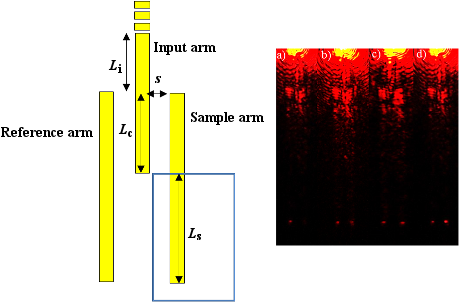
- Chamanei Perera Kristy Vernon Elliot Cheng Juna Sathian Esa Jaatinen Timothy Davis Science and Engineering Faculty, Queensland University of Technology, Brisbane 4001, Queensland, Australia Australian National Nanofabrication Facility QLD node, University of Queensland, St Lucia 4072, Queensland

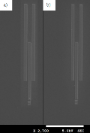
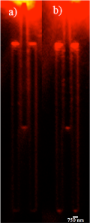


Near-field visualization of plasmonic lenses: an overall analysis of characterization errors
Beilstein J. Nanotechnol. 2015, 6, 2069–2077, doi:10.3762/bjnano.6.211
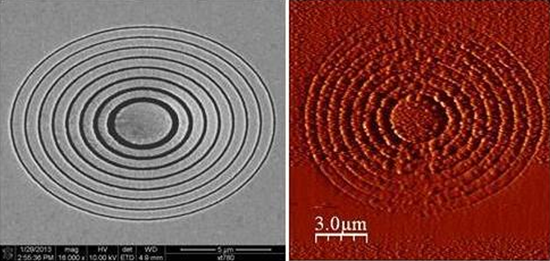
- nanophotonic devices. Keywords: characterization; nanofabrication; near-field; plasmonic lenses; plasmonic structures; Introduction The characteristics of nanophotonic devices that are based on surface plasmon polaritons (SPPs) are appealing because of the extraordinary transmission in free space [1][2][3][4
- [21]. This plasmonic lens has been selected here as a typical example for the purpose of illustrating and analyzing the characterization errors originated from the nanofabrication process of the plasmonic lenses. The focused spot can be tuned by means of tailoring the long and the short axes of the
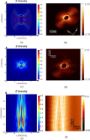
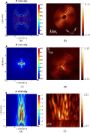
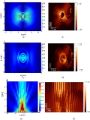
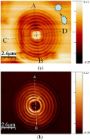
- limit (less than half of the incident wavelength of 532 nm). To verify it experimentally, FIB and NSOM were employed for nanofabrication and near-field characterization, respectively. Figure 3, Figure 4 and Figure 5 are NSOM probing results for the lenses with different ratios σ ranging from 0.7 to 0.9




The role of low-energy electrons in focused electron beam induced deposition: four case studies of representative precursors
Beilstein J. Nanotechnol. 2015, 6, 1904–1926, doi:10.3762/bjnano.6.194
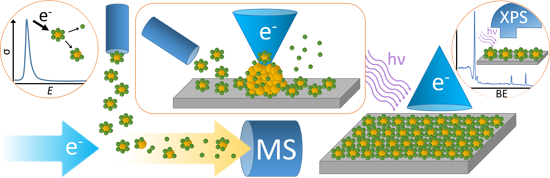
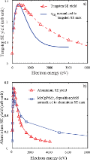
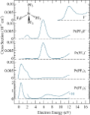
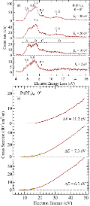
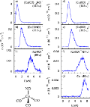
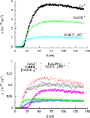
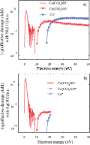
- induced deposition (FEBID) is a single-step, direct-write nanofabrication technique capable of writing three-dimensional metal-containing nanoscale structures on surfaces using electron-induced reactions of organometallic precursors. Currently FEBID is, however, limited in resolution due to deposition








Focused particle beam-induced processing
Beilstein J. Nanotechnol. 2015, 6, 1883–1885, doi:10.3762/bjnano.6.191

- nanofabrication. Along the same path, Gregor Hlawacek, Bene Poelsema and coworkers focused on the interaction of helium ions with metal surfaces (gold in particular) [13][14][15]. In a series of three distinct articles, they concentrate on ion channeling, crystal mapping, and finally, ion-induced modification of
- polymerization that is a basis for the creation of ultrathin nanomembranes. Finally, André Beyer and coworkers show impressive HIM images of ultrathin carbon nanomembranes [17], which is a clear indication of the potential of the bourgeoning fields of helium ion microscopy and lithography towards nanofabrication
In situ SU-8 silver nanocomposites
Beilstein J. Nanotechnol. 2015, 6, 1661–1665, doi:10.3762/bjnano.6.168
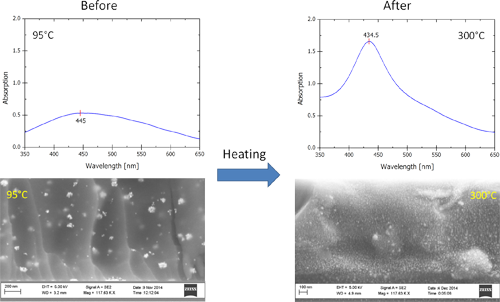
- photoresist; in situ synthesis; metal nanoparticles; micro and nanofabrication; nanocomposite; Findings Noble metal nanoparticles (NPs) have been of high interest for many years as their unique properties make them useable in a large variety of applications [1]. The application of these NPs ranges from
- optical imaging, optoelectronics and electrochemistry to catalysts [2]. However, it is difficult to use such NPs in conjunction with standard top down micro- and nanofabrication processes as positioning and control of the nanoparticles are impossible to maintain [3]. Homogeneous polymeric thin film metal
- nanocomposites are therefore of great interest within micro- and nanofabrication [4][5][6]. The nanoparticles encased in a polymeric matrix should maintain their physical properties, while the nanocomposite can be structured by using standard fabrication methods allowing for the development of new optoelectronic


Molecular materials – towards quantum properties
Beilstein J. Nanotechnol. 2015, 6, 1485–1486, doi:10.3762/bjnano.6.153
- , and a great deal of interest from scientists working in materials science, chemistry, physics, and nanofabrication technologies has been attracted. For example, the company D-wave has demonstrated a quantum annealer that performs certain calculations sufficiently rapidly to have a consortium, which
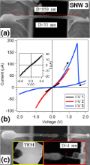
Structural transitions in electron beam deposited Co–carbonyl suspended nanowires at high electrical current densities
Beilstein J. Nanotechnol. 2015, 6, 1298–1305, doi:10.3762/bjnano.6.134
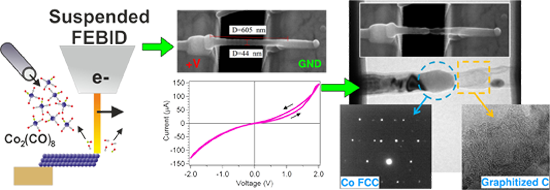
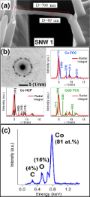
- of nanotechnology and nanoscience in advanced applications and fundamental research requires nanofabrication techniques that are highly resolved but at the same time flexible and feasible with research laboratory equipment. A promising approach is represented by focused electron beam induced
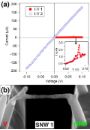
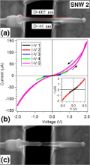
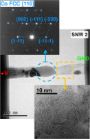
- beam path [24]. This approach offers the possibility to deposit and analyze the material free from any substrate contribution, but above all it enables 3D nanofabrication [25]. The SNWs are characterized electrically at high current densities and analyzed structurally by transmission electron

Fabrication of high-resolution nanostructures of complex geometry by the single-spot nanolithography method
Beilstein J. Nanotechnol. 2015, 6, 976–986, doi:10.3762/bjnano.6.101
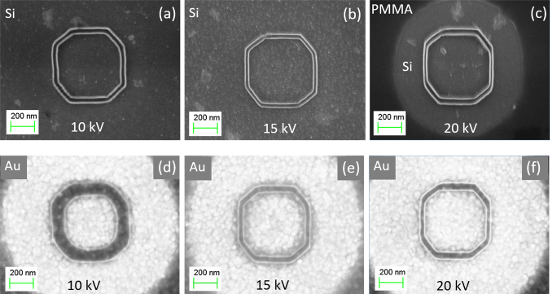
- silicon substrates, gold-coated substrates can also successfully be used for the single-spot nanopattering technique. An explanation of the results related to the resist overexposure was demonstrated using Monte Carlo simulations. Our nanofabrication method significantly accelerates (up to 10 times) the
- resolution on semiconductor and metallized substrates using the single-spot nanofabrication was demonstrated at low-energy acceleration voltages. The resulting nanostructures have sharp edges and defect-free lines. Arrays of nanoelements or complex nanostructures can be easily scaled to large areas, with the


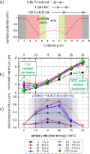
Electron-stimulated purification of platinum nanostructures grown via focused electron beam induced deposition
Beilstein J. Nanotechnol. 2015, 6, 907–918, doi:10.3762/bjnano.6.94
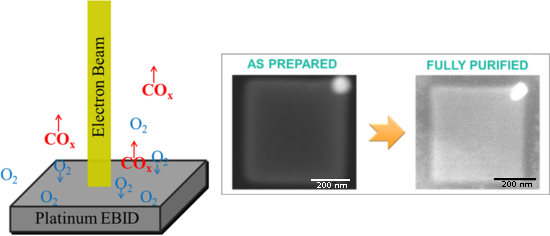
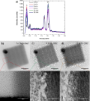
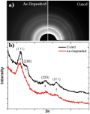
- Brett B. Lewis Michael G. Stanford Jason D. Fowlkes Kevin Lester Harald Plank Philip D. Rack Materials Science and Engineering Department, University of Tennessee, Knoxville, TN 37996, USA Nanofabrication Research Laboratory, Center for Nanophase Materials Sciences, Oak Ridge National Laboratory




Magnetic properties of self-organized Co dimer nanolines on Si/Ag(110)
Beilstein J. Nanotechnol. 2015, 6, 777–784, doi:10.3762/bjnano.6.80
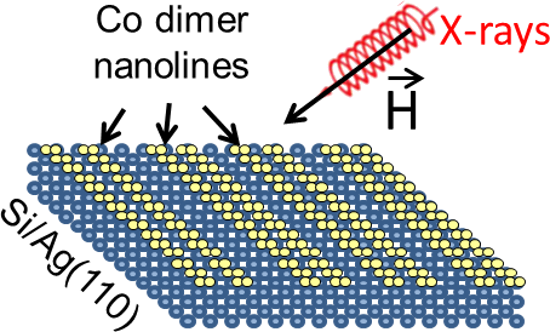
- transition metal nanostructures, it appears interesting to also study the growth of such objects on a non-metallic template. We underline that since self-organized growth allows the fabrication of a high-density of nanostructures with a narrow size distribution, this route of nanofabrication opens up the


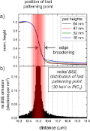
Fundamental edge broadening effects during focused electron beam induced nanosynthesis
Beilstein J. Nanotechnol. 2015, 6, 462–471, doi:10.3762/bjnano.6.47
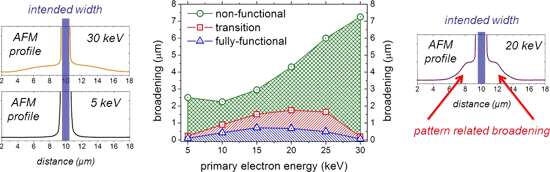
- more complex proximity effects that significantly reduce lateral edge sharpness and thus should be avoided if desiring high lateral resolution. Keywords: focused electron beam induced deposition; nanofabrication; platinum; simulation; Introduction Focused electron beam induced deposition (FEBID) has
- candidate for an enabling nanofabrication technology. The technique relies on the local nano-synthesis of precursor molecules by a focused electron beam and its subsequent electron emission from the substrate and the deposit itself [1][3][4][5][6]. Typically, a gaseous precursor is brought into the chamber