Search results
Search for "precursor" in Full Text gives 617 result(s) in Beilstein Journal of Nanotechnology. Showing first 200.
Classification and application of metal-based nanoantioxidants in medicine and healthcare
Beilstein J. Nanotechnol. 2024, 15, 396–415, doi:10.3762/bjnano.15.36
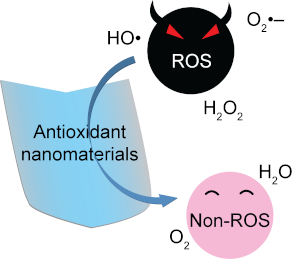
- peroxide or organic hydroperoxide (ROOH) to produce ROS. In nature, biological systems commonly use catalase (CAT) and glutathione peroxidase (GPx) as preventive antioxidants to degrade hydrogen peroxide, which is a precursor of ROS. CAT, containing a heme active site, and GPx, containing a selenium active
- collaborators synthesized mesoporous carbon nanospheres (PMCSs) derived from a MOF precursor, exhibiting dual photodynamic and photothermal characteristics. Utilizing this framework, concentration and temperature at thrombotic sites were elevated significantly upon local irradiation (808 nm laser), resulting in


Design, fabrication, and characterization of kinetic-inductive force sensors for scanning probe applications
Beilstein J. Nanotechnol. 2024, 15, 242–255, doi:10.3762/bjnano.15.23
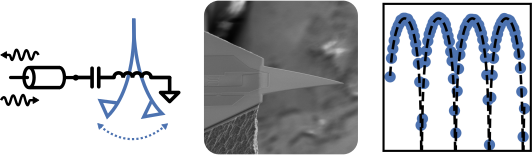
- ], or to realize laterally grown high-aspect ratio nanopillars [36]. We realize sharp, vertically grown conductive tips at the apex of the Si-N cantilever using FEBID with a Pt precursor gas. Figure 6 shows the resulting structure. We obtain the conical shape by stacking multiple depositions with



Graphene removal by water-assisted focused electron-beam-induced etching – unveiling the dose and dwell time impact on the etch profile and topographical changes in SiO2 substrates
Beilstein J. Nanotechnol. 2024, 15, 190–198, doi:10.3762/bjnano.15.18
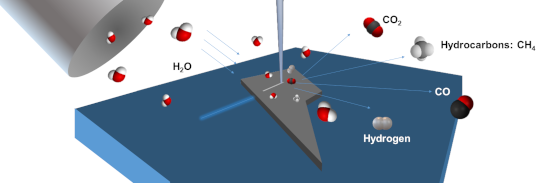
- is dependent on the precursor dynamics (adsorption/desorption rate, diffusion), electron beam (lateral size, electron flux, energy), and scanning parameters (dwell time, refresh time, scanning strategy) [22]. Additionally, residual hydrocarbons inside the scanning electron microscope chamber manifest


Assessing phytotoxicity and tolerance levels of ZnO nanoparticles on Raphanus sativus: implications for widespread adoptions
Beilstein J. Nanotechnol. 2024, 15, 115–125, doi:10.3762/bjnano.15.11
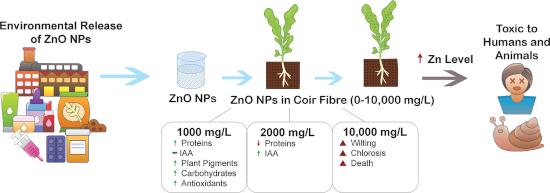
- , previous studies have also highlighted the significant adherence of ZnO NPs to the root surface of Lolium perenne and Zea mays [53][54]. Conclusion In this study, ZnO NPs were successfully synthesized via a wet chemical method from the ZnCl2 precursor and characterized using PXRD, FTIR, UV–vis, and DLS


Influence of conductive carbon and MnCo2O4 on morphological and electrical properties of hydrogels for electrochemical energy conversion
Beilstein J. Nanotechnol. 2024, 15, 57–70, doi:10.3762/bjnano.15.6
- tissues. The amount of water absorbed depends on factors such as the structure of the hydrogel, the composition of the precursor hydrogel solution, the cross-link density, and the technique of its synthesis. The simple reaction of one or more monomers is used for the production of this kind of material [1
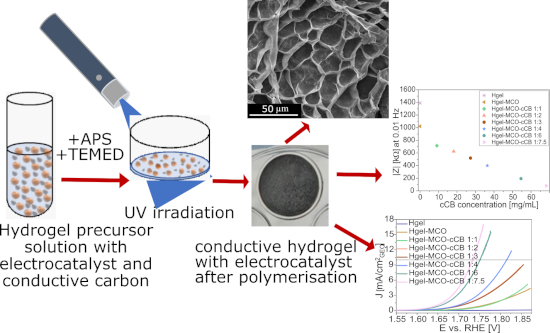
- particles of the MnCo2O4 electrocatalyst and conductive carbon in a PNIPAAm hydrogel precursor solution, which was then subjected to polymerisation. As a result, a hydrogel composite was created in a single-stage synthesis process. In addition, the applied methodology allowed us to avoid the need to use
- MCO and cCB particles in the hydrogel precursor solution to obtain a more homogeneous distribution of these particles in the structure of the polymer matrix and on its surface. The Fourier-transform infrared spectroscopy (FTIR) results of the hydrogel compositions and their pure components are shown


A combined gas-phase dissociative ionization, dissociative electron attachment and deposition study on the potential FEBID precursor [Au(CH3)2Cl]2
Beilstein J. Nanotechnol. 2023, 14, 1178–1199, doi:10.3762/bjnano.14.98
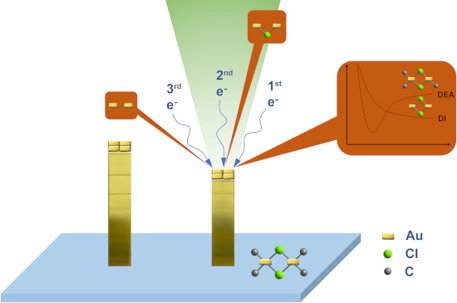
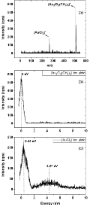
- fabrication of functional gold nanostructures for application in plasmonic and detector technology, we conducted a comprehensive study on [Au(CH3)2Cl]2 as a potential precursor for such depositions. Fundamental electron-induced dissociation processes were studied under single collision conditions, and the
- composition and morphology of FEBID deposits fabricated in an ultrahigh-vacuum (UHV) chamber were explored on different surfaces and at varied beam currents. In the gas phase, dissociative ionization was found to lead to significant carbon loss from this precursor, and about 50% of the chlorine was on average
- that we attribute to electron-induced secondary and tertiary reactions in the deposition process. We find this precursor to be stable at ambient conditions and to have sufficient vapor pressure to be suitable for use in HV instruments. More importantly, in the UHV setup, FEBID with [Au(CH3)2Cl]2



Properties of tin oxide films grown by atomic layer deposition from tin tetraiodide and ozone
Beilstein J. Nanotechnol. 2023, 14, 1085–1092, doi:10.3762/bjnano.14.89
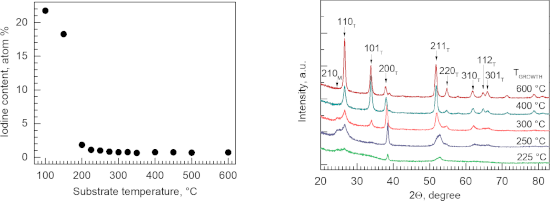
- . Suitable evaporation temperatures for the SnI4 precursor as well as the relationship between growth per cycle and substrate temperature were determined. Crystal growth in the films in the temperature range of 225–600 °C was identified. Spectroscopic analyses revealed low amounts of residual iodine and
- implied the formation of single-phase oxide in the films grown at temperatures above 300 °C. Appropriateness of the mentioned precursor system to the preparation of SnO2 films was established. Keywords: atomic layer deposition; tin oxide; tin tetraiodide; Introduction Atomic layer-deposited SnO2 films
- precursor combinations for obtaining SnO2 in atomic layer deposition (ALD) processes [9]. Two of these processes have employed SnI4 as the metal precursor with either O2 [10][11][12][13][14] or H2O2 [10][11][15] as oxidizer. Of these two oxygen sources, O2 would be more desirable because with it a hydrogen


Recognition mechanisms of hemoglobin particles by monocytes – CD163 may just be one
Beilstein J. Nanotechnol. 2023, 14, 1028–1040, doi:10.3762/bjnano.14.85
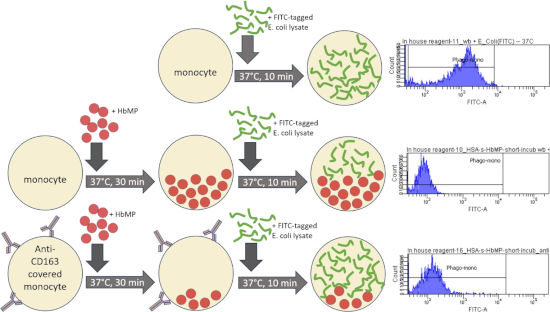
- size or other physical properties of the particles. In this study, we screened several monocytic surface receptors for a possible influence on the uptake of HbMPs by monocytes, which are precursor cells of macrophages. We chose to screen for CD14- as well as CD33-dependent HbMP uptake by monocytes




Fragmentation of metal(II) bis(acetylacetonate) complexes induced by slow electrons
Beilstein J. Nanotechnol. 2023, 14, 980–987, doi:10.3762/bjnano.14.81
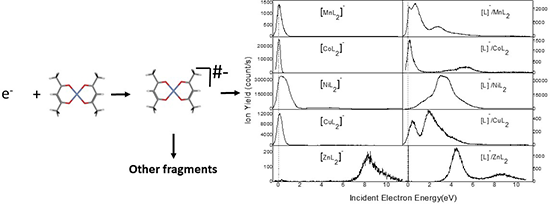
- electron beam with an organometallic target (e.g., focused electron beam-induced deposition, FEBID) is a promising technique for direct 3D deposition of high-purity materials with minimum residual carbon in the product on the surface [4][5]. The FEBID precursor molecules adsorb and diffuse on the surface
- these two species, the interaction of slow electrons with the metal chelates also produces a rich variety of fragment anions, which are reported and discussed in the present report. A comprehensive picture of the fragmentation pattern of each ML2 precursor, including the quantification of dissociation
- incoming scattering electron is captured by the precursor molecule to form a transient negative ion, TNI or [ML2]#−. If the electron autodetachment time of the TNI is longer than the dissociation time, the transient anion undergoes dissociation into a negative fragment and one or more neutral counterpart(s


Isolation of cubic Si3P4 in the form of nanocrystals
Beilstein J. Nanotechnol. 2023, 14, 971–979, doi:10.3762/bjnano.14.80
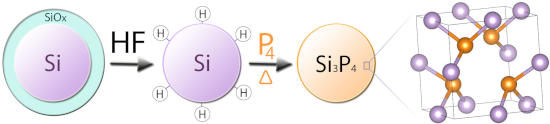
- precursor for diffusion doping of wafers and as anode material for Li-ion batteries. A similar method with a hydrogenation step offers the possibility to obtain other compounds, such as silicon selenides, arsenides, and sulfides. Keywords: ampoule annealing; defective zinc blende structure; DFT
- Si3P4 phase. Also worth noting was that the synthesis of cubic Si3P4 NPs could be performed immediately after laser-induced or plasma-enhanced chemical vapor deposition of nanosilicon from the silane precursor (since the NPs obtained this way are readily hydrogenated). Additionally, there is preliminary
- (reagent grade) were used for sol preparation; 40% hydrofluoric acid (pure) was used for etching. Si NPs were synthesized by laser-induced chemical vapor deposition using a silane precursor (the average particle diameter was 20 nm [41]). The NPs oxidized when stored in air, and the resultant mass fraction


Low temperature atomic layer deposition of cobalt using dicobalt hexacarbonyl-1-heptyne as precursor
Beilstein J. Nanotechnol. 2023, 14, 951–963, doi:10.3762/bjnano.14.78
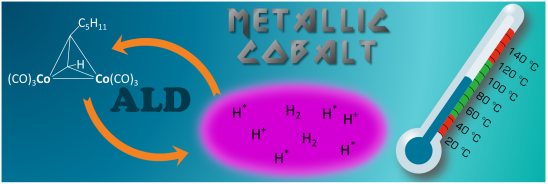
- operates at low temperatures using dicobalt hexacarbonyl-1-heptyne [Co2(CO)6HC≡CC5H11] and hydrogen plasma. For this precursor an ALD window in the temperature range between 50 and 110 °C was determined with a constant deposition rate of approximately 0.1 Å/cycle. The upper limit of the ALD window is
- defined by the onset of the decomposition of the precursor. In our case, decomposition occurs at temperatures of 125 °C and above, resulting in a film growth in chemical vapour deposition mode. The lower limit of the ALD window is around 35 °C, where the reduction of the precursor is incomplete. The
- for the deposition of metallic cobalt including twelve plasma-assisted processes. Generally, these plasma-assisted ALD processes are reported to be carried out at temperatures above 100 °C. These processes use precursors such as CoCp2, Co(EtCp)2, or CpCo(CO)2 [12][13][14]. The commonly used precursor


N-Heterocyclic carbene-based gold etchants
Beilstein J. Nanotechnol. 2023, 14, 865–871, doi:10.3762/bjnano.14.71
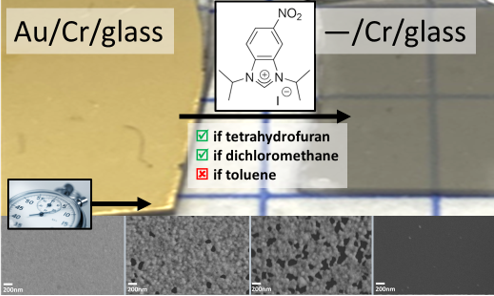
- two different solution-based surface functionalization routes. One involved the deprotonation of a benzimidazolium precursor in toluene under air-free conditions. The other was in methanol and took advantage of the equilibrium between a benzimidazolium hydrogen carbonate salt and free carbene with



Silver-based SERS substrates fabricated using a 3D printed microfluidic device
Beilstein J. Nanotechnol. 2023, 14, 793–803, doi:10.3762/bjnano.14.65
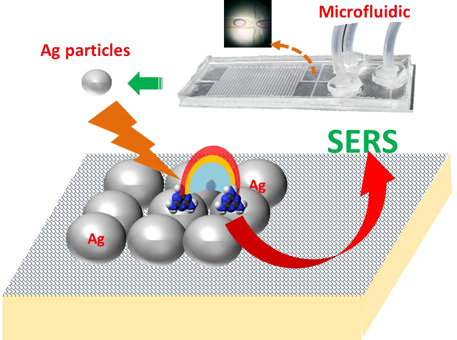
- tool for detecting ultralow concentrations of chemical compounds and biomolecules. We present a reproducible method for producing Ag nanoparticles that can be used to create highly sensitive SERS substrates. A microfluidic device was employed to confine the precursor reagents within the droplets
- method limits the amount of precursor chemicals and enables the sequential flow of droplets, resulting in silver nanoparticles of uniform shape and size. We investigated the effects of different synthesis conditions on the size distribution, dispersity, and LSPR wavelength of the silver nanoparticles



In situ magnesiothermic reduction synthesis of a Ge@C composite for high-performance lithium-ion batterie anodes
Beilstein J. Nanotechnol. 2023, 14, 751–761, doi:10.3762/bjnano.14.62
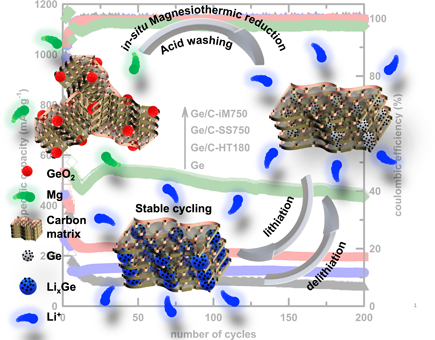
- GeO2 and biomass-derived carbon as precursor. A series of experiments using other methods to combine Ge and biomass carbon was also conducted for comparison. The in situ synthesized electrode exhibits superior electrochemical performance in lithium storage. This is attributed to a better contact
- Fd−3m, JCPDS card No. 04-0545). There is no observable signal related to the GeO2 precursor. The XRD pattern of the BC-800 carbon material exhibits a diffraction signal at 2θ = 26.3° attributed to the (002) plane of disordered graphite-like carbon. The peaks at 2θ = 28.1° and 44.0° correspond to the
- out according to our previous work [33]. Ge and BC-800 at a mass ratio of 2:5 (approximate to that estimated from the Ge/C-750 precursor) were added to a mixture of ethanol and DI water at a ratio of 1:1 (v/v). The dispersion was well stirred in a Teflon beaker, transferred into an autoclave, and held


Control of morphology and crystallinity of CNTs in flame synthesis with one-dimensional reaction zone
Beilstein J. Nanotechnol. 2023, 14, 741–750, doi:10.3762/bjnano.14.61
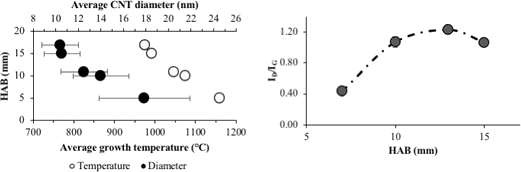
- values shows stable growth regions that yield CNTs of the same morphology. The identified regions are likely to share a common distribution of temperature and precursor concentration (scalar) that is favorable for the formation of CNTs. Although the scalar distribution could vary the formation rate


Cross-sectional Kelvin probe force microscopy on III–V epitaxial multilayer stacks: challenges and perspectives
Beilstein J. Nanotechnol. 2023, 14, 725–737, doi:10.3762/bjnano.14.59
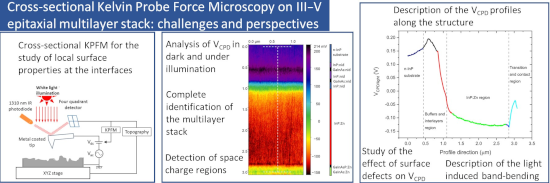
- ), and arsine (AsH3) were the source materials, with hydrogen (H2) as a carrier gas. Diethylzinc (DEZn) was used as a source of Zn for p-type doping the InP:Zn and the phosphorus-based quaternary (GaInAsP:Zn) and GaInAs:Zn layers. The precursor flow was varied to cover a doping level range from 1 × 10¹⁸


A graphene quantum dots–glassy carbon electrode-based electrochemical sensor for monitoring malathion
Beilstein J. Nanotechnol. 2023, 14, 701–710, doi:10.3762/bjnano.14.56
- hydrothermal process with glucose as a precursor undergoing carbonization. Different spectroscopic techniques were used to analyze the optical characteristics of GQDs, including UV–visible, photoluminescence, FTIR, and Raman spectroscopy. Atomic force microscopy, transmission electron microscopy, and X-ray
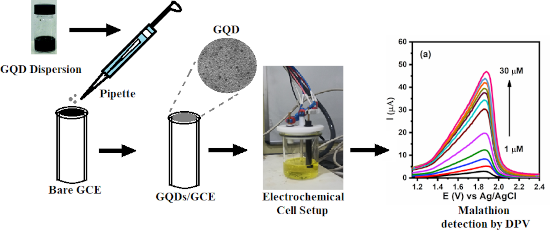
- organophosphate pesticide malathion. Graphene quantum dots were synthesized hydrothermally using glucose as precursor. The glassy carbon electrode that served as working electrode in the electrochemical cell was modified with graphene quantum dots by drop casting. To evaluate the modified electrode’s oxidation
- were taken from Fisher Scientific. For all experimental work and the preparation of stock solutions, deionized (DI) water was used. Synthesis of graphene quantum dots Graphene quantum dots (GQDs) were synthesized using glucose as a precursor material via a hydrothermal route [29] with some


Titania nanoparticles for photocatalytic degradation of ethanol under simulated solar light
Beilstein J. Nanotechnol. 2023, 14, 616–630, doi:10.3762/bjnano.14.51
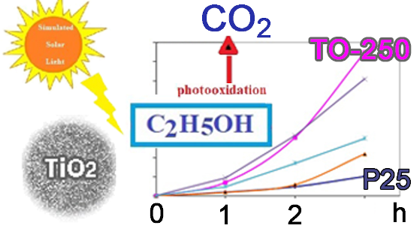
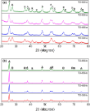
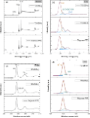
- ) that yield the highest photocatalytic decomposition of ethanol as harmful compound in gaseous or liquid media, that is air and wastewater. Results and Discussion Powder characterization The main chemical reaction of the TiCl4 precursor in laser pyrolysis in the presence of synthetic air can be
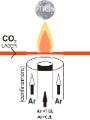
- . Ethylene was used to absorb the infrared laser radiation and transfer the energy to the precursor molecules, thus playing the role of a sensitizer. The reaction took place in the volume delimited by the orthogonally intersection of the laser beam with the precursor flow (Figure 12). The precursors were
- injected through the central nozzle. The reactive flow was a mixture of synthetic air (Siad 99.99% purity) as oxidizer, C2H4 (Siad 99.5% purity) as sensitizer, and TiCl4 vapor (Aldrich 98% purity) as Ti precursor. Synthetic air was used as carrier of gaseous TiCl4 from a liquid reservoir (via a bubbler




ZnO-decorated SiC@C hybrids with strong electromagnetic absorption
Beilstein J. Nanotechnol. 2023, 14, 565–573, doi:10.3762/bjnano.14.47
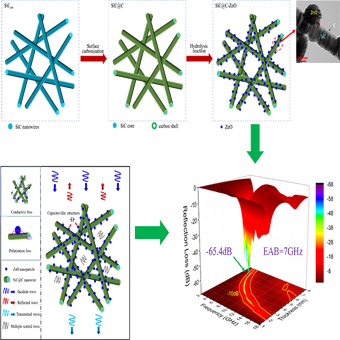
- , which has been rarely investigated before. Herein, we describe a new strategy for preparing ternary hybrids (SiC@C-ZnO, SCZ) by growing ZnO particles on carbon surfaces derived from SiC nanowires. The influence of ZnO precursor (ZnNO3·6H2O) dosage on composition, microstructure and electromagnetic
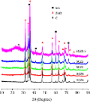
- . Figure 5 shows that the increase of the dosage of ZnNO3·6H2O does not lead to an increased dielectric tangent loss, suggesting that a moderate content of ZnO precursor is needed to synthesize SiC@C-ZnO with relatively good dielectric performance for microwave absorption. Although the SCZ0.5 sample has


Nanoarchitectonics to entrap living cells in silica-based systems: encapsulations with yolk–shell and sepiolite nanomaterials
Beilstein J. Nanotechnol. 2023, 14, 522–534, doi:10.3762/bjnano.14.43
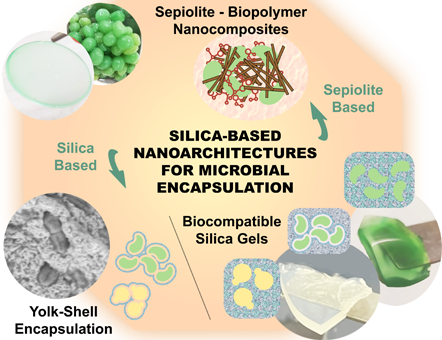
- various issues regarding the replacement of toxic precursor components and by-products by non-toxic substances in order to improve viability and/or growth of the entrapped cells. In fact, new organic, inorganic, and hybrid materials for cell entrapment need to be optimised regarding characteristics such
- adapting the protocol previously described by Rooke and co-workers [41]. The synthesis conditions were optimised regarding concentration of sodium silicate precursor, temperature, and content of silica nanoparticles (LUDOX® TMA), using a combinatorial exploration of the different synthesis parameters
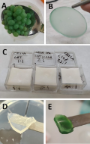
- precursor could be cast and gelled as thin films or hollow tubular monoliths with thin walls, improving the interaction between the encapsulated cells and a liquid medium in which the material could be placed. In addition to the optimisation of the sol–gel synthesis, the conditions for yolk–shell
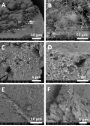


Mixed oxides with corundum-type structure obtained from recycling can seals as paint pigments: color stability
Beilstein J. Nanotechnol. 2023, 14, 467–477, doi:10.3762/bjnano.14.37
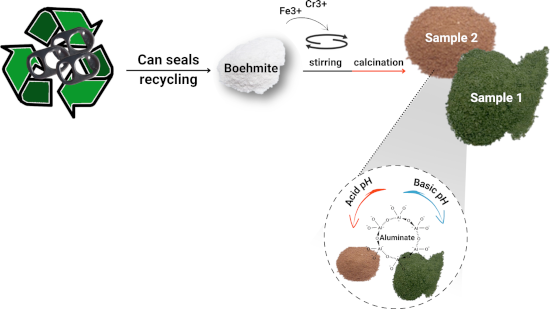
- interests to produce synthetic inorganic pigments [1] using metallic aluminium scrap as precursor to obtain a white matrix that can then be colored by chromophore ions as an approach within the circular economy of aluminium [1]. Aluminium production has one of the most significant energy consumption
- atmospheres than organic pigments [12]. In addition, inorganic pigments offer the advantage of lower production cost [12] when using recycling materials as a precursor. Global demand for pigments was around 12 million tons in 2020 and is dominated by titanium dioxide white pigment [11]. However, iron oxide
- boehmite (γ-AlO(OH)) obtained from recycling aluminium can seals as a precursor. The boehmite phase was chosen because it is a lamellar phase and can allocate ions between the lamellas. The aluminium recycling process to obtain boehmite is based on the acid digestion of metallic aluminium can seals. After




Molecular nanoarchitectonics: unification of nanotechnology and molecular/materials science
Beilstein J. Nanotechnol. 2023, 14, 434–453, doi:10.3762/bjnano.14.35
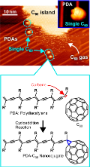
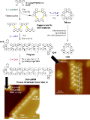
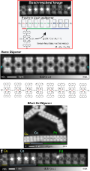
- molecular structures. Kawai et al. reported that local probe chemistry on an ultrathin NaCl film formed on a Cu(111) surface at 4.3 K led to the conversion of 6,13-dibromopentaleno[1,2-b:4,5-b′]dinaphthalene to a single Sondheimer–Wong diyne (Figure 3) [114]. The structures of the precursor, two
- -workers used 1,4,5,8-tetrabromonaphthalene as a molecular precursor and sequential dehalogenation reactions under mild conditions to synthesize very thin (five carbon atoms wide) armchair graphene nanoribbons on a Au(111) surface [122]. The spatial distribution of the electronic structure and other
- properties were investigated. Müllen, Fasel, and co-workers have succeeded in nanoarchitectonics of graphene nanoribbons with zigzag edges with atomic precision by on-surface synthesis via cyclodehydrogenation of precursor monomers [123]. The physical properties of the graphene nanoribbons, such as band





Plasmonic nanotechnology for photothermal applications – an evaluation
Beilstein J. Nanotechnol. 2023, 14, 380–419, doi:10.3762/bjnano.14.33




Polymer nanoparticles from low-energy nanoemulsions for biomedical applications
Beilstein J. Nanotechnol. 2023, 14, 339–350, doi:10.3762/bjnano.14.29
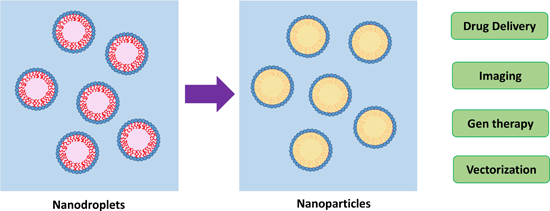
- phase, but it is always smaller (ca. 25 nm from TEM) than the precursor nanoemulsion droplets, regardless of the PLGA concentration. DXM can be encapsulated with efficiencies higher than 88% for PLGA concentrations in the 0.5–4 wt % range. The drug release kinetics seems to be slower as the PLGA
- concentration in the precursor nanoemulsions is increased. Cell viabilities (HeLa cells) were higher than 70% when incubated with non-loaded and DXM-loaded PLGA nanoparticles. PLGA nanoparticles have been also produced from nonionic/cationic surfactant nanoemulsions, specifically in the system water




Biocatalytic synthesis and ordered self-assembly of silica nanoparticles via a silica-binding peptide
Beilstein J. Nanotechnol. 2023, 14, 280–290, doi:10.3762/bjnano.14.25
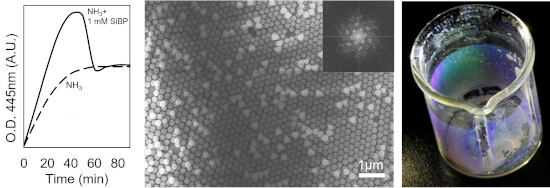
- demonstrate that the SiBP acts as a multirole agent when used alone or in combination with a strong base catalyst (NH3). When used alone, SiBP catalyzes the hydrolysis of precursor molecules in a dose-dependent manner and produces 17–20 nm SiO2 particles organized in colloidal gels. When used in combination
- (arginine) amino acids. The hypotheses of this study were as follows: (1) The basic serine and arginine residues in the SiBP can facilitate hydrolysis of the precursor molecules and, thus, catalyze the synthesis of SiO2 particles. (2) The affinity of the SiBP to SiO2 can narrow down the size distribution of
- stabilizes the favorable orientation of histidine. Then a nucleophilic attack by serine on the Si–O bond of the precursor molecule results in a Ser–O–Si(OR)3 transitory complex. The hydrolysis is completed by the addition of water, separating the protein and the hydrolyzed precursor molecule, and the release