


Search results
Search for "TiO2" in Full Text gives 370 result(s) in Beilstein Journal of Nanotechnology. Showing first 200.
A review on the green and sustainable synthesis of silver nanoparticles and one-dimensional silver nanostructures
Beilstein J. Nanotechnol. 2021, 12, 102–136, doi:10.3762/bjnano.12.9
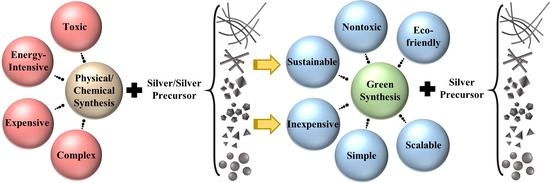
- [143][231]. In most cases, AgNPs are synthesized in metal oxide thin films such as TiO2, SiO2, and ZrO2 where the average particle size is almost 10 nm when the heating temperature is 600 °C in the case of SiO2 thin films, and 500 °C in the case of TiO2 and ZrO2 [231]. Arun Kumar et al. [145
- precursor for this purpose [241]. An important advantage of this technique is the establishment of a silver-metal-oxide (e.g. SiO2 or TiO2) nanocomposite coating using only one deposition step [241]. The CVD method also provides many opportunities for the synthesis of silver-coated materials with varying


Atomic layer deposited films of Al2O3 on fluorine-doped tin oxide electrodes: stability and barrier properties
Beilstein J. Nanotechnol. 2021, 12, 24–34, doi:10.3762/bjnano.12.2
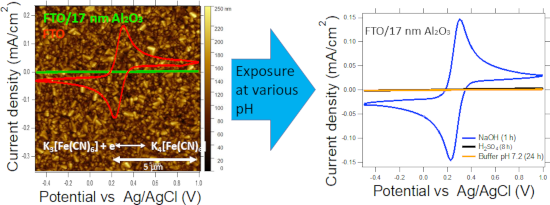
- better the blocking. This approach has been used previously [18][19][20] for testing semiconducting nonporous blocking layers of oxides (TiO2 or SnO2) deposited onto FTO. In this way, direct electron transfer between the redox couple in the electrolyte solution and the conducting substrate (i.e., FTO


Bio-imaging with the helium-ion microscope: A review
Beilstein J. Nanotechnol. 2021, 12, 1–23, doi:10.3762/bjnano.12.1

- HIM-SIMS was published by Lovric et al., who investigated E.coli bacteria exposed to TiO2 nanoparticles using the sector-field SIMS spectrometer [36]. In this review article, we build upon previous articles by Kim [37] and Gölzhäuser and Hlawacek [38] to present an overview on past discoveries and
- they investigated E.coli which were exposed to TiO2 nanoparticles with the sector-field spectrometer [36]. The authors report on secondary ion maps of CN− from the biomass as well as of Ti+ from the nanoparticles. So far, the mass resolution achieved does not allow for using HIM-SIMS to characterise


Unravelling the interfacial interaction in mesoporous SiO2@nickel phyllosilicate/TiO2 core–shell nanostructures for photocatalytic activity
Beilstein J. Nanotechnol. 2020, 11, 1834–1846, doi:10.3762/bjnano.11.165
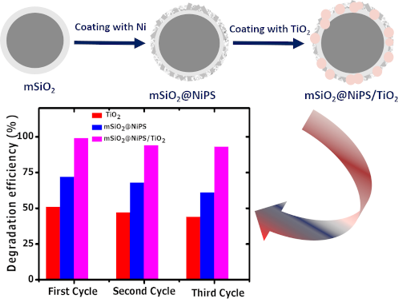
- @NiPS/TiO2) core–shell nanostructures. The TEM results showed that the mSiO2@NiPS composite has a core–shell nanostructure with a unique flake-like shell morphology. XPS analysis revealed the successful formation of 1:1 nickel phyllosilicate on the SiO2 surface. The addition of TiO2 to the mSiO2@NiPS
- yielded the mSiO2@NiPS/TiO2 composite. The bandgap energy of mSiO2@NiPS and of mSiO2@NiPS/TiO2 were estimated to be 2.05 and 2.68 eV, respectively, indicating the role of titania in tuning the optoelectronic properties of the SiO2@nickel phyllosilicate. As a proof of concept, the core–shell nanostructures
- were used as photocatalysts for the degradation of methyl violet dye and the degradation efficiencies were found to be 72% and 99% for the mSiO2@NiPS and the mSiO2@NiPS/TiO2 nanostructures, respectively. Furthermore, a recyclability test revealed good stability and recyclability of the mSiO2@NiPS/TiO2


Nanocasting synthesis of BiFeO3 nanoparticles with enhanced visible-light photocatalytic activity
Beilstein J. Nanotechnol. 2020, 11, 1822–1833, doi:10.3762/bjnano.11.164
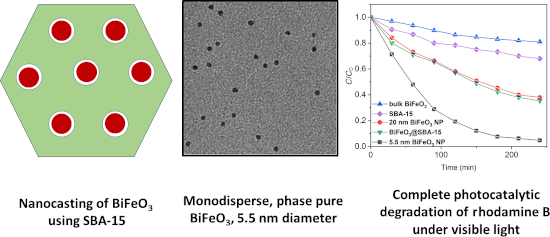
- the complete mineralization of dyes is achieved by the generation of hydroxyl and superoxide anion radicals [10][11]. Traditional photocatalysts, such as TiO2 or ZnO, provide chemical stability and facile preparation methods [12][13]. However, their environmental benefit in large-scale industrial




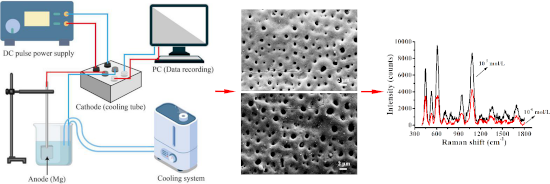
Fabrication of nano/microstructures for SERS substrates using an electrochemical method
Beilstein J. Nanotechnol. 2020, 11, 1568–1576, doi:10.3762/bjnano.11.139
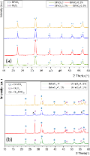
- a KCl-saturated Ag/AgCl rod are used as the working, counter, and reference electrodes, respectively. Using this approach, Au/TiO2 nanocomposites formed on Pt substrates yielded a SERS enhancement factor of 1.8 × 10⁸ for R6G molecules [34]. Chang et al. [35] fabricated different Ag nanostructures on


Antimicrobial metal-based nanoparticles: a review on their synthesis, types and antimicrobial action
Beilstein J. Nanotechnol. 2020, 11, 1450–1469, doi:10.3762/bjnano.11.129

- different morphologies and sizes. For example, the technique has been used to obtain ultrafine MgO nanoparticles (8–10 nm) [50], TiO2 nanoparticles (10–20 nm) [51], and even flower-like microstructures (diameter ≈6 µm) and microtubes (diameter ≈1 µm and length ≈4 µm) [52]. The sol–gel technique has been
- widely used to synthesize nanoparticles since it is a simple and relatively fast technique. With this technique it is possible to fabricate TiO2 NPs smaller than 10 nm [56][57] and MgO NPs with sizes ranging from 35 to 50 nm [53][54]. Furthermore, it has been used in the synthesis of N–Ag–TiO2–ZnO
- ][132]. When the size of titanium dioxide is reduced to the nanoscale (TiO2 NPs), its photocatalytic property is greatly improved, generating more reactive oxygen species (ROS). ROS damages bacterial cells, DNA chains, and other cellular structures through oxidative stress. Therefore, the use of TiO2


High permittivity, breakdown strength, and energy storage density of polythiophene-encapsulated BaTiO3 nanoparticles
Beilstein J. Nanotechnol. 2020, 11, 1190–1197, doi:10.3762/bjnano.11.103
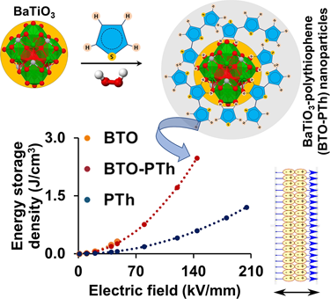
- dioxide (TiO2 Tronox, 99.5%, Tronox Pigments GmbH) are used as Ba and Ti precursors for the hydrothermal synthesis of BTO nanoparticles. Ba(OH)2·8H2O also acts as the mineralizer and prevents the use of NaOH or KOH for controlling the pH value of the reaction mixture [12]. Equimolar amounts of Ba and Ti


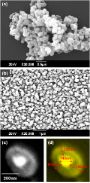


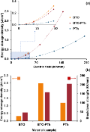
Photothermally active nanoparticles as a promising tool for eliminating bacteria and biofilms
Beilstein J. Nanotechnol. 2020, 11, 1134–1146, doi:10.3762/bjnano.11.98
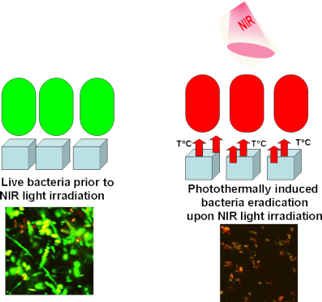
- formation are controversial as the Ag nanoparticles seem to be effective against the Gram-negative but not so much against the Gram-positive strains [6]. The antibacterial properties of a wide range of nanoparticles and their corresponding nanocomposites, such as ZnO [17][18], TiO2 [19][20], Fe3O4 [21][22


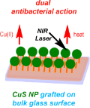
Gram-scale synthesis of splat-shaped Ag–TiO2 nanocomposites for enhanced antimicrobial properties
Beilstein J. Nanotechnol. 2020, 11, 1119–1125, doi:10.3762/bjnano.11.96

- multidrug-resistant bacterial strains. In this regard, metal-oxide-based antibacterial nanomaterials have received potential research interest due to the efficient prevention of microorganism growth. In this study, splat-shaped Ag–TiO2 nanocomposites (NCs) were synthesized on the gram scale and the enhanced
- antibacterial properties of TiO2 in the presence of silver were examined. The formation of Ag–TiO2 NCs was analyzed through various characterization techniques. The cell viability experimental results demonstrated that the Ag–TiO2 NCs have good biocompatibility. The antibacterial activity of the prepared Ag
- –TiO2 NCs was tested against the Gram-positive Staphylococcus aureus (S. aureus) and Gram-negative Escherichia coli (E. coli) bacterial strains. The Ag–TiO2 NCs exhibited promising and superior antibacterial properties compared to TiO2 nanospheres as confirmed by the bacterial growth and inhibition zone


Highly sensitive detection of estradiol by a SERS sensor based on TiO2 covered with gold nanoparticles
Beilstein J. Nanotechnol. 2020, 11, 1026–1035, doi:10.3762/bjnano.11.87
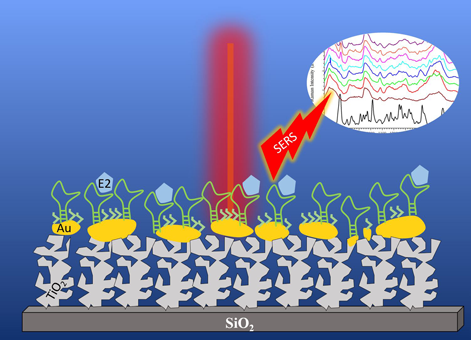
- Procédés et des Matériaux (LSPM), CNRS, Université Sorbonne Paris Nord, 93430, Villetaneuse, France CSPBAT, UMR 7244, Université Sorbonne Paris Nord, 93430 Villetaneuse, France 10.3762/bjnano.11.87 Abstract We propose the use of gold nanoparticles grown on the surface of nanoporous TiO2 films as surface
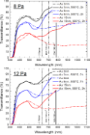
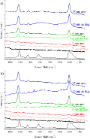
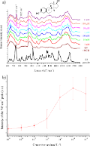
- -enhanced Raman scattering (SERS) sensors for the detection of 17β-estradiol. Gold deposition on top of a TiO2 surface leads to the formation of nanoparticles the plasmonic properties of which fulfil the requirements of a SERS sensor. The morphological and optical properties of the surface were investigated
- . Specifically, we demonstrate that the TiO2 background pressure during pulsed laser deposition and the annealing conditions offer control over the formation of Au nanoparticles with different sizes, shapes and distributions, yielding a versatile sensor. We have exploited the surface for the detection of 17β



Atomic layer deposition for efficient oxygen evolution reaction at Pt/Ir catalyst layers
Beilstein J. Nanotechnol. 2020, 11, 952–959, doi:10.3762/bjnano.11.79
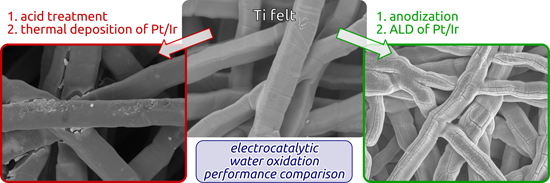
- etching. The surface roughness has increased, thereby increasing the specific surface area. The acid treatment also generates a homogeneously thin and stable TiO2 layer, which provides corrosion resistance while maintaining low transfer coefficients [24]. After coating with the catalyst layer (Figure 1c
- this, a Pt/Ir mixture can be deposited along the TiO2 tube walls by atomic layer deposition (ALD). Energy-dispersive X-ray analysis confirms the presence of all elements expected (Figure 3d). The metallic nature of the ALD deposits, the lack of any segregation between Pt and Ir, and the metal oxide


Adsorption behavior of tin phthalocyanine onto the (110) face of rutile TiO2
Beilstein J. Nanotechnol. 2020, 11, 821–828, doi:10.3762/bjnano.11.67

- , Swiss Federal Laboratories for Materials Science and Technology, Überlandstrasse 129, 8600 Dübendorf, Switzerland 10.3762/bjnano.11.67 Abstract The adsorption behavior of tin phthalocyanine (SnPc) molecules on rutile TiO2(110) was studied by scanning tunneling microscopy (STM). Low-temperature STM
- measurements of single molecules reveal the coexistence of two conformations of molecules on the TiO2 surface. Density functional theory-based simulations (DFT) indicate that the difference originates from the position of the tin atom protruding from the molecule plane. The irreversible switching of Sn-up
- tunneling microscopy (STM); tin phthalocyanine (SnPc); titanium dioxide (TiO2); Introduction Phthalocyanines (Pcs) are aromatic molecules that can form metal complexes with a variety of elements, which can be used to tune molecular properties, such as position or shape of adsorption bands. Therefore, Pcs


Effect of Ag loading position on the photocatalytic performance of TiO2 nanocolumn arrays
Beilstein J. Nanotechnol. 2020, 11, 717–728, doi:10.3762/bjnano.11.59
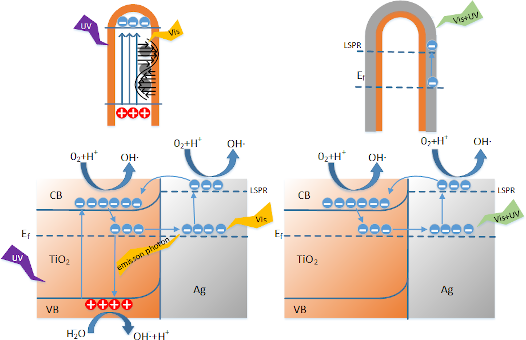
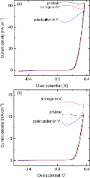
- solar energy harvesting in photovoltaic and photocatalytic applications owing to their extremely high visible-light absorption and tuned effective band gap. In this work, Ag-loaded TiO2 nanocolumn (Ag-TNC) arrays were fabricated based on anodic aluminum oxide (AAO) template by combining atomic layer
- deposition (ALD) and vacuum evaporation. The effects of the Ag loading position and deposition thickness, and the morphology, structure and composition of Ag-deposited TNC arrays on its optical and photocatalytic properties were studied. The Ag-filled TiO2 (AFT) nanocolumn arrays exhibited higher removal
- efficiency of methylene blue (MB) compared with Ag-coated TiO2 (ACT) nanocolumn arrays and pure TiO2 nanocolumns arrays. Both experimental and theoretical simulation results demonstrated that the enhanced photocatalytic performance of AFT nanocolumn arrays was attributed to the surface plasmon resonance (SPR


A novel dry-blending method to reduce the coefficient of thermal expansion of polymer templates for OTFT electrodes
Beilstein J. Nanotechnol. 2020, 11, 671–677, doi:10.3762/bjnano.11.53
- . González-Benito et al. [11] used high-energy ball cryomilling to uniformly disperse 5 wt % of titanium dioxide (TiO2) nanoparticles with a size of 65 nm within poly(ethylene-co-vinyl acetate) (EVA) to subsequently obtain a film of the composite with lower CTE by hot pressing. Ren et al. [12] first prepared


Preparation, characterization and photocatalytic performance of heterostructured CuO–ZnO-loaded composite nanofiber membranes
Beilstein J. Nanotechnol. 2020, 11, 631–650, doi:10.3762/bjnano.11.50
- narrow direct bandgap of 1.2–1.79 eV [14]. Because of that, CuO is usually used in combination with large-bandgap semiconductors, such as ZnO and TiO2, in order to improve their photocatalytic activity under solar light irradiation [15]. It was reported that the p–n heterojunction between ZnO and CuO has
- characteristics, such as high surface area, good thermal stability, and excellent mechanical properties [32][33]. CNFs loaded with metal oxide nanoparticles have attracted a great deal of attention regarding the photocatalytic purification of water. He et al. [34] fabricated porous graphene/TiO2 CNFs by
- electrospinning and observed their photocatalytic performance. Yuan et al. [35] obtained TiO2/WO3 CNFs using electrospinning and applied them in the photocatalytic removal of mercury. Teng et al. [36] prepared TiO2/NiO CNFs by electrospinning and used them for photocatalysis. Polyacrylonitrile (PAN) has been












Correction: Photocatalytic antibacterial performance of TiO2 and Ag-doped TiO2 against S. aureus. P. aeruginosa and E. coli
Beilstein J. Nanotechnol. 2020, 11, 547–549, doi:10.3762/bjnano.11.43

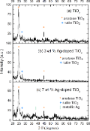
- ., India Department of Biotechnology, Motilal Nehru National Institute of Technology, Allahabad, Prayagraj, 211004, U.P., India 10.3762/bjnano.11.43 Keywords: Ag-doped TiO2; antimicrobial activity; sol–gel; The following is a correction to the section “XRD of TiO2 and Ag-doped TiO2”, which contains a new
- results of the article. XRD of TiO2 and Ag-doped TiO2 nanoparticles X-ray diffraction (XRD) was used to characterize as-prepared TiO2 and Ag-doped TiO2 nanoparticles. The diameter of crystalline TiO2, 3 wt % Ag-doped TiO2 and 7 wt % Ag-doped TiO2 nanoparticles annealed at 450 °C was calculated by the
- the measured XRD pattern to powder diffraction patterns in the International Centre for Diffraction Data (ICDD) database. The characteristic peaks of the TiO2 nanoparticle sample indicate an anatase phase (2θ = 24.8°, 44.5°, compared with JCPDS file no. 00-021-1272) with some indication of a rutile
Interfacial charge transfer processes in 2D and 3D semiconducting hybrid perovskites: azobenzene as photoswitchable ligand
Beilstein J. Nanotechnol. 2020, 11, 466–479, doi:10.3762/bjnano.11.38
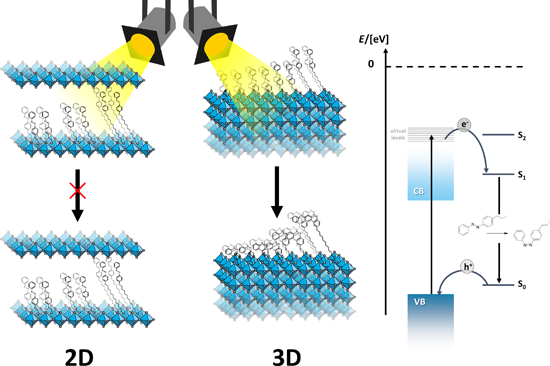
- system of a semiconductor. Torres et al. reported calculations of a charge-transfer complex of para-methyl red/TiO2 in the gas phase where the isomerisation is fully quenched. The photoexcited state is oxidized immediately through a charge transfer from the azobenzene to TiO2 and no conformational change
- photoswitching of azobenzene on semiconducting TiO2 is suppressed due to a sudden oxidation of the chromophore. The formation of a heterogeneous charge-transfer complex disturbs the isomerisation and no photoswitching is observed [37]. To clarify possible electronical processes, the relative energies of valence
- ligands attached to semiconductors can change conformation under irradiation with light is still a question that is being discussed. Rego et al. simulated a very fast charge transfer from azobenzene to the conduction band of TiO2, followed by a strong vibronic relaxation that excites the N–N stretching




Nanoarchitectonics: bottom-up creation of functional materials and systems
Beilstein J. Nanotechnol. 2020, 11, 450–452, doi:10.3762/bjnano.11.36
- TiO2 and ZnO nanoparticles exhibit distinct and useful properties [35]. Other examples include a self-assembled MoS2-based composite that was developed for energy conversion and storage purposes [36], a silver-nanoparticle/cellulose-nanofiber composite that was applied for surface-enhanced Raman

Atomic-resolution imaging of rutile TiO2(110)-(1 × 2) reconstructed surface by non-contact atomic force microscopy
Beilstein J. Nanotechnol. 2020, 11, 443–449, doi:10.3762/bjnano.11.35
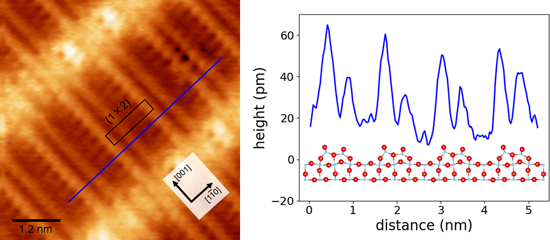
- Systems Engineering, Kochi University of Technology, 185 Miyanokuchi, Tosayamada, Kami, Kochi 782-8502, Japan 10.3762/bjnano.11.35 Abstract The structure of the rutile TiO2(110)-(1 × 2) reconstructed surface is a phase induced by oxygen reduction. There is ongoing debate about the (1 × 2) reconstruction
- characterize the surface. Ti2O3 rows appeared as bright spots in both NC-AFM and STM images observed in the same area. High-resolution NC-AFM images revealed that the rutile TiO2(110)-(1 × 2) reconstructed surface is composed of two domains with different types of asymmetric rows. Keywords: non-contact atomic
- force microscopy; (1 × 2) reconstruction; rutile; surface structure; titanium dioxide (TiO2); Introduction Titanium dioxide (TiO2) is a well-known photocatalyst and has been studied for applications in water splitting and the coating of materials [1]. To optimize the photocatalytic function, it is


Synthesis and enhanced photocatalytic performance of 0D/2D CuO/tourmaline composite photocatalysts
Beilstein J. Nanotechnol. 2020, 11, 407–416, doi:10.3762/bjnano.11.31
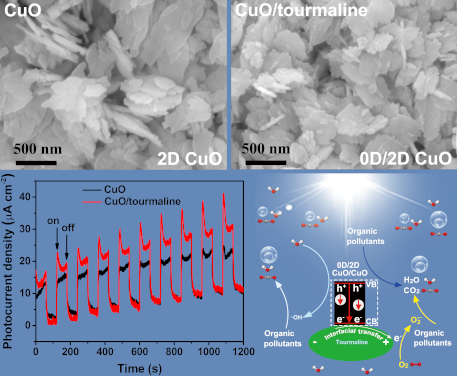
- the treatment of organic contaminants in wastewater is in urgent need owing to the deterioration of the ecological environment [1]. Metal oxides, such as ZnO [2], TiO2 [3], Fe2O3 [4], and CuO [5], have been demonstrated to be promising photocatalysts. In particular, the band gap energy (Eg) of the p
- construction of CuO-based heterostructures (e.g., 0D/2D CuO/TiO2, 0D/3D CuO/ZnO, 2D/2D CuO/Fe2O3, 0D/2D CuO/C3N4, 2D/0D CuO/Ag3PO4) [6][12][15][16][17] and the dispersion of CuO on supporting materials (e.g., graphene, carbon nanotube) [7][18] are considered to be the most effective ways to address these


Fabrication of Ag-modified hollow titania spheres via controlled silver diffusion in Ag–TiO2 core–shell nanostructures
Beilstein J. Nanotechnol. 2020, 11, 141–146, doi:10.3762/bjnano.11.12
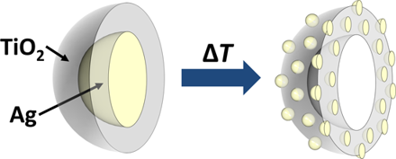
- metal nanoparticles. A simple method employing sol–gel coating of nanoparticles with titania followed by controlled silver diffusion was developed and applied for the synthesis of Ag-modified hollow TiO2 spheres. The morphology of the synthesized structures and their chemical composition was
- investigated using SEM and X-ray photoelectron spectroscopy, respectively. The optical properties of the synthesized structures were characterized using UV–vis spectroscopy. Ag–TiO2 hollow nanostructures with different optical properties were prepared simply by a change of the annealing time in the last
- (HSs) have received increasing attention due to their potential application in a variety of areas [1][2][3][4] such as solar energy conversion or photocatalysis [2][5][6][7]. Among them, of great interest are TiO2 HSs modified with plasmonic nanoparticles (NPs), which allow for the combination of the



Recent progress in perovskite solar cells: the perovskite layer
Beilstein J. Nanotechnol. 2020, 11, 51–60, doi:10.3762/bjnano.11.5

- and spray coating PSC fabrication processes. Jiang et al. [34] solved this problem by successfully applying inkjet printing to deposit a flat and uniform CH3NH3PbI3 (MAPbI3) perovskite layer on a TiO2 film. Inkjet printing is a noncontact printing technique with direct control of material deposition


Synthesis of amorphous and graphitized porous nitrogen-doped carbon spheres as oxygen reduction reaction catalysts
Beilstein J. Nanotechnol. 2020, 11, 1–15, doi:10.3762/bjnano.11.1
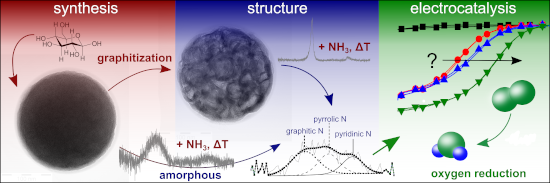
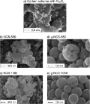
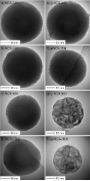
- Figure 10), where they were covered by a layer of N-doped TiO2 (TiON@NCS) [34] or N-doped TaxOy (TaON@NCS) [33]. The covering was supposed to serve two purposes, first, to yield ORR activity and, second, to protect the (nitrided) carbon core against corrosion. In this study we used the same procedure for





Advanced hybrid nanomaterials
Beilstein J. Nanotechnol. 2019, 10, 2563–2567, doi:10.3762/bjnano.10.247
- the polyol process” [19], the synthetic process was found to be of prime importance to shape the nanoparticles and to optimize their surface/volume ratio in relation to the magnetic behavior. A one-step non-hydrolytic sol–gel synthesis of mesoporous TiO2 phosphonate hybrid materials was applied to



