


Search results
Search for "aluminium" in Full Text gives 154 result(s) in Beilstein Journal of Nanotechnology.
Properties of Ni and Ni–Fe nanowires electrochemically deposited into a porous alumina template
Beilstein J. Nanotechnol. 2016, 7, 1709–1717, doi:10.3762/bjnano.7.163
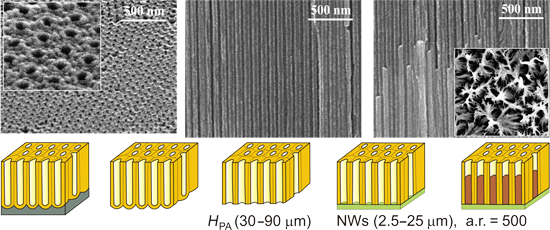
- anodization of Al foil, as described in details elsewhere [35]. First, commercial aluminium foil (99.995%) with a size of 60 × 48 mm and a thickness of ca. 100 µm is annealed at 350 °C for 1 h. Then, the samples were electropolished in a mixture of chloric acid and acetic acid 1:4 (volumetric ratio) at T ≈ 8


Biomechanics of selected arborescent and shrubby monocotyledons
Beilstein J. Nanotechnol. 2016, 7, 1602–1619, doi:10.3762/bjnano.7.154
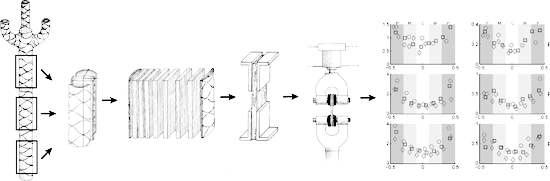
- & Peschke, Nossen, Germany). To prevent slipping of the samples, they were fixed with all-purpose glue (Blitzschnelle Pipette, UHU GmbH & Co KG, Bühl, Germany) in four L-shaped aluminium brackets which then were clamped to the jaws of the testing device (Figure 2B). The free length (lfree) for each sample
- two aluminium plates (Figure 2C) at a distance of roughly 10 mm with all-purpose glue (Blitzschnelle Pipette, UHU, GmbH & Co KG, Bühl, Germany). Samples were kept in a box with wet paper tissue until testing to prevent the samples from drying. The tensile testing of the samples was performed at a



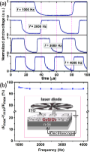
Nanostructured germanium deposited on heated substrates with enhanced photoelectric properties
Beilstein J. Nanotechnol. 2016, 7, 1492–1500, doi:10.3762/bjnano.7.142
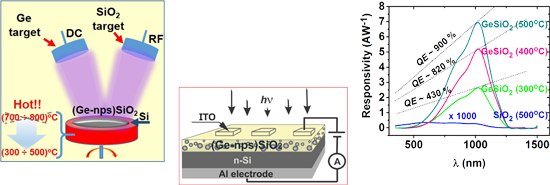
- . Under these conditions, the resulted film thickness is about 250 nm after 30 min for deposition. For electrical, photoelectrical and speed time response measurements, an aluminium (Al) continuous back electrode and a top matrix of indium thin oxide (ITO) electrodes (9 mm2 in size) using the shadow




The influence of phthalocyanine aggregation in complexes with CdSe/ZnS quantum dots on the photophysical properties of the complexes
Beilstein J. Nanotechnol. 2016, 7, 1018–1027, doi:10.3762/bjnano.7.94
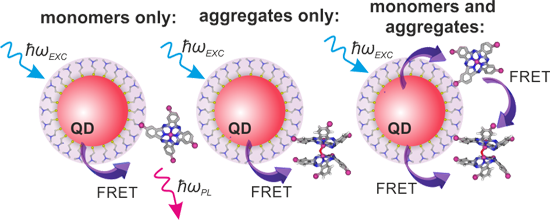
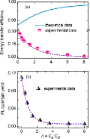
- Technology, Dublin 8, Ireland 10.3762/bjnano.7.94 Abstract The formation of nonluminescent aggregates of aluminium sulfonated phthalocyanine in complexes with CdSe/ZnS quantum dots causes a decrease of the intracomplex energy transfer efficiency with increasing phthalocyanine concentration. This was
- ][21]. This statement was recently supported by the Nyokong group [22] where FRET efficiencies up to 93% were predicted in nanocomposites based on glutathione-capped CdTe/CdS/ZnS QDs covalently linked with aluminium sulfonated phthalocyanine. However, analysis of donor PL quenching and acceptor PL
- problem important for PDT application needs to be clarified. Water-soluble sulfonated phthalocyanine derivatives, especially aluminium and zinc complexes, are well-understood sensitizers for PDT and, at the same time, they easily form nonluminescent aggregates in aqueous solution [30][31][32][33][34]. So



Reconstitution of the membrane protein OmpF into biomimetic block copolymer–phospholipid hybrid membranes
Beilstein J. Nanotechnol. 2016, 7, 881–892, doi:10.3762/bjnano.7.80
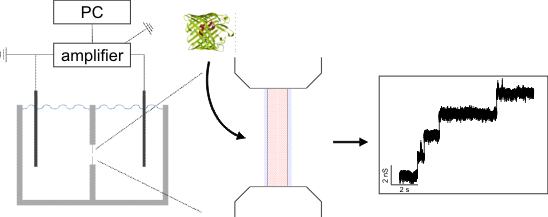
- block copolymers. (A) Reaction scheme for the synthesis of poly(1,4-isoprene-block-ethylene oxide) block copolymers. Anionic polymerization of isoprene in toluene was initiated with sec-butyl lithium. Sequential polymerization of ethylene oxide was enabled by triisobutyl aluminium. (B) Size exclusion



Understanding interferometry for micro-cantilever displacement detection
Beilstein J. Nanotechnol. 2016, 7, 841–851, doi:10.3762/bjnano.7.76
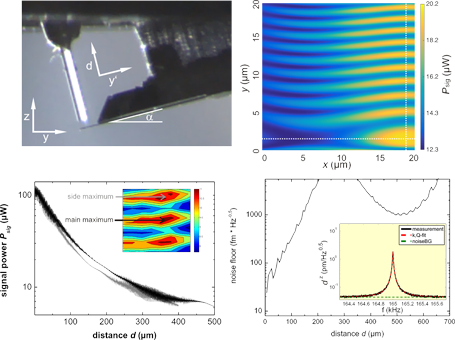
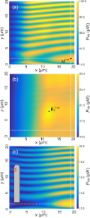
- area of 20 μm × 20 μm. A SPM1000 scan controller (RHK Technology Inc., Troy(MI) USA) is used to drive the scanning tube piezo, while a custom-built, low-noise power supply is used to position the fiber exactly at the optimal position. Most experiments are performed with three aluminium-coated silicon




![[Graphic 27]](/bjnano/content/inline/2190-4286-7-76-i36.png?max-width=637&scale=1.18182) of the noise floor of the interferometer signal as a function of the...
of the noise floor of the interferometer signal as a function of the...
Templated green synthesis of plasmonic silver nanoparticles in onion epidermal cells suitable for surface-enhanced Raman and hyper-Raman scattering
Beilstein J. Nanotechnol. 2016, 7, 834–840, doi:10.3762/bjnano.7.75
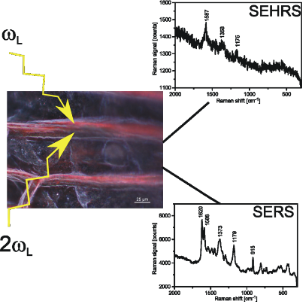
- nanoparticles; surface-enhanced Raman scattering; surface-enhanced hyper-Raman scattering; Introduction Nanostructures made from metals, such as silver, gold, aluminium or palladium in various sizes and shapes attract growing attention because of their interesting properties and broad applications in many


Direct formation of gold nanorods on surfaces using polymer-immobilised gold seeds
Beilstein J. Nanotechnol. 2016, 7, 809–816, doi:10.3762/bjnano.7.72
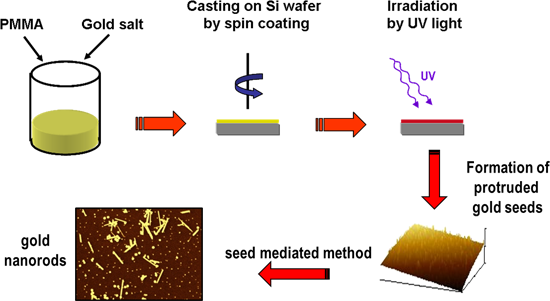
- solutions were deposited on substrates (silicon wafers, glass or Si3N4 membranes) through spin-coating. Finally, these films were kept under a DC deuterium 30 W UV lamp for 24 h. The UV lamp is operated at 310 mA and 72 V. A UV-enhanced aluminium flat mirror from Thorlabs Inc. was used to divert the UV beam
- ) high Mw PMMA with 60 wt % Au salt concentration (P2-60). Set-up for UV exposure on the samples using a deuterium UV lamp with diverted beam set-up using an UV-enhanced aluminium flat mirror. Acknowledgements MKA would like to thanks Ms. Katie Cunnea from Research complex at Harwell (RCaH) for her


Functional fusion of living systems with synthetic electrode interfaces
Beilstein J. Nanotechnol. 2016, 7, 296–301, doi:10.3762/bjnano.7.27
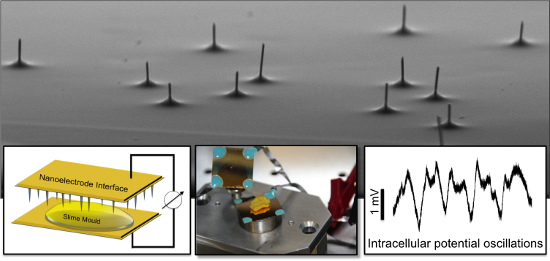
- homogenous, low defect and parallel-oriented crystal planes were produced by electrodeposition as previously described [1]. This process employed polycarbonate (PC), track-etched filter membranes with a pore density of 1 × 10⁶ pores/cm2 and a pore size of 100 nm (Figure 1a, 1–4). Aluminium (Al) contacts were


Synthesis and applications of carbon nanomaterials for energy generation and storage
Beilstein J. Nanotechnol. 2016, 7, 149–196, doi:10.3762/bjnano.7.17
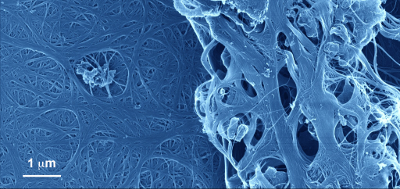
- , ≈0.62–1.25 TPa [40] Electrical resistivity, ≈1 μΩ cm [41] Thermal conductivity, ≈3000 W/mK [42] In addition to their extraordinary properties, the density of CNTs is around 1.33–1.4 g/cm3 [40], which is half of the density of aluminium (2.7 g/cm3), making them very attractive for lightweight















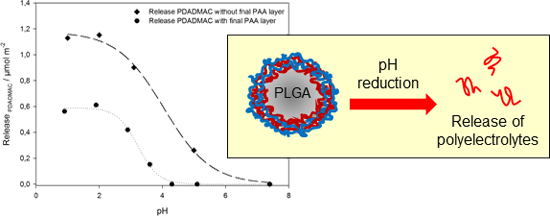
pH-Triggered release from surface-modified poly(lactic-co-glycolic acid) nanoparticles
Beilstein J. Nanotechnol. 2015, 6, 2504–2512, doi:10.3762/bjnano.6.260
- ). An aliquot (20.0 µL) of homogenized nanoparticle dispersion was transferred to a disposable aluminium weighing dish, which was weighted previously. The filled weighing dish was dried for at least four hours in a drying cabinet (Thermo Fisher Scientific Inc., USA) at 80 °C. The particle concentration


Large area scanning probe microscope in ultra-high vacuum demonstrated for electrostatic force measurements on high-voltage devices
Beilstein J. Nanotechnol. 2015, 6, 2485–2497, doi:10.3762/bjnano.6.258
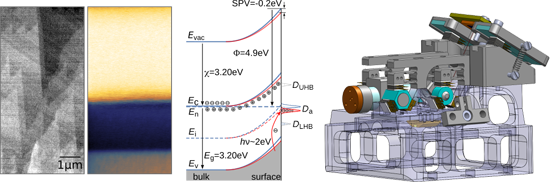
- Fermi-level position on SiC samples is strongly affected by surface preparation and material properties [44]. Figure 6 shows a KPFM measurement of a SiC calibration sample consisting of a 2 μm thick nitrogen-doped n-type (NN = 2 × 1018 cm−3) followed by a 4 μm thick aluminium doped p-type (NAl = 1


A single-source precursor route to anisotropic halogen-doped zinc oxide particles as a promising candidate for new transparent conducting oxide materials
Beilstein J. Nanotechnol. 2015, 6, 2161–2172, doi:10.3762/bjnano.6.222
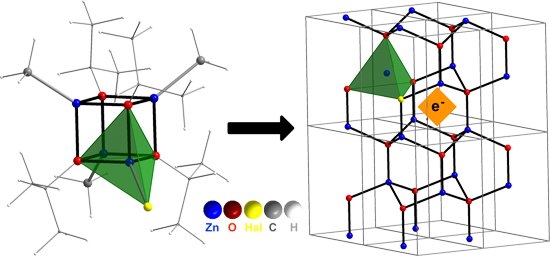
- ], most attention was devoted to n-doping via substitution in the cation (Zn2+) lattice. The most prominent example known to date is aluminium-doped ZnO (AZO) [21][22]. AZO contains much more common elements compared to ITO, however, it cannot yet compete regarding its electrical properties. Much less



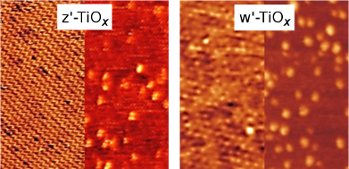
Distribution of Pd clusters on ultrathin, epitaxial TiOx films on Pt3Ti(111)
Beilstein J. Nanotechnol. 2015, 6, 2007–2014, doi:10.3762/bjnano.6.204
- the Moiré superstructure of ultrathin aluminium oxide films grown on the chemically ordered, Ni3Al(111) surface [11][12][13][14]. The advantages of growing an oxide film from a component of an ordered alloy surface with a higher enthalpy of oxide formation are the somewhat better structural quality of


Radiation losses in the microwave Ku band in magneto-electric nanocomposites
Beilstein J. Nanotechnol. 2015, 6, 1700–1707, doi:10.3762/bjnano.6.173
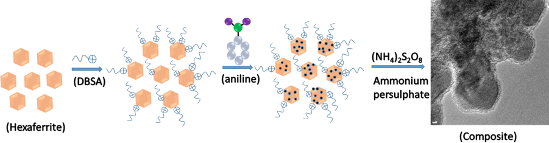
- , samples have been moulded in rectangular shape using an aluminium die. Polyvinyl alcohol (PVA) is used as a hardener to enhance the strength of the pellet. The incident electromagnetic wave continually gets reflected and scattered within the PANI and embedded particles and get entrapped causing a loss of


Structural and magnetic properties of iron nanowires and iron nanoparticles fabricated through a reduction reaction
Beilstein J. Nanotechnol. 2015, 6, 1652–1660, doi:10.3762/bjnano.6.167
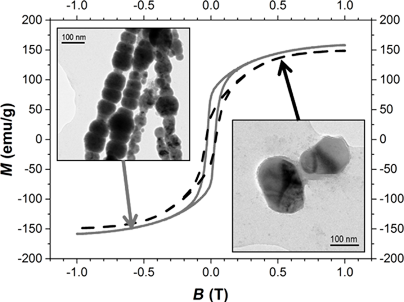
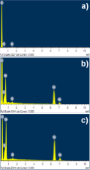
- empty sample holder, the holder with nanowires and the holder with nanoparticles are presented in Figure 2. All of them contain the signals originating from aluminium, carbon and oxygen. This is caused by usage of the aluminium holder, which has been covered with graphite to allow for the conduction of



Nanomechanical humidity detection through porous alumina cantilevers
Beilstein J. Nanotechnol. 2015, 6, 1332–1337, doi:10.3762/bjnano.6.137
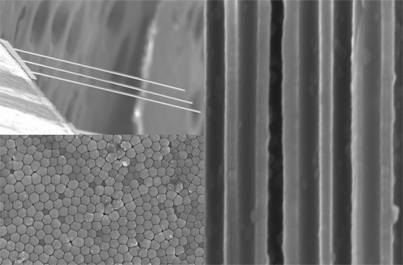
- behavior of the resonance frequency of porous anodic alumina cantilever arrays during water vapor adsorption and emphasize their possible use in the micromechanical sensing of humidity levels at least in the range of 10–22%. The sensitivity of porous anodic aluminium oxide cantilevers (Δf/Δm) and the
- of the cantilever arrays for micromechanical sensing. Keywords: anodic aluminium oxide; atomic force microscopy (AFM); cantilever arrays; humidity; mechanical sensor; porous alumina; Introduction The last two decades have seen a surge in resonant micro- and nanomechanical engineering raised by the
- through porosity”. One promising porous system exhibiting all the necessary characteristics is anodic aluminium oxide (AAO). Its huge surface area offers an enormous number of binding sites. The adsorption of chemicals on the surface of the cantilever manifests itself by the shift of the resonance



Charge carrier mobility and electronic properties of Al(Op)3: impact of excimer formation
Beilstein J. Nanotechnol. 2015, 6, 1107–1115, doi:10.3762/bjnano.6.112
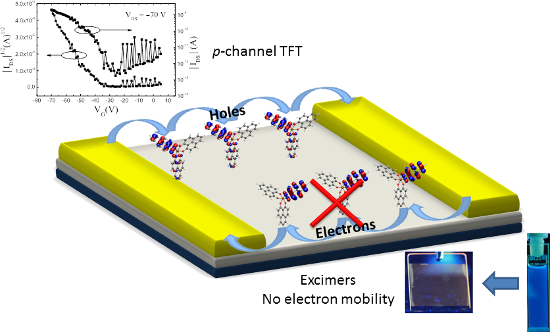
- carrier mobility of the organic semiconductor tris(1-oxo-1H-phenalen-9-olate)aluminium(III) (Al(Op)3) both experimentally and theoretically. We experimentally estimated the HOMO and LUMO energy levels to be −5.93 and −3.26 eV, respectively, which were close to the corresponding calculated values. Al(Op)3


High sensitivity and high resolution element 3D analysis by a combined SIMS–SPM instrument
Beilstein J. Nanotechnol. 2015, 6, 1091–1099, doi:10.3762/bjnano.6.110
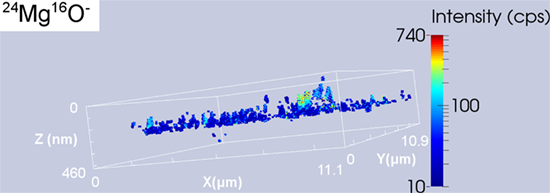
- included inside the γ matrix. Figure 2c and Figure 2d show the overlay between the AFM and the SIMS mapping after sputtering a 15 × 15 µm2 area for 16 h. Given that the initial sample surface was flat (root mean squared roughness of 1.1 nm), it can be noticed that the aluminium-containing γ′ phase sputters


From lithium to sodium: cell chemistry of room temperature sodium–air and sodium–sulfur batteries
Beilstein J. Nanotechnol. 2015, 6, 1016–1055, doi:10.3762/bjnano.6.105
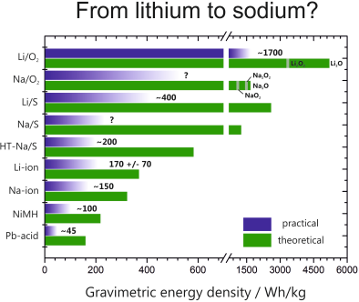
- or stop at a different stoichiometry. Two notable exceptions exist that might be of advantage for sodium cells. Aluminium forms binary alloys with lithium but not with sodium. Therefore, aluminium instead of the more expensive copper can be used as a current collector for the negative electrode in


Morphology control of zinc oxide films via polysaccharide-mediated, low temperature, chemical bath deposition
Beilstein J. Nanotechnol. 2015, 6, 799–808, doi:10.3762/bjnano.6.83
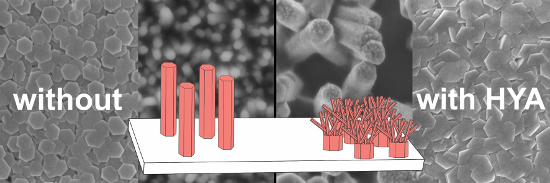
- where highly conductive materials are required (e.g., solar cells and light emitting diodes (LEDs)), ZnO must be doped. Several groups have reported the successful doping of ZnO films with dopants such as magnesium [21], iodine [22], boron [23][24], titanium [25], manganese [26], and aluminium [27][28




Influence of gold, silver and gold–silver alloy nanoparticles on germ cell function and embryo development
Beilstein J. Nanotechnol. 2015, 6, 651–664, doi:10.3762/bjnano.6.66
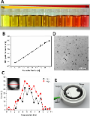
- . (C) TEM-EDX line scan with inset showing high-angular annular dark field micrograph. (D) TEM micrograph of a Ag50Au50 nanoparticle dispersion after stabilisation with BSA. (E) Aluminium batch chamber for the synthesis of silver and gold–silver alloy nanoparticles. Reproduced with permission from [50




Silica micro/nanospheres for theranostics: from bimodal MRI and fluorescent imaging probes to cancer therapy
Beilstein J. Nanotechnol. 2015, 6, 546–558, doi:10.3762/bjnano.6.57

- deposition of a silica layer on aluminium oxide and then to this solution trimethoxy(octadecyl)silane (C18-silane) was added. Next, to this silica microemulsion mixture the fluorescent material rhodamine B (RhB) was added. Finally, Fe3O4 NPs were introduced inside gold-capped nanotubes. The structure and


Filling of carbon nanotubes and nanofibres
Beilstein J. Nanotechnol. 2015, 6, 508–516, doi:10.3762/bjnano.6.53
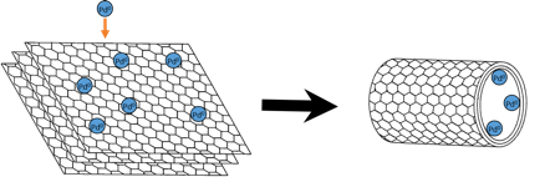
- surface or alters their morphology in undesired ways (e.g., reduction in length). Due to this challenge, much research has been focussed on producing CNTs that are open at both ends. This has been achieved by using an anodic aluminium oxide (AAO) film as a template for the thermal decomposition of


Advances in NO2 sensing with individual single-walled carbon nanotube transistors
Beilstein J. Nanotechnol. 2014, 5, 2179–2191, doi:10.3762/bjnano.5.227
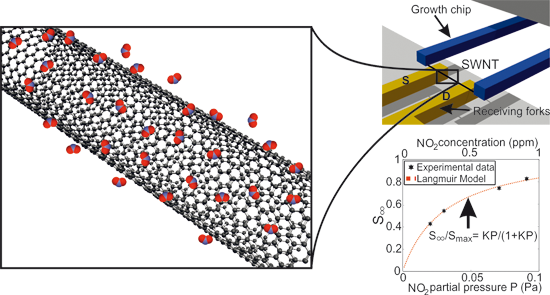
- later be removed selectively, it is possible to improve the contact resistance as well as reduce the hysteresis simultaneously, as shown by Khamis et al. [66] with organic layers, and Liu et al. [17] with an aluminium oxide layer. Another possibility is to eliminate dielectrics altogether, for example





