


Search results
Search for "charge density" in Full Text gives 154 result(s) in Beilstein Journal of Nanotechnology.
Influence of calcium on ceramide-1-phosphate monolayers
Beilstein J. Nanotechnol. 2016, 7, 236–245, doi:10.3762/bjnano.7.22
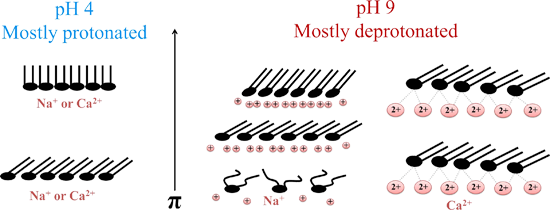
- a condensed monolayer, while at pH 7.2 the electrostatic repulsion of the negatively charged phosphomonoester head groups becomes more important and the monolayer is in a less solid-like state. Also at pH 7.2, the monolayer has a higher charge density than on water. They also determined the pKa2 in


Mismatch detection in DNA monolayers by atomic force microscopy and electrochemical impedance spectroscopy
Beilstein J. Nanotechnol. 2016, 7, 220–227, doi:10.3762/bjnano.7.20
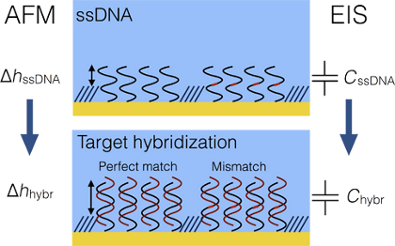
- capacitance at the interface, due to a combination of height changes, displacement of water molecules upon binding of new strands, and rearrangement of charge density, bringing to a new value for the capacitance, CdsDNA [36]. Our device can follow the variation of capacitance in real time, allowing for the
- capacitance plateau, whereas AFM was not able to directly detect a height difference. Indeed, the changes of capacitance at the functionalized electrode are the results of a combination of changes of height in the molecular case and rearrangement of charge density. The distortions on the DNA structure due to
- of the DNA layer, the other more sensitive to its charge density) let us conclude that the structural deformations related to a single mismatch have a strong influence on the charge distribution only, leaving the molecular structure not significantly affected. Schematics of the atomic force


3D solid supported inter-polyelectrolyte complexes obtained by the alternate deposition of poly(diallyldimethylammonium chloride) and poly(sodium 4-styrenesulfonate)
Beilstein J. Nanotechnol. 2016, 7, 197–208, doi:10.3762/bjnano.7.18
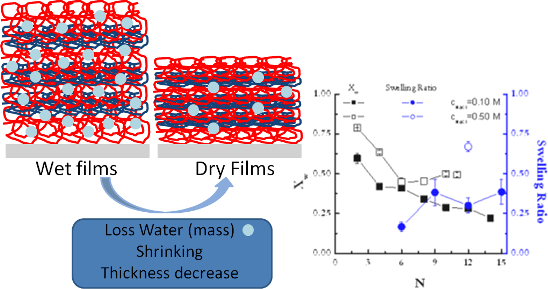
- their role during film formation is critical for controlling the structure and physicochemical properties of the films [13]. Among the most relevant variables are the charge density of the molecules, the concentration of the solution used, ionic strength, solvent quality for the molecules, pH, and
- polyelectrolyte occurs until a certain degree of charge inversion is reached, independently of the assembly conditions. This is explained considering that the increase of the ionic strength reduces the effective charge density of the polyelectrolyte multilayers, thus the overcompensation threshold is reached for



Charge injection and transport properties of an organic light-emitting diode
Beilstein J. Nanotechnol. 2016, 7, 47–52, doi:10.3762/bjnano.7.5
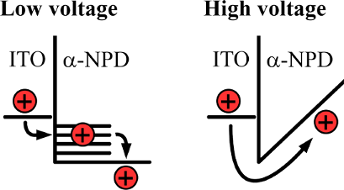
- efficacy (60–70 lm/W), which is the current benchmark for novel light sources [4]. Organic semiconductors have zero doping level and very low intrinsic charge density, therefore all charges in OLED device are injected from the electrodes. As a result, the energy band diagram analysis plays a key role in
- characteristics. At voltages below 2 V the low charge injection region can be recognized, since the current density J follows applied voltage bias V linearly, where e·n is the charge density (e: elementary charge, n charge carrier density), μeff is the effective charge mobility, and L the organic film thickness
- -relaxation processes in OLED devices. Charge injection/transport phenomena are thermally activated processes that follow the Boltzmann distribution. The Arrhenius plots of conductivities have been used to evaluate activation energies, as shown in Figure 5a. Since the conductivity G is affected by charge


pH-Triggered release from surface-modified poly(lactic-co-glycolic acid) nanoparticles
Beilstein J. Nanotechnol. 2015, 6, 2504–2512, doi:10.3762/bjnano.6.260
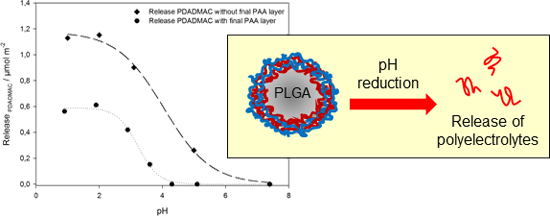
- charged substrates. The most common and therefore best investigated multilayer build-up involves two oppositely charged polyelectrolytes. Weak polyelectrolytes, such as polyacrylic acid (PAA), with a pH-dependent charge density can be used to add pH-tunable properties to the nanoparticle surface to which
- , which could be attributed to successful adsorption of the cationic PEI layer. pH-Sensitivity of the PAA layer in dependence on the adsorption pH value PAA, as a weak polyelectrolyte with a charge density depending on pH, can be easily adsorbed onto positively charged substrates, such as PLGA
- nanoparticles with an adsorbed layer of PEI. In order to investigate the effect of the linear charge density of adsorbing chains on the resulting layer properties, PAA from solutions adjusted to three different pH values, respectively, was adsorbed to PLGA–PEI nanoparticles. Regarding the ionization degree, the


Electroviscous effect on fluid drag in a microchannel with large zeta potential
Beilstein J. Nanotechnol. 2015, 6, 2207–2216, doi:10.3762/bjnano.6.226
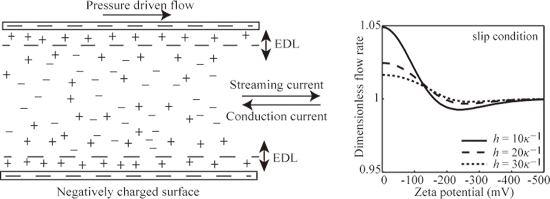
- molecular dynamics (MD) simulations. They found that a large surface charge density results in a smaller slip. Jing and Bhushan [13] experimentally studied the coupling relationship between the surface charge and the slip of a smooth and hydrophobic octadecyltrichlorosilane (OTS) sample immersed in
- deionized water and saline solutions using the colloidal probe atomic force microscopy technique. They also found that an increasing surface charge density results in a decreasing slip length. Thus, the coupling between the surface charge and slip should be considered when study the combined effect of EDL
- flow in the microchannel, dp/dx is the driving pressure gradient, ρe = ze(n+ − n−) is the local net charge density in the EDL, and Ex is the electrical field strength. The modified Navier–Stokes equation gives the velocity boundary conditions where b is the charge-dependent slip length. The effect of


Mapping bound plasmon propagation on a nanoscale stripe waveguide using quantum dots: influence of spacer layer thickness
Beilstein J. Nanotechnol. 2015, 6, 2046–2051, doi:10.3762/bjnano.6.208
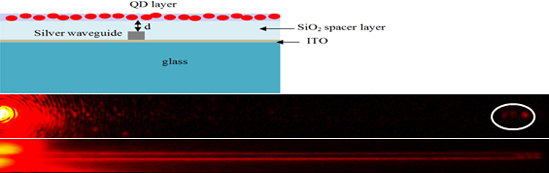
- are a coherent oscillation of electrons in a metal [1]. Loosely bound electrons can combine with incoming photons and propagate along the metal/dielectric interface. These charge density waves create a strong near-field [1]. There is increasing demand for high speed data communication as well as




Transformations of PTCDA structures on rutile TiO2 induced by thermal annealing and intermolecular forces
Beilstein J. Nanotechnol. 2015, 6, 1498–1507, doi:10.3762/bjnano.6.155
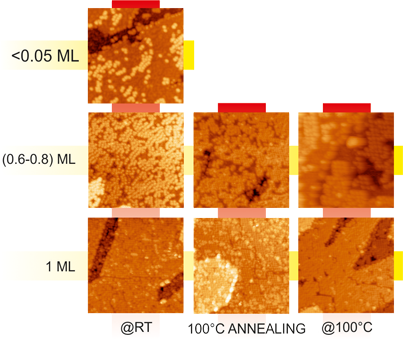
- ) should contribute mostly to the STM appearance when imaging of empty states is performed. The charge density contour of the PTCDA LUMO orbital comprises 14 lobes located symmetrically with respect to the longer molecular axis, where the orbital wave function changes its sign. As a result, the charge
- density in the proximity of the longer axis is very low, and thus, that area does not contribute significantly to the tunnelling process. In our high-resolution measurements, a single PTCDA molecule appears as two lobes with a clear depression between them. Considering the LUMO contour, the depression


Current–voltage characteristics of manganite–titanite perovskite junctions
Beilstein J. Nanotechnol. 2015, 6, 1467–1484, doi:10.3762/bjnano.6.152
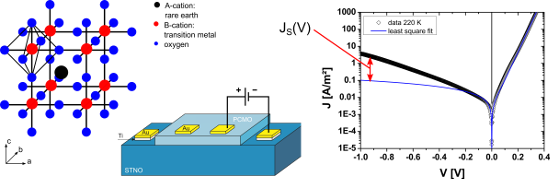
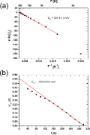
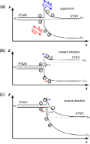
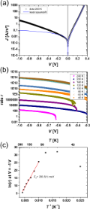
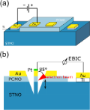
- charge density and the material structure, the concept of bending rigid electronic bands at an interface can break down because of the emergence of new types of quasiparticles and order [32]. The nature of polaron quasiparticles may change during their interfacial transfer because of the variation of the





Scalable, high performance, enzymatic cathodes based on nanoimprint lithography
Beilstein J. Nanotechnol. 2015, 6, 1377–1384, doi:10.3762/bjnano.6.142
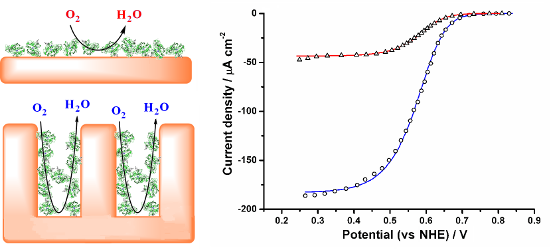
- the experimentally measured charge (qreal) associated with the Au oxide reduction process performed by running cyclic voltammetry (Supporting Information File 1, Figure S1). A current peak related to the reduction of the Au was integrated to calculate qreal. The theoretical charge density (σt


Surface excitations in the modelling of electron transport for electron-beam-induced deposition experiments
Beilstein J. Nanotechnol. 2015, 6, 1260–1267, doi:10.3762/bjnano.6.129
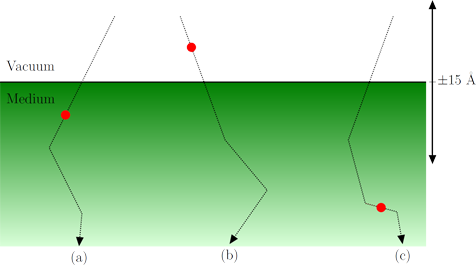
- . Review Inelastic collisions in the bulk of the material Energy losses of a charged projectile moving in a solid can be described accurately within the semiclassical dielectric formalism. In this approach, one assumes that the presence of the charged projectile disturbs the equilibrium charge density of
- Fourier transform of the projectile charge density ρ(r,t) = Z0eδ(r−vt), where Z0 is the projectile charge in units of the modulus of the electron charge, e, and v is the velocity of the projectile. To obtain this expression, the following approximations were considered: (1) The Coulomb gauge was adopted
- arising from a charge density induced in the bulk of the material and another one arising from a charge density induced at the surface of the material. The DIIMFP resulting from the induced electric field becomes more complicated, with two additional parametric dependencies: (1) on the depth coordinate


From lithium to sodium: cell chemistry of room temperature sodium–air and sodium–sulfur batteries
Beilstein J. Nanotechnol. 2015, 6, 1016–1055, doi:10.3762/bjnano.6.105
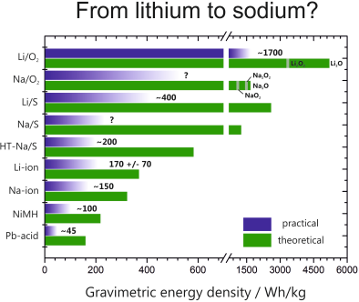
- corresponds to a larger charge density, and the lithium ion polarizes it environment stronger than the sodium ion. This causes severe differences in chemical bonding and ion mobility. The solubility of sodium and lithium compounds in solvents are different. The discharge products and/or interphases (SEI
- (if known) and the total amount of charge should be stated. Given this, the charge density (mAh/cm3) and areal capacity (mAh/cm2) can be calculated and benchmarked against commercialized LIB materials (approximately 1–4 mAh/cm2 and 350–600 mAh/cm3). A comparable problem is that the common definition


Multiscale modeling of lithium ion batteries: thermal aspects
Beilstein J. Nanotechnol. 2015, 6, 987–1007, doi:10.3762/bjnano.6.102
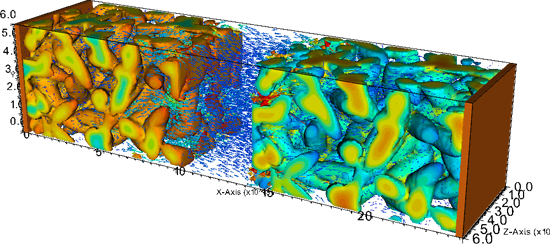
- determined by Φ through Equation 10 and not by φ. It is possible to obtain the formulation in Equation 44 and Equation 45 directly from the entropy law by choosing the flux N+ and the electric current j together with the molar density c+ = ρ+/M+ =: c and the free charge density ρF = F(z+c+ + z−c−) as primary
- electric current we finally obtain the equation for the electric charge ρF, the molar concentration of positive ions c := c+ and the entropy density: The electric charge density ρF is coupled to Coulomb’s law (Equation 10) and to the pressure equation (Equation 29). The entropy production is given by The
- external surface into the host material and shielding of the charges by lattice deformations and reorganization of the electronic charge density distribution. These elementary steps were identified experimentally [62][63] for the intercalation of Li in graphite. In this still very simple model no


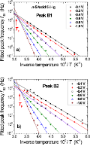
Entropy effects in the collective dynamic behavior of alkyl monolayers tethered to Si(111)
Beilstein J. Nanotechnol. 2015, 6, 583–594, doi:10.3762/bjnano.6.60
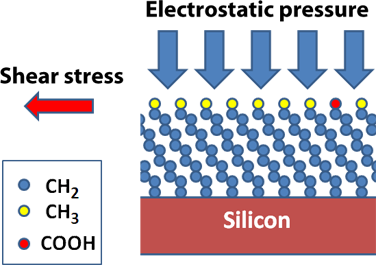
- ] and measurements can be performed in a well-defined metal/OML/semiconductor planar configuration, which is relevant for molecular electronics devices. Admittance spectroscopy provides insights in the modulation of localized charge density and dipole reorientation in a system submitted to a time




Chains of carbon atoms: A vision or a new nanomaterial?
Beilstein J. Nanotechnol. 2015, 6, 559–569, doi:10.3762/bjnano.6.58
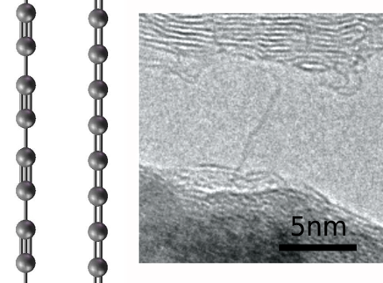
- oscillations of charge density and interatomic forces, extending over longer distances along the chain. Such Friedel oscillations in one-dimensional systems decay as 1/r. Experimental observations of carbon chains The first experimental indication for the existence of carbon chains has been deduced from a


Dynamic force microscopy simulator (dForce): A tool for planning and understanding tapping and bimodal AFM experiments
Beilstein J. Nanotechnol. 2015, 6, 369–379, doi:10.3762/bjnano.6.36
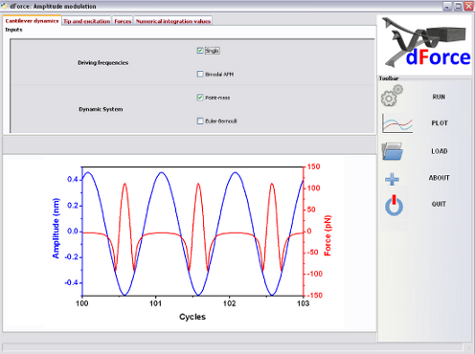
- tip–surface charge density and σs is the sample surface charge density. Hertz contact mechanics The elastic contact between the tip and sample is usually modelled with the Hertz model [46] whereby for a spherical tip and a half-space sample the force is given by where δ is the indentation and Eeff is


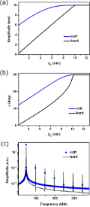
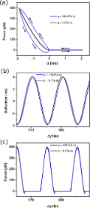


Kelvin probe force microscopy in liquid using electrochemical force microscopy
Beilstein J. Nanotechnol. 2015, 6, 201–214, doi:10.3762/bjnano.6.19
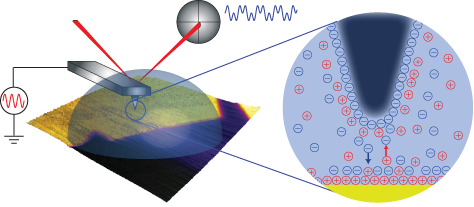
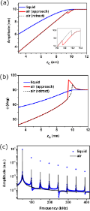
- electrostatic response, or more generally when the force experienced by the system is governed purely by the time-independent Maxwell stress tensor directly related to the charge density between probe and sample [58]. The data can be presented as an EcFM spectra representing the bias- and time-dependent for a


![[Graphic 6]](/bjnano/content/inline/2190-4286-6-19-i11.png?max-width=637&scale=1.18182) response collected 200 nm above a grounded Au electrode in (a, b, c) air, (d, e, f) decane an...
response collected 200 nm above a grounded Au electrode in (a, b, c) air, (d, e, f) decane an...


![[Graphic 22]](/bjnano/content/inline/2190-4286-6-19-i27.png?max-width=637&scale=1.18182) spectra [bias-on] collected 500 nm above HOPG in aqueous solutions of increasing salt concent...
spectra [bias-on] collected 500 nm above HOPG in aqueous solutions of increasing salt concent...

![[Graphic 25]](/bjnano/content/inline/2190-4286-6-19-i30.png?max-width=637&scale=1.18182) spectra [bias-on] collected 500 nm above (a) HOPG and (b) Au in milli-Q water (vertical color...
spectra [bias-on] collected 500 nm above (a) HOPG and (b) Au in milli-Q water (vertical color...

![[Graphic 27]](/bjnano/content/inline/2190-4286-6-19-i32.png?max-width=637&scale=1.18182) spectra [bias-on] recorded 500 nm above a HOPG/Au boundary in milli-Q water. T...
spectra [bias-on] recorded 500 nm above a HOPG/Au boundary in milli-Q water. T...

Exploring plasmonic coupling in hole-cap arrays
Beilstein J. Nanotechnol. 2015, 6, 1–10, doi:10.3762/bjnano.6.1
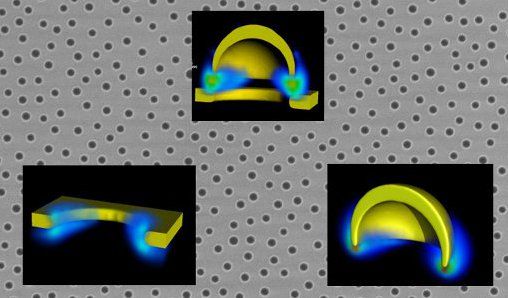
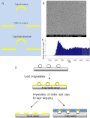
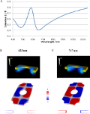
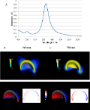
- experimental spectra are reproduced identifying the two resonances: a low energy resonance with a relatively high intensity and a high energy but low intensity resonance. E-field intensity (|E|2/|E0|2) and charge density plots (shown in Figure 5b) confirm the low energy resonance as a dipolar mode and the high
- extinction spectra of a hole array (holes diameter 110 nm) in 20 nm thick gold film. Underneath the E-field intensity (|E|2/|E0|2) and charge density plots for the peak at 633 nm (B) and dip at 717 nm (C) is shown. The direction of the light propagation is normal to the surface and the polarization
- horizontal in the figure plane. Schematic view of the first order and second order BW-SPP’s charge oscillations for the hole arrays. A) Simulated extinction spectra of a 20 nm thick gold cap (110 nm in diameter). Underneath the E-field intensity (|E|2/|E0|2) and charge density plots for the peaks at 560 nm




Poly(styrene)/oligo(fluorene)-intercalated fluoromica hybrids: synthesis, characterization and self-assembly
Beilstein J. Nanotechnol. 2014, 5, 2450–2458, doi:10.3762/bjnano.5.254
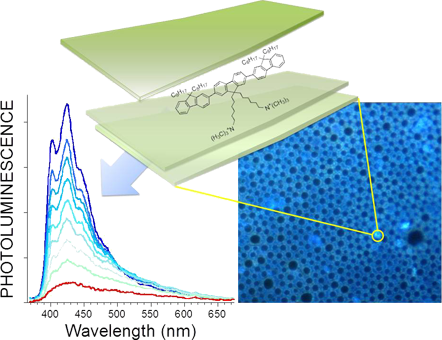
- through a self-assembly approach. Results and Discussion Synthesis and characterization of TF-intercalated SME Hybrids Sodium-exchanged Somasif ME100 (SME) has been chosen to intercalate a fluorescent oligo(fluorene) cation (hereafter named TF) thanks to its very low iron impurities and low charge density
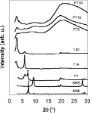
- area for the charge deficit layer (assuming an average layer charge density of 0.77 nm2 as reported by Choy et al. [23]). When the TF loading is increased up to 15% and 30% CEC the XRD spectra change. T15 shows two uncorrelated peaks at 2.65 and 5.85°, indicating that different intercalating
- ; therefore, considering an average layer charge density of 0.77 nm2, the area available of SME surface is oversaturated by the oligo(fluorene) cation with a loading of 30% CEC. Synthesis and characterization of PS/TF-intercalated SME hybrids Aiming to improve the processability of the TF-intercalated SME




Effect of channel length on the electrical response of carbon nanotube field-effect transistors to deoxyribonucleic acid hybridization
Beilstein J. Nanotechnol. 2014, 5, 2081–2091, doi:10.3762/bjnano.5.217
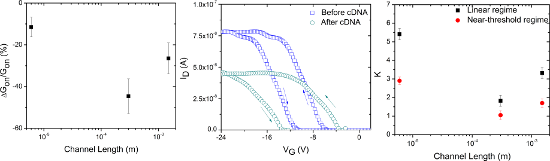
- sweeps reflected as an increase in hysteresis. This differs from the CNT-FET-based DNA detection studies reported by Gui et al. [32], where charge density modification near the CNT–metal electrode junction through electron doping causes a negative shift in the forward and reverse sweep threshold voltages


Optical properties and electrical transport of thin films of terbium(III) bis(phthalocyanine) on cobalt
Beilstein J. Nanotechnol. 2014, 5, 2070–2078, doi:10.3762/bjnano.5.215
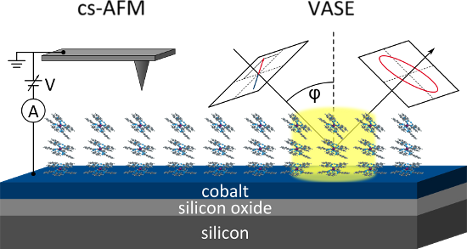
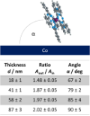
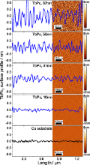
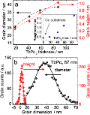
- charge density per unit volume in all films, a reduction in the ratio σ/L corresponds to a reduction in the carrier mobility in the direction perpendicular to the substrate. This is in agreement with the increasingly standing molecules. The validity of the model applied for the ohmic region should be



Effects of surface functionalization on the adsorption of human serum albumin onto nanoparticles – a fluorescence correlation spectroscopy study
Beilstein J. Nanotechnol. 2014, 5, 2036–2047, doi:10.3762/bjnano.5.212
- , Table 2, Figure 3a) [22]. By reacting the amines on lysine side chains with succinic acid anhydride, the number of negatively charged carboxylic acid groups on the surface is increased. Succinylation is likely to reduce the charge density of the positively charged region on HSA that is responsible for



Silicon and germanium nanocrystals: properties and characterization
Beilstein J. Nanotechnol. 2014, 5, 1787–1794, doi:10.3762/bjnano.5.189
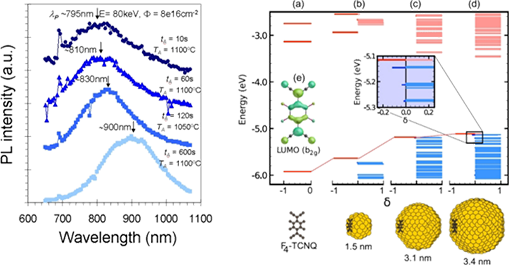
- (“particle in a box”). This has the advantage of allowing for expansion of the charge density in plane-waves and the use of numerical approaches developed for crystalline solids. However, care has to be taken to ensure that there is little interaction between periodic images of the system. This is
- traditionally used in solid state physics rely on the use of plane-wave basis sets for expansion of wavefunctions and charge density. A disadvantage of this approach is that to make the basis size finite it is then necessary to impose periodic boundary conditions, allowing for sufficiently large vacuum spaces


Controlling the dispersion of supported polyoxometalate heterogeneous catalysts: impact of hybridization and the role of hydrophilicity–hydrophobicity balance and supramolecularity
Beilstein J. Nanotechnol. 2014, 5, 1749–1759, doi:10.3762/bjnano.5.185
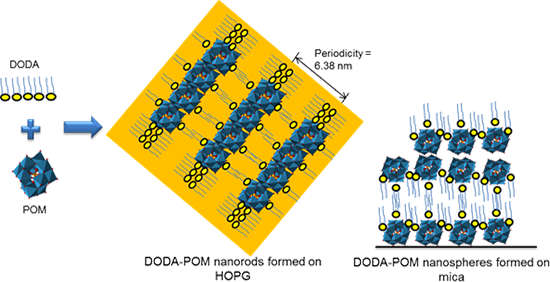
- supramolecular chemistry, but also in new materials technology [1][2]. For example, their tunable molecular architecture, charge density, strong redox capability, electro- and photochemical properties, make that these molecular metal-oxide nano-clusters are increasingly applied in diverse fields, such as
- dependent on the interaction between various factors such as the type of hybridization (i.e., through electrostatic interaction or covalent bonding), the nature of the POM building block (formula, charge density), and the chemical nature and hydrophilic or hydrophobic character of the surface on which the


Nanocrystalline ceria coatings on solid oxide fuel cell anodes: the role of organic surfactant pretreatments on coating microstructures and sulfur tolerance
Beilstein J. Nanotechnol. 2014, 5, 1712–1724, doi:10.3762/bjnano.5.181

- –GDC composite). In previous studies of oxide film deposition on surfactant-treated surfaces, sulfonate surfaces strongly favored the formation of continuous films of ZrO2, TiO2, and SnO2 [26]. This outcome is attributed to the high negative surface charge density of well-packed sulfonate surfaces





