Search results
Search for "corrosion" in Full Text gives 137 result(s) in Beilstein Journal of Nanotechnology.
First-principles study of the structure of water layers on flat and stepped Pb electrodes
Beilstein J. Nanotechnol. 2016, 7, 533–543, doi:10.3762/bjnano.7.47
- importance as it is relevant in, e.g., electrocatalysis, electrochemical energy conversion and storage, and corrosion. At the same time this interaction is of fundamental interest as there are still many open questions left with respect to the structure of liquid–solid interfaces and the influence of the



Case studies on the formation of chalcogenide self-assembled monolayers on surfaces and dissociative processes
Beilstein J. Nanotechnol. 2016, 7, 263–277, doi:10.3762/bjnano.7.24
- molecular layer can eventually form. This was noted for the case of alkanethiol SAMs on Pd and it was shown that this led to interesting consequences, such as greater resistance to corrosion by chemical etchants [46][47]. In biotechnology applications, a greater resistance to invasion by cells was observed


Synthesis and applications of carbon nanomaterials for energy generation and storage
Beilstein J. Nanotechnol. 2016, 7, 149–196, doi:10.3762/bjnano.7.17

















Green and energy-efficient methods for the production of metallic nanoparticles
Beilstein J. Nanotechnol. 2015, 6, 2354–2376, doi:10.3762/bjnano.6.243
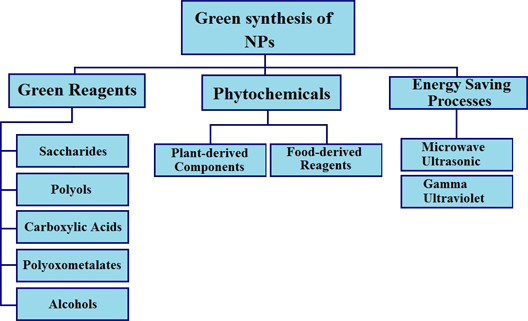
- used in larger amounts than the other materials [124][125]. In addition, most of the conventional solvents have problems, such as toxicity, flammability, and corrosion. Their solubility and volatility may result in contamination of air, water and soil and also can increase the risk of exposure to



Electrochemical coating of dental implants with anodic porous titania for enhanced osteointegration
Beilstein J. Nanotechnol. 2015, 6, 2183–2192, doi:10.3762/bjnano.6.224
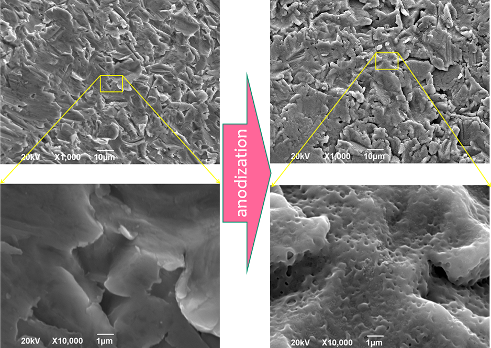
- dental and orthopedic implants, thanks to its very good strength, corrosion resistance and biocompatibility [1][2]. Despite the very high success rate of Ti dental implants (>90%), there is still room for optimization of osteointegration, particularly for diabetics, smokers and oncology patients [3]. As


Thermal energy storage – overview and specific insight into nitrate salts for sensible and latent heat storage
Beilstein J. Nanotechnol. 2015, 6, 1487–1497, doi:10.3762/bjnano.6.154
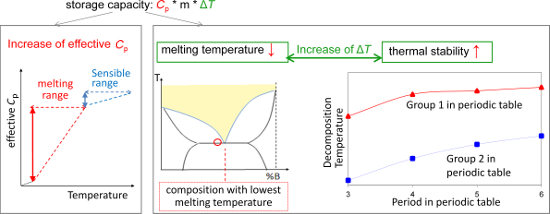
- temperatures are required. A novel method to identify the composition of salt mixtures featuring a decreased melting temperature is presented at the end of this section. Additionally limitations of molten salt storage may arise due to storage media costs, the risk of corrosion and the difficulty in hygroscopic


Thermal treatment of magnetite nanoparticles
Beilstein J. Nanotechnol. 2015, 6, 1385–1396, doi:10.3762/bjnano.6.143
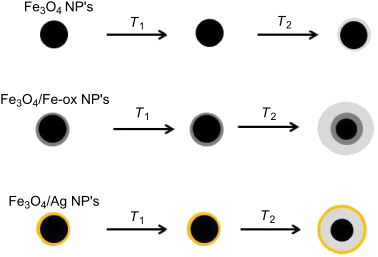
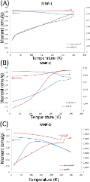
- the fabrication methods determine, to some extent, the sensitivity of the nanoparticles to external factors. Keywords: high temperature corrosion; internal oxidation; IR spectroscopy; metal matrix composites; Mössbauer spectroscopy; X-ray diffraction; Introduction Nanostructured magnetite has become






High photocatalytic activity of V-doped SrTiO3 porous nanofibers produced from a combined electrospinning and thermal diffusion process
Beilstein J. Nanotechnol. 2015, 6, 1281–1286, doi:10.3762/bjnano.6.132
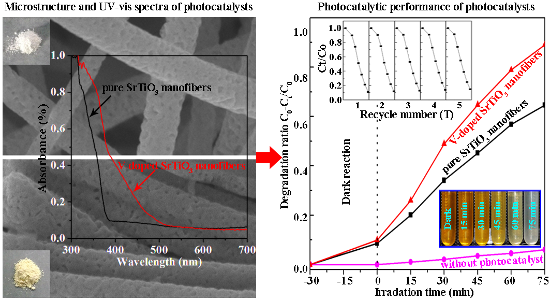
- excellent photocatalytic properties of Fe-doped SrTiO3, Nd-doped SrTiO3 and Ni/La co-doped SrTiO3 [18][19][20]. These new photocatalysts enable a good response to light or overcome light corrosion caused by the excessive accumulation of photogenerated carriers due to poor conductivity. However, there are


From lithium to sodium: cell chemistry of room temperature sodium–air and sodium–sulfur batteries
Beilstein J. Nanotechnol. 2015, 6, 1016–1055, doi:10.3762/bjnano.6.105
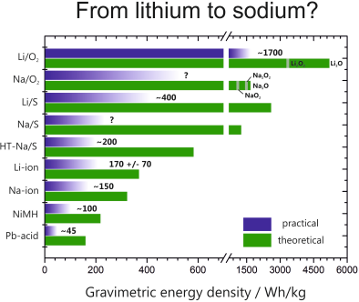
- solvent employed in their study (DMSO) is known to be unstable in Li/O2 cells [85][86]. Notwithstanding the above, the understanding of electrode corrosion and the search for stable electrode materials, either modified carbons or non-carbon materials, is of crucial importance for a reliable Li/O2 battery


Stiffness of sphere–plate contacts at MHz frequencies: dependence on normal load, oscillation amplitude, and ambient medium
Beilstein J. Nanotechnol. 2015, 6, 845–856, doi:10.3762/bjnano.6.87
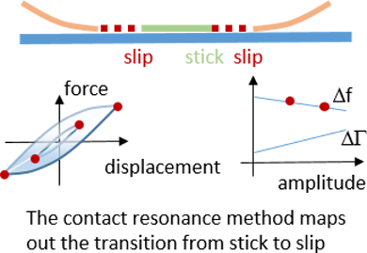
- small tangential displacement at contacts between rough surfaces. These small displacements per se have little influence on the strength of the contact. They are still of immense practical relevance because they cause fretting wear [19][20][21], which is a special type of corrosion. Microslip at





Mapping of elasticity and damping in an α + β titanium alloy through atomic force acoustic microscopy
Beilstein J. Nanotechnol. 2015, 6, 767–776, doi:10.3762/bjnano.6.79
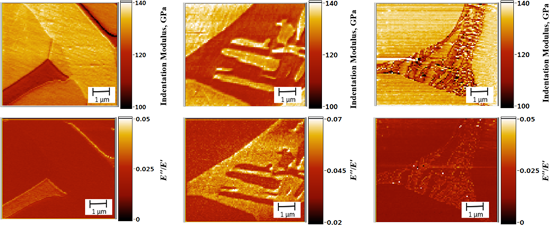
- toughness can be achieved. Ti-6Al-4V combines the benefits of high strength, light weight, formability and corrosion resistance and finds applications in aircraft structural components, aerospace fasteners, high-performance automotive parts, marine applications, medical devices, and sports equipment. Owing
- to the good corrosion resistance and biocompatibility, Ti-6Al-4V is also widely used in making load-bearing metal implants [20]. Different studies have been reported on phase transformations [21] and mechanical property variations with various phases [22] in Ti-6Al-4V. Kumar et al. [1] have


Simple approach for the fabrication of PEDOT-coated Si nanowires
Beilstein J. Nanotechnol. 2015, 6, 640–650, doi:10.3762/bjnano.6.65
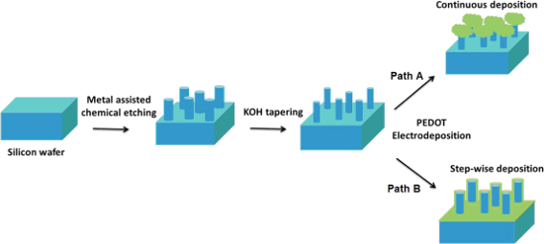
- Matériaux, 13397 Marseille Cedex 20, France, Université Abderrahmane Mira, Lab. d’Electrochimie, Corrosion et de Valorisation énergétique, 06000 Bejaia, Algeria 10.3762/bjnano.6.65 Abstract The synthesis of a conformal poly(3,4-ethylenedioxythiophene) (PEDOT) layer on Si nanowires was demonstrated using a




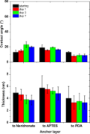
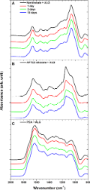
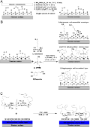
Self-assembled anchor layers/polysaccharide coatings on titanium surfaces: a study of functionalization and stability
Beilstein J. Nanotechnol. 2015, 6, 617–631, doi:10.3762/bjnano.6.63
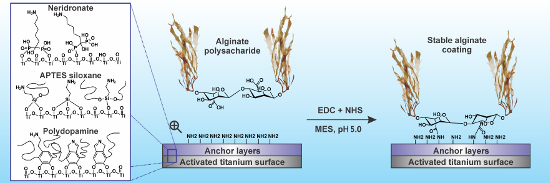
- strength, appropriate Young’s modulus, outstanding biocompatibility and excellent corrosion resistance make commercially pure titanium a highly favored, biocompatible, metallic material [2]. The biocompatibility and corrosion resistance of titanium surfaces is closely related to the presence of a


Entropy effects in the collective dynamic behavior of alkyl monolayers tethered to Si(111)
Beilstein J. Nanotechnol. 2015, 6, 583–594, doi:10.3762/bjnano.6.60
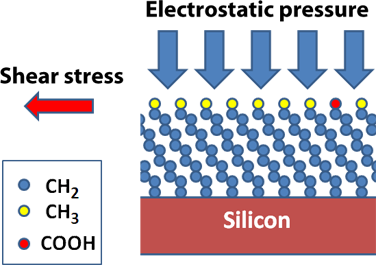
- surface chemistry, surface energy, biocompatibility, friction, corrosion, liquid chromatography, interfacial interactions and electronic transport [1][2][3][4][5][6]. More recent studies have been focused on the functionalization of nanostructures. However, in spite of a large number of experimental and




Silica micro/nanospheres for theranostics: from bimodal MRI and fluorescent imaging probes to cancer therapy
Beilstein J. Nanotechnol. 2015, 6, 546–558, doi:10.3762/bjnano.6.57

- corrosion of fluorescent NPs and particle–particle magnetic bipolar interactions [3]. Further because of the large surface area, pore volume and easy functionalization, silica spheres have widespread applications as catalysts [4], in cosmetics [5], as nanocontainers [6], as nanoreactors [7], as adsorbing
- was also seen in the fluorescence spectra, in which the emission spectra shifted from 610 to 580 nm. Such shift in the absorption and emission spectra was attributed to a possible corrosion of CdTe QDs after silica coating. Magnetic properties of these hybrid nanocomposites were monitored at room


In situ scanning tunneling microscopy study of Ca-modified rutile TiO2(110) in bulk water
Beilstein J. Nanotechnol. 2015, 6, 438–443, doi:10.3762/bjnano.6.44
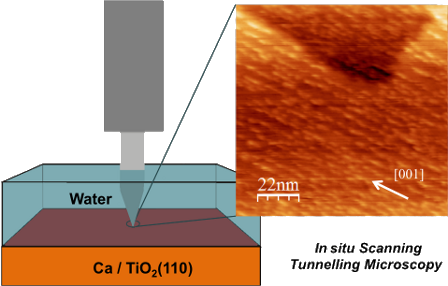
- applications ranging from nanotechnology [7] to gas sensing [8], as well as catalysis [9] and biomedicine [10][11]. In particular, the high corrosion resistance of titanium to biological environments has stimulated the study of this metal and its oxide for in vivo or in vitro calcium phosphate ceramic growth


Kelvin probe force microscopy in liquid using electrochemical force microscopy
Beilstein J. Nanotechnol. 2015, 6, 201–214, doi:10.3762/bjnano.6.19
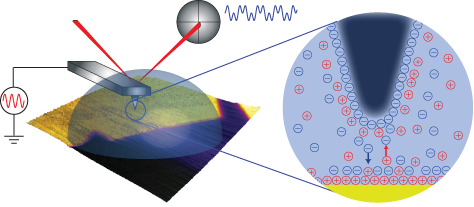
- ., pseudocapacitive storage). Consequently, understanding the local electrostatic, electrochemical and double layer ion dynamics at the solid–liquid interface is crucial to the study of corrosion, sensing, energy storage and bioelectric interfaces [3]. These processes are dynamic in nature, involving changes of the


![[Graphic 6]](/bjnano/content/inline/2190-4286-6-19-i11.png?max-width=637&scale=1.18182) response collected 200 nm above a grounded Au electrode in (a, b, c) air, (d, e, f) decane an...
response collected 200 nm above a grounded Au electrode in (a, b, c) air, (d, e, f) decane an...


![[Graphic 22]](/bjnano/content/inline/2190-4286-6-19-i27.png?max-width=637&scale=1.18182) spectra [bias-on] collected 500 nm above HOPG in aqueous solutions of increasing salt concent...
spectra [bias-on] collected 500 nm above HOPG in aqueous solutions of increasing salt concent...

![[Graphic 25]](/bjnano/content/inline/2190-4286-6-19-i30.png?max-width=637&scale=1.18182) spectra [bias-on] collected 500 nm above (a) HOPG and (b) Au in milli-Q water (vertical color...
spectra [bias-on] collected 500 nm above (a) HOPG and (b) Au in milli-Q water (vertical color...

![[Graphic 27]](/bjnano/content/inline/2190-4286-6-19-i32.png?max-width=637&scale=1.18182) spectra [bias-on] recorded 500 nm above a HOPG/Au boundary in milli-Q water. T...
spectra [bias-on] recorded 500 nm above a HOPG/Au boundary in milli-Q water. T...

Materials and characterization techniques for high-temperature polymer electrolyte membrane fuel cells
Beilstein J. Nanotechnol. 2015, 6, 68–83, doi:10.3762/bjnano.6.8

- boundary between proton conductive electrolyte, electron conductive catalyst, and reactant gases. Moreover, the elevated operating temperatures promote carbon corrosion and therefore degrade the integrity of the catalyst support. These are only some examples how materials properties affect the stability
- potentials leads to severe corrosion of theses carbon materials, a drawback well-known from the PAFC research. Carbon nanotubes are a promising alternative for catalyst support because of their higher corrosion resistivity [47]. Matsumoto et al. [48] fabricated a catalyst material by wrapping individual




SERS and DFT study of copper surfaces coated with corrosion inhibitor
Beilstein J. Nanotechnol. 2014, 5, 2489–2497, doi:10.3762/bjnano.5.258
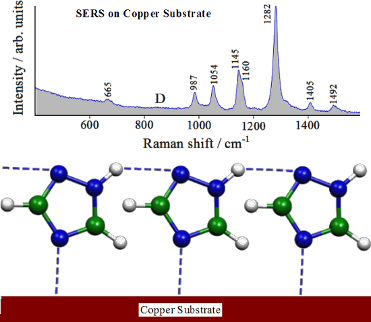
- /bjnano.5.258 Abstract Azole derivatives are common inhibitors of copper corrosion due to the chemical adsorption occurring on the metal surface that gives rise to a protective film. In particular, 1,2,4-triazole performs comparable to benzotriazole, which is much more widely used, but is by no means an
- anticorrosive thin film, the SERS spectra were interpreted with the aid of theoretical calculations based on the density functional theory (DFT) approach. Keywords: copper corrosion; DFT; inhibitor film; 1,2,4-triazole; SERS; Introduction Copper has a long history in a variety of industrial uses due to its
- large electrical and thermal conductivity, mechanical workability and durability (due to its endurance to weathering). These properties, however, can be compromised by the occurrence of corrosion. In fact, copper undergoes severe corrosion in the presence of ions such as chlorides, which can be present


Rapid degradation of zinc oxide nanoparticles by phosphate ions
Beilstein J. Nanotechnol. 2014, 5, 2007–2015, doi:10.3762/bjnano.5.209
- that zinc oxide can react with phosphoric acid to form various zinc phosphates which have applications, e.g., as dental cement [2]. Zinc phosphate can also be used as corrosion inhibitor for metals as it forms a protecting layer on metal surfaces [3]. This usage is possible because of the low
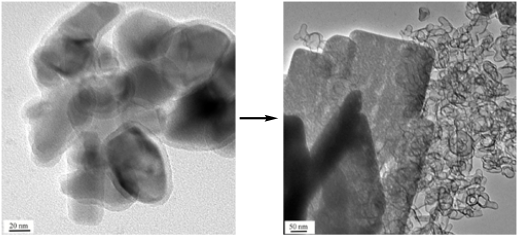
- with buffer A (100 mg/L) after one hour. However, after one day destruction is also complete with buffer B. This behaviour can be explained in terms of the formation of a relatively compact layer of sparingly soluble zinc phosphate at the surface, as in technical corrosion protection, which is induced


On the structure of grain/interphase boundaries and interfaces
Beilstein J. Nanotechnol. 2014, 5, 1603–1615, doi:10.3762/bjnano.5.172
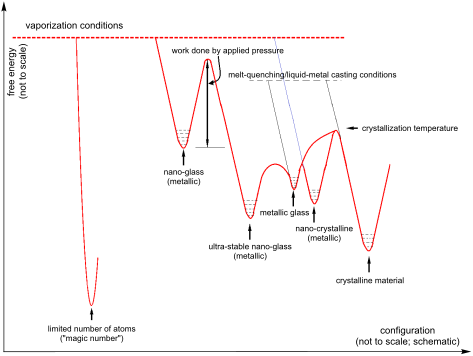
- ) lattice, could be physically meaningful, with certain limits imposed on the permissible deviations from the CSL position. In this category there are four models [39][42][43][44], of which the one of Palumbo and Aust [39][45][46] perhaps matches experimental results (concerning boundary corrosion) more
- coworkers [48][49][50] have examined the relevance of the CSL concept in understanding the two properties of segregation and corrosion by using TEM, atom probe tomography (APT) and a “pseudo” 3D-EBSD approach. The major conclusions are as follows. (a) Segregation for low-angle grain boundaries scales with
- the studied Σ9 boundary is not symmetric, i.e., the Miller indices of the boundary plane measured with respect to the two mutual grains are not identical, and therefore, also do not correspond to a coherency plane. (d) In case of corrosion, only the low-angle boundaries and the Σ3 and Σ5 boundaries do



Liquid fuel cells
Beilstein J. Nanotechnol. 2014, 5, 1399–1418, doi:10.3762/bjnano.5.153
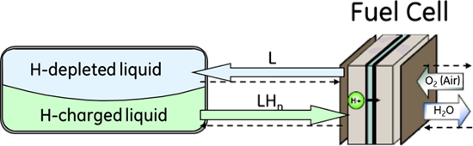
- separating the individual cells in the stack should have a high corrosion resistance, good electronic and thermal conductivity, and be designed to evenly distribute reactants and products. It is worth noting that the bipolar plates have an impact on the cost structure comparable with the impact of catalytic
- GE and used composite electrodes (a Pt black mixed with Teflon) and an AEM impregnated with 30% KOH [10]. An advantage of AEM fuel cells is that it is possible to use non-PGM electrocatalysts while classic PGM-oxide catalysts are less corrosion stable [11]. In general, AEMs have a lower conductivity
- replace traditional carbon support, e.g., Vulcan XC-72. The addition of more corrosion-resistant ZrC to XC-72 carbon (1:1) provided a narrower particle size distribution and a better dispersion on the surface and resulted in a higher activity during formic acid oxidation [138]. Nanocomposite-based on Pd

Restructuring of an Ir(210) electrode surface by potential cycling
Beilstein J. Nanotechnol. 2014, 5, 1349–1356, doi:10.3762/bjnano.5.148
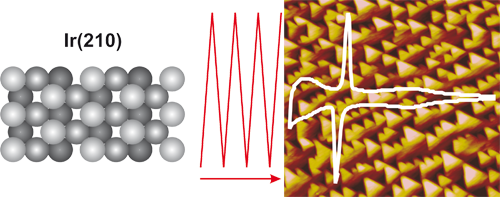
- Khaled A. Soliman Dieter M. Kolb Ludwig A. Kibler Timo Jacob Institut für Elektrochemie, Universität Ulm, 89069 Ulm, Germany Permanent address: Electrochemistry and Corrosion Laboratory, Physical Chemistry Department, National Research Centre, Cairo, 12622, Egypt 10.3762/bjnano.5.148 Abstract


Magnesium batteries: Current state of the art, issues and future perspectives
Beilstein J. Nanotechnol. 2014, 5, 1291–1311, doi:10.3762/bjnano.5.143
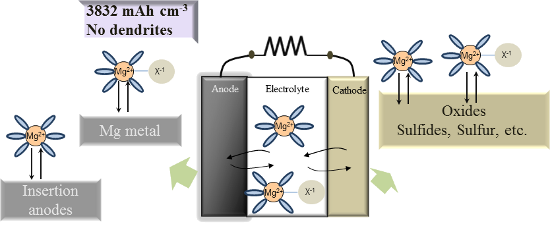
- cm−1), share several critical draw backs which are: 1) The presence of chloride; which is an integral part in the make of these salts/complexes. This was found to cause severe corrosion of non-noble metals that becomes apparent at potentials exceeding 2 V vs Mg [7][8][26]. This is problematic as it
- magnesium metal (see the Introduction section). Motivated by solving the corrosion problem caused by chloride ions and eliminating tetrahydrofuran as a solvent/cosolvent, Mohtadi et al. [27] proposed a magnesium borohydride based electrolyte for the magnesium battery. The premise of their concept was that
- slow transport properties. Another is the presence of chloride ions making them prime suspects in the corrosion issue. Hence, we believe that the discovery/design of new electroactive species is needed. Recent development in this direction is manifested in the borohydride electrolytes, where


Neutral and charged boron-doped fullerenes for CO2 adsorption
Beilstein J. Nanotechnol. 2014, 5, 413–418, doi:10.3762/bjnano.5.49
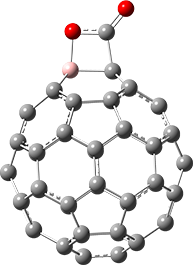
- common technology for the capture of CO2. However this method is criticized for its very high energy consumption and operational limitations such as corrosion, slow uptake rates, foaming and large equipment. Hence there is a huge interest in solid adsorbent materials for CCS [3][4][5][6]. In past few