


Search results
Search for "dielectric constant" in Full Text gives 186 result(s) in Beilstein Journal of Nanotechnology.
Al2O3/TiO2 inverse opals from electrosprayed self-assembled templates
Beilstein J. Nanotechnol. 2018, 9, 216–223, doi:10.3762/bjnano.9.23
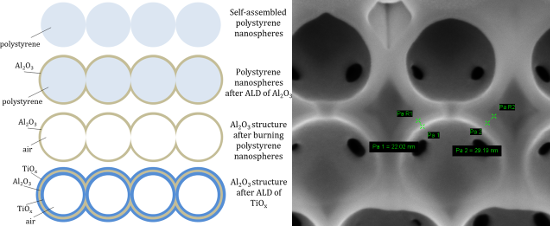
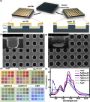
- opals is challenging, requiring large size, three-dimensional ordered layers of high dielectric constant ratio. In this article, alumina/TiO2–air inverse opals with a 98.2% reflectivity peak at 798 nm having an area of 2 cm2 and a thickness of 17 µm are achieved using a sacrificial self-assembled


Dielectric properties of a bisimidazolium salt with dodecyl sulfate anion doped with carbon nanotubes
Beilstein J. Nanotechnol. 2018, 9, 164–174, doi:10.3762/bjnano.9.19
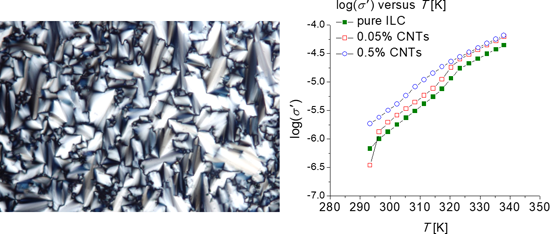
- studies while the corresponding phase transition enthalpies were obtained by DSC. The ILC was doped with CNT in concentration of 0.05% w/w and 0.5% w/w. The dielectric spectra were recorded in the frequency range from 10−1 to 107 Hz. The dependence of the dielectric constant and electric energy loss on


Electrical properties of a liquid crystal dispersed in an electrospun cellulose acetate network
Beilstein J. Nanotechnol. 2018, 9, 155–163, doi:10.3762/bjnano.9.18
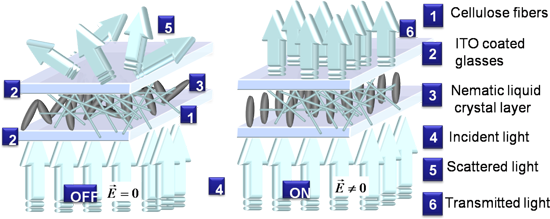
- techniques, such as polarized optical microscopy, dielectric spectroscopy and impedance measurements. Dielectric constant and electric energy loss were studied as a function of frequency and temperature. The activation energy was evaluated and the relaxation time was obtained by fitting the spectra of the
- dielectric constant, and the imaginary part, iε″(ω), is the dielectric loss [37]. Figure 4 shows dielectric constant and dielectric loss as functions of the temperature at two constant representative frequencies, 1 Hz and 10 Hz, for (a) the cell with CA fibers before filling in the LC, and (b) for the same
- fitting parameters of the Vogel–Fulcher–Tammann law (see below in Figure 6 and Table 1). Figure 5 presents dielectric constant and dielectric loss as functions of the frequency for the CA cell (a) before and (b) after filling in the LC, at three constant temperatures. For the CA sample without LC measured


Nematic topological defects positionally controlled by geometry and external fields
Beilstein J. Nanotechnol. 2018, 9, 109–118, doi:10.3762/bjnano.9.13
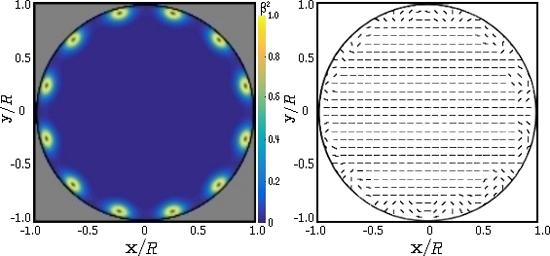
- representative characteristic elastic constant in the single elastic constant approximation, is the external electric field, ε0 is the permittivity of free space, and Δε is the dielectric constant anisotropy. We model conditions at the LC confining boundaries either by [15][16]: or where w is the surface


![[Graphic 25]](/bjnano/content/inline/2190-4286-9-13-i36.svg?max-width=637&scale=1.18182) with the largest positive eigenvalue, corresponding to the 2D biaxi...
with the largest positive eigenvalue, corresponding to the 2D biaxi...


Impact of titanium dioxide nanoparticles on purification and contamination of nematic liquid crystals
Beilstein J. Nanotechnol. 2017, 8, 2766–2770, doi:10.3762/bjnano.8.275
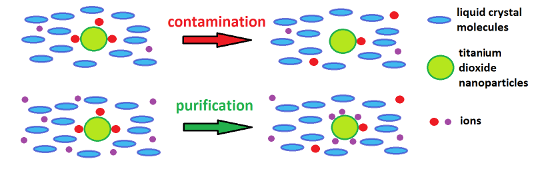
- ]: where сi – ion density, q – elementary charge, D – average diffusion coefficient, ε0 – dielectric constant, d – thickness of the cell gap, kB – Boltzmann factor, T – temperature, f – frequency, and ε∞ – high-frequency dielectric permittivity. We have evaluated the ion density and the average diffusion
Enhanced photoelectrochemical water splitting performance using morphology-controlled BiVO4 with W doping
Beilstein J. Nanotechnol. 2017, 8, 2640–2647, doi:10.3762/bjnano.8.264
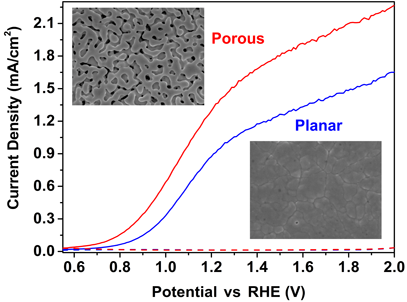
- [22]: where e0 is the electron charge (1.60·10−19 C), ε is the dielectric constant of BiVO4 (68) [23][24], ε0 is the electrical permittivity of vacuum (8.85·10−12 F·m−1), A is the electrode area, Nd is the donor density, V is the potential applied at the electrode, and C is the surface capacitance


Refractive index sensing and surface-enhanced Raman spectroscopy using silver–gold layered bimetallic plasmonic crystals
Beilstein J. Nanotechnol. 2017, 8, 2492–2503, doi:10.3762/bjnano.8.249
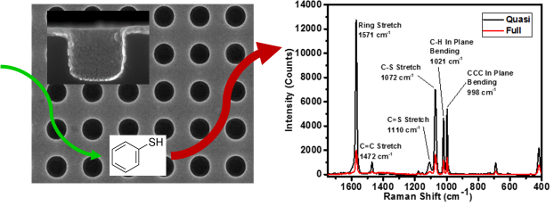
- effect which limits the degree of conformal coverage realized in the sputter coating metallization step. In the calculation, we used a Drude plus two-pole Lorentzian model to obtain the dielectric constant of the metal as a function of wavelength [48][61]. Figure 2 presents the experimentally measured


Synthesis of metal-fluoride nanoparticles supported on thermally reduced graphite oxide
Beilstein J. Nanotechnol. 2017, 8, 2474–2483, doi:10.3762/bjnano.8.247
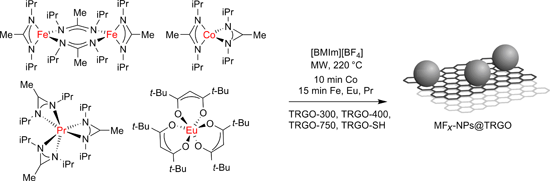
- important technical applications [15][16][17][18][19][20][21][22]. They can be used as composite materials [23][24], in chemical sensors [25], electrodes for fuel cells [26][27][28], for catalysis [29][30][31][32] or for hydrogen storage [33]. Because of their high ionic charge, polarity and dielectric
- constant, ILs are an ideal media for microwave reactions and for the stabilization of M-NPs [34][35][36][37]. Soft wet-chemical synthesis in organic solvents from metal-organic complexes is an essential method to obtain metal or metal alloy nanoparticles [38][39][40][41][42][43][44][45][46][47][48][49][50


Substrate and Mg doping effects in GaAs nanowires
Beilstein J. Nanotechnol. 2017, 8, 2126–2138, doi:10.3762/bjnano.8.212
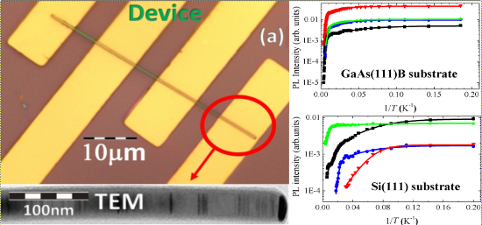
- capacitance (C) can be estimated considering a metallic cylinder-plane system from [19]: where L is the length of the FET channel, ε0 the vacuum permittivity, εr = 3.9 the relative dielectric constant of the SiO2 insulator layer, h = 300 nm the thickness of the SiO2 layer, and d the nanowire diameter. From


Self-assembly of chiral fluorescent nanoparticles based on water-soluble L-tryptophan derivatives of p-tert-butylthiacalix[4]arene
Beilstein J. Nanotechnol. 2017, 8, 1825–1835, doi:10.3762/bjnano.8.184
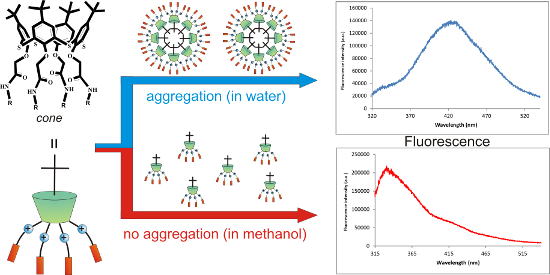
- in methanol (Figure 4, Supporting Information File 1, Figure S29). It turned out that the emission maxima are close for all compounds in methanol, which indicates the absence of excimer formation. Perhaps this is due to the fact that in water, as a more polar solvent (dielectric constant 78.36



The effect of the electrical double layer on hydrodynamic lubrication: a non-monotonic trend with increasing zeta potential
Beilstein J. Nanotechnol. 2017, 8, 1515–1522, doi:10.3762/bjnano.8.152
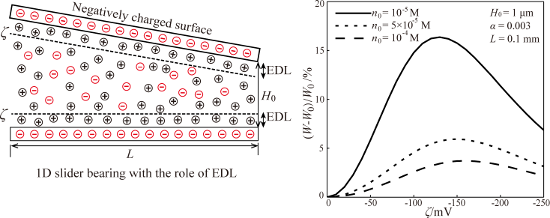
- = [2n0c2e2/(εε0kBT)]1/2 (n0 is the original bulk ion concentration of the lubricant, c is the chemical valence of free ions in the lubricant, e is the elementary charge, ε is the lubricant’s relative permittivity, and ε0 is vacuum’s absolute dielectric constant) is the reciprocal of the Debye length, z is


Adsorption and electronic properties of pentacene on thin dielectric decoupling layers
Beilstein J. Nanotechnol. 2017, 8, 1388–1395, doi:10.3762/bjnano.8.140
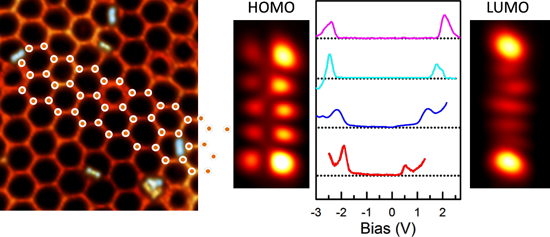
- of εr = 4 is assumed for the dielectric constant of h-BN, as proposed by Kim et al. [19] for 2–5 nm thin h-BN films. Using the following formula, the resulting energy shift can be estimated: Approximating the ion as a point charge yields an estimate for the energy shift of about 0.64 eV, compared to
- of the molecular position d and the dielectric constant of a single sheet of h-BN. Similar STS measurements of pentacene were carried out on KCl/Au(111), KCl/Cu(111) and KCl/(Cu110). The resulting STS data are depicted in Figure 7. The HOMO–LUMO gap can be used as a measure of the efficiency of an


Micro- and nano-surface structures based on vapor-deposited polymers
Beilstein J. Nanotechnol. 2017, 8, 1366–1374, doi:10.3762/bjnano.8.138
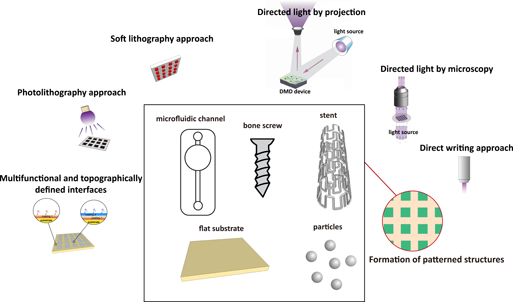
- , dielectric constant, temperature, and morphology and various chemical compositions [58][59][60][61][62][63][64][65]. Because of the challenges in fabrication processes, gradients are often generated with solution-based technology. Limitations remain for the ongoing technologies, for example, the lack long


A top-down approach for fabricating three-dimensional closed hollow nanostructures with permeable thin metal walls
Beilstein J. Nanotechnol. 2017, 8, 1231–1237, doi:10.3762/bjnano.8.124
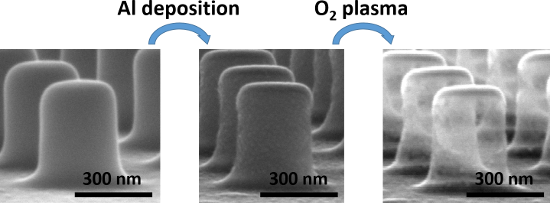
- (thickness tAl) and varying on the sidewalls from a value of 0.5 × (tAl − tAlO) at the upper vertical surfaces to tAl at the bottom (on the Al substrate). The top cladding (superstrate) is considered to be air. The dielectric constant of Al was modelled by the well-known Drude–Lorentz equation. The


Optical response of heterogeneous polymer layers containing silver nanostructures
Beilstein J. Nanotechnol. 2017, 8, 1065–1072, doi:10.3762/bjnano.8.108
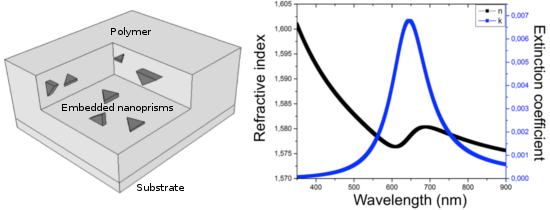
- oscillator and ε∞ is the high energy dielectric constant. We focused on the plasmonic properties of the silver NPs in the visible wavelength range. Therefore, the Lorentz model was sufficient to account for the optical properties of the NPs, and the electronic intraband transitions occurring in the UV [27
- the Lorentz laws, we noticed that the two constants (n∞ from the Cauchy model and ε∞ from the Lorentz model) are only contained in the real part of the dielectric constant and correspond to an offset. Nanospheres of 10 nm diameter were included in a 55,000 g·mol−1 PVP layer on a silicon substrate
- distributed in the layer, the effective dielectric constant accounts for the averaged optical response of the nanoprisms. A single Lorentz oscillator is required to fit the nanospheres and nanoprisms in PVP. This easy method allows us to obtain the optical indices of thin films with complex inclusions. The
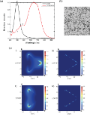


Near-field surface plasmon field enhancement induced by rippled surfaces
Beilstein J. Nanotechnol. 2017, 8, 956–967, doi:10.3762/bjnano.8.97
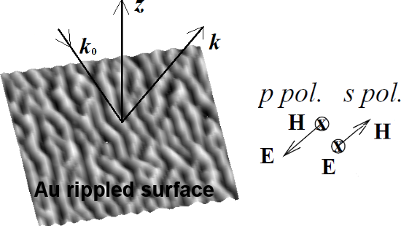
- two-dimensional system corresponds to the condition Re(εm(ωr)) = −εd, where εm(ωr) is the dielectric function of the metal at the resonant frequency and εd is the effective dielectric constant. In a randomly organized nanostructure, collective plasmon oscillations are deeply influenced by the locally


Vapor-phase-synthesized fluoroacrylate polymer thin films: thermal stability and structural properties
Beilstein J. Nanotechnol. 2017, 8, 933–942, doi:10.3762/bjnano.8.95
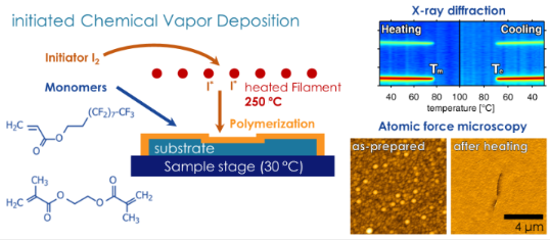
- surfaces are used as biocompatible surfaces [1], antifouling coatings [2], and as low dielectric constant materials [3] for microelectronics. Perfluoroacrylates are particularly appealing for such applications, as they combine the hydrophobic properties of the fluorinated pendant groups with easy


Relationships between chemical structure, mechanical properties and materials processing in nanopatterned organosilicate fins
Beilstein J. Nanotechnol. 2017, 8, 863–871, doi:10.3762/bjnano.8.88

- organosilicate clearly results in a slight stiffening of the fins, it also results in the incorporation of significant amounts of hydroxyl groups (Si–OH) that can increase both the dielectric constant/capacitance and electrical leakage of nanoporous oganosilicate dielectrics [51]. This is typically counteracted

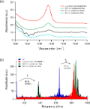


Advances in the fabrication of graphene transistors on flexible substrates
Beilstein J. Nanotechnol. 2017, 8, 467–474, doi:10.3762/bjnano.8.50
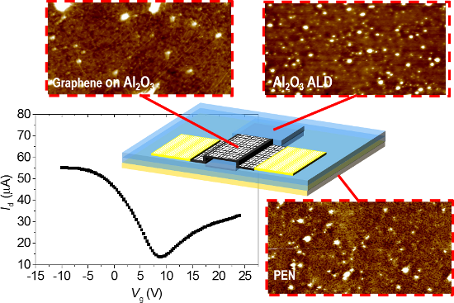
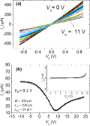
- applications. In this case the thickness and the dielectric constant of the insulating film have crucial importance in order to maintain a reasonably high gate capacitance of the final device. In particular, considering high κ-dielectrics such as HfO2 or Al2O3 with film thickness in the order of 10 nm, the
- substrate. The resulting dielectric constant is 6.9, which is reasonably high considering the low temperature (100 °C) adopted for the dielectric growth and the high roughness of the substrate. As a way of comparison with silicon dioxide, the resulting equivalent oxide thickness (EOT) is 16.8 nm. Several



Fabrication of black-gold coatings by glancing angle deposition with sputtering
Beilstein J. Nanotechnol. 2017, 8, 434–439, doi:10.3762/bjnano.8.46
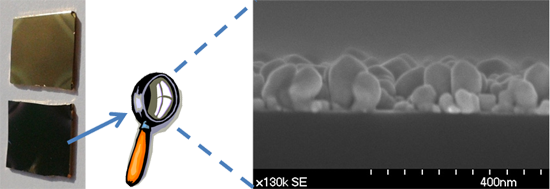
- evolution is quite different. The continuous film shows the characteristic reflecting behavior of metallic films, related to the contribution of the free electrons (Drude) to the dielectric constant. The reflectance of this sample goes up to 80%. In the nanostructured sample, on the other hand, the same
- contribution of the free electrons to the dielectric constant is responsible for the appearance of LSPRs, which as discussed above induce enhanced multiple scattering and light-trapping effects for the particular size distribution and separation among nanostructures occurring in the nanostructured films


Impact of contact resistance on the electrical properties of MoS2 transistors at practical operating temperatures
Beilstein J. Nanotechnol. 2017, 8, 254–263, doi:10.3762/bjnano.8.28
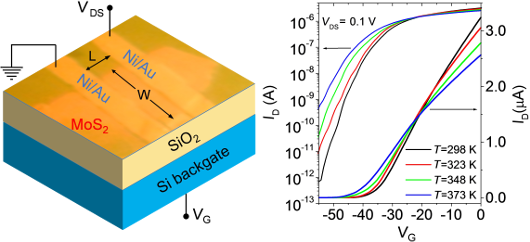
- ≈ 9.1 × 10⁻⁵ F/m2 (ε0 is the vacuum dielectric constant, εox = 3.9, tox = 380 nm, the permittivity and the thickness of the SiO2 film, respectively), on the capacitance of the MoS2 depletion region, Cs, as well as on the capacitance associated with MoS2/SiO2 interface traps, Cit [5]. In the depletion




Optical and photocatalytic properties of TiO2 nanoplumes
Beilstein J. Nanotechnol. 2017, 8, 190–195, doi:10.3762/bjnano.8.20
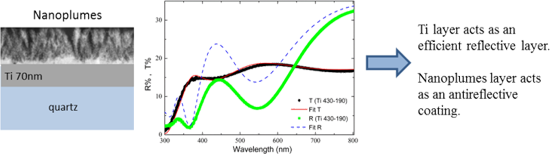
- reflectance spectrum of the titanium layer before the chemical etching. We assumed that the functional form for the dielectric constant of the metallic film is given by the “Drude free carrier” expression [26]: where ω, ωP, γ and ε∞ are, respectively, the light frequency, the plasma frequency, the damping
- constant, and the low-frequency dielectric constant tabulated for titanium. The refractive index of titanium is calculated by the square root of Equation 1 [26]: The refractive index of the TiO2 film was extracted by fitting both the reflectance and transmittance spectra of the Ti (430-190) sample, by


Graphene–polymer coating for the realization of strain sensors
Beilstein J. Nanotechnol. 2017, 8, 21–27, doi:10.3762/bjnano.8.3
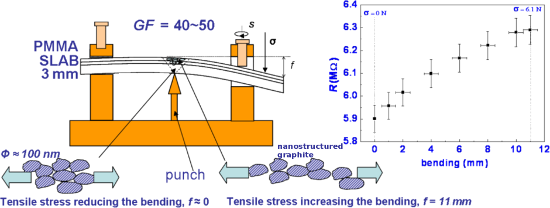
- is the effective relative dielectric constant of the layer. The value of τ found by the fitting procedure implies that for Ec ≈ 100 meV, an intergrain distance d of few nanometers is found, consistently with the adopted model. From Equation 3, and taking into account the definition of gauge factor


Streptavidin-coated gold nanoparticles: critical role of oligonucleotides on stability and fractal aggregation
Beilstein J. Nanotechnol. 2017, 8, 1–11, doi:10.3762/bjnano.8.1
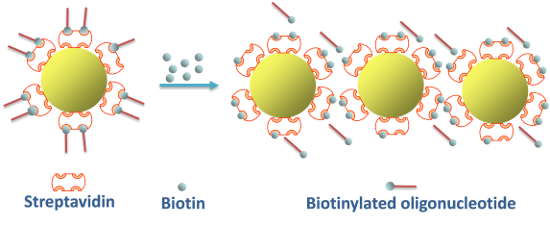
- surface plasmons (SPs) propagating along the interface between the flat metal surface and dielectric. The signal enhancement produced when AuNPs are used in assays is a consequence of the large variation of the local dielectric constant caused by AuNPs [8]. In fact, the interaction between propagating and
- , respectively. The shift is a consequence of changes in the local dielectric constant and effective thickness of the layer adsorbed on the AuNP surface [30]. No significant broadening of peaks is observed after the functionalization steps, indicating that particles did not appreciably aggregate. The 4 nm shift
- Equation 1: where εs and εm represent the dielectric constant of the shell (SA) and the surrounding medium (water), respectively, λp is the bulk metal plasmon wavelength (131 nm for gold [32]), λmax,bare is the wavelength of maximum absorption for AuNPs (520 nm, Figure 2), g is the fraction of nanoparticle




Effect of Anderson localization on light emission from gold nanoparticle aggregates
Beilstein J. Nanotechnol. 2016, 7, 2013–2022, doi:10.3762/bjnano.7.192
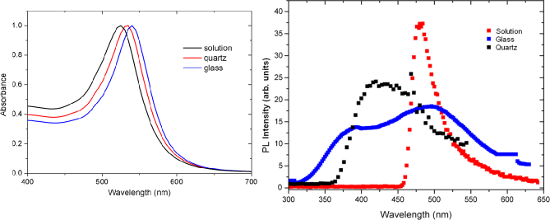
- electron microscopy, X-ray diffraction and X-ray photoelectron spectroscopy. The dielectric constant of the surrounding medium plays a crucial role in determining the aggregate geometry, which affects the Anderson localization of light in the aggregates and hence causes a red-shift in the plasmonic
- revealed a primary particle size of ≈14 nm. For spherical nanoparticles, the condition of plasmon resonance excitation is satisfied when εreal = −2εm, where εreal is the real part of the dielectric constant of the particle material and εm is the dielectric constant of the medium. For nonspherical
- into several modes. According to the Drude free-electron model [16], the electron resonance for small spherical metallic nanoparticles is described according to the following expression for the static polarizability α: where R is the particle radius, ε is the complex dielectric constant of the





