


Search results
Search for "transport properties" in Full Text gives 169 result(s) in Beilstein Journal of Nanotechnology.
First-principles study of the structure of water layers on flat and stepped Pb electrodes
Beilstein J. Nanotechnol. 2016, 7, 533–543, doi:10.3762/bjnano.7.47
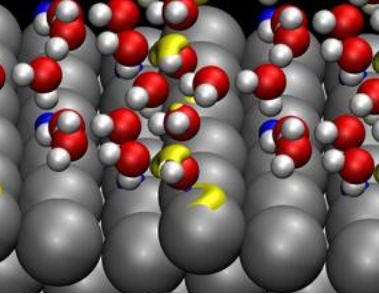
- temperatures were addressed using ab initio molecular dynamics (AIMD) simulations [16] yielding good agreement with the experiment [17], and the influence of the presence of ions in aqueous electrolytes on the transport properties of atomic junctions was assessed [18] taking into account an appropriate
- transport properties of the switch are concerned. Acknowledgements Financial support by the Baden-Württemberg Foundation through the project C3 within the network “Functional Nanostructures” is gratefully acknowledged. Computational resources have been provided by the bwHPC5 project of the Federal State of


Charge and heat transport in soft nanosystems in the presence of time-dependent perturbations
Beilstein J. Nanotechnol. 2016, 7, 439–464, doi:10.3762/bjnano.7.39
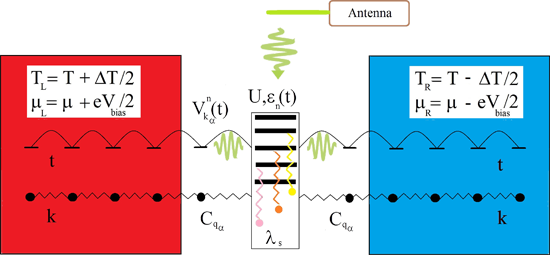
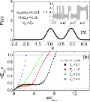
- Sant’Angelo, Via Cintia, I-80126 Napoli, Italy 10.3762/bjnano.7.39 Abstract Background: Soft nanosystems are electronic nanodevices, such as suspended carbon nanotubes or molecular junctions, whose transport properties are modulated by soft internal degrees of freedom, for example slow vibrational modes
- -dependent perturbations; Introduction In some nanoelectronic devices, internal soft degrees of freedom, such as slow vibrational modes, cannot be neglected since they actively modulate the transport properties. Indeed, the electron–vibration coupling significantly affects the charge and heat transport of
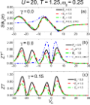
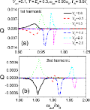
- displacement and acquire an explicit periodic dependence on time. We have treated distinct systems in our unified approach. In particular we have studied the electronic transport properties at finite bias of a NEMS device consisting of a vibrating suspended CNT actuated by an external antenna. In this setup






Invariance of molecular charge transport upon changes of extended molecule size and several related issues
Beilstein J. Nanotechnol. 2016, 7, 418–431, doi:10.3762/bjnano.7.37
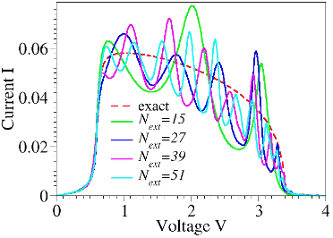
- is whether the transport properties are independent of how this partitioning is made as shown in Figure 1. We are not aware of previous attempts in the literature to demonstrate or even check this invariance. Addressing this issue is one of the main aims of the present work. Results and Discussion
- . Approximations of wide- and flat-electrode bands and related issues At first sight, the concept of the invariance of the transport properties upon the choice of the extended molecule size may seem of merely academic interest (possibly a part of a Ph.D. tutorial) or useful for checking the correctness of
- numerical code to compute transport properties (which should not change whatever the size of the central region chosen). To see that the results presented above are also relevant for more pragmatic purposes, the effect of negative differential resistance (NDR) is discussed next in conjunction with common


Rigid multipodal platforms for metal surfaces
Beilstein J. Nanotechnol. 2016, 7, 374–405, doi:10.3762/bjnano.7.34

- significantly affect the charge transport properties of the molecular junctions [55]. Nevertheless, these anchoring groups have been explored most frequently when attached to core structures that are not highly conjugated and exhibit poor conductivity (e.g., saturated alkanes) [26][30][56]. In contrast, highly










Dependence of lattice strain relaxation, absorbance, and sheet resistance on thickness in textured ZnO@B transparent conductive oxide for thin-film solar cell applications
Beilstein J. Nanotechnol. 2016, 7, 75–80, doi:10.3762/bjnano.7.9
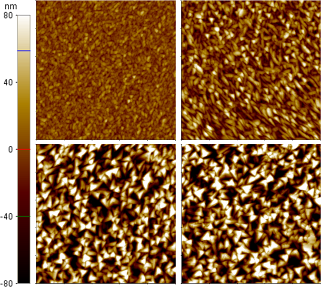
- , doping impurities, such as B, Al, and Ga, can improve the electrical transport properties of ZnO [18]. There are two benefits to using a B-doped ZnO (ZnO@B) film as the TCO layer. First, B has the smallest ionic radius among the three dopants (B3+: 0.23Å, Al3+: 0.54 Å, Ga3+: 0.62 Å,), which results in
- investigation. Experimental Synthesis of ZnO@B thin films by LPCVD The polar c-plane ZnO samples were grown on a sapphire substrate at 170 °C at a pressure of 0.6 Torr in a LPCVD reactor. DEZ and H2O were used as the precursors for Zn and O, respectively. ZnO was doped with B to improve the electrical transport
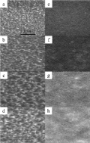
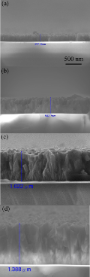
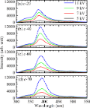
- properties of ZnO thin films [9][18]. B2H6 was used as a doping gas. Four ZnO@B samples with 20-, 40-, 60-, and 70-minute growth times, corresponding to 272, 544, 1022, and 1388 nm in thickness, were prepared (samples c-20, c-40, c-60, and c-70, respectively). For the four samples, the B2H6, DEZ, and H2O flow



Current-induced runaway vibrations in dehydrogenated graphene nanoribbons
Beilstein J. Nanotechnol. 2016, 7, 68–74, doi:10.3762/bjnano.7.8
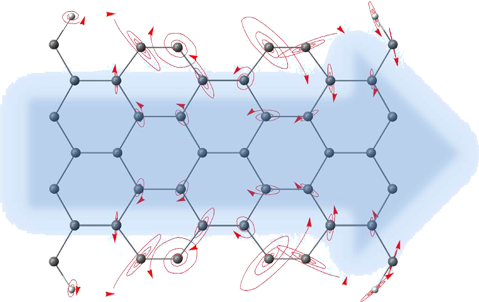
- how armchair nanoribbons can serve as a possible testbed for probing the current-induced forces. Keywords: current-induced forces; density functional theory (NEGF-DFT); graphene; molecular electronics; Introduction The electronic and transport properties of graphene has been the focus of intense
Charge injection and transport properties of an organic light-emitting diode
Beilstein J. Nanotechnol. 2016, 7, 47–52, doi:10.3762/bjnano.7.5
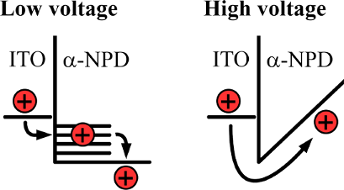
- improvement. In details, the organic–organic and metal–organic interfaces determine injection properties, whereas the conductivities of organic layers limit the charge transport properties. Charge transport in organic semiconductors has been widely studied by electrical characterization techniques such as
- correlation between obtained results of different characterization techniques is reliable only for the same device. This study demonstrates charge transport properties in OLED devices formed by indium tin oxide (ITO)/N,N'-di-1-naphthyl-N,N'-diphenyl-1,1'-biphenyl-4,4'-diamine (α-NPD)/Alq3/Al system. The
- transport properties of OLED devices has been done on the organic double-layer sandwiched between two electrodes ITO/α-NPD/Alq3/Al. The devices were grown on glass slides precoated with ITO with sheet resistance lower than 10 Ω/sq. The substrates were cleaned sequentially in ultrasonic bath by isopropanol


High electronic couplings of single mesitylene molecular junctions
Beilstein J. Nanotechnol. 2015, 6, 2431–2437, doi:10.3762/bjnano.6.251
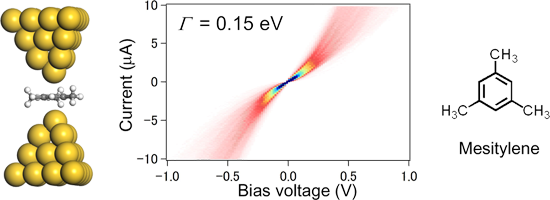
- transport properties of single mesitylene (1,3,5-trimethylbenzene) molecular junctions. The electronic conductance and the current–voltage characteristics of mesitylene molecules wired into Au electrodes were measured by a scanning tunnelling microscopy-based break-junction method at room temperature in a




Negative differential electrical resistance of a rotational organic nanomotor
Beilstein J. Nanotechnol. 2015, 6, 2332–2337, doi:10.3762/bjnano.6.240
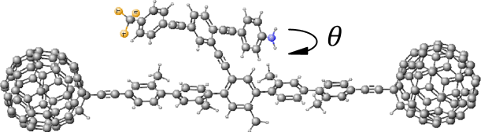
- effect of the external electric field on transport properties of the dumbbell molecule, consider the molecule connected to two gold electrodes in a junction, as shown in Figure 3a. Since we are interested in a two-terminal switch, we focus on the effect of the source–drain electric field induced by gold


Kelvin probe force microscopy for local characterisation of active nanoelectronic devices
Beilstein J. Nanotechnol. 2015, 6, 2193–2206, doi:10.3762/bjnano.6.225
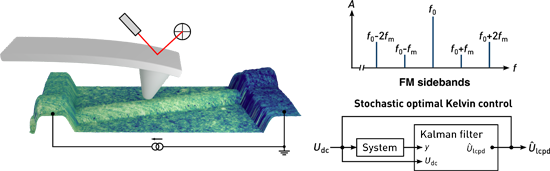
- modulation; Kalman filter; Kelvin probe force microscopy; sidebands; Introduction Device performance of current nanoelectronic devices, and even more so of potential future generations including nanowires or molecular junctions, critically depends on transport properties varying on a length scale of a few
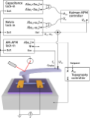
- , and assuming uniform material or transport properties, for the nanowire device in Figure 9 we hereby obtain a contact resistance of 40 kΩ at the left electrode, 150 kΩ at the right electrode, and a channel resistance of 50 kΩ. In Figure 10, we compare the performance of our Kalman-KFM controller with


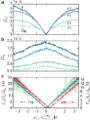
![[Graphic 33]](/bjnano/content/inline/2190-4286-6-225-i48.png?max-width=637&scale=1.18182) for different modulation amplitu...
for different modulation amplitu...




Thermoelectricity in molecular junctions with harmonic and anharmonic modes
Beilstein J. Nanotechnol. 2015, 6, 2129–2139, doi:10.3762/bjnano.6.218
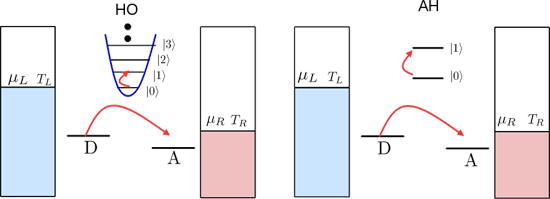
- energy transport properties of molecular junctions is delivered by the so-called cumulant generating function , defined in terms of the characteristic function as with Here λe, λp are counting fields for energy and particles, respectively, defined for the right lead measurement, t is the final


High Ion/Ioff current ratio graphene field effect transistor: the role of line defect
Beilstein J. Nanotechnol. 2015, 6, 2062–2068, doi:10.3762/bjnano.6.210
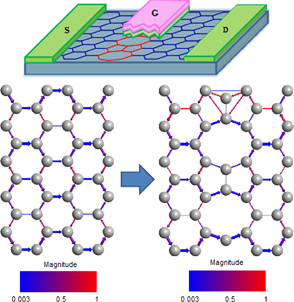
- of its unique electronic transport properties. The properties of graphene such ultra-thin body properties for optimum electrostatic scaling and excellent thermal conductivity has made it a potential alternative to silicon and facilitated the manufacture of devices [1][2]. Furthermore, the high
- along the edge of zigzag nanoribbons. There are also studies on the line defects in armchair nanoribbons [16][17]. The research into divacancies and ELD in armchair nanoribbons shows that the presence of divacancy defects has significant impacts on the band structure and electronic transport properties


Simulation of thermal stress and buckling instability in Si/Ge and Ge/Si core/shell nanowires
Beilstein J. Nanotechnol. 2015, 6, 1970–1977, doi:10.3762/bjnano.6.201
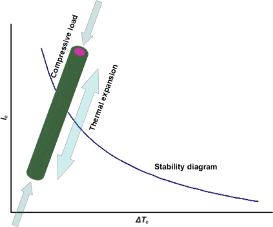
- years, a drastic rise in the research activities on semiconductor core/shell nanowires (CSNWs) made of silicon and germanium has occurred. Such studies are often motivated by the excellent charge transport properties of the materials [1][2][3][4], for which they are now seen as prospective candidates
- becomes a crucial operating parameter for the CSNW devices. On one hand, it directly affects the transport properties through phononic contributions, while on the other, it can induce thermal stress in the system. Although the former effect can be quantified through direct transport measurements [2][10
- strategy is easier for materials with a lower Debye temperature. Such cases would not require the quantum scaling of temperature, which is the most computationally expensive and prohibitive part of this method for systems with large sizes. Furthermore, some other effects such as the change in transport


Current–voltage characteristics of manganite–titanite perovskite junctions
Beilstein J. Nanotechnol. 2015, 6, 1467–1484, doi:10.3762/bjnano.6.152
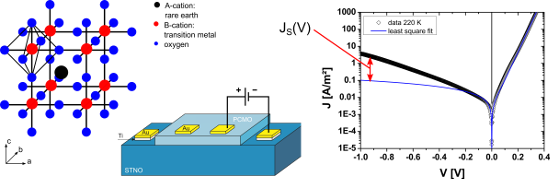
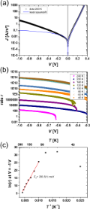
- transport properties in the bulk and across junction interfaces. However, the insight that the J–V curves provide into microscopic processes is intimately linked to the applied analysis. It is quite remarkable that for the limiting cases of quasi-free electrons and small polarons, the analysis of J–V curves
- same barrier calculated from J–V curves in the dark. The result that the same value for the energy barrier is obtained from analysis of transport properties in the dark and under illumination (Equation 22 and Equation 16, respectively) confirms the consistency of the analysis and applicability of the





Electron and heat transport in porphyrin-based single-molecule transistors with electro-burnt graphene electrodes
Beilstein J. Nanotechnol. 2015, 6, 1413–1420, doi:10.3762/bjnano.6.146
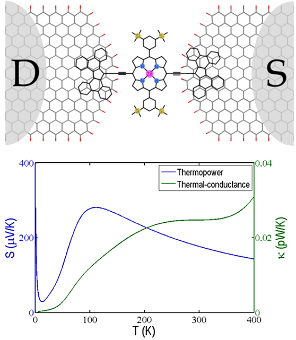
- Hatef Sadeghi Sara Sangtarash Colin J. Lambert Quantum Technology Centre, Physics Department, Lancaster University, Lancaster, LA1 4YB, UK 10.3762/bjnano.6.146 Abstract We have studied the charge and thermal transport properties of a porphyrin-based single-molecule transistor with electro-burnt
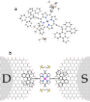
- , the edges of the EBG are likely terminated by oxygen, especially close to the junction. Therefore, before studying the transport properties of the PM, we focus on the transport properties of the EBG electrodes with oxygen-terminated edges. Figure 3 shows the molecular and electronic structure of the


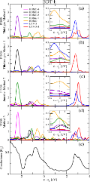
Can molecular projected density of states (PDOS) be systematically used in electronic conductance analysis?
Beilstein J. Nanotechnol. 2015, 6, 1247–1259, doi:10.3762/bjnano.6.128
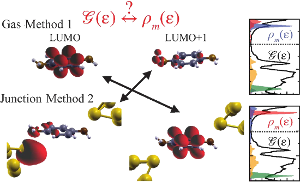
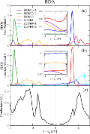
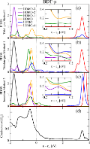
- importance of the lead–molecule charge transfer and the significance of its role in transport properties of molecular junctions. Here, it constitutes the basis for the construction of a new method of analysis. Application of the new method to BDT-h We apply our new method to the case of BDT-h (hollow





Electrical characterization of single molecule and Langmuir–Blodgett monomolecular films of a pyridine-terminated oligo(phenylene-ethynylene) derivative
Beilstein J. Nanotechnol. 2015, 6, 1145–1157, doi:10.3762/bjnano.6.116
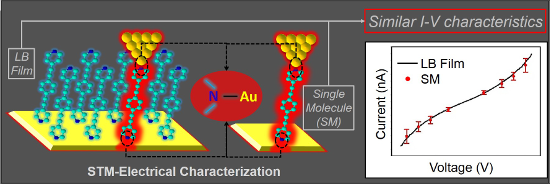
- interactions, for example, van der Waals interactions and polarization effects in electronic transport properties [22][23][24]. In addition, planar-sandwiched monolayer structures are more closely aligned with practical electronic applications. Three main techniques have been used to fabricate molecular


Charge carrier mobility and electronic properties of Al(Op)3: impact of excimer formation
Beilstein J. Nanotechnol. 2015, 6, 1107–1115, doi:10.3762/bjnano.6.112
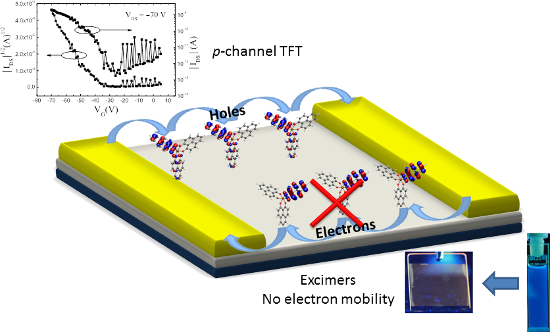
- the formation of excimers in the solid state, which is crucial for the transport properties. The incorporation of Al(Op)3 into organic thin film transistors (TFTs) was performed in order to measure the charge carrier mobility. The experimental setup detected no electron mobility, while a hole mobility
- efficiently accept and delocalize additional electrons) suggest more robust electron charge transport properties. This discrepancy is explained by the excimer formation, whose inclusion in the multiscale simulation workflow is expected to bring the theoretical simulation and experiment into agreement
- parameters for charge transporting materials [15]. In particular, lower LUMO and HOMO energies enable easier reduction of the metal chelate, leading to enhanced electron injection and transport properties, and an increased resistance to oxidization, resulting in an improved hole blocking character. For this


Tunable magnetism on the lateral mesoscale by post-processing of Co/Pt heterostructures
Beilstein J. Nanotechnol. 2015, 6, 1082–1090, doi:10.3762/bjnano.6.109
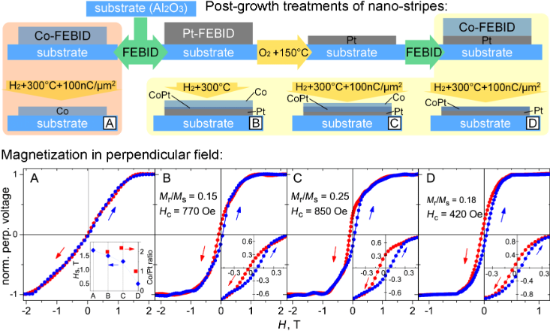
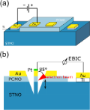
- induced deposition; heterostructures; in situ processing; platinum; Introduction Controlling magneto-transport properties on the nanometer-scale is essential for basic research in micro-magnetism [1] and spin-dependent transport [2] as well as for various applications, such as magnetic domain-wall logic
- values for purified individual Co [30] and Pt [39] FEBID structures. Magneto-transport properties The central finding of this work lies in the modification of the field dependences of the Hall voltage U(H) measured at 10 K for all samples, see Figure 4. The magnetic field was directed perpendicular to


From lithium to sodium: cell chemistry of room temperature sodium–air and sodium–sulfur batteries
Beilstein J. Nanotechnol. 2015, 6, 1016–1055, doi:10.3762/bjnano.6.105
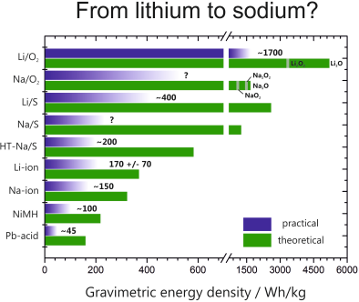
- LIBs and NIBs, the behavior is in most cases quite different. The reason is related to the larger size of the sodium ion that affects the phase stability, the transport properties and the interphase formation. The basic characteristics of multielectron transfer reactions involving sodium-based
- : Considerably high combined overpotential occurs and the cell kinetics are sluggish. Various processes can contribute to overpotential, but using catalysts or optimizing the transport properties might be effective strategies for improvement. Type 3: The voltage continuously increases during charging and might


Multiscale modeling of lithium ion batteries: thermal aspects
Beilstein J. Nanotechnol. 2015, 6, 987–1007, doi:10.3762/bjnano.6.102
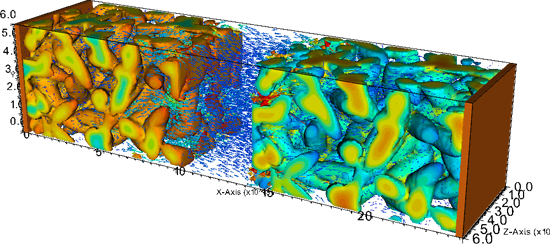
- can be compared (Table 2). To this end the effective transport properties required in the meso-case instead of bulk values are computed from the micro-structure by using the software GeoDict [89]. As described in the previous section, the meso-model used here is a 3D + 1D model, i.e., three spatial


Production, detection, storage and release of spin currents
Beilstein J. Nanotechnol. 2015, 6, 736–743, doi:10.3762/bjnano.6.75
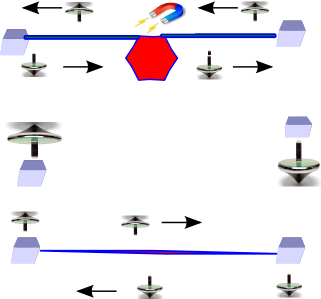
- and transport properties of materials [2]. On the other hand, other promising themes of research on spin currents remain largely to be explored. One is the spin version of quantum pumping – something that is not possible classically. A seminal paper by Thouless [3] pointed out that quantum mechanics


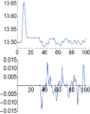

Electroburning of few-layer graphene flakes, epitaxial graphene, and turbostratic graphene discs in air and under vacuum
Beilstein J. Nanotechnol. 2015, 6, 711–719, doi:10.3762/bjnano.6.72
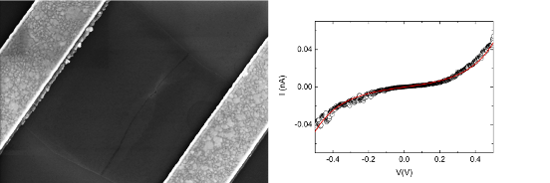
- their use for room temperature operations [8][9]. In a three-terminals geometry, the relatively thick electrodes lead to a screening of the gate potential; the atomistic configuration of the metal–molecule–metal junction has a large number of parameters that determine the transport properties which

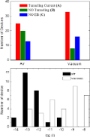
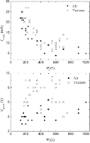


Entropy effects in the collective dynamic behavior of alkyl monolayers tethered to Si(111)
Beilstein J. Nanotechnol. 2015, 6, 583–594, doi:10.3762/bjnano.6.60
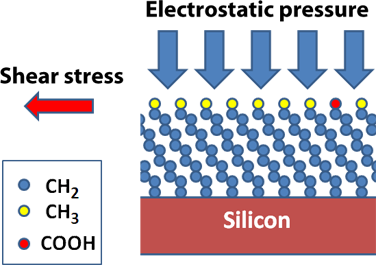
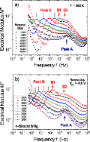
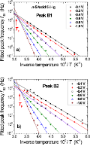
- ] conformational changes on electron transport properties have rarely been explicitly described. In this context, this admittance spectroscopy study emphasizes a collective dynamic behavior of linear saturated (n-alkyl) chains tethered to Si(111). Dynamic properties are very sensitive to structure and conformation




Raman spectroscopy as a tool to investigate the structure and electronic properties of carbon-atom wires
Beilstein J. Nanotechnol. 2015, 6, 480–491, doi:10.3762/bjnano.6.49
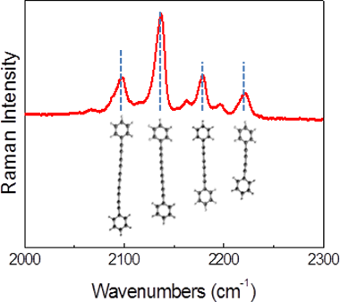
- theoretical prediction of the electronic and transport properties of carbon wires connected to metal electrodes and to other carbon nanostructures such as graphene and nanotubes, while detailed experimental work is still needed to unveil the structure and properties of these systems. Raman spectroscopy is a
- also attracted interest as a molecular junction, as shown in a number of theoretical investigations and a few experimental works regarding wires connected to graphene and nanotubes. These have shown interesting electronic and transport properties [80][81][82][83][84]. While experimental work is still





