Search results
Search for "force" in Full Text gives 1143 result(s) in Beilstein Journal of Nanotechnology. Showing first 200.
Exploring the relationships between physiochemical properties of nanoparticles and cell damage to combat cancer growth using simple periodic table-based descriptors
Beilstein J. Nanotechnol. 2024, 15, 297–309, doi:10.3762/bjnano.15.27
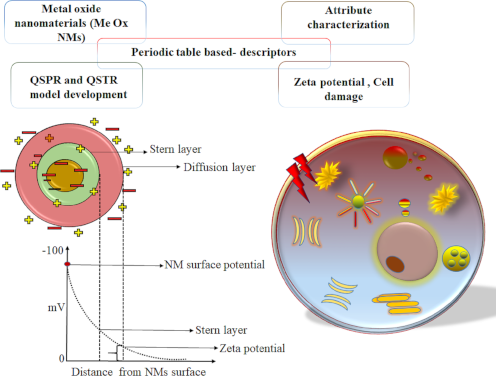
- valence potential allow for an easier formation of the electrostatic double layer (EDL). If the solution with NPs shifts to lower ionic strength, then the zeta potential increases as the EDL expands to balance the electrostatic force, thus allowing for the dispersion of NPs. The descriptor


Determining by Raman spectroscopy the average thickness and N-layer-specific surface coverages of MoS2 thin films with domains much smaller than the laser spot size
Beilstein J. Nanotechnol. 2024, 15, 279–296, doi:10.3762/bjnano.15.26
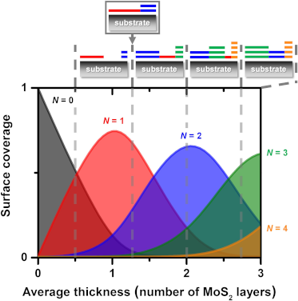
- . However, atomic force microscopy revealed that they are constituted of nanoflakes (with a lateral size of typically 50 nm) with possibly a distribution of thicknesses. Furthermore, depending on the synthesis conditions, the MoS2 surface coverage can be incomplete, and the thin film average thickness can


Design, fabrication, and characterization of kinetic-inductive force sensors for scanning probe applications
Beilstein J. Nanotechnol. 2024, 15, 242–255, doi:10.3762/bjnano.15.23
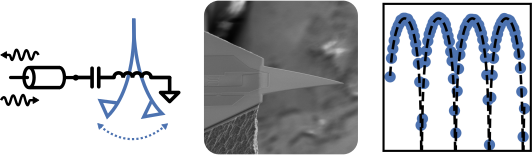
- August K. Roos Ermes Scarano Elisabet K. Arvidsson Erik Holmgren David B. Haviland Department of Applied Physics, KTH Royal Institute of Technology, Hannes Alfvéns väg 12, SE-114 19 Stockholm, Sweden 10.3762/bjnano.15.23 Abstract We describe a transducer for low-temperature atomic force
- microscopy based on electromechanical coupling due to a strain-dependent kinetic inductance of a superconducting nanowire. The force sensor is a bending triangular plate (cantilever) whose deflection is measured via a shift in the resonant frequency of a high-Q superconducting microwave resonator at 4.5 GHz
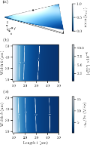
- . We present design simulations including mechanical finite-element modeling of surface strain and electromagnetic simulations of meandering nanowires with large kinetic inductance. We discuss a lumped-element model of the force sensor and describe the role of an additional shunt inductance for tuning



Quantitative wear evaluation of tips based on sharp structures
Beilstein J. Nanotechnol. 2024, 15, 230–241, doi:10.3762/bjnano.15.22
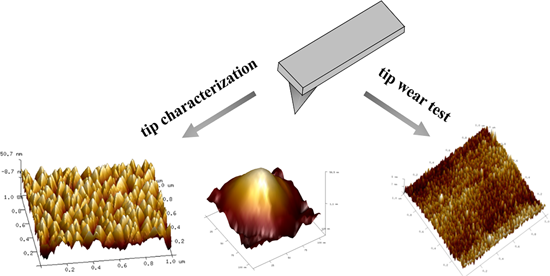
- Ke Xu Houwen Leng School of Electrical & Control Engineering, Shenyang Jianzhu University, Shenyang 110168, China 10.3762/bjnano.15.22 Abstract To comprehensively study the influence of atomic force microscopy (AFM) scanning parameters on tip wear, a tip wear assessment method based on sharp
- scanning frequency and free amplitude, and a set point of approximately 0.2, resulting in clear, high-quality AFM images. Keywords: atomic force microscopy; estimated tip diameter; scanning parameter; tip reconstruction; tip wear; Introduction AFM is a commonly used multifunctional technology in
- scans, and the degree of wear increases with higher free amplitude. This increase is due to the increase in tip–sample force when the distance is constant [22][23]. To investigate the impact of the line scanning frequency on wear, the tip’s free amplitude was maintained at approximately 300 mV, the set




Multiscale modelling of biomolecular corona formation on metallic surfaces
Beilstein J. Nanotechnol. 2024, 15, 215–229, doi:10.3762/bjnano.15.21
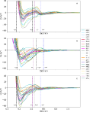
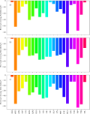
- (TiO2, SiO2, and Fe2O3), carbonaceous NPs (graphene, carbon nanotubes, and carbon black), semiconductors (CdSe) [26], and polymers [27], it lacks the set of short-range potentials required for calculating milk protein-aluminum adsorption energies. Here, we compute potentials of mean force (PMF) for Al
- GROMACS-2018.6 and PLUMED (PLUMED2-2.5.1.conda.5) software packages [29][30][31]. CHARMM-GUI/Nanomaterial Modeler was employed to construct the topology and force fields of three fcc surfaces of Al: (100), (110), and (111) [32]. The General Amber Force Field (GAFF) was utilized to model side-chains
- analogues (SCA) within the system [33][34]. The AMBER force field is a widely recognized and extensively validated force field that provides accurate descriptions of molecular systems [35]. We evaluated the short-range PMFs between 22 SCAs and an Al slab in a solvent environment comprising water and salt




Ion beam processing of DNA origami nanostructures
Beilstein J. Nanotechnol. 2024, 15, 207–214, doi:10.3762/bjnano.15.20
- for about 2 h. Afterwards, 100 μL of the synthesis mixture was filtered through 100 kDa MWCO Amicon centrifugal filter units to remove excess staple strands. This was done three times, each time adding 400 μL of FOB, at a relative centrifugal force of 4000g for 4 min. The filters were then flipped and


Graphene removal by water-assisted focused electron-beam-induced etching – unveiling the dose and dwell time impact on the etch profile and topographical changes in SiO2 substrates
Beilstein J. Nanotechnol. 2024, 15, 190–198, doi:10.3762/bjnano.15.18
- provides information about the degree of damage caused by this method. Atomic force microscopy (AFM) measurements reveal important aspects of topographical changes induced in the substrate and help to establish optimized conditions for the etching process. Results The fundamentals of water-assisted FEBIE
- those with similar characteristics, allowing us to distinguish between irradiated and nonirradiated areas of the graphene layer and evaluate the etching results. Atomic force microscopy Precise surface analysis of etched structures can be performed by AFM. We used a unique AFM LiteScope from NenoVision


Modification of graphene oxide and its effect on properties of natural rubber/graphene oxide nanocomposites
Beilstein J. Nanotechnol. 2024, 15, 168–179, doi:10.3762/bjnano.15.16
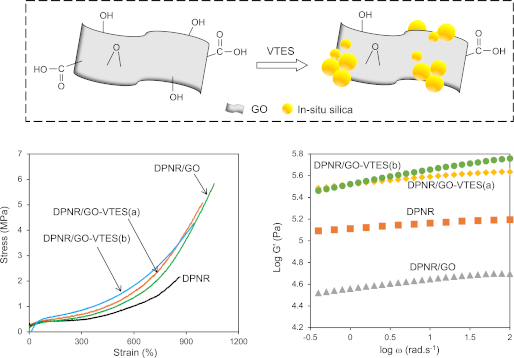
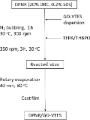
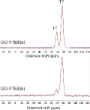
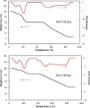
- chemical interaction between GO and NR. Dynamic mechanical properties Dynamic mechanical properties of composite samples reveal how much energy is stored or lost during applied cyclic shearing force. Figure 11 shows the dependence of the storage modulus (G'), loss modulus (G''), and loss tangent (tan δ) of
- G' value of DPNR/GO could be explained by thin and large surface GO layers. The GO sheet could not withstand large shearing force, causing the rubber particles to slip. The high G' value of DPNR/GO-VTES(a) and DPNR/GO-VTES(b) may be due to hard silica particles, which may contribute to higher energy
- dissipation while applying force than DPNR/GO-VTES(a) and DPNR. The loss tangent (tan δ) is defined as a G''/G' ratio. The dependence of tan δ with frequency for DPNR/GO samples was quite similar to that of DPNR, in which tan δ decreased as frequency decreased. This phenomenon is appointed to the pure






CdSe/ZnS quantum dots as a booster in the active layer of distributed ternary organic photovoltaics
Beilstein J. Nanotechnol. 2024, 15, 144–156, doi:10.3762/bjnano.15.14
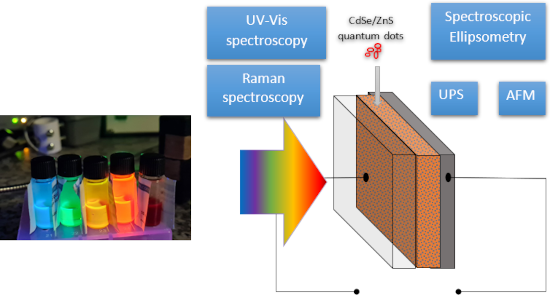
- relations of refractive indices and extinction coefficient were investigated. The morphologies of the thin films were studied with atomic force microscopy. The chemical boundaries of the ternary layers were determined by Raman spectroscopy. Based on UPS studies, the energy diagram of the potential devices
- carried out for three incidence angles (65°, 70°, and 75°). A Bruker atomic force microscope (AFM) MULTIMODE 8 was used in the measurements in the ScanAsyst in Air mode, using silicon nitride probes (with a nominal tip radius of 2 nm and a spring constant equal to 0.4 N/m). The substrate was
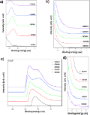
- observed in our study. Atomic force microscopy Surface examinations of the sample mixtures were performed. Figure 7 illustrates the surface morphology in a two-dimensional format. Three-dimensional images of the surface are in Supporting Information File 1, Figure S1. The roughness profile parameters for




Enhanced feedback performance in off-resonance AFM modes through pulse train sampling
Beilstein J. Nanotechnol. 2024, 15, 134–143, doi:10.3762/bjnano.15.13
- Mustafa Kangul Navid Asmari Santiago H. Andany Marcos Penedo Georg E. Fantner Laboratory for Bio- and Nano-Instrumentation, Swiss Federal Institute of Technology Lausanne (EPFL), Lausanne CH-1015, Switzerland 10.3762/bjnano.15.13 Abstract Dynamic atomic force microscopy (AFM) modes that operate
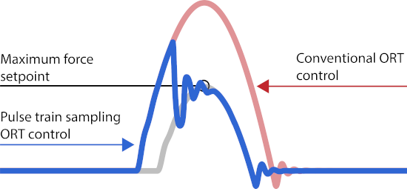
- force, as well as reduced lateral force. Simultaneously, they enable mechanical property mapping of the sample. However, ORT modes have an intrinsic drawback: a low scan speed due to the limited ORT rate, generally in the low-kilohertz range. Here, we analyze how the conventional ORT control method
- vertical force changes during a defined time window of the tip–sample interaction. Through this, we use multiple samples in the proximity of the maximum force for the feedback loop, rather than only one sample at the maximum force instant. This method leads to improved topography tracking at a given ORT


Assessing phytotoxicity and tolerance levels of ZnO nanoparticles on Raphanus sativus: implications for widespread adoptions
Beilstein J. Nanotechnol. 2024, 15, 115–125, doi:10.3762/bjnano.15.11
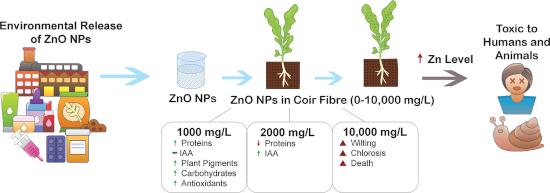
- microvoids in the liquid. This exerted a shear force on NP agglomerates, effectively overcoming the van der Waals force that holds them together [56]. The effect of ZnO NPs on soluble protein and IAA contents Plants grown in coir medium treated with 10,000 mg/L did not survive. Therefore, protein and IAA


Berberine-loaded polylactic acid nanofiber scaffold as a drug delivery system: The relationship between chemical characteristics, drug-release behavior, and antibacterial efficiency
Beilstein J. Nanotechnol. 2024, 15, 71–82, doi:10.3762/bjnano.15.7
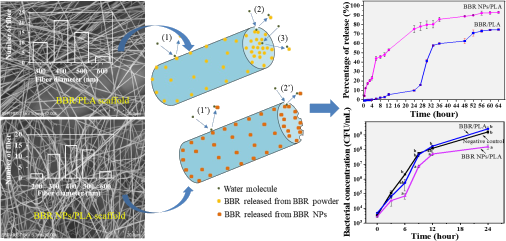
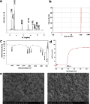
- positively charged quaternary ammonium groups of BBR, increasing the charge density of the blend solution. As the higher charged solution jet, the elongation force imposed on the jet was higher, forming smaller fibers [3][34]. Interestingly, although the same amount of BBR drug was incorporated in the BBR


TEM sample preparation of lithographically patterned permalloy nanostructures on silicon nitride membranes
Beilstein J. Nanotechnol. 2024, 15, 1–12, doi:10.3762/bjnano.15.1
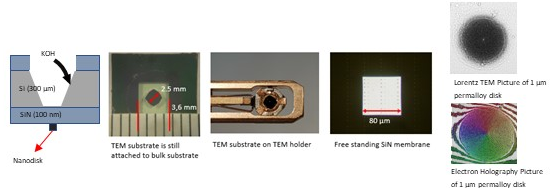
- in Py nanodisks [1][2] with independent polarity and helicity [3]. Since then, many studies have been done on manipulating magnetic vortices inside Py nanodisks using micromagnetic simulations [4][5][6] and a variety of magnetic measurement techniques including magnetic force microscopy [7
- force onto the electron beam, which deflects the beam. The force on each electron in the beam is given by where F is the force, e is the charge, v is the relativistic velocity of the electron beam, and B is the magnetic field exerted by the sample. In the case of a vortex structure, the electron beam is


unDrift: A versatile software for fast offline SPM image drift correction
Beilstein J. Nanotechnol. 2023, 14, 1225–1237, doi:10.3762/bjnano.14.101
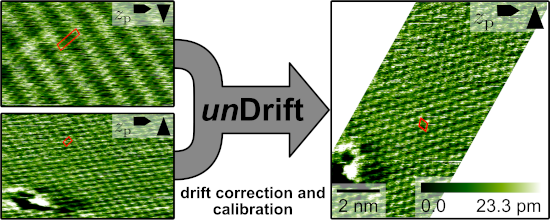
- force microscopy; calibration; drift correction; image correlation functions; periodic structures; scanning probe microscopy; Introduction In science and technology, scanning probe microscopy (SPM) techniques are widely used to study the structure and properties of surfaces and interfaces from the


Determination of the radii of coated and uncoated silicon AFM sharp tips using a height calibration standard grating and a nonlinear regression function
Beilstein J. Nanotechnol. 2023, 14, 1200–1207, doi:10.3762/bjnano.14.99
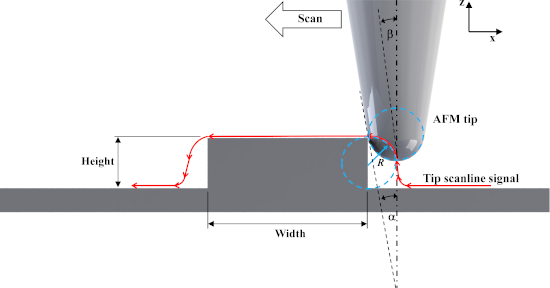
- . However, this method yields an accurate estimate of the tip radius with a low root mean squared error of the curve fitting results. Keywords: AFM tip calibration; nonlinear regression curve fitting; Introduction Atomic force microscopy (AFM) with a sharp tip is typically used to characterize
- force curves with contact mechanics models and extracting the adhesion and friction forces [5][6]. If we do not know the exact value of the tip radius, the sample image with the observation of scanning frequency and the calculation results are not accurate. This indicates that the measurement results
- strongly depend on the geometry of the AFM tip [7][8]. For example, the Pt-coated HQ:NSC18/Pt tip (for electrical force modulation AFM probes) and the Cr/Au-coated HQ:NSC16/Cr-Au tip (for tapping mode AFM probes with long AFM cantilever) produced by MikroMasch [9] have estimated nominal tip radii lower


A combined gas-phase dissociative ionization, dissociative electron attachment and deposition study on the potential FEBID precursor [Au(CH3)2Cl]2
Beilstein J. Nanotechnol. 2023, 14, 1178–1199, doi:10.3762/bjnano.14.98
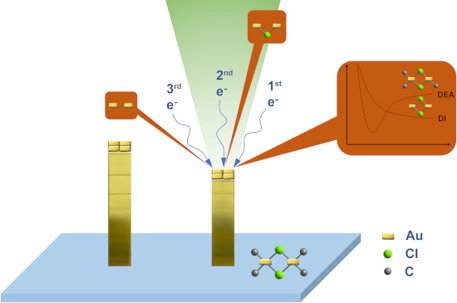
- three experiments. The FEBID structures were investigated by SEM and noncontact atomic force microscopy (AFM). Figure 3a shows the SEM images of the deposits along with the respective deposition parameters. Magnified sections from these SEM images are shown in Figure 3b. Auger electron spectroscopy was



Spatial variations of conductivity of self-assembled monolayers of dodecanethiol on Au/mica and Au/Si substrates
Beilstein J. Nanotechnol. 2023, 14, 1169–1177, doi:10.3762/bjnano.14.97
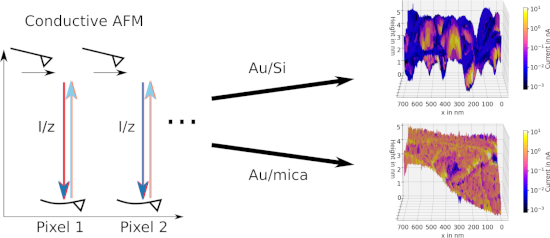
- electronics. A common test bed for fundamental investigations on how to acquire this conductivity are alkanethiol layers on gold substrates. A widely used approach in measuring the conductivity of a molecular layer is conductive atomic force microscopy. Using this method, we investigate the influence of a
- /Si; conductive atomic force microscopy; dodecanethiol; self-assembled monolayers; Introduction For decades, the need for miniaturization of electronics has pushed the research field into the direction of bottom-up, rather than top-down, approaches. In this research field, molecular electronics [1][2
- applied method uses conductive atomic force microscopy (CAFM). In this technique, a conductive probe is used in an AFM, which allows for imaging the surface topography (and other characteristics such as adhesion and stiffness) with lateral resolution while simultaneously being able to measure current


Hierarchically patterned polyurethane microgrooves featuring nanopillars or nanoholes for neurite elongation and alignment
Beilstein J. Nanotechnol. 2023, 14, 1157–1168, doi:10.3762/bjnano.14.96
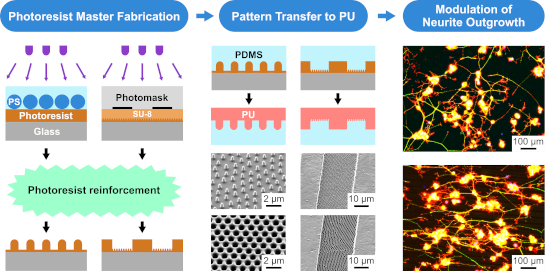
- uncrosslinked PDMS monomers (Supporting Information File 1, Figure S3C). Atomic force microscopy (AFM) scans of the samples (Figure 1F–H) show that the nanopillars and nanoholes have sub-micrometer feature sizes and a periodicity of around 1.2 µm. Due to AFM measurement artifacts, especially for lateral
- ) Cross-sectional profile of the flat (F), nanopillar (G), and nanohole (H) PU surface from atomic force microscopy scans, showing the dimensions of the nanostructures (G, H). (Dimensions in parentheses were obtained from SEM images in Supporting Information File 1, Figure S4.) (I) Water contact angles on
- microgroove (C), pillar–groove (D), and hole–groove (E) substrates, with corresponding high-magnification images (insets). (F–H) Cross-sectional profile of the microgroove (F), pillar–groove (G), and hole–groove (H) PU surface from atomic force microscopy scans, showing the dimensions of the structures. (I, J


Elasticity, an often-overseen parameter in the development of nanoscale drug delivery systems
Beilstein J. Nanotechnol. 2023, 14, 1149–1156, doi:10.3762/bjnano.14.95
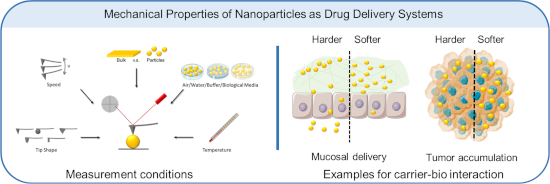
- article, we discuss examples highlighting the influence of elasticity in nanoscale biological interactions focusing on mucosal delivery and on tumor targeting. Besides this, we discuss the influence of different measurement settings using atomic force microscopy for the determination of mechanical
- properties of drug carriers. Keywords: atomic force microscopy; drug delivery; elasticity; mechanical properties; nanomedicine; nanoparticles; stiffness measurement; tissue/body distribution; Introduction Drug delivery systems are developed with the aim to transport a given drug to the site of action
- determine mechanical properties of nanoparticles (or their corresponding bulk materials) highlighting quartz crystal microbalance, rheology, and atomic force microscopy (AFM) are summarized by Li et al. [18]. Another often reported method is particle deformability, being extrusion a possibility for


A multi-resistance wide-range calibration sample for conductive probe atomic force microscopy measurements
Beilstein J. Nanotechnol. 2023, 14, 1141–1148, doi:10.3762/bjnano.14.94
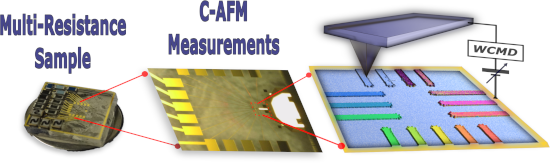
- work, we demonstrate the development of a multi-resistance reference sample for calibrating resistance measurements in conductive probe atomic force microscopy (C-AFM) covering the range from 100 Ω to 100 GΩ. We present a comprehensive protocol for in situ calibration of the whole measurement circuit
- : calibration; conductive probe atomic force microscopy; measurement protocol; nanoscale; resistance reference; Introduction Since its introduction thirty years ago by Murrell et al. [1], conductive probe atomic force microscopy (C-AFM) has evolved into a unique and powerful technique for measuring local
- -AFM measurements in scanning mode. To extract quantitative values comparable to those listed in Table 1, the surface of each electrode was individually imaged at different locations using the same operating parameters, that is, scan speed, scan orientation, applied force, and bias voltage. A histogram


Dual-heterodyne Kelvin probe force microscopy
Beilstein J. Nanotechnol. 2023, 14, 1068–1084, doi:10.3762/bjnano.14.88
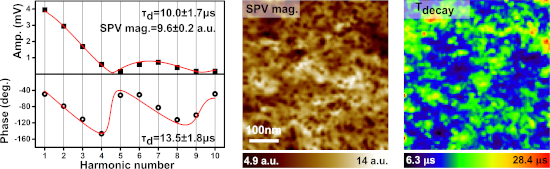
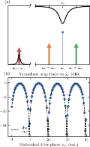
- Benjamin Grevin Fatima Husainy Dmitry Aldakov Cyril Aumaitre Univ. Grenoble Alpes, CNRS, CEA, IRIG-SyMMES, 38000 Grenoble, France 10.3762/bjnano.14.88 Abstract We present a new open-loop implementation of Kelvin probe force microscopy (KPFM) that provides access to the Fourier spectrum of the
- time-periodic surface electrostatic potential generated under optical (or electrical) pumping with an atomic force microscope. The modulus and phase coefficients are probed by exploiting a double heterodyne frequency mixing effect between the mechanical oscillation of the cantilever, modulated
- ; intermodulation; KPFM; nc-AFM; surface photovoltage; time-resolved measurements; Introduction Kelvin probe force microscopy (KPFM) is a well-known variant of AFM that allows probing at the nanoscale the electrostatic landscape on the surface of a sample by measuring the so-called contact potential difference




Spatial mapping of photovoltage and light-induced displacement of on-chip coupled piezo/photodiodes by Kelvin probe force microscopy under modulated illumination
Beilstein J. Nanotechnol. 2023, 14, 1059–1067, doi:10.3762/bjnano.14.87
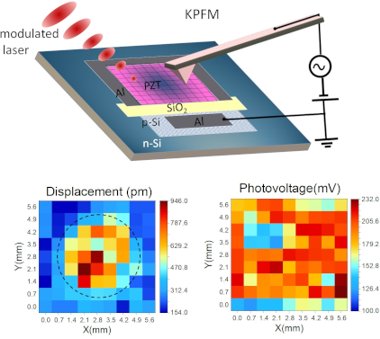
- In this work, a silicon photodiode integrated with a piezoelectric membrane is studied by Kelvin probe force microscopy (KPFM) under modulated illumination. Time-dependent KPFM enables simultaneous quantification of the surface photovoltage generated by the photodiode as well as the resulting
- mechanical oscillation of the piezoelectric membrane with vertical atomic resolution in real-time. This technique offers the opportunity to measure concurrently the optoelectronic and mechanical response of the device at the nanoscale. Furthermore, time-dependent atomic force microscopy (AFM) was employed to
- spatially map voltage-induced oscillation of various sizes of piezoelectric membranes without the photodiode to investigate their position- and size-dependent displacement. Keywords: Kelvin probe force microscopy (KPFM); light-driven micro/nano systems; piezoelectric membrane; surface photovoltage (SPV


Exploring internal structures and properties of terpolymer fibers via real-space characterizations
Beilstein J. Nanotechnol. 2023, 14, 1004–1017, doi:10.3762/bjnano.14.83
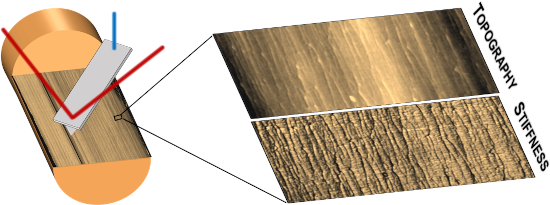
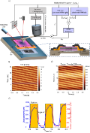
- investigated the processing and properties of high-performance terpolymer fibers, much remains to be understood about the internal nano- and microstructures of these fibers, and how these morphologies relate to fiber properties. Here we use a focused ion beam notch technique and multifrequency atomic force
- Kevlar® K29 fibers, we find remarkable differences between the internal structures of the two fibers, and posit connections between our measurements and multifunctional performance studies from the literature. Keywords: atomic force microscopy; correlative characterization; high-performance fibers
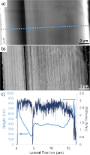
- ® and UHMWPE [9][10][11][12][13]. Here we extend this technique to Technora® by notching individual fibers (Figure 1b), gently opening them along shear planes to expose internal surfaces, and then scanning across those surfaces using an atomic force microscope (AFM) (Figure 1c). AFM scans yield internal






Metal-organic framework-based nanomaterials for CO2 storage: A review
Beilstein J. Nanotechnol. 2023, 14, 964–970, doi:10.3762/bjnano.14.79
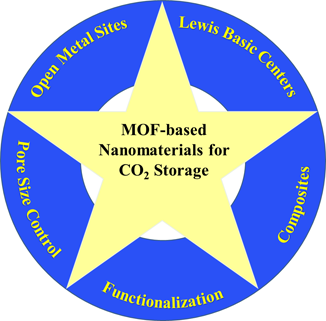
- investigations under 10 bar and 298 K. At pressures higher than 10 bar, computational and experimental results were significantly different because of the unsuitable force field under high pressure conditions. Recently, Stanton et al. also used the GCMC technique to predict the CO2 adsorption of various MOF




Upscaling the urea method synthesis of CoAl layered double hydroxides
Beilstein J. Nanotechnol. 2023, 14, 927–938, doi:10.3762/bjnano.14.76
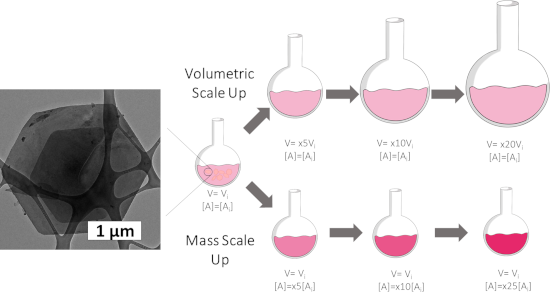
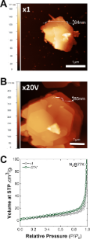
- CoAl-based LDH synthesis through an ARR method had been demonstrated, morphological aspects were addressed by means of scanning electron microscopy (SEM), transmission electron microscopy (TEM), and atomic force microscopy (AFM) (Figure 4 and Figure 5). For reference x1, well-defined hexagonal single
- microscope at an accelerating voltage of 20 kV. Atomic force microscopy (AFM) AFM was carried out with a Bruker Dimension Icon microscope in scan-assist-mode. A Bruker Scanasyst-Air silicon tip with a diameter of around 10 nm was used to obtain images with a resolution of 512 × 512 or 1024 × 1024 pixels. The