Search results
Search for "nanomaterials" in Full Text gives 614 result(s) in Beilstein Journal of Nanotechnology. Showing first 200.
Determining by Raman spectroscopy the average thickness and N-layer-specific surface coverages of MoS2 thin films with domains much smaller than the laser spot size
Beilstein J. Nanotechnol. 2024, 15, 279–296, doi:10.3762/bjnano.15.26
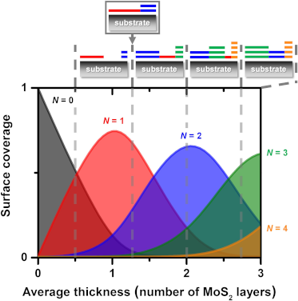
- Raman spectroscopy is a widely used technique to characterize nanomaterials because of its convenience, non-destructiveness, and sensitivity to materials change. The primary purpose of this work is to determine via Raman spectroscopy the average thickness of MoS2 thin films synthesized by direct liquid


Vinorelbine-loaded multifunctional magnetic nanoparticles as anticancer drug delivery systems: synthesis, characterization, and in vitro release study
Beilstein J. Nanotechnol. 2024, 15, 256–269, doi:10.3762/bjnano.15.24
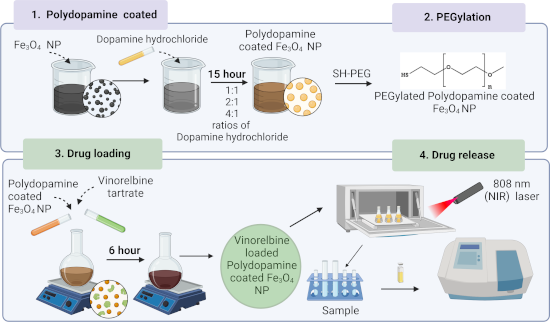
- , as they increase permeability and retention effect in solid tumors, enabling precise application to the targeted cells. Various structures such as silica-based conjugates, inorganic polymers, ceramic nanomaterials, gold, iron oxide, and noble metal nanoparticles have been utilized [9][10]. Among the


Ion beam processing of DNA origami nanostructures
Beilstein J. Nanotechnol. 2024, 15, 207–214, doi:10.3762/bjnano.15.20
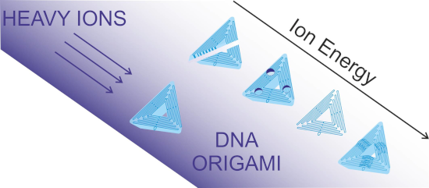
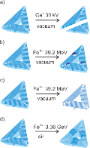
- of various factors concerning material properties and the parameters of the impinging ion beam [22][23][24][25]. While crucial for modern nanotechnology, SHI cause severe damage to DNA [26][27][28]. This challenges the use of DNA-based nanomaterials for combined top-down and bottom-up nanoprocessing


Assessing phytotoxicity and tolerance levels of ZnO nanoparticles on Raphanus sativus: implications for widespread adoptions
Beilstein J. Nanotechnol. 2024, 15, 115–125, doi:10.3762/bjnano.15.11

- nanomaterials may dissolve and then undergo biotransformation or be internalized as intact particles in a biological context [48]. As an example, the biotransformation of ZnO NPs into Zn nitrate, Zn phosphate, and Zn citrate in desert plant species has been reported [49]. Also, the bioaccumulation of intact ZnO


New application of bimetallic Ag/Pt nanoplates in a colorimetric biosensor for specific detection of E. coli in water
Beilstein J. Nanotechnol. 2024, 15, 95–103, doi:10.3762/bjnano.15.9
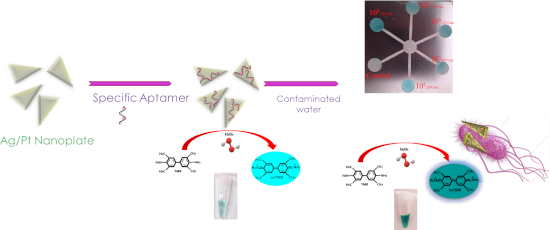
- ]. Nanomaterials have improved the ability to detect pathogens in water and food by enhancing signals and sensitivity. These materials, which encompass nanoparticles, nanorods, nanowires, and nanoclusters, can be combined with aptamers, antibodies, enzymes, and other ligands to display unique physical, chemical
- , and optical traits. The colorimetric method typically depends on the enzymatic properties, aggregation, and dispersion of these nanomaterials, which can be influenced by the presence of aptamers, antibodies, and other agents [4]. Among the various colorimetric test techniques, the enzymatic conversion
- such as pathogens [14]. Functional nanomaterials with catalytic activity similar to enzymes (nanozymes) reveal substantial benefits over natural enzymes, such as ultrahigh environmental stability, appropriate catalytic activity, and ease of prototyping [15][16]. We created plate-like silver


Berberine-loaded polylactic acid nanofiber scaffold as a drug delivery system: The relationship between chemical characteristics, drug-release behavior, and antibacterial efficiency
Beilstein J. Nanotechnol. 2024, 15, 71–82, doi:10.3762/bjnano.15.7
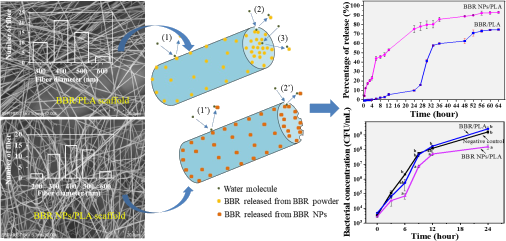
- improved the miscibility with the PLA, forming a uniform drug dispersion in the PLA matrix and, therefore, restricting the drug release. One of the main issues in clinical treatments is bacterial infections, which prolong treatment time or cause further complications. Among various types of nanomaterials


A combined gas-phase dissociative ionization, dissociative electron attachment and deposition study on the potential FEBID precursor [Au(CH3)2Cl]2
Beilstein J. Nanotechnol. 2023, 14, 1178–1199, doi:10.3762/bjnano.14.98
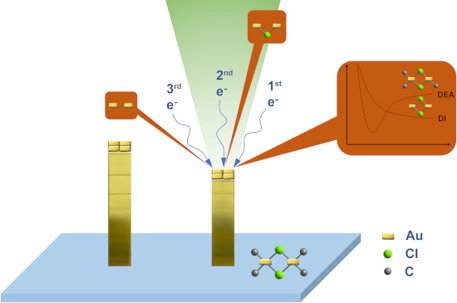
- the potential to widen the scope of applicable nanomaterials. In FEBID, a focused electron beam is directed onto the surface of a substrate in close proximity to a gas inlet, through which a precursor compound is supplied to deliver the material for the nanostructures to be built. For metallic



Elasticity, an often-overseen parameter in the development of nanoscale drug delivery systems
Beilstein J. Nanotechnol. 2023, 14, 1149–1156, doi:10.3762/bjnano.14.95

- elasticity of nanomaterials. Even though the exact temperature of the particles is not known, it is assumed to be equal to the surrounding temperature after a sufficient equilibration time. Many studies are performed at room temperature or at 25 °C instead of at the temperature in which biologic studies are


Properties of tin oxide films grown by atomic layer deposition from tin tetraiodide and ozone
Beilstein J. Nanotechnol. 2023, 14, 1085–1092, doi:10.3762/bjnano.14.89
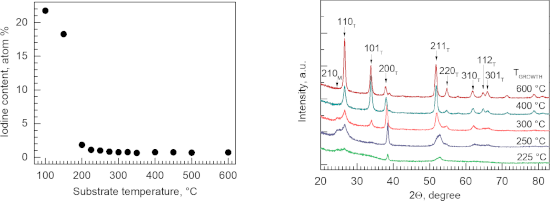
- quantum and nanomaterials” (TK134), and the Estonian Research Agency (PRG753). We acknowledge MAX IV Laboratory for time on Beamline FinEstBeAMS under Proposal 20220073. Research conducted at MAX IV, a Swedish national user facility, is supported by the Swedish Research council under contract 2018-07152


Experimental investigation of usage of POE lubricants with Al2O3, graphene or CNT nanoparticles in a refrigeration compressor
Beilstein J. Nanotechnol. 2023, 14, 1041–1058, doi:10.3762/bjnano.14.86
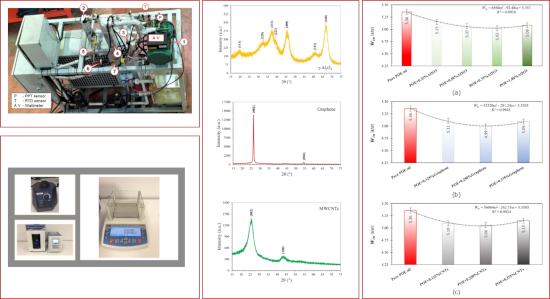
- manufacturer for graphene nanomaterials (refer to Table 3) is consistent. The diameter value is a common characteristic value encountered in the literature for graphene nanomaterials [25]. Moreover, Figure 4b shows the multilayer structure of graphene nanoplates. The EDS was performed on the graphene sample to





A visible-light photodetector based on heterojunctions between CuO nanoparticles and ZnO nanorods
Beilstein J. Nanotechnol. 2023, 14, 1018–1027, doi:10.3762/bjnano.14.84
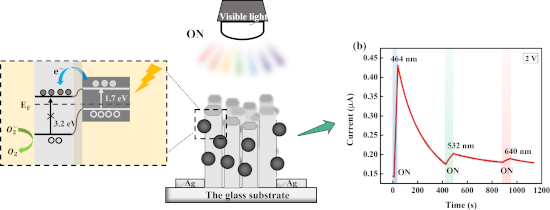
- because of its large exciton binding energy of 60 meV at room temperature [20], excellent chemical and thermal stability, high electron mobility, non-toxicity, low cost, and simple synthesis [21][22]. Various shapes of ZnO nanomaterials can be easily obtained by controlling synthesis conditions (e.g
- [21]. Regardless, pure ZnO still has the considerable drawback of a wide bandgap (ca. 3.35 eV), which limits its usability for visible-light photodetectors. ZnO absorbs light only in the UV region (less than 4% of the sunlight spectrum) [23]. Extending the operation range of ZnO nanomaterials toward


Nanoarchitectonics of photothermal materials to enhance the sensitivity of lateral flow assays
Beilstein J. Nanotechnol. 2023, 14, 988–1003, doi:10.3762/bjnano.14.82
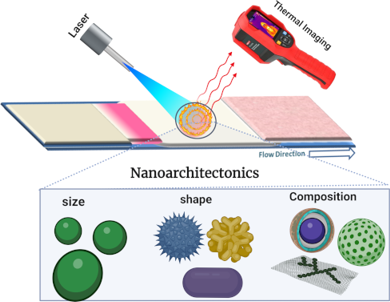
- analytes using LFAs. One of the promising strategies is to enhance the photothermal properties of nanomaterials to generate heat after light irradiation, followed by a temperature measurement to detect and quantify the analyte concentration. Recently, it has been observed that the nanoscale architecture of
- materials, including size, shape, and nanoscale composition, plays a significant role in enhancing the photothermal properties of nanomaterials. In this review, we discuss the nanoarchitectonics of nanomaterials regarding enhanced photothermal properties and their application in LFAs. Initially, we discuss
- advances in photothermal LFAs and their application in detecting analytes. Keywords: lateral flow assay; nanoarchitectonics; photothermal; photothermal nanomaterials; signal amplification; Introduction Lateral flow assays (LFAs) are a versatile and convenient point-of-care testing (POCT) technique used


Metal-organic framework-based nanomaterials for CO2 storage: A review
Beilstein J. Nanotechnol. 2023, 14, 964–970, doi:10.3762/bjnano.14.79

- , including pore size manipulation, post-synthetic modifications, and composite formation. Finally, the extant challenges and anticipated prospects pertaining to the development of MOF-based nanomaterials for CO2 storage are described. Keywords: CO2 storage; metal-organic frameworks; nanomaterials; open
- different kinetic diameters of gas molecules. Herein, we present a comprehensive examination of the current scientific literature pertaining to the utilization of metal-organic framework (MOF)-based nanomaterials in the context of CO2 storage and conversion. This account focuses on the introduction of MOFs
- . Finally, the expected direction and existing challenges in progressing MOF-based nanomaterials for CO2 storage are discussed. Review Nanosized MOFs with adsorption centers for CO2 capture MOFs with open metal sites OMSs are a fundamental characteristic of MOF-based nanomaterials, generating strong




Prediction of cytotoxicity of heavy metals adsorbed on nano-TiO2 with periodic table descriptors using machine learning approaches
Beilstein J. Nanotechnol. 2023, 14, 939–950, doi:10.3762/bjnano.14.77
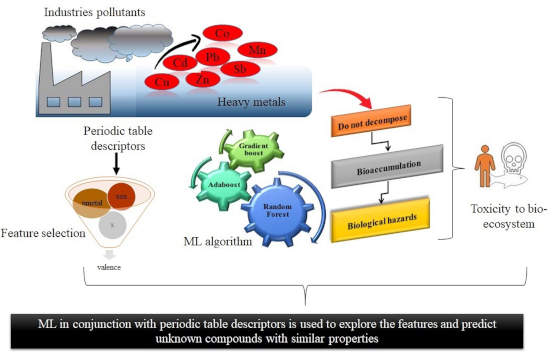
- nanomaterials based on structure similarities with known substances. Materials with similar structures are likely to produce similar toxicity through comparable mechanisms. The development of machine learning (ML) approaches, such as artificial neural networks (ANNs), decision trees, logistic regression (LR


Ni, Co, Zn, and Cu metal-organic framework-based nanomaterials for electrochemical reduction of CO2: A review
Beilstein J. Nanotechnol. 2023, 14, 904–911, doi:10.3762/bjnano.14.74
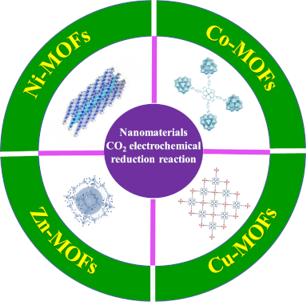
- CO2 conversion. Finally, a meticulous discourse encompasses the challenges encountered and the prospects envisioned for the advancement of MOF-based nanomaterials in the realm of electrochemical reduction of CO2. Keywords: carbon capture; CO2 reduction; electrocatalysis; metal-organic frameworks
- ; nanomaterials; Introduction The emission of carbon dioxide resulting from the utilization of fossil fuels has been identified as a primary cause of the greenhouse effect, ultimately contributing to the severity of climate change [1]. To mitigate these detrimental consequences, numerous strategies have been
- augmentation of MOF properties can be accomplished by converting pristine MOFs into nanoscale materials. A diverse array of MOF nanomaterials has been reported, encompassing single-atom nanocatalysts (SACs), hetero-atom-doped nanomaterials, and MOF nanofiber-based aerogels, among others, as highlighted by


Green SPIONs as a novel highly selective treatment for leishmaniasis: an in vitro study against Leishmania amazonensis intracellular amastigotes
Beilstein J. Nanotechnol. 2023, 14, 893–903, doi:10.3762/bjnano.14.73
- effort on the search for new treatments for different diseases. Its main objective is to develop therapies with higher specificity, effectiveness, and safety, as well as less toxicity [6]. One interesting class of nanomaterials in medicine are superparamagnetic iron oxide nanoparticles (SPIONs). SPIONs
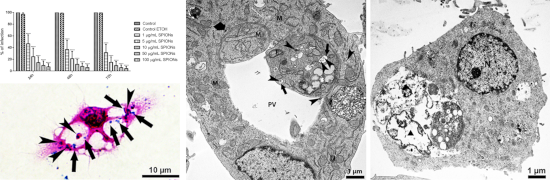
- , different from most compounds, drugs, and nanomaterials developed in the last decades. During TEM analyses, we observed that intracellular amastigotes were undergoing substantial ultrastructural alterations (Figure 5) when treated with SPIONs. These alterations include (1) accumulation of lipid bodies, (2


Carboxylic acids and light interact to affect nanoceria stability and dissolution in acidic aqueous environments
Beilstein J. Nanotechnol. 2023, 14, 762–780, doi:10.3762/bjnano.14.63
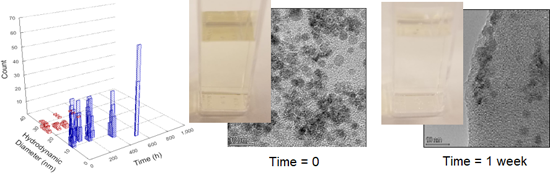
- ; environmentally mediated dissolution; nanoceria; Introduction Background Ceria nanomaterials have many applications, including acting as redox catalysts/metal supports [1], sunscreens [2], heat-resistant coatings [3], and much more [4]. Biomedical applications of ceria-based compounds as therapeutics have the
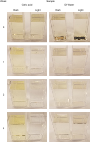
Control of morphology and crystallinity of CNTs in flame synthesis with one-dimensional reaction zone
Beilstein J. Nanotechnol. 2023, 14, 741–750, doi:10.3762/bjnano.14.61
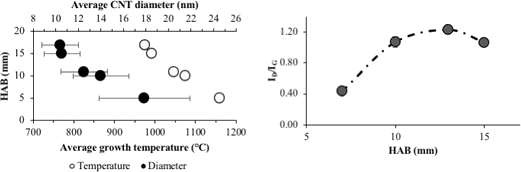
- utilized in photon energy conversion devices due to the excellent photo response in the visible and near-UV light regions. Hence, controlling morphology and functionalization of such nanomaterials during synthesis will open vast opportunities to satisfy the requirements for various specific applications
- % temperature variation has yielded 66% variation in crystallinity of the grown CNTs. Conclusion Controlling the morphology of CNTs through flame synthesis remains a challenging topic, although it is highly useful for the functionalization of nanomaterials for specific applications. The heterogeneous


Nanoarchitectonics for advanced applications in energy, environment and biology: Method for everything in materials science
Beilstein J. Nanotechnol. 2023, 14, 738–740, doi:10.3762/bjnano.14.60

- the 20th century [4][5] whereas nanoarchitectonics was proposed by Masakazu Aono in the early 21st century [6]. Nanoarchitectonics is a methodology for architecting functional material systems from components at the nanoscale (i.e., atoms, molecules, and nanomaterials) following the footsteps of

Nanomaterials for photocatalysis and applications in environmental remediation and renewable energy
Beilstein J. Nanotechnol. 2023, 14, 722–724, doi:10.3762/bjnano.14.58
- ]. Semiconducting photocatalyst nanomaterials, such as SnO2, TiO2, MoS2, g-C3N4, and Bi-nanostructures have been proven efficient for a range of applications, including organic pollutant removal, NOx degradation, renewable energy production, and waste-to-energy conversion [15][17][18]. Figure 1 shows a general
- semiconductor materials for sustainable applications; for instance, dye solar cells, solar-driven water splitting, NOx removal, and contaminant degradation. The synthesis of semiconductor nanomaterials published on this thematic issue indicates a wide range of synthetic routes. The as-prepared nanomaterials
- semiconducting nanomaterials, perovskites, or Bi-based nanomaterials are presented to incentivize fine-tuning of current studies and research works on photocatalytic efficiency of nanomaterials [27]. In addition, this Thematic Issue will undoubtedly provide the reader with novel ideas for developing

A graphene quantum dots–glassy carbon electrode-based electrochemical sensor for monitoring malathion
Beilstein J. Nanotechnol. 2023, 14, 701–710, doi:10.3762/bjnano.14.56
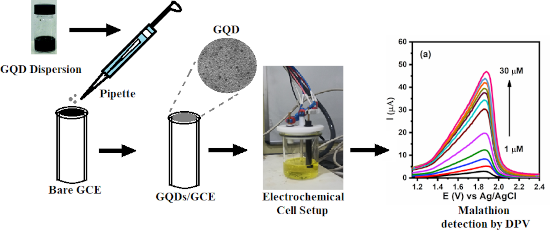
- application of electrochemical methods in detection of pesticides has already been extensively studied [9][10][11][12][13]. Nanomaterials are ideal for electrochemical sensing because of their unique properties such as high chemical stability, thermal conductivity, electrical conductivity, and large surface
- -area to volume ratio to provide enhanced analyte interaction with the sensing surface [14]. Carbon-based nanomaterials and nanocomposites are being investigated for the electrochemical detection of a variety of pesticides, including organophosphates, organochlorines, and carbamates [15][16][17]. The
- lowers the detection limit [18]. In an effort to combine the properties of carbon dots and graphene, graphene quantum dots (GQDs) with a size smaller than 100 nm and only a few layers of graphene (3 to 10 layers) have been developed as a new class of carbon nanomaterials [19]. Scientists have explored


Humidity-dependent electrical performance of CuO nanowire networks studied by electrochemical impedance spectroscopy
Beilstein J. Nanotechnol. 2023, 14, 683–691, doi:10.3762/bjnano.14.54
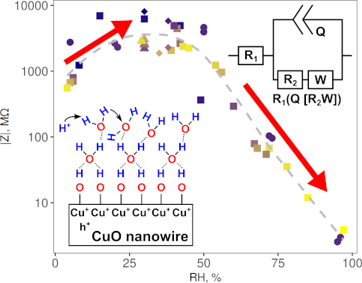
- ; electrochemical impedance spectroscopy; humidity; nanowire; sensor; Introduction Semiconductor metal oxide nanomaterials have demonstrated a great potential for integration in a variety of devices, such as gas and humidity sensors, nanoelectronics, and low-power thermoelectrical generators [1][2][3][4][5][6


Metal-organic framework-based nanomaterials as opto-electrochemical sensors for the detection of antibiotics and hormones: A review
Beilstein J. Nanotechnol. 2023, 14, 631–673, doi:10.3762/bjnano.14.52
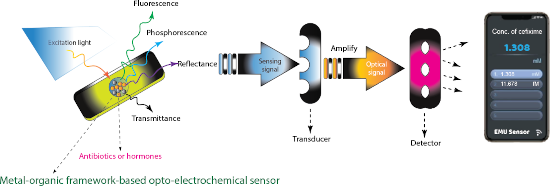
- , in situ analyte monitoring, and potential miniaturization. Portability, miniaturisation, and fast signal responses are just a few of the breakthroughs in sensor design made possible by nanomaterials. Nanomaterials are becoming a key component of the analytical procedures required for pharmaceutical
- , environmental, food safety, and health analyses. They have exceptional physico-chemical and opto-electronic properties, a high surface area-to-volume ratio, and their surfaces are easy to functionalize. Additionally, compared to their bulk counterparts, nanomaterials are particularly sensitive to changes in
- surface chemistry, enabling nanosensors to achieve extremely low detection limits. Numerous nanomaterials shown in Figure 3 have different functionalities, including high conductivity, good catalytic activity, and optical and plasmonic properties, making them attractive candidates for opto-electrochemical


ZnO-decorated SiC@C hybrids with strong electromagnetic absorption
Beilstein J. Nanotechnol. 2023, 14, 565–573, doi:10.3762/bjnano.14.47
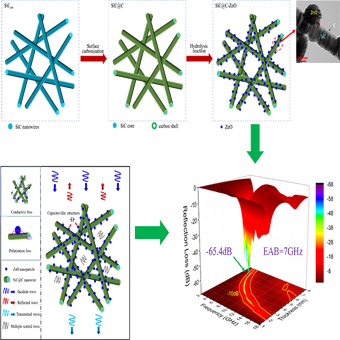
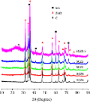
- of SiC nanomaterials through surface carbonization of SiC nanowires and hydrolysis. SiC@C-ZnO composites were synthesized with different dosages of ZnNO3·6H2O. Composition, microstructure, and electromagnetic properties of the composites were characterized and analyzed. Results from TEM and XRD show


Nanoarchitectonics to entrap living cells in silica-based systems: encapsulations with yolk–shell and sepiolite nanomaterials
Beilstein J. Nanotechnol. 2023, 14, 522–534, doi:10.3762/bjnano.14.43
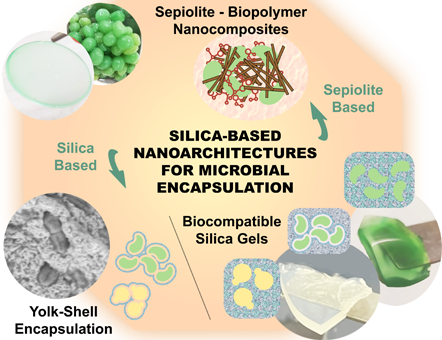
- present protocols. Keywords: biohybrids; cell immobilization; encapsulation; microorganism entrapment; silicates; Introduction Bio-inorganic hybrid nanomaterials with highly specific functionalities can be prepared following Nature’s design approaches [1]. A wide range of materials resulting from the
- show promising properties for utilization in photobioreactors and biosensor devices [18][19][20][21]. According to Fakhrullin et al. [22], cellular nanoencapsulation can be nowadays considered as a promising way to develop more complex systems based on nanoshell assemblies using inorganic nanomaterials
- as shell components [22][23][24][25]. All these biotechnological and multidisciplinary approaches are concerned with cell surface engineering for efficient encapsulation using divers nanomaterials. However, a recent review article published by Homburg and Patel [26] showed the necessity to solve