


Search results
Search for "semiconductors" in Full Text gives 357 result(s) in Beilstein Journal of Nanotechnology. Showing first 200.
Kelvin probe force microscopy work function characterization of transition metal oxide crystals under ongoing reduction and oxidation
Beilstein J. Nanotechnol. 2019, 10, 1596–1607, doi:10.3762/bjnano.10.155
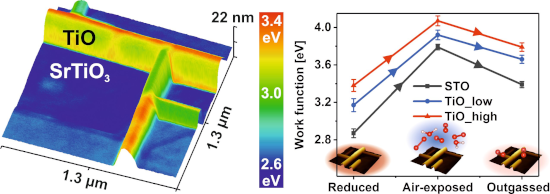
- and similarities between those two structures. Based on the electronic conduction, most transition metal oxides could be classified as insulators or semiconductors. However, due to the plethora of available valence states in which a cation can be, many transition metal oxides may also exhibit metallic


Graphynes: an alternative lightweight solution for shock protection
Beilstein J. Nanotechnol. 2019, 10, 1588–1595, doi:10.3762/bjnano.10.154
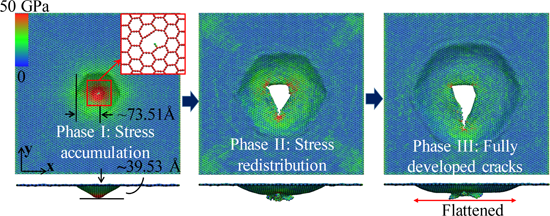
- [8]. GY has a non-zero bandgap, which indicates a potential application in next-generation carbon-based semiconductors [9]. In addition, the properties of GYs are highly tunable through the modification of the topology. For instance, GYs are found to absorb light in the HOMO–LUMO band and the energy




Materials nanoarchitectonics at two-dimensional liquid interfaces
Beilstein J. Nanotechnol. 2019, 10, 1559–1587, doi:10.3762/bjnano.10.153
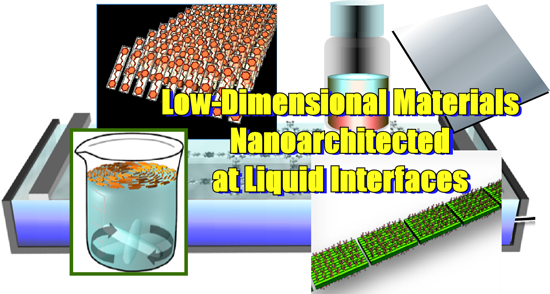
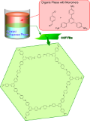
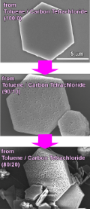
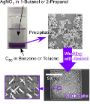
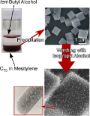
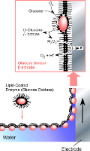
- nanoarchitectonics (controlled single atom/ion transfer) to regulate the number of dopant atoms in one-dimensional solid electrolyte nanodots (α-Ag2+δS) [127]. The nanoarchitectonic construction of one-dimensional nanowires from II–VI semiconductors was demonstrated for the use as wavelength division multiplexer as













BiOCl/TiO2/diatomite composites with enhanced visible-light photocatalytic activity for the degradation of rhodamine B
Beilstein J. Nanotechnol. 2019, 10, 1412–1422, doi:10.3762/bjnano.10.139
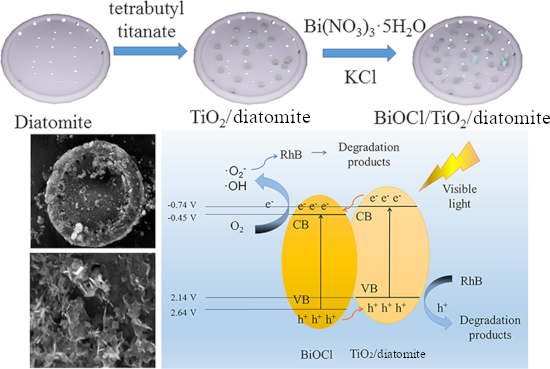
- such as doping [21], sensitization [22], modification [23], coupled and supported semiconductors [24]. As an important bismuth oxyhalide semiconductor material, bismuth oxychloride (BiOCl) has gained extensive attention in photocatalysis [25][26]. BiOCl has a band gap of 3.05–3.55 eV [27], which allows
- Figure 9. BiOCl and TiO2/diatomite are n-type semiconductors, and the flat-band potential (vs Ag/AgCl) is −0.75 V and −1.04 V, respectively. According to Equation 1, the flat-band potential relative to Ag/AgCl can be converted to the normal hydrogen electrode (NHE) potential: where E0Ag/AgCl = 0.197 V
- [46]. Generally, for n-type semiconductors, the flat-band potential is about 0.1 V smaller than the minimum of the conduction band (CB). Therefore, the positions of the CB for BiOCl and TiO2/diatomite are about −0.45 V and −0.74 V (vs NHE), respectively. According to Equation 2 and Eg of BiOCl and


Construction of a 0D/1D composite based on Au nanoparticles/CuBi2O4 microrods for efficient visible-light-driven photocatalytic activity
Beilstein J. Nanotechnol. 2019, 10, 1360–1367, doi:10.3762/bjnano.10.134
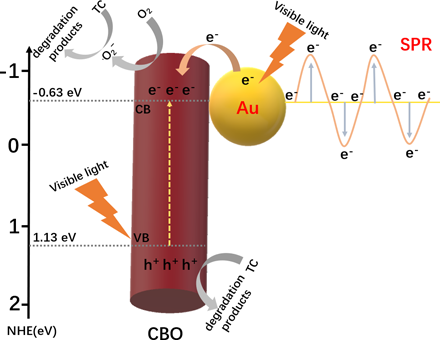
- the carriers migrating to the surface of the semiconductor to participate in the photoreactions [15]. Decorating semiconductors with noble metals, such as Ag, Au, and Pt, is a strategy to enhance the photocatalytic performance. Certain noble metals exhibiting surface plasmon resonance (SPR) can
- promote the absorption of visible light and produce hot charge carriers that can increase the charge density of the substrate semiconductor [16][17]. In addition, as an effective electron sink, noble metals can capture photogenerated electrons and leave holes on the surface of semiconductors, which can be


Imaging the surface potential at the steps on the rutile TiO2(110) surface by Kelvin probe force microscopy
Beilstein J. Nanotechnol. 2019, 10, 1228–1236, doi:10.3762/bjnano.10.122
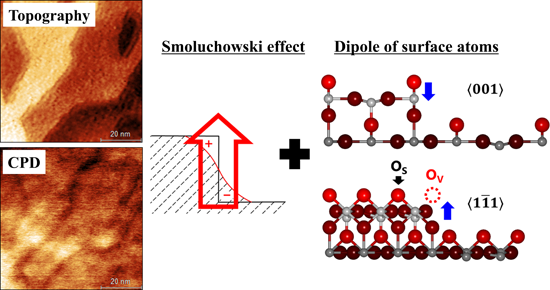
- addition, we also observed a drop in CPD on the surface without O2 exposure, indicating that the drop in CPD is not due to O2 adsorption. Third, we analyze the influence of the local pinning of the Fermi level due to defect states [55][56]. In the case of n-type semiconductors, negatively charged defect
- states derived from donor atoms may localize at the steps and increase the work function due to upward band bending. In contrast, for p-type semiconductors positively charged defect states from acceptor atoms may localize at the steps and decrease the work function due to downward band bending. However
- free electrons than semiconductors. In this study there is not enough experimental evidence to conclude that the Smoluchowski effect is responsible for the observed effect; further experiments or theoretical investigations such as DFT calculations would be required. In addition to the Smoluchowski-like
![[Graphic 16]](/bjnano/content/inline/2190-4286-10-122-i16.svg?max-width=637&scale=1.18182) and
and ![[Graphic 17]](/bjnano/content/inline/2190-4286-10-122-i17.svg?max-width=637&scale=1.18182) .
.

![[Graphic 38]](/bjnano/content/inline/2190-4286-10-122-i38.svg?max-width=637&scale=1.18182) and
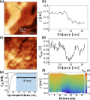
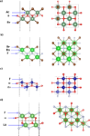
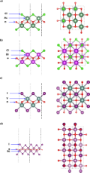
and ![[Graphic 39]](/bjnano/content/inline/2190-4286-10-122-i39.svg?max-width=637&scale=1.18182) steps. (a) Topographic image...
steps. (a) Topographic image...


![[Graphic 72]](/bjnano/content/inline/2190-4286-10-122-i72.svg?max-width=637&scale=1.18182) , b)
, b) ![[Graphic 73]](/bjnano/content/inline/2190-4286-10-122-i73.svg?max-width=637&scale=1.18182) , c) reduced
, c) reduced ![[Graphic 74]](/bjnano/content/inline/2190-4286-10-122-i74.svg?max-width=637&scale=1.18182) , and d)
, and d) ![[Graphic 75]](/bjnano/content/inline/2190-4286-10-122-i75.svg?max-width=637&scale=1.18182) steps. B...
steps. B...
A highly efficient porous rod-like Ce-doped ZnO photocatalyst for the degradation of dye contaminants in water
Beilstein J. Nanotechnol. 2019, 10, 1157–1165, doi:10.3762/bjnano.10.115
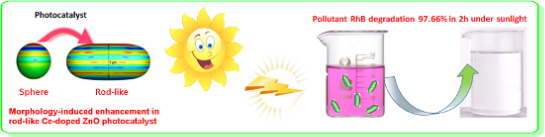
- ]. Recently, photocatalytic degradation of organic dyes using semiconductors has attracted much attention [6]. This refers to the process in which organic compounds are gradually oxidized into inorganic compounds or even H2O and CO2 under the synergistic effects of light and photocatalysis. ZnO is one of the


Photoactive nanoarchitectures based on clays incorporating TiO2 and ZnO nanoparticles
Beilstein J. Nanotechnol. 2019, 10, 1140–1156, doi:10.3762/bjnano.10.114
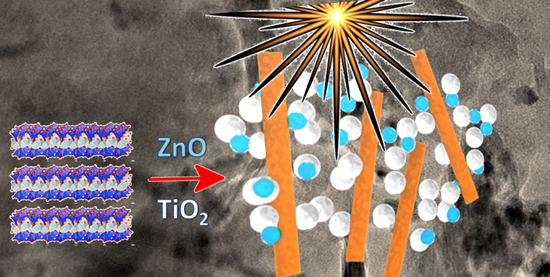
- silicates showing diverse structural arrangements and morphologies (Figure 1) with topologies able to accommodate a variety of NPs of semiconductors such as TiO2 and ZnO. TiO2 and, to a minor extent, ZnO NPs in the form of anatase and wurtzite phases (Figure 1E and 1F, respectively), are semiconducting
- semiconductors such as ZnO are increasingly investigated for processes concerning environmental remediation, antibacterial activity and chemical technologies for hydrogen production and synthesis of organic compounds [22]. Anyway, according to WoS, in the given period TiO2 NPs appear to be cited ten times more
- transition metals or with other semiconductors. Among them, semiconductor heterojunctions have attracted great attention [139]. The doping of TiO2 and ZnO NPs with the aim to conveniently tuning the bandgap energy values can be a suitable option. In this context, it has been verified for both types of NPs, a



Electronic and magnetic properties of doped black phosphorene with concentration dependence
Beilstein J. Nanotechnol. 2019, 10, 993–1001, doi:10.3762/bjnano.10.100
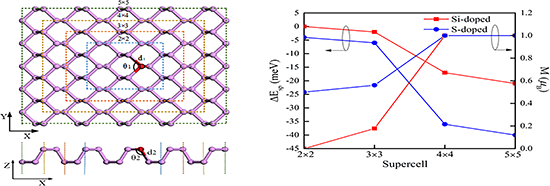
- polarization is taken into account, the bandgaps of the Si- and S-doped phosphorenes widen in the 4 × 4 × 1 and 5 × 5 × 1 supercells with concentrations of 1.56% and 1%, respectively, so that the Si- and S-doped phosphorenes become semimetals or semiconductors. This phenomenon suggests that the magnetism needs


Synthesis of novel C-doped g-C3N4 nanosheets coupled with CdIn2S4 for enhanced photocatalytic hydrogen evolution
Beilstein J. Nanotechnol. 2019, 10, 912–921, doi:10.3762/bjnano.10.92
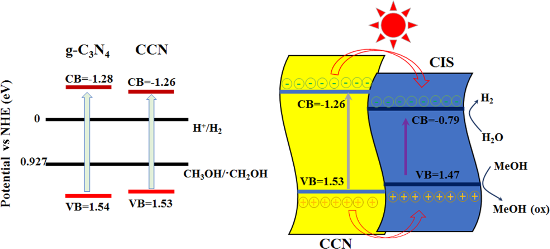
- effective strategy, the combination of C-doping with nanocomposite semiconductors, is presented in this work. C-doped g-C3N4 (CCN) was prepared by supramolecular self-assembly and subsequently a number of CdIn2S4/CCN composite photocatalysts were designed and fabricated though in situ decoration of CdIn2S4
- CIS, improving the charge transfer/separation efficiency. Upon visible-light irradiation, both CCN nanosheets and CIS can absorb photons to produce massive electron–hole pairs, then electrons in the VB of the semiconductors are able to be excited to the CB, leaving holes in the VB. Because the CB edge


Comparing a porphyrin- and a coumarin-based dye adsorbed on NiO(001)
Beilstein J. Nanotechnol. 2019, 10, 874–881, doi:10.3762/bjnano.10.88
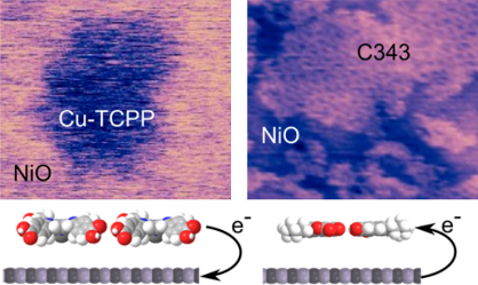
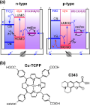
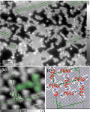
- -bandgap p-type semiconductors, such as NiO, and their functionalization with sensitizers, have been less extensively studied by using SPM [12][13][14][15]. NiO was the first reported p-type wide-bandgap semiconductor [16], and can be used for the fabrication of p-type DSSCs with photoactive cathodes, a



Electronic properties of several two dimensional halides from ab initio calculations
Beilstein J. Nanotechnol. 2019, 10, 823–832, doi:10.3762/bjnano.10.82
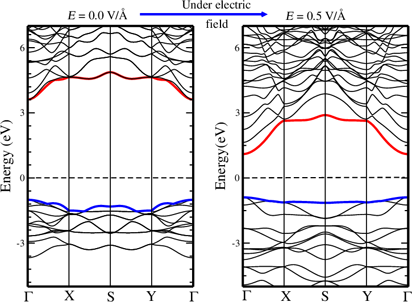
- Brillouin zone. The resulting band structures using HSE are presented in the following paragraphs. In Figure 7, we present the band structures of the AcOBr, BaFBr, BiOBr, and CaFBr monolayers. We found that the AcOBr, BaFBr, and CaFBr monolayers are direct-bandgap semiconductors with the valence-band
- earlier studies [42] that 2D materials can display a much larger sunlight absorption than commonly employed semiconductors. Also, the materials studied here can be employed in heterostructures to complement or replace other large-bandgap 2D materials, such as hexagonal boron nitride, or to dissociate


Ultrasonication-assisted synthesis of CsPbBr3 and Cs4PbBr6 perovskite nanocrystals and their reversible transformation
Beilstein J. Nanotechnol. 2019, 10, 666–676, doi:10.3762/bjnano.10.66
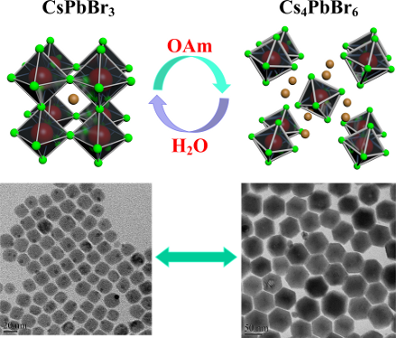
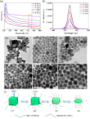
- ; ultrasonication; Introduction Metal halide perovskite nanocrystals (PNCs) are promising candidates for application in the fields of light-emitting diodes (LEDs) [1][2], high-efficiency solar cells [3], low-threshold lasers [4], and photodetectors [5]. Compared to traditional semiconductors, colloidal PNCs



Reduced graphene oxide supported C3N4 nanoflakes and quantum dots as metal-free catalysts for visible light assisted CO2 reduction
Beilstein J. Nanotechnol. 2019, 10, 448–458, doi:10.3762/bjnano.10.44
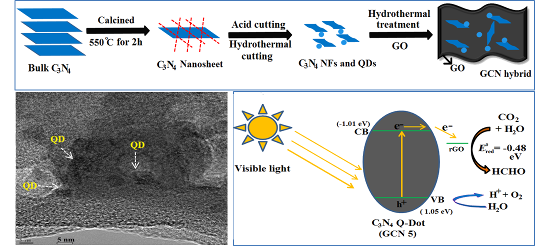
- of the GCN-5 sample are measured by using the Mulliken electronegativity theory [32]; ECB = X − Ee − 0.5 Eg, where ECB is the CB edge potential; X is the geometric mean of the absolute electronegativity of the constituent atoms in the semiconductors, which is defined as arithmetic mean of the atomic
- electron affinity (EEA) and first ionization (Eion) energy; Ee is the energy of free electrons on the hydrogen scale (≈4.5 eV vs NHE); Eg is the band gap of semiconductors. The conduction and valence band potential value for GCN-5 are −1.01 and 1.05 eV, respectively, and is found to be lower than any CN





Geometrical optimisation of core–shell nanowire arrays for enhanced absorption in thin crystalline silicon heterojunction solar cells
Beilstein J. Nanotechnol. 2019, 10, 322–331, doi:10.3762/bjnano.10.31
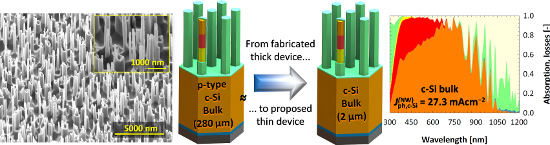
- reflected by the top surface of the nanowire, thus increasing total reflection. Anttu et al. suggest another possible explanation for the optimal cross section value [19]. In their work on III–V semiconductors nanowire arrays, they observed the presence of optimum, bandgap-dependent nanowire diameter values


Interaction of Te and Se interlayers with Ag or Au nanofilms in sandwich structures
Beilstein J. Nanotechnol. 2019, 10, 238–246, doi:10.3762/bjnano.10.22
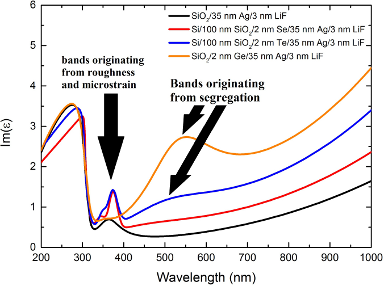
- semiconductor atoms essentially act as nanoparticles which absorb light due to localized plasmon excitation [25][26]. If that is the case, such additional bands should be observable in the permittivity of any plasmonic metal thin layer film in which a semiconductor segregates. Of the semiconductors, only Ge and
- the surface of Au layer were detected. This indicates the occurrence of grain boundary segregation or diffusion of these semiconductors in the plasmonic thin films. The curve shape of the Te concentration in the Ag layer suggests the dominant role of segregation. The study of the electron energy loss


Raman study of flash-lamp annealed aqueous Cu2ZnSnS4 nanocrystals
Beilstein J. Nanotechnol. 2019, 10, 222–227, doi:10.3762/bjnano.10.20
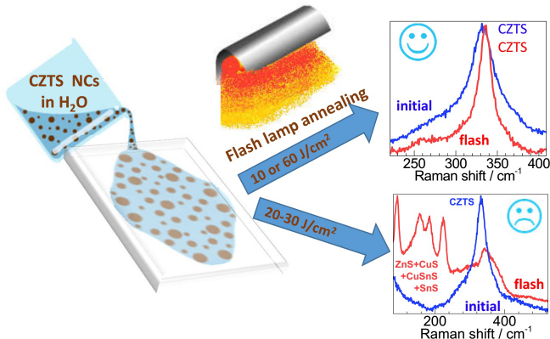
- Yevhenii Havryliuk Oleksandr Selyshchev Mykhailo Valakh Alexandra Raevskaya Oleksandr Stroyuk Constance Schmidt Volodymyr Dzhagan Dietrich R. T. Zahn V. E. Lashkaryov Institute of Semiconductors Physics, National Academy of Sciences of Ukraine, Kyiv, 03028, Ukraine Semiconductor Physics, Chemnitz


Sputtering of silicon nanopowders by an argon cluster ion beam
Beilstein J. Nanotechnol. 2019, 10, 135–143, doi:10.3762/bjnano.10.13
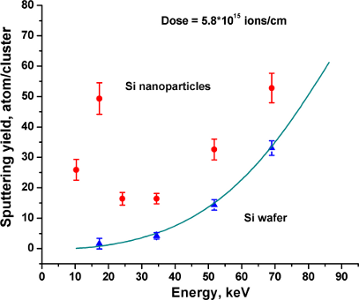
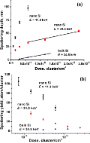
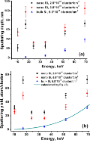
- surface morphology, with preferable erosion of hills as compared with valleys [6], which also results in the smoothing of the surface [7]. Sputtering by an argon cluster beam has been studied for many pure metals (Cu, Ag, Au, W, Pt, Ni) and their alloys, semiconductors (Si and SiC), and insulators (SiO2





Surface plasmon resonance enhancement of photoluminescence intensity and bioimaging application of gold nanorod@CdSe/ZnS quantum dots
Beilstein J. Nanotechnol. 2019, 10, 22–31, doi:10.3762/bjnano.10.3
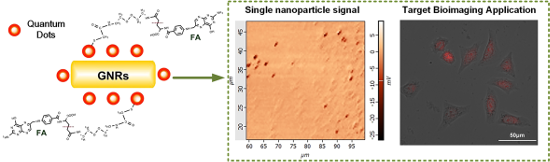
- formed with metals and semiconductors, i.e., plasmonic, composite QD nanostructures, provides another efficient way to tune the unique optical properties. In the past decades, much attention has been given to the development of metal-enhanced optical properties. Some researchers have noted that certain


Zn/F-doped tin oxide nanoparticles synthesized by laser pyrolysis: structural and optical properties
Beilstein J. Nanotechnol. 2019, 10, 9–21, doi:10.3762/bjnano.10.2
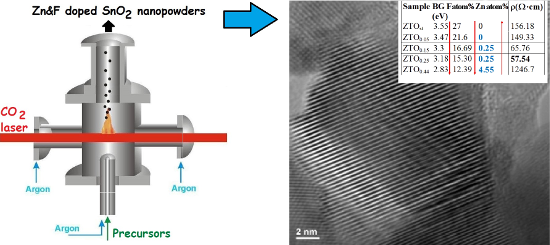
- (3.6 eV). This may be attributed to the impurity clustering which occurs in heavily doped semiconductors. Also, the carbon presence in all (including the reference without F and Zn) of our laser-synthesized tin-oxide-based nanopowders can also influence the optical properties, including the bandgap



Investigation of CVD graphene as-grown on Cu foil using simultaneous scanning tunneling/atomic force microscopy
Beilstein J. Nanotechnol. 2018, 9, 2953–2959, doi:10.3762/bjnano.9.274
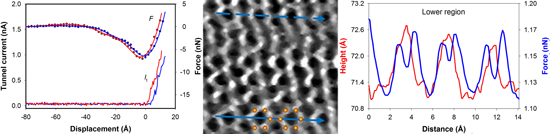
- interactions with a larger range. When we compare the range of interactions in the tunnel current and force measurements, we see a different situation to that reported on other surfaces in previous studies. Based on previous works on semiconductors such as Si(111) and Si(100), the onset of tunnel current is


Site-controlled formation of single Si nanocrystals in a buried SiO2 matrix using ion beam mixing
Beilstein J. Nanotechnol. 2018, 9, 2883–2892, doi:10.3762/bjnano.9.267
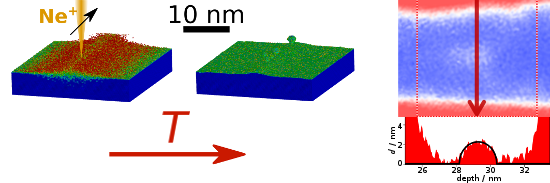
- the two parameters, time and temperature, into one quantity – the thermal budget (TB) in units of cm2, based on a formalism used to describe the diffusion of dopants in semiconductors [29]. We calculate from the annealing temperature T and the annealing time t. The other parameters and constants are


Graphene-enhanced metal oxide gas sensors at room temperature: a review
Beilstein J. Nanotechnol. 2018, 9, 2832–2844, doi:10.3762/bjnano.9.264
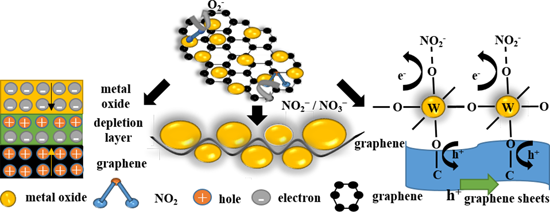
- semiconductors (MOS) are widely used as materials for gas sensing. Usually, MOS gas sensors have some common shortages, such as relatively poor selectivity and high operating temperature. Graphene has drawn much attention as a gas sensing material in recent years because it can even work at room temperature
- , which reduces power consumption. However, the low sensitivity and long recovery time of the graphene-based sensors limit its further development. The combination of metal-oxide semiconductors and graphene may significantly improve the sensing performance, especially the selectivity and response/recovery
- achieved at all [19][20]. Metal-oxide semiconductors (MOS), including tin oxide (SnO2), titanium dioxide (TiO2), zinc oxide (ZnO), copper oxide (CuO), tungsten oxide (WO3), indium oxide (In2O3), ferric oxide (Fe2O3) and cobalt oxide (Co3O4) are important materials for gas sensors [21][22][23][24][25][26



Biomimetic surface structures in steel fabricated with femtosecond laser pulses: influence of laser rescanning on morphology and wettability
Beilstein J. Nanotechnol. 2018, 9, 2802–2812, doi:10.3762/bjnano.9.262
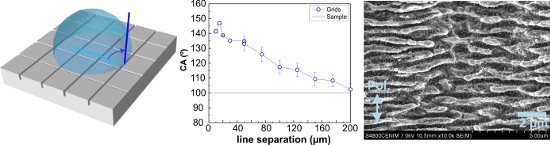
- superhydrophobic states. Results and Discussion Ripples, grooves and spikes formed by single laser scanning The formation of LIPSSs occurs when a certain number of laser pulses has accumulated in a given area in a single laser scan. For metals and semiconductors, three well-differentiated structures, ripples



Variation of the photoluminescence spectrum of InAs/GaAs heterostructures grown by ion-beam deposition
Beilstein J. Nanotechnol. 2018, 9, 2794–2801, doi:10.3762/bjnano.9.261
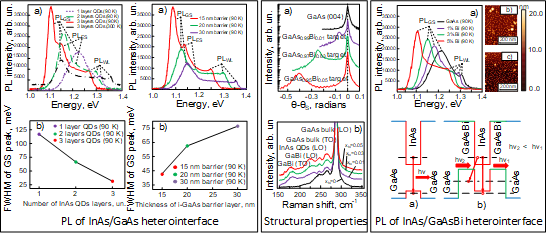
- . It is shown that isovalent doping of GaAs potential barriers by bismuth was accompanied by a red-shift of the photoluminescence peak of InAs quantum dots of 121 meV. Keywords: infrared photodetectors; ion-beam deposition; nanoheterostructures; photoluminescence; quantum dot; semiconductors





