


Search results
Search for "topography" in Full Text gives 451 result(s) in Beilstein Journal of Nanotechnology. Showing first 200.
Current measurements in the intermittent-contact mode of atomic force microscopy using the Fourier method: a feasibility analysis
Beilstein J. Nanotechnol. 2020, 11, 453–465, doi:10.3762/bjnano.11.37
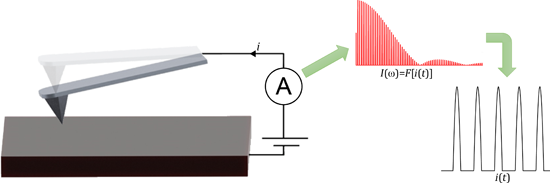
- surface properties, such as topography, viscoelasticity, electrical potential and conductivity. Some of these properties are measured using contact methods (static contact or intermittent contact), while others are measured using noncontact methods. Some properties can be measured using different


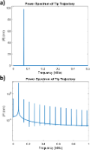


A review of demodulation techniques for multifrequency atomic force microscopy
Beilstein J. Nanotechnol. 2020, 11, 76–91, doi:10.3762/bjnano.11.8

- provide further nanomechanical sample information. These include properties such as sample elasticity, stiffness and adhesiveness [17], which are mapped simultaneously with the topography. Acquiring these observables requires the accurate demodulation of amplitude and phase of multiple frequency
- illustrates a cantilever driven at multiple frequencies being amplitude-modulated by a sample topography. In MF-AFM, the cantilever deflection signal contains frequency components originating from the fundamental resonance mode, as well as from higher eigenmodes and/or harmonics. If for simplicity we assume
- are preferred over the Kalman filter, as they are significantly easier to implement. (a) Schematic diagram of sample topography amplitude-modulating a cantilever the oscillation of which consists of multiple frequencies. (b) Double-sided amplitude frequency spectrum of a cantilever oscillating at


The effect of heat treatment on the morphology and mobility of Au nanoparticles
Beilstein J. Nanotechnol. 2020, 11, 61–67, doi:10.3762/bjnano.11.6
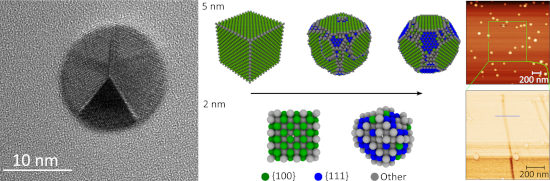
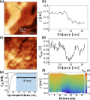
- and 2 nm NPs into rounded shapes bounded by energetically favorable surfaces. Atoms are colored according to their crystallographic surface type. (a) Profile of a Au NP and (b) topography image of NPs on the Si substrate prior to manipulation. (c and d) Phase images recorded during the manipulation


Label-free highly sensitive probe detection with novel hierarchical SERS substrates fabricated by nanoindentation and chemical reaction methods
Beilstein J. Nanotechnol. 2019, 10, 2483–2496, doi:10.3762/bjnano.10.239
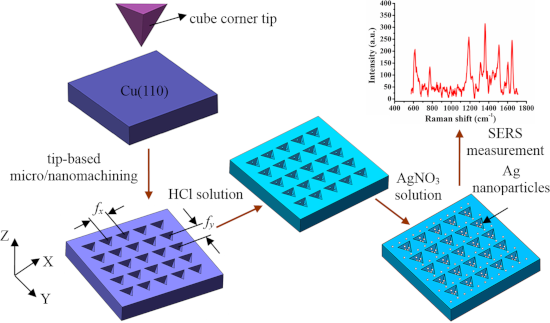
- . Compared with the pyramidal cavities etched for 5 minutes, the topography of the pyramidal cavities etched by 10 minutes are obviously changed as shown in Figure 2c. Figure 1e and Figure 2d show SEM images of arrayed triangular cavities with fx = 5 μm and fy = 1 μm. Compared with cavities etched for 5
- of the Cu substrate. The simulation model corresponds to the SEM topography of the indentation structures fabricated by different feeds in the AgNO3 solution after 5 minutes as shown in Figure 1d,e. The Ag nanoparticles are formed on the pile-ups of the indentation structures and the adjacent


Mobility of charge carriers in self-assembled monolayers
Beilstein J. Nanotechnol. 2019, 10, 2449–2458, doi:10.3762/bjnano.10.235
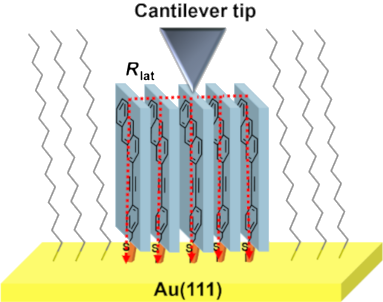
- determination of apparent heights of islands from STM data is somewhat indirect, the conductivities of the patterned areas were determined directly by means of highly sensitive current measurements, where the conductive tip of the AFM is used as a top electrode. This setup allows determining the topography and
- rather indirect. In contrast, with the conductive AFM the conductivity can be determined for a fixed height of the AFM tip above the SAM surface directly from simultaneous measurements of the topography and conductive response of the SAMs. The topography and the associated conductivity measurements of
- the sample surface with PAT islands prepared by grafting insulating HDT in the PAT SAM are shown in Figure 2. Figure 2a and Figure 2c show the topography image of a representative surface area with grafted PAT islands with different magnifications. Figure 2b represents the 3D image of the current


Self-assembly of a terbium(III) 1D coordination polymer on mica
Beilstein J. Nanotechnol. 2019, 10, 2440–2448, doi:10.3762/bjnano.10.234
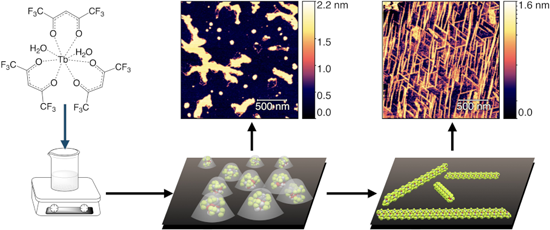
- solution and a pulsed Horiba Scientific DeltaDiode DD-340 nm for the CHCl3 solution. Deposition of [Tb(hfac)3·2H2O]n on the mica substrate. AFM topography images of [Tb(hfac)3·2H2O]n@mica (a) 30 minutes and (b) 1 day after deposition showing the presence on the surface of needle-like objects together with




Integration of sharp silicon nitride tips into high-speed SU8 cantilevers in a batch fabrication process
Beilstein J. Nanotechnol. 2019, 10, 2357–2363, doi:10.3762/bjnano.10.226
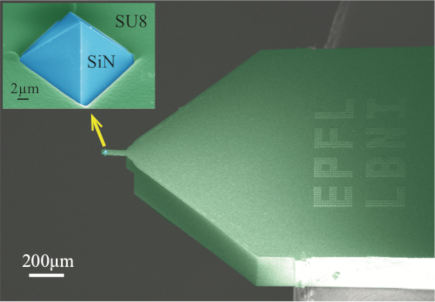
- (SPM) [1]. Quality and accuracy of an AFM image strongly depend on the tip geometry since the image topography is the convolution of the surface topography and the cantilever tip geometry [2]. More precisely, the resulting images suffer from the effect of dilation [3]. AFM images with tip artefacts are
- topography significantly better. Discussion The critical feature of any AFM cantilever is the tip. For general imaging, the quality of the tip is primarily determined by the tip radius and the wear rate of the tip. We need to comment that our tips have a decent sharpness compared to other silicon nitride
- µm pitch reference sample taken by the RTESPA silicon cantilever and the LSNT-tip SU8 cantilever at scan rates of 1, 10, 20 and 30 Hz. The SU8 cantilever shows a better topography tracking ability compared to the RTESPA cantilever due to its higher tapping bandwidth. The scale bar is 500 nm


A novel method to remove impulse noise from atomic force microscopy images based on Bayesian compressed sensing
Beilstein J. Nanotechnol. 2019, 10, 2346–2356, doi:10.3762/bjnano.10.225
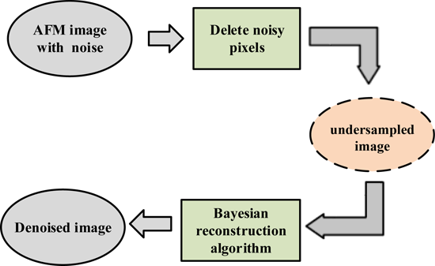
- result, Φ ∈ RM×N is the measurement matrix, xT ∈ RN×1 represents the true sample topography, and e is the measurement noise. If M is smaller than N, then the AFM imaging is CS imaging. Because the AFM only samples one pixel of an image at a time and moves around to obtain an image, the compressed
- sampling of the AFM can be seen as randomly collecting partial elements of x. The undersampling process can be modeled by an identity matrix with some rows removed, shown in Figure 2. In order to recover the true AFM image from the undersampled data, the sample topography x must be sparse, i.e. some
- CS imaging because all the rows of the image are stacked together to generate a vector [19][28]. In CS AFM imaging, recovering the true sample topography from the undersampled information has high computational cost. For a n × n AFM image, the compressed sampling matrix is M × N (n ≪ M < N), which


Atomic force acoustic microscopy reveals the influence of substrate stiffness and topography on cell behavior
Beilstein J. Nanotechnol. 2019, 10, 2329–2337, doi:10.3762/bjnano.10.223
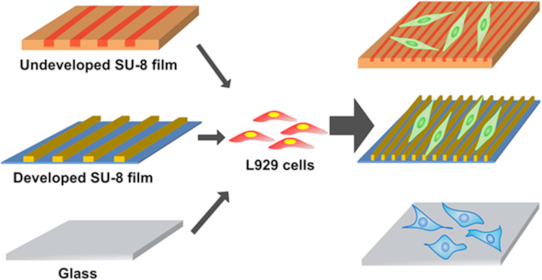
- Manufacturing of China, Changchun University of Science and Technology, Changchun 130022, China Computer Department, Changchun Medical College, Changchun 130031, China JR3CN & IRAC, University of Bedfordshire, Luton LU1 3JU, UK 10.3762/bjnano.10.223 Abstract The stiffness and the topography of the substrate at
- the cell–substrate interface are two key properties influencing cell behavior. In this paper, atomic force acoustic microscopy (AFAM) is used to investigate the influence of substrate stiffness and substrate topography on the responses of L929 fibroblasts. This combined nondestructive technique is
- able to characterize materials at high lateral resolution. To produce substrates of tunable stiffness and topography, we imprint nanostripe patterns on undeveloped and developed SU-8 photoresist films using electron-beam lithography (EBL). Elastic deformations of the substrate surfaces and the cells


Microbubbles decorated with dendronized magnetic nanoparticles for biomedical imaging: effective stabilization via fluorous interactions
Beilstein J. Nanotechnol. 2019, 10, 2103–2115, doi:10.3762/bjnano.10.205
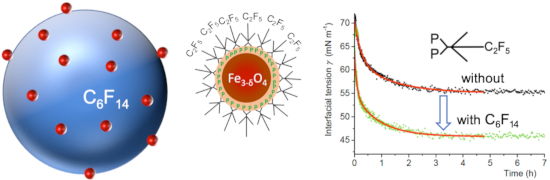
- 5.0 ± 1.0 nm, respectively. These measurements are in agreement with earlier reports [43]. Figure 11A shows an AFM topography image of a mixed film composed of DPPC and IONP@C2F5OEG8Den. The IONPs are embedded within the DPPC monolayer domains in which they are well-dispersed, showing no tendency to
- the bubble characteristics and stability. For further experimental details see [48]. Each measurement was repeated three times for different bubble preparations. The volume of the microbubble dispersion injected in the acoustic cell was 2 mL. AFM topography analysis of mixed films of DPPC and
- @C4F9OEG8 (blue). Schematic representation of dendronized IONPs a) incorporated within the MB DPPC shell and b) located at the surface of this shell. AFM topography images (1 × 1 µm) and height profiles of a) IONP@C2F5OEG8Den and b) IONP@C2H5OEG8Den. Dispersions of IONPs in ethanol (0.002 mg mL−1) were spin


Ion mobility and material transport on KBr in air as a function of the relative humidity
Beilstein J. Nanotechnol. 2019, 10, 2084–2093, doi:10.3762/bjnano.10.203
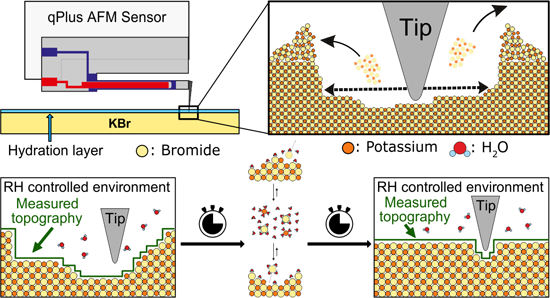
- from 25.0% to 35.1% within a time period of 46 h. Figure 2b and Figure 2c show the surface topography directly before and after this period. It can be observed that the accumulated material around the top right and the middle left structure has completely eroded. Also, for the other structures only a
- on the surface. This state is observed by the AFM technique as the surface topography. (2) In the second state the ions are dissolved in the hydration layer or in a physiosorbed or precursor state [30], which shows a high mobility and cannot be imaged. The material from the accumulation over time


Nanostructured and oriented metal–organic framework films enabling extreme surface wetting properties
Beilstein J. Nanotechnol. 2019, 10, 1994–2003, doi:10.3762/bjnano.10.196
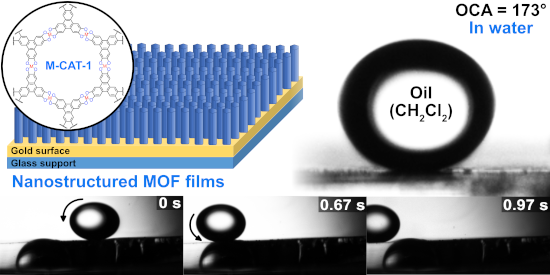
- (OCA) of diiodomethane on these pellets reveals an inverse wetting phenomenon. Under these conditions, the M-CAT-1 materials reject oil and turn oleophobic with an OCA of 90° (Figure 1H). Constructing nanostructured M-CAT-1 surfaces According to Wenzel’s model, film topography has a strong impact on


Nanoarchitectonics meets cell surface engineering: shape recognition of human cells by halloysite-doped silica cell imprints
Beilstein J. Nanotechnol. 2019, 10, 1818–1825, doi:10.3762/bjnano.10.176
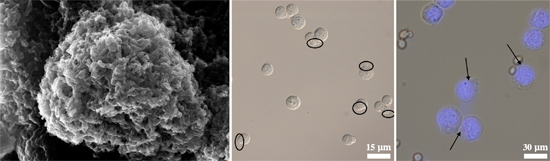
- , fixed with formaldehyde, sputter-coated with a thin gold layer and then imaged using a Hitachi SU8000 microscope. As shown in Figure 2D–F, the typical smooth surface topography of HeLa cells was changed drastically by the deposition of either pure or halloysite-doped silica. Analysing the cell diameter
- cells and (G) HeLa cells coated with halloysite-doped silica shells. Atomic force microscopy (PeakForce Tapping mode) images of inorganic silica/halloysite imprints templated on HeLa cells: (A) topography image, (B) non-specific adhesion map; (C) scanning electron microscopy image of inorganic silica


Growth dynamics and light scattering of gold nanoparticles in situ synthesized at high concentration in thin polymer films
Beilstein J. Nanotechnol. 2019, 10, 1768–1777, doi:10.3762/bjnano.10.172
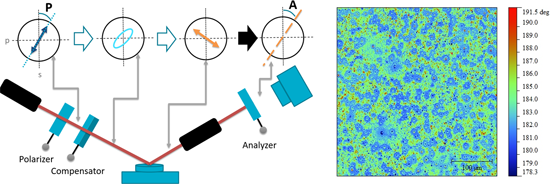
- were imaged by AFM. A typical image of 5 μm × 5 μm size is presented in Figure 5a. It unambiguously shows the presence of the AuNPs. The topography of the samples was characterized by the average surface roughness parameter (Sa) and by the root-mean-square surface roughness parameter (Sq). For the
- angle of incidence (AOI) of θi = −20° (note that incidence angles are conventionally negative in BRDF measurements). A 12 mW HeNe Laser was also used in preliminary experiments in order to qualitatively evidence scattering after the annealing of the samples. Atomic force microscopy The topography of the
- °). Azimuth angles are varied along these circles (0–360°). Scattered intensity in the plane orthogonal to the incidence plane (azimuth 90° or 270°) as a function of the scattering angle. (A) Non-annealed sample; (B) sample annealed for 120 min at 135 °C. AFM topography images (Color scale bars in nanometers


Stationary beam full-field transmission helium ion microscopy using sub-50 keV He+: Projected images and intensity patterns
Beilstein J. Nanotechnol. 2019, 10, 1648–1657, doi:10.3762/bjnano.10.160
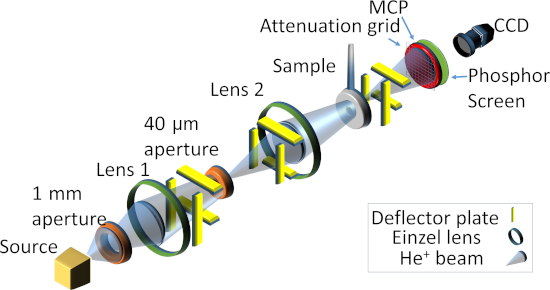
- suggests that the orientation of the particle surface is responsible for the direction of deflection. The local surface topography then defines the caustic pattern and the exact position of the bright points around the edge. Figure 4C shows that there is still a large amount of intensity at the center of
- increased rate of charging. However, the motion of the spots could also be due to the most intense section of the beam (i.e., the focal plane of Lens 2) intersecting with different positions along the surfaces of the charged sample, having varying topography, which then deflect the beam to different


Subsurface imaging of flexible circuits via contact resonance atomic force microscopy
Beilstein J. Nanotechnol. 2019, 10, 1636–1647, doi:10.3762/bjnano.10.159
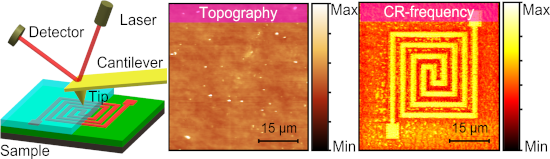
- ranging from 1000 to 6000 rpm. The resulting cover thicknesses were 52, 117, 185, 380, and 653 nm as measured by AFM. Furthermore, the top surface was smoothed to eliminate the cross-talk of surface topography in subsurface CR-AFM imaging. Our experiments were performed on an MFP-3D Origin AFM (Asylum
- . The obtained topography and resonance frequency images are shown in Figure 2a and Figure 2b, respectively. We can clearly discern the circuit pattern from the resonance frequency image, which cannot be found in the topography. This verifies the CR-AFM’s capability in detecting subsurface circuit
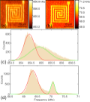
- sample was scanned with the PPP-FM cantilever by using its first mode under an applied normal force of 1162 nN. The obtained topography and the resonance frequency image are shown in Figure 9b and Figure 9c, respectively. Even the smallest defects can be clearly observed from the CR-AFM frequency image



Kelvin probe force microscopy work function characterization of transition metal oxide crystals under ongoing reduction and oxidation
Beilstein J. Nanotechnol. 2019, 10, 1596–1607, doi:10.3762/bjnano.10.155
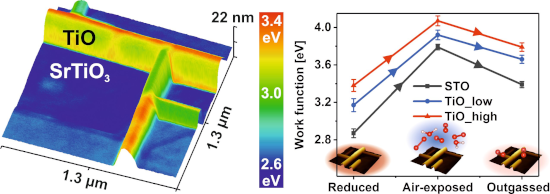
- , providing the possibility of obtaining current maps as well as I–V characteristics at a given spot. Figure 2a and Figure 2b show the topography and current maps of the TiO nanowire network on SrTiO3(100). TiO has a higher conductivity than the surrounding SrTiO3 (STO) surface (the no current areas at
- topography and work function of the same area. Differences in the WF are as high as 900 meV between TiO and SrTiO3, in favor of TiO. However, there is also a certain variation within the TiO and SrTiO3 structures, which will be discussed later. The bias sweep measurements presented in Figure 2f show
- 3D topography overprinted image with color scale representing the WF is shown in Figure 3a. The WF of titanium monoxide varies to as high as 300 meV, even within one nanowire. This is not an imaging artifact but rather a morphological-related feature, which is proved by the two profiles obtained for


Development of a new hybrid approach combining AFM and SEM for the nanoparticle dimensional metrology
Beilstein J. Nanotechnol. 2019, 10, 1523–1536, doi:10.3762/bjnano.10.150
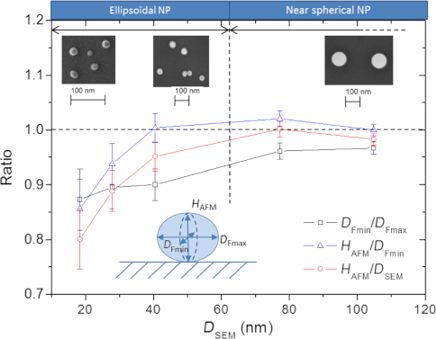
- Figure 8. The profiles correspond to the intensity in grey level and the topography of the sample along the NP diameter for SEM and AFM measurements, respectively. For simplicity, the SEM diameter used here corresponds to DSEM, i.e., the projected area-equivalent diameter. Figure 7a and Figure 7b



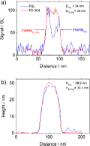
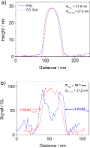

Kelvin probe force microscopy of the nanoscale electrical surface potential barrier of metal/semiconductor interfaces in ambient atmosphere
Beilstein J. Nanotechnol. 2019, 10, 1401–1411, doi:10.3762/bjnano.10.138
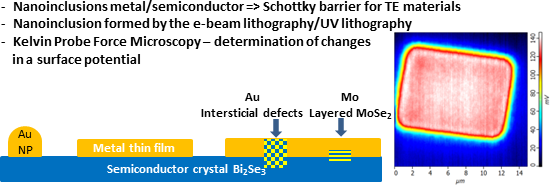
- tunneling microscopy (STM) [27][28] or by using AFM in the semicontact mode. The latter enables a describtion not only of the topography (size and shape) but also a detection of the changes in density, stiffness and adhesion of NPs [20][21][24][29][30]. In the present study we demonstrate that the Schottky
- had to be used to decrease the plasma intensity. The topography, phase shift image, Kelvin probe force microscopy and I–V characteristics were measured by the AFM SolverPro M, Nt-MDT (Russia) with a resolution of 512 × 512 pixels. The HA_NC tips (resonant frequency 140 kHz, force constant 3.5 N/m
- potential difference) measurement was achieved by the modulation of the VAC at a frequency higher than the bandwidth of the topography feedback system. The topography was measured by the oscillation at the first resonance frequency of the AFM tip, and VCPD was measured by the amplitude of the oscillation at


Highly ordered mesoporous silica film nanocomposites containing gold nanoparticles for the catalytic reduction of 4-nitrophenol
Beilstein J. Nanotechnol. 2019, 10, 1368–1379, doi:10.3762/bjnano.10.135
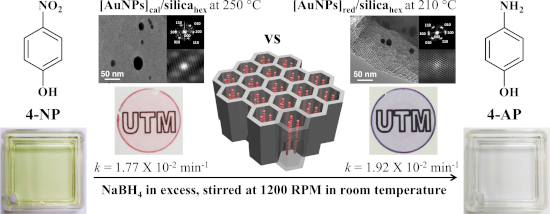
- TEM 3D tomography at low accelerating voltage with topography-based reconstruction to show the pore orientation at the various angles with the presence of AuNPs (see Supporting Information File 1 for the movie). Optical properties of AuNPs Surface plasmon resonance (SPR) peaks in the UV–vis spectrum


Nanoscale spatial mapping of mechanical properties through dynamic atomic force microscopy
Beilstein J. Nanotechnol. 2019, 10, 1332–1347, doi:10.3762/bjnano.10.132
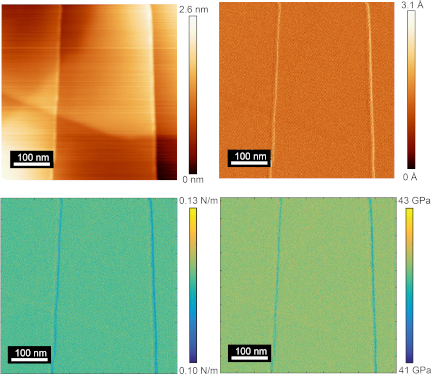
- with the HOPG surface. The HOPG surface was scanned under a constant preload force, modulation frequency, and drive signal while the amplitude and phase response of the cantilever were recorded simultaneously with the topography and the lateral force signals using a digital lock-in amplifier supplied
- response of the cantilever were simultaneously recorded with the topography and the lateral force signals using a digital lock-in amplifier supplied with the RHK R9 controller. The calibration of the detected variations in amplitude and phase into elastic and loss modulus with high accuracy requires a good
- topography, environmental contamination, the Schwoebel–Ehrlich barrier, energy dissipation through viscoelastic energy losses, applied normal force, tip shape, and modulation frequency (both for CR and FMM modes). Each examination will show that the elastic modulus measured in the previous section is




Imaging the surface potential at the steps on the rutile TiO2(110) surface by Kelvin probe force microscopy
Beilstein J. Nanotechnol. 2019, 10, 1228–1236, doi:10.3762/bjnano.10.122
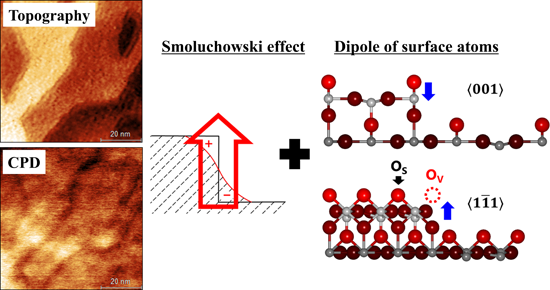
- the fAC component of the electrostatic force, providing the CPD value (VCPD). The topography and CPD were measured sequentially using the lift-mode technique to minimize crosstalk [47]. In this scanning mode, the topography (z) is scanned in the first trace using AFM and immediately retraced with a
- about 70 mV, which is consistent with a previous study, in which surfaces with a high step density were found to have a lower work function than surfaces with a low step density [28]. The drop in CPD at the steps is not due to a feedback error since the forward and backward curves of the topography and
- , which is the opposite behavior to the decrease in CPD at the steps (Figure 2c and Figure 2e). Therefore, we can rule out the influence of an unintentional increase of the tip–sample distance. In addition, the influence of the electrostatic force on the topography measurements has been investigated. As a
![[Graphic 16]](/bjnano/content/inline/2190-4286-10-122-i16.svg?max-width=637&scale=1.18182) and
and ![[Graphic 17]](/bjnano/content/inline/2190-4286-10-122-i17.svg?max-width=637&scale=1.18182) .
.

![[Graphic 38]](/bjnano/content/inline/2190-4286-10-122-i38.svg?max-width=637&scale=1.18182) and
and ![[Graphic 39]](/bjnano/content/inline/2190-4286-10-122-i39.svg?max-width=637&scale=1.18182) steps. (a) Topographic image...
steps. (a) Topographic image...


![[Graphic 72]](/bjnano/content/inline/2190-4286-10-122-i72.svg?max-width=637&scale=1.18182) , b)
, b) ![[Graphic 73]](/bjnano/content/inline/2190-4286-10-122-i73.svg?max-width=637&scale=1.18182) , c) reduced
, c) reduced ![[Graphic 74]](/bjnano/content/inline/2190-4286-10-122-i74.svg?max-width=637&scale=1.18182) , and d)
, and d) ![[Graphic 75]](/bjnano/content/inline/2190-4286-10-122-i75.svg?max-width=637&scale=1.18182) steps. B...
steps. B...
Influence of dielectric layer thickness and roughness on topographic effects in magnetic force microscopy
Beilstein J. Nanotechnol. 2019, 10, 1056–1064, doi:10.3762/bjnano.10.106
- structures with submicrometer resolution [1][2][3][4][5][6][7][8]. Although the MFM signals in the so-called interleave mode are taken at a certain distance (lift height) from the sample, following the topography of the sample measured in a first scan, a total force is measured with unknown contributions
- effect. During the imaging of nanoparticles a mirroring of the topography is often observed in MFM phase images [15][16][17][18]. Neves et al. [15] distinguished between magnetic and nonmagnetic nanoparticles by applying an external bias to the tip minimizing the topographical influence of the sample
- . Without an external tip bias a positive phase shift in the MFM image was reported for the nonmagnetic nanoparticles. Passeri et al. [19] also observed a positive phase shift for nonmagnetic niosomes in the MFM phase image. Angeloni et al. [16] discussed the topography-induced positive phase shift for




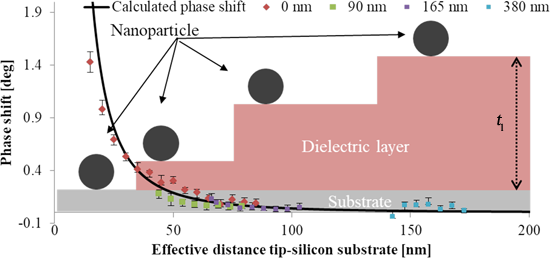
![[Graphic 2]](/bjnano/content/inline/2190-4286-10-106-i7.svg?max-width=637&scale=1.18182) ; black line) and measured phase shift for single nanoparticles with 10 ± 2 nm diameter...
; black line) and measured phase shift for single nanoparticles with 10 ± 2 nm diameter...


Revisiting semicontinuous silver films as surface-enhanced Raman spectroscopy substrates
Beilstein J. Nanotechnol. 2019, 10, 1048–1055, doi:10.3762/bjnano.10.105
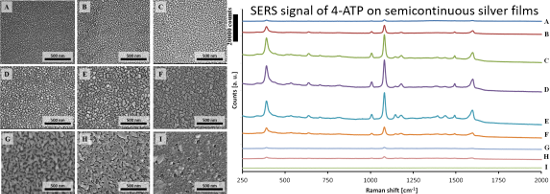
- and white and metal coverage was calculated. The AFM maps were collected using an NTEGRA atomic force microscope from NT-MDT company. The surface topography measurements were made in semi-contact mode. We used HA_NC ETALON (NT-MDT) probe with 140 kHz ± 10% resonant frequency, force constant of 3.5 N/m




Tailoring the stability/aggregation of one-dimensional TiO2(B)/titanate nanowires using surfactants
Beilstein J. Nanotechnol. 2019, 10, 1024–1037, doi:10.3762/bjnano.10.103
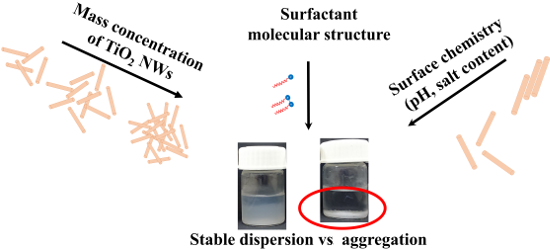
- resolution of the Raman spectrometer was 4 cm−1. The morphology of the TNWs was visualized by using high-resolution scanning electron microscopy Zeiss HR-SEM (Gemini Class) at 3–5 kV. AFM imaging was performed with a Nanosurf Flex AFM in dynamic force mode (simultaneously acquiring topography, amplitude and





