Search results
Search for "X-ray diffraction" in Full Text gives 585 result(s) in Beilstein Journal of Nanotechnology. Showing first 200.
High permittivity, breakdown strength, and energy storage density of polythiophene-encapsulated BaTiO3 nanoparticles
Beilstein J. Nanotechnol. 2020, 11, 1190–1197, doi:10.3762/bjnano.11.103
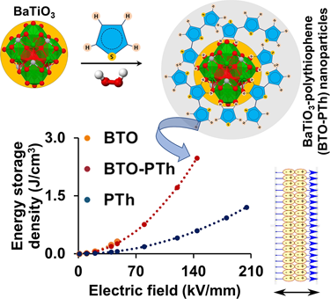
- mixture. All materials including BTO, BTO-PTh, and PTh are characterized using Fourier-transform infrared spectroscopy (Nicolet 520 FTIR spectrophotometer) and X-ray diffraction (STOE STADI P X-ray diffractometer). The morphology of BTO and BTO-PTh nanoparticles is studied using scanning electron
- , respectively, which is attributed to the interactions between β-hydrogens of PTh and oxygen atoms on the BTO surface. X-ray diffraction patterns of BTO, PTh, and core–shell BTO-PTh nanoparticles are presented in Figure 3. Pristine PTh is amorphous in nature and shows a low-intensity broad peak at around 23




Gram-scale synthesis of splat-shaped Ag–TiO2 nanocomposites for enhanced antimicrobial properties
Beilstein J. Nanotechnol. 2020, 11, 1119–1125, doi:10.3762/bjnano.11.96

- with ethanol and centrifuged for further use. Pure TiO2 NPs were also prepared by using the above method without the addition of Ag as a precursor. Sample characterizations The crystal structure of the samples was investigated through X-ray diffraction (XRD, ARL X'TRA, Thermo Techno, USA) using a
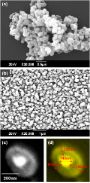
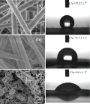
- nanocomposites may also have potential to be used in wound healing, photocatalytic and toxic dye removal applications. X-ray diffraction (XRD) patterns of pure TiO2 NPs and Ag–TiO2 nanocomposites at different ratios. SEM and EDS images of the synthesized splat-shaped nanoparticles: (a) pure TiO2 NPs, (b, c) Ag


Plant growth regulation by seed coating with films of alginate and auxin-intercalated layered double hydroxides
Beilstein J. Nanotechnol. 2020, 11, 1082–1091, doi:10.3762/bjnano.11.93
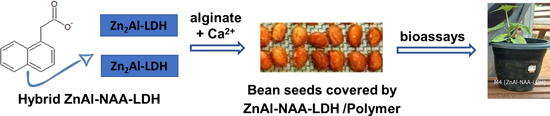
- analytical techniques, including powder X-ray diffraction, thermogravimetric analysis coupled to differential scanning calorimetry and mass spectrometry, specific surface area measurement, and scanning electron microscopy. Bioassays were performed with the seeds coated with the composite film to assess the
- seeds to evaluate germination rate and germination speed index (GSI), and biometric analyses with the values of root area, root fresh matter, and shoot length of the plants. Results and Discussion Characterization of ZnAl-NAA-LDH The powder X-ray diffraction (XRD) patterns of neat NAA and ZnAl-NAA-LDH
- software by image) [33]. Root fresh matter determination was performed with the aid of a high-precision analytical scale (Shimadzu AUY 220). The length of the shoot of the plants was measured directly with a high-grade ruler (1:1.000). Characterizations techniques Powder X-ray diffraction patterns (XRD



Excitonic and electronic transitions in Me–Sb2Se3 structures
Beilstein J. Nanotechnol. 2020, 11, 1045–1053, doi:10.3762/bjnano.11.89
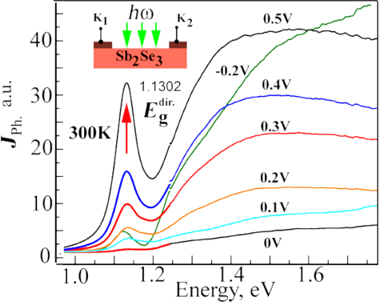
- μm) could also be obtained from the crystal with the aid of adhesive tape. X-ray diffraction was performed in order to verify the quality of the crystalline sheets and their spatial crystalline groups. Optical transmission and reflection spectra were obtained on a double-grating spectrometer SDL-1
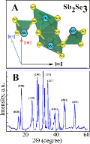
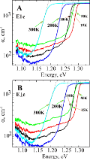
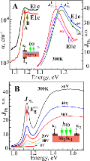
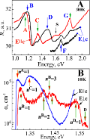
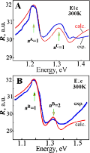
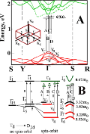
- a 1:2 aperture and 7 Å/mm linear dispersion. Results and Discussion The quality and composition of the single crystals were verified by optical and X-ray diffraction (XRD) analysis. The position of the atoms relative to the crystal lattice axes and the crystal XRD pattern is shown in Figure 1. A


Microwave-induced electric discharges on metal particles for the synthesis of inorganic nanomaterials under solvent-free conditions
Beilstein J. Nanotechnol. 2020, 11, 1019–1025, doi:10.3762/bjnano.11.86
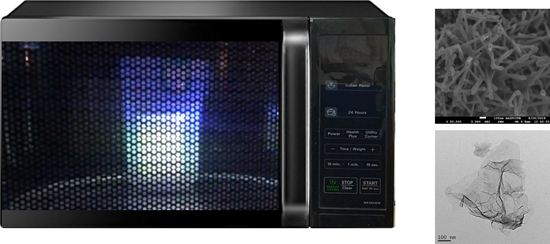
- treatment is essential before using metal particles in further microwave arc experiments. All metal powders were treated with 0.5 M nitric acid under sonication for 10 min to create rough surfaces. In this process, copper partially gets oxidized to Cu2O. The X-ray diffraction (XRD) patterns show reflections
- copper. Graphitic carbon nitride (g-C3N4) or graphite powder (commercially available) are used as carbon source. g-C3N4 is synthesized and characterized according to [18]. X-ray diffraction (XRD) and X-ray photoelectron spectroscopy (XPS) confirms the formation of g-C3N4 (Figure S1 in Supporting
- supernatant solution is collected for further characterization. Characterization of products The reaction products are characterized by X-ray diffraction (PANanalytical X’pert PRO), field-emission scanning electron microscopy (JEOL JSM 7600F, combined with energy-dispersive spectroscopy (EDS)), transmission


Gas-sensing features of nanostructured tellurium thin films
Beilstein J. Nanotechnol. 2020, 11, 1010–1018, doi:10.3762/bjnano.11.85
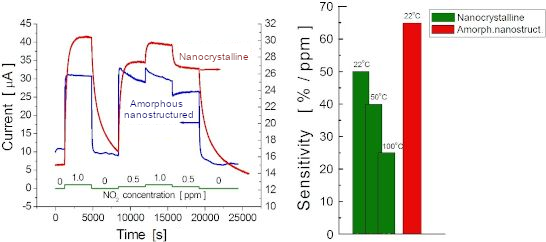
- different operating temperatures with respect to scanning electron microscopy and X-ray diffraction analyses. It was shown that both types of films interacted with nitrogen dioxide, which resulted in a decrease of electrical conductivity. The gas sensitivity, as well as the response and recovery times
- one another. No Te crystallites were observed in this case. The structural phase state of the grown films was adequately confirmed by X-ray diffraction (XRD). Figure 2 shows the XRD patterns of Te films grown on either Pyrex glass (Figure 2A) or nanostructured Al2O3 substrates (Figure 2B). According


Uniform Fe3O4/Gd2O3-DHCA nanocubes for dual-mode magnetic resonance imaging
Beilstein J. Nanotechnol. 2020, 11, 1000–1009, doi:10.3762/bjnano.11.84
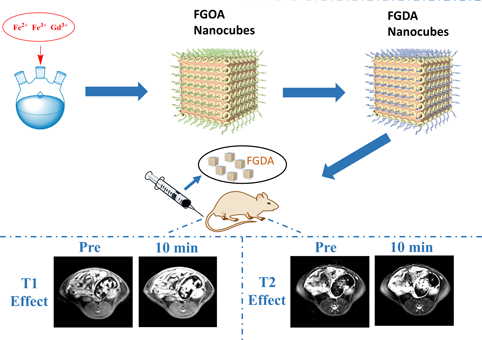
- analyze the distribution of the elements within the samples. The samples were ultrasonically homogenized for 30 minutes and an 8 μL aliquot was collected in a copper mesh and kept at 55 °C for 2 h. After drying, the samples were placed in the HRTEM for imaging. X-ray diffraction (XRD, UltimalV, Japan; Cu



Electrochemical nanostructuring of (111) oriented GaAs crystals: from porous structures to nanowires
Beilstein J. Nanotechnol. 2020, 11, 966–975, doi:10.3762/bjnano.11.81
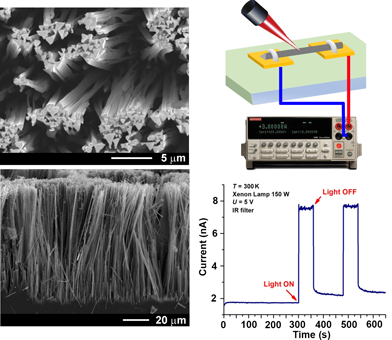
- mounted on the cold station of a LTS-22-C-330 cryogenic system. X-ray diffraction analysis of the samples was performed with a Philips X-Pert MPD System with Cu Kα1 radiation. Electrical contacts to GaAs nanowires. The contacts were realized using laser leam lithography (µPG 101, Heidelberg Instruments


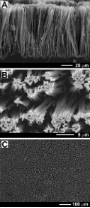


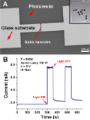

Atomic layer deposition for efficient oxygen evolution reaction at Pt/Ir catalyst layers
Beilstein J. Nanotechnol. 2020, 11, 952–959, doi:10.3762/bjnano.11.79
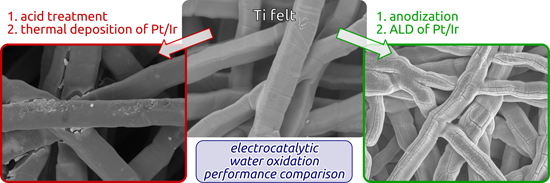
- particular, we have determined particle sizes by transmission electron microscopy (TEM), investigated the homogeneously mixed nature of the Pt/Ir catalyst by X-ray diffraction (XRD), selected-area electron diffraction (SAED), and X-ray photoelectron spectroscopy (XPS). We have also examined various ALD
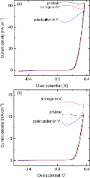
- nature of the surfaces have also been demonstrated in recent publications by X-ray diffraction, selected-area electron diffraction and transmission electron microscopy [22][23]. Herein, we investigate two different catalyst loadings: (1) IrALD25PtALD10, i.e., 25 ALD cycles Ir followed by 10 ALD cycles Pt


Band tail state related photoluminescence and photoresponse of ZnMgO solid solution nanostructured films
Beilstein J. Nanotechnol. 2020, 11, 899–910, doi:10.3762/bjnano.11.75
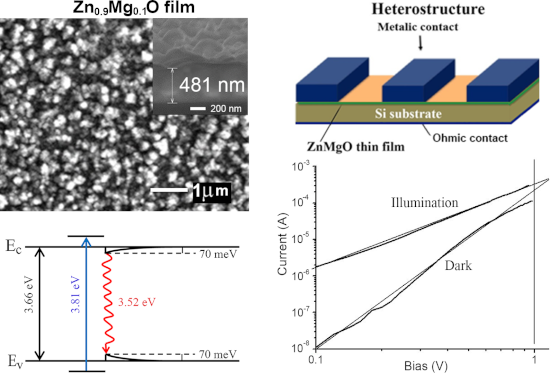
- unavoidable in the structure transformation process, in a certain interval of Mg concentrations. The phase segregation process was investigated in detail by means of X-ray diffraction, element-specific near-edge X-ray absorption fine structure (NEXAFS), electron dispersive spectroscopy (EDS), atomic force
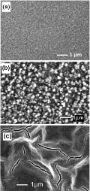
- nanoparticles embedded into the ZnMgO matrix are useful for fast electron transport and high charge balance in quantum dot light emitting diodes [22]. The multiphase composition of films prepared by spin coating and annealed at temperatures lower that 450 °C was revealed by X-ray diffraction (XRD) analysis. As

Templating effect of single-layer graphene supported by an insulating substrate on the molecular orientation of lead phthalocyanine
Beilstein J. Nanotechnol. 2020, 11, 814–820, doi:10.3762/bjnano.11.66
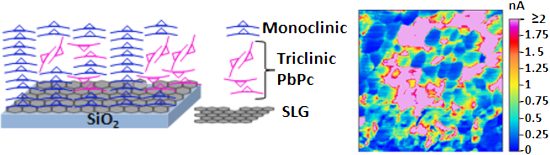
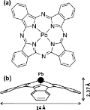
- Technology, Kattankulathur 603 203, Tamil Nadu, India 10.3762/bjnano.11.66 Abstract The influence of single-layer graphene on top of a SiO2/Si surface on the orientation of nonplanar lead phthalocyanine (PbPc) molecules is studied using two-dimensional grazing incidence X-ray diffraction. The studies
- specific device applications. Keywords: conducting atomic force microscopy (C-AFM); lead phthalocyanine (PbPc); molecular orientation; single-layer graphene; substrate effect; two-dimensional grazing incidence X-ray diffraction (2D-GIXRD); Introduction Organic semiconductors have been extensively used in
- substrate, using synchrotron two-dimensional grazing incidence X-ray diffraction (2D-GIXRD). We show that although graphene induces the face-on stacking of monoclinic domains, the underlying SiO2 substrate can still cause edge-on triclinic orientations as well. We also present the electrical current mapping


Epitaxial growth and superconducting properties of thin-film PdFe/VN and VN/PdFe bilayers on MgO(001) substrates
Beilstein J. Nanotechnol. 2020, 11, 807–813, doi:10.3762/bjnano.11.65
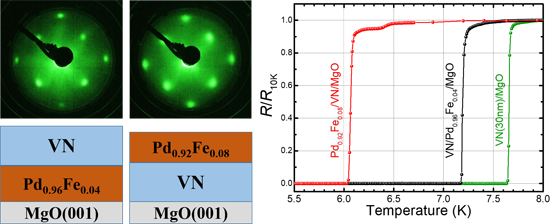
- composition were controlled by X-ray photoelectron spectroscopy. In situ low-energy electron diffraction and ex situ X-ray diffraction show that the 30 nm thick single-layer VN as well as the double-layer VN(30 nm)/Pd0.92Fe0.08(12 nm) and Pd0.96Fe0.04(20 nm)/VN(30 nm) structures have grown cube-on-cube
- , VN and Pd: aMgO = 421.2 pm, aVN = 413.7 pm [35] and aPd = 389.1 pm. Thus, the lattice mismatch between MgO and VN is only about 1.7%, and between Pd and VN it is as small as 5.95%. The in situ LEED analysis was corroborated with ex situ X-ray diffraction (XRD, BRUKER D8, Germany) measurements using


Nickel nanoparticles supported on a covalent triazine framework as electrocatalyst for oxygen evolution reaction and oxygen reduction reactions
Beilstein J. Nanotechnol. 2020, 11, 770–781, doi:10.3762/bjnano.11.62
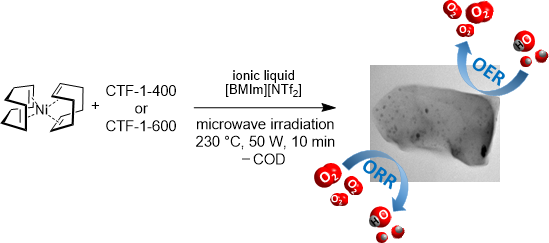
- Information File 1). As expected, both CTF-1-400 and CTF-1-600 (as-synthesized) showed limited long-range order according to powder X-ray diffraction (PXRD) measurements (Figure S1, Supporting Information File 1) [32][42]. Nitrogen sorption measurements for CTF-1-400 showed a type-I isotherm with 954 m2/g
- bis(trifluoromethylsulfonyl)imide ([BMIm][NTf2]) was synthesized in two steps following a literature procedure [67]. The anion purity of IL by ion chromatography was found to be above 99% and the water content of the IL by Karl-Fischer titration was less than 10 ppm. Methods Powder X-ray diffraction


Structural optical and electrical properties of a transparent conductive ITO/Al–Ag/ITO multilayer contact
Beilstein J. Nanotechnol. 2020, 11, 695–702, doi:10.3762/bjnano.11.57
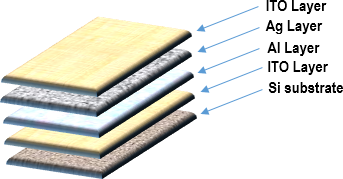
- pure ITO layer (as reference) were prepared by RF and DC sputtering. The microstructural, optical and electrical properties of the ITO/Al–Ag/ITO (IAAI) films were investigated before and after annealing at 400 °C. X-ray diffraction measurements show that the insertion of the Al–Ag intermediate bilayer
- –Ag/ITO) are examined. Moreover, annealing was carried out at 400 °C with an ITO/Al–Ag/ITO (IAAI) multilayer film and a pure ITO film for comparison. Results and Discussion Figure 1 shows the X-ray diffraction (XRD) patterns for as-deposited and annealed IAAI multilayer films. The as-deposited film
- composition of the as-deposited and annealed IAAI films was determined using X-ray diffraction. A PANalytic XPERT-PRO MPD X-ray diffractometer model was used with Cu Kα1 (λ = 1.540598 Å) radiation, 40 kV working voltage and 30 mA filament current, in a range of 2θ = 15–90°. The Scherrer equation was used to


Preparation, characterization and photocatalytic performance of heterostructured CuO–ZnO-loaded composite nanofiber membranes
Beilstein J. Nanotechnol. 2020, 11, 631–650, doi:10.3762/bjnano.11.50
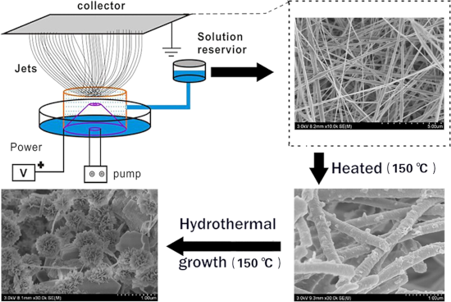
- -transform infrared spectroscopy (FTIR, Nicolet5700, Thermo Nicolet Company, Waltham, MA, USA), carrying out 32 scans within the wavenumber range of 400–4000 cm−1 with a resolution of 4 cm−1. X-ray diffraction (XRD) analyses were carried out using a Philips X’Pert-Pro MPD (PANalytical, Almelo & Eindhoven
- analysis of CuO–ZnO-loaded CNFMs The X-ray diffraction spectrum of heterostructured CuO–ZnO-loaded CNFMs is given in Figure 19. The diffraction peaks of PAN and PVDF are located at 17° and 21°, respectively, and the superposition peak of Cu(Ac)2 and Zn(Ac)2 is at 7°, indicating remainders of Cu(Ac)2 and Zn
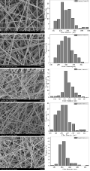
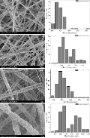
- CuO–ZnO-loaded CNFMs after different times of hydrothermal synthesis: (a) 6 h; (b) 12 h; (c) 18 h; (d) 24 h. X-ray diffraction pattern of heterostructured CuO–ZnO-loaded CNFMs. Elemental compositions of CNFMs with different CuO–ZnO heterostructures. Morphologies and CA of CNFMs before and after heat











Correction: Photocatalytic antibacterial performance of TiO2 and Ag-doped TiO2 against S. aureus. P. aeruginosa and E. coli
Beilstein J. Nanotechnol. 2020, 11, 547–549, doi:10.3762/bjnano.11.43

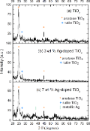
- results of the article. XRD of TiO2 and Ag-doped TiO2 nanoparticles X-ray diffraction (XRD) was used to characterize as-prepared TiO2 and Ag-doped TiO2 nanoparticles. The diameter of crystalline TiO2, 3 wt % Ag-doped TiO2 and 7 wt % Ag-doped TiO2 nanoparticles annealed at 450 °C was calculated by the
Interfacial charge transfer processes in 2D and 3D semiconducting hybrid perovskites: azobenzene as photoswitchable ligand
Beilstein J. Nanotechnol. 2020, 11, 466–479, doi:10.3762/bjnano.11.38
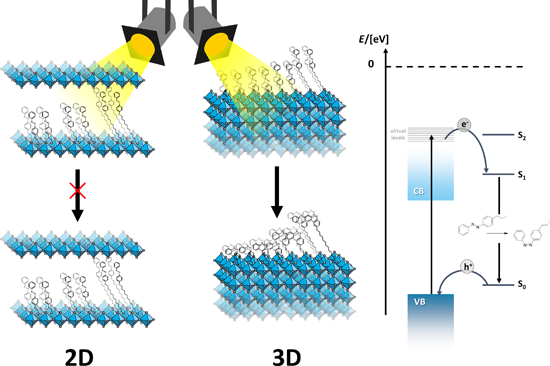
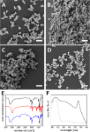
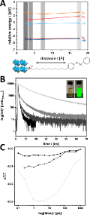
- headgroup provides not enough space for the molecule to fit into the structure. The materials were examined by using a combination of methods to study their structure and electronic properties. In Figure 2D the powder X-ray diffraction (PXRD) patterns and the associated scanning electron microscopy (SEM
- . The suspension was stirred for 1 h, then the particles were centrifuged, washed three times with 3 mL DCM and then dried under reduced pressure. The samples were kept under nitrogen atmosphere to prevent decomposition. Characterization X-ray diffraction (XRD) measurements of drop-cast particles on
- , (C) SEM image of 2D-AzoOC12, scale bar = 1 µm. (D) Powder X-ray diffraction (PXRD) pattern of the 2D LHPs with incorporated AzoC2, AzoOC4 and AzoOC12 with a layer thickness of d(001) = 2.48 nm, d(001) = 2.84 nm and d(001) = 3.40 nm, respectively (from top to bottom). (E) 1H NMR spectra in the




Atomic-resolution imaging of rutile TiO2(110)-(1 × 2) reconstructed surface by non-contact atomic force microscopy
Beilstein J. Nanotechnol. 2020, 11, 443–449, doi:10.3762/bjnano.11.35
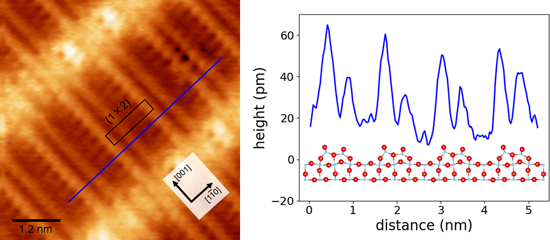
- clean surface is relatively easy. A well-known rutile TiO2(110) surface is the (1 × 1) structure [2]. The (1 × 1) surface has been studied using low-energy electron diffraction (LEED) [3][4], surface X-ray diffraction [5], non-contact atomic force microscopy (NC-AFM) [6][7][8][9], scanning tunneling


Synthesis and enhanced photocatalytic performance of 0D/2D CuO/tourmaline composite photocatalysts
Beilstein J. Nanotechnol. 2020, 11, 407–416, doi:10.3762/bjnano.11.31
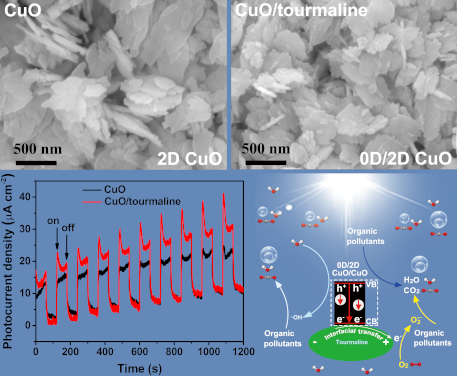
- product was named CuO/tourmaline-1:1 (1:1 in mass ratio of the CuO/tourmaline). By controlling the dosage of Cu(CH3COO)2·H2O and NaOH in proportion the CuO/tourmaline composites in different mass ratios of the CuO/tourmaline were acquired. Characterization X-ray diffraction (XRD) patterns were obtained


Facile biogenic fabrication of hydroxyapatite nanorods using cuttlefish bone and their bactericidal and biocompatibility study
Beilstein J. Nanotechnol. 2020, 11, 285–295, doi:10.3762/bjnano.11.21
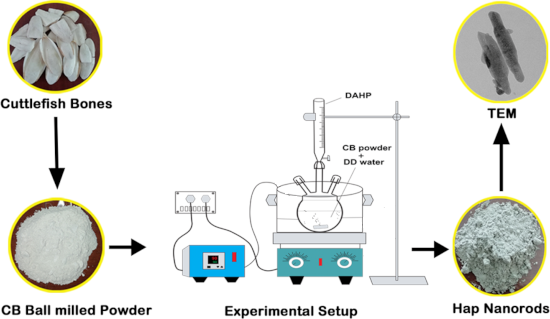
- ) nanorods using cuttlefish bone powder as a precursor (CB-Hap NRs). The obtained CB-Hap NRs were investigated using transmission electron microscopy (TEM), Fourier transform infrared spectroscopy (FTIR), X-ray diffraction (XRD) and thermogravimetric analysis (TGA) techniques to evaluate their
- setup via an oil bath approach to synthesize Hap nanorods from cuttlefish bone powders and optimize their synthesis parameters. The systematic characterization using X-ray diffraction (XRD), Fourier transform infrared spectroscopy (FTIR) and transmission electron microscopy (TEM) was performed to
- ]. Characterization of cuttlebone-Hap nanorods X-ray diffraction The X-ray diffraction (XRD) was carried out using an X-ray powder diffractometer (Bruker, Model D8 Advance) to study the crystallinity and phase formation of Hap nanorods. CB powder samples (ball milled) and CB-Hap NR powder was gently ground using a


Simple synthesis of nanosheets of rGO and nitrogenated rGO
Beilstein J. Nanotechnol. 2020, 11, 68–75, doi:10.3762/bjnano.11.7
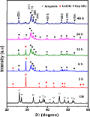
- force microscopy (AFM), X-ray diffraction (XRD) and thermogravimetric analysis (TGA). X-ray diffraction patterns of the samples were collected in the range of 10–70° (2θ) using a Bruker D8 diffractometer with a Cu Kα source (λ = 0.154178 nm). The morphology of the samples was examined using a Tescan


Influence of the epitaxial composition on N-face GaN KOH etch kinetics determined by ICP-OES
Beilstein J. Nanotechnol. 2020, 11, 41–50, doi:10.3762/bjnano.11.4
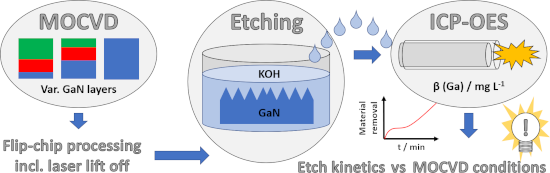
- ICP-OES analysis. Methods PLM images were recorded directly after epitaxy on an Olympus BX51 microscope combined with an Olympus U-RFL-T UV light source. For excitation, 408 nm wavelength light was used. X-ray diffraction (XRD) was measured on a Bruker/Jordan Valley QC Velox. Scanning electron
- structure of a GaN layer stack grown by metal organic chemical vapour deposition (MOCVD) was varied in the unintentionally doped u-GaN bulk region. Different sequences of 2D and 3D grown layers led to a variation in dislocation density, which was monitored by photoluminescence microscopy (PLM) and X-ray
- diffraction (XRD). Thin-film processing including laser lift off (LLO) was applied. The influence of epitaxial changes on the N-face etch kinetics was determined in aqueous KOH solution at elevated temperature. Inductively-coupled plasma optical emission spectroscopy (ICP-OES) was used to measure the etch


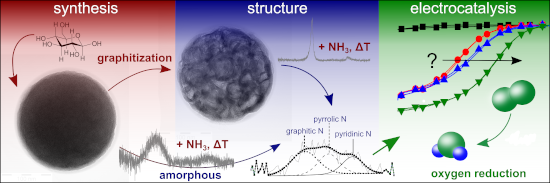
Synthesis of amorphous and graphitized porous nitrogen-doped carbon spheres as oxygen reduction reaction catalysts
Beilstein J. Nanotechnol. 2020, 11, 1–15, doi:10.3762/bjnano.11.1
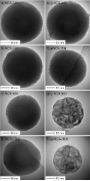
- %). TEM images (Figure 3a–d) reveal no highly ordered domains (e.g., graphene layers) of the said N-doped carbon spheres, which is in good agreement with the results of the X-ray diffraction measurements (XRD, Figure 4), confirming an amorphous carbon structure for all particles mentioned so far. Upon
- thickness of the graphite layers Lc determined by X-ray diffraction measurements. Similar observation was made by Liu et al. for carbon spheres that were synthesized by hydrothermal treatment of a sucrose solution and subsequently graphitized in the presence of nickel-oxide particles. High-resolution TEM
- (Shirley background; peak shape: 70% Gaussian/30% Lorentzian) was carried out using the CasaXPS software package. X-ray diffraction (XRD) measurements were performed using a Bruker D8 Advance instrument (Bruker Karlsruhe), employing Cu Kα radiation (λ = 0.154 nm) in a 2θ range of 5° to 80° (0.02




Synthesis and acetone sensing properties of ZnFe2O4/rGO gas sensors
Beilstein J. Nanotechnol. 2019, 10, 2516–2526, doi:10.3762/bjnano.10.242
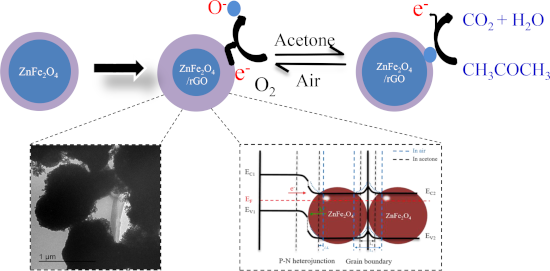
- of ZnFe2O4 and reduced graphene oxide (rGO) with different rGO content were prepared via a simple solvothermal method followed by a high-temperature annealing process in an inert atmosphere. The X-ray diffraction analysis confirmed that the introduction of rGO had no effect on the spinel structure of
- rate of 5 °C/min to reduce GO to rGO [33][34], and five samples were obtained: hollow spheres of pure ZnFe2O4 and ZnFe2O4/rGO composite spheres with 0.1, 0.25, 0.5 and 1 wt % of rGO. Characterization methods The crystal phases of pure ZnFe2O4 and the ZnFe2O4/rGO composites were characterized by X-ray
- diffraction (XRD, Bruker D8 Advance) using Cu Kα radiation at room temperature. The 2θ range was 10−80°, and the scanning rate was 5°·min−1. The microscopic morphology and the size of all samples were observed using a field-emission scanning electron microscope equipped with an energy-dispersive spectrometer




Coating of upconversion nanoparticles with silica nanoshells of 5–250 nm thickness
Beilstein J. Nanotechnol. 2019, 10, 2410–2421, doi:10.3762/bjnano.10.231
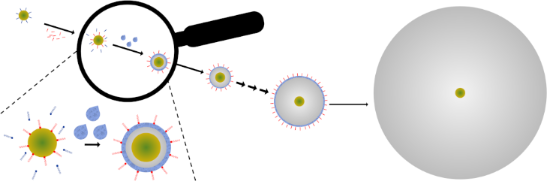
- particles of similar sizes [58][60][61]. Since the surface of the particles corresponds to that of particles from a standard Stöber synthesis, the colloids can be functionalized with the same diverse methods as Stöber silica particles [58]. Figure S5 in Supporting Information File 1 shows X-ray diffraction
- , 20 and 40 ppm) or erbium standard for ICP (c(Er3+) = 1, 5 and 10 ppm). X-ray diffraction (XRD) measurements A minimum amount of 10 mg of dried particles were used for the XRD measurements. The XRD device was a Rigaku SmartLab 3 kW with a DTex Ultra 250 detector (40 kV, 30 mA) equipped with a Cu Kα1