


Search results
Search for "interface" in Full Text gives 1005 result(s) in Beilstein Journal of Nanotechnology. Showing first 200.
Cross-sectional Kelvin probe force microscopy on III–V epitaxial multilayer stacks: challenges and perspectives
Beilstein J. Nanotechnol. 2023, 14, 725–737, doi:10.3762/bjnano.14.59
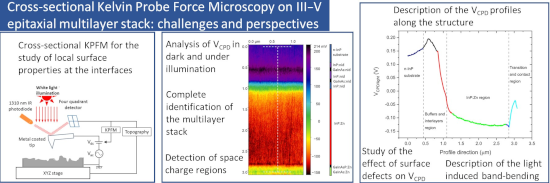
- . Additionally, the detected surface potential change related to the space charge region at the GaInAsP:Zn/GaInAs:Zn interface is higher and closer to the simulation. As described in the Experimental section (“Kelvin probe force microscopy”), the SPV can be calculated by applying Equation 2 to the experimental
- defects is responsible for reducing the carrier lifetime, or by the lack of a true ohmic contact between the sample holder and the n-type InP substrate during the KPFM measurement. In the second case, a potential barrier would be present at the metal contact/n-InP substrate interface, which could reduce
- along the x axis. Several regions along the structure have been highlighted using different colours (see text). The black arrow indicates the space charge region at the InP:nid/InP:Zn interface. SPV profile along the structure calculated from the values of VCPD/dark and VCPD/light shown in the profiles


Humidity-dependent electrical performance of CuO nanowire networks studied by electrochemical impedance spectroscopy
Beilstein J. Nanotechnol. 2023, 14, 683–691, doi:10.3762/bjnano.14.54
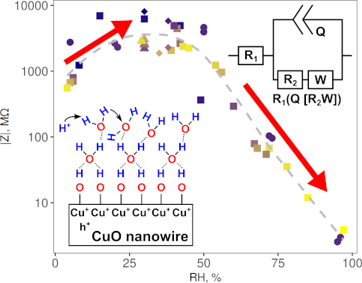
- chemisorption and physisorption at the nanowire interface, which suppress electronic transport inside the p-type semiconductor nanowire but enhance ionic transport in the water layers adsorbed on the nanowire surface. Possible physicochemical processes at the nanowire surface are discussed in line with


Metal-organic framework-based nanomaterials as opto-electrochemical sensors for the detection of antibiotics and hormones: A review
Beilstein J. Nanotechnol. 2023, 14, 631–673, doi:10.3762/bjnano.14.52
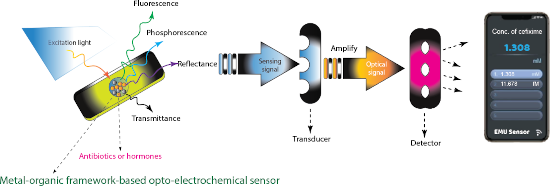
- conductometric sensors at various frequencies. In potentiometric sensors, a local equilibrium is created at the sensor–analyte interface, and when no current is present, the composition or concentration of the analyte is determined from the potential difference (voltage) between the working and the reference


ZnO-decorated SiC@C hybrids with strong electromagnetic absorption
Beilstein J. Nanotechnol. 2023, 14, 565–573, doi:10.3762/bjnano.14.47
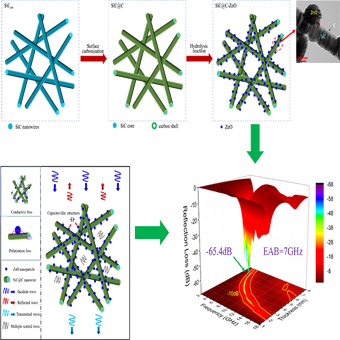
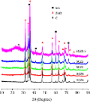
- . Figure 2c clearly shows the two kinds of interfaces, that is (1) the interface between a SiC core and a carbon shell and (2) the interface between the carbon phase and a ZnO particle. The (111) and (002) interplane spacings of, respectively, β-SiC and ZnO can be seen (Figure 2d,f), while the carbon is an
- that there are some fluctuations in the high-frequency range (10–16 GHz), which are called Debye relaxation peaks. These peaks are caused by shape anisotropy or surface polarization. For the SCZ samples, the unique core–shell structure and the interface polarization effect between different phases may
- ]. Furthermore, the introduction of immobilized ZnO particles on the carbon surface may result in the formation of capacitor-like structures at the heterogeneous interface between carbon and ZnO (Figure 7a) [31]. Also, the heterogeneous interface among the SiCnw core, the porous carbon shell, and the ZnO


Observation of multiple bulk bound states in the continuum modes in a photonic crystal cavity
Beilstein J. Nanotechnol. 2023, 14, 544–551, doi:10.3762/bjnano.14.45
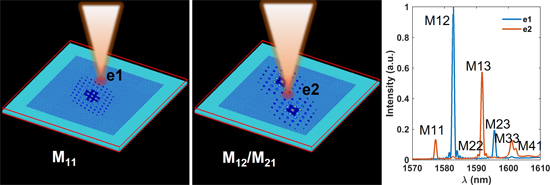
- heterostructure interface, as drawn in the inset of Figure 2a. The in-plane momentum of an infinite system could be selected to any value. However, in a finite-lattice system, the continuous band of structures splits into a series of discrete modes located at discrete points with distance δk = π/Leff in the
- bandgap heterostructure, respectively. Na, Nb, Pa = p, and Pb are the number of nanoblocks and lattice periods in regions A and B, respectively. Inset: the transition region at the interface between the two regions. (b) Band diagram of the structures in regions A and B. (c) The momentum distribution of


Nanoarchitectonics to entrap living cells in silica-based systems: encapsulations with yolk–shell and sepiolite nanomaterials
Beilstein J. Nanotechnol. 2023, 14, 522–534, doi:10.3762/bjnano.14.43
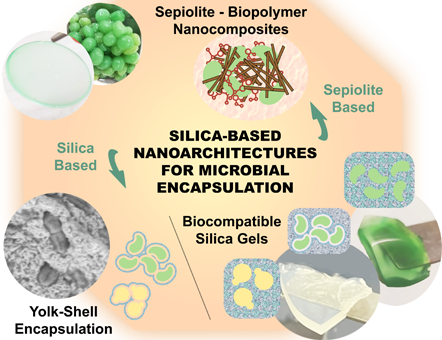
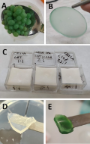
- and Figure 3D show that several yeast cells are embedded in the transparent silica matrix, featuring a visible interface resulting from the shellization process. The G57-4 silica gel materials with embedded yeasts were studied in further detail using the environmental SEM/EDS equipment described below


Conjugated photothermal materials and structure design for solar steam generation
Beilstein J. Nanotechnol. 2023, 14, 454–466, doi:10.3762/bjnano.14.36
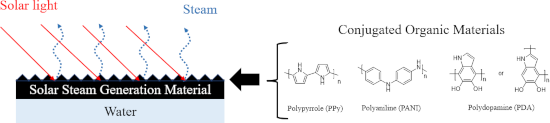
- efficiency, solar energy absorbers with various structures have been fabricated. Different structures have their advantages. Overall, the main purpose is to increase light absorption, increase evaporate interface area, and minimize heat loss to the environment. Janus structures are often applied to SSG
- observations (Figure 12a). These materials can stably float at the air–water interface (Figure 12b). The water contact angle of the bulk materials was as high as 130° without any surface modification (Figure 12c). Hydrophobic foams are considered to have advantages over hydrophilic foams, such as a greater
- of the foam floating at the air–water interface. (c) The water contact angle of the foam. (d–f) Time-dependent mass changes with and without the evaporator foam under different optical concentrations. Figure 12 was adapted from [34] (“A durable monolithic polymer foam for efficient solar steam


Molecular nanoarchitectonics: unification of nanotechnology and molecular/materials science
Beilstein J. Nanotechnol. 2023, 14, 434–453, doi:10.3762/bjnano.14.35
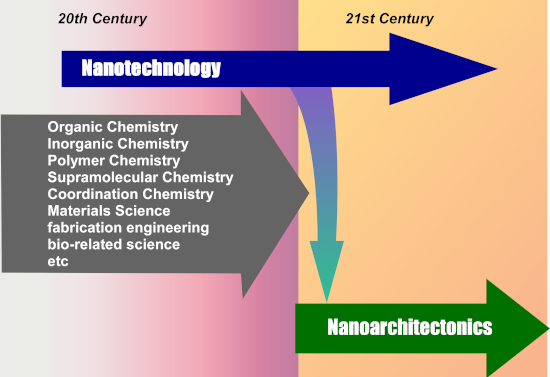
- expression through nanoarchitectonics. Shi and co-workers created nanoparticle surfactants at liquid–liquid interfaces by exploiting the interaction between nanoparticles and polymer ligands [101]. They showed that a size-dependent aggregation of nanoparticle surfactants can be generated at the interface
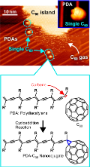
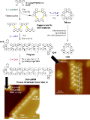
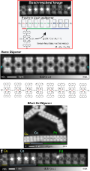
- heterojunction interface (Figure 10) [126]. This synthesis strategy is based on the difference in dissociation energies of C–Br and C–I bonds. The growth order of the block copolymers of graphene nanoribbons can be controlled. Such heterojunctions provide a viable platform that can be used directly for
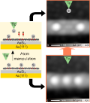
- this method, one precursor is vaporized and the other precursor is introduced to the surface in advance, allowing coupling reactions to occur at the solid–vapor interface. Various two-component chemical reactions can be applied to this methodology, not limited to the Schiff base reaction they reported




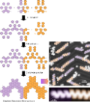

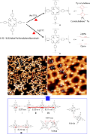
Plasmonic nanotechnology for photothermal applications – an evaluation
Beilstein J. Nanotechnol. 2023, 14, 380–419, doi:10.3762/bjnano.14.33
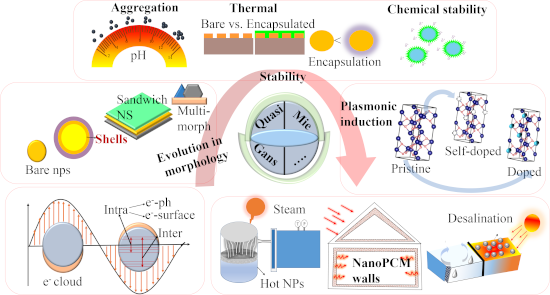


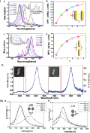


Polymer nanoparticles from low-energy nanoemulsions for biomedical applications
Beilstein J. Nanotechnol. 2023, 14, 339–350, doi:10.3762/bjnano.14.29
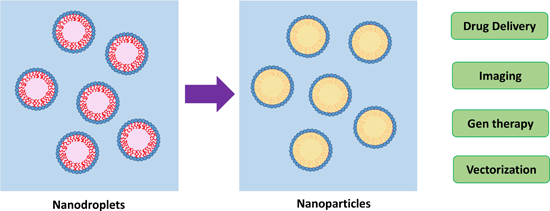
- -emulsification or spontaneous emulsification [16]. Here, one component present in the oil phase diffuses into the aqueous phase, resulting in the formation of metastable oily droplets by local supersaturation produced near the interface followed by oil nucleation. The ouzo effect is an example of this phenomenon
- , in which water is further added to a homogeneous solution composed of oil, a short-chain alcohol, and water (without surfactant) [17]. Assuming that all surfactant molecules are adsorbed at the O/W interface, the diameter of the nanoemulsion droplets (excluding the hydrated surfactant layer) can be
- roughly estimated by [18]: where Ms is the surfactant molecular weight, as is the area occupied per surfactant molecule at the O/W interface, NA is Avogadro’s number, ρ0 is the density of the oil phase, Ros is the oil/surfactant mass ratio, and vL is the molar volume of the hydrophobic part of the




Bismuth-based nanostructured photocatalysts for the remediation of antibiotics and organic dyes
Beilstein J. Nanotechnol. 2023, 14, 291–321, doi:10.3762/bjnano.14.26
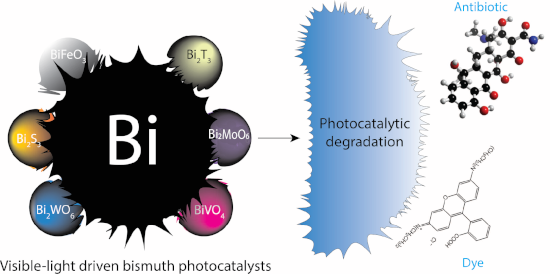
- were degraded by 94.8% and 81.1% after 1 h, respectively. Another strategy for overcoming constraints such as low charge migration and the unpredictable direction of charge diffusion is the construction of a Schottky junction. A Schottky junction can be created at the interface between the
- facile solvothermal technique. An intrinsic electric field is created at the interface as a result of the active migration of electrons from BiVO4 to NiSe2. This improves the separation efficiency of the photogenerated carriers, and the interaction at the interface lowers the bandgap of BiVO4, which in


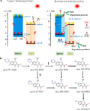
Spin dynamics in superconductor/ferromagnetic insulator hybrid structures with precessing magnetization
Beilstein J. Nanotechnol. 2023, 14, 233–239, doi:10.3762/bjnano.14.22
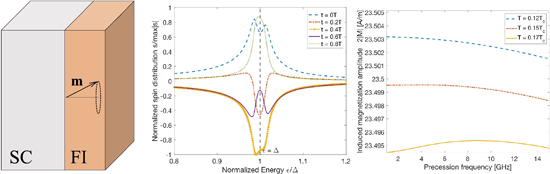
- film S that is in contact with a ferromagnetic insulator layer FI. Spin current and induced magnetization are calculated not only at the interface of the S/FI hybrid structure, but also inside the superconducting film. The new and interesting predicted effect is the frequency dependence of the induced
- magnetization with a maximum appearing at high temperatures. It is also shown that the increase of the magnetization precession frequency can drastically change the spin distribution of quasiparticles at the S/FI interface. Keywords: ferromagnetic resonance; proximity effect; superconducting spintronics
- calculated [29]. Another important problem that occurs during consideration of the dynamic inverse proximity effect is the nonequilibrium behavior of quasiparticles at the S/FI interface. In this work, we present our new results that prove that adiabatic dynamics of quasiparticles into the superconducting


High–low Kelvin probe force spectroscopy for measuring the interface state density
Beilstein J. Nanotechnol. 2023, 14, 175–189, doi:10.3762/bjnano.14.18
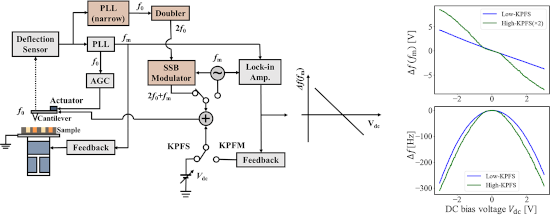
- of the effects of semiconductor interface states with high spatial resolution using high and low AC bias frequencies compared with the cutoff frequency of the carrier transfer between the interface and bulk states. Information on the energy spectrum of the interface state density is important for
- interface state density inside semiconductors. We derive an analytical expression for the electrostatic forces between a tip and a semiconductor sample in the accumulation, depletion, and inversion regions, taking into account the charge transfer between the bulk and interface states in semiconductors. We
- show that the analysis of electrostatic forces in the depletion region at high- and low-frequency AC bias voltages provides information about the interface state density in the semiconductor bandgap. As a preliminary experiment, high-low KPFS measurements were performed on ion-implanted silicon



A distributed active patch antenna model of a Josephson oscillator
Beilstein J. Nanotechnol. 2023, 14, 151–164, doi:10.3762/bjnano.14.16
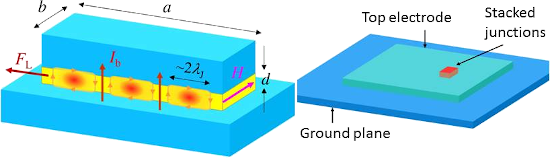
- from Josephson oscillators. Figure 1a shows a sketch of a typical FFO. It is based on a sandwich-type (overlap) JJ with the length, a ≫ λJ, much larger than the Josephson penetration depth, and both in-plane sizes much larger than the thickness of the junction interface, d ≪ b ≪ a. The in-plane


Formation of nanoflowers: Au and Ni silicide cores surrounded by SiOx branches
Beilstein J. Nanotechnol. 2023, 14, 133–140, doi:10.3762/bjnano.14.14
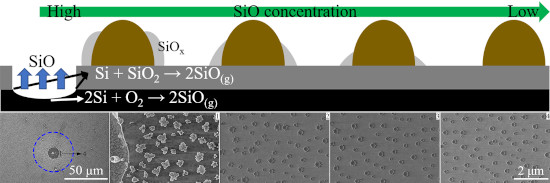
- substrate at higher temperatures in oxygen-deficient environment [3][4]. Another cost-effective nanofabrication method, thin film dewetting, driven by the reduction of the surface energy and the interface energy has also been profusely studied because it provides a straightforward and fast way to produce
- , such as Au and Ni, can diffuse to the Si/SiO2 interface and enhance the decomposition rate there [38][39][40]. Hence, increasing decomposed areas with the thicker Au layer means that Au enhances the decomposition of SiO2 more than Ni. Completely different structures can be observed inside the
- ][4], dewetting of the Au/Ni bilayers and diffusion of Au and Ni atoms from the bilayers to the SiO2/Si interface begin at high temperatures. Simultaneously, decomposition is initiated at the SiO2/Si interface, and it can be strengthened by the diffused Au and Ni atoms to finally form the


Characterisation of a micrometer-scale active plasmonic element by means of complementary computational and experimental methods
Beilstein J. Nanotechnol. 2023, 14, 110–122, doi:10.3762/bjnano.14.12
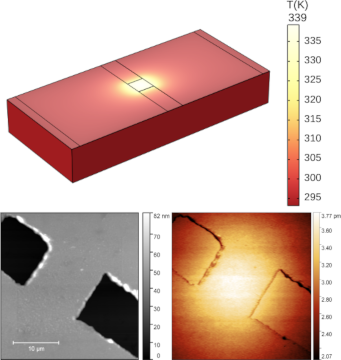
- polaritons (SPPs) are mixed states of photons and electron density waves propagating along the interface between a conductor and a dielectric. As a result of this phenomenon, an electric field strongly confined in the z-direction is produced at the interface. As direct excitation of a smooth metallic surface
- reference light is recorded after the aperture and reflected from a cube beam splitter, with the signal photodiode placed on the 2θ arm of a high-accuracy (18 arcsec resolution) Siemens θ–2θ X-ray diffractometer stage with inbuilt goniometer to collect light reflected from the interface. The absolute
- deposition substrate for a thin silver film of 48 nm. The incident angles were referenced to the air–prism interface. The sinusoidal current was generated using a function generator with a current buffer to ensure impedance matching to the system under investigation. A transimpedance-amplified photodiode




Antimicrobial and mechanical properties of functionalized textile by nanoarchitectured photoinduced Ag@polymer coating
Beilstein J. Nanotechnol. 2023, 14, 95–109, doi:10.3762/bjnano.14.11
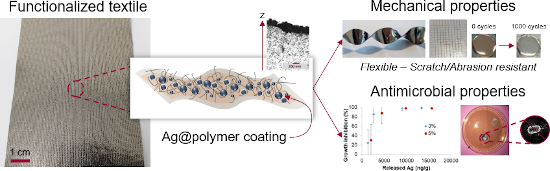
- significantly affect the flexibility of the original cotton substrate (Figure 6). In the case of Ag@PEG600DA coatings, the samples do not show any cracking or loss of adhesion at the coating/textile interface following a bending-type deformation for example; the metal surface remains visually intact. However



Frontiers of nanoelectronics: intrinsic Josephson effect and prospects of superconducting spintronics
Beilstein J. Nanotechnol. 2023, 14, 79–82, doi:10.3762/bjnano.14.9

- magnetic proximity effect at a ferromagnetic–insulator–superconductor (FIS) interface was investigated through combined experimental and theoretical work [25]. Manifestations of nonlinear features in magnetic dynamics and current–voltage characteristics of the 0 Josephson junction in superconductor
Gap-directed chemical lift-off lithographic nanoarchitectonics for arbitrary sub-micrometer patterning
Beilstein J. Nanotechnol. 2023, 14, 34–44, doi:10.3762/bjnano.14.4
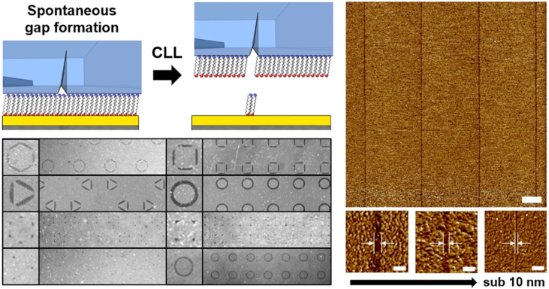
- cause lithographic limitation, the structural gaps generated at the stamp–substrate interface during the contacting stage can provide another opportunity to create minute geometries. For example, nanochannels with height on the order of 10 nm and millimeters in length can be created when a nanowire is
- nanometer level can be obtained via the use of microscale features generated from conventional lithography. Nevertheless, the integration of interface structure gap formation and soft lithography, unfortunately, is still challenging since the molecular lateral diffusion problem remains to restrict pattern
- this approach lies on the deliberately-designed soft material stamp structure geometry and stereo dimension. To induce the spontaneous generation of controllable structure gaps at the stamp–substrate interface, the feature height (H), spacing distance (D), and width (W) on a soft material stamp are


The influence of structure and local structural defects on the magnetic properties of cobalt nanofilms
Beilstein J. Nanotechnol. 2023, 14, 23–33, doi:10.3762/bjnano.14.3
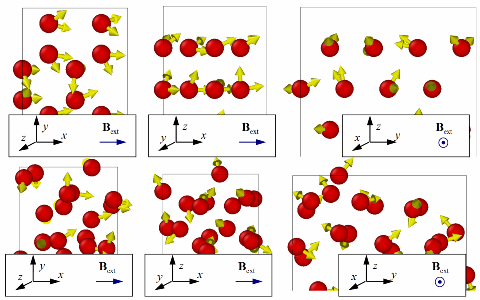
- of the sample. The results of numerical experiments are described in the literature [37][38][39]. The next stage of sample study involved the optimization of the nanofilm interface. The basic magnetic properties of the nanocomposite depend on the quality of the interface between the layers, so the
- problem of obtaining clearly separated contact layers is highly relevant. Using simulations, it was demonstrated that optimization of the nanofilm interface can be obtained either by introducing additional intermediate thin layers neutral to the original composition, such as aluminum oxide, or by


Observation of collective excitation of surface plasmon resonances in large Josephson junction arrays
Beilstein J. Nanotechnol. 2022, 13, 1578–1588, doi:10.3762/bjnano.13.132
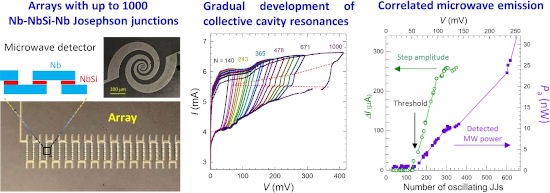
- formation of standing waves at the electrode/substrate interface. We observe that resonant steps in the current–voltage characteristics appear above some threshold number of junctions, Nth ≈ 100, and then progressively enhance in amplitude with further increment of the number of junctions in the resistive
- profound step structure in the current–voltage (I–V) characteristics. The resonances are caused by the formation of surface plasmon-type standing waves at the electrode–substrate interface [34]. Thus, the electrodes themselves act as a common external resonator, facilitating the effective indirect coupling
- interconnecting Nb electrodes, acting as a travelling wave antenna for surface plasmons at the electrode–substrate interface [9][34]. The linear array contains also two extra Nb lines (without JJs) on each side of the array forming a slot waveguide, which may act as an additional external resonator. However




From a free electron gas to confined states: A mixed island of PTCDA and copper phthalocyanine on Ag(111)
Beilstein J. Nanotechnol. 2022, 13, 1572–1577, doi:10.3762/bjnano.13.131
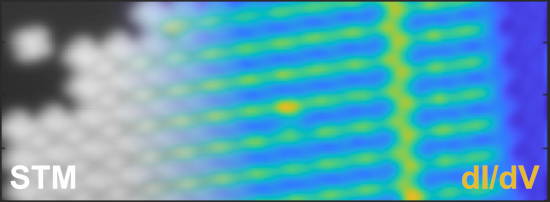
- at submonolayer coverage, it forms islands under which the native Shockley state of the Ag(111) surface can no longer be found. Previous work has shown that this state shifts upwards to form a new interface state starting at 0.6 V above the Fermi level, having properties of a two-dimensional electron
- include a metal–organic interface. At this interface, it is important to be able to modify the band structure to optimize the efficiency of a device [1]. One of the most successful methods to change the electronic structure of a molecular semiconductor device is to add a second molecular species either at
- coverage, lies flat on metal surfaces. Submonolayer coverage of PTCDA on Ag(111) is known to form islands with a herringbone reconstruction [3][4]. These islands are hosts to an interface state that acts like a free-electron gas [5]. This interface state has been observed with two-photon photoelectron


Utilizing the surface potential of a solid electrolyte region as the potential reference in Kelvin probe force microscopy
Beilstein J. Nanotechnol. 2022, 13, 1558–1563, doi:10.3762/bjnano.13.129
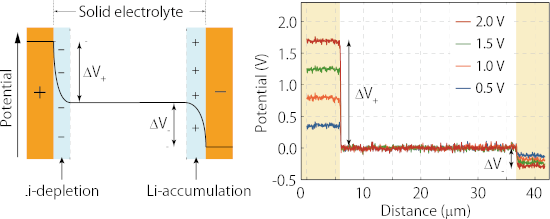
- , in the case of electrochemical devices such as batteries, the redox reactions that occur at the electrode are determined by the potential difference across the electrode–electrolyte interface, not the electrode potential relative to ground. This prevents the accurate consideration of redox reactions
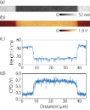
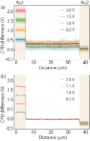
- interface [13]. In the case of KPFM measurements, the CPD can be measured not only at the electrodes but also over the electrolyte region. Therefore, the change in the potential difference across the electrode–electrolyte interface can, in principle, be detected without a reference electrode, although this
- -accumulation layer on the negative electrode side [14][15]. Consequently, a voltage drop occurs only close to the interface between the electrode and the solid electrolyte, with the potential within the solid electrolyte region becoming constant, as depicted in Figure 1b. In general, the magnitude of the




Induced electric conductivity in organic polymers
Beilstein J. Nanotechnol. 2022, 13, 1551–1557, doi:10.3762/bjnano.13.128
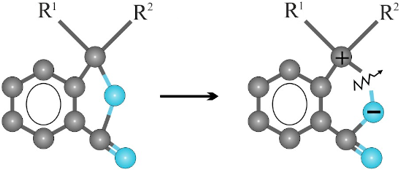
- interface are completely or partially elongated. Also, film formation at such low concentrations strongly depends on the energy interaction of macromolecules with the substrate surface, which explains the weak dependence of the film thickness on the solution concentration. With an increase in concentration



Photoelectrochemical water oxidation over TiO2 nanotubes modified with MoS2 and g-C3N4
Beilstein J. Nanotechnol. 2022, 13, 1541–1550, doi:10.3762/bjnano.13.127
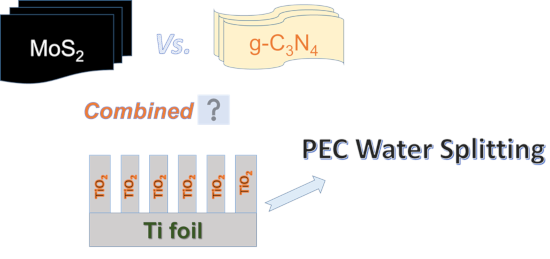
- with previous publications [50][51][52]. Figure 5 shows the results of electrochemical impedance spectroscopy (EIS), that is, Nyquist and Mott–Schottky plots of the materials, which give information about the charge transfer mechanism at the interface. In Figure 5a, the Nyquist plots of the samples all
- , the area of interface or the electrode, the applied and flat band potentials, the Boltzmann constant, and the temperature, respectively. The plot of 1/C2 vs V shows an intercept of the x-axis, which corresponds to the flat band potential (Efb), that is, the conduction band maximum (CBM) level of the





