Search results
Search for "dissipation" in Full Text gives 241 result(s) in Beilstein Journal of Nanotechnology. Showing first 200.
A scanning probe microscope for magnetoresistive cantilevers utilizing a nested scanner design for large-area scans
Beilstein J. Nanotechnol. 2015, 6, 451–461, doi:10.3762/bjnano.6.46
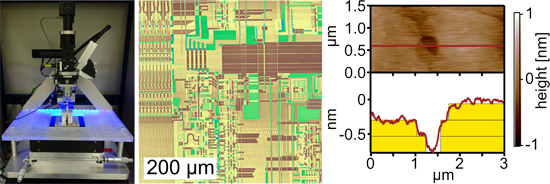
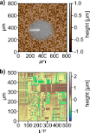
- , atomic step edges of 2.54 Å height are resolved. For dynamic-mode experiments, the phase-shift signal is of high interest as it provides information about energy dissipation between tip and sample [60][61] and visualizes chemical contrasts [62]. To demonstrate this kind of measurement also with our TMR
- topography contrast in ambient conditions is most likely caused by the thin water films present on hydrophilic SiOx under ambient conditions [65]. This effect obscures the height difference between the FDTS and SiOx. However, as shown in Figure 7a, the difference of the energy dissipation between the two
- sample system, dissipative tip–sample forces are dominant. Therefore, a high phase-signal contrast can be observed and reveals the different materials of the sample due to different energy dissipation between tip and sample while the amplitude-signal feedback reveals no topographic features. b) On such


Influence of spurious resonances on the interaction force in dynamic AFM
Beilstein J. Nanotechnol. 2015, 6, 420–427, doi:10.3762/bjnano.6.42
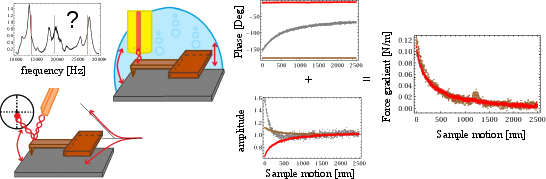
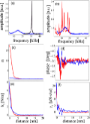
- and the dissipation are shown in Figure 2e and Figure 2f. In both cases it is possible to observe the same results in terms of force gradient and dissipation, the main difference between the two excitation methods being only the calibration parameters a and , which were in the case of electrostatic
- (Figure 4a), whereas the dissipation remains constant and approximately equal to zero. The force was used to obtain all unknown constants. Interestingly, the values of r and that result from the calibration are those that would be expected if the spurious peaks were not present. Notice in Figure 4d that
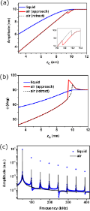
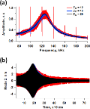
- excited (blue) and mechanically excited (red) in liquid; (c and d) normalized excitation and phase, respectively; e) force gradient and f) dissipation measured at the mica/deionized water interface with electrostatic excitation of the tip (blue) and conventional piezoelectric excitation (red). Equation 14


A surface acoustic wave-driven micropump for particle uptake investigation under physiological flow conditions in very small volumes
Beilstein J. Nanotechnol. 2015, 6, 414–419, doi:10.3762/bjnano.6.41
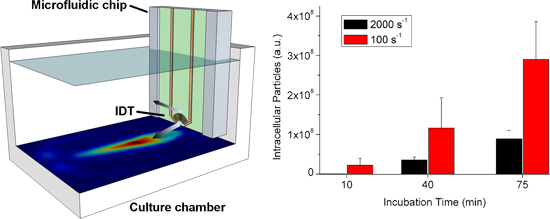
- generator is no solution to that problem since dissipation would heat the sample. However, as we will show, the application of focusing interdigital transducers (FIDTs) in an L-shape configuration allows for shear rates of up to 4000 s−1 without significant sample heating. Results and Discussion
- significant heating due to dissipation at the applied input power of PSAW ≈ 19 dBm. Characterization of the flow pattern The characterization of the SAW-induced velocity field is done by particle image velocimetry (PIV). For improving the resolution while being able to capture the whole chamber the method is


Dynamic force microscopy simulator (dForce): A tool for planning and understanding tapping and bimodal AFM experiments
Beilstein J. Nanotechnol. 2015, 6, 369–379, doi:10.3762/bjnano.6.36
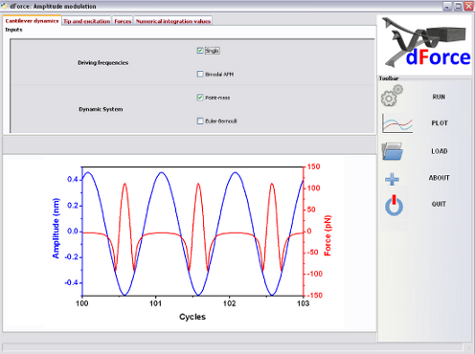
- ]. They explained the origin of the phase contrast observed on heterogeneous samples by tapping mode AFM in air [3] and liquid [4][5]. In the process, simulations validated the theory of AFM phase imaging in air [6][7], its use to identify energy dissipation processes [7] or to measure the energy




Mechanical properties of MDCK II cells exposed to gold nanorods
Beilstein J. Nanotechnol. 2015, 6, 223–231, doi:10.3762/bjnano.6.21
- about cellular properties like the cytoskeleton or the plasma membrane [21]. Alternatively, mechanical properties of cells in response to nanoparticle exposure can be monitored time resolved by the quartz crystal microbalance with dissipation monitoring (D-QCM) [14][22][23]. The QCM-method records
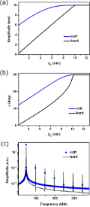
- of cells with GDA results in a shift to lower resonance frequency by a few hundred Hertz, while dissipation grows [14]. The same is observed for CTAB-coated gold nanorods and nanospheres (Figure 6). In good accordance, elasticity measurements of MDCK II cells after GDA fixation with an AFM provides a
- that both mass load (change in resonant frequency) and dissipation (representing energy loss) increase upon administration of CTAB coated gold nanorods. The response time of the cells to administration of particles is fairly fast (few hours) and depends heavily on particle concentration. We carried out


High-frequency multimodal atomic force microscopy
Beilstein J. Nanotechnol. 2014, 5, 2459–2467, doi:10.3762/bjnano.5.255
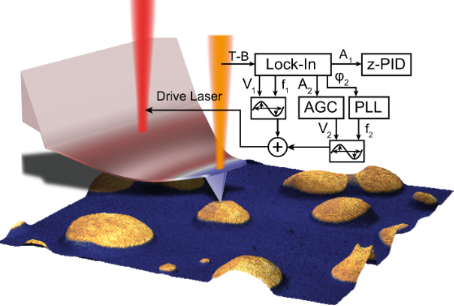
- our system for noise performance will decrease the baseline noise value further [35]. Dissipation imaging Bimodal imaging The capability for clean, high-frequency cantilever excitation, and low-noise, high-frequency deflection readout provide a powerful platform for extending multifrequency techniques
- amplification is kept constant with the PLL, the amount of drive signal needed to keep the amplitude constant is proportional to the power dissipated in the tip–sample interaction. The power dissipation (Pdiss) is calculated from the applied excitation signal (Vex·sin (2πf)) and the intrinsic power dissipation
- of the cantilever (P0) as where V0 is the excitation voltage, f0 the excitation frequency, k the spring constant, A the amplitude and Q the quality factor far from the surface [39]. The acquired dissipation is, to a first approximation, only dependent on the materials properties and the additional


Modeling viscoelasticity through spring–dashpot models in intermittent-contact atomic force microscopy
Beilstein J. Nanotechnol. 2014, 5, 2149–2163, doi:10.3762/bjnano.5.224
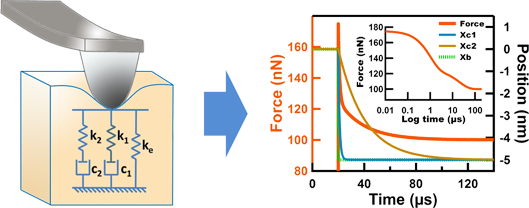
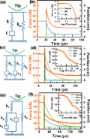
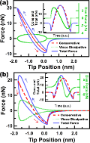
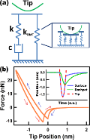
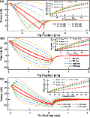
- quantitative information about the dissipative and conservative tip–sample interactions by converting them to energy-based quantities, namely the dissipated power (Pts) and virial (Vts) [9][11]. Although several authors have achieved quantification of energy dissipation processes [12][13][14][15], the further
- force–distance curve and dissipation behavior of these models, focusing on single-eigenmode tip–sample impacts. Throughout the paper, the advantages and disadvantages of the various models are discussed, along with possible enhancements that can lead to more accurate simulation of viscoelastic material
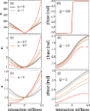
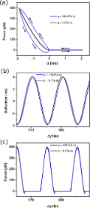
- to its original position. Despite the limitations of the Linear Maxwell model, it is able to model dissipation which is evidenced by the presence of a hysteresis loop in the force–distance (FD) curve (see Figure 1c). This dissipation loop arises from the gap between the energy input (energy given by


Effect of channel length on the electrical response of carbon nanotube field-effect transistors to deoxyribonucleic acid hybridization
Beilstein J. Nanotechnol. 2014, 5, 2081–2091, doi:10.3762/bjnano.5.217
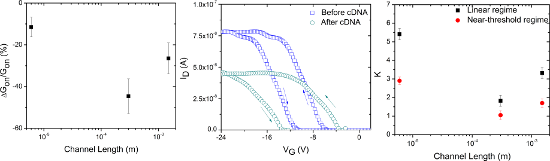
- charge traps are in the filled state [35][37]. On the contrary, in the near-threshold regime, the lack of dissipation of injected charges on account of hysteresis causes the potential induced by the trapped charges to exceed the potential of the back gate voltage [37], which emphasized the need to


Dissipation signals due to lateral tip oscillations in FM-AFM
Beilstein J. Nanotechnol. 2014, 5, 2048–2057, doi:10.3762/bjnano.5.213
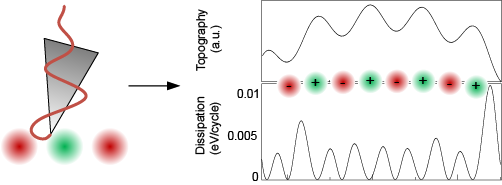
- usually uncontrolled mechanical damping of the lateral excitation. For certain cantilevers, this dissipation mechanism can lead to dissipation rates larger than 0.01 eV per period. The mechanism produces an atomic contrast for ionic crystals with two maxima per unit cell in a line scan. Keywords: atomic
- force microscopy (AFM); frequency-modulated atomic force microscopy (FM-AFM); energy dissipation; Introduction The usage of scanning probe microscopes requires an understanding of the physical processes during the scan, otherwise images can be misinterpreted. Due to the importance of frequency
- -modulated atomic force microscopy (FM-AFM), the physical processes involved have been studied intensively in the past [1]. This includes the relation between tip–surface interaction and frequency-shift [2], as well as features such as the energy dissipation during the scan [3], which is an interesting side


Dynamic calibration of higher eigenmode parameters of a cantilever in atomic force microscopy by using tip–surface interactions
Beilstein J. Nanotechnol. 2014, 5, 1899–1904, doi:10.3762/bjnano.5.200
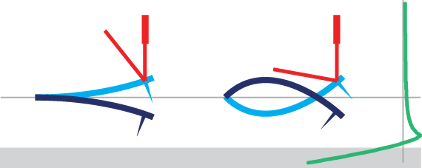
- damage since the dissipation is almost zero in this regime. Finally, the linear method is dependent on the unknown higher eigenmode free amplitude, , which must be small for the linear approximation to be valid. Since is not known a priori, one can use the following formula to try to make a rough guess


![[Graphic 25]](/bjnano/content/inline/2190-4286-5-200-i35.png?max-width=637&scale=1.18182) , using Equation 9 for two different cantilevers: ...
, using Equation 9 for two different cantilevers: ...
Real-time monitoring of calcium carbonate and cationic peptide deposition on carboxylate-SAM using a microfluidic SAW biosensor
Beilstein J. Nanotechnol. 2014, 5, 1823–1835, doi:10.3762/bjnano.5.193
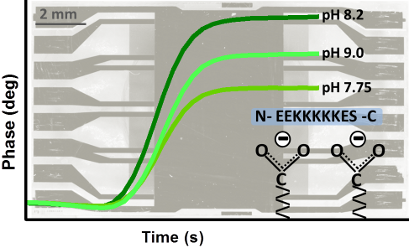
- microbalances with dissipation QCM-D [35]. Mass and viscosity changes can be continuously and simultaneously monitored in standardized systems, as long as the amplitude signal is strongly correlated with the viscosity of the fluid [36]. Recently, multichannel experiments became possible, enhancing the


The surface properties of nanoparticles determine the agglomeration state and the size of the particles under physiological conditions
Beilstein J. Nanotechnol. 2014, 5, 1774–1786, doi:10.3762/bjnano.5.188
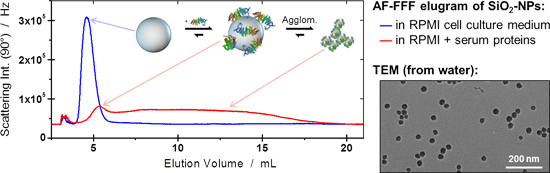
- small amounts of agglomerates could be detected. However, the alkylation of the secondary amine groups results in a significant growth of the hydrodynamic size at physiological salinity. In presence of serum proteins a dissipation of the agglomerates was observed. Thus, the increase in diameter in the


Controlling the optical and structural properties of ZnS–AgInS2 nanocrystals by using a photo-induced process
Beilstein J. Nanotechnol. 2014, 5, 1767–1773, doi:10.3762/bjnano.5.187
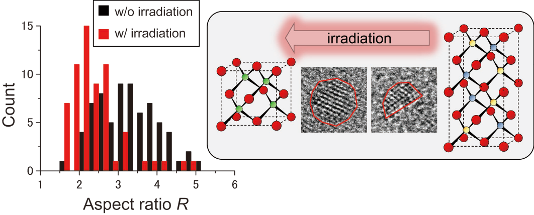
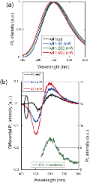
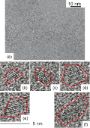
- -radiative energy dissipation, and resulted in the increase of the emission intensity of the band edge. Using the emission spectra to control the nanocrystal size For the investigation of ways to control the size of ZAIS nanocrystals, we synthesized ZAIS nanocrystals with 532 nm irradiation (λ2) during the




Probing viscoelastic surfaces with bimodal tapping-mode atomic force microscopy: Underlying physics and observables for a standard linear solid model
Beilstein J. Nanotechnol. 2014, 5, 1649–1663, doi:10.3762/bjnano.5.176
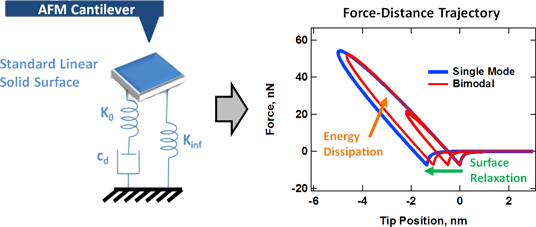
- properties and the AFM observables. The physics of the tip–sample interactions and its effect on the observables are illustrated and discussed, and a brief research outlook on viscoelasticity measurement with intermittent-contact AFM is provided. Keywords: amplitude-modulation; bimodal; dissipation
- ] and Garcia et al. [31] proved mathematically that when tip–sample energy dissipation is absent, the phase shift remains unchanged even if the elastic properties of the sample are non-uniform across the surface. This enables the user to directly map variations in energy dissipation based on the phase
- to obtain images of the sample topography, energy dissipation and elasticity of polymer surfaces immersed in a liquid environment [16]. We have also reported experiments in which images of Vts and Pts were compared for different control schemes applied to the higher mode, including open loop


A sonochemical approach to the direct surface functionalization of superparamagnetic iron oxide nanoparticles with (3-aminopropyl)triethoxysilane
Beilstein J. Nanotechnol. 2014, 5, 1472–1476, doi:10.3762/bjnano.5.160
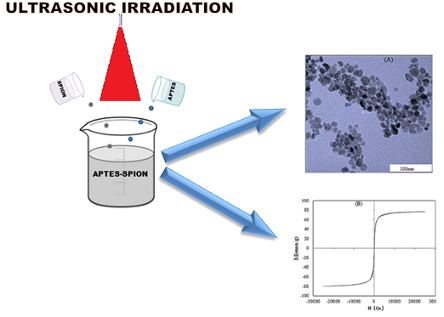
- synthesized in an ice bath for heat dissipation. The colloidal suspension of SPION was initially dispersed for 2 min by using a Vibra-Cell ultrasonic horn. Subsequently, APTES was then added and the mixture was further sonicated for 20 min. The resulting product was left overnight and then separated with


Probing the electronic transport on the reconstructed Au/Ge(001) surface
Beilstein J. Nanotechnol. 2014, 5, 1463–1471, doi:10.3762/bjnano.5.159
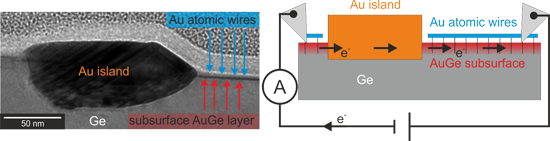
- financial support from the Deutsche Forschungsgemeinschaft under the program “SFB616: Energy Dissipation at Surfaces” and the Polish National Science Center, grant no. DEC-2012/07/B/ST5/00906. Part of the research was carried out with equipment purchased with financial support from the European Regional




Synthesis, characterization, and growth simulations of Cu–Pt bimetallic nanoclusters
Beilstein J. Nanotechnol. 2014, 5, 1371–1379, doi:10.3762/bjnano.5.150
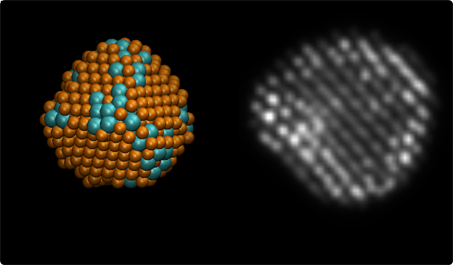
- each particle and represents the force due to the potential interaction between the particles and the NP, as they do not interact with each other. The friction constant γ and the random force are related by the fluctuation–dissipation theorem. The Langevin dynamics was implemented by Ermak's


A nanometric cushion for enhancing scratch and wear resistance of hard films
Beilstein J. Nanotechnol. 2014, 5, 1005–1015, doi:10.3762/bjnano.5.114
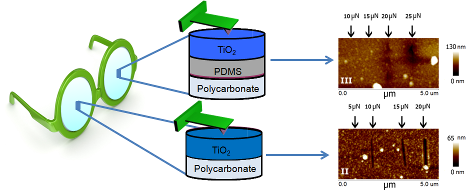
- dissipation during deformation of the hard film. In their classic model of friction, Bowden and Tabor [13] divide the friction into two terms, a plowing term and an adhesion term. The latter is associated with friction arising from the energy required to break the adhesive bonds, and the former from the
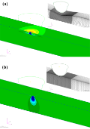
- or spallation due to compressive stress. Thus, a large mismatch between the lateral stresses on the two components will lead to wear and to energy dissipation. The FEA modeling confirms the observed behavior. The modeling points to a mechanistic interpretation: (1) The extensive deformation of the



Functionalized nanostructures for enhanced photocatalytic performance under solar light
Beilstein J. Nanotechnol. 2014, 5, 994–1004, doi:10.3762/bjnano.5.113
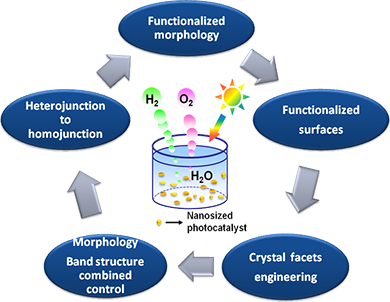
- charge carriers to the target surface reaction sites within their life time to avoid their recombination in the form of heat dissipation, and (2) the rapid implementation of reduction and oxidation reactions by those excited charges, should be promoted. Among the various approaches, nanostructure design


Resonance of graphene nanoribbons doped with nitrogen and boron: a molecular dynamics study
Beilstein J. Nanotechnol. 2014, 5, 717–725, doi:10.3762/bjnano.5.84
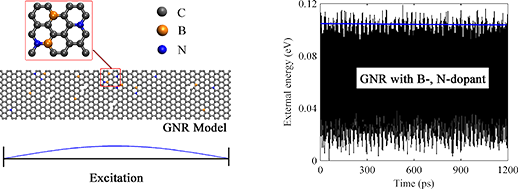
- with the results presented in Figure 2a, a much slower energy dissipation is found for the GNR with 1.89% B-dopant (see Figure 2b). We note that, although the GNR with a higher density of B-dopant might have a higher Q, the resonance frequency appears to have a consistent trend to decrease when the B
- , the external energy is observed to experience a sharp dissipation from 0.10 to 0.06 eV within 150 ps of simulation time. Afterwards, it fluctuates around 0.06 eV with no obvious dissipation. From the frequency spectrum, the resonance frequency is estimated to be 106 GHz. For the GNRs with a density of
- % B- and N-dopants, a very high Q of about 8300 is observed, while for the case with 0.88% dopants, an extremely low Q of about 1980 is detected. Figure 7a depicts the results obtained from the case with 0.38% dopants. A fast energy dissipation is observed, with the resonance frequency being estimated


Correction to "Energy dissipation in multifrequency atomic force microscopy"
Beilstein J. Nanotechnol. 2014, 5, 667–667, doi:10.3762/bjnano.5.78

- /bjnano.5.78 Keywords: band excitation; multifrequency atomic force microscopy (AFM); phase reference; wavelet transforms; In the section "Energy dissipation" of the above manuscript, there is a typesetting error in the mathematical expressions after Equation 5. The correct form must be: The energy
Energy dissipation in multifrequency atomic force microscopy
Beilstein J. Nanotechnol. 2014, 5, 494–500, doi:10.3762/bjnano.5.57
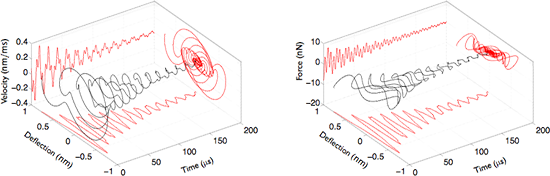
- energy dissipation is a fundamental aspect of the tip–sample interaction, allowing to quantify compositional contrast variations at the nanoscale [2]. The applied forces and the energy delivered to the sample are relevant for the imaging and the manipulation of soft materials in a variety of environments
- each flexural eigenmode upon impact. In the present work we build on that results to study in greater details the tip–sample force interactions separately for each mode and in particular the energy dissipation. Since the dissipative interactions are important in characterizing the compositional
- and third modes are not contact modes. This is proved by their frequency scaling, which is similar to that of free flexural modes and differs considerably from that of a pinned cantilever. For a discussion on this point we refer the reader to [5]. Energy dissipation The energy balance of each decaying


Challenges and complexities of multifrequency atomic force microscopy in liquid environments
Beilstein J. Nanotechnol. 2014, 5, 298–307, doi:10.3762/bjnano.5.33
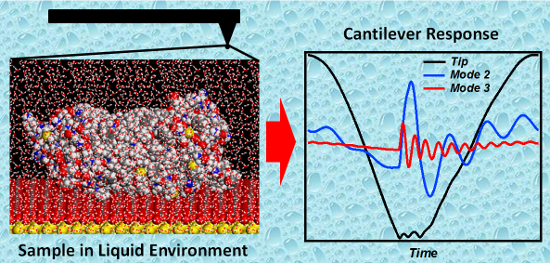
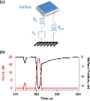
- cantilever are momentarily excited through the tip–sample impact (see Figure 1c), which is more prevalent for softer cantilevers than for harder ones. When this happens, the phase contrast does not map dissipation, but instead short-range conservative interaction variations. The phenomenon is called
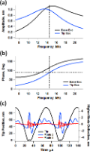
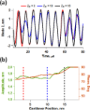
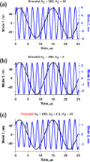
- change as tip–sample dissipation changes, leading to inaccurate readings. In frequency modulation operation this would cause the system to lock to a varying (non-constant) phase, which would render the results meaningless. Accurate measurements of this type with base-excited systems would only be
- level of tip–sample dissipation changes due to tip–sample interactions, such that the effective quality factor drops to 1.5, the phase will remain locked at the same value, but now the phase response of the system will follow a different curve (red dotted line). If one now follows the horizontal green




Effect of contaminations and surface preparation on the work function of single layer MoS2
Beilstein J. Nanotechnol. 2014, 5, 291–297, doi:10.3762/bjnano.5.32
- DFG in the framework of the Priority Program 1459 Graphene (O.O., N.S.), the SFB 616 Energy dissipation on surfaces (K.M., B.K.B.), and from the ERC under Grant No. 259286 (J.M.). We thank M. Freudenberg for graphics support.



Frequency, amplitude, and phase measurements in contact resonance atomic force microscopies
Beilstein J. Nanotechnol. 2014, 5, 278–288, doi:10.3762/bjnano.5.30
- using the tapping-mode (amplitude modulation) technique [13], within which variations in the phase contrast can be directly related to changes in energy dissipation [14][15]. Conservative and dissipative interactions are generally expressed in terms of the virial (Vts) and the dissipated power (Pts
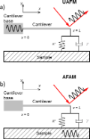
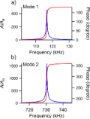
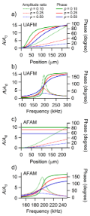
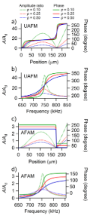
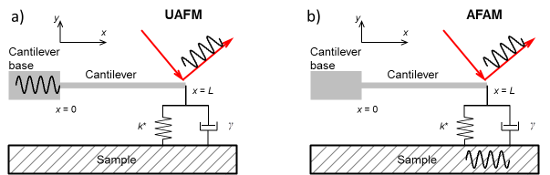
- use of their specific frequency dependences, both amplitude and phase are theoretically available for elastic modulus and dissipation measurements in both UAFM and AFAM configurations. a) UAFM configuration with a mechanical vibration applied to the base of the cantilever and signal detection at the