


Search results
Search for "nanostructure" in Full Text gives 366 result(s) in Beilstein Journal of Nanotechnology. Showing first 200.
Preparation and morphology-dependent wettability of porous alumina membranes
Beilstein J. Nanotechnol. 2018, 9, 1423–1436, doi:10.3762/bjnano.9.135
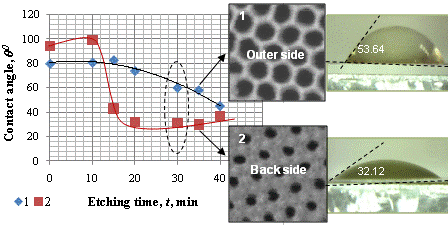
- , in oxalate electrolyte). The comparison of the wetting nature of the two surfaces of the PAM allows the contributions due to morphology and chemical properties to wetting of the nanostructure surface to be distinguished. It was shown that the etching method influences the surface morphology of the


The electrical conductivity of CNT/graphene composites: a new method for accelerating transmission function calculations
Beilstein J. Nanotechnol. 2018, 9, 1254–1262, doi:10.3762/bjnano.9.117
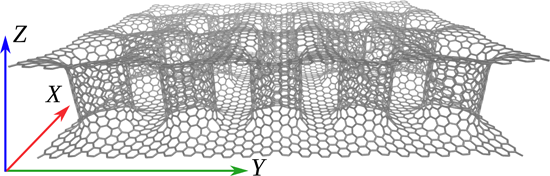
- of the nanostructure. However, in order to obtain a converged form of the averaged transmission function, it may be necessary to calculate it in a set of points in the reciprocal lattice, which is unattainable for a large number of atoms in the considered system. In this connection, the development


Heterostuctures of 4-(chloromethyl)phenyltrichlorosilane and 5,10,15,20-tetra(4-pyridyl)-21H,23H-porphine prepared on Si(111) using particle lithography: Nanoscale characterization of the main steps of nanopatterning
Beilstein J. Nanotechnol. 2018, 9, 1211–1219, doi:10.3762/bjnano.9.112
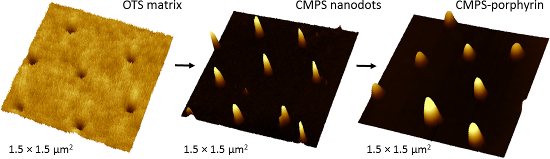
- . The center-to-center spacing of each nanostructure measures 500 nm which matches to the diameter of the original surface mask of Si spheres. The areas with CMPS have self-polymerized to form multilayer nanostructures. The OTS resist confines the multilayer polymerization of CMPS to form within the
- Supporting Information File 1, Figure S1) The nanostructures of CMPS also showed growth in lateral dimensions after the addition of porphyrin. A comparison of the nanostructure surface coverage was conducted to evaluate lateral growth of the nanostructures before and after porphyrin addition. The percentage
- lateral dimensions for CMPS nanodots, the growth was directed in the vertical direction to create taller nanostructures. However, the nanodot structures became taller and wider after reaction with H2TPyP to form heterostructures. This indicates that 3D growth takes place in the nanostructure assembly


Circular dichroism of chiral Majorana states
Beilstein J. Nanotechnol. 2018, 9, 1194–1199, doi:10.3762/bjnano.9.110
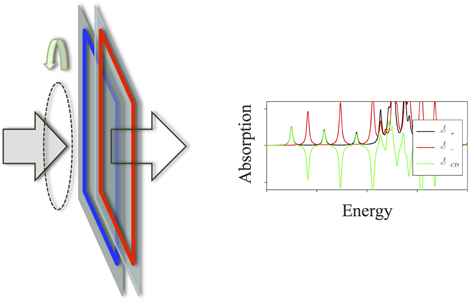
- along the nanostructure perimeter with the excitation operator. This rule is far less obvious than rule (a) and results from the approximately 1D character of the chiral edge modes and the interference induced by the propagation through corners. Indeed, we have seen that for active transitions within


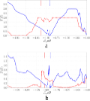
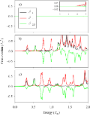
![[Graphic 14]](/bjnano/content/inline/2190-4286-9-110-i18.svg?max-width=637&scale=1.18182) . Panels a) and b) correspond to the phases in Figure 1d with one (ΔB = 2...
. Panels a) and b) correspond to the phases in Figure 1d with one (ΔB = 2...
![[Graphic 15]](/bjnano/content/inline/2190-4286-9-110-i19.svg?max-width=637&scale=1.18182) ,
, ![[Graphic 16]](/bjnano/content/inline/2190-4286-9-110-i20.svg?max-width=637&scale=1.18182) and
and ![[Graphic 17]](/bjnano/content/inline/2190-4286-9-110-i21.svg?max-width=637&scale=1.18182) defined in the main text. The shown results correspond to the spe...
defined in the main text. The shown results correspond to the spe...

![[Graphic 19]](/bjnano/content/inline/2190-4286-9-110-i23.svg?max-width=637&scale=1.18182) ,
, ![[Graphic 20]](/bjnano/content/inline/2190-4286-9-110-i24.svg?max-width=637&scale=1.18182) and
and ![[Graphic 21]](/bjnano/content/inline/2190-4286-9-110-i25.svg?max-width=637&scale=1.18182) for (a) a square of Lx = Ly = 20 LU), and for (b) a rectangle of L...
for (a) a square of Lx = Ly = 20 LU), and for (b) a rectangle of L...
Review on nanoparticles and nanostructured materials: history, sources, toxicity and regulations
Beilstein J. Nanotechnol. 2018, 9, 1050–1074, doi:10.3762/bjnano.9.98

- nanomaterial, it is referred to as nanofiber. Nanocomposite: Multiphase structure with at least one phase on the nanoscale dimension. Nanostructure: Composition of interconnected constituent parts in the nanoscale region. Nanostructured materials: Materials containing internal or surface nanostructure. The use
- most famous nanostructure property in plants is the superhydrophobicity in lotus leaves that helps in self-cleaning and super-wettability of the leaves [193]. Many studies in the literature have suggested that stacks of nanostructures are responsible for the circular layer in plants and insects which


Magnetic characterization of cobalt nanowires and square nanorings fabricated by focused electron beam induced deposition
Beilstein J. Nanotechnol. 2018, 9, 1040–1049, doi:10.3762/bjnano.9.97
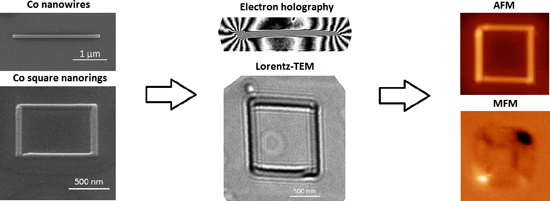
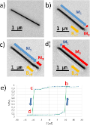
- promise for reliable, high-capacity and high-performance devices [7]. However, in all of the proposed applications, the stability of the magnetic state of the nanostructure depends on factors such as its composition, crystal structure and shape [8]. Co-based magnetic nanostructures can be deposited by
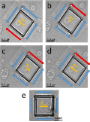
- coercivity is an important property in applications, as it ensures a stable magnetic state in such a nanostructure. The NWs presented here have a small enough diameter to behave in a single-domain-like manner. Higher coercivities could be achieved by depositing NWs with smaller widths. Lorentz TEM and MFM of
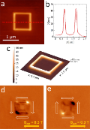
- surroundings. However, due to the low Co deposit amount in this halo, it does not affect the overall magnetization state of the nanostructure. The halo may at most slightly modify the coercivity of the nanostructures [45]. Conclusion Co NWs and square nanorings were deposited using FEBID from a Co carbonyl
Towards the third dimension in direct electron beam writing of silver
Beilstein J. Nanotechnol. 2018, 9, 842–849, doi:10.3762/bjnano.9.78
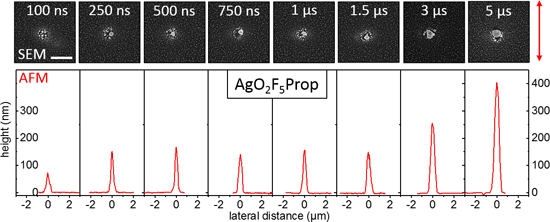
- correspond to the full width FW (99.9%) of the SE density [9][27] but exceed the typical nanostructure widths of 3D FEBID [1][3]. Interestingly, the halo diameter tends to increase for decreasing beam current. In view of the results presented in Figure 2, this is most probably caused by forward scattering
- through the nanostructure. The EDX spectra taken on the apex of the pillars are displayed in Figure 3d. The observed Si peak implies that the EDX spectrum from the primary electrons (tip apex) is superimposed by X-ray signals generated by forward scattered electrons (reaching the substrate). Neglecting


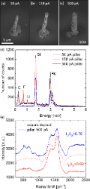
A review of carbon-based and non-carbon-based catalyst supports for the selective catalytic reduction of nitric oxide
Beilstein J. Nanotechnol. 2018, 9, 740–761, doi:10.3762/bjnano.9.68
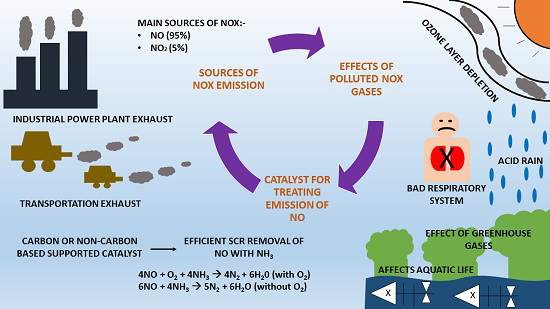
- an attractive catalyst support for SCR catalysts due to their electronic properties and unique nanostructure [71][72][73]. CNT-supported metal oxide catalysts are well-known in the adsorption field and present interesting properties for the denitrification of NOx species [74][75]. Ma et al. [56
Electron interactions with the heteronuclear carbonyl precursor H2FeRu3(CO)13 and comparison with HFeCo3(CO)12: from fundamental gas phase and surface science studies to focused electron beam induced deposition
Beilstein J. Nanotechnol. 2018, 9, 555–579, doi:10.3762/bjnano.9.53
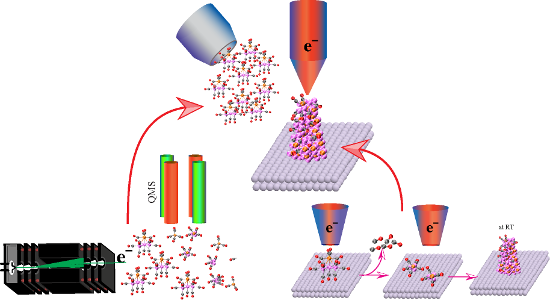
- ; focused electron beam induced deposition; heteronuclear FEBID precursors; surface science; Introduction Direct-write technologies using electron beams for nanostructure deposition can surpass the limitations of standard lithography techniques, such as the growth of three-dimensional nanostructures with
- such as magnetism at the nanoscale. Magnetic nanostructures are fundamental building blocks for applications in data storage and processing as well as the potential successor technologies based on magnonics [67] and spintronics [68] combined with high integration density relying on 3D nanostructure


Single-step process to improve the mechanical properties of carbon nanotube yarn
Beilstein J. Nanotechnol. 2018, 9, 545–554, doi:10.3762/bjnano.9.52
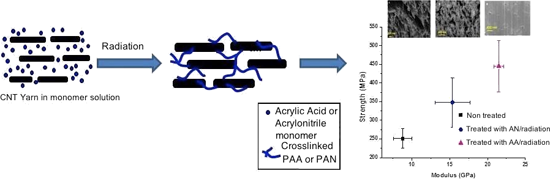
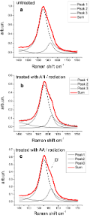
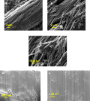
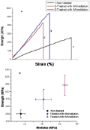
- high-performance carbon fibers. The reasons for the lower tensile strength compared to carbon fibers are believed to be defects and an inhomogeneous nanostructure, very weak interactions between CNTs, and the packing of CNT bundles [17][18]. It is still a challenge to develop a method that can produce




Green synthesis of fluorescent carbon dots from spices for in vitro imaging and tumour cell growth inhibition
Beilstein J. Nanotechnol. 2018, 9, 530–544, doi:10.3762/bjnano.9.51
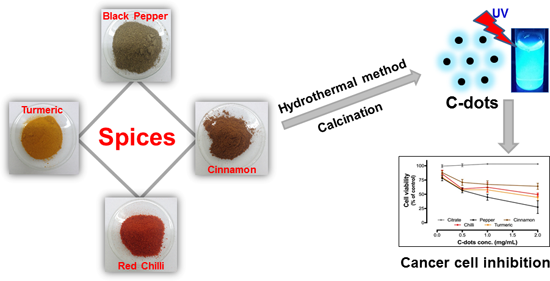
- %, respectively, whereas there was no significant growth inhibition to non-cancerous cells. Our preliminary results showed that this effect might be attributed to the presence of active molecules within the C-dot nanostructure, and more studies should be performed to understand the mechanism of action. Although
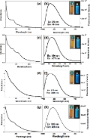


Sugarcane juice derived carbon dot–graphitic carbon nitride composites for bisphenol A degradation under sunlight irradiation
Beilstein J. Nanotechnol. 2018, 9, 353–363, doi:10.3762/bjnano.9.35
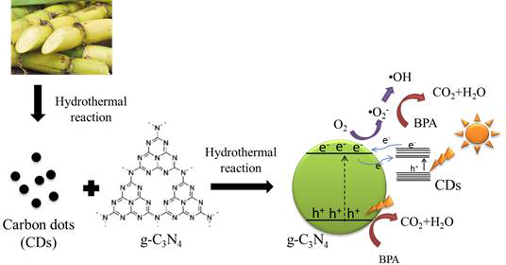
- great support to attach with CDs. After incorporating the CDs, the CD/g-C3N4 composites exhibited a more packed and agglomerated morphological nanostructure compared to that of pure g-C3N4. A similar observation was reported in our previous research [28], showing that the clustered effect was attributed


Review: Electrostatically actuated nanobeam-based nanoelectromechanical switches – materials solutions and operational conditions
Beilstein J. Nanotechnol. 2018, 9, 271–300, doi:10.3762/bjnano.9.29
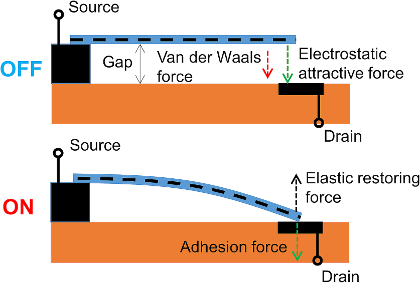
- continuum-based theories may occur. For instance, for cantilevered resonating nanostructures, continuum mechanics predictions fail when the cross-sectional area of the nanostructure is on the order of tens of lattice constants [3]. At this level, quantum effects, crystalline perfection, surface and
- contact area [8][10][11][54], observe the electrical breakdown mechanism for a single nanostructure [55][56][57][58], and investigate the dynamic processes occurring in the switch nanocontact [54]. The durability of a NEM switch strongly depends on the evolution of the contact between the switching
- [110]; (3) Young’s modulus shows almost no dependence on the diameter of metal nanowires, for example, for Au [111]. The change of the Young’s modulus can be explained by an increased influence of the surface atoms on the overall elastic behaviour of the nanostructure at sizes below a few nanometres


Dopant-stimulated growth of GaN nanotube-like nanostructures on Si(111) by molecular beam epitaxy
Beilstein J. Nanotechnol. 2018, 9, 146–154, doi:10.3762/bjnano.9.17
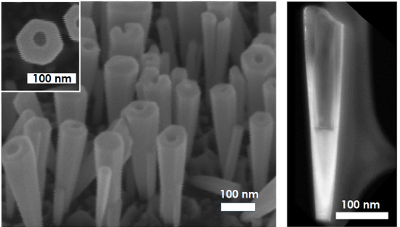
- the study, we introduce a new dopant-stimulated method for GaN nanotube-like nanostructure synthesis using a high-intensity Si flux. Transmission electron microscopy was used to investigate the morphological features of the GaN nanostructures. The synthesized structures have a hexagonal cross-section
- and possess high crystal quality. We propose a theoretical model of the novel nanostructure formation which includes the role of the dopant Si. Some of the Si-doped samples were studied with the photoluminescence (PL) technique. The analysis of the PL spectra shows that the highest value of donor
- efficiency of over 20% in such a simple SC [9]. The development of controllable methods of GaN nanostructure growth and doping on Si substrates opens up new possibilities for integration of III–V materials with established CMOS technology. The latter issue represents one of the bottlenecks of modern opto


Electron-driven and thermal chemistry during water-assisted purification of platinum nanomaterials generated by electron beam induced deposition
Beilstein J. Nanotechnol. 2018, 9, 77–90, doi:10.3762/bjnano.9.10
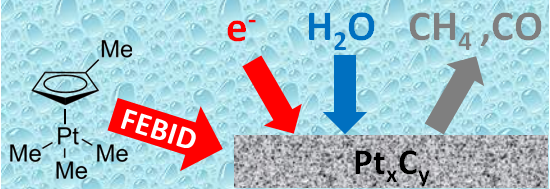
- deposition; nanostructure purification; platinum precursor; Introduction Focused electron beam induced deposition (FEBID) produces solid nanomaterials with size down to the sub-10 nm regime by decomposing precursor molecules adsorbed on a surface under a tightly focused high-energy electron beam [1
- obtain insight into some mechanistic aspects of the water-assisted purification process. Our results provide a fundament for the molecular understanding and rational control of FEBID nanostructure purification using water as process gas [12] with additional implications for the stability of the
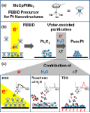
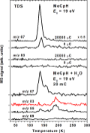
- precursor were thus deposited on the surface so that the resulting deposit had an estimated thickness in the range of a typical FEBID nanostructure [12]. This deposit was then used for a desorption experiment to study the reactions occuring during a water-assisted purification process (Figure 8). We note



Gas-sensing behaviour of ZnO/diamond nanostructures
Beilstein J. Nanotechnol. 2018, 9, 22–29, doi:10.3762/bjnano.9.4
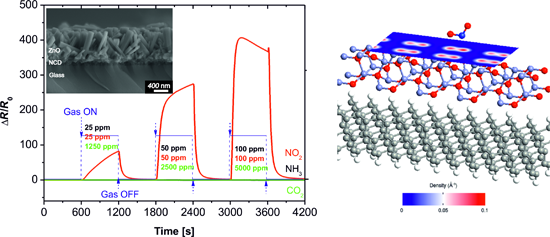
- cell electrodes, light emitting devices, quantum dots and gas sensors [5][6][7][8][9][10][11][12][13]. The improvement in response of metal-oxide sensors has been observed by several authors, due to the formation of isolated functional layers on the one-dimensional nanostructure surface using metal


Facile synthesis of silver/silver thiocyanate (Ag@AgSCN) plasmonic nanostructures with enhanced photocatalytic performance
Beilstein J. Nanotechnol. 2017, 8, 2781–2789, doi:10.3762/bjnano.8.277
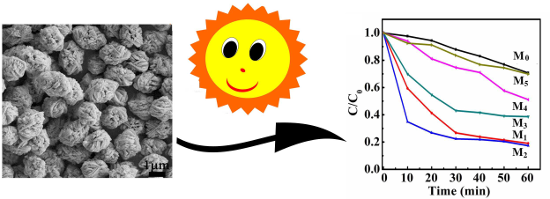
- 84% oxytetracycline was degraded in 60 min in the fifth cycle, and the efficiency was almost the same as for the first cycle. Further investigations revealed that after five cyclic experiments, the microstructure of Ag@AgSCN had no obvious changes except a somewhat smoother Ag@AgSCN nanostructure
- content of Ag in Ag@AgSCN nanostructures can be controlled by simply adjusting the irradiation time of the UV light. The catalytic performance of the nanostructure was evaluated by degradation of oxytetracycline under visible-light irradiation. The Ag@AgSCN nanostructures showed high photocatalytic
- -Elmer Lambda-35 UV–vis spectrometer. (a) XRD patterns of Ag@AgSCN nanostructures with different molar ratios of Ag to AgSCN. An (b) SEM image and (c) SAED pattern of the Ag@AgSCN nanostructure (sample M2). (a) UV–vis diffuse reflectance spectra of M0, M1, M2, M3, M4, M5. (b) Kubelka–Munk plots of M0 and


Enhanced photoelectrochemical water splitting performance using morphology-controlled BiVO4 with W doping
Beilstein J. Nanotechnol. 2017, 8, 2640–2647, doi:10.3762/bjnano.8.264
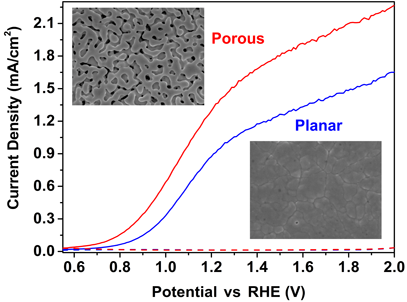
- % increase). Keywords: bismuth vanadate; charge separation; nanostructure; photoelectrochemical water splitting; Introduction Solar hydrogen generation is one of the most promising approaches to create clean energy and to overcome the environmental problems associated with use of conventional fossil fuels
- values of ηsep and ηinj of the planar and porous W-doped BiVO4 are shown in Figure 5b and 5c. ηsep at 1.23 V vs RHE of the planar and porous W-doped BiVO4 are, respectively, 41% and 47%, representing a 14% increase by the nanostructure formation. ηinj at 1.23 V vs RHE of the planar and porous W-doped
- BiVO4 are, respectively, 55% and 66%, corresponding to a 20% increase by the nanostructure formation. It has been reported that porous structures can shorten the hole diffusion distance to the surface and, thus, enhance the charge separation efficiency close to 60% at 1.23 V vs RHE [12]. Our finding is


Localized growth of carbon nanotubes via lithographic fabrication of metallic deposits
Beilstein J. Nanotechnol. 2017, 8, 2592–2605, doi:10.3762/bjnano.8.260
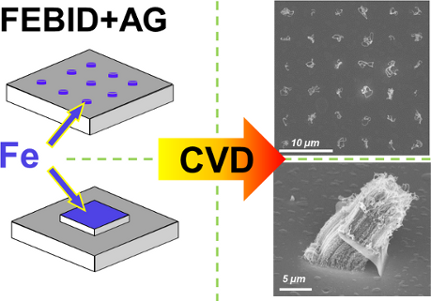
- , hindering the coalescence of Fe nanoparticles, resulting in more active sites for CNT nucleation [28][29][30]. A peculiar lift-up of the CNT nanostructure was also observed for the first time. Based on energy dispersive X-ray (EDX) spectroscopy and SEM data, the corresponding mechanism is also discussed
- directly contribute to the CNT growth for example by catalytic carbon source dissociation [30]. As depicted in Figure 6f, a spatially well-defined 4 × 4 µm2 CNT nanostructure with high density was synthesized, indicating the possibility to produce CNT forest structures by further exploring the experimental
- accelerating voltage in keV and ρ is the density of the detected sample. Considering the thickness of Fe nanostructure is approximately ≈30 nm, one can expect ≈1.6% Fe signal, which is below the detection limit of the method [45]. In additional experiments on other samples, the fabrication of CNT forests and

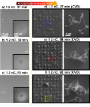
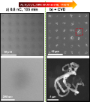


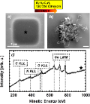

Direct writing of gold nanostructures with an electron beam: On the way to pure nanostructures by combining optimized deposition with oxygen-plasma treatment
Beilstein J. Nanotechnol. 2017, 8, 2530–2543, doi:10.3762/bjnano.8.253
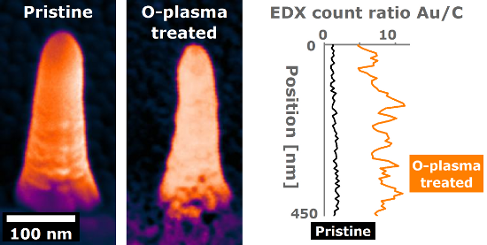
- and/or sufficiently long DT lead to an increase of the Au content in the deposits. However, setting too small PPS and too long DT drastically increased the total deposition time to a few hours, even for a relatively small planar nanostructure having an area of a few square micrometers. Thus the PPS
- the main planar nanostructure, with more material deposited in the SSA direction, clearly indicating a shadowing effect. This likely occurred due to scattering of primary electrons on already deposited material, which resulted with favoured generation of secondary electrons in front of the deposit (as
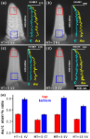
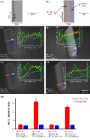
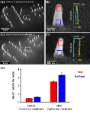
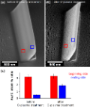
- , the shape of the deposit was largely preserved, but more importantly, the EDX analysis showed an increase in Au content throughout the nanostructure. The enhancement factor (EF) was considerably larger on the initially Au-poor, “end” side (EF ≈ 4), while the initially Au-rich “beginning” side saw only

Refractive index sensing and surface-enhanced Raman spectroscopy using silver–gold layered bimetallic plasmonic crystals
Beilstein J. Nanotechnol. 2017, 8, 2492–2503, doi:10.3762/bjnano.8.249
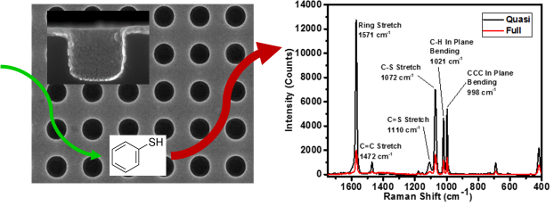
- a metal nanostructure (localized surface plasmons). The attributes of these excitations are highly sensitive to local refractive index changes, which in turn allow for their exploitation in chemical and biological sensing [7][8][9]. In this way, surface plasmonic resonance (SPR) sensors are
- frequencies. A ≈5 nm titanium dioxide adhesion layer was deposited using atomic layer deposition (Cambridge nanotech) on the embossed SOG nanostructure followed by deposition of a ≈50 nm metallic film (Au, Ag or both) via one of the various methods. Sputter deposition in a 5 mTorr argon atmosphere (AJA


Au nanostructure fabrication by pulsed laser deposition in open air: Influence of the deposition geometry
Beilstein J. Nanotechnol. 2017, 8, 2438–2445, doi:10.3762/bjnano.8.242
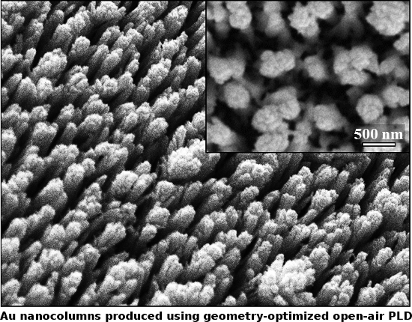
- water drop (Vd = 2 μL) with respect to the underlying substrate surface. Results and Discussion Nanostructure formation We present the general aspects of the nanostructure fabrication process using geometry 4 as an example, where the samples were deposited using a standard on-axis configuration
- procedure described in the Experimental section. The nanoparticles and aggregates produced in the ablated plasma led to the formation of a chain-like nanostructure on the substrate. SAED electron diffraction patterns of the nanostructure are also shown in Figure 1b. The interplanar distance from the main
- are arranged along the (111) reflection plane of Au, which possesses the lowest surface-free energy. This crystallite alignment leads to the chain-like nanostructure formation on the substrate, as shown in Figure 1b. The XPS analysis of the as-deposited Au nanostructure is presented in Figure 3. The


Comparing postdeposition reactions of electrons and radicals with Pt nanostructures created by focused electron beam induced deposition
Beilstein J. Nanotechnol. 2017, 8, 2410–2424, doi:10.3762/bjnano.8.240
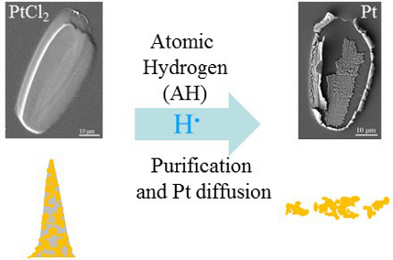
- demonstrated great potential in the field of nanostructure fabrication [1][2][3][4]. In FEBID, a volatile organometallic precursor is introduced into a vacuum chamber (typically a modified scanning electron microscope (SEM)) and irradiated by a focused electron beam [2][3]. The precursor decomposes under
- electron beam irradiation, with non-volatile product species being incorporated into the growing deposit. The size and shape of the nanostructure are controlled by manipulation of the electron beam (focusing ability and patterning capabilities), which allows an almost unlimited array of three-dimensional
- impact the shape integrity of the deposits by producing voids, cracks or other unwanted side effects [5][9][10][14][15]. An ideal purification strategy in FEBID is one that removes all of the organic impurities to leave behind a compact, high-fidelity metal nanostructure, whose shape is unchanged as




Increasing the stability of DNA nanostructure templates by atomic layer deposition of Al2O3 and its application in imprinting lithography
Beilstein J. Nanotechnol. 2017, 8, 2363–2375, doi:10.3762/bjnano.8.236
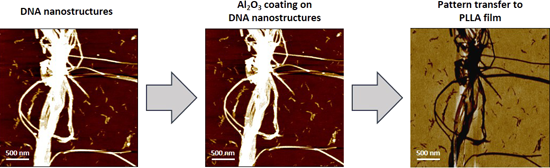
- Hyojeong Kim Kristin Arbutina Anqin Xu Haitao Liu Department of Chemistry, University of Pittsburgh, 219 Parkman Avenue, Pittsburgh, Pennsylvania 15260, United States of America 10.3762/bjnano.8.236 Abstract We present a method to increase the stability of DNA nanostructure templates through
- resistive to UV/O3 oxidation. The ALD-coated DNA templates were used for a direct pattern transfer to poly(L-lactic acid) films. Keywords: aluminium oxide (Al2O3); atomic layer deposition; DNA nanostructure; nanofabrication; nanoimprint lithography; pattern transfer; polymer stamp; replica molding
- ; Introduction In 1982, Seeman et al. first introduced the idea of utilizing DNA to build a mechanically robust nanostructure [1]. Since then, the field of structural DNA nanotechnology has evolved remarkably from immobile Holliday junctions to complex shapes fabricated from single-stranded tiles [2][3]. Through




Surfactant-induced enhancement of droplet adhesion in superhydrophobic soybean (Glycine max L.) leaves
Beilstein J. Nanotechnol. 2017, 8, 2345–2356, doi:10.3762/bjnano.8.234
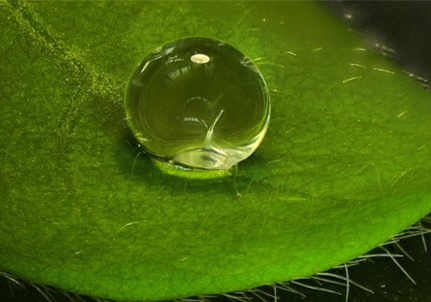
- and five variations of nonionic surfactants) have been investigated. The leaf surface structures show a hierarchical organization, built up by convex epidermal cells (microstructure) and superimposed epicuticular platelet-shaped wax crystals (micro- to nanostructure). Chemical analysis of the





