


Search results
Search for "nucleation" in Full Text gives 382 result(s) in Beilstein Journal of Nanotechnology. Showing first 200.
Review on nanoparticles and nanostructured materials: history, sources, toxicity and regulations
Beilstein J. Nanotechnol. 2018, 9, 1050–1074, doi:10.3762/bjnano.9.98

- the formation of Ag NPs along with possible nucleation mechanisms are presented in recent review articles [153][181][182][183][184]. This list assists in identifying the crucial factor that induces nanoparticle nucleation. This identification results in the preparation of nanometer-sized targeted


Fatigue crack growth characteristics of Fe and Ni under cyclic loading using a quasi-continuum method
Beilstein J. Nanotechnol. 2018, 9, 1000–1014, doi:10.3762/bjnano.9.93
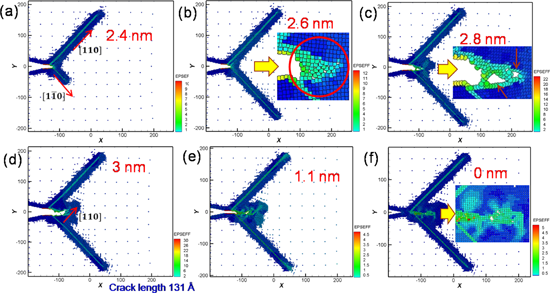
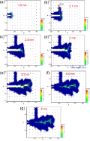
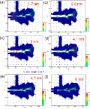
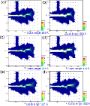
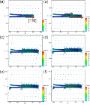
- . Zhang et al. have examined the effect of the phase boundary on the fatigue crack propagation in an α/β-iron biphasic system under cyclic tensile loading [13]. They found that the nucleation of new cracks typically appears at the phase boundary because of dislocation pile-ups. However, most of these









Effect of annealing treatments on CeO2 grown on TiN and Si substrates by atomic layer deposition
Beilstein J. Nanotechnol. 2018, 9, 890–899, doi:10.3762/bjnano.9.83
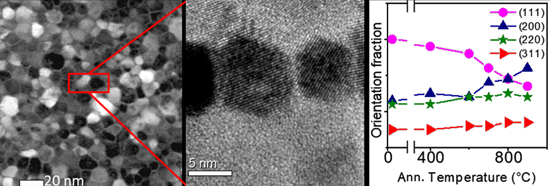
- depends also on the nature of the surface. Metallic surfaces offer less centers of nucleation for diketonate molecules, implying a further reduction of the complete surface coverage and leaving space between Ce atoms to be occupied by O atoms during the subsequent O3 pulse. The alternating presence of Ce
- study of the first deposition steps of CeO2 by thermal ALD upon different substrates is required to fully elucidate the mechanism of the growth and nucleation of CeO2, and possibly validate our proposed phenomenological model. A possible approach would be the study by dedicated in situ ALD growth at


Facile chemical routes to mesoporous silver substrates for SERS analysis
Beilstein J. Nanotechnol. 2018, 9, 880–889, doi:10.3762/bjnano.9.82
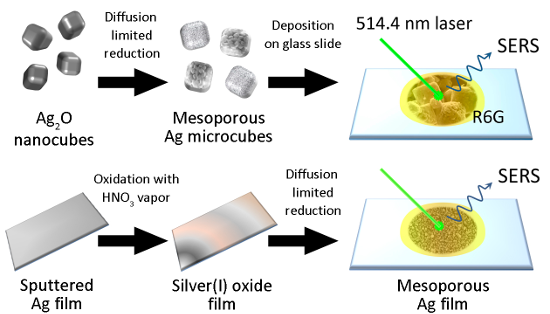
- role as surfactant, partly blocking the nucleation at (100) facets if the prevalent growth mechanism is normal or lateral layer-by-layer growth [28]. Presumably, the PVP adsorbates remained at the Ag2O crystallite surface after the washing procedure. Remarkably, the porous polyhedron-like silver


Dynamics and fragmentation mechanism of (C5H4CH3)Pt(CH3)3 on SiO2 surfaces
Beilstein J. Nanotechnol. 2018, 9, 711–720, doi:10.3762/bjnano.9.66
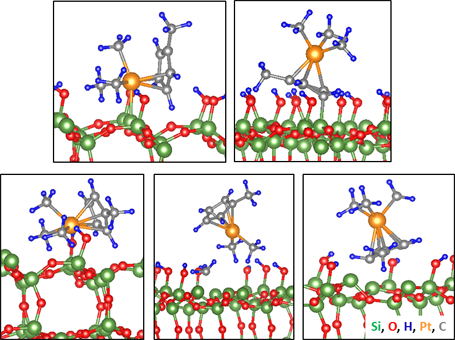
- fragmentation pathways qualitatively. In a recent investigation, thickness-controlled site-selective Pt deposits were obtained by direct atomic layer deposition (ALD) in which ALD was performed on EBID patterned substrates. In this ALD process, an O2 pulse is used to obtain better nucleation, even though the



Mechanistic insights into plasmonic photocatalysts in utilizing visible light
Beilstein J. Nanotechnol. 2018, 9, 628–648, doi:10.3762/bjnano.9.59
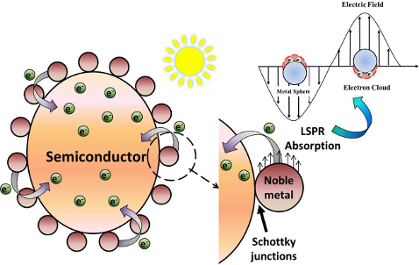
- were used to prepare Ag-ZnO nanostructures, in which both green extracts acted as a shape controllers and reducing agents of Ag+ to overcome the self-nucleation problem of Ag NPs [164][165]. Direct photocatalysis by plasmonic metals Plasmonic catalyst systems have almost exclusively focused on the





Colloidal solution of silver nanoparticles for label-free colorimetric sensing of ammonia in aqueous solutions
Beilstein J. Nanotechnol. 2018, 9, 499–507, doi:10.3762/bjnano.9.48
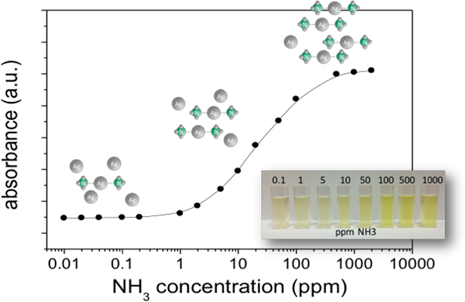
- nucleation rate (0 < a < 1), b is connected to the dimensionality of the growing particles (b can assume the values: 1, 2, and 3), and c is the growth rate in each dimension (c is either 0.5 or 1) [33][34][35]. It can be shown that Figure 6d report the experimental values as suggest by Equation 3: Y(t) as a
- function of log(t). In this way, the constants k and n can be obtained from the line intercept with the y-axis and the slope of the straight line (Table 2). Different NH3 concentrations give rise to different Ag nanoparticles agglomeration and nucleation rates. In particular, the rate of nucleation of the
- solutions, has the capability to control and stabilize the nanoparticles. In addition, as also observed by Nesakumar et al. the formation of the diamine silver complex increases the SPR absorbance of AgNPs in solutions containing ammonia, which increases the rate of nucleation [28]. Compared to literature



BN/Ag hybrid nanomaterials with petal-like surfaces as catalysts and antibacterial agents
Beilstein J. Nanotechnol. 2018, 9, 250–261, doi:10.3762/bjnano.9.27
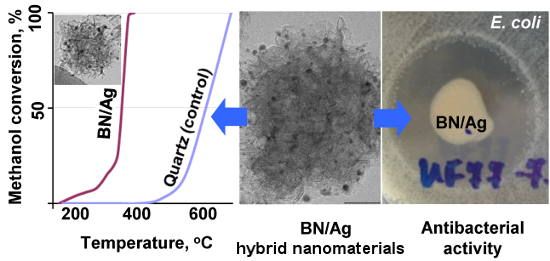
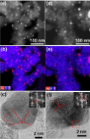
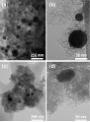
- furnace, as described elsewhere [43]. For the synthesis of BN/Ag HNMs, a piece of pure Ag foil was placed in the hot zone of the CVD reactor during BN NPs preparation. As a result, Ag vapors were simultaneously condensed along with the nucleation and growth of the BN NPs. This technique allows us to





Dopant-stimulated growth of GaN nanotube-like nanostructures on Si(111) by molecular beam epitaxy
Beilstein J. Nanotechnol. 2018, 9, 146–154, doi:10.3762/bjnano.9.17
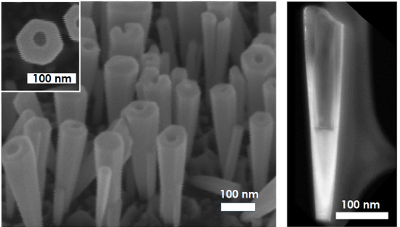
- nucleation and growth of NWs is played by growth species diffusion. We could thus conclude that Ga adatom kinetics on the substrate strongly depend on the surface layer chemistry and can be altered by the annealing procedure. We have also considered the volume of incorporated material in our experimental
- faster nucleation, though the material consumption is not notably affected. On the other hand, when the substrate temperature was 810 °С we observed a 60% reduction of material incorporation with a corresponding decrease in the elongation rate and surface density. An increase of the substrate temperature
- approaches, axial growth of GaN NWs at high growth temperature can be explained by the near zero nucleation barrier on the top polar facet of this wurtzite structure, in comparison to its nonpolar sidewalls [27][41]. Crystallization on the NW top facet starts earlier and reduces the Ga adatom concentration


Atomic layer deposition and properties of ZrO2/Fe2O3 thin films
Beilstein J. Nanotechnol. 2018, 9, 119–128, doi:10.3762/bjnano.9.14
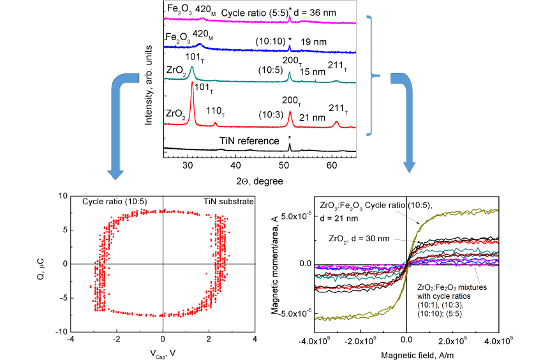
- composition in terms of the constituent metal ratio. Possibly, due to the different adsorption and nucleation rates of different metal precursors, the marked deviations in the chemical composition could not be avoided. One can also see that the oxide cycle ratio does not directly match with the cation ratio
- . This was actually expected because the nucleation of every oxide is slower with the growth rate retarded during the first few deposition cycles, and the content of metal deposited does not linearly correspond to the amount of additive cycles at the early stages of the growth. The nonlinearity of the
- film and TiN electrode layer is distinguishable; the film is dense and the crystal growth has started immediately together with the nucleation process. The TEM image proves the formation of a stacked layer structure. Electrical and magnetic properties Most samples exhibited charge polarization, as


Comparative study of post-growth annealing of Cu(hfac)2, Co2(CO)8 and Me2Au(acac) metal precursors deposited by FEBID
Beilstein J. Nanotechnol. 2018, 9, 91–101, doi:10.3762/bjnano.9.11
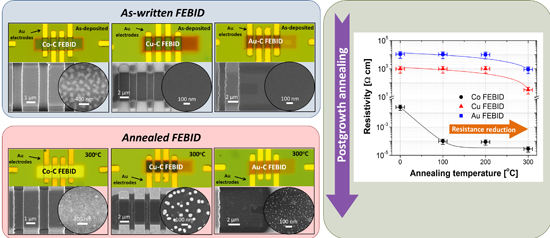
- procedure efficiently removes the carbon matrix allowing for the nucleation of pure Au grains with (d) around 16 nm average size and 23 nm dispersion. Summary of the atomic composition of the deposits measured by EDX within ± 2 atom % error. Property summary of the as-grown and 300 °C annealed FEBID


Growth model and structure evolution of Ag layers deposited on Ge films
Beilstein J. Nanotechnol. 2018, 9, 66–76, doi:10.3762/bjnano.9.9
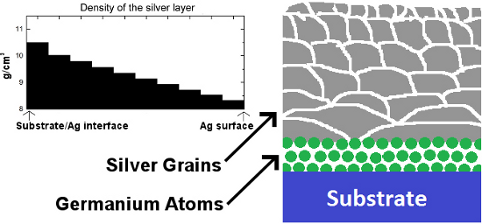
- conditions [18] and with a Ge nucleation film, they are smoother than layers of similar thickness deposited directly on glass [19] and have significantly lower mean grain size [20]. The reduction of scattering losses due to a temporary decrease of RMS roughness to 0.2 nm was reported for an e-beam evaporated
- 10 nm Ag layer on a sapphire substrate at room temperature with a 1 nm germanium wetting film [18]. Recently, it was observed that the germanium atoms, which form the nucleation film, efficiently segregate [21] through the silver structure towards the surface [22][23], which results in additional
- 3a) the density decreases from 10.5 g/cm3 (which is the density of a bulk silver) at the SiO2/Ag interface to 8.5 g/cm3 at the Ag/LiF interface. This indicates a high non-uniformity in the sizes and shapes of the grains and the varying number of voids. Since germanium serves as a nucleation film for




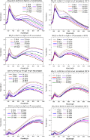


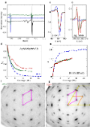
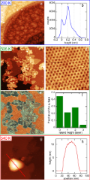
Transition from silicene monolayer to thin Si films on Ag(111): comparison between experimental data and Monte Carlo simulation
Beilstein J. Nanotechnol. 2018, 9, 48–56, doi:10.3762/bjnano.9.7
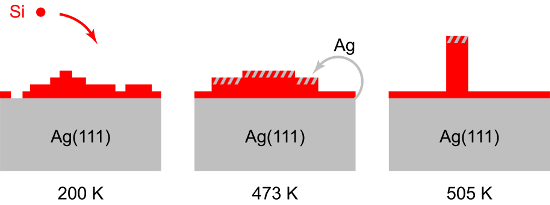
- diffusing when it nucleates. In the frame of multilayer silicene growth, above the monolayer, nucleation gives rise to the growth of successive terraces. In the frame of silicon growth mediated by surfactant Ag atoms, the nucleation above the Si monolayer is treated differently, as it gives rise to the
- formation of thick Si islands with an additional layer corresponding to the Ag–Si HCT reconstruction on top of the island. In that case, nucleation of an atom on the monolayer results in the growth of an island of height hmin, covering a fraction δθ of the surface, by conversion of a fraction δθ(hmin + 0.5

Facile synthesis of silver/silver thiocyanate (Ag@AgSCN) plasmonic nanostructures with enhanced photocatalytic performance
Beilstein J. Nanotechnol. 2017, 8, 2781–2789, doi:10.3762/bjnano.8.277
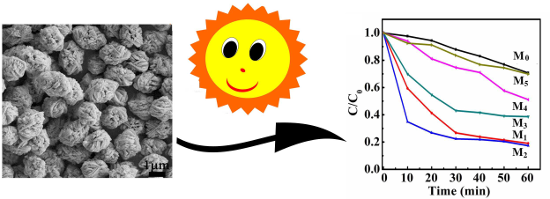
- addition of the AgNO3 solution finished and the homogeneous nucleation stopped due to the decrease in concentration of the Ag(I) ions. Then, the heterogeneous nucleation on the nanoplate surface occurred and some small nanoplates gradually filled in the crisscross gap of the star-shaped Ag@AgSCN


One-step chemical vapor deposition synthesis and supercapacitor performance of nitrogen-doped porous carbon–carbon nanotube hybrids
Beilstein J. Nanotechnol. 2017, 8, 2669–2679, doi:10.3762/bjnano.8.267
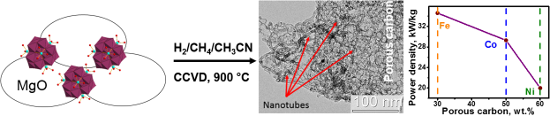
- particles. The nucleation and growth of CNTs typically require stabilization of the catalytic nanoparticles at elevated temperatures, and MgO is often used for this purpose [18]. Rümmeli et al. have shown that under typical CCVD conditions for CNT growth and in the absence of a deposited catalyst, the MgO


The role of ligands in coinage-metal nanoparticles for electronics
Beilstein J. Nanotechnol. 2017, 8, 2625–2639, doi:10.3762/bjnano.8.263
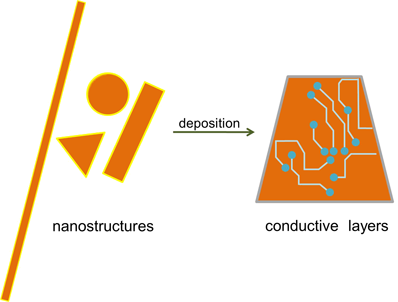
- initial nucleation processes of particle synthesis; this is probably the mechanism of the formation of ultrathin gold nanowires [64]. Silver nanoparticle synthesis by reduction of silver salts is an important case of ligand-directed nanoparticle growth. Cetyltrimethylammonium bromide (CTAB, Figure 2) in


Localized growth of carbon nanotubes via lithographic fabrication of metallic deposits
Beilstein J. Nanotechnol. 2017, 8, 2592–2605, doi:10.3762/bjnano.8.260
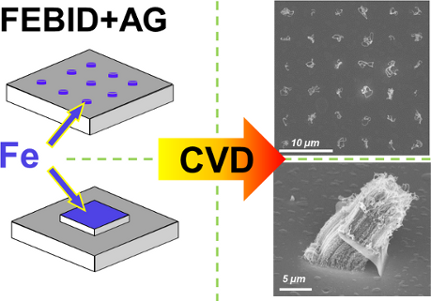
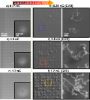
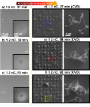
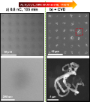
- , hindering the coalescence of Fe nanoparticles, resulting in more active sites for CNT nucleation [28][29][30]. A peculiar lift-up of the CNT nanostructure was also observed for the first time. Based on energy dispersive X-ray (EDX) spectroscopy and SEM data, the corresponding mechanism is also discussed




PTFE-based microreactor system for the continuous synthesis of full-visible-spectrum emitting cesium lead halide perovskite nanocrystals
Beilstein J. Nanotechnol. 2017, 8, 2521–2529, doi:10.3762/bjnano.8.252
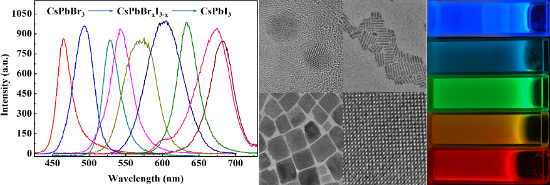
- 600 μm inner diameter and a thermally controlled oil bath. A miniature PTFE chamber containing a magnetic stir bar was used for the mixing of two different precursors. The volume of the convection micro-mixer was 80 μL, and the micro-mixer was used to completely mix the precursors for the nucleation
- of CsPbX3 QDs. A three-dimensional serpentine microchannel was constructed by interlacing a PTFE capillary (600 μm inner diameter) along two parallel metal bars (800 μm outer diameter). The PTFE capillaries were used as the microreactor and microchannels. Further nucleation and growth of the CsPbX3


Synthesis of metal-fluoride nanoparticles supported on thermally reduced graphite oxide
Beilstein J. Nanotechnol. 2017, 8, 2474–2483, doi:10.3762/bjnano.8.247
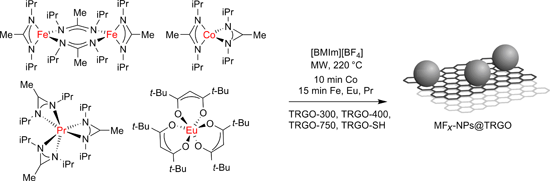
- reactive sites for the nucleation and growth of metal nanoparticles. The nucleation and growth mechanism depends on the degree of oxygen functionalization at the graphene surface sheets, such that no nanoparticles are obtained at totally reduced graphene surfaces [7][79]. TRGO is generally regarded as a


Laser-assisted fabrication of gold nanoparticle-composed structures embedded in borosilicate glass
Beilstein J. Nanotechnol. 2017, 8, 2454–2463, doi:10.3762/bjnano.8.244
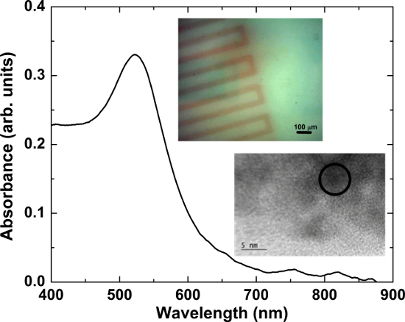
- . Increasing the laser fluence or the number of the laser pulses increases the defect volume density. Since the formation of nanoparticles was only observed after annealing in the irradiated areas, one could assume that these defects play a key role in nanoparticle nucleation. It is accepted [16][17] that the


Comparing postdeposition reactions of electrons and radicals with Pt nanostructures created by focused electron beam induced deposition
Beilstein J. Nanotechnol. 2017, 8, 2410–2424, doi:10.3762/bjnano.8.240
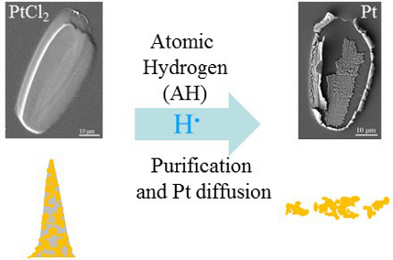
- measured by EDS. The Pt atoms in this region could be less susceptible to the effects of subsequent AH exposure, possibly due to Pt nucleation and coalescence in the electron beam purification step and/or a decrease in local heating from the exothermicity of the AH purification step (which would enhance




Electron beam induced deposition of silacyclohexane and dichlorosilacyclohexane: the role of dissociative ionization and dissociative electron attachment in the deposition process
Beilstein J. Nanotechnol. 2017, 8, 2376–2388, doi:10.3762/bjnano.8.237
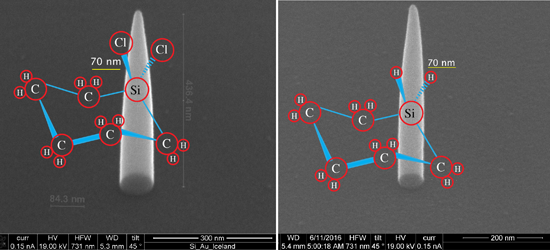
- that the significantly larger oxygen content in the deposits formed from DCSCH is the result of hydrolysis in reactions with residual water in the background gas and at the surfaces. In EBID pillar growth one can distinguish three stages: the nucleation stage, a fast-growth stage and a saturation stage
- [4][40]. In the nucleation stage a dot-like deposit will form, predominantly due to the scattered electrons emitted from the substrate surface. In the fast-growth stage, a cone shaped pillar grows with maximum lateral and vertical growth rate. During the fast growth stage, the growth is enhanced by





Tailoring the nanoscale morphology of HKUST-1 thin films via codeposition and seeded growth
Beilstein J. Nanotechnol. 2017, 8, 2307–2314, doi:10.3762/bjnano.8.230
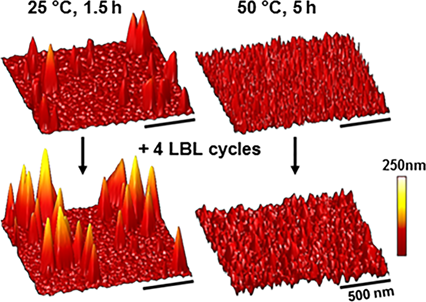
- crystallite nucleation and ripening) that was observed for the LBL deposition was not observed in the same manner for the codeposition. Throughout the codeposition procedure, a dynamic process was observed at the substrate interface. Large particles initially formed on the substrate, followed by the increased


Ta2N3 nanocrystals grown in Al2O3 thin layers
Beilstein J. Nanotechnol. 2017, 8, 2162–2170, doi:10.3762/bjnano.8.215
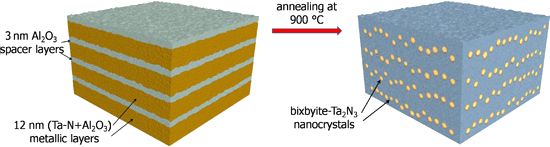
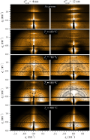
- components in the metallic layers, that is, the nucleation and growth of Ta-based NPs. At 600 °C, the GISAXS signal is weak due to a low density contrast between the initially formed Ta clusters and the surrounding media, which is presumably still rich in tantalum. The GISAXS signal increases in intensity


Synthesis and characterization of noble metal–titania core–shell nanostructures with tunable shell thickness
Beilstein J. Nanotechnol. 2017, 8, 2083–2093, doi:10.3762/bjnano.8.208
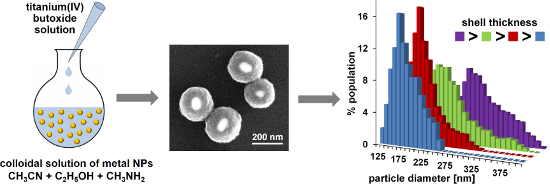
- water and acetone several times. Gold colloids Gold colloids were prepared using the Frens method. 100 mL of 0.01% (w/w) aqueous HAuCl4 solution were heated to boiling point and 0.6 mL of 1% (w/w) of sodium citrate solution were added. In ca. 2 min the boiling solution turned blue (nucleation) and after





