Search results
Search for "scales" in Full Text gives 403 result(s) in Beilstein Journal of Nanotechnology. Showing first 200.
Formation mechanisms of boron oxide films fabricated by large-area electron beam-induced deposition of trimethyl borate
Beilstein J. Nanotechnol. 2018, 9, 1282–1287, doi:10.3762/bjnano.9.120
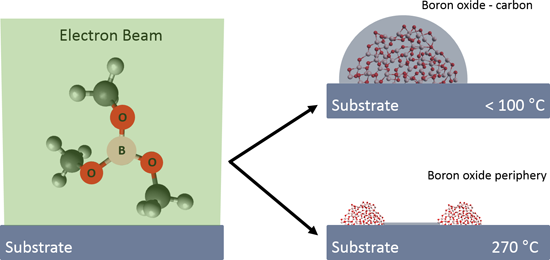
- , 6.3 Pa precursor pressure, 2 keV electron energy, 32 electrons·Å−2·s−1 maximum electron flux) reveals that conventional descriptions of EBID deposition kinetics apply to these larger scales [27]. Therefore, recipes developed for nanoscale fabrication can be upscaled without the need for intensive



Atomistic modeling of tribological properties of Pd and Al nanoparticles on a graphene surface
Beilstein J. Nanotechnol. 2018, 9, 1239–1246, doi:10.3762/bjnano.9.115
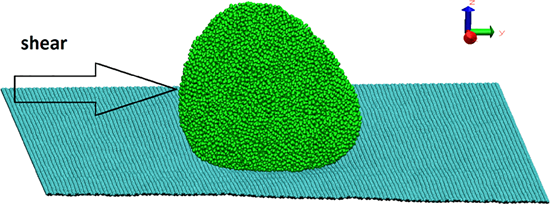
- of interfacial processes, they are limited to much shorter spatial and temporal length scales than in most experiments. Recent experimental and computer simulation studies of static and sliding friction of metallic nanoparticles have focused on the dependence of friction on the particle size
- may result from the different sizes of the contact area, namely 103–105 nm2 in experiments versus ca. 10 nm2 in our simulations, and different interaction potentials, and different length and time scales. The contact area in [10][11] is determined, as in experiments, on the basis of the lateral sizes


Heterostuctures of 4-(chloromethyl)phenyltrichlorosilane and 5,10,15,20-tetra(4-pyridyl)-21H,23H-porphine prepared on Si(111) using particle lithography: Nanoscale characterization of the main steps of nanopatterning
Beilstein J. Nanotechnol. 2018, 9, 1211–1219, doi:10.3762/bjnano.9.112
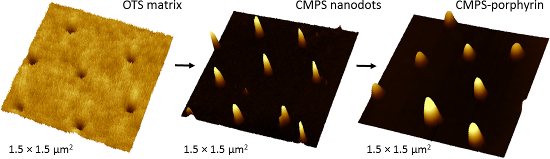
- the points of contact between the surface and the base of the Si spheres of the surface mask. The spheres protect small local areas from assembly of OTS. There are ≈40 nanoholes in Figure 2a, which scales to a surface density of 108 nanoholes per cm2. Differences in tip–sample interactions are


Circular dichroism of chiral Majorana states
Beilstein J. Nanotechnol. 2018, 9, 1194–1199, doi:10.3762/bjnano.9.110
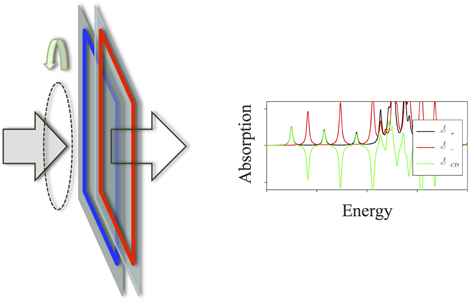
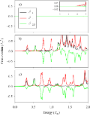
- in Figure 3 for selected values of ΔB. They correspond to zero (Figure 3a), one (Figure 3b) and two (Figure 3c) chiral bands. As anticipated, in presence of the chiral states the system develops a clear CD. For the sake of a better comparison, identical scales have been used in the three panels of
- Figure 3. In these scales, the two absorptions and the CD essentially vanish in the absence of chiral modes (Figure 3a). The rightmost inset in panel Figure 3a shows that for energies exceeding the quasiparticle gap a small absorption eventually appears due to transitions between bulk states (cf. Figure


![[Graphic 14]](/bjnano/content/inline/2190-4286-9-110-i18.svg?max-width=637&scale=1.18182) . Panels a) and b) correspond to the phases in Figure 1d with one (ΔB = 2...
. Panels a) and b) correspond to the phases in Figure 1d with one (ΔB = 2...
![[Graphic 15]](/bjnano/content/inline/2190-4286-9-110-i19.svg?max-width=637&scale=1.18182) ,
, ![[Graphic 16]](/bjnano/content/inline/2190-4286-9-110-i20.svg?max-width=637&scale=1.18182) and
and ![[Graphic 17]](/bjnano/content/inline/2190-4286-9-110-i21.svg?max-width=637&scale=1.18182) defined in the main text. The shown results correspond to the spe...
defined in the main text. The shown results correspond to the spe...

![[Graphic 19]](/bjnano/content/inline/2190-4286-9-110-i23.svg?max-width=637&scale=1.18182) ,
, ![[Graphic 20]](/bjnano/content/inline/2190-4286-9-110-i24.svg?max-width=637&scale=1.18182) and
and ![[Graphic 21]](/bjnano/content/inline/2190-4286-9-110-i25.svg?max-width=637&scale=1.18182) for (a) a square of Lx = Ly = 20 LU), and for (b) a rectangle of L...
for (a) a square of Lx = Ly = 20 LU), and for (b) a rectangle of L...
Field-controlled ultrafast magnetization dynamics in two-dimensional nanoscale ferromagnetic antidot arrays
Beilstein J. Nanotechnol. 2018, 9, 1123–1134, doi:10.3762/bjnano.9.104
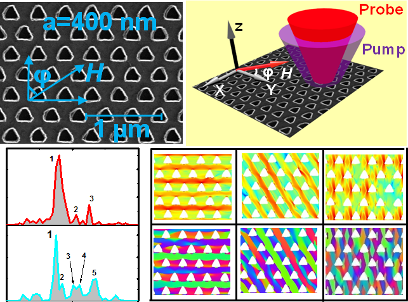
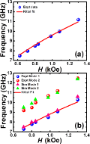
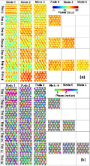
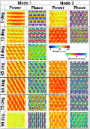
- nm, arranged in hexagonal lattice with varying lattice constants, (a) a = 400 nm, b = 360 nm and (b) a = 700 nm, b = 560 nm. The lattice constants are shown in the micrographs along with the length scales. The unit cell is marked inside the lattice. The horizontal and diagonal channels for spin-wave



A simple extension of the commonly used fitting equation for oscillatory structural forces in case of silica nanoparticle suspensions
Beilstein J. Nanotechnol. 2018, 9, 1095–1107, doi:10.3762/bjnano.9.101
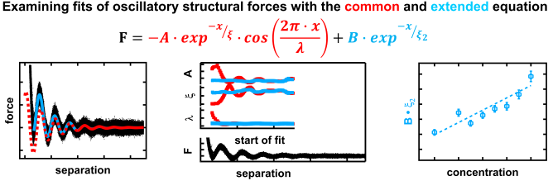
- the particles in confinement is solely dependent on the particle concentration of the suspension. Several publications in the past claimed that for charged particles the period scales with 2(R + κ−1) including the particle radius R. The Debye length κ−1 is calculated from the ion concentration induced


Review on nanoparticles and nanostructured materials: history, sources, toxicity and regulations
Beilstein J. Nanotechnol. 2018, 9, 1050–1074, doi:10.3762/bjnano.9.98

- with the extracellular matrix (ECM) within the stem cells includes influential stem cell behavior through sources of passive mechanical force. A wide structural protein spectrum and polysaccharides of different length scales with dominating nanometer-sized collagen fibrils strands of 35–60 nm diameter


Comparative study of antibacterial properties of polystyrene films with TiOx and Cu nanoparticles fabricated using cluster beam technique
Beilstein J. Nanotechnol. 2018, 9, 861–869, doi:10.3762/bjnano.9.80
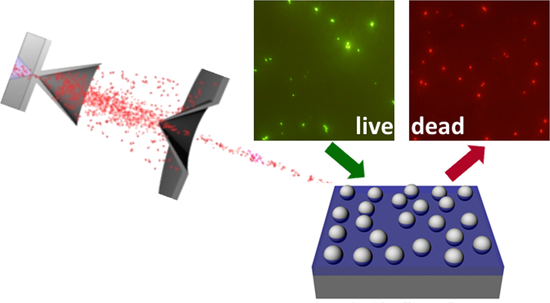
- the Cu clusters are size-selected prior the deposition (see Experimental section). The annealing leads to the immersion of NPs into PS by about 30–50% of their diameter as can be seen in Figure 1b while comparing the height scales in panels (a) and (b). These images are given just for the illustration




Mechanistic insights into plasmonic photocatalysts in utilizing visible light
Beilstein J. Nanotechnol. 2018, 9, 628–648, doi:10.3762/bjnano.9.59
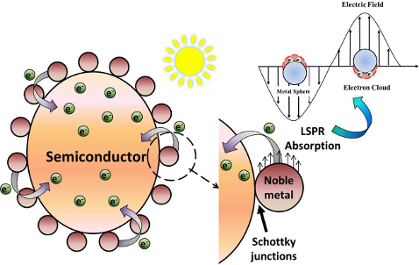
- nanoarchitectures with underlying mechanisms. For example, the velvet black scales on snake skins have been shown to demonstrate four times better absorbance than other scales in the UV–NIR spectrum range due to their hierarchical pattern of leaf-like microstructures with nanoridges [150]. In other case, the
- geometry of the scales of a butterfly promote a light trapping effect from the UV to NIR range, which significantly increases the light absorption compared to a non-patterned system [149]. These works inspired the combination of bismuth vanadate (BiVO4) with the 3D architecture design of a butterfly wing





Anchoring Fe3O4 nanoparticles in a reduced graphene oxide aerogel matrix via polydopamine coating
Beilstein J. Nanotechnol. 2018, 9, 591–601, doi:10.3762/bjnano.9.55
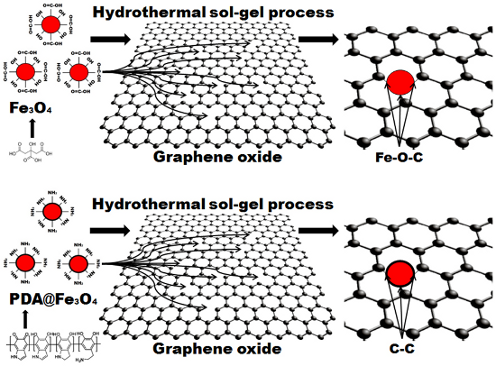
- -Fe3O4 and rGO-PDA@Fe3O4 aerogel samples. FTIR absorption (a) and XPS survey (b) spectra of rGO, rGO-Fe3O4 and rGO-PDA@Fe3O4 aerogel samples. XPS C 1s, O 1s, N 1s and Fe 2p spectra of rGO, rGO-Fe3O4 and rGO-PDA@Fe3O4 aerogel samples. The intensity scales are the same for respective elements (in order to


Lyapunov estimation for high-speed demodulation in multifrequency atomic force microscopy
Beilstein J. Nanotechnol. 2018, 9, 490–498, doi:10.3762/bjnano.9.47
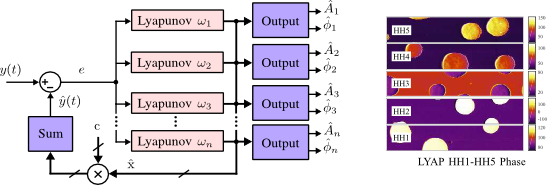
- modeled. This reduces its realizable performance through limitations of the sample rate. An estimator in the form of a Lyapunov filter [25] was demonstrated to perform similarly to the Kalman filter [26]. However, the Lyapunov filter complexity scales significantly better than the Kalman filter when





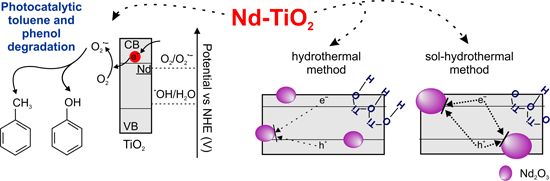
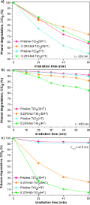
Influence of the preparation method on the photocatalytic activity of Nd-modified TiO2
Beilstein J. Nanotechnol. 2018, 9, 447–459, doi:10.3762/bjnano.9.43
- spectra were recorded on PHI 5000 VersaProbe (ULVAC-PHI) spectrometer with monochromatic Al Kα radiation (hν = 1486.6 eV). The binding energy (BE) scales of all detected HR spectra were calibrated by centering the aliphatic carbon peak (C–C) at 284.8 eV. Measurement of photocatalytic activity The




Electron interaction with copper(II) carboxylate compounds
Beilstein J. Nanotechnol. 2018, 9, 384–398, doi:10.3762/bjnano.9.38
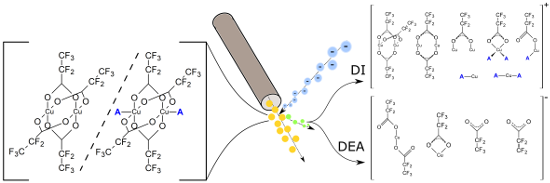
- latter, reactive chemical species (radicals) and electrons lead to activation of molecules and this process can be controlled well on large scales. One of the most innovative techniques, known as EBID or FEBID (Focused Electron Beam Induced Deposition) [2][3], uses a high energy electron beam that can be


Periodic structures on liquid-phase smectic A, nematic and isotropic free surfaces
Beilstein J. Nanotechnol. 2018, 9, 342–352, doi:10.3762/bjnano.9.34
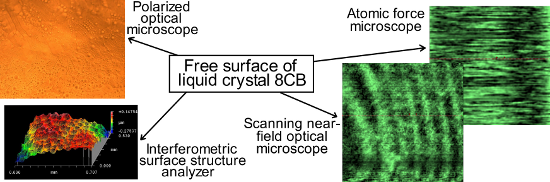
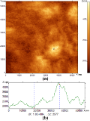
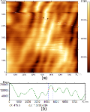
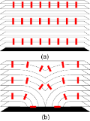
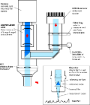
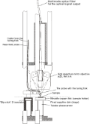
- substrate a) without a material; b) a 3D reconstruction of the display with a very thin LC film. Schematic diagram of the CryoSNOM produced by CDP System Corp. (http://www.cdpsystems.com/moscan.html). SEM photo of the SNOM probe in the topographical regime, where the scales represent Al metallization









Design of polar self-assembling lactic acid derivatives possessing submicrometre helical pitch
Beilstein J. Nanotechnol. 2018, 9, 333–341, doi:10.3762/bjnano.9.33
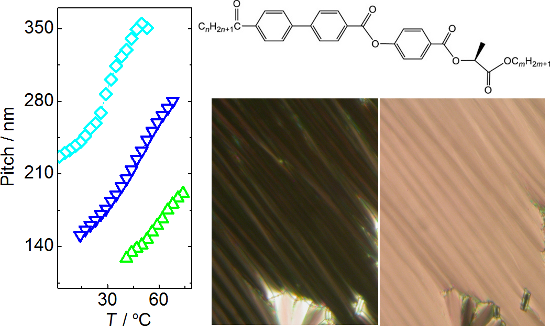
- liquid crystalline (LC) mesophases (e.g., layered structure on nanoscale) belongs to one of the most exciting but special groups of such smart self-organized organic materials [1][2][6]. These advanced materials are able to self-assemble at nanoscopic and mesoscopic length scales; the intermolecular


The nanofluidic confinement apparatus: studying confinement-dependent nanoparticle behavior and diffusion
Beilstein J. Nanotechnol. 2018, 9, 301–310, doi:10.3762/bjnano.9.30
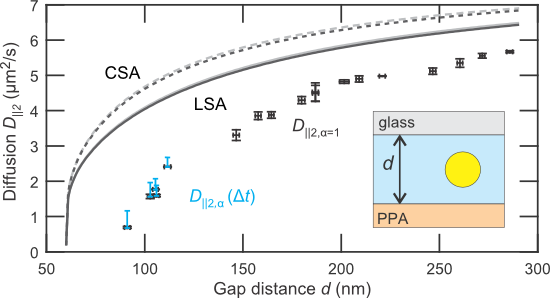
- 100 nm. This distance range interferes with several natural length scales of particle–surface interactions [8], such as the electrostatic interactions. The electrostatic interactions between charged objects and surfaces in a nanofluidic system decay approximately exponentially with separation and a



Combined scanning probe electronic and thermal characterization of an indium arsenide nanowire
Beilstein J. Nanotechnol. 2018, 9, 129–136, doi:10.3762/bjnano.9.15
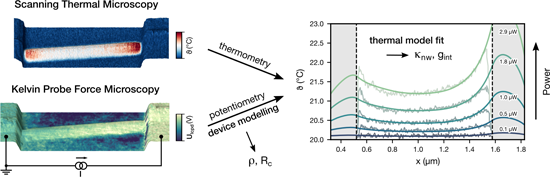
- need for characterization techniques able to map both electronic and thermal properties down to the relevant length scales in operating devices. Unlike optical techniques that are limited by diffraction to a resolution of several hundred nanometres, scanning probe methods rely on the interaction of a


Material discrimination and mixture ratio estimation in nanocomposites via harmonic atomic force microscopy
Beilstein J. Nanotechnol. 2017, 8, 2771–2780, doi:10.3762/bjnano.8.276
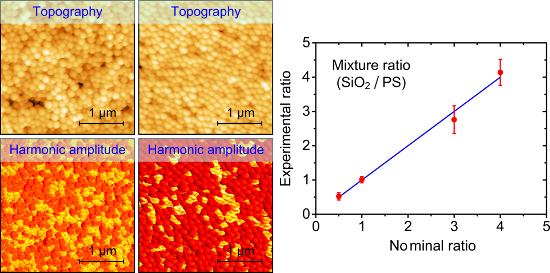
- tapping mode AFM, the contact force and contact time per oscillation period dominate the harmonic signals [27]. These two quantities are assumed to be related to the amplitude set-point. It is well known that the peak force in tapping mode scales with the amplitude feedback settings [28]. However, the
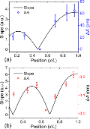
- frequencies roughly scales with the mode shape slope. A laser spot located at the free end can enhance the harmonic signals compared with other locations. Furthermore, positioning a laser spot on the eigenmode slope nodes should be avoided because the harmonic amplitudes will reach to near zero and show




Dry adhesives from carbon nanofibers grown in an open ethanol flame
Beilstein J. Nanotechnol. 2017, 8, 2719–2728, doi:10.3762/bjnano.8.271
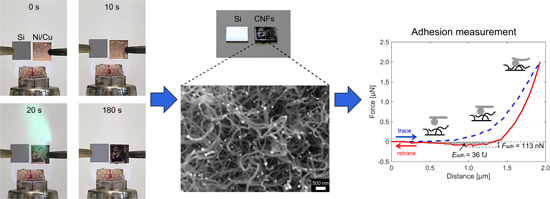
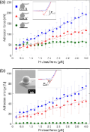
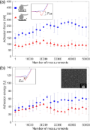
- be, however, a good starting point for the fabrication of CNFs on larger scales with the same chemical process but under more defined conditions. Finally, we think that the presented approach is especially useful for educational purposes, because it does not need an elaborate set-up. Schematic setup


Patterning of supported gold monolayers via chemical lift-off lithography
Beilstein J. Nanotechnol. 2017, 8, 2648–2661, doi:10.3762/bjnano.8.265
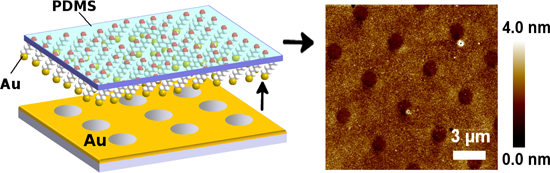
- during chemical lift-off lithography is a scarcely studied hybrid material. We show that these Au–alkanethiolate layers on poly(dimethylsiloxane) (PDMS) are transparent, functional, hybrid interfaces that can be patterned over nanometer, micrometer, and millimeter length scales. Unlike other ultrathin Au


Interface conditions of roughness-induced superoleophilic and superoleophobic surfaces immersed in hexadecane and ethylene glycol
Beilstein J. Nanotechnol. 2017, 8, 2504–2514, doi:10.3762/bjnano.8.250
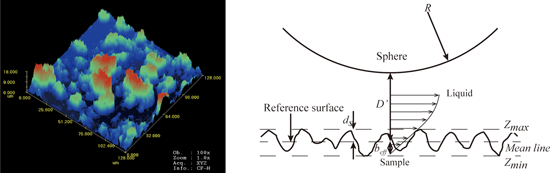
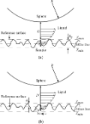
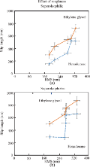
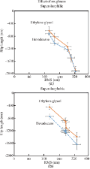
- degrees of roughness, and demonstrated that surface roughness at different length scales seems to influence the additional slippage. Kunert and Harting [20] investigated the problem of roughness-induced slip by means of lattice Boltzmann (LB) simulations and measured the slip length on a randomly generated
- , the scale effect of roughness influences the values of boundary slip. Surfaces at different scales need to be discussed individually. Finally, the position of the boundary needs to be determined firstly when investigating boundary slip, after that the position of the reference surface needs to be





Changes of the absorption cross section of Si nanocrystals with temperature and distance
Beilstein J. Nanotechnol. 2017, 8, 2315–2323, doi:10.3762/bjnano.8.231
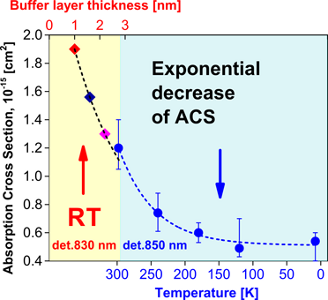
- . The quantum yield is a quantity that, in principle, must be independent on the number of absorbed photons [1]. In assumption that the internal quantum efficiency, ηI = τPL/τr, scales with the barrier thickness x in the same way as PL QY [5] (η = Nem/Nabs), i.e., the fraction of bright NCs Nem does not


Velocity dependence of sliding friction on a crystalline surface
Beilstein J. Nanotechnol. 2017, 8, 2186–2199, doi:10.3762/bjnano.8.218
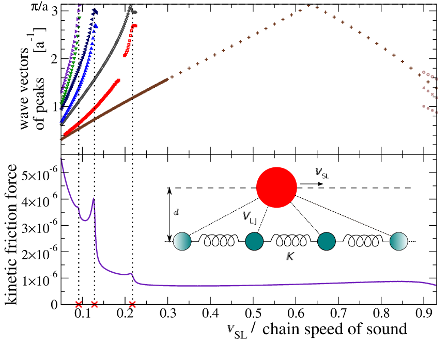
- ; dissipation; friction; nanotribology; phonons; velocity dependence; Introduction Friction affects a wide variety of phenomena spanning broad ranges of length and time scales. Due to its practical and technological relevance, the study of friction was addressed even long before physics became a science


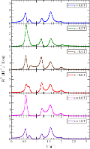
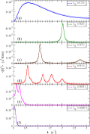

![[Graphic 31]](/bjnano/content/inline/2190-4286-8-218-i50.svg?max-width=637&scale=1.18182) as functions of vSL. Panels (c) and (d): detail ...
as functions of vSL. Panels (c) and (d): detail ...

![[Graphic 34]](/bjnano/content/inline/2190-4286-8-218-i53.svg?max-width=637&scale=1.18182) , with the dynamic friction Fd as a function of vSL...
, with the dynamic friction Fd as a function of vSL...


![[Graphic 40]](/bjnano/content/inline/2190-4286-8-218-i59.svg?max-width=637&scale=1.18182) (symbols), compared with the values of k of the phonons who...
(symbols), compared with the values of k of the phonons who...


Angstrom-scale flatness using selective nanoscale etching
Beilstein J. Nanotechnol. 2017, 8, 2181–2185, doi:10.3762/bjnano.8.217
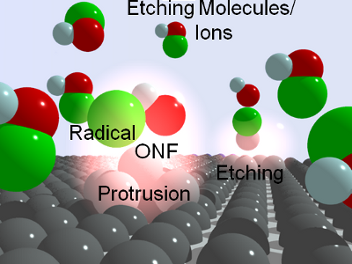
- etching on smaller scales less than 10 nm for both wet and dry etching. In addition, by comparing wet and dry etching, near-field dry etching was shown to be effective for the selective etching of nanoscale structures because of the large value of the mean free path of the etching molecules. Hence
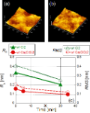
- , further control of the selective etching at smaller scales should be achievable by controlling mean free path (i.e. the partial pressure of the gas). Schematic of the near-field etching process. Experimental setup for the near-field wet etching technique. Time dependence of surface roughness using a



Modelling focused electron beam induced deposition beyond Langmuir adsorption
Beilstein J. Nanotechnol. 2017, 8, 2151–2161, doi:10.3762/bjnano.8.214
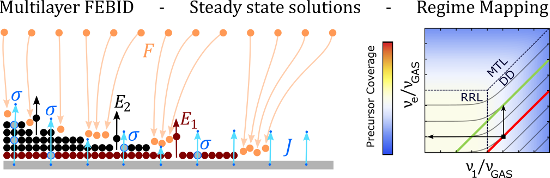
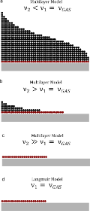
- saturated monolayers, appearance of multilayers, or the convergence from the multilayer model to the Langmuir model, can be understood in terms of the characteristic time scales of the system. These results are synthesized in a set of dimensionless FEBID frequency maps for Langmuir, and homogeneous and