Search results
Search for "silica" in Full Text gives 406 result(s) in Beilstein Journal of Nanotechnology. Showing first 200.
SO2 gas adsorption on carbon nanomaterials: a comparative study
Beilstein J. Nanotechnol. 2018, 9, 1782–1792, doi:10.3762/bjnano.9.169

- , e.g., for flue gas scrubbing applications. These include, but are not limited to, various zeolites [3][4], metal-organic frameworks [5][6][7][8], mesoporous silica [9][10][11] and carbon nanomaterials [12][13][14][15]. Due to its higher stability against moisture and corrosive gases (typical flue gas


Toward the use of CVD-grown MoS2 nanosheets as field-emission source
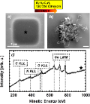
Beilstein J. Nanotechnol. 2018, 9, 1686–1694, doi:10.3762/bjnano.9.160
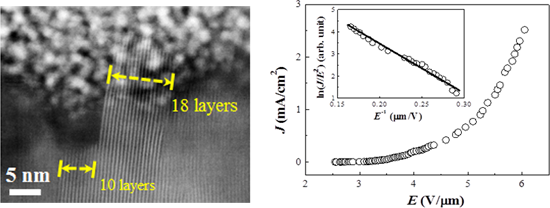
- overnight, the silica layer was removed, freeing the PMMA/MoS2 film from the growth substrate (SiO2/Si). The sample was subsequently transferred to deionized water to rinse the chemical etchants. Then, the desired substrate (here, FTO) was used to lift the PMMA/MoS2 out of the water. The sample was then

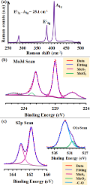


Friction force microscopy of tribochemistry and interfacial ageing for the SiOx/Si/Au system
Beilstein J. Nanotechnol. 2018, 9, 1647–1658, doi:10.3762/bjnano.9.157
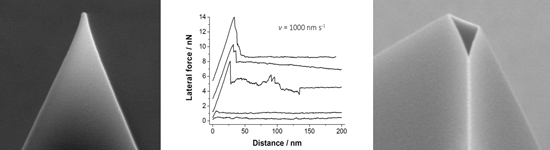
- ultra-sharp tip is scanned across the surface line by line probing a square frame. Lateral forces acting on the sliding contact are determined as deflection of a cantilever spring holding the tip. Single-asperity contact ageing between silica tip and surface has been directly observed in ambient




Nanocomposites comprised of homogeneously dispersed magnetic iron-oxide nanoparticles and poly(methyl methacrylate)
Beilstein J. Nanotechnol. 2018, 9, 1613–1622, doi:10.3762/bjnano.9.153
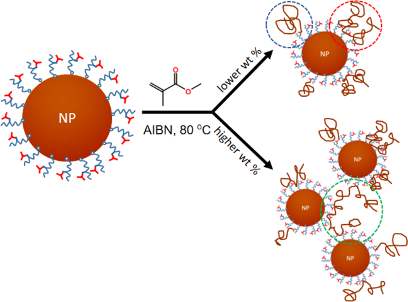
- was successfully overcome by using polymer-grafted nanoparticles (magnetic and silica), i.e., composite nanoparticles that were mixed with the polymer, usually in the solution [10][22][23][24]. Critical factors that influence the state of dispersion of polymer-grafted nanoparticles in nanocomposites


Correlative electrochemical strain and scanning electron microscopy for local characterization of the solid state electrolyte Li1.3Al0.3Ti1.7(PO4)3
Beilstein J. Nanotechnol. 2018, 9, 1564–1572, doi:10.3762/bjnano.9.148
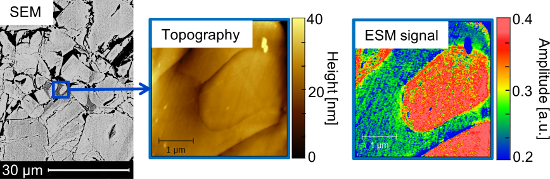
- ground for 10 to 15 minutes at 150 rpm. This was followed by polishing the samples for 4 to 8 minutes at 300 rpm in four steps. In the first two steps, a diamond suspension with 3 µm and 2 µm particles was used. Finally, two finishing steps were performed with a 0.2 µm silica suspension and a 0.05 µm


Formation mechanisms of boron oxide films fabricated by large-area electron beam-induced deposition of trimethyl borate
Beilstein J. Nanotechnol. 2018, 9, 1282–1287, doi:10.3762/bjnano.9.120
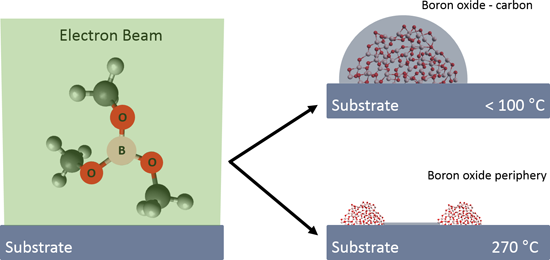
- structural properties similar to those of tetraethyl orthosilicate (TEOS, Si(C2H5O)4), which has been well characterized as a precursor for EBID of silica films [14]. TMB has previously been used for boron doping of SiO2 [15] and diamond [16], and the deposition of BCN fibres [17], BN nanotubes [18] and BN
- substrate temperatures between 26 and 405 °C. The deposition rate decreases rapidly with increasing substrate temperature, with TMB not undergoing activated chemisorption from the gas phase in stark contrast to the alkoxide-based silica precursor molecule TEOS. The morphology and composition of deposited



Surface characterization of nanoparticles using near-field light scattering
Beilstein J. Nanotechnol. 2018, 9, 1228–1238, doi:10.3762/bjnano.9.114
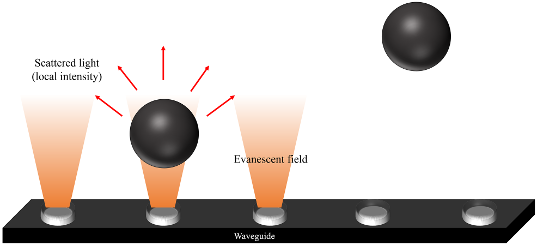
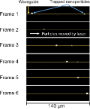
- and colleagues established that near-field light scattering using the nanophotonic force microscope can be used to measure the size of bare silica and PEG-coated silica nanoparticles very accurately [24]. PEGylation of the nanoparticle slightly altered the particle’s surface chemistry and increased




Heterostuctures of 4-(chloromethyl)phenyltrichlorosilane and 5,10,15,20-tetra(4-pyridyl)-21H,23H-porphine prepared on Si(111) using particle lithography: Nanoscale characterization of the main steps of nanopatterning
Beilstein J. Nanotechnol. 2018, 9, 1211–1219, doi:10.3762/bjnano.9.112
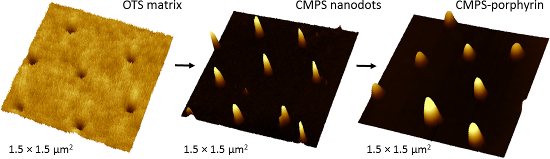
- the uncovered sites of Si(111) to enable spatial confinement of the surface reaction. Silica spheres with a diameter of 500 nm were used as a surface mask to prepare nanoscopic holes within the OTS matrix film. Next, the samples were immersed in solutions of CMPS dissolved in toluene or bicyclohexane
- were characterized after each key step of sample preparation. A surface platform of nanoholes was generated in the first step by depositing silica spheres on a silicon substrate (Figure 1a). The masked surface was then immersed in a solution of OTS to form a methyl-terminated matrix film in between the
- silica spheres of the surface mask. The spheres were then removed with a washing step to produce a hexagonal pattern of nanoholes within the OTS film (Figure 1b), conforming to the arrangement of the surface mask. Samples with nanoholes within OTS were then placed in a solution of CMPS and either toluene


Circular dichroism of chiral Majorana states
Beilstein J. Nanotechnol. 2018, 9, 1194–1199, doi:10.3762/bjnano.9.110
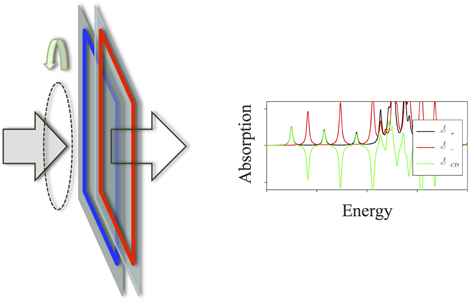
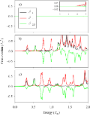
- allowed measuring the extinction spectrum of a single silica shell-coated silver nanoparticle excited with varying polarizations [29]. Energy eigenvalues close to zero energy as a function of ΔB. Panels a) and b) are for a square of dimensions Lx = Ly = 10LU, while c) and d) correspond to a rectangle of


![[Graphic 14]](/bjnano/content/inline/2190-4286-9-110-i18.svg?max-width=637&scale=1.18182) . Panels a) and b) correspond to the phases in Figure 1d with one (ΔB = 2...
. Panels a) and b) correspond to the phases in Figure 1d with one (ΔB = 2...
![[Graphic 15]](/bjnano/content/inline/2190-4286-9-110-i19.svg?max-width=637&scale=1.18182) ,
, ![[Graphic 16]](/bjnano/content/inline/2190-4286-9-110-i20.svg?max-width=637&scale=1.18182) and
and ![[Graphic 17]](/bjnano/content/inline/2190-4286-9-110-i21.svg?max-width=637&scale=1.18182) defined in the main text. The shown results correspond to the spe...
defined in the main text. The shown results correspond to the spe...

![[Graphic 19]](/bjnano/content/inline/2190-4286-9-110-i23.svg?max-width=637&scale=1.18182) ,
, ![[Graphic 20]](/bjnano/content/inline/2190-4286-9-110-i24.svg?max-width=637&scale=1.18182) and
and ![[Graphic 21]](/bjnano/content/inline/2190-4286-9-110-i25.svg?max-width=637&scale=1.18182) for (a) a square of Lx = Ly = 20 LU), and for (b) a rectangle of L...
for (a) a square of Lx = Ly = 20 LU), and for (b) a rectangle of L...
A simple extension of the commonly used fitting equation for oscillatory structural forces in case of silica nanoparticle suspensions
Beilstein J. Nanotechnol. 2018, 9, 1095–1107, doi:10.3762/bjnano.9.101
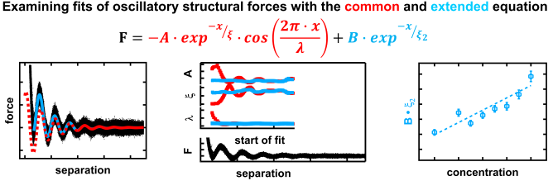
- are obtained, namely wavelength, amplitude and decay length, which are related to the period, the strength and the correlation length of the oscillatory structural forces, respectively. The paper addresses structural forces between a silica microsphere and a silicon wafer across silica nanoparticle
- concentrations of silica nanoparticles. As a consequence, the parameters of the common fit equation vary with the starting point of the fit. Although the wavelength is least affected and seems to be quite robust against the starting point of the fit, all three parameters show distinct oscillations, with a period
- small separations and even for high silica nanoparticle concentrations (10 wt %). Furthermore wavelength, amplitude and decay length become independent of the starting point of the fit and in case of the latter two of each other. The larger forces at small separations indicate a more pronounced ordering


Single-crystalline FeCo nanoparticle-filled carbon nanotubes: synthesis, structural characterization and magnetic properties
Beilstein J. Nanotechnol. 2018, 9, 1024–1034, doi:10.3762/bjnano.9.95
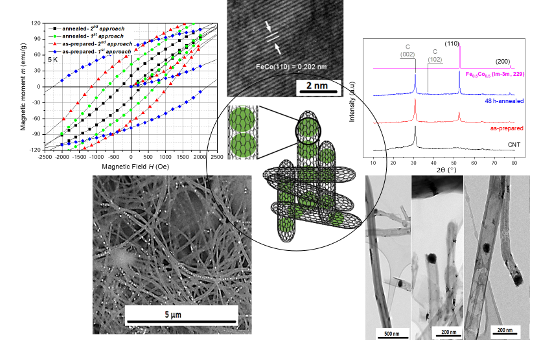
- to be used in potential applications. Due to their high surface-to-volume (S/V) ratio, MNPs are more susceptible to oxidation, agglomeration, aggregation [31][32]. Therefore, it is necessary to produce MNPs with a protective layer which preserves their properties. Compared to polymer or silica


Enzymatically promoted release of organic molecules linked to magnetic nanoparticles
Beilstein J. Nanotechnol. 2018, 9, 986–999, doi:10.3762/bjnano.9.92
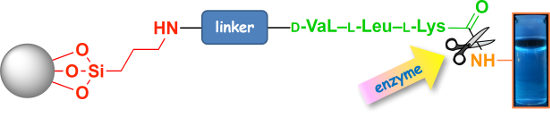
- by reaction with 3-aminopropyltri(ethoxy)silane (APTES) [36]. The final product was coded as NP@APTES. We also prepared magnetic nanoparticles through the reverse micelle methodology, as described elsewhere [37]. In this case the nanoparticles obtained were silica-coated and already capped with APTES
- . They are here identified as NP@silica@APTES. The morphology and chemical composition of these nanoparticles was studied using field emission scanning electron microscopy (FE-SEM) in combination with energy dispersive X-ray spectroscopy (EDXS) in addition to dynamic light scattering (DLS). In Figure 1A
- films of the copper grids used to deposit a drop of sample for analysis. Due to the magnetic interactions between particles, the sample is characterized by large aggregates, which are comprised of single nanoparticles with a mean diameter of about 10 nm. The sample NP@silica@APTES is characterized by




A review of carbon-based and non-carbon-based catalyst supports for the selective catalytic reduction of nitric oxide
Beilstein J. Nanotechnol. 2018, 9, 740–761, doi:10.3762/bjnano.9.68

- sturdy carbon composition; (iv) able to be produced in different physical shape (granules, pellets, fibres, and cloth) as carbon-based catalyst is very much porous in structure; (v) the cost of carbon-based supports is usually lower and more economical as compared to the conventional supports (silica and
Cyclodextrin-assisted synthesis of tailored mesoporous silica nanoparticles
Beilstein J. Nanotechnol. 2018, 9, 693–703, doi:10.3762/bjnano.9.64
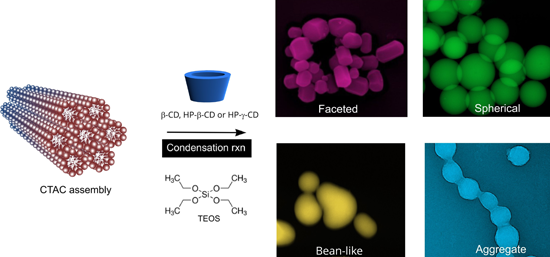
- /bjnano.9.64 Abstract Mesoporous silica nanoparticles (MSNs) have sparked considerable interest in drug/gene delivery, catalysis, adsorption, separation, sensing, antireflection coatings and bioimaging because of their tunable structural properties. The shape, size and pore structure of MSNs are greatly
- smaller particle size than those produced with HP-functional CDs. FTIR, TGA and solid-state 13C NMR demonstrated the adsorption of CDs on the particle surfaces. The proposed concept allows for the synthesis of silica nanoparticles with control over particle shape and size by adjusting the concentration of
- additives in a simple, one-pot reaction system for a wide range of applications. Keywords: cyclodextrin; faceted particles; mesoporous silica nanoparticles (MSN); microporous; Introduction With the availability of several types of surfactants and the increased understanding of sol–gel chemistry, numerous


Electron interactions with the heteronuclear carbonyl precursor H2FeRu3(CO)13 and comparison with HFeCo3(CO)12: from fundamental gas phase and surface science studies to focused electron beam induced deposition
Beilstein J. Nanotechnol. 2018, 9, 555–579, doi:10.3762/bjnano.9.53


Design of polar self-assembling lactic acid derivatives possessing submicrometre helical pitch
Beilstein J. Nanotechnol. 2018, 9, 333–341, doi:10.3762/bjnano.9.33
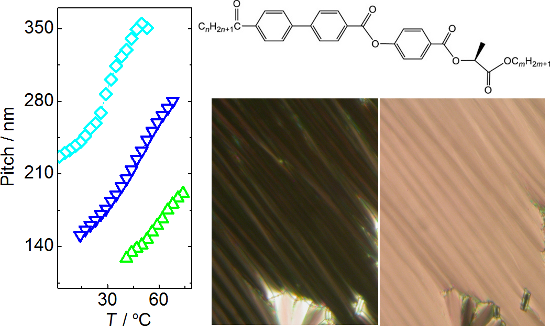
- performed similarly as generally described in [37]. The specific reaction scheme for the synthetic design is presented in Scheme 1. The crude products were purified by column chromatography on silica gel (Kieselgel 60, Merck, Darmstadt) using a mixture of CH2Cl2 and acetone (99.8:0.2) as the eluent and


Wafer-scale bioactive substrate patterning by chemical lift-off lithography
Beilstein J. Nanotechnol. 2018, 9, 311–320, doi:10.3762/bjnano.9.31
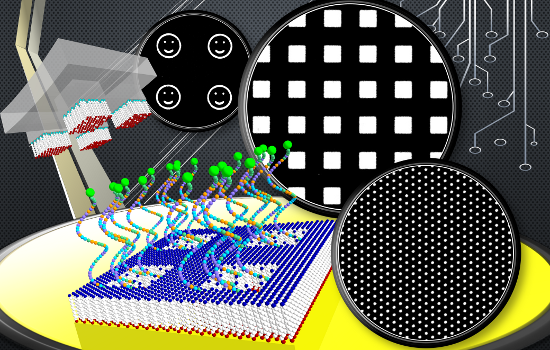
- -arrangement of silane or thiol molecules on silica or Au surfaces, which has been proven as a convenient route for the fabrication of functional surfaces toward versatile targets [12][13][14][15][16]. In addition to direct surface modification, the versatility of anchoring molecule tail groups provides


Liquid-crystalline nanoarchitectures for tissue engineering
Beilstein J. Nanotechnol. 2018, 9, 205–215, doi:10.3762/bjnano.9.22
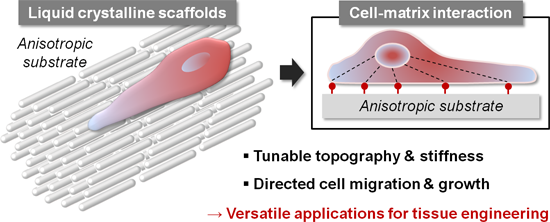
- matrix was confirmed by a nonlinear optics technique [88]. These properties enable the exploitation of the LC collagen matrix as a potential corneal implant. This matrix can be also utilized as a biological template for silica hybridization with long-range ordered structures [89]. Such 3D ordered


Growth model and structure evolution of Ag layers deposited on Ge films
Beilstein J. Nanotechnol. 2018, 9, 66–76, doi:10.3762/bjnano.9.9
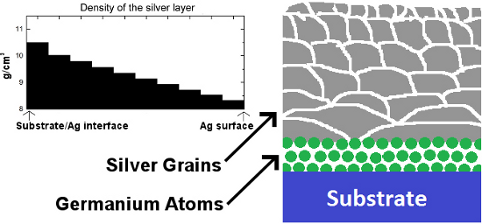
- stable Ag-based layers of thickness less than 15 nm on fused silica substrates is magnetron cosputtering of silver and aluminum. Surface root-mean-square (RMS) roughness of 15 nm Al-doped Ag films with an Al atomic concentration of 4% have been recently reported to be equal to 0.4 nm [16]. However, in
- with Raman microscopy, which have been kept at a pressure below 10−3 Torr until the measurement. Results and Discussion Crystalline structure of Ag layers grown on Ge wetted silica substrates Figure 1 presents the XRD spectra of the investigated silver films. In each case, there is a strong diffraction
- , with the exception of the sample annealed at 300 °C. Detailed information about this comparison can be found in the experimental section. The grain size of the 35 nm thick Ag layer on silica is as large as 18 nm which is half of its thickness. This is because the adhesion of silver to glasses is






Thermo- and electro-optical properties of photonic liquid crystal fibers doped with gold nanoparticles
Beilstein J. Nanotechnol. 2017, 8, 2790–2801, doi:10.3762/bjnano.8.278
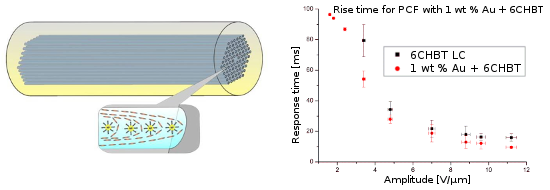
- stable due to relatively weak interactions of dopant particles [14]. Up to now, NP-doped LCs have been reported mostly in LC cells. In this paper, we present the experimental results of electro- and thermo-optic properties of LC cells as well as silica glass microcapillaries (MCs) and photonic crystal


Dry adhesives from carbon nanofibers grown in an open ethanol flame
Beilstein J. Nanotechnol. 2017, 8, 2719–2728, doi:10.3762/bjnano.8.271
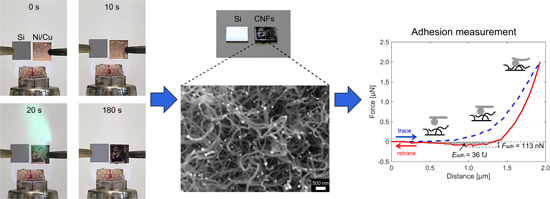
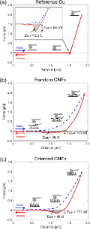
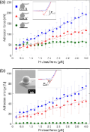
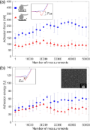
- small preload forces up to 0.6 μN, the adhesion of the plain copper substrate is comparable or higher than that of CNFs. This might be due to smaller contact area between CNFs and the silica sphere caused by a low preload force. The adhesion forces for oriented and randomly oriented CNFs, however
- , increase linearly with preload force whereas the adhesion force of the reference is nearly constant between 50 and 60 nN. The increase in adhesion is in agreement with the study of Ge and co-workers [44]. The reason for this is that a higher preload force brings more CNFs in contact with the silica sphere
- prevents that some CNFs get in contact with the silica sphere, as schematically shown in Figure 7. Consequently, the oriented CNFs have higher adhesion forces and energies than the randomly oriented CNFs. An important question for dry adhesives is their long-term stability. It is essential for various


One-step chemical vapor deposition synthesis and supercapacitor performance of nitrogen-doped porous carbon–carbon nanotube hybrids
Beilstein J. Nanotechnol. 2017, 8, 2669–2679, doi:10.3762/bjnano.8.267
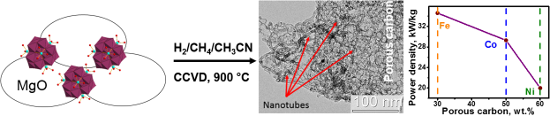
- works devoted to one-step formation of porous carbon–CNT hybrids for energy storage applications. Lei et al. have reported the CCVD synthesis of nitrogen-doped ordered mesoporous carbon and multiwalled CNTs (MWCNTs) with the use of a silica SBA-15 template impregnated by iron nitrate [14


Localized growth of carbon nanotubes via lithographic fabrication of metallic deposits
Beilstein J. Nanotechnol. 2017, 8, 2592–2605, doi:10.3762/bjnano.8.260
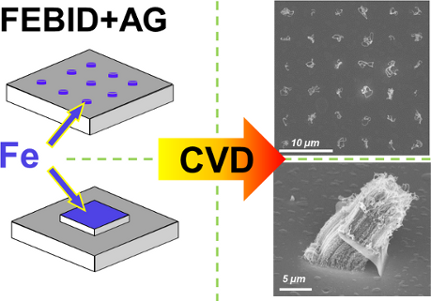
- investigated in detail. Based on these results, the parameters could be optimized such that EBID point matrixes (6 × 6) were fabricated on a silica surface whereby at each predefined site only one CNT was produced. Furthermore, the localized fabrication of CNT forests was targeted and successfully achieved on
- precursor exposure after EBID. Transmission electron microscope (TEM) analysis was performed with a FEI Tecnai G2 20 X-TWIN instrument with a point resolution of 0.26 nm. The silica wafer was put in an Eppendorf tube and mixed with 1 mL ethanol. After ultrasonic treatment, one drop was put on a holey carbon




Ferrocholesteric–ferronematic transitions induced by shear flow and magnetic field
Beilstein J. Nanotechnol. 2017, 8, 2552–2561, doi:10.3762/bjnano.8.255
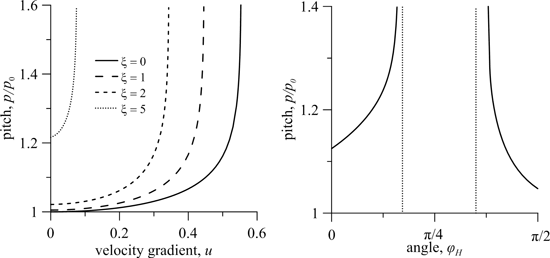
- ; helix unwinding; liquid crystals; magnetic field; shear flow; Introduction The dispersing of nanoparticles of different nature (e.g., carbon nanotubes, ferromagnetic or ferroelectric particles, quantum dots, silica particles) into liquid crystals (LCs) leads to a change in the properties of the


Interface conditions of roughness-induced superoleophilic and superoleophobic surfaces immersed in hexadecane and ethylene glycol
Beilstein J. Nanotechnol. 2017, 8, 2504–2514, doi:10.3762/bjnano.8.250
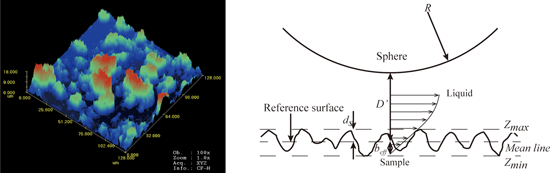
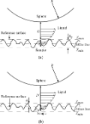
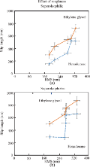
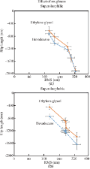
- concentration of silica nanoparticles in the composite surfaces from 10 to 30 mg·mL−1 leads to an increase in the amplitude parameters, while the pitch parameters remain random. To decouple the individual effect of the amplitude parameters and pitch parameters on slip, surfaces with the same AR roughness were