Search results
Search for "substrate" in Full Text gives 1420 result(s) in Beilstein Journal of Nanotechnology. Showing first 200.
Graphene removal by water-assisted focused electron-beam-induced etching – unveiling the dose and dwell time impact on the etch profile and topographical changes in SiO2 substrates
Beilstein J. Nanotechnol. 2024, 15, 190–198, doi:10.3762/bjnano.15.18
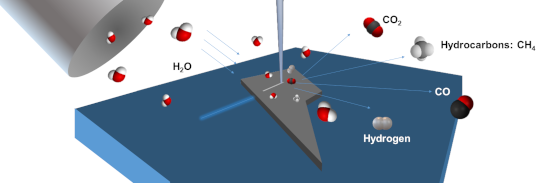
- nanopatterning, we have found significant morphological changes induced in the SiO2 substrate even at low electron dose values (<8 nC/μm2). We demonstrate that graphene etching and topographical changes in SiO2 substrates can be controlled via electron beam parameters such as dwell time and dose. Keywords
- applicable due to the high impact on the underlying substrate. Helium ion milling was believed to be the most suitable tool for structuring graphene [12]. However, it requires expensive equipment, and even this technique introduces a substantial number of defects into the graphene layer, as shown by Kim et
- of concept of water-assisted graphene etching. Moreover, the effects of changes in the topography of Si/SiO2 substrate during this process have not been addressed so far, as they may be observed only under certain experimental conditions. In a standard scanning electron microscope, the morphological


CdSe/ZnS quantum dots as a booster in the active layer of distributed ternary organic photovoltaics
Beilstein J. Nanotechnol. 2024, 15, 144–156, doi:10.3762/bjnano.15.14
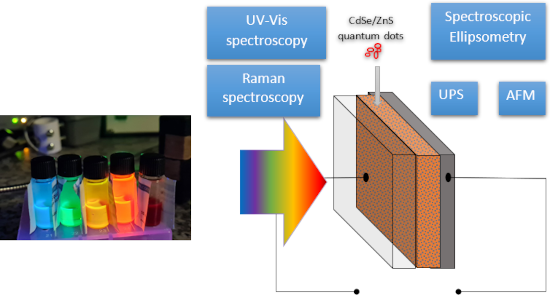
- ultrasonicated for 20 s and then applied to the substrate according to the test method. The angular velocity of the spin coater was also determined by the specific test method and its required film thickness. To keep the typical ratio of the donor and acceptor equal to 1:1 and simultaneously highlight the QD
- carried out for three incidence angles (65°, 70°, and 75°). A Bruker atomic force microscope (AFM) MULTIMODE 8 was used in the measurements in the ScanAsyst in Air mode, using silicon nitride probes (with a nominal tip radius of 2 nm and a spring constant equal to 0.4 N/m). The substrate was
- monocrystalline silicon. A WITec Alpha 300 M+ spectrometer with a 488 nm laser, 600 groove grating, and a 100× ZEISS objective was used for Raman measurements. The samples were deposited on a glass substrate. Ultraviolet photoelectron spectroscopy (UPS) was conducted in an ultrahigh-vacuum chamber with a base




In situ optical sub-wavelength thickness control of porous anodic aluminum oxide
Beilstein J. Nanotechnol. 2024, 15, 126–133, doi:10.3762/bjnano.15.12
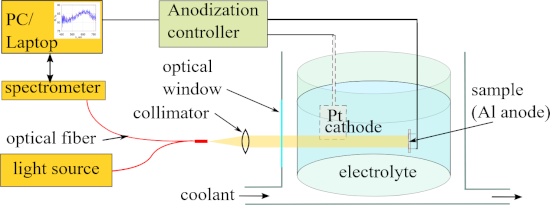
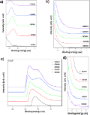
- heating, electrolyte flow [19], arrangement of the electrodes, and crystallographic orientation of the aluminum substrate [20]. In this work, we continuously recorded the reflectance spectra from a PAAO-coated aluminum surface during anodization. In a similar reflective interference spectroscopy (RIfS
- -center distance, and ≈30 nm pore diameter corresponded well to the expected results of using anodization in 0.3 M oxalic acid electrolyte and 40 V voltage [24][25]. PAAO is not a homogeneous material; instead, it consists of a porous layer and the barrier layer on top of the Al substrate (Figure 1b). To
- consistent thickness determination during anodization using reflectance measurements at normal incidence, it was sufficient to assume a single PAAO layer with the effective RI neff. A simplified model consisting of an Al substrate with the complex RI [29], PAAO with constant neff, and water with RI [30


New application of bimetallic Ag/Pt nanoplates in a colorimetric biosensor for specific detection of E. coli in water
Beilstein J. Nanotechnol. 2024, 15, 95–103, doi:10.3762/bjnano.15.9
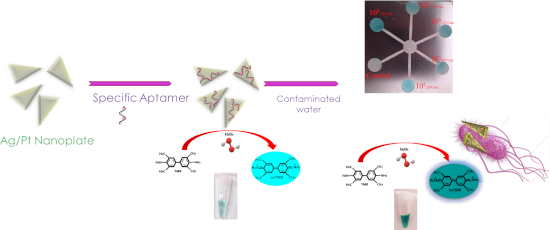
- . This nanobiosensor has the ability to specifically bind to E. coli, increasing the peroxidase activity of the apt-Ag/Pt NPL. Finally, the blue color of the solution in the contaminated water samples was increased in the presence of 3,3′,5,5′-tetramethylbenzidine (TMB) as a substrate and H2O2. The assay
- of a chromogenic substrate, such as 3,3′,5,5′-tetramethylbenzidine (TMB), is widely employed. This conversion process can generate vibrant products when H2O2 is present [11][12]. Colorimetric biosensors often use chromogenic substrates such as TMB, ABTS, and o-phenylenediamine (OPD) to produce a
- visual readout signal through peroxidase mimetic activity. The TMB is preferred due to its reliance on a single organic substrate, eliminating the need for a helper molecule. Studies have shown TMB to be non-mutagenic, but it may still be carcinogenic. However, the low solubility of TMB in water requires


Study of the reusability and stability of nylon nanofibres as an antibody immobilisation surface
Beilstein J. Nanotechnol. 2024, 15, 83–94, doi:10.3762/bjnano.15.8
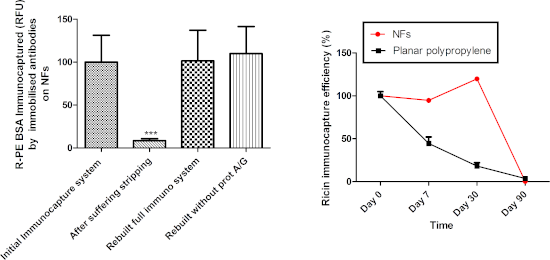
- mouse antibody, made in collaboration with the National Center for Biotechnology (CNB) – CSIC. 10-Acetyl-3,7-dihydroxyphenoxazine (ADHP, Ampliflu) was used as a fluorogenic substrate for horseradish peroxidase (HRP) (Sigma-Aldrich). BSA, from Sigma-Aldrich, labelled with RPE was selected as toxin
- excess reagents. Peroxidase-labelled streptavidin was added to detect immunocaptured ricin through biotin and streptavidin binding. A fluorescent peroxidase substrate (ADH, Ampliflu) was added, and the fluorescence was measured (λemission = 530 nm and λexcitation = 590 nm). This value was divided by the


Measurements of dichroic bow-tie antenna arrays with integrated cold-electron bolometers using YBCO oscillators
Beilstein J. Nanotechnol. 2024, 15, 26–36, doi:10.3762/bjnano.15.3
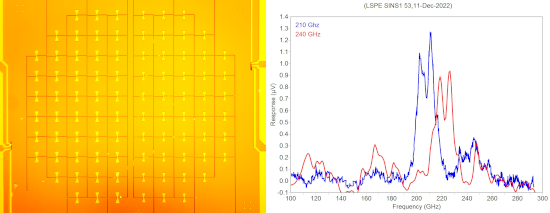
- We consider properties of dichroic antenna arrays on a silicon substrate with integrated cold-electron bolometers to detect radiation at frequencies of 210 and 240 GHz. This frequency range is widely used in cosmic microwave background experiments in space, balloon, and ground-based missions such as
- dichroic receiving systems, one should overcome the limitation of a silicon substrate, whose thickness affects the efficiency of detection as a refractive medium. In the case of close frequencies, however, one can find a compromise of matching the average frequency of both arrays with reasonable detection
- ] (Figure 1a). The basic element of the receiving matrix is a dipole bow-tie antenna, in the gap of which the CEB is embedded (Figure 1b). This matrix is located on a silicon substrate, which is 260 µm thick. Since the operation of the CEB in the matrix is assumed to be in the voltage bias mode, the


TEM sample preparation of lithographically patterned permalloy nanostructures on silicon nitride membranes
Beilstein J. Nanotechnol. 2024, 15, 1–12, doi:10.3762/bjnano.15.1
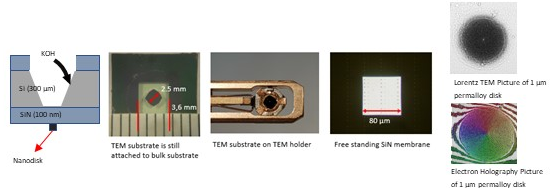
- submicrometer apertures were milled on SiN membranes using a focused ion beam. Furthermore, we have developed a new TEM sample preparation method, where we fabricated Py nanostructures on a bulk substrate with a SiN buffer layer and etched the substrate to create a thin SiN membrane under the Py nanostructure
- ion beam. This method avoids the resist-based fabrication, which is common in preparing nanodisk samples for TEM [8][20]. We have also developed a method of sample preparation for patterned nanostructures starting from a bulk substrate. This method is versatile and might be useful for more complicated
- magnetron sputtering through the resist aperture. We used DC magnetron sputtering in a pure Ar environment at a pressure of 1 Pa to deposit Py at room temperature. The effective permalloy target had a diameter of 8 mm. The sputtered material almost forms a parallel beam when it approaches the substrate at a


Determination of the radii of coated and uncoated silicon AFM sharp tips using a height calibration standard grating and a nonlinear regression function
Beilstein J. Nanotechnol. 2023, 14, 1200–1207, doi:10.3762/bjnano.14.99
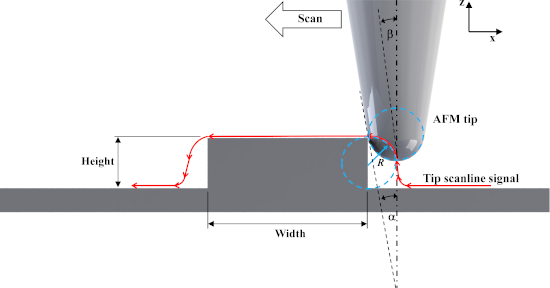
- of SiO2 with height = 20 nm, grate distance = 2 µm, and pitch distance = 5 µm, on top of a silicon substrate, which allows for more space for the AFM tips to sweep along the height grate geometry. The corner edge radius of the grating height is not provided in the specification [15]. However, recent
- standard purchased from Budget Sensor [15], the grate height pattern made of silicon oxide (SiO2) has a height of 20 nm, a grate distance of 2 µm, and a pitch distance of 5 µm on top of the silicon substrate. So, the height distance that the tip end can slide along is equal to the distance measured from


A combined gas-phase dissociative ionization, dissociative electron attachment and deposition study on the potential FEBID precursor [Au(CH3)2Cl]2
Beilstein J. Nanotechnol. 2023, 14, 1178–1199, doi:10.3762/bjnano.14.98
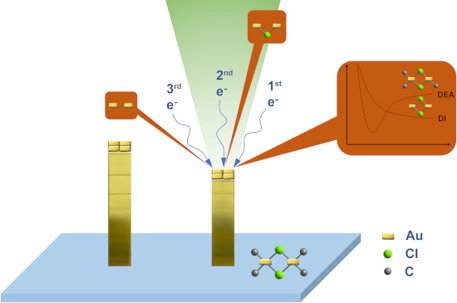
- the potential to widen the scope of applicable nanomaterials. In FEBID, a focused electron beam is directed onto the surface of a substrate in close proximity to a gas inlet, through which a precursor compound is supplied to deliver the material for the nanostructures to be built. For metallic
- structures, these precursor molecules are commonly organometallics that adsorb on the substrate and are decomposed by the electron beam irradiation. Ideally, a pure metal is deposited while fragmented volatile ligands are pumped away [11][12][13]. Several parameters affect the FEBID process, including the
- electron beam energy and current, the substrate material, the environment inside the deposition chamber, and the composition of the precursor [14][15][16][17]. Heretofore, various chemical vapor deposition (CVD) precursors have been applied for FEBID depositions. For gold nanostructures, these include, for



Spatial variations of conductivity of self-assembled monolayers of dodecanethiol on Au/mica and Au/Si substrates
Beilstein J. Nanotechnol. 2023, 14, 1169–1177, doi:10.3762/bjnano.14.97
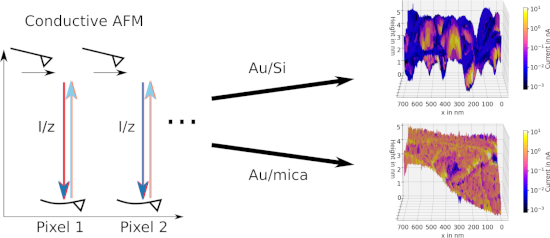
- rougher and a flatter gold substrate on the lateral variation of the conductivity. We find that the roughness of the substrate crucially defines this variation. We conclude that it is paramount to adequately choose a gold substrate for investigations on molecular layer conductivity. Keywords: Au/mica; Au
- the use in applications, the properties of such layers of molecules and the interface they form with the metal substrate have to be investigated carefully and systematically. In order to achieve comparability between different types of molecules, ordered layers are favorable, which makes self
- substrate and the mercury electrode yields the conductivity of the SAM, averaged over the contact area of the mercury droplet. In such studies, one of the crucial problems was mercury filling out defects in the SAMs, which leads to short circuits and unreliable currents running through the microcontact


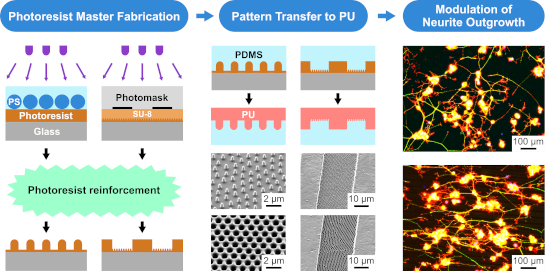
Hierarchically patterned polyurethane microgrooves featuring nanopillars or nanoholes for neurite elongation and alignment
Beilstein J. Nanotechnol. 2023, 14, 1157–1168, doi:10.3762/bjnano.14.96
- nerves are few and far between. Thus, further work is necessary to ascertain the potential of such structures for peripheral nerve regeneration. One of the reasons for the limited work on discrete nanostructures and hierarchical structures may be the expensive or non-versatile techniques for substrate
- Supporting Information File 1, Figure S2). Scanning electron microscopy (SEM) images (Figure 1C–E) confirm the featureless surface of flat PU and the ordered arrays of nanopillars and nanoholes on the nanopatterned films. For the PU nanopillar substrate, some short pillars occassionally appeared (Figure 1D
- nanopillar substrate having the smallest CAs (CA ≈ 30°). Based on confocal fluorescence microscopy of immunostained samples (Figure 1J–L), laminin successfully adsorbed onto the O2 plasma-treated PU samples. There was good laminin coverage on all of the samples, even on the nanostructures, as indicated by


A multi-resistance wide-range calibration sample for conductive probe atomic force microscopy measurements
Beilstein J. Nanotechnol. 2023, 14, 1141–1148, doi:10.3762/bjnano.14.94
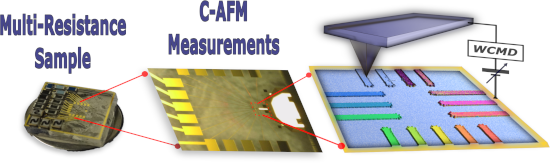
- -AFM imaging and I–V curves measurement to define the conditions for calibrated measurements. Calibration sample design and fabrication The sample developed in this work consisted of a square fused silica substrate (11 mm wide, 2 mm thick), on which gold connection lines and pads were fabricated by
- droplets (F42240, lead-free solder paste – class 5, CIF, France). The fused silica substrate was placed on a heating plate set to 270 °C, which required around 3 min to reach the melting temperature of the solder droplets (217 °C), as observed under an optical microscope. Upon cooling, 16 SMD resistors
- were fixed on the sample surface, creating a set of 15 resistance values, as shown in Figure 1a. The substrate was fixed onto a circular metallic plate (15 mm diameter), which acts as a back electrode connected to all resistances using a peripheral gold line and dashes of silver paste deposited on the


Sulfur nanocomposites with insecticidal effect for the control of Bactericera cockerelli
Beilstein J. Nanotechnol. 2023, 14, 1106–1115, doi:10.3762/bjnano.14.91
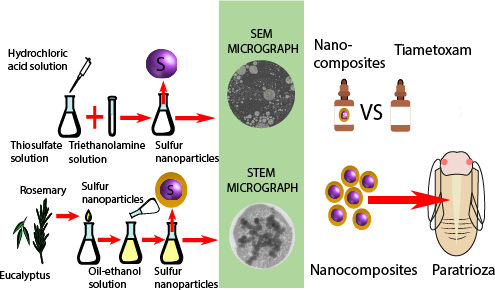
- , and O, corresponding to the by-products of the reduction of sodium thiosulfate to sulfur (see Experimental section), were found [19][31][34]. Carbon is from the substrate used in the EDS analysis [35][36]. The TEM micrograph in Figure 3a reveals the formation of spherical SNPs that agglomerate into


Density functional theory study of Au-fcc/Ge and Au-hcp/Ge interfaces
Beilstein J. Nanotechnol. 2023, 14, 1093–1105, doi:10.3762/bjnano.14.90
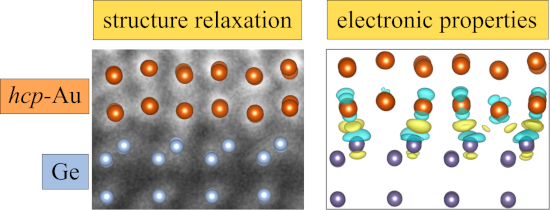
- crystalline phases on a specific substrate [2][3]. The structure of a heterophase can be studied using advanced atomic-resolution experiments, such as high-resolution electron microscopy [4], high-resolution secondary-electron microscopy [5], scanning transmission electron microscopy [6][7] or scanning
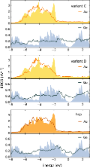
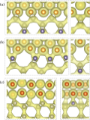
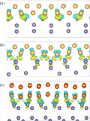
- , involving a hexagonal AuGe β phase present during the intermediate stages of growth. Interestingly, while the fcc crystallites were randomly oriented with respect to the Ge substrate, the hcp nanostructures were typically found with (001) planes at 60–65° to the (111) Ge planes [22]. In a recent experiment
- , stable hcp nanoislands were obtained under controlled annealing conditions on the germanium substrate [23]. After initial crystallization of the fcc gold phase, the hcp phase grows from the eutectic Au/Ge liquid. The atomically resolved STEM-HAADF measurements as well as electron backscatter diffraction





Properties of tin oxide films grown by atomic layer deposition from tin tetraiodide and ozone
Beilstein J. Nanotechnol. 2023, 14, 1085–1092, doi:10.3762/bjnano.14.89
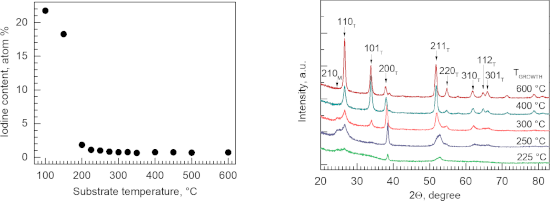
- . Suitable evaporation temperatures for the SnI4 precursor as well as the relationship between growth per cycle and substrate temperature were determined. Crystal growth in the films in the temperature range of 225–600 °C was identified. Spectroscopic analyses revealed low amounts of residual iodine and
- photocurrent and normalising the signal to a reference photocurrent signal from a clean gold mesh located behind the last optical element of the beamline. Results and Discussion To establish the evaporator temperature that provides the maximum coverage of substrate surface with precursor molecules and
- at the early stage of the ALD process (Figure 4). The highest GPC of the films was obtained at a substrate temperature of 300 °C (Figure 4). Obviously, there was no significant temperature window for saturation [20], that is, the so-called ALD window, in any temperature range. This may be related to


Dual-heterodyne Kelvin probe force microscopy
Beilstein J. Nanotechnol. 2023, 14, 1068–1084, doi:10.3762/bjnano.14.88
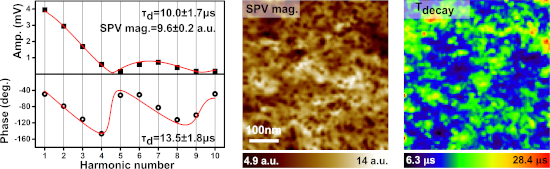
- reference substrate, a bulk organic photovoltaic heterojunction thin film, and an optoelectronic interface obtained by depositing caesium lead bromide perovskite nanosheets on a graphite surface. The conclusion provides perspectives for future improvements and applications. Keywords: heterodyne
- applications of KPFM are extremely broad. It is now used by physicists, chemists, and biologists to characterize the nanoscale electronic/electrostatic properties of an ever-expanding range of materials, interfaces, and devices, in ambient conditions, under ultrahigh vacuum, or at the liquid–substrate
- components (modulus and phase) onto a 2D grid. The validity of DHe-KPFM implementation is first demonstrated by carrying out measurements on a conducting reference substrate under electrical pumping. The results confirm that – thanks to the constant transfer function over the entire spectrum provided by the




Spatial mapping of photovoltage and light-induced displacement of on-chip coupled piezo/photodiodes by Kelvin probe force microscopy under modulated illumination
Beilstein J. Nanotechnol. 2023, 14, 1059–1067, doi:10.3762/bjnano.14.87
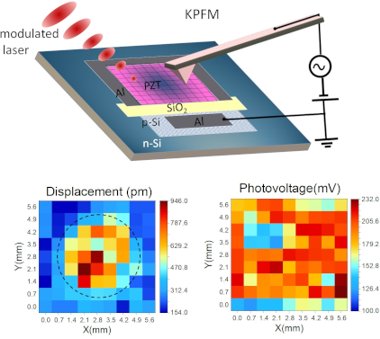
- . This final step was carried out to minimize the clamping effect of the actuator on the silicon substrate, thus enhancing the movement of the membrane. Kelvin probe force microscopy under modulated illumination In this experiment, we used KPFM with modulated illumination to study device type-I, namely
- membrane with a maximum of 946 pm, while decreasing to a few picometers at the side edges. The decay of displacement from the center to the edge is expected from the clamping effect at the edges, where the Si substrate is thicker [38]. The measured CPD shift in Figure 3b indicates that the photovoltage
- . Figure 4a–d exhibits the spatial mappings of one-quarter of the voltage-driven piezoelectric actuators (device type-II) with different dimensions from large to small sizes, respectively. The backside etching of the silicon substrate is marked by the dashed line. The measured displacement for each point


A visible-light photodetector based on heterojunctions between CuO nanoparticles and ZnO nanorods
Beilstein J. Nanotechnol. 2023, 14, 1018–1027, doi:10.3762/bjnano.14.84
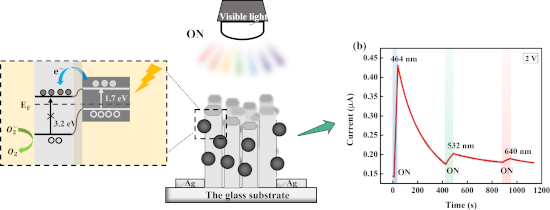
- -emission scanning electron microscopy (FESEM) image of ZnO NRs exhibits nanorods with hexagonal cross section, well aligned with the glass substrate (Figure 1a). Figure 1b indicates that many spherical nanoparticles are formed on the ZnO NRs after spraying the CuO NP solution with a concentration of 0.05 M
- bonding between nanoparticles and nanorods. To fabricate the photodetector, CuO NPs/ZnO NRs were deposited on a glass substrate initially. Then, silver electrodes with a thickness of 100 nm were directly patterned on the glass substrate by a sputtering process using a shadow mask with 0.3 cm channel


Exploring internal structures and properties of terpolymer fibers via real-space characterizations
Beilstein J. Nanotechnol. 2023, 14, 1004–1017, doi:10.3762/bjnano.14.83
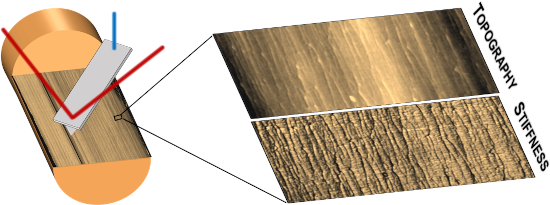
- expect that these features resulted from the way this particular fiber split open after FIB notching. Likewise, the lone drop in stiffness makes sense, as the AFM probe experiences a local reduction in tip–substrate contact area. However, similar topography and stiffness jumps forming a compliant band
- stiffness (or “stiffness”), quantified in [N/m], makes no assumptions about tip–substrate interactions such as tip size or shape. It is primarily useful for semi-quantitative mapping to show the relative fluctuations in stiffness within different regions. However, stiffness itself is not a material property
- AFM tip was taken to be a cylindrical punch, and the tip radius was calibrated by scanning on polystyrene (ET,PS = 2.7 GPa, Bruker) as a control substrate before and after each scan on a fiber surface. ET quantifications from fiber maps were only kept when mean ET,PS values varied by less than 10



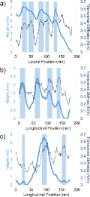


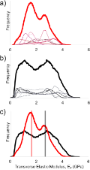

Isolation of cubic Si3P4 in the form of nanocrystals
Beilstein J. Nanotechnol. 2023, 14, 971–979, doi:10.3762/bjnano.14.80
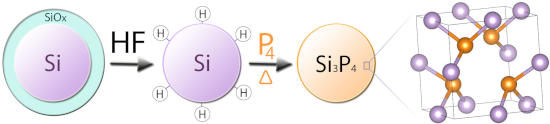
- the case of alcoholysis passivation, degassed 1-dodecanol was introduced to the Si3P4 product powder without air contact. Si3P4 NPs samples were examined on a diffractometer DRON-4-07 (Cu Kα radiation) in the form of films on a polished quartz substrate; phase analysis was performed using the program
- –1100 nm. The mass concentration of Si3P4 material in the sol (for the sake of attenuation coefficient calculation) was determined by drop casting 3.00 μL of the sol onto a sapphire substrate followed by an XRF study of the resultant film. DFT-GGA computations (structure optimization and calculation of


Low temperature atomic layer deposition of cobalt using dicobalt hexacarbonyl-1-heptyne as precursor
Beilstein J. Nanotechnol. 2023, 14, 951–963, doi:10.3762/bjnano.14.78
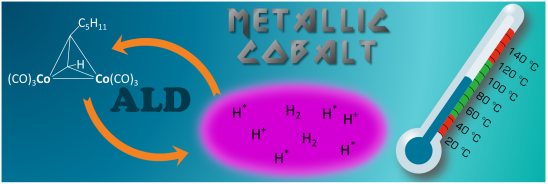
- contamination [16]. Thermal ALD processes operate usually at temperatures higher than 150 °C [17][18][19][20][21]. Characteristic for ALD processes, the growth rate is mainly independent of the substrate temperature in a specific temperature range, often denominated as ALD window. Within this range, the
- angle of 70° towards the wafer normal. However, for measurements the inner reactor has to be opened and the substrate has to be moved to a defined measurement position. This was done after a subset of typically 100 ALD cycles. The film thickness after a series of depositions was determined ex situ using
- sites of the substrate surface covered by the precursor will saturate with increasing duration of the precursor pulse resulting in an upper limit of the growth rate per cycle. This saturation follows an exponential decay curve [40]. Adapting Tuomo Suntola’s assumption of the surface occupation


Ni, Co, Zn, and Cu metal-organic framework-based nanomaterials for electrochemical reduction of CO2: A review
Beilstein J. Nanotechnol. 2023, 14, 904–911, doi:10.3762/bjnano.14.74
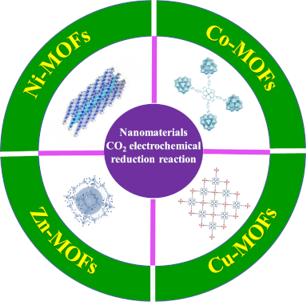
- carbon pastes, which serve as cathodes for CO2RR. To illustrate, Kornienko et al. deposited a Co-based MOF material onto an FTO substrate as a working electrode for CO2 conversion [40]. This material exhibited good performance in CO generation, achieving a faradaic efficiency (FE) of 76% (at −0.7 V vs
- converting individual MOFs into MOF-derived carbon-support nanomaterials. Another issue is the durability of the working electrodes. Many studies have employed drop casting and the use of binders to affix MOFs onto the substrate for electrode fabrication. This approach presents drawbacks such as reduced
- accessibility to active sites and unstable MOFs/substrate interfaces. Therefore, further studies are required to develop binder-free electrodes by in situ synthesis of MOFs on conductive substrates, such as nickel foam, copper foil, and carbon cloth, to overcome the aforementioned limitations and advancing the


Two-dimensional molecular networks at the solid/liquid interface and the role of alkyl chains in their building blocks
Beilstein J. Nanotechnol. 2023, 14, 872–892, doi:10.3762/bjnano.14.72
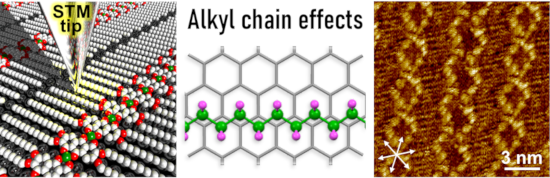
- , namely molecule–molecule, molecule–substrate, and solvent–molecule interactions (Figure 1). The target molecules are dissolved in non-conductive solvents with low volatility, such as 1-phenyloctane, 1,2,4-trichlorobenzene (TCB), long-chain n-alkanes, and octanoic acid [35][36][37]. The physisorbed
- , halogen bonding, and metal coordination, are often exploited for the formation of 2D structures. However, dispersion forces originating from the alkyl chains also play an important role in the adsorption onto the substrate, as well as in the in-plane intermolecular interactions at the solid/liquid
- functionalized group have been reported to exhibit distorted adsorption on HOPG in some cases [44][58][59][60][61]. This review mainly focuses on the alkyl chain effects on the HOPG surface. However, it is important to note that the kinds of substrate have influence on the 2D molecular self-assemblies. 2D





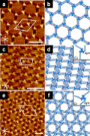

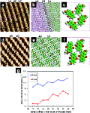

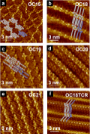


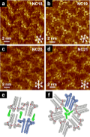
N-Heterocyclic carbene-based gold etchants
Beilstein J. Nanotechnol. 2023, 14, 865–871, doi:10.3762/bjnano.14.71
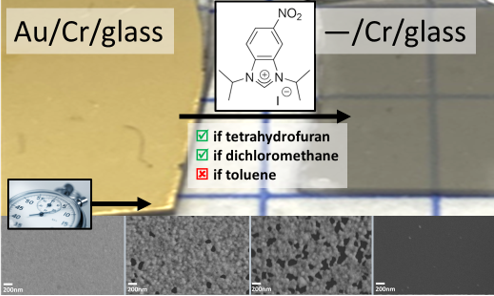
- the present work we show that one must carefully consider the particular NHC-related species, the solvent, the exposure time, and the concentration in order to avoid deleterious effects such as dissolution of the gold film or nanoparticle substrate. At the same time, we introduce a molecular etchant



Silver-based SERS substrates fabricated using a 3D printed microfluidic device
Beilstein J. Nanotechnol. 2023, 14, 793–803, doi:10.3762/bjnano.14.65
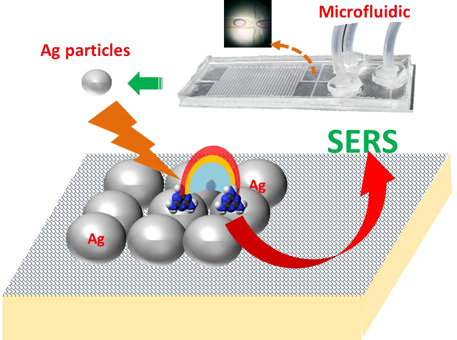
- , resulting in Ag nanoparticles of uniform shape and size. The study investigates the effects of various synthesis conditions on the size distribution, dispersity, and localized surface plasmon resonance wavelength of the Ag nanoparticles. To create the SERS substrate, the as-synthesized Ag nanoparticles were
- and 8.21 × 10³, respectively, were obtained. The detection limits for rhodamine B and melamine were estimated to be 1.94 × 10⁻¹⁰ M and 2.8 × 10⁻⁸ M with relative standard deviation values of 3.4% and 4.6%, respectively. The developed SERS substrate exhibits exceptional analytical performance and has
- the potential to be a valuable analytical tool for monitoring environmental contaminants. Keywords: 3D printing; microfluidic droplet; SERS substrate; silver nanoparticle; smartphone detection; Introduction Surface-enhanced Raman spectroscopy (SERS) has emerged as a powerful optical trace detection