Search results
Search for "thermal stability" in Full Text gives 237 result(s) in Beilstein Journal of Nanotechnology. Showing first 200.
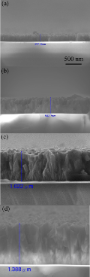
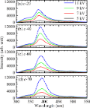
Dependence of lattice strain relaxation, absorbance, and sheet resistance on thickness in textured ZnO@B transparent conductive oxide for thin-film solar cell applications
Beilstein J. Nanotechnol. 2016, 7, 75–80, doi:10.3762/bjnano.7.9
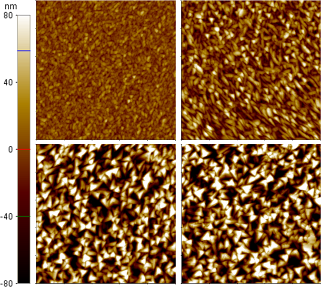
- meV), high thermal stability, high transparency, and high conduction, wurtzite ZnO is a very promising TCO material used for the front contact, barrier layer, and intermediate reflector in solar cells [1][2][3][4][5][6][7][8][9]. Low-pressure chemical vapor deposition (LPCVD) can be implemented to



Evaluation of gas-sensing properties of ZnO nanostructures electrochemically doped with Au nanophases
Beilstein J. Nanotechnol. 2016, 7, 22–31, doi:10.3762/bjnano.7.3
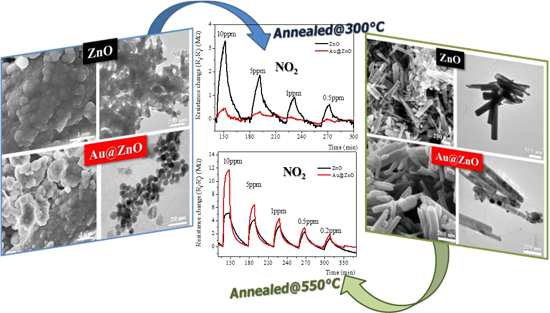
- used as a gas-sensing material because of its remarkable properties, such as high chemical and thermal stability, wide direct band gap, chemical sensitivity to different adsorbed gases, highly mobile conduction carriers, non-toxicity and low cost [18][19][20]. Moreover, since gas-sensing mechanism is a


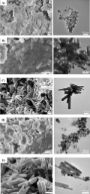


Large area scanning probe microscope in ultra-high vacuum demonstrated for electrostatic force measurements on high-voltage devices
Beilstein J. Nanotechnol. 2015, 6, 2485–2497, doi:10.3762/bjnano.6.258
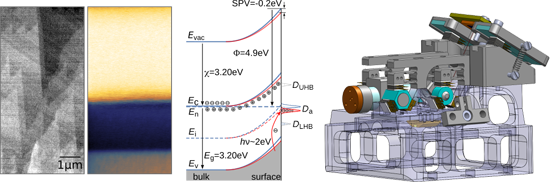
- vacuum system for reasons of thermal stability. The maximum optical power output of the diode is 7 mW. The light emitted from the diode is fed into the vacuum chamber through a single mode fibre (Fiberguide ASI4.3/125) and a custom designed optical vacuum feed-through to the focusing optics consisting of


Green and energy-efficient methods for the production of metallic nanoparticles
Beilstein J. Nanotechnol. 2015, 6, 2354–2376, doi:10.3762/bjnano.6.243
- exhibited higher thermal stability of Ag–CTS in comparison to CTS. Their microbial experiments showed that the antibacterial performance of Ag–CTS is more than either Ag NPs or CTS [72]. Sun et al. prepared Au NPs using HAuCl4 as a precursor and CTS as the reducing agent and stabilizer in a 30 h reaction at


Green synthesis, characterization and catalytic activity of natural bentonite-supported copper nanoparticles for the solvent-free synthesis of 1-substituted 1H-1,2,3,4-tetrazoles and reduction of 4-nitrophenol
Beilstein J. Nanotechnol. 2015, 6, 2300–2309, doi:10.3762/bjnano.6.236
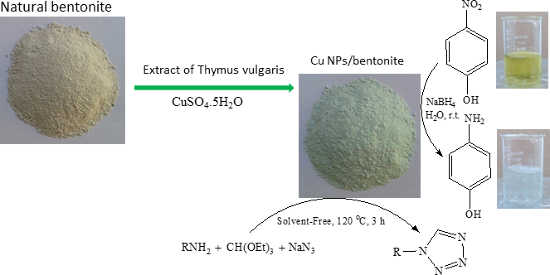
- distributed and stable metal NPs. In recent decades, the use of natural bentonites has been studied due to their high specific surface area, low cost, ordered structure, thermal stability, high safety, high exchange capacity and intercalation abilities [8]. Smectites are major clay minerals in bentonite with


Plasma fluorination of vertically aligned carbon nanotubes: functionalization and thermal stability
Beilstein J. Nanotechnol. 2015, 6, 2263–2271, doi:10.3762/bjnano.6.232
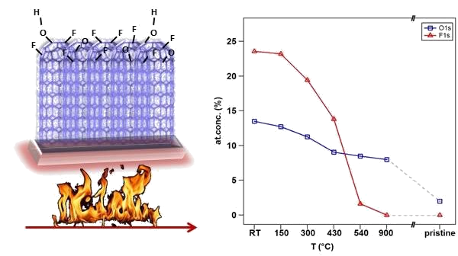
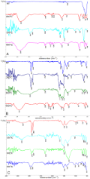
- properties upon plasma treatment. The existence of oxygen-based grafted species is associated with background oxygen species present in the plasma chamber in addition to fluorine. The thermal stability and desorption process of the fluorine species grafted on the carbon nanotubes during the fluorine plasma
- treatment were evaluated by combining different spectroscopic techniques. Keywords: carbon nanotubes; spectroscopy; synchrotron radiation; thermal stability; Introduction The covalent functionalization of carbon nanostructures has been largely exploited, and different techniques have been employed for
- responsible for creating defects on the carbon surface, that is, active sites for grafting fluorine and oxygen species [24][25][26]. In Figure 1 we show the changes of the vCNTs chemical composition at the surface (tips) with increasing heating temperature. In order to evaluate the thermal stability of the


Paramagnetism of cobalt-doped ZnO nanoparticles obtained by microwave solvothermal synthesis
Beilstein J. Nanotechnol. 2015, 6, 1957–1969, doi:10.3762/bjnano.6.200
- materials, including physical and chemical approaches. However, the physical methods suffer from difficulties in controlling thermal stability and the doping homogeneity in the final products [32][33]. The chemical approach has also been widely employed to synthesize ZnO-based DMS materials [32]. The




Synthesis, characterization and in vitro biocompatibility study of Au/TMC/Fe3O4 nanocomposites as a promising, nontoxic system for biomedical applications
Beilstein J. Nanotechnol. 2015, 6, 1677–1689, doi:10.3762/bjnano.6.170
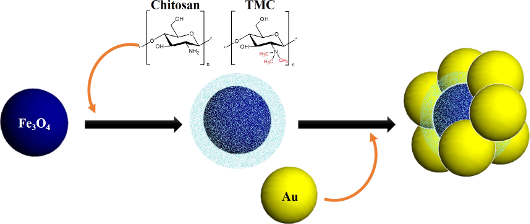
- derivatives, N-trimethylchitosan (TMC), were applied to construct three-layer nanocomposites in an Au/polymer/Fe3O4 system. It was demonstrated that replacement of chitosan with TMC reasonably improved the properties of the final nanocomposites including their size, magnetic behavior and thermal stability
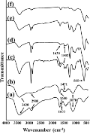
- modification by a chitosan or TMC coating. The successful coating process was confirmed by FTIR. These nanocomplexes were then exposed to Au nanoparticles, which assembled on the surface to form the final nanoparticles. The size, magnetic behavior, chemical composition, thermal stability and surface
- was analyzed based on a comparison of the nanoparticles. The FTIR peaks were observed due to the vibrational normal modes, which mostly include stretching vibrations and bending vibrations. The TGA technique (TGA-50, Shimadzu, Japan) was used for the analysis of the thermal stability. Furthermore




Formation of pure Cu nanocrystals upon post-growth annealing of Cu–C material obtained from focused electron beam induced deposition: comparison of different methods
Beilstein J. Nanotechnol. 2015, 6, 1508–1517, doi:10.3762/bjnano.6.156
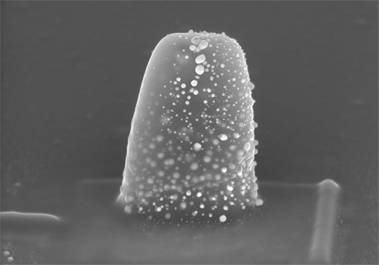
- materials obtained for the Cu(II)(hfac)2 and (hfac)Cu(I)VTMS precursor, respectively, can be attributed to the lower thermal stability of (hfac)CuVTMS which is 63 °C compared to 250 °C for Cu(hfac)2. Electrical measurements showed that the as-deposited FEBID lines from Cu(hfac)2 were highly resistive with a




Transformations of PTCDA structures on rutile TiO2 induced by thermal annealing and intermolecular forces
Beilstein J. Nanotechnol. 2015, 6, 1498–1507, doi:10.3762/bjnano.6.155
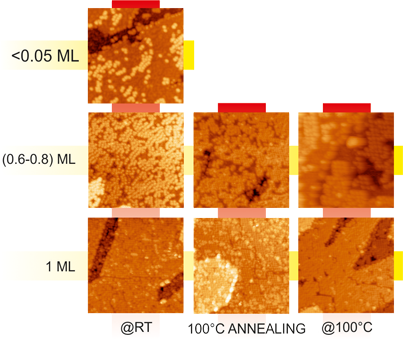
- moment, the molecules are likely to adsorb flat on crystalline templates and form ordered structures through self-assembly processes. Third, the PTCDA molecules are easily processable. They exhibit high thermal stability, as well as robustness against electron and photon bombardment. Therefore, one may
- favoured ordered structure [36]. Post-deposition annealing To test the thermal stability of the system, we have performed post-deposition annealing experiments. The annealing of the closed molecular layer performed at 100 °C does not lead to any significant change in the molecular assembly. The results are


Thermal energy storage – overview and specific insight into nitrate salts for sensible and latent heat storage
Beilstein J. Nanotechnol. 2015, 6, 1487–1497, doi:10.3762/bjnano.6.154
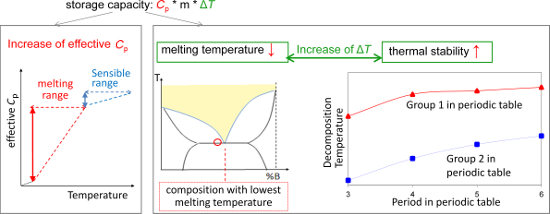
- thermal stability which define the lower and upper limits of usable temperature in sensible heat storage systems. In latent storage systems the melting temperature defines the temperature at which the heat is stored. In thermal power plants the stored heat can be used to generate steam which drives
- /nitrates For sensible heat storage at elevated temperatures (T > 100 °C) molten salts are most suitable. Advantages of molten salts are the high thermal stability, relatively low material costs, high heat capacity, high density, non-flammability and low vapor pressure. Due to the low vapor pressure
- mixture the material costs can be reduced. The non-eutectic mixture has a liquidus temperature of about 240 °C and the temperature limit of thermal stability is about 550 °C. For applications at higher temperatures salts with other anions, such as carbonates, chlorides and fluorides might be potential


Thermal treatment of magnetite nanoparticles
Beilstein J. Nanotechnol. 2015, 6, 1385–1396, doi:10.3762/bjnano.6.143
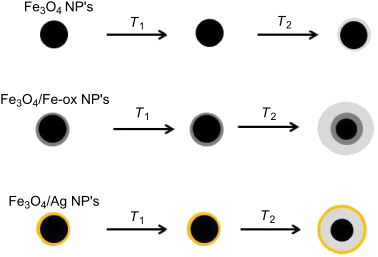
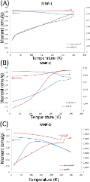
- thermal stability of the nanoparticles was tested. Before and after heat treatment, the nanoparticles were examined using transmission electron microscopy, IR spectroscopy, differential scanning calorimetry, X-ray diffraction and Mössbauer spectroscopy. Based on the obtained results, it was observed that
- materials, sensors and catalysts [4], or even environmental remediation or sieves [5]. For this reason, the study of the physical properties and the chemical and thermal stability of ferrite nanoparticles is of crucial importance [6]. Moreover, magnetite nanostructures can be relatively easy to obtain by a
- growth. On the other hand, it has been shown that for particular granular powders, the thermal stability increases with larger grain size [14]. These size-related effects are explained by enthalpy and stress, which influences the activation energy value [15]. Thermal sensitivity depends, in most cases




The convenient preparation of stable aryl-coated zerovalent iron nanoparticles
Beilstein J. Nanotechnol. 2015, 6, 1192–1198, doi:10.3762/bjnano.6.121
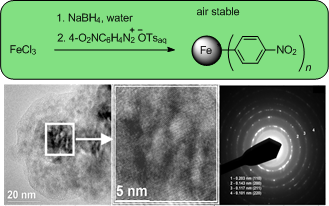
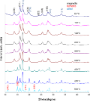
- the aryl layers and evolution of carbon dioxide registered by a mass spectroscopy (MS) detector. The resulting data suggests the formation of a multilayer coating on the NPs surface. The 4-nitrophenyl-coated ZVI NPs exhibited a high thermal stability and did not show any indication of oxidation at


Charge carrier mobility and electronic properties of Al(Op)3: impact of excimer formation
Beilstein J. Nanotechnol. 2015, 6, 1107–1115, doi:10.3762/bjnano.6.112
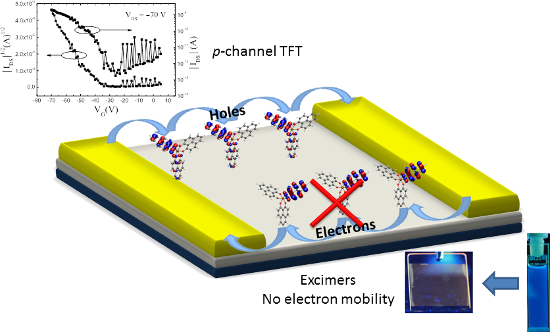
- similar trend in the HOMO energies of Al(Op)3 and Alq3, we could, based on this single molecule energy analogy, assume that Al(Op)3, when implemented in a device, would prevent hole diffusion in the same manner as Alq3. In order to confirm the thermal stability of Al(Op)3, the complex was deposited by


Structure and mechanism of the formation of core–shell nanoparticles obtained through a one-step gas-phase synthesis by electron beam evaporation
Beilstein J. Nanotechnol. 2015, 6, 874–880, doi:10.3762/bjnano.6.89
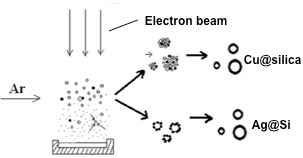
- components. These particles have been of interest as they can exhibit unique properties arising from the combination of core and shell material, geometry, and design [1][2]. Additionally, they have been designed so that the shell material can improve the reactivity, thermal stability, or oxidative stability


Transformation of hydrogen titanate nanoribbons to TiO2 nanoribbons and the influence of the transformation strategies on the photocatalytic performance
Beilstein J. Nanotechnol. 2015, 6, 831–844, doi:10.3762/bjnano.6.86
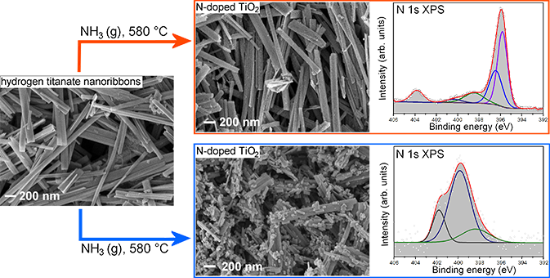
- A2TinO2n+1, form a variety of layered structures for 3 ≤ n ≤ 6 in which the alkali cations (A) occupy the interlayer space. Thus, located alkali cations are mobile and are easily exchanged by protons. The resulting hydrogen titanates have poor thermal stability and can be easily transformed to TiO2 upon




Conformal SiO2 coating of sub-100 nm diameter channels of polycarbonate etched ion-track channels by atomic layer deposition
Beilstein J. Nanotechnol. 2015, 6, 472–479, doi:10.3762/bjnano.6.48
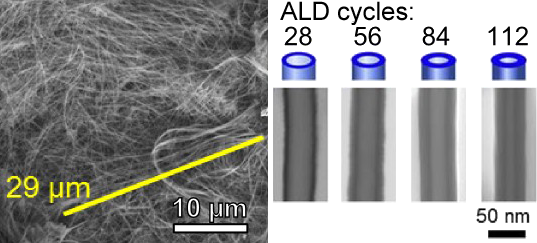
- surfaces, one must guarantee the thermal stability of the polymer. We thus developed a low-temperature process by using silicon tetrachloride (SiCl4) and water as precursors and pyridine as catalyst. For PC track-etched membranes this approach successfully produces uniform and conformal SiO2 coatings. To
- applying an ALD process at 325 K using SiCl4, water, and pyridine. The adjustment of the ALD process to almost ambient temperature guarantees the thermal stability of the PC membrane. FTIR and XPS analysis confirm the successful deposition of SiO2. HRSEM and SAXS investigations provide clear evidence of a


Release behaviour and toxicity evaluation of levodopa from carboxylated single-walled carbon nanotubes
Beilstein J. Nanotechnol. 2015, 6, 243–253, doi:10.3762/bjnano.6.23
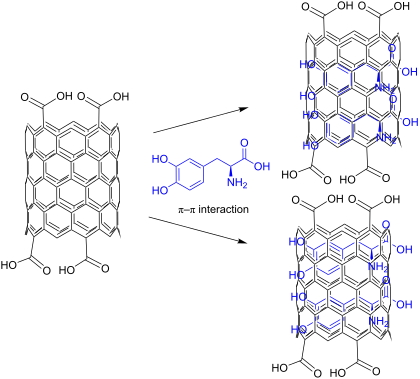
- intense research for theranostic delivery systems, especially in the field of cancer chemotherapy [7][8][9]. Their attractive properties such as good biocompatibility and excellent chemical and thermal stability ensure the stability and solubility of drugs in aqueous environments. Furthermore, their




Materials and characterization techniques for high-temperature polymer electrolyte membrane fuel cells
Beilstein J. Nanotechnol. 2015, 6, 68–83, doi:10.3762/bjnano.6.8
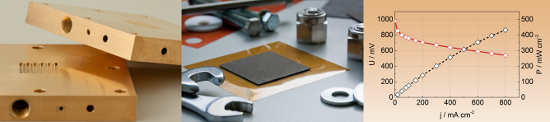
- for HT-PEMs, which is still one of the most promising concepts so far. PBI (poly[2,2'-(m-phenylene)-5,5'-bibenzimidazole]) itself is an aromatic heterocyclic polymer. The aromatic backbone provides excellent thermal stability with a glass transition temperature of 430 °C, good chemical resistance, and




Morphology, structural properties and reducibility of size-selected CeO2−x nanoparticle films
Beilstein J. Nanotechnol. 2015, 6, 60–67, doi:10.3762/bjnano.6.7
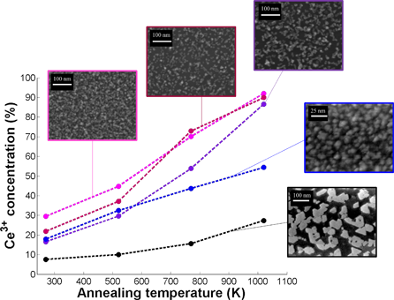
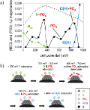
- structure by scanning electron microscopy (SEM) and high resolution transmission electron microscopy (HRTEM). The thermal stability of the NPs was investigated by XPS. The aim of this work is to investigate the fundamental relationship between NPs chemical and physical properties, in order to improve the


Liquid-phase exfoliated graphene: functionalization, characterization, and applications
Beilstein J. Nanotechnol. 2014, 5, 2328–2338, doi:10.3762/bjnano.5.242
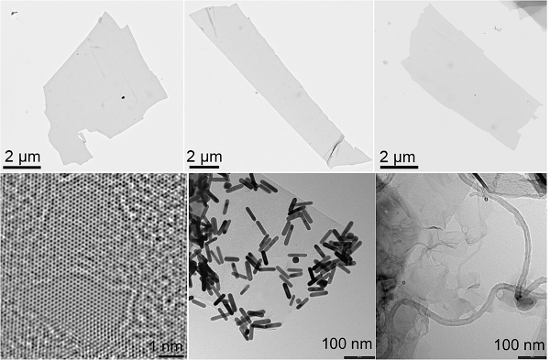
- exfoliation of graphite in water or polar solvents. This procedure yields stable solutions of negatively charged graphene sheets [13]. As charged, intercalating species, ionic liquids are considered a green alternative. The negligible vapour pressure, thermal stability, wide electrochemical potential window




In situ metalation of free base phthalocyanine covalently bonded to silicon surfaces
Beilstein J. Nanotechnol. 2014, 5, 2222–2229, doi:10.3762/bjnano.5.231
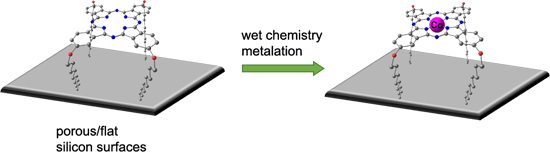
- Free (Pc) and metallophthalocyanines (M–Pc) are molecules of great interest because of their versatile optical and electronic properties as well as their thermal stability [1]. These properties make them attractive molecular materials for applications in photovoltaic cells [2], sensing devices [3][4

The influence of molecular mobility on the properties of networks of gold nanoparticles and organic ligands
Beilstein J. Nanotechnol. 2014, 5, 1664–1674, doi:10.3762/bjnano.5.177
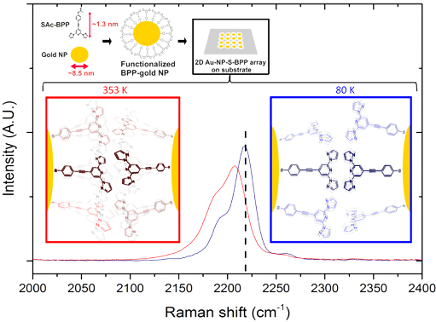
- provides additional experimental insight into the question of thermal stability of the nanoparticles architecture. Here, not only the S-BPP molecules, but also the nanoparticles are expected to play a role. At low temperatures, the thermal energy kBT becomes comparable to their charging energy EC = e2/2C




On the structure of grain/interphase boundaries and interfaces
Beilstein J. Nanotechnol. 2014, 5, 1603–1615, doi:10.3762/bjnano.5.172
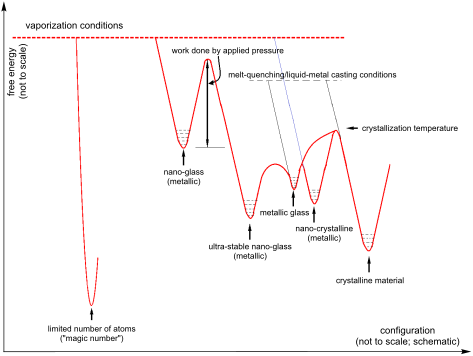
- % lower, but the enthalpy and the kinetic stability were higher compared with the melt-quenched glass variant. The rule of thumb that thermal stability is proportional to density is violated. (With a qualification “as long as the nature of the bonding between atoms does not change”, the above rule of