


Search results
Search for "Kalman filter" in Full Text gives 7 result(s) in Beilstein Journal of Nanotechnology.
Deep-learning recognition and tracking of individual nanotubes in low-contrast microscopy videos
Beilstein J. Nanotechnol. 2025, 16, 1316–1324, doi:10.3762/bjnano.16.96
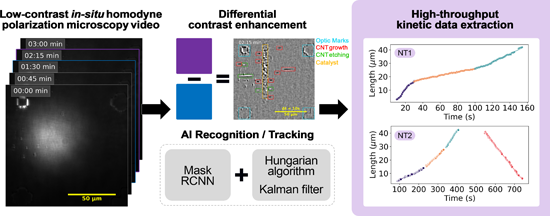
- by frame through the video. To extract the growth kinetics of each nanotube, the as-recognized objects were tracked using the Hungarian method [25] and Kalman filter (or linear quadratic estimation) [26], which are widely used for object tracking [27]. The Hungarian algorithm matched masks across
- clusters were then subjected to a Kalman filter to merge segments corresponding to the same nanotube (Supporting Information File 4). The information about tracked segments is entered into tables for final manual verification and labeling of events. This manual step remains essential due to the complexity
- of nanotube kinetics, which involves switches between growth, pauses, shrinkage, and structure change during growth [20]. Pauses (Figure 3c,d) cannot be efficiently traced by the Hungarian method or Kalman filter, necessitating manual verification to ensure correct assignment of newly grown segments


Measurement of electrostatic tip–sample interactions by time-domain Kelvin probe force microscopy
Beilstein J. Nanotechnol. 2020, 11, 911–921, doi:10.3762/bjnano.11.76
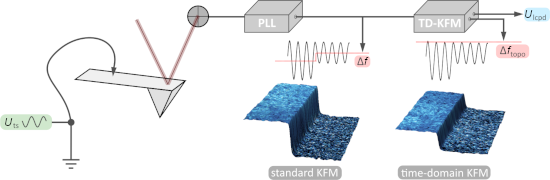
- Kalman filter; Kelvin probe force microscopy (KFM); time domain; Introduction Electrostatic forces are important interactions in non-contact atomic force microscopy (NC-AFM). They arise from differences in the work function of the tip and the sample, from trapped charges, or from potentials applied to
- . Another possibility for compensating the remaining frequency shift is the use of two-pass methods with feed-forward compensation techniques [20][21]. In this paper, we present a time-domain (TD) controller for KFM as a single-pass solution to the problem outlined above. Our method uses a Kalman filter as
- to the applied bias voltage. A state observer based on an extended Kalman filter is used to continuously fit the resulting parabola. The output of the time-based controller is an estimation of the topography-induced frequency shift Δftopo (which is not affected by Δfrem), the surface potential Ulcpd


A review of demodulation techniques for multifrequency atomic force microscopy
Beilstein J. Nanotechnol. 2020, 11, 76–91, doi:10.3762/bjnano.11.8

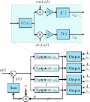
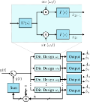
- multifrequency atomic force microscopy. The compared methods include the lock-in amplifier, coherent demodulator, Kalman filter, Lyapunov filter, and direct-design demodulator. Each method is implemented on a field-programmable gate array (FPGA) with a sampling rate of 1.5 MHz. The metrics for comparison include
- ; Kalman filter; Lyapunov filter; digital signal processing; field-programmable gate array (FPGA); Introduction Atomic force microscopy (AFM) [1] has enabled innovation in nanoscale engineering since it was invented in 1986 by Binnig and co-workers. Atomic-scale topographical resolution is achieved by
- [28][31]. Motivated by improving high-speed MF-AFM demodulation capabilities, a multifrequency Kalman filter was developed [32]. It outperformed a commercially available lock-in amplifier in terms of both tracking bandwidth and noise performance. However, a major disadvantage of the Kalman filter is


Lyapunov estimation for high-speed demodulation in multifrequency atomic force microscopy
Beilstein J. Nanotechnol. 2018, 9, 490–498, doi:10.3762/bjnano.9.47
- , previous work by the authors includes a multifrequency Kalman filter [24]. It was shown to outperform a commercially available LIA in terms of both tracking bandwidth and noise performance. However, a major disadvantage of the Kalman filter is the large computational expense of each additional frequency
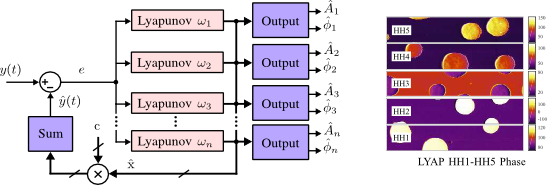
- modeled. This reduces its realizable performance through limitations of the sample rate. An estimator in the form of a Lyapunov filter [25] was demonstrated to perform similarly to the Kalman filter [26]. However, the Lyapunov filter complexity scales significantly better than the Kalman filter when
- in the combined output feedback as dictated by the output equation (Equation 6). The Lyapunov filters timing constraints for a five-frequency system result in a maximum sampling rate of fs = 3.5 MHz. This is a large improvement over the multifrequency Kalman filter [24], which was 1.5 MHz for a three





Combined scanning probe electronic and thermal characterization of an indium arsenide nanowire
Beilstein J. Nanotechnol. 2018, 9, 129–136, doi:10.3762/bjnano.9.15
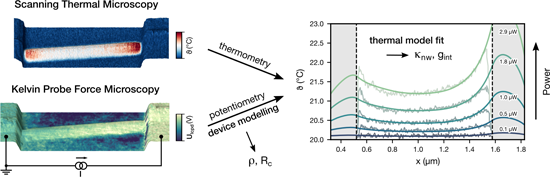
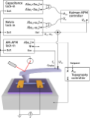
- ′′ and the KFM sensitivity. The feedback loop in our setup uses both pairs of sidebands and a Kalman filter to continuously estimate the surface potential and to avoid topographical artefacts [20]. Scanning thermal measurements of the InAs nanowire. (a) Setup for SThM measurements. (b) Topography and


A review of demodulation techniques for amplitude-modulation atomic force microscopy
Beilstein J. Nanotechnol. 2017, 8, 1407–1426, doi:10.3762/bjnano.8.142
- the signal has motivated the development of filters such as the time-varying Kalman filter [44] and Lyapunov filter [45][46]. These methods are based on a linear parametric model of the cantilever deflection signal and were shown to be extendable for the estimation of multiple frequencies for
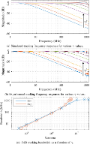
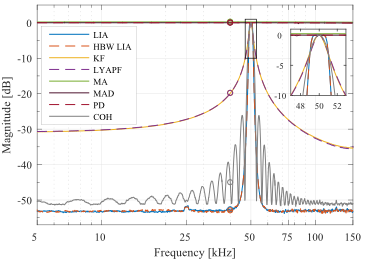
- -modulation AFM over their entire tracking bandwidth range. The methods considered are the lock-in amplifier, high-bandwidth lock-in amplifier, Lyapunov filter, Kalman filter, RMS-to-DC conversion (moving-average filter and mean absolute deviation computation), peak detector and coherent demodulator. To make
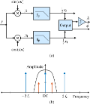
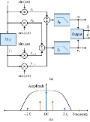
- ° phase-shift block H(s) as shown in Figure 4a. Such an operation can be realized with a Hilbert transform filter or an all-pass filter tuned to the carrier frequency [57]. Amplitude and phase are recovered by employing the output Equation 4 without an additional scaling factor. Kalman filter The Kalman




Kelvin probe force microscopy for local characterisation of active nanoelectronic devices
Beilstein J. Nanotechnol. 2015, 6, 2193–2206, doi:10.3762/bjnano.6.225
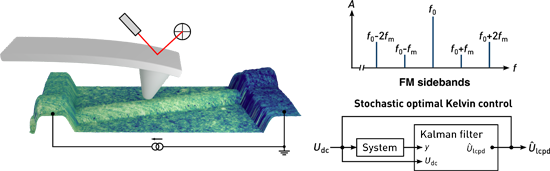
- superior resolution of FM-KFM while maintaining robust topography feedback and minimal crosstalk, we introduce a novel FM-KFM controller based on a Kalman filter and direct demodulation of sidebands. We discuss the origin of sidebands in FM-KFM irrespective of the cantilever quality factor and how direct
- modulation; Kalman filter; Kelvin probe force microscopy; sidebands; Introduction Device performance of current nanoelectronic devices, and even more so of potential future generations including nanowires or molecular junctions, critically depends on transport properties varying on a length scale of a few
- ] or fast scanning [39]. According to the separation principle [37], the optimal controller that minimises the expected error can be constructed by finding an optimal ‘observer’ and an optimal ‘regulator’. As an observer, we use a Kalman filter [40], which continuously blends the sideband measurements


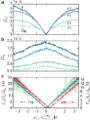
![[Graphic 33]](/bjnano/content/inline/2190-4286-6-225-i48.png?max-width=637&scale=1.18182) for different modulation amplitu...
for different modulation amplitu...




Other Beilstein-Institut Open Science Activities



