


Search results
Search for "built-in electric field" in Full Text gives 10 result(s) in Beilstein Journal of Nanotechnology.
Recent progress in enhancing built-in electric fields of perovskite solar cells via junction engineering
Beilstein J. Nanotechnol. 2026, 17, 602–621, doi:10.3762/bjnano.17.42
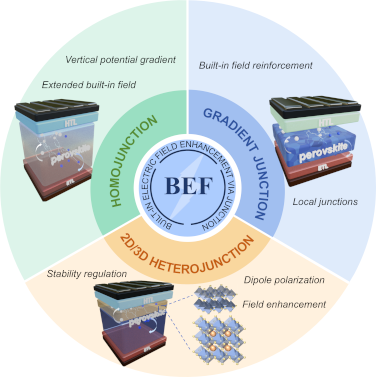
- Tong Xiao Ke Xu School of Electrical & Control Engineering, Shenyang Jianzhu University, Shenyang, China 10.3762/bjnano.17.42 Abstract The performance of perovskite solar cells (PSCs) is primarily governed by the built-in electric field (BEF), which dictates photocarrier separation, drift
- , optimizing the BEF provides a powerful lever for advancing power conversion efficiency, open-circuit voltage, and long-term operational stability in state-of-the-art PSCs, while avoiding the introduction of parasitic energy barriers. Keywords: band alignment; built-in electric field; carrier dynamics
- , carriers migrate at the interface through diffusion and drift, gradually establishing a built-in electric field (BEF) that aligns the Fermi levels on both sides. This field is not only the primary driving force that sustains carrier separation but also a direct determinant of device photovoltaic conversion


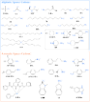

Dual-heterodyne Kelvin probe force microscopy
Beilstein J. Nanotechnol. 2023, 14, 1068–1084, doi:10.3762/bjnano.14.88




A self-powered, flexible ultra-thin Si/ZnO nanowire photodetector as full-spectrum optical sensor and pyroelectric nanogenerator
Beilstein J. Nanotechnol. 2020, 11, 1623–1630, doi:10.3762/bjnano.11.145
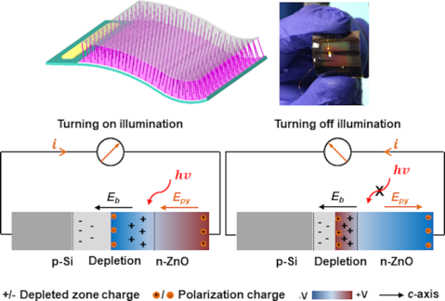
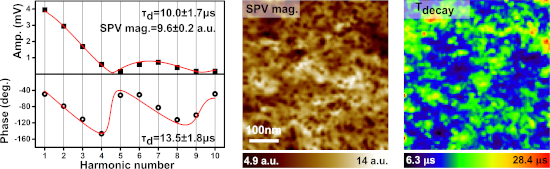
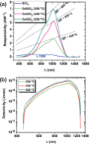
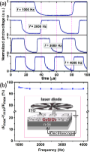
- curve. Working mechanism of PENGs. under zero bias, a depletion zone and corresponding built-in electric field are formed without illumination (left). Upon illumination, the pyroelectric electric field and transient output current are generated (middle). Reverse pyroelectric field and reverse transient


Multimodal noncontact atomic force microscopy and Kelvin probe force microscopy investigations of organolead tribromide perovskite single crystals
Beilstein J. Nanotechnol. 2018, 9, 1695–1704, doi:10.3762/bjnano.9.161
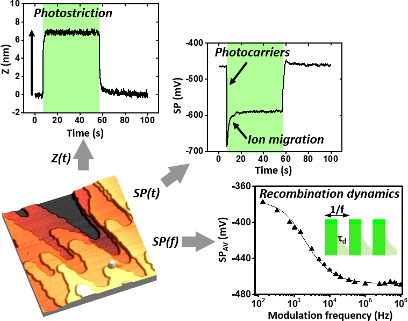
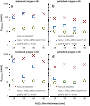
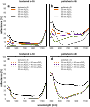
- single crystals [28]. Here, the band bending is due to the existence of surface states which are filled by forming a charge-depleted layer (also called a space-charge layer) beneath the surface [15]. The resulting internal built-in electric field induces a spatial separation of the photogenerated
- for systems where the bulk recombination is purely (or almost completely) bimolecular. This scenario is remarkably consistent with our previous deduction about the existence of surface states (which are here a key ingredient at the origin of the built-in electric field and photocarrier spatial
- carrier recombination dynamics in the bulk may strongly differ from the SPV decays probed by time-resolved KPFM. Let us remind the reader here that the SPV originates from spatially separated carriers due to the existence of a built-in electric field at the vicinity of the surface. In the future, it would


Cr(VI) remediation from aqueous environment through modified-TiO2-mediated photocatalytic reduction
Beilstein J. Nanotechnol. 2018, 9, 1448–1470, doi:10.3762/bjnano.9.137
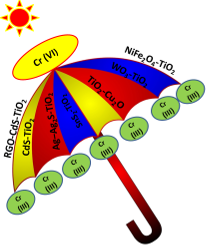
- on TiO2 nanoparticles to form TiO2/Cu2O nanocomposites, a p–n nano-heterojunction having a built-in electric field at the interfaces. This built-in electric field largely prevented the recombination of photoexcited charge carriers, resulting in increased lifetime of photocarriers, induced higher


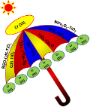
Nanostructured germanium deposited on heated substrates with enhanced photoelectric properties
Beilstein J. Nanotechnol. 2016, 7, 1492–1500, doi:10.3762/bjnano.7.142
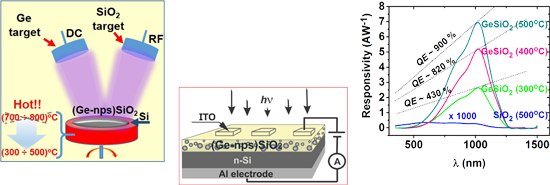
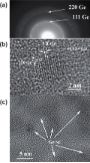
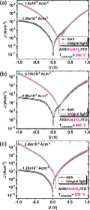
- the high-quality material with high crystallinity, a low density of trap centers, and a quick separation of huge amounts of photogenerated carriers by the built-in electric field formed at the SiO2/Ge interface. Conclusion In summary, deposition parameters have been optimized to nanostructure Ge:SiO2




Synthesis and applications of carbon nanomaterials for energy generation and storage
Beilstein J. Nanotechnol. 2016, 7, 149–196, doi:10.3762/bjnano.7.17
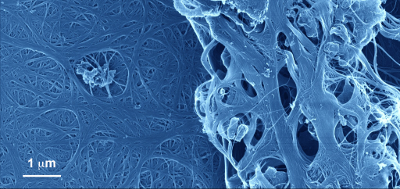
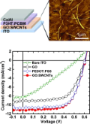
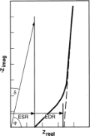
- bound state of an electron and a hole that are attracted to each other by the electrostatic Coulomb force. Its diffusion length is about 10 nm. Exciton separation at the interface between the donor and the acceptor. Because of the built-in electric field at the interface, the electron is transferred to















Graphene quantum interference photodetector
Beilstein J. Nanotechnol. 2015, 6, 726–735, doi:10.3762/bjnano.6.74
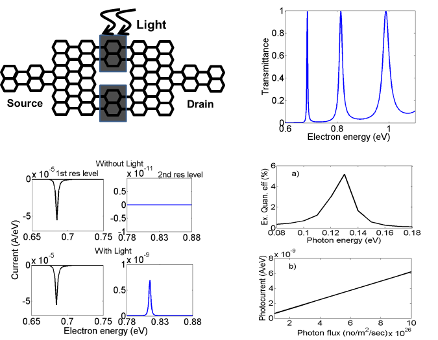
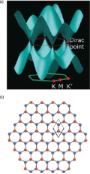
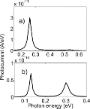
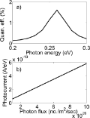
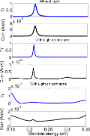
- generation mechanisms in graphene photodetectors include the photovoltaic effect, photothermoelectric effect, bolometric effect and phonon drag effect [3]. In the photovoltaic effect, the built-in electric field generated in the junction of p- and n-type graphene is utilized for separation of photogenerated
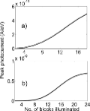
- electrons and holes. Photocurrent generation without a p–n junction and bias has also been demonstrated by utilizing the built-in electric field at the metal–graphene interface [20]. In this paper, we present the simulation results of two different approaches for an all-graphene (leads and device




Surface passivation and optical characterization of Al2O3/a-SiCx stacks on c-Si substrates
Beilstein J. Nanotechnol. 2013, 4, 726–731, doi:10.3762/bjnano.4.82
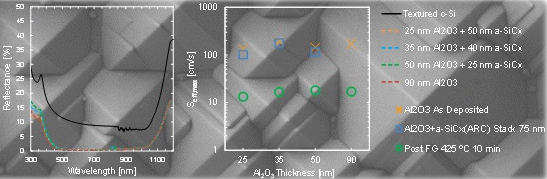
- widely reported [3][7][18][22], and it has been related to a lower Dit ≤ 1 × 10¹¹ eV−1cm−2 [17] combined with a higher concentration of fixed negative charges. The presence of these charges provides an electrostatic shielding due to a built-in electric field at the c-Si/Al2O3 interface [4][23]. Here, we

Kelvin probe force microscopy of nanocrystalline TiO2 photoelectrodes
Beilstein J. Nanotechnol. 2013, 4, 418–428, doi:10.3762/bjnano.4.49
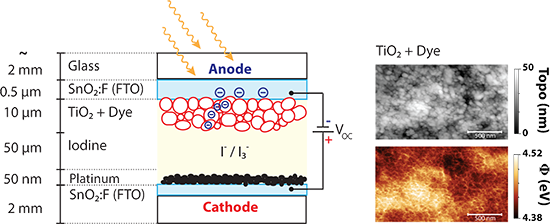
- that the SPV under sub-bandgap illumination results from a reduction of the built-in potential, Vbi, at the TiO2/SnO2-interface. This built-in electric field is screened by the photogenerated charge carriers resulting in a downward band bending of the TiO2 conduction band edge Ecb. The measured SPV of
- SPV spectroscopy on different locations. It is constant throughout the TiO2 layer and in agreement with literature values for bulk anatase. The measured SPV under sub-bandgap illumination is formed at the SnO2:F/TiO2 interface due to the presence of a built-in electric field. According to our results





