Search results
Search for "carbon cloth" in Full Text gives 14 result(s) in Beilstein Journal of Nanotechnology.
Photocatalytic degradation of ofloxacin in water assisted by TiO2 nanowires on carbon cloth: contributions of H2O2 addition and substrate absorbability
Beilstein J. Nanotechnol. 2025, 16, 1567–1579, doi:10.3762/bjnano.16.111
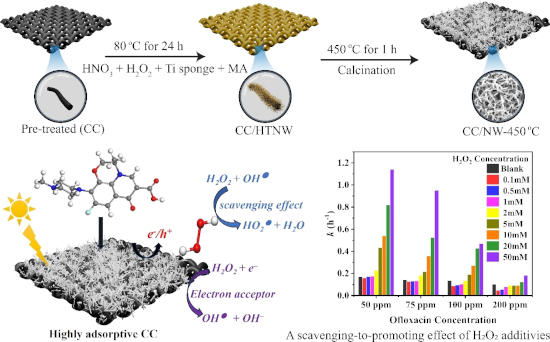
- unsatisfactory interaction with target contaminants diminishes photocatalytic degradation efficiency in water. Here, we present a mild solution method to precipitate anatase TiO2 nanowire arrays, measuring 1.5 μm in thickness, over carbon cloth to ensure substantial interactions with target pollutants and, in
- turn, a superior photoactivity. Compared to TiO2 nanowire arrays grown on metallic Ti substrates, TiO2 nanowires supported on carbon cloth substrates demonstrate markedly superior efficiency in the photocatalytic degradation of ofloxacin (OFL) molecules in water when exposed to UV light. The TiO2
- amount, below which a negative effect is noted. This investigation demonstrates the potential of improving the photoactivity of one-dimensional TiO2 nanostructures by utilizing a highly adsorptive substrate, which can help mitigate the effects of hazardous materials in water. Keywords: carbon cloth


Influence of laser beam profile on morphology and optical properties of silicon nanoparticles formed by laser ablation in liquid
Beilstein J. Nanotechnol. 2025, 16, 1533–1544, doi:10.3762/bjnano.16.108
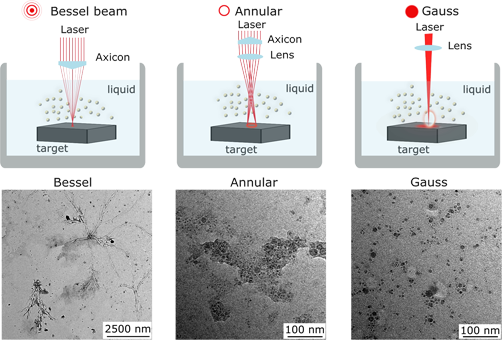
- as a supercapacitor electrode material are in progress. In these experiments, the fabricated Si NPs are deposited onto a carbon cloth and used as working electrodes in the three-electrode scheme. As shown in [50], the application of carbon cloth as a support material in supercapacitors demonstrated a
- number of benefits from the mechanical and chemical stability of the carbon cloth material, which, together with its low cost and large surface area, make it especially promising for the flexible devices. The results of these experiments are the subject of upcoming works. Conclusion In summary, laser


Facile one-step radio frequency magnetron sputtering of Ni/NiO on stainless steel for an efficient electrode for hydrogen evolution reaction
Beilstein J. Nanotechnol. 2025, 16, 837–846, doi:10.3762/bjnano.16.63
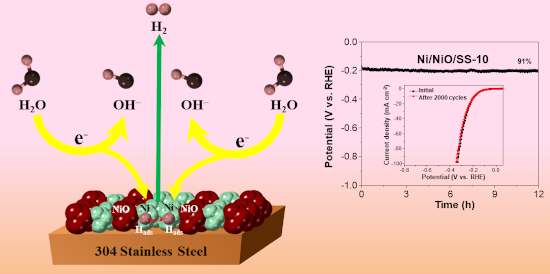
- substrates such as nickel foam (NF), carbon cloth, and fluorine-doped tin oxide [27][28][29]. Also, SS displays high electrical conductivity, outstanding chemical stability, and good mechanical properties. Therefore, numerous researchers have used SS as a template to deposit nanomaterials using various


Ni, Co, Zn, and Cu metal-organic framework-based nanomaterials for electrochemical reduction of CO2: A review
Beilstein J. Nanotechnol. 2023, 14, 904–911, doi:10.3762/bjnano.14.74
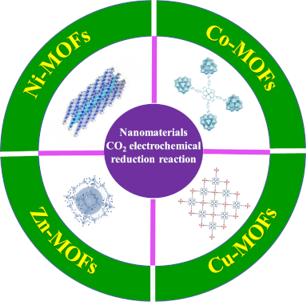
- catalyst for CO2RR. The author postulated that Co(II) is converted into Co(I), which acts as a redox center for the reduction of CO2 into CO (Figure 3c,d). Because of their poor conductivity, Co-MOFs are typically grown on conductive templates, such as fluorine-doped tin oxide (FTO), carbon cloth, and
- accessibility to active sites and unstable MOFs/substrate interfaces. Therefore, further studies are required to develop binder-free electrodes by in situ synthesis of MOFs on conductive substrates, such as nickel foam, copper foil, and carbon cloth, to overcome the aforementioned limitations and advancing the


Progress and innovation of nanostructured sulfur cathodes and metal-free anodes for room-temperature Na–S batteries
Beilstein J. Nanotechnol. 2021, 12, 995–1020, doi:10.3762/bjnano.12.75
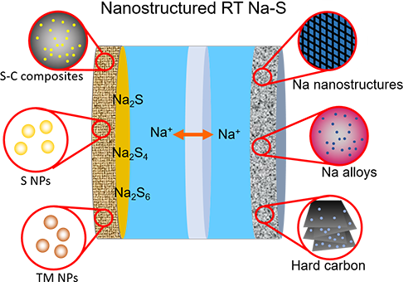
- in a carbon cloth as sulfur host and Na2S6 catholyte as active material, that showed a reversible capacity of 610 mAh·g−1 after 500 cycles at 0.2 A·g−1. Likewise, a cathode where sulfur is used as the core layer and MoO3 is used as the catalytic shell layer was designed by Vijaya Kumar Saroja and co





Nickel nanoparticles supported on a covalent triazine framework as electrocatalyst for oxygen evolution reaction and oxygen reduction reactions
Beilstein J. Nanotechnol. 2020, 11, 770–781, doi:10.3762/bjnano.11.62
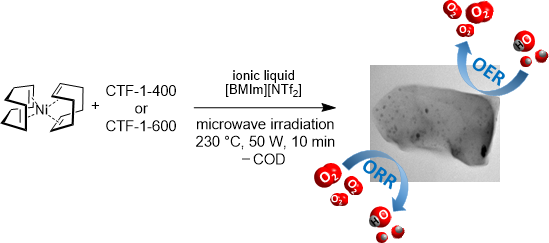
- on carbon cloth [56]. Similarly, Ni(OH)2 nanoparticles have an overpotential of only 299 mV to reach 10 mA/cm2 (vs RHE) [55]. But this value increases to 462 mV for Ni(OH)2 grown on carbon cloth [56]. Thus, the high electrocatalytic activity of the bare CTF-1-600 support is adversely affected by the


High-performance asymmetric supercapacitor made of NiMoO4 nanorods@Co3O4 on a cellulose-based carbon aerogel
Beilstein J. Nanotechnol. 2020, 11, 240–251, doi:10.3762/bjnano.11.18
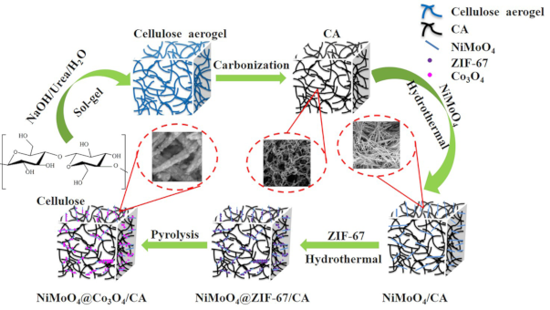
- construction of an integrated hierarchical porous nanoarchitecture by combining two metal oxides is a brilliant way to greatly enhance the overall electrochemical performance owing to synergistic effects [20]. For example, Li et al. synthesized 3D hybrid Co3O4/NiMoO4 nanowire/nanosheet arrays on a carbon cloth





Facile synthesis of carbon nanotube-supported NiO//Fe2O3 for all-solid-state supercapacitors
Beilstein J. Nanotechnol. 2019, 10, 1923–1932, doi:10.3762/bjnano.10.188
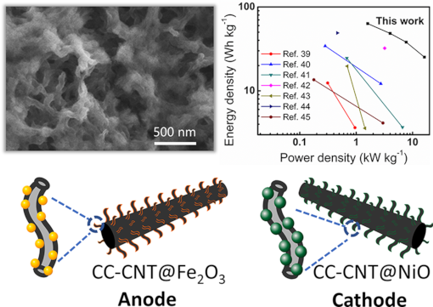
- Education, School of Physical Science and Technology, Lanzhou University, Lanzhou 730000, China 10.3762/bjnano.10.188 Abstract We have successfully prepared iron oxide and nickel oxide on carbon nanotubes on carbon cloth for the use in supercapacitors via a simple aqueous reduction method. The obtained
- carbon cloth–carbon nanotube@metal oxide (CC-CNT@MO) three-dimensional structures combine the high specific capacitance and rich redox sites of metal oxides with the large specific area and high electrical conductivity of carbon nanotubes. The prepared CC-CNT@Fe2O3 anode reaches a high capacity of 226
- Fe2O3 on a carbon cloth–carbon nanotubes (CC-CNT) substrate with NaBH4 as reductant and ferric chloride as the reactant. NaBH4 is an active reducing agent with which most metal chlorides can be reduced to metal [22][23][24] and then be oxidized in air to form CNT@metal oxide composites. We also adapted


Hierarchically structured 3D carbon nanotube electrodes for electrocatalytic applications
Beilstein J. Nanotechnol. 2019, 10, 1475–1487, doi:10.3762/bjnano.10.146
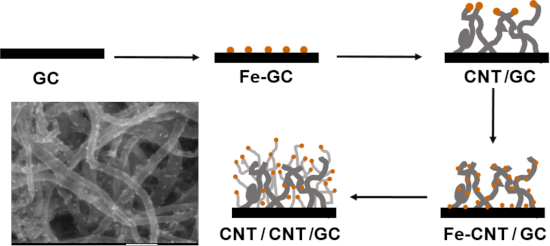
- that the density and diameter of CNTs synthesized on carbon cloth with ethylene as the carbon precursor over a nickel catalyst at 700 °C decrease with decreasing ratio of H2 to N2 [62], while CNTs grown on an Fe-decorated Si wafer at 825 °C using toluene increased in density and diameter with
- hybrid material on carbon cloth (101.52 mA mg−1Pt), and the Pt-surface specific peak current was two times higher than that of Pt-graphene/CNT on carbon cloth (0.34 mA cm−2Pt) reported previously [79], indicating that the introduction of secondary CNTs may provide a similar or superior beneficial effect





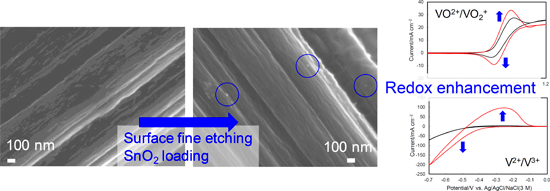
Concurrent nanoscale surface etching and SnO2 loading of carbon fibers for vanadium ion redox enhancement
Beilstein J. Nanotechnol. 2019, 10, 985–992, doi:10.3762/bjnano.10.99
- carbon cloth (ElectroChem). The reference electrode was Ag/AgCl/NaCl (3 M) (0.212 V vs standard hydrogen electrode). The electrolytes were H2SO4 (2 M) and VOSO4 (1 M)/H2SO4 (2 M). The measurements were carried out under Ar atmosphere at 25 °C. A flow cell test was performed using three layers of 3 cm2 of
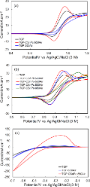
- -550Air, and TGP-550Air. Cyclic voltammograms in Ar-saturated 2 M H2SO4 at 25 °C for TGP, TGP-550Air, and TGP-CSnPc-TAir (T = 500, 550, 600 and 650 °C). The reference electrode was Ag/AgCl/NaCl (3 M). The counter electrode was carbon cloth. Scan rate: 50 mV·s−1. Cyclic voltammograms in 1 M VOSO4 + 2 M
- H2SO4 at 25 °C for (a,b) VO2+/VO2+, (c) V2+/3+ redox reactions at TGP, TGP-550Air, TGP-CSnPc-TAir (T =500, 550, 600 and 650 °C). The reference electrode was Ag/AgCl/NaCl (3 M). The counter electrode was carbon cloth. Scan rates were (a,b) 1 mV·s−1 and (c) 50 mV·s−1. Charge–discharge curves and cycling



An efficient electrode material for high performance solid-state hybrid supercapacitors based on a Cu/CuO/porous carbon nanofiber/TiO2 hybrid composite
Beilstein J. Nanotechnol. 2019, 10, 781–793, doi:10.3762/bjnano.10.78
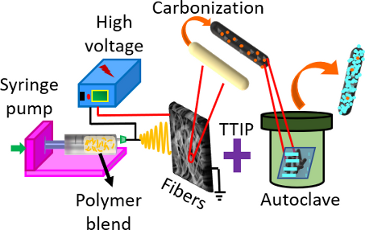
- . For the two-electrode configuration, a symmetric solid-state hybrid supercapacitor (SSHSC) was fabricated using the Cu/CuO/PCNF/TiO2 composite as an active electrode material coated on a carbon cloth (2 × 2 cm2), PVA/H2SO4 polymer gel electrolyte, separator of polypropylene sheet. The preparation of


Hydrogen-induced plasticity in nanoporous palladium
Beilstein J. Nanotechnol. 2018, 9, 3013–3024, doi:10.3762/bjnano.9.280
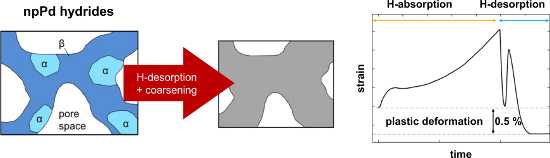
- KOH aqueous solution. For electrochemical characterisation a porous carbon cloth was used as counter electrode. In order to assure measurement stability a pre-treatment consisting of five voltammetric cycles was applied at a scan rate of 0.1 mV·s−1 in a potential window between −1 V and 0.4 V. All


Materials and characterization techniques for high-temperature polymer electrolyte membrane fuel cells
Beilstein J. Nanotechnol. 2015, 6, 68–83, doi:10.3762/bjnano.6.8
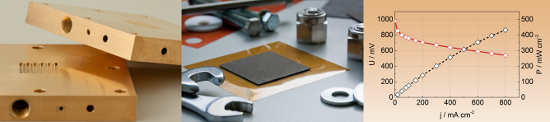
- between the fiber bundles of the carbon cloth. To validate the technique, the authors also quantified the amount of acid of the cell using both viewing directions. Despite some minor discrepancy between though-pane and in-plane imaging directions, the quantitative analysis agreed quite well with the




Liquid fuel cells
Beilstein J. Nanotechnol. 2014, 5, 1399–1418, doi:10.3762/bjnano.5.153
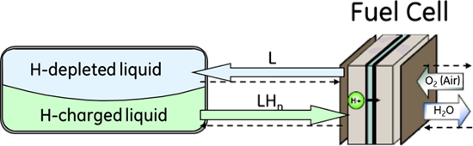
- % NaBH4 in the anolyte and with 2 M H2O2 in 1.5 M H2SO4 in the catholyte [176]. A similar composition of fuel (10 wt % NaBH4 in 20 wt % NaOH, 15 wt % H2O2 in 1 M sulfuric acid) produced 410 mW/cm2 at 80 °C [177]. The sputtering of metals on a carbon cloth provides well-dispersed nanoscale particles with