Search results
Search for "co-doping" in Full Text gives 20 result(s) in Beilstein Journal of Nanotechnology.
Synthesis of Cu–Mo/TiO2 and Co–Mo/TiO2 photocatalysts for the efficient degradation of organic pollutants in water
Beilstein J. Nanotechnol. 2026, 17, 559–570, doi:10.3762/bjnano.17.37
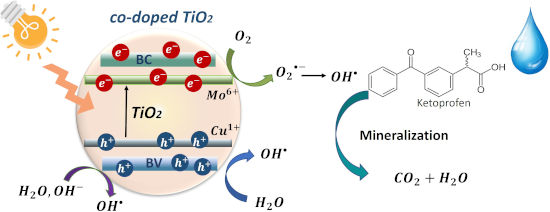
- the complete degradation of ketoprofen and 90% of mineralization. It was determined that HO· radicals play an important role in the oxidation reactions. Keywords: co-doping; photocatalysis; titanium dioxide; water remediation; Introduction Water is an essential part of every living entity
- new bands generated by doping can be passivated, and they will not act as charge recombination centers if the semiconductor oxide is co-doped with two different elements [5]. TiO2 co-doping can be achieved by incorporating combinations of metal/metal, non-metal/metal, and non-metal/non-metal dopants
- lattice and the effects on photocatalytic performance have been reported in several studies [7][8][9][10]. Crucial factors for successfully co-doping a material are the selection of compatible co-dopants and the synthesis method to introduce the dopants [11]. The main objective of working with metal/metal



Optical bio/chemical sensors for vitamin B12 analysis in food and pharmaceuticals: state of the art, challenges, and future outlooks
Beilstein J. Nanotechnol. 2025, 16, 2207–2244, doi:10.3762/bjnano.16.153


Emerging strategies in the sustainable removal of antibiotics using semiconductor-based photocatalysts
Beilstein J. Nanotechnol. 2025, 16, 264–285, doi:10.3762/bjnano.16.21
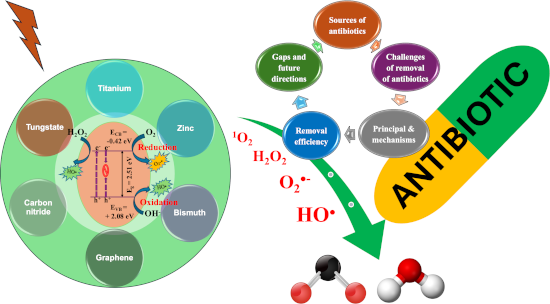
- CB of the material [58][59]. This action serves to reduce the bandgap, which in turn extends the absorption wavelength edge towards the region of visible light [60][61]. The idea of modifying semiconductor materials in the second generation involves the process of co-doping with both metal and



Recent advances in green carbon dots (2015–2022): synthesis, metal ion sensing, and biological applications
Beilstein J. Nanotechnol. 2022, 13, 1068–1107, doi:10.3762/bjnano.13.93
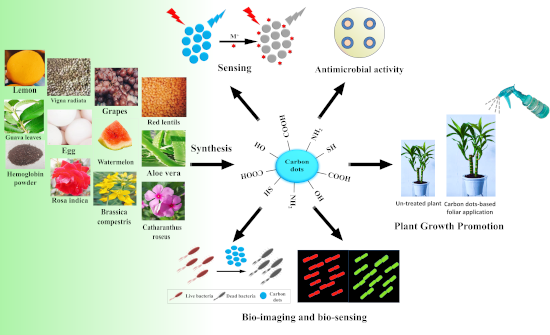
- CDs containing surfactants that contain nitrogen, phosphorus, or sulfur [16][88]. Usually, CDs synthesized from a single precursor without any doping agent have low QYs and are inadequate for bioimaging and other applications. Numerous researches claim that co-doping, or the simultaneous doping of two
- or more distinct atoms, can mitigate the drawbacks of CDs. The optical characteristics and applications of CDs may be enhanced by doping them with nitrogen, sulfur, and other elements. Due to the synergistic interaction between the doped heteroatoms in CDs, the co-doping with heteroatoms has started




Boosting of photocatalytic hydrogen evolution via chlorine doping of polymeric carbon nitride
Beilstein J. Nanotechnol. 2021, 12, 473–484, doi:10.3762/bjnano.12.38
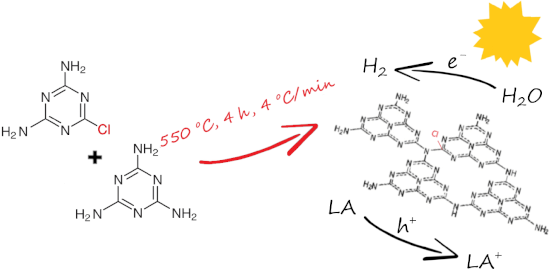
- . studied the photoactivity of PCN doped with S in the CO2 reduction reaction. The yield of CH3OH over the unit area of the photocatalyst was almost 2.5 times higher than of pristine PCN [35]. Recently, co-doping of g-C3N4 with two non-metallic elements has been also studied. This strategy can enhance


Structural and electronic properties of SnO2 doped with non-metal elements
Beilstein J. Nanotechnol. 2020, 11, 1321–1328, doi:10.3762/bjnano.11.116
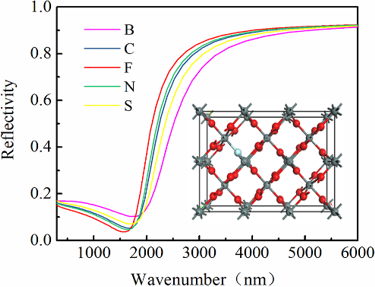
- successfully prepared from N-doped SnO2 films. Through Al/N co-doping, a p-type SnO2 semiconductor thin film with excellent electrical properties was prepared. The resistivity, hole concentration and hole mobility were 7.1 × 10⁻³ Ω·cm, 6.24 × 1019 cm−3 and 14.1 cm2·V−1·s−1, respectively [8]. Doping SnO2 with F



Synthesis of P- and N-doped carbon catalysts for the oxygen reduction reaction via controlled phosphoric acid treatment of folic acid
Beilstein J. Nanotechnol. 2019, 10, 1497–1510, doi:10.3762/bjnano.10.148
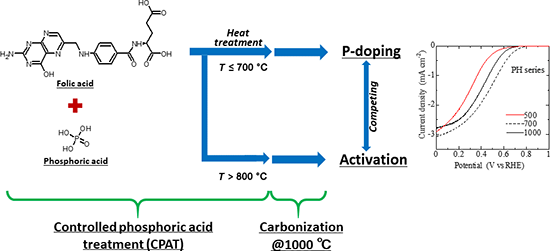
- acid solution [11], and since then, much attention has been directed at the activation of carbon catalysts through co-doping [18]. The concept of co-doping has been even extended to three-component catalysts, as exemplified by studies on N, P, S-doped and N, P, F-doped carbon materials [19][20
- , co-doping with P and N was found to be an effective way of increasing the ORR activity of carbon materials [22][23][24][25][26]. Most of the reported PN-doping techniques involve the carbonization of [N-containing polymer + P-containing compound] mixtures or of ionic liquids containing both N and P
- 400 °C, precursor co-doping with N and P atoms was promoted at 400–700 °C, and the increase of BET-SSA accompanied by the decrease of N and P content was promoted above 800 °C. As a result, maximum N and P contents were obtained at a CPAT temperature of 700 °C. This behavior agreed with the results of





The effect of magneto-crystalline anisotropy on the properties of hard and soft magnetic ferrite nanoparticles
Beilstein J. Nanotechnol. 2019, 10, 1348–1359, doi:10.3762/bjnano.10.133
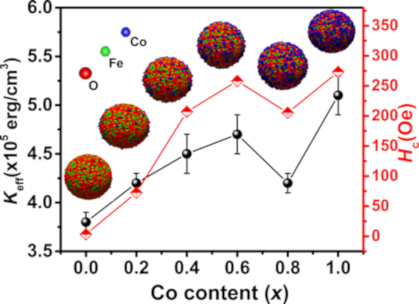
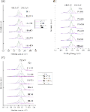
- anisotropy and magnetic interactions on properties of magnetic nanoparticles, in this work, a series of CoxFe3−xO4 (0 ≤ x ≤ 1) NPs was synthesized using a co-precipitation method. The effect of Co doping on the structural, magnetic and hyperthermia properties of CoxFe3−xO4 nanoparticles has been studied. We
- Co doping on the average crystallite size was studied using the Scherrer equation: where ⟨D⟩XRD is the average crystallite size, K ≈ 0.9 is the Scherrer constant and β is the full width at half-maximum (FWHM) of the XRD peaks. Table 1 shows that the crystallite size increases with increasing cobalt
- ILP decrease with increasing cobalt content. This is because in the samples containing cobalt (Hc > H) the system exhibits minor loops with a slight hysteresis losses. Conclusion In the present paper, we studied the effect of Co doping on the structural, magnetic and hyperthermia properties of CoxFe3


Luminescence of Tb3Al5O12 phosphors co-doped with Ce3+/Gd3+ for white light-emitting diodes
Beilstein J. Nanotechnol. 2019, 10, 1237–1242, doi:10.3762/bjnano.10.123
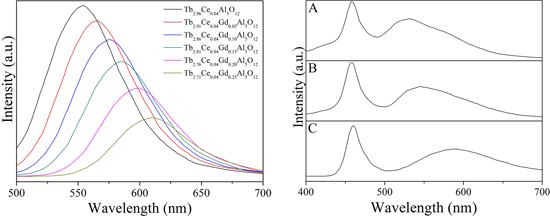
- wavelength at about 554 nm. After co-doping Gd3+ into Tb2.96Ce0.04Al5O12, the peak wavelength of the Ce3+ emission band shifts to longer wavelengths, which is induced by the increasing crystal field splitting. However, the Ce3+ emission intensity also decreases because the substitution of Tb3+ with Gd3
- that Tb3Al5O12 is also a good host for various ions and the luminescent properties could be tuned by co-doping different ions into the Tb3Al5O12 host. The Tb3Al5O12:Ce3+ phosphor also shows a yellow emission band. But the emission wavelength is longer than that of the Y3Al5O12:Ce3+ phosphor because Tb3
- longer than 611 nm [9]. We aimed to shift the emission wavelength of Tb3Al5O12:Ce3+ to a longer wavelength that is, however, still shorter than 611 nm. In this work, we report the synthesis and luminescence of a series of Ce3+/Gd3+-co-doped Tb3Al5O12 phosphors. The effect of co-doping Gd3+ on the


Photoactive nanoarchitectures based on clays incorporating TiO2 and ZnO nanoparticles
Beilstein J. Nanotechnol. 2019, 10, 1140–1156, doi:10.3762/bjnano.10.114
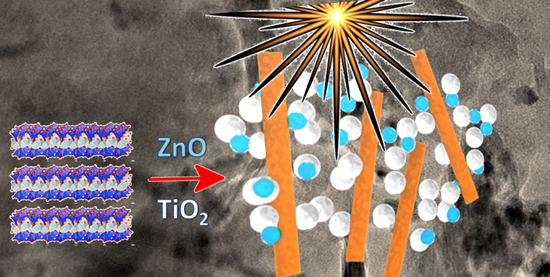
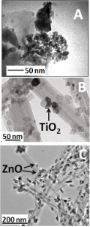
- 2.25 eV, corresponding to a light wavelength of 550 nm suitable for a photocatalyst responsive to visible light was reported. The co-doping of N and S [149] and Cu, Ag, and Fe on TiO2@bentonite has also been reported [150]. Other authors also reported the modification of the photoactivity



Porous N- and S-doped carbon–carbon composite electrodes by soft-templating for redox flow batteries
Beilstein J. Nanotechnol. 2019, 10, 1131–1139, doi:10.3762/bjnano.10.113
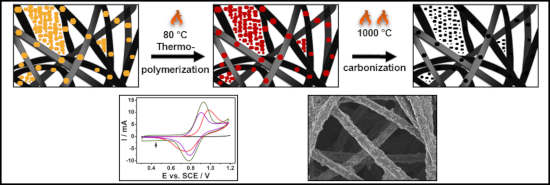
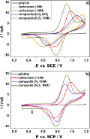
- functionality. Results and Discussion For the synthesis of nitrogen-doped carbon composite electrodes phloroglucinol was suggested as a carbon source whereas pyrrole-2-carboxaldehyde was utilized as a nitrogen source and the block copolymer Pluronic® F-127 was used as porogen. In the co-doping process
- can be observed. While the fibers of the co-doped composite electrode are covered completely and the space between fibers is filled up almost completely, the N-doped felt exhibits only partial coverage. It seems as if the carbon coating sticks more readily to the fibers after co-doping. But so far, we
- have not come up with a reasonable explanation for this observation. Elemental mapping by scanning EDS was performed to investigate whether the co-doping was homogeneous and the results are shown in Figure 3. The co-doped composite felt contains significant quantities of carbon, nitrogen, oxygen and



Co-doped MnFe2O4 nanoparticles: magnetic anisotropy and interparticle interactions
Beilstein J. Nanotechnol. 2019, 10, 856–865, doi:10.3762/bjnano.10.86
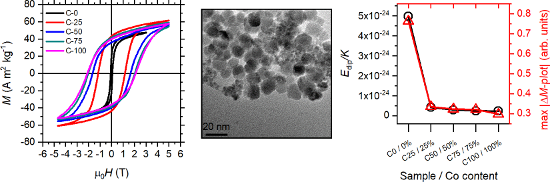
- , the effect of the chemical composition, i.e., the amount of Co doping, produces marked differences on the magnetic properties, especially on the magnetic anisotropy, with evident large changes in the coercive field. Moreover, Co substitution has a profound effect on the interparticle interactions, too
- equal for all the samples, which indicate that Co doping does not induce any significant structural variation. However, the obtained values (about 8.34 Å) are smaller than those reported for bulk CoFe2O4 (8.38 Å) and MnFe2O4 (8.51 Å) [24]. This can be justified by the effect of the cationic distribution
- anisotropy of single particles produced by the Co doping reduces the effective coupling. When the anisotropy is small, the interactions can exert the strongest effect. This leads to the spinglass-like interacting regime observed in C0, owning this sample the smallest anisotropy. These results illustrate that


Impact of the anodization time on the photocatalytic activity of TiO2 nanotubes
Beilstein J. Nanotechnol. 2018, 9, 2628–2643, doi:10.3762/bjnano.9.244
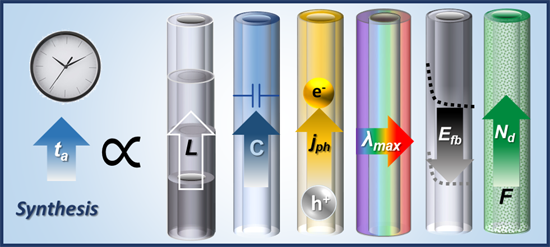
- ] observed that a water-based electrolyte containing NH4F induced a co-doping with F and N in the TNTs. Their study suggested that a combination of applied potential and annealing temperature were responsible for the high photocatalytic activity (PCA) of their materials in the oxidation of methyl orange. In
- ][41]. These observations are relevant to our study since the presence of both F and N signals suggests a co-doping effect, as shown in Figure S1a (Supporting Information File 1). Moreover, the modification of the bandgap can be ascribed to the doping effect and will be discussed in the following


Metal-free catalysis based on nitrogen-doped carbon nanomaterials: a photoelectron spectroscopy point of view
Beilstein J. Nanotechnol. 2018, 9, 2015–2031, doi:10.3762/bjnano.9.191
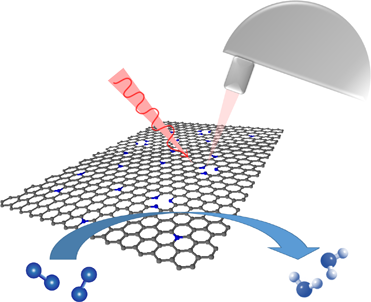
- paragraph. The increasing interest in new functionalization strategies of carbon nanomaterials have been triggered by the wide range of potential applications. Co-doping After the reports on the catalytic performance of nitrogen-doped carbon nanomaterials for the ORR, the scientific interest turned to the
- possibility of co-doping the carbon nanomaterials with nitrogen and another element aiming at a further enhancement of those properties through synergistic effects. The first report showing co-doping to enhance the metal-free catalytic activities of carbon-based catalysts dates back to 2011 and it is based on




Sulfur-, nitrogen- and platinum-doped titania thin films with high catalytic efficiency under visible-light illumination
Beilstein J. Nanotechnol. 2018, 9, 1629–1640, doi:10.3762/bjnano.9.155
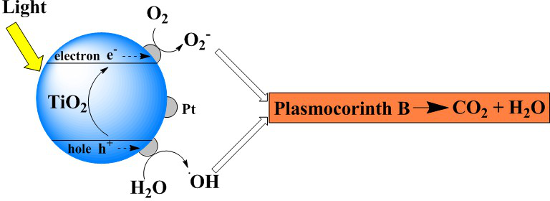
- photocatalytic activity under a broader solar spectrum: doping with metals [23][24][25][26], nonmetals [27][28][29][30] and co-doping [31][32]. When doping with metals, they act as a free electron trap and thereby prevent electron–hole recombination, which results in enhanced photocatalytic activity of the


Cr(VI) remediation from aqueous environment through modified-TiO2-mediated photocatalytic reduction
Beilstein J. Nanotechnol. 2018, 9, 1448–1470, doi:10.3762/bjnano.9.137
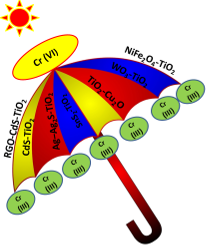
- , nonmetals and co-doping [85][86][87][88], (ii) coupling of photosensitized nanomaterials [89], (iii) combination of heterojunction materials [90] and (iv) introduction of plasmonic photocatalysts for hot electron generation [62][76]. The modification of TiO2 induces the enhancement of photocatalytic


Low-temperature CO oxidation over Cu/Pt co-doped ZrO2 nanoparticles synthesized by solution combustion
Beilstein J. Nanotechnol. 2017, 8, 1546–1552, doi:10.3762/bjnano.8.156

- + ions dissolve into the ZrO2 lattice. Due to the smaller ionic radii of Cu2+ and Pt2+, the structure of ZrO2 lattice shrinks during replacement of Zr4+ by Cu2+ and Pt2+ ions. This results in the generation of oxygen vacancies (source of oxygen in CO oxidation) and confirms the co-doping of Cu and Pt


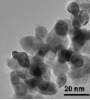


Calcium fluoride based multifunctional nanoparticles for multimodal imaging
Beilstein J. Nanotechnol. 2017, 8, 1484–1493, doi:10.3762/bjnano.8.148
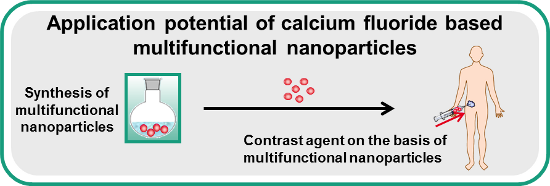
- is to create multifunctional NPs by precipitation and simultaneous doping of the NP matrix with various ions [8][9]. Due to their co-doping with lanthanide ions, NPs on the basis of calcium phosphate or gadolinium oxide are also detectable by MRI and PL [10][11][12][13]. In recent years, fluorides


Paramagnetism of cobalt-doped ZnO nanoparticles obtained by microwave solvothermal synthesis
Beilstein J. Nanotechnol. 2015, 6, 1957–1969, doi:10.3762/bjnano.6.200
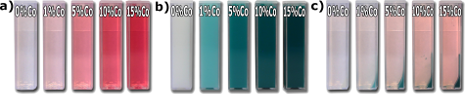
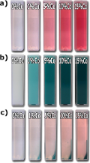
- +, (d) 10 mol % of Co2+, and (e) 15 mol % of Co2+ ions. Dependence between the nominal and experimental Co doping concentration for the samples before annealing. (a) Photographs of the Zn1−xCoxO precursor in ethylene glycol where the color varies with the composition. (b) Photographs of nanoparticle




Nanostructure sensitization of transition metal oxides for visible-light photocatalysis
Beilstein J. Nanotechnol. 2014, 5, 696–710, doi:10.3762/bjnano.5.82
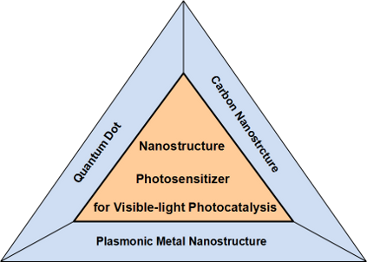
- -metal doping. We investigated a range of non-metal doping such as N, S, I and even S, N co-doping, in a serial of ion-exchangeable semiconductors [140][141][142][143][144]. It was found that homogeneous doping can be more easily realized on ion-exchangeable semiconductors than on bulk crystal