Search results
Search for "electron energy loss spectroscopy" in Full Text gives 48 result(s) in Beilstein Journal of Nanotechnology.
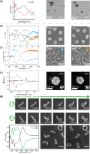
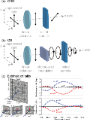
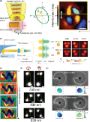
Chiral plasmonic nanostructures fabricated with circularly polarized light
Beilstein J. Nanotechnol. 2025, 16, 2245–2264, doi:10.3762/bjnano.16.154
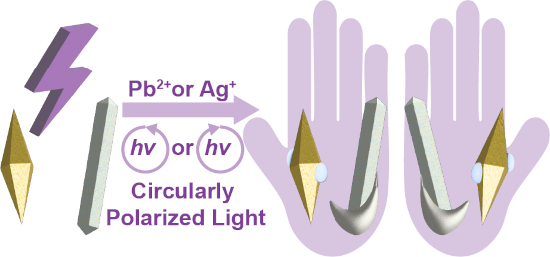
- field. This section will cover the experimental methods for observing the near fields of cPNSs. Advanced techniques, such as near-field scanning optical microscopy (NSOM), cathodoluminescence (CL), electron energy loss spectroscopy (EELS), and photoemission electron microscopy (PEEM), offer spatial





Evaluating metal-organic precursors for focused ion beam-induced deposition through solid-layer decomposition analysis
Beilstein J. Nanotechnol. 2025, 16, 1942–1951, doi:10.3762/bjnano.16.135
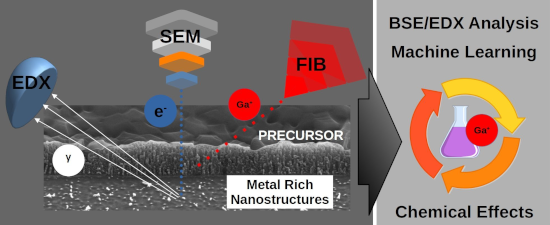
- adsorbed on the surface, such as electron-stimulated desorption, high-resolution electron energy loss spectroscopy, and focused electron beam secondary ion mass spectrometry [5]. To characterize compounds in terms of their applicability in the FIBID process, comparisons are made with the FEBID process, and


Crystalline and amorphous structure selectivity of ignoble high-entropy alloy nanoparticles during laser ablation in organic liquids is set by pulse duration
Beilstein J. Nanotechnol. 2025, 16, 1141–1159, doi:10.3762/bjnano.16.84
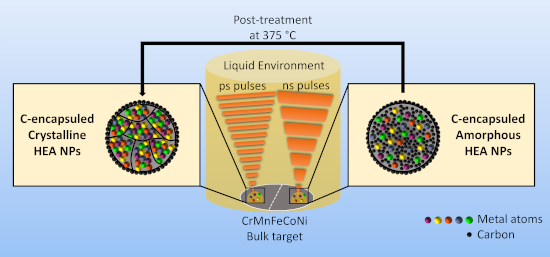
- solution; EELS; electron energy loss spectroscopy; laser processing in liquids; multicomponent alloy; STEM-EDX; selected area electron diffraction; X-ray diffraction; Introduction High-entropy alloys (HEAs), also referred to as compositionally complex solid solutions (CCSS) [1], are of great interest in
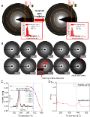
- . Nanoparticle characterization is done by high-resolution transmission electron microscopy (HRTEM), energy-dispersive X-ray spectroscopy (STEM-EDX), selected-area electron diffraction (SAED), X-ray diffraction (XRD), and electron energy loss spectroscopy (EELS), complemented by tempering and laser post
- in organic solvents (acetone, ethanol, acetonitrile). In a systematic experimental series using high-resolution transmission electron microscopy, scanning transmission electron microscopy with energy-dispersive X-ray spectroscopy, selected-area electron diffraction, X-ray diffraction, electron energy




TEM sample preparation of lithographically patterned permalloy nanostructures on silicon nitride membranes
Beilstein J. Nanotechnol. 2024, 15, 1–12, doi:10.3762/bjnano.15.1
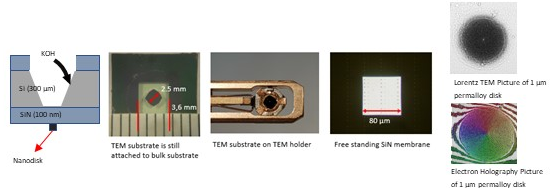
- Lorentz microscopy and electron holography, along with simultaneous structural and chemical characterization techniques such as electron diffraction, 4D STEM, and energy-dispersive X-ray (EDX) and electron energy loss spectroscopy (EELS), enable a correlative characterization to investigate magnetic


Carboxylic acids and light interact to affect nanoceria stability and dissolution in acidic aqueous environments
Beilstein J. Nanotechnol. 2023, 14, 762–780, doi:10.3762/bjnano.14.63
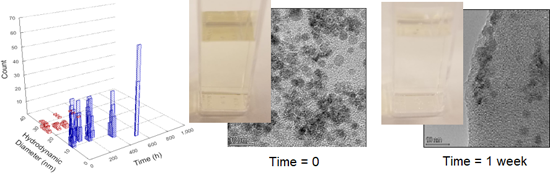
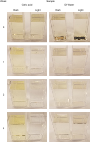
- ; however, after twelve weeks, an increase in the electron energy loss spectroscopy M5 peak, corresponding to an increase in the Ce3+ valence state, is apparent. DLS analysis DLS results of the 20 chemicals studied under the two conditions are shown in Table 1. Numerical values of these results are given in
Investigation of electron-induced cross-linking of self-assembled monolayers by scanning tunneling microscopy
Beilstein J. Nanotechnol. 2022, 13, 462–471, doi:10.3762/bjnano.13.39
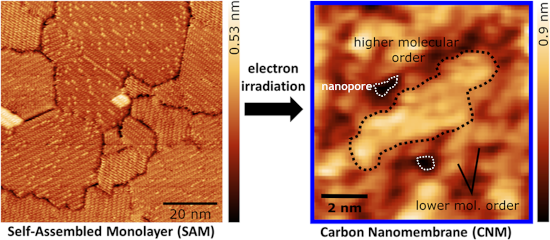
- electron energy loss spectroscopy (HREELS) [53][54], Raman spectroscopy [55], and low-energy electron microscopy (LEEM) [56] as well as by theoretical analysis [57][58][59]. It is now well established that electron irradiation leads to cleavage of C–H and S–H bonds, followed by the formation of C–C bonds


The preparation temperature influences the physicochemical nature and activity of nanoceria
Beilstein J. Nanotechnol. 2021, 12, 525–540, doi:10.3762/bjnano.12.43
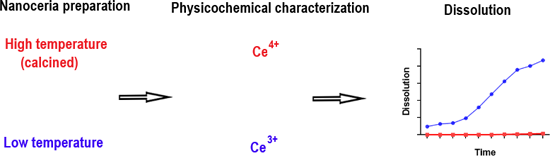
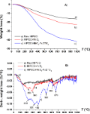
- , of one hundred particles were calculated using ImageJ software. Energy-dispersive X-ray spectroscopy (EDS) and electron energy loss spectroscopy (EELS) were conducted using Thermo Scientific’s SuperX G2 and Gatans’ Enfinium ER, respectively. Thermogravimetric analysis (TGA) (PerkinElmer TGA7) was
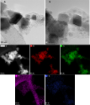
- . (C) HAADF STEM image. (D–G) EDS-determined chemical composition. NM-212 cerium valence determined by electron energy loss spectroscopy. The left image was obtained at the edge, the right image at the ENM core. Thermogravimetric analysis of NM-212. Representative and near average of three
- determinations. Non-baseline corrected Fourier-transform infrared spectroscopy of NM-212 with peaks indicated by dashed lines at 1630, 1420, and 1320 cm−1. Transmission electron microscopy image of calcined solvothermally synthesized nanoceria. Electron energy loss spectroscopy of calcined solvothermally




Hexagonal boron nitride: a review of the emerging material platform for single-photon sources and the spin–photon interface
Beilstein J. Nanotechnol. 2020, 11, 740–769, doi:10.3762/bjnano.11.61
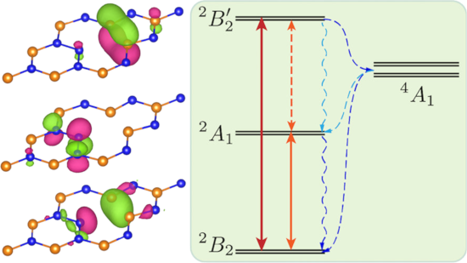
- means, such as optical reflectance and absorption, electron energy loss spectroscopy, X-ray absorption, emission, and inelastic scattering. Regarding luminescence studies, PL is the light emission, i.e., the electromagnetic radiation from matter after the absorption of photons. It is originated by




Green fabrication of lanthanide-doped hydroxide-based phosphors: Y(OH)3:Eu3+ nanoparticles for white light generation
Beilstein J. Nanotechnol. 2019, 10, 1200–1210, doi:10.3762/bjnano.10.119
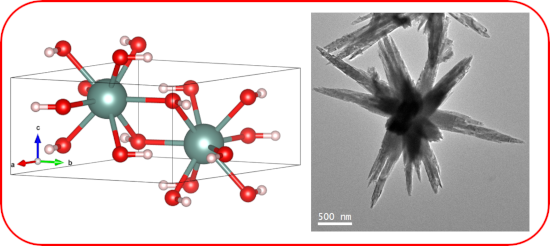
- microscope with a 0.19 nm point-to-point resolution at 200 keV equipped with an embedded Quantum Gatan Image Filter (Quantum GIF) for electron energy loss spectroscopy (EELS) analysis. The images were analyzed via Gatan Digital Micrograph software. Optical characterization was carried out using an Ocean

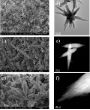


Accurate control of the covalent functionalization of single-walled carbon nanotubes for the electro-enzymatically controlled oxidation of biomolecules
Beilstein J. Nanotechnol. 2018, 9, 2750–2762, doi:10.3762/bjnano.9.257
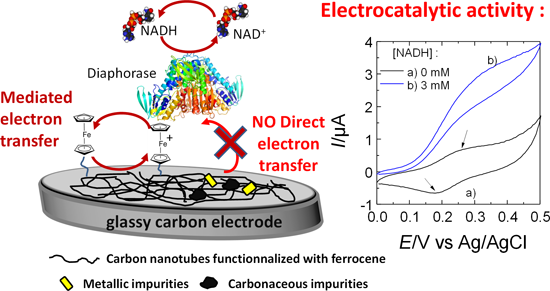
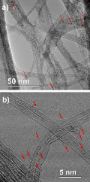
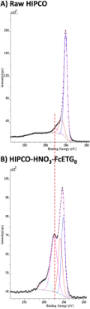
- -resolution scanning electron transmission microscopy (HRSTEM) and electron energy loss spectroscopy (EELS) analyses support that the outer tubes of the carbon-nanotube bundles were covalently grafted with FcETGn groups. This result confirms that the electrocatalytic effect observed during the oxidation of
- , high-resolution scanning electron transmission microscopy (HRSTEM) and electron energy loss spectroscopy (EELS) analyses strongly supports the role of ferrocene in the observed electrocatalytic effect for NADH oxidation and rule out the hypothetic role of metallic and carbonaceous impurities. Moreover
- microscopy (HRSTEM) were performed using a probe aberration-corrected JEOL ARM200 microscope equipped with a cold field emission gun, a JEOL JED2300T energy dispersive X-ray spectrometer (EDS) and a Gatan GIF Quantum energy filter for electron energy loss spectroscopy (EELS). The microscope was operated at






Optical near-field mapping of plasmonic nanostructures prepared by nanosphere lithography
Beilstein J. Nanotechnol. 2018, 9, 1536–1543, doi:10.3762/bjnano.9.144
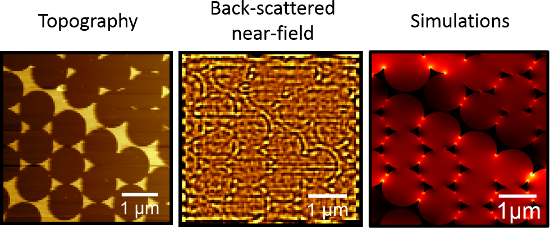
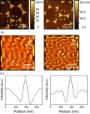
- intensity on the map [31]. The same principle is used with scanning transmission electron microscopy (STEM) and electron energy loss spectroscopy (EELS) [32][33][34]. This technique based on inelastic scattering measures the energy losses of the electrons. At the hot spots, the plasmon excitation results in




Cathodoluminescence as a probe of the optical properties of resonant apertures in a metallic film
Beilstein J. Nanotechnol. 2018, 9, 1491–1500, doi:10.3762/bjnano.9.140
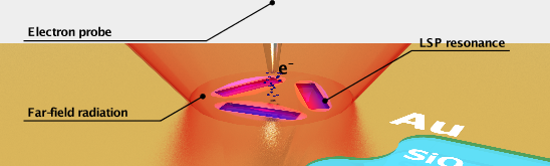
- space and time [38], and hence, an electron beam can induce a time-varying polarization in an adjacent material leading to optical excitation. Optical resonances can be probed by studying either the loss in the energy of the electrons (through electron energy loss spectroscopy, EELS) [38][39] or the


Electron interactions with the heteronuclear carbonyl precursor H2FeRu3(CO)13 and comparison with HFeCo3(CO)12: from fundamental gas phase and surface science studies to focused electron beam induced deposition
Beilstein J. Nanotechnol. 2018, 9, 555–579, doi:10.3762/bjnano.9.53
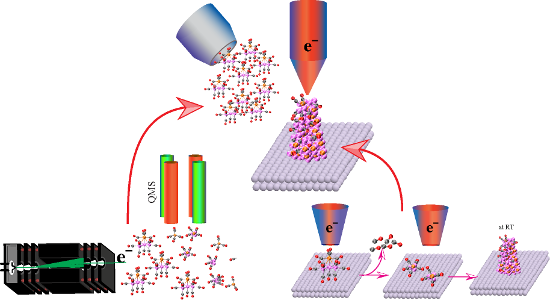
- ), reflection-absorption IR spectroscopy (RAIRS), and/or high-resolution electron energy loss spectroscopy (HREELS), while mass spectrometry has been used to identify gas phase species generated as a result of electron irradiation. As such the surface science experiments represent an increased level of


Electron-driven and thermal chemistry during water-assisted purification of platinum nanomaterials generated by electron beam induced deposition
Beilstein J. Nanotechnol. 2018, 9, 77–90, doi:10.3762/bjnano.9.10
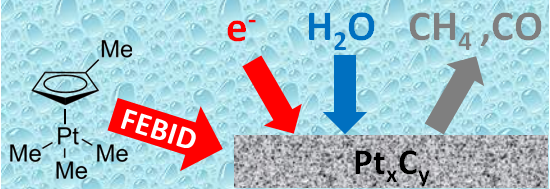
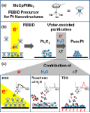
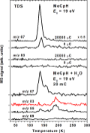
- of a previous study on the electron-induced decomposition of MeCpPtMe3 by high-resolution electron energy loss spectroscopy (HREELS) [26] which has revealed that the nature of the deposit is similar for E0 = 50 eV and 500 eV. H2O was dosed onto this partially degraded precursor layer without prior



Response under low-energy electron irradiation of a thin film of a potential copper precursor for focused electron beam induced deposition (FEBID)
Beilstein J. Nanotechnol. 2018, 9, 57–65, doi:10.3762/bjnano.9.8
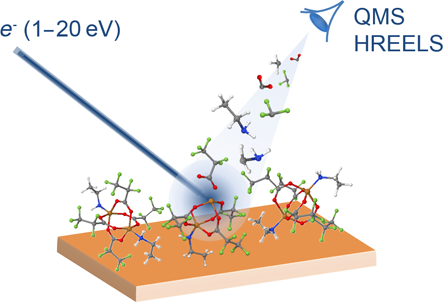
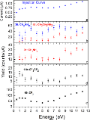
- ligands that are solid and stable under ambient conditions. They are directly deposited on the surface for studying the fragmentation with surface science tools. Results: Infrared spectroscopy and high-resolution electron energy loss spectroscopy (HREELS) are combined to show that the precursor is able to



Direct writing of gold nanostructures with an electron beam: On the way to pure nanostructures by combining optimized deposition with oxygen-plasma treatment
Beilstein J. Nanotechnol. 2017, 8, 2530–2543, doi:10.3762/bjnano.8.253
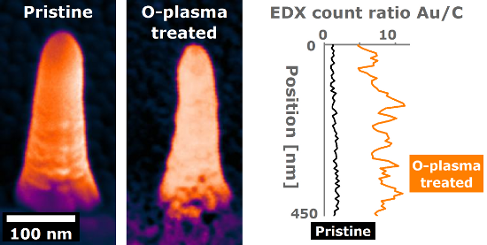
- [65]. More accurate compositional quantification could probably be achieved by performing atom probe tomography or thickness-corrected STEM electron energy loss spectroscopy (EELS). Planar Au nanostructures The main goal here was to elucidate the effects of each experimental parameter on the

Comprehensive investigation of the electronic excitation of W(CO)6 by photoabsorption and theoretical analysis in the energy region from 3.9 to 10.8 eV
Beilstein J. Nanotechnol. 2017, 8, 2208–2218, doi:10.3762/bjnano.8.220
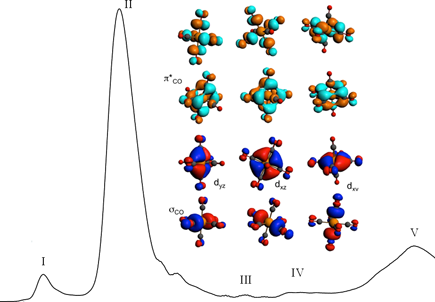
- and theoretical methods are also demanded to assess the nature of the excited states from which estimates of ND cross sections can be obtained from electron energy loss spectroscopy. From the experimental point of view, such electron impact excitation spectra cannot be recorded with higher energy
- assignments of Gray and Beach [1][2] were based on electronic transitions at 4.039 and 4.609 eV assigned to 1T1g←1A1g and 1T2g←1A1g and expected to be weak because of a dipole-forbidden nature. Note that the electron energy loss spectroscopy data only reports the 1T2g←1A1g transition at 4.54 eV. The
- with a local maximum cross section value of 75.5 Mb. Electron energy loss spectroscopy data reported values at 9.75 eV [6] and 10.3 eV [7], whereas the photoabsorption data of Qi et al. [5] reveals a feature at 10.06 eV followed by a CO vibrational structure with several quanta being excited. Koerting


Magnetic properties of optimized cobalt nanospheres grown by focused electron beam induced deposition (FEBID) on cantilever tips
Beilstein J. Nanotechnol. 2017, 8, 2106–2115, doi:10.3762/bjnano.8.210
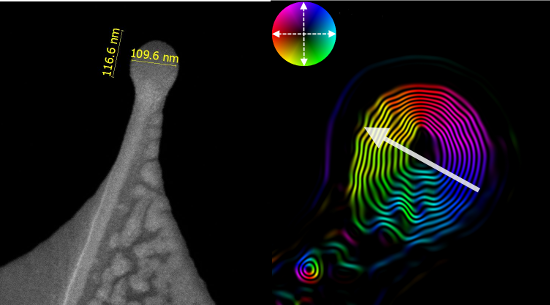
- analyze the chemical composition of the cobalt nanospheres by electron energy loss spectroscopy (EELS) in scanning transmission electron microscopy (STEM) mode and their local magnetic properties by electron holography in a transmission electron microscope (TEM), the specimens were prepared for TEM


Charge transfer from and to manganese phthalocyanine: bulk materials and interfaces
Beilstein J. Nanotechnol. 2017, 8, 1601–1615, doi:10.3762/bjnano.8.160
- photoemission spectroscopy (IPES), electron energy-loss spectroscopy (EELS), spectroscopic ellipsometry and X-ray absorption spectroscopy (XAS). Here, we only briefly mention the kind of information that is provided by these methods, and we refer the reader to comprehensive literature for detailed information
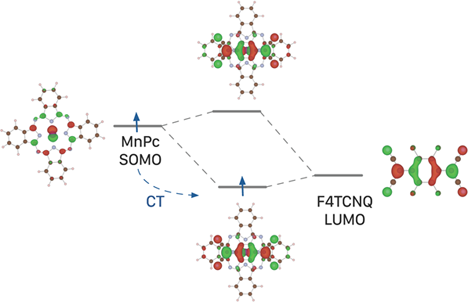
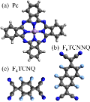
- analyzed using the relative intensities of photoemission core-level features [104], and in all cases we obtained a stoichiometric ratio of 1:1. We have analyzed the electronic properties of the new organic charge-transfer compound MnPc/F4TCNQ using photoemission and electron energy-loss spectroscopy as
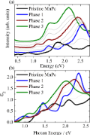
- potassium doping as determined using electron energy-loss spectroscopy (panel (a)) and spectroscopic ellipsometry (panel (b)). Panel (a) shows the so-called loss function, Im(−1/ε) [56], while panel (b) shows the imaginary part of the dielectric function, ε2 [49]. The potassium concentration increases from


Structural properties and thermal stability of cobalt- and chromium-doped α-MnO2 nanorods
Beilstein J. Nanotechnol. 2017, 8, 1032–1042, doi:10.3762/bjnano.8.104
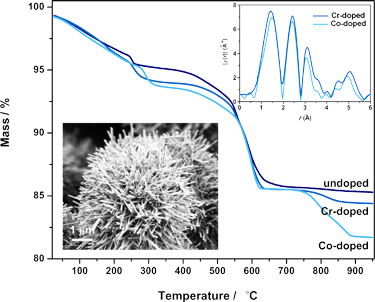
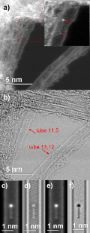
- ). The sulfur detected in the samples is originating from the sulfuric acid that was a part of the reaction mixture [26]. The chemical composition of an individual nanorod (Co-90) was determined using electron energy loss spectroscopy (EELS) in combination with high-angle annular dark field scanning


3D Nanoprinting via laser-assisted electron beam induced deposition: growth kinetics, enhanced purity, and electrical resistivity
Beilstein J. Nanotechnol. 2017, 8, 801–812, doi:10.3762/bjnano.8.83
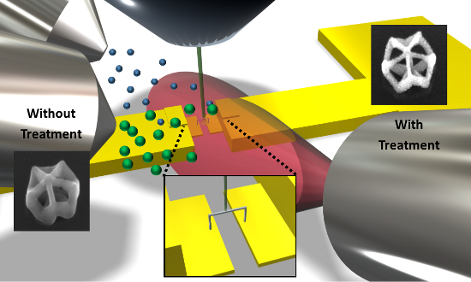
- roughly 45° relative to the FEI GIS. Figure 1 is a schematic illustrating the geometry of the gas and laser delivery systems relative to the substrate and electron beam impact point. STEM imaging and EELS analysis Scanning transmission electron microscope (STEM) imaging and electron energy loss
- spectroscopy (EELS) were performed using a Nion UltraSTEM 100 which is equipped with aberration correction of the probe forming lens. Beam-induced damage and contamination were minimized by using an accelerating voltage of 60 kV and a 40 pA beam current. High angle annular dark field (HAADF) and bright field


On the pathway of cellular uptake: new insight into the interaction between the cell membrane and very small nanoparticles
Beilstein J. Nanotechnol. 2016, 7, 1296–1311, doi:10.3762/bjnano.7.121
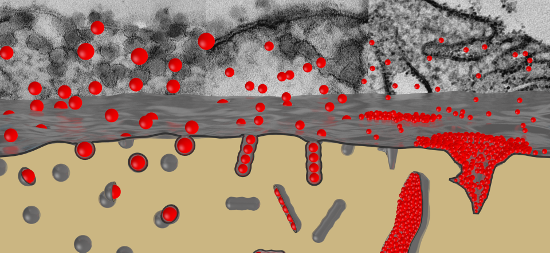
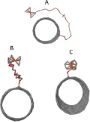
- to the TEM brightfield image. Membrane segmentation was done in a similar way, using principal components analysis of spectrum image series [50] prior to segmentation. EELS/EDX For spatially resolved elemental analysis we applied EDX spectroscopy and electron energy loss spectroscopy (EELS). For EDX




Photocurrent generation in carbon nanotube/cubic-phase HfO2 nanoparticle hybrid nanocomposites
Beilstein J. Nanotechnol. 2016, 7, 1075–1085, doi:10.3762/bjnano.7.101
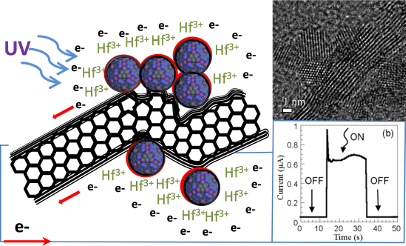
- electronic structure of the C K-edge in the nanocomposites was probed by electron energy loss spectroscopy, highlighting the key role of the MWCNT growth defects in anchoring HfO2 NPs. A combined optical emission and absorption spectroscopy approach illustrated that, in contrast to HfO2 NPs, the metallic
- the point-to-point resolution was ≈1 Å in STEM mode. High resolution transmission electron microscopy (HRTEM) carried out on the same microscope at 200 kV provided a point-to-point resolution of 2.4 Å. Electron energy loss spectroscopy (EELS) was acquired in STEM mode with an Enfinium spectrometer at


Distribution of Pd clusters on ultrathin, epitaxial TiOx films on Pt3Ti(111)
Beilstein J. Nanotechnol. 2015, 6, 2007–2014, doi:10.3762/bjnano.6.204
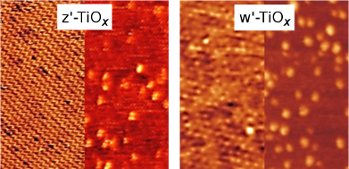
- images. Former LEED measurements have shown a commensurate rectangular unit cell with a (6 × 3√3) superstructure with respect to the (1 × 1) spots of the alloy surface and a unit cell size of (16.6 ± 0.2) × (14.4 ± 0.2) Å, while high resolution electron energy loss spectroscopy (HREELS) and X-ray


The role of low-energy electrons in focused electron beam induced deposition: four case studies of representative precursors
Beilstein J. Nanotechnol. 2015, 6, 1904–1926, doi:10.3762/bjnano.6.194
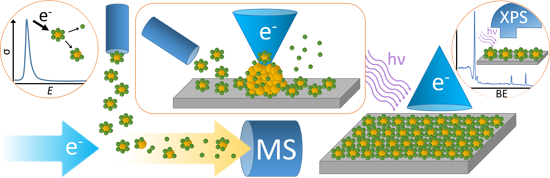
- electron energy loss spectroscopy (HREELS). For experimental details on the UHV surface experiments discussed here, see [25][50]. The shortcoming of these surface experiments is, however, that the precursor molecules are subjected to interactions with SEs with an energy distribution (similar to that in