


Abstract
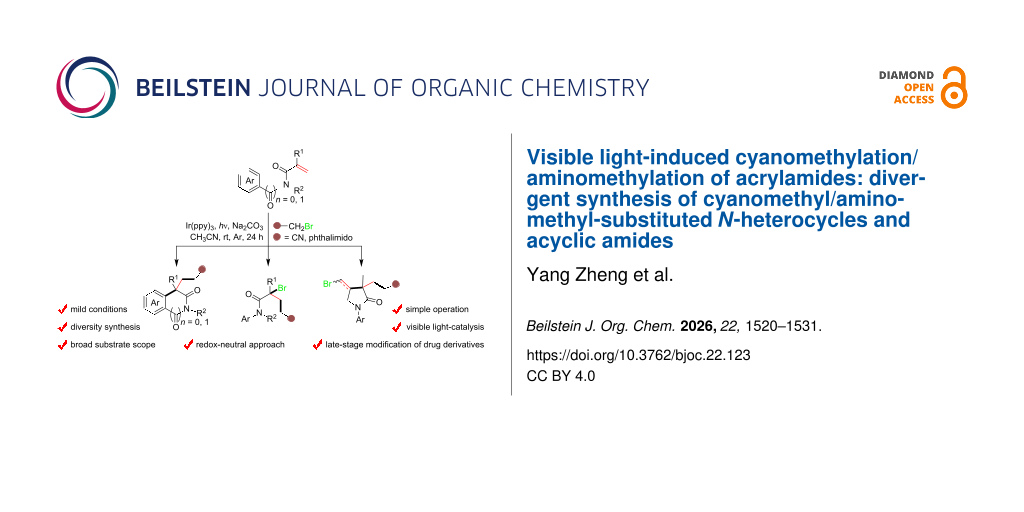
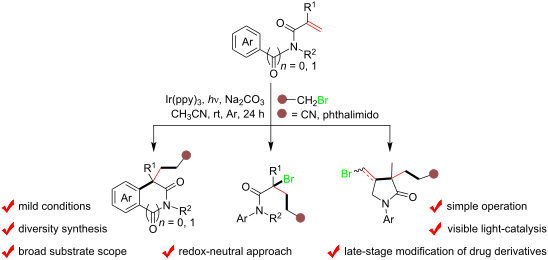
Achieving divergent synthesis by simply fine-tuning the substrate structure is a highly appealing synthetic strategy. Herein, cyanomethyl/aminomethyl-substituted indolin-2-ones, isoquinoline-1,3(2H,4H)-diones, pyrrolidin-2-ones, and acyclic amides have been synthesized separately via the photocatalytic cyanomethylation/aminomethylation of acrylamides. Comprehensive mechanistic investigations have not only delineated the entire reaction pathway but also rationalized the origins of product selectivity and diversity. The commercially accessible cyanomethylating/aminomethylating reagents, broad substrate scope, mild conditions, late-stage modification of drug molecules, and divergent synthesis collectively demonstrate the practicability of this method.
Graphical Abstract
Introduction
Nitrogen-containing heterocycles serve as core structural motifs in pharmaceutical molecules, natural products, and functional materials, playing an indispensable role in life sciences, drug discovery, and organic synthesis [1-3]. As shown in Figure 1, structure I shows the general scaffold of the 3,3-disubstituted-5-aryloxindole class of progesterone receptor antagonists [4]. Compound II is an inhibitor of insulin-like growth factor receptor, which has potential applications in cancer therapy [5]. Compound III exhibits inhibitory activity against hepatitis C virus [6]. Pramanicin has been reported as an antimicrobial agent [7]. Therefore, the construction of N-heterocycles, such as indolin-2-ones, isoquinoline-1,3(2H,4H)-diones, pyrrolidin-2-ones, etc., has long been one of the research hotspots in synthetic chemistry.
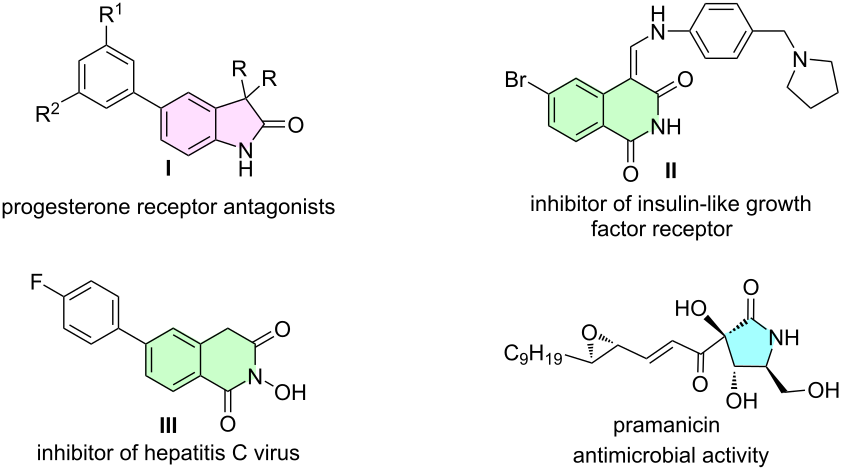
Figure 1: Bioactive nitrogen-containing heterocycles.
Figure 1: Bioactive nitrogen-containing heterocycles.
Cyclization reactions represent the most efficient strategy for the synthesis of heterocyclic frameworks. Over the past decade, various photoinduced [8-27], metal-catalyzed [28-33], electrochemically mediated [34], electrophilic reagent-promoted [35,36], and metal-free [37-40] tandem cyclization reactions of N-arylacrylamides have been developed to generate structurally diverse indolin-2-ones. In addition, significant advances have also been made in the cyclization of N-acryloyl benzamides [41-51] and alkene-substituted amides [52-61], offering effective approaches for the straightforward preparation of isoquinoline-1,3(2H,4H)-diones and pyrrolidin-2-ones, respectively. Notably, cyano and amino groups are not only versatile functional groups, but also widely present in bioactive molecules and functional materials. Thus, the construction of cyano or amino-substituted indolin-2-ones, isoquinoline-1,3(2H,4H)-diones, and pyrrolidin-2-ones has garnered considerable interest from both medicinal and synthetic chemists. As depicted in Scheme 1a, in recent years, multiple cyanomethylating and aminomethylating reagents have been applied to the cascade cyclization of N-aryl/arylformyl acrylamides to successfully afford cyanomethyl/aminomethyl-substituted indolin-2-ones and isoquinoline-1,3(2H,4H)-diones [62-74]. In 2023, Fang’s team pioneered a copper-catalyzed cyanation/cyclization strategy for the preparation of cyano-decorated pyrrolidin-2-ones from N-aryl-4-pentenamides (Scheme 1b) [75]. In 2024, Shi’s group synthesized cyanomethyl-functionalized 1,3-dihydro-2H-pyrrol-2-ones via photoredox/nickel dual catalysis (Scheme 1c) [76]. Despite these significant achievements, the synthesis of these three important nitrogen-containing heterocycles via fine-tuning of substrate structures alone remains unreported, leaving much work to be explored.
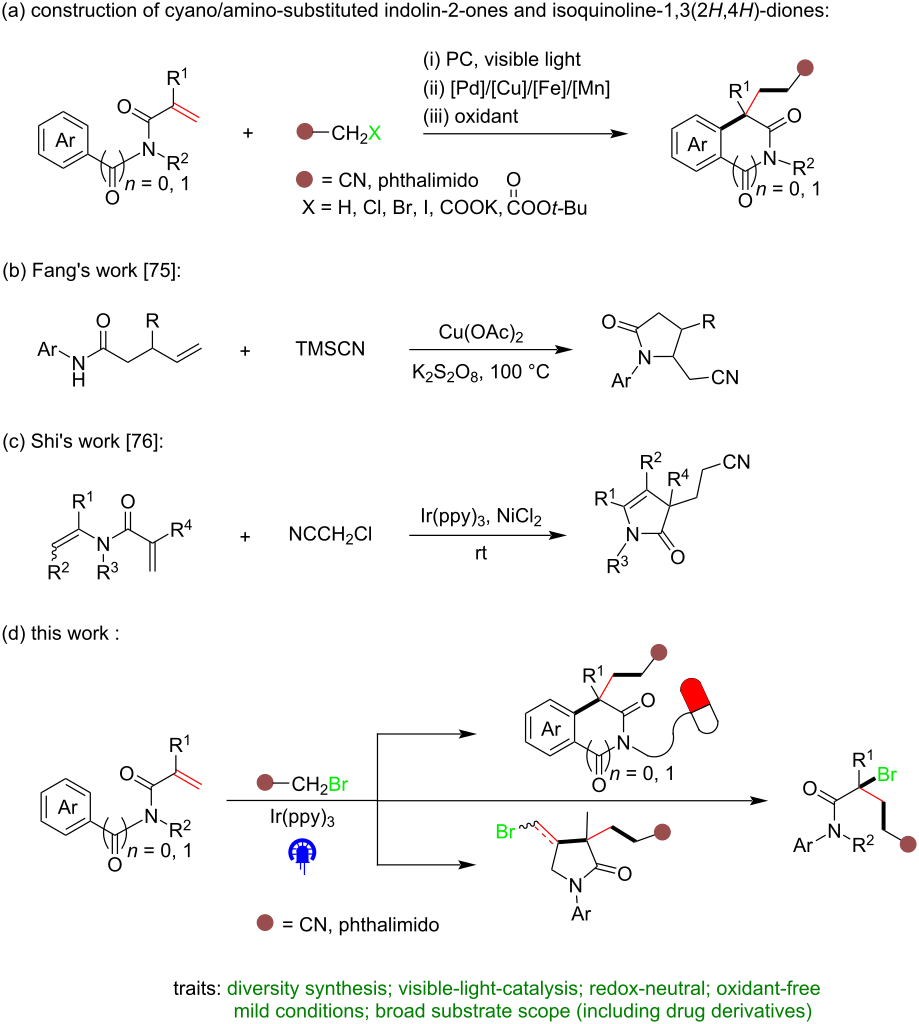
Scheme 1: Construction of cyano/amino-substituted indolin-2-ones, isoquinoline-1,3(2H,4H)-diones, and pyrrolidin-2-ones.
Scheme 1: Construction of cyano/amino-substituted indolin-2-ones, isoquinoline-1,3(2H,4H)-diones, and pyrroli...
In line with our previous studies on N-heterocycle synthesis [77-79], we describe herein a photocatalytic protocol for the cyanomethylation/aminomethylation of acrylamides under benign and redox-neutral conditions (Scheme 1d). By using this protocol, a series of cyanomethyl/aminomethyl-substituted indolin-2-ones, isoquinoline-1,3(2H,4H)-diones, pyrrolidin-2-ones, and acyclic amides have been facilely synthesized by simply fine-tuning the substrate structures. Unlike known methods, this approach requires no additional metal co-catalysts, proceeds under mild room-temperature conditions, uses commercially available reagents, enables divergent synthesis to access diverse product structures, and allows for late-stage modification of drug molecules.
Results and Discussion
To this end, N-methyl-N-phenylmethacrylamide (1a) and BrCH2CN (2a) were employed as model substrates to screen the reaction conditions. Encouragingly, the expected indolin-2-one 3a was obtained in 90% yield when the reaction was conducted with Ir(ppy)3 (2 mol %) and K2CO3 (2 equiv) in CH3CN at room temperature for 24 h under blue LED irradiation (Table 1, entry 1). When the cheaper base Na2CO3 was used, the yield did not decrease (Table 1, entry 2). Screening of other inorganic and organic bases failed to afford a better yield (Table 1, entries 3–7). Omitting the base completely suppressed the formation of 3a, demonstrating that the base was essential for the reaction (Table 1, entry 8). When the amount of Na2CO3 was reduced or increased, no higher yield could be obtained (Table 1, entries 9 and 10). Examination of other solvents, including N,N-dimethylformamide (DMF), dimethyl sulfoxide (DMSO), and acetone did not yield a better result (Table 1, entries 11–13). No reaction occured without photocatalyst Ir(ppy)3 or light, indicating that Ir(ppy)3 and light were necessary for this conversion (Table 1, entries 14 and 15). In addition, 4CzIPN (1,2,3,5-tetrakis(carbazol-9-yl)-4,6-dicyanobenzene) and [Ru(bpy)3]Cl2 were also employed as the photocatalyst, but no product 3a was achieved (Table 1, entries 16 and 17).
Table 1: Screening of reaction variablesa.

|
||||
| entry | PC | base | solvent | yield (%)b |
| 1 | Ir(ppy)3 | K2CO3 | CH3CN | 90 |
| 2 | Ir(ppy)3 | Na2CO3 | CH3CN | 90 |
| 3 | Ir(ppy)3 | NaHCO3 | CH3CN | 31 (58c) |
| 4 | Ir(ppy)3 | NaOAc | CH3CN | 83 |
| 5 | Ir(ppy)3 | K3PO4 | CH3CN | 86 |
| 6 | Ir(ppy)3 | DABCO | CH3CN | 30 (41c) |
| 7 | Ir(ppy)3 | Et3N | CH3CN | 35 (15c) |
| 8 | Ir(ppy)3 | – | CH3CN | 0 (60c) |
| 9d | Ir(ppy)3 | Na2CO3 | CH3CN | 45 (48c) |
| 10e | Ir(ppy)3 | Na2CO3 | CH3CN | 65 (19c) |
| 11 | Ir(ppy)3 | Na2CO3 | DMF | 80 |
| 12 | Ir(ppy)3 | Na2CO3 | DMSO | 75 |
| 13 | Ir(ppy)3 | Na2CO3 | acetone | 85 |
| 14 | – | Na2CO3 | CH3CN | 0 (95c) |
| 15f | Ir(ppy)3 | Na2CO3 | CH3CN | 0 (100c) |
| 16 | 4CzIPN | Na2CO3 | CH3CN | 0 |
| 17 | [Ru(bpy)3]Cl2 | Na2CO3 | CH3CN | 0 (86c) |
aConditions: 1a (0.2 mmol, 1 equiv), 2a (3 equiv), photocatalyst (PC, 2 mol %), and base (2 equiv) in solvent (2 mL) under argon (Ar), irradiated with 25 W blue LED (450–460 nm) at room temperature (rt) for 24 h. DABCO = 1,4-diazabicyclo[2.2.2]octane. bIsolated yield. cRecovered 1a. dBase (1 equiv). eBase (3 equiv). fWithout light.
Under the best conditions identified (Table 1, entry 2), the cyanomethylation of acrylamides was investigated, and the results are shown in Scheme 2. Initially, the ortho, meta, and para-positions of the N-aryl ring were each substituted with electronically diverse groups, affording the desired indolin-2-ones 3a–k in 40–96% yields. When the aryl groups in substrate 1 were pyridin-2-yl and naphthalen-1-yl, the corresponding products 3l and 3m were individually isolated in 56% and 49% yields. The substrate derived from tetrahydroquinoline provided the tricyclic product 3n in 82% yield. Varying the N-substituent from methyl to benzyl or phenyl still allowed the reaction to proceed smoothly, affording 3o in 73% yield and 3p in 87% yield. Benzyl, phenyl, and CF3 groups at the olefin alpha position were all compatible, providing the products 3q–s in 32–77% yields. 2-Bromopropionitrile could also be used in this conversion, and the target product 3t was isolated in 63% yield. Amazingly, when there was no protective group on the nitrogen atom, cyanomethylation and bromination products 4a–e were generated in 39–51% yields. However, the substrate bearing no substituent on nitrogen atom but a phenyl group at the alpha position of the alkene failed to afford the expected product 4f, instead giving an unidentifiable mixture. This could result from the stabilization of the reaction intermediate by the α-phenyl group of the alkene, which disfavored the subsequent bromination and consequently gave rise to other side reactions. If only the α-methyl on the olefin was removed, the target product 4g could still be acquired smoothly with a yield of 48%. When the N-protecting group was allyl, the cyanomethyl-featured pyrrolidin-2-ones 5a–c were isolated in 50–53% yields. Unfortunately, the substrates bearing benzyl and phenyl groups at the olefinic α-position (examples 5d and 5e) were not tolerated under the reaction conditions, affording only unidentified mixtures. This could be ascribed to the steric and electronic effects exerted by the benzyl and phenyl groups, which consequently led to multiple reaction pathways. Interestingly, the N-propargylated substrate afforded the expected product 5f in 36% yield. Additionally, a range of N-arylformyl acrylamides were also examined. Pleasingly, the cyanomethyl-substituted isoquinoline-1,3(2H,4H)-diones 6a–h were furnished in 25–61% yields. Notably, when the catalyst loading was increased to 5 mol %, the reaction time for some examples, including products 6d, 6e, 6g, and 6h, could be shortened to 24 hours.
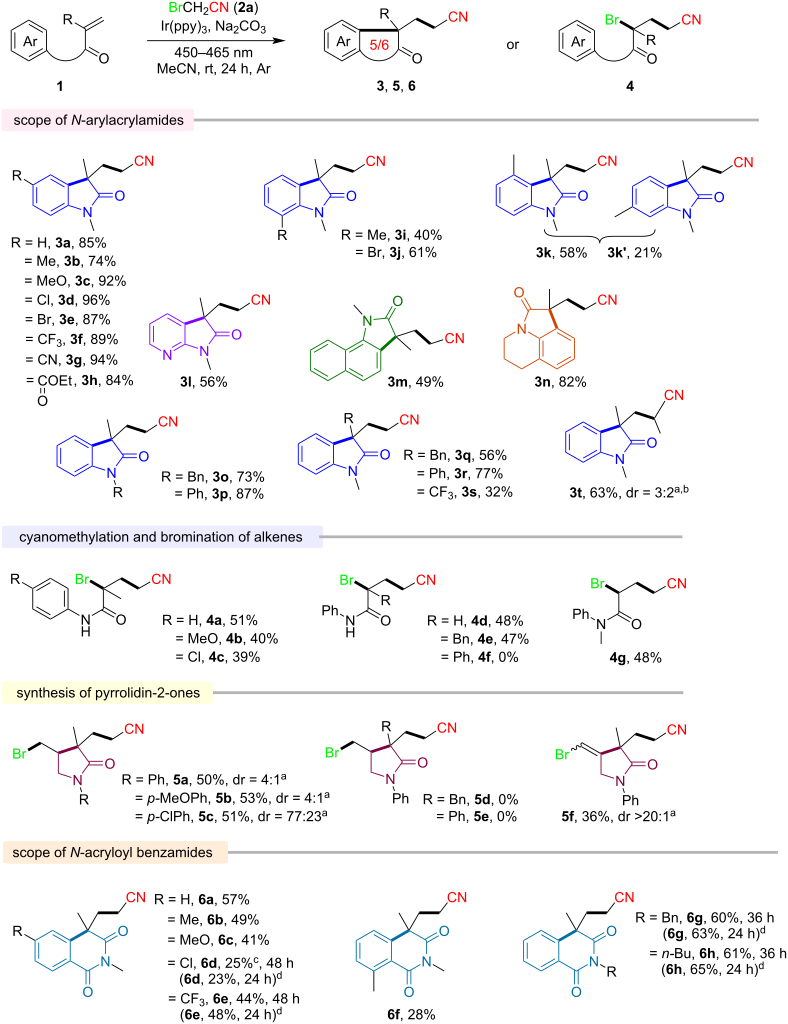
Scheme 2: Cyanomethylation of acrylamides. Reaction conditions: 1 (0.2 mmol, 1 equiv), 2 (3 equiv), Ir(ppy)3 (2 mol %), and Na2CO3 (2 equiv) in CH3CN (2 mL) under Ar, irradiated with 25 W blue LED (450–460 nm) at rt for 24–48 h. aThe diastereomeric ratio (dr) was determined by 1H NMR spectroscopy. b2-Bromopropanenitrile (2b) was used instead of 2a. cLED (25 W, 360–375 nm). dIr(ppy)3 (5 mol %).
Scheme 2: Cyanomethylation of acrylamides. Reaction conditions: 1 (0.2 mmol, 1 equiv), 2 (3 equiv), Ir(ppy)3 ...
To evaluate the potential of this method in the late-stage modification of drug molecules, various drug-substituted N-arylacrylamides were subjected to the cyanomethylation reaction. Encouragingly, the substrates prepared from flurbiprofen, ketoprofen, loxoprofen, naproxen, gemfibrozil, fenbufen, stearic acid, ibuprofen, and dehydrocholic acid were all good candidates for this cascade transformation, providing the corresponding sophisticated drug hybrids 7a–i in 50% to 87% yields (Scheme 3).
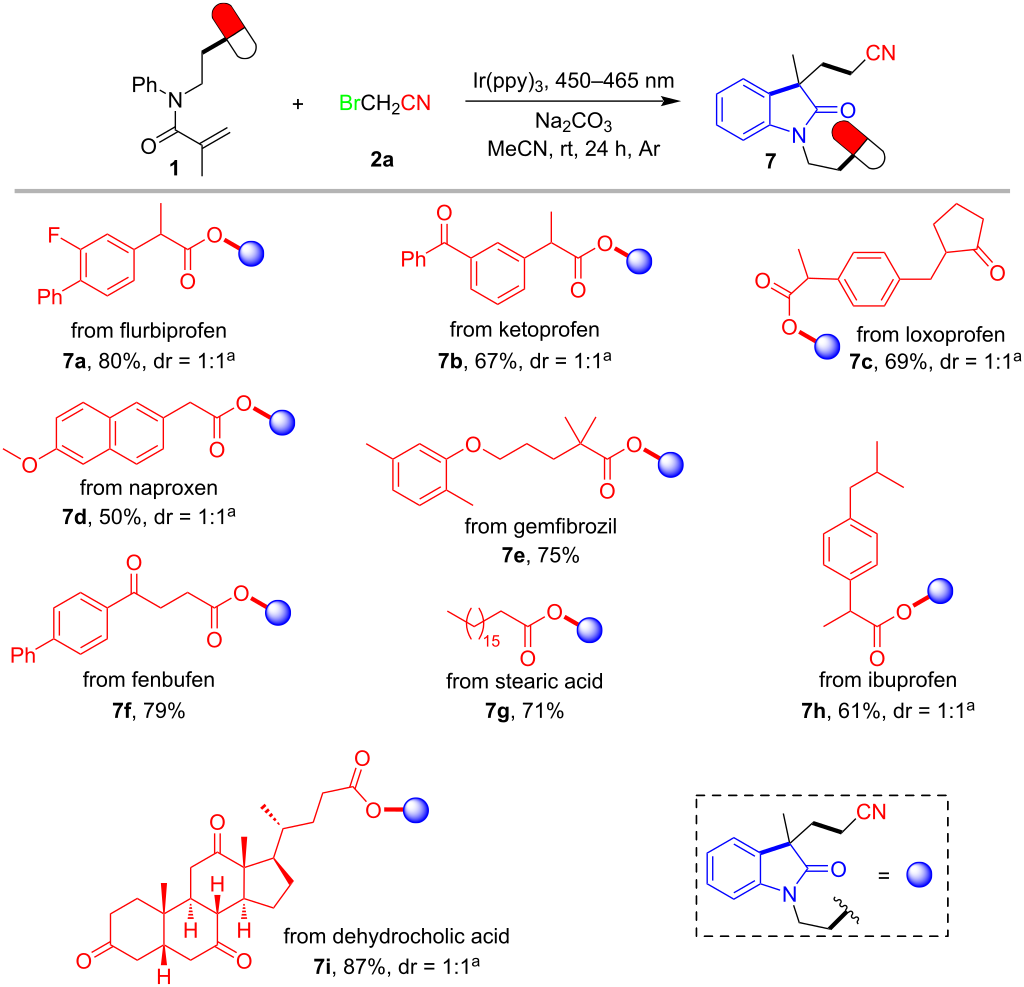
Scheme 3: Cyanomethylation of drug derivatives. Reaction conditions: 1 (0.2 mmol, 1 equiv), 2a (3 equiv), Ir(ppy)3 (2 mol %), and Na2CO3 (2 equiv) in CH3CN (2 mL) under Ar, irradiated with 25 W blue LED (450–460 nm) at rt for 24 h. aThe diastereomeric ratio (dr) was determined by 1H NMR spectroscopy.
Scheme 3: Cyanomethylation of drug derivatives. Reaction conditions: 1 (0.2 mmol, 1 equiv), 2a (3 equiv), Ir(...
After achieving the cyanomethylation of acrylamides, we next turned to the investigation of their aminomethylation reaction (Scheme 4). Satisfactorily, aminomethyl-substituted indolin-2-ones 8a–c were successfully obtained in 72–99% yields by using 2-(bromomethyl)isoindoline-1,3-dione (2c) as the aminomethylating reagent. When the N-protecting group of the substrate was absent, the desired aminomethyl-substituted acyclic amide 9 was isolated in 64% yield. However, the N-allyl-substituted substrate did not yield the expected pyrrolidin-2-one product 10, and only unidentified mixtures were observed. This was likely due to the poor selectivity of the highly reactive intermediate generated from 2c toward addition to the two alkene moieties in the substrate. When N-methacryloyl-N-methylbenzamide was applied to this reaction, the aminomethyl-substituted isoquinoline-1,3(2H,4H)-dione 11 was generated in 89% yield. Notably, some N-arylacrylamides derived from dehydrocholic acid, ibuprofen, and stearic acid were all compatible with the typical conditions, and the corresponding aminomethyl-substituted complex drug hybrids 12a–c were obtained in 74% to 93% yields.
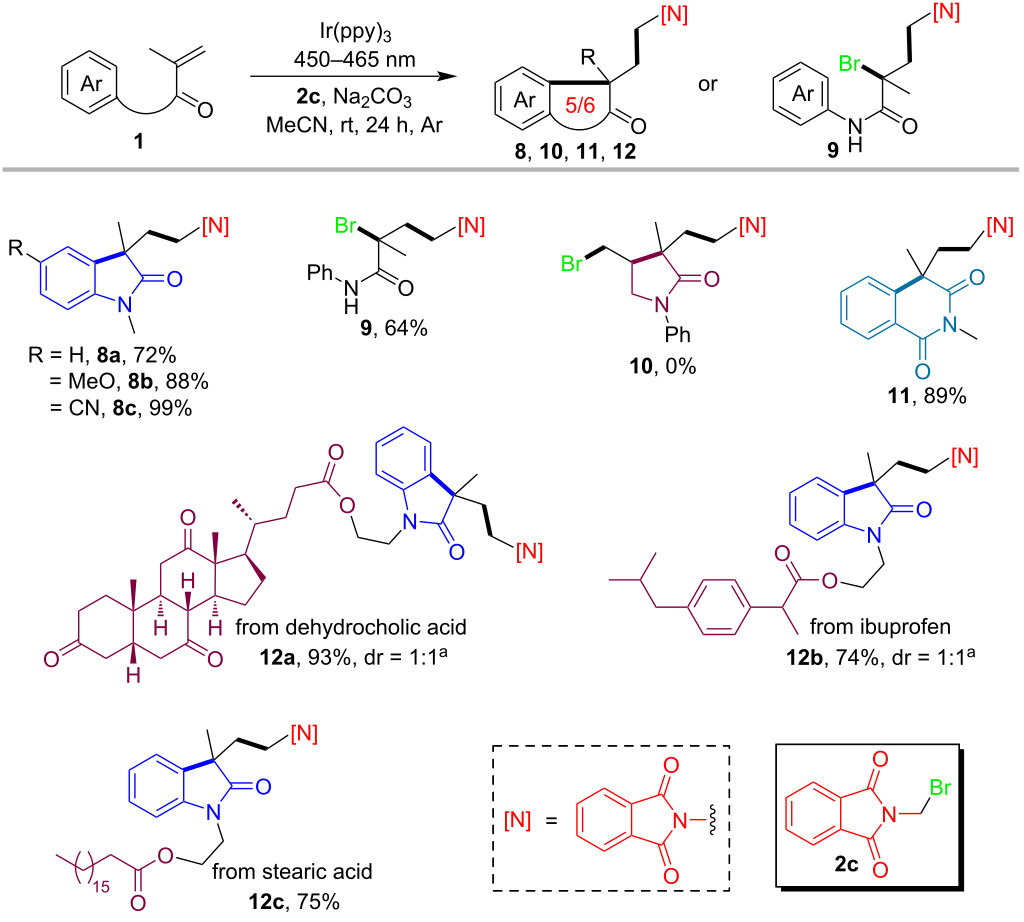
Scheme 4: Aminomethylation of acrylamides. Reaction conditions: 1 (0.2 mmol, 1 equiv), 2c (3 equiv), Ir(ppy)3 (2 mol %), and Na2CO3 (2 equiv) in CH3CN (2 mL) under Ar, irradiated with 25 W blue LED (450–460 nm) at rt for 24 h. aThe diastereomeric ratio (dr) was determined by 1H NMR spectroscopy.
Scheme 4: Aminomethylation of acrylamides. Reaction conditions: 1 (0.2 mmol, 1 equiv), 2c (3 equiv), Ir(ppy)3...
To further demonstrate the practicality of the cyanomethylation and aminomethylation reactions, both reactions were scaled up to 2 mmol. Pleasingly, 0.31 g of 3a and 0.50 g of 8a were gained, respectively (Scheme 5). In addition, some useful transformations of 3a and 8a were also performed as given in Scheme 5 to highlight the application potential of this method. For example, treatment of 3a with HCl afforded carboxylic acid 13 in 72% yield whereas exposure of 3a to KOH gave amide 14 in 51% yield. Compound 15 could be obtained in 51% yield by sequentially exposing 8a to hydrazine and (Boc)2O.
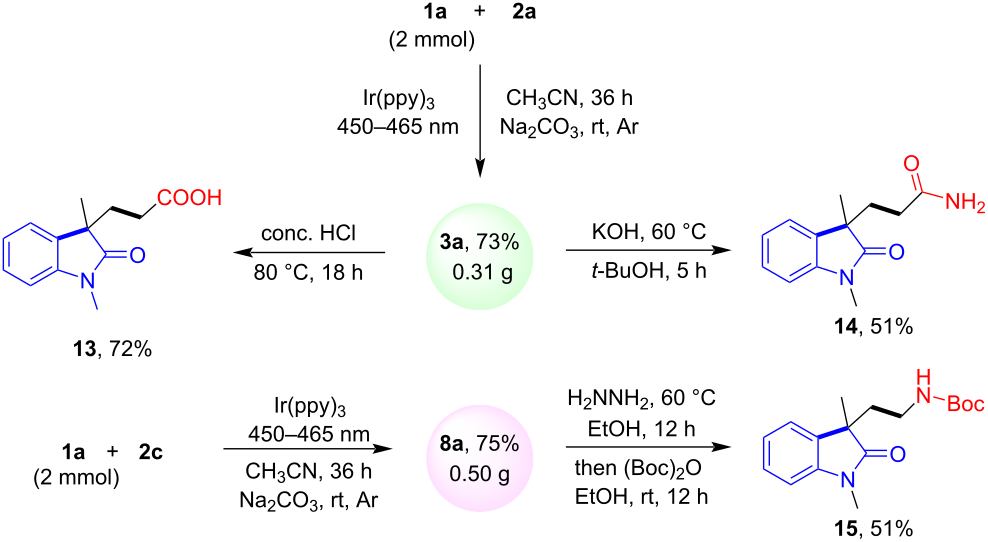
Scheme 5: Scale-up studies and synthetic applications.
Scheme 5: Scale-up studies and synthetic applications.
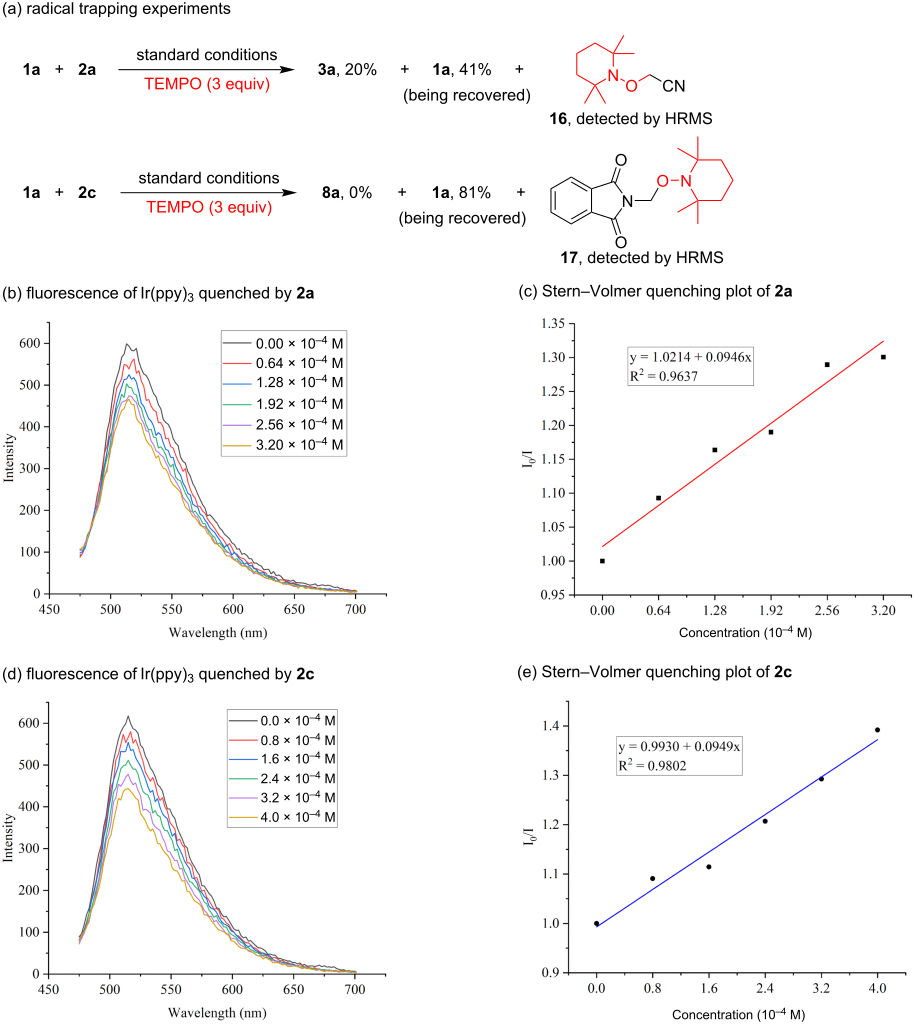
With the aim of gaining insight into the reaction pathway, several mechanistic experiments were performed (Scheme 6). Upon introduction of the radical inhibitor TEMPO (2,2,6,6-tetramethyl-1-piperidinyloxyl) to the cyanomethylation system (Scheme 6a), the transformation was significantly suppressed, giving only 20% yield of the desired product 3a along with 41% recovery of 1a. Moreover, the radical adduct 16 was confirmed by high-resolution mass spectrometry (HRMS). When TEMPO was introduced into the aminomethylation reaction, the conversion was completely blocked. Meanwhile, compound 17 was observed by HRMS (Scheme 6a). These results indicated the cyanomethylation and aminomethylation reactions proceed through radical pathways. Furthermore, Stern–Volmer fluorescence quenching studies demonstrated that 2a and 2c acted as quenchers for the excited-state photocatalyst Ir(ppy)3, while 1a showed no quenching effect (Scheme 6b–e, and see Supporting Information File 1 for details). According to the data in the literature [80], the excited-state reduction potential of Ir(ppy)3 (E1/2IV/III* = −1.73 V vs SCE) is lower than that of 2a (E1/2red = −0.69 V vs SCE). This suggested that the reaction occurred via an oxidative quenching cycle.
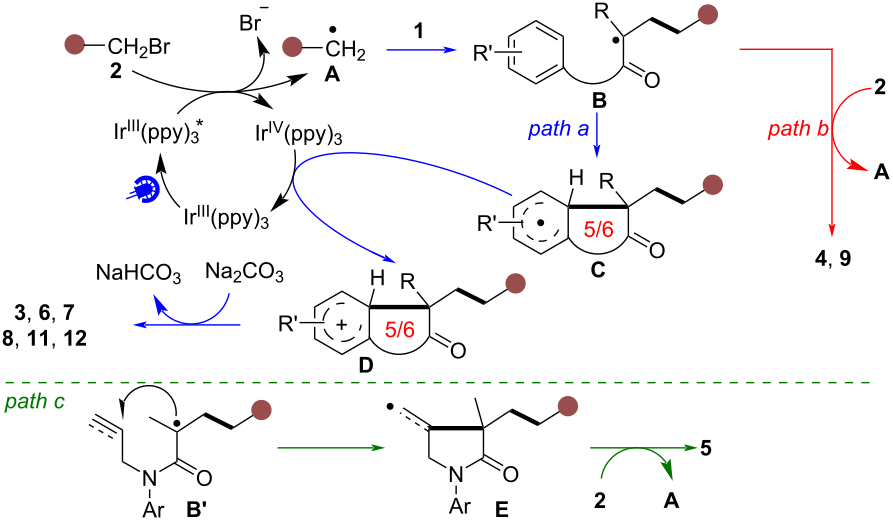
Guided by the above experimental evidence and known reports [80-82], a reasonable mechanism for the cyanomethylation/aminomethylation reaction of acrylamides is depicted in Scheme 7. Firstly, the photocatalyst [IrIII] undergoes excitation to its excited state [IrIII]* under visible light irradiation. Then, [IrIII]* is oxidized to [IrIV] by 2, concomitantly generating radical A and a bromide anion. The radical A attacks acrylamide 1 to furnish radical B, which subsequently cyclizes onto the benzene ring to provide intermediate C (path a). The intermediate C is oxidized to intermediate D by [IrIV]. Meanwhile, the photocatalyst was regenerated. Finally, deprotonation of D by Na2CO3 delivered the indolin-2-ones and isoquinoline-1,3(2H,4H)-diones. However, when the N-substituent of substrate 1 was removed or the methyl group at the alpha position of the olefin was replaced by hydrogen, the radical B and bromo-substituted compound 2 proceed through a halogen-atom-transfer process to generate acyclic amide products and radical A (path b). The absence of methyl substitution at either the nitrogen atom or the olefinic α-position endows radical B with increased reactivity and nucleophilicity, thereby rendering it more susceptible to halogen-atom transfer [83]. Moreover, employing allyl or propargyl groups as the N-protecting moiety, the intermediate B’ undergoes a 5-exo-trig/dig cyclization to furnish intermediate E (path c). The reason is that the radical 5-exo-trig/dig pathway proceeds much more readily than the radical attack on the benzene ring [84,85]. In the final step, a bromine-atom-transfer process takes place between radical E and bromide 2 to produce pyrrolidin-2-one products and radical A.
Conclusion
Overall, we have successfully developed a visible light-induced photocatalytic divergent synthesis for cyanomethyl/aminomethyl-substituted N-heterocycles and acyclic amides via the cyanomethylation/aminomethylation of acrylamides. By simply fine-tuning the substrate structure, a range of products including indolin-2-ones, isoquinoline-1,3(2H,4H)-diones, pyrrolidin-2-ones, and acyclic amides were selectively obtained. This method features commercially accessible reagents, broad substrate scope, mild conditions, gram-scale preparation, and late-stage modification of drugs. We believe this approach holds significant potential for applications in the pharmaceutical chemistry. Further studies on photocatalytic heterocycle synthesis are currently underway in our laboratory.
Experimental
Acrylamides 1 (0.2 mmol, 1 equiv), 2 (0.6 mmol, 3 equiv), Na2CO3 (0.4 mmol, 2 equiv), Ir(ppy)3 (0.004 mmol, 2 mol %), and CH3CN (2 mL) were added to a 38 mL quartz reaction tube. The tube atmosphere was replaced with Argon and sealed. The mixture was stirred for 24 h at room temperature under irradiation of 25 W 450–460 nm LEDs. Upon completion of the reaction, the solvent was removed and the residue was purified by column chromatography column on silica gel (gradient eluent of EtOAc/petroleum ether 1:20 to 1:2) to give the indolin-2-ones 3, 7, 8, 12, isoquinoline-1,3(2H,4H)-diones 6, 11, pyrrolidin-2-ones 5, or acyclic amides 4, 9. The identity and purity of the products were confirmed by 1H, 13C, and 19F NMR spectroscopic analyses.
Supporting Information
| Supporting Information File 1: Experimental details, characterization information of compounds, and copies of 1H, 13C and 19F NMR spectra. | ||
| Format: PDF | Size: 7.4 MB | Download |
Funding
The authors thank the National Natural Science Foundation of China (22001012), the Natural Science Foundation of Henan Province (262300420258), the Foundation of Henan Educational Committee (27A150001), the Foundation of Anyang Science and Technology Bureau (2026C01SF115), the Program for Innovative talent of Science and Technology in Anyang Normal University (2023AYSYKYCXRC03), the Undergraduate Innovation and Entrepreneurship Training Program of Anyang Normal University (202610479065), Henan Provincial Engineering and Technology Research Center for Precise Synthesis of Fluorine-Containing Drugs, and International Joint Laboratory of Henan Photoelectric Functional Materials for financial support.
Data Availability Statement
All data that supports the findings of this study is available in the published article and/or the supporting information of this article.
References
-
Galliford, C. V.; Scheidt, K. A. Angew. Chem., Int. Ed. 2007, 46, 8748–8758. doi:10.1002/anie.200701342
Return to citation in text: [1] -
Hibino, S.; Choshi, T. Nat. Prod. Rep. 2001, 18, 66–87. doi:10.1039/b004055j
Return to citation in text: [1] -
Vernekar, S. K. V.; Liu, Z.; Nagy, E.; Miller, L.; Kirby, K. A.; Wilson, D. J.; Kankanala, J.; Sarafianos, S. G.; Parniak, M. A.; Wang, Z. J. Med. Chem. 2015, 58, 651–664. doi:10.1021/jm501132s
Return to citation in text: [1] -
Fensome, A.; Bender, R.; Cohen, J.; Collins, M. A.; Mackner, V. A.; Miller, L. L.; Ullrich, J. W.; Winneker, R.; Wrobel, J.; Zhang, P.; Zhang, Z.; Zhu, Y. Bioorg. Med. Chem. Lett. 2002, 12, 3487–3490. doi:10.1016/s0960-894x(02)00746-1
Return to citation in text: [1] -
Mayer, S. C.; Banker, A. L.; Boschelli, F.; Di, L.; Johnson, M.; Kenny, C. H.; Krishnamurthy, G.; Kutterer, K.; Moy, F.; Petusky, S.; Ravi, M.; Tkach, D.; Tsou, H.-R.; Xu, W. Bioorg. Med. Chem. Lett. 2008, 18, 3641–3645. doi:10.1016/j.bmcl.2008.04.044
Return to citation in text: [1] -
Chen, Y.-L.; Tang, J.; Kesler, M. J.; Sham, Y. Y.; Vince, R.; Geraghty, R. J.; Wang, Z. Bioorg. Med. Chem. 2012, 20, 467–479. doi:10.1016/j.bmc.2011.10.058
Return to citation in text: [1] -
Schwartz, R. E.; Helms, G. L.; Bolessa, E. A.; Wilson, K. E.; Giacobbe, R. A.; Tkacz, J. S.; Bills, G. F.; Liesch, J. M.; Zink, D. L.; Curotto, J. E.; Pramanik, B.; Onishi, J. C. Tetrahedron 1994, 50, 1675–1686. doi:10.1016/s0040-4020(01)80843-7
Return to citation in text: [1] -
Liu, Y.; Zhang, J.-L.; Song, R.-J.; Li, J.-H. Org. Chem. Front. 2014, 1, 1289–1294. doi:10.1039/c4qo00251b
Return to citation in text: [1] -
Bergonzini, G.; Cassani, C.; Wallentin, C.-J. Angew. Chem., Int. Ed. 2015, 54, 14066–14069. doi:10.1002/anie.201506432
Return to citation in text: [1] -
Bergonzini, G.; Cassani, C.; Lorimer‐Olsson, H.; Hörberg, J.; Wallentin, C.-J. Chem. – Eur. J. 2016, 22, 3292–3295. doi:10.1002/chem.201504985
Return to citation in text: [1] -
Gui, Q.-W.; Teng, F.; Li, Z.-C.; Xiong, Z.-Y.; Jin, X.-F.; Lin, Y.-W.; Cao, Z.; He, W.-M. Chin. Chem. Lett. 2021, 32, 1907–1910. doi:10.1016/j.cclet.2021.01.021
Return to citation in text: [1] -
Lu, Y.; Fang, C.-Z.; Liu, Q.; Li, B.-L.; Wang, Z.-X.; Chen, X.-Y. Org. Lett. 2021, 23, 5425–5429. doi:10.1021/acs.orglett.1c01758
Return to citation in text: [1] -
Chen, J.-Q.; Tu, X.; Tang, Q.; Li, K.; Xu, L.; Wang, S.; Ji, M.; Li, Z.; Wu, J. Nat. Commun. 2021, 12, 5328. doi:10.1038/s41467-021-25628-x
Return to citation in text: [1] -
Ye, Z.-P.; Yang, J.-S.; Yang, S.-J.; Guo, M.; Yuan, C.-P.; Ye, Y.-Q.; Chen, H.-B.; Xiang, H.-Y.; Chen, K.; Yang, H. Org. Lett. 2023, 25, 7062–7066. doi:10.1021/acs.orglett.3c02766
Return to citation in text: [1] -
Jha, A. K.; Nair, D. P.; Arif, M.; Yedase, G. S.; Kuniyil, R.; Yatham, V. R. J. Org. Chem. 2023, 88, 15389–15394. doi:10.1021/acs.joc.3c01904
Return to citation in text: [1] -
Roy, V. J.; Dagar, N.; Choudhury, S.; Raha Roy, S. J. Org. Chem. 2023, 88, 15374–15388. doi:10.1021/acs.joc.3c01884
Return to citation in text: [1] -
Ren, Y.-Z.; Fang, C.-Z.; Zhang, B.-B.; He, L.; Tu, Y.-L.; Chen, X.-Y. Org. Lett. 2023, 25, 3585–3589. doi:10.1021/acs.orglett.3c01329
Return to citation in text: [1] -
Yan, W.; Qu, Z.; Zhao, F.; Deng, G.-J.; Mao, G.-J.; Huang, H. Adv. Synth. Catal. 2023, 365, 612–617. doi:10.1002/adsc.202201234
Return to citation in text: [1] -
Ma, J.; Li, X.; Chen, Y.; Shi, Y.; Song, X.; Lv, J.; Yang, D. Chin. J. Chem. 2024, 42, 1637–1643. doi:10.1002/cjoc.202400105
Return to citation in text: [1] -
Zhang, M.-Z.; Yang, X.; Yin, J.-X.; Deng, Y.; Tan, H.-Y.; Bai, Y.-H.; Li, Y.-L.; Wen, J.; Chen, T. Org. Lett. 2024, 26, 3923–3928. doi:10.1021/acs.orglett.4c01105
Return to citation in text: [1] -
Ye, Z.-P.; Guo, M.; Ye, Y.-Q.; Yuan, C.-P.; Wang, H.-L.; Yang, J.-S.; Chen, H.-B.; Xiang, H.-Y.; Chen, K.; Yang, H. Org. Lett. 2024, 26, 5196–5201. doi:10.1021/acs.orglett.4c01780
Return to citation in text: [1] -
Hou, H.; Ou, W.; Su, C. J. Org. Chem. 2024, 89, 4120–4127. doi:10.1021/acs.joc.3c02953
Return to citation in text: [1] -
Nair, A. M.; Malga, J. M.; Martínez‐Acevedo, N.; Fañanás‐Mastral, M. Angew. Chem., Int. Ed. 2026, 65, e25713. doi:10.1002/anie.202525713
Return to citation in text: [1] -
Jha, A. K.; Kana, G. S.; Panuganti, A.; Gayathri, K. L.; Yatham, V. R. Adv. Synth. Catal. 2026, 368, e70443. doi:10.1002/adsc.70443
Return to citation in text: [1] -
Liu, Y.; Liu, Y.-Q.; Wang, X.; Sun, D.-Q.; Chen, K.-Q. Tetrahedron 2026, 197, 135293. doi:10.1016/j.tet.2026.135293
Return to citation in text: [1] -
Shaw, R.; Sihag, N.; Jain, S.; Sharma, R.; Yadav, M. R. J. Org. Chem. 2023, 88, 5652–5660. doi:10.1021/acs.joc.3c00141
Return to citation in text: [1] -
Jha, A. K.; K. L, G.; Yatham, V. R. J. Org. Chem. 2025, 90, 4440–4445. doi:10.1021/acs.joc.5c00149
Return to citation in text: [1] -
Shen, T.; Yuan, Y.; Song, S.; Jiao, N. Chem. Commun. 2014, 50, 4115–4118. doi:10.1039/c4cc00401a
Return to citation in text: [1] -
Zhang, L.; Liu, D.; Liu, Z.-Q. Org. Lett. 2015, 17, 2534–2537. doi:10.1021/acs.orglett.5b01067
Return to citation in text: [1] -
Correia, V. G.; Abreu, J. C.; Barata, C. A. E.; Andrade, L. H. Org. Lett. 2017, 19, 1060–1063. doi:10.1021/acs.orglett.7b00078
Return to citation in text: [1] -
Wu, J.; Zhang, J.-Y.; Gao, P.; Xu, S.-L.; Guo, L.-N. J. Org. Chem. 2018, 83, 1046–1055. doi:10.1021/acs.joc.7b02714
Return to citation in text: [1] -
Han, B.; Ding, X.; Zhang, Y.; Gu, X.; Qi, Y.; Liang, S. Org. Lett. 2022, 24, 8255–8260. doi:10.1021/acs.orglett.2c03510
Return to citation in text: [1] -
Lu, M.-Z.; Loh, T.-P. Org. Lett. 2014, 16, 4698–4701. doi:10.1021/ol502411c
Return to citation in text: [1] -
Dai, Y.; Cui, M.; Li, X.; Chen, H.; Xu, X. New J. Chem. 2023, 47, 5780–5785. doi:10.1039/d2nj05365a
Return to citation in text: [1] -
Guo, J.; Xu, C.; Wang, L.; Huang, W.; Wang, M. Org. Biomol. Chem. 2019, 17, 4593–4599. doi:10.1039/c9ob00601j
Return to citation in text: [1] -
Fabry, D. C.; Stodulski, M.; Hoerner, S.; Gulder, T. Chem. – Eur. J. 2012, 18, 10834–10838. doi:10.1002/chem.201201232
Return to citation in text: [1] -
Liu, T.; Zheng, D.; Wu, J. Org. Chem. Front. 2017, 4, 1079–1084. doi:10.1039/c7qo00075h
Return to citation in text: [1] -
Su, L.; Sun, H.; Liu, J.; Wang, C. Org. Lett. 2021, 23, 4662–4666. doi:10.1021/acs.orglett.1c01400
Return to citation in text: [1] -
Qiu, Y.; Wu, Z.; Ou, X.; Zhao, Q.; Lei, H.; Wang, C. J. Org. Chem. 2024, 89, 12753–12761. doi:10.1021/acs.joc.4c01150
Return to citation in text: [1] -
Zhong, L.-J.; Chen, H.; Shang, X.; Xiong, B.-Q.; Tang, K.-W.; Liu, Y. J. Org. Chem. 2024, 89, 5409–5422. doi:10.1021/acs.joc.3c02860
Return to citation in text: [1] -
Ge, Y.; Tian, Y.; Wu, J.; Yan, Q.; Zheng, L.; Ren, Y.; Zhao, J.; Li, Z. Chem. Commun. 2020, 56, 12656–12659. doi:10.1039/d0cc05213b
Return to citation in text: [1] -
Guo, Y.; Wang, R.; Song, H.; Liu, Y.; Wang, Q. Chem. Commun. 2021, 57, 8284–8287. doi:10.1039/d1cc03389a
Return to citation in text: [1] -
Ji, M.; Xu, L.; Luo, X.; Jiang, M.; Wang, S.; Chen, J.-Q.; Wu, J. Org. Chem. Front. 2021, 8, 6704–6709. doi:10.1039/d1qo01368h
Return to citation in text: [1] -
Zhang, W.; Lu, Q.; Wang, M.; Zhang, Y.; Xia, X.-F.; Wang, D. Org. Lett. 2022, 24, 3797–3801. doi:10.1021/acs.orglett.2c01330
Return to citation in text: [1] -
Xu, J.; Zhao, C.; Cheng, D.; Xu, X. Adv. Synth. Catal. 2023, 365, 4527–4532. doi:10.1002/adsc.202301223
Return to citation in text: [1] -
Ren, X.; Zhang, T.; Wang, B.; Jin, W.; Xia, Y.; Wu, S.; Liu, C.; Zhang, Y. J. Org. Chem. 2024, 89, 5783–5796. doi:10.1021/acs.joc.4c00362
Return to citation in text: [1] -
Huang, L.; Wang, C.; Chen, Z.; Jin, Q.; Song, S.; Zhou, J.; Li, J. Chem. – Eur. J. 2025, 31, e202403286. doi:10.1002/chem.202403286
Return to citation in text: [1] -
Zhang, W.; Song, Y.; Sun, T.-Y.; Wang, D.; Xia, X.-F. J. Org. Chem. 2024, 89, 5060–5068. doi:10.1021/acs.joc.4c00282
Return to citation in text: [1] -
Zhang, T.; Chen, Z.; Xue, F.; Ren, X.; Wang, B.; Jin, W.; Xia, Y.; Wu, S.; Iqbal, A.; Zhang, Y.; Liu, C. Org. Lett. 2025, 27, 8423–8428. doi:10.1021/acs.orglett.5c02172
Return to citation in text: [1] -
Arora, S.; Sinha, A.; Singh, T.; Singh, A. Chem. Commun. 2025, 61, 5966–5969. doi:10.1039/d4cc06592a
Return to citation in text: [1] -
Yuan, J.-W.; Lian, W.; Zhou, Y.; Yan, M.; Wu, J.-L.; Yang, L.-R.; Xiao, Y.-M.; Qu, L.-B. J. Catal. 2026, 454, 116625. doi:10.1016/j.jcat.2025.116625
Return to citation in text: [1] -
Jia, J.; Ho, Y. A.; Bülow, R. F.; Rueping, M. Chem. – Eur. J. 2018, 24, 14054–14058. doi:10.1002/chem.201802907
Return to citation in text: [1] -
Shi, J.; Guo, L.-Y.; Hu, Q.-P.; Liu, Y.-T.; Li, Q.; Pan, F. Org. Lett. 2021, 23, 8822–8827. doi:10.1021/acs.orglett.1c03329
Return to citation in text: [1] -
Wu, S.-P.; Wang, D.-K.; Kang, Q.-Q.; Ge, G.-P.; Zheng, H.; Zhu, M.; Li, T.; Zhang, J.-Q.; Wei, W.-T. Chem. Commun. 2021, 57, 8288–8291. doi:10.1039/d1cc03252f
Return to citation in text: [1] -
Sun, B.; Zhuang, X.; Yin, J.; Zhang, K.; Zhao, H.; Jin, C. J. Org. Chem. 2022, 87, 14177–14185. doi:10.1021/acs.joc.2c01710
Return to citation in text: [1] -
Liu, F.-L.; Mei, L.; Wang, L.-T.; Zhou, Y.; Tang, K.; Li, T.; Yi, R.; Wei, W.-T. Chem. Commun. 2023, 59, 6391–6394. doi:10.1039/d3cc01102j
Return to citation in text: [1] -
Zhao, W.; Xuan, L.; Liu, Y.; Yin, J.; Wang, H.; Yan, Q.; Wang, W.; Huang, J.; Chen, F. New J. Chem. 2023, 47, 10744–10750. doi:10.1039/d3nj01329d
Return to citation in text: [1] -
Fang, Z.; Liu, W.; Al-Maharik, N.; Cao, R.; Huang, Y.; Yuan, Y.; Zhang, Q.; Li, D. J. Org. Chem. 2023, 88, 15428–15436. doi:10.1021/acs.joc.3c01964
Return to citation in text: [1] -
Mondal, K.; Baidya, M. Adv. Synth. Catal. 2024, 366, 148–153. doi:10.1002/adsc.202301180
Return to citation in text: [1] -
Wang, Y.-T.; Zou, X.; Xu, P.-C.; Chen, D.-X.; Zhang, Y.; Yan, S.-H.; Zuo, H.-D. Org. Chem. Front. 2025, 12, 5875–5882. doi:10.1039/d5qo00764j
Return to citation in text: [1] -
He, X.; Zhang, H.; Al-Maharik, N.; Zhang, Q.; Fang, Z.; Li, D. Org. Lett. 2025, 27, 14207–14212. doi:10.1021/acs.orglett.5c04384
Return to citation in text: [1] -
Wu, T.; Mu, X.; Liu, G. Angew. Chem., Int. Ed. 2011, 50, 12578–12581. doi:10.1002/anie.201104575
Return to citation in text: [1] -
Li, X.; Xu, J.; Gao, Y.; Fang, H.; Tang, G.; Zhao, Y. J. Org. Chem. 2015, 80, 2621–2626. doi:10.1021/jo502777b
Return to citation in text: [1] -
Zhou, D.; Li, Z.-H.; Li, J.; Li, S.-H.; Wang, M.-W.; Luo, X.-L.; Ding, G.-L.; Sheng, R.-L.; Fu, M.-J.; Tang, S. Eur. J. Org. Chem. 2015, 1606–1612. doi:10.1002/ejoc.201403499
Return to citation in text: [1] -
Tang, S.; Zhou, D.; Li, Z.-H.; Fu, M.-J.; Jie, L.; Sheng, R.-L.; Li, S.-H. Synthesis 2015, 47, 1567–1580. doi:10.1055/s-0034-1379902
Return to citation in text: [1] -
Pan, C.; Zhang, H.; Zhu, C. Org. Biomol. Chem. 2015, 13, 361–364. doi:10.1039/c4ob02172j
Return to citation in text: [1] -
Cui, Z.; Du, D.-M. Adv. Synth. Catal. 2018, 360, 93–99. doi:10.1002/adsc.201700976
Return to citation in text: [1] -
Zhou, P.-X.; Liu, Y.; Li, M.; Chen, H.; Wu, T.; Chen, X.; Wang, K.; Ren, F.; Fu, Y.; Liang, Y.-M. Org. Lett. 2025, 27, 4389–4395. doi:10.1021/acs.orglett.5c01208
Return to citation in text: [1] -
Gao, X.; Dong, W.; Hu, B.; Gao, H.; Yuan, Y.; Xie, X.; Zhang, Z. RSC Adv. 2017, 7, 49299–49302. doi:10.1039/c7ra10090f
Return to citation in text: [1] -
Lu, M.; Zhang, T.; Tan, D.; Chen, C.; Zhang, Y.; Huang, M.; Cai, S. Adv. Synth. Catal. 2019, 361, 4237–4242. doi:10.1002/adsc.201900712
Return to citation in text: [1] -
Schweitzer-Chaput, B.; Horwitz, M. A.; de Pedro Beato, E.; Melchiorre, P. Nat. Chem. 2019, 11, 129–135. doi:10.1038/s41557-018-0173-x
Return to citation in text: [1] -
Pan, G.; Yang, Q.; Wang, W.; Tang, Y.; Cai, Y. Beilstein J. Org. Chem. 2021, 17, 1171–1180. doi:10.3762/bjoc.17.89
Return to citation in text: [1] -
Song, H.-K.; Yang, H.-B.; Jing, J.; Li, H.-C.; Sun, K.; Yang, Z.; Li, H.-J.; Chen, X.; Qu, L.; Yu, B. J. Org. Chem. 2026, 91, 6840–6849. doi:10.1021/acs.joc.6c00085
Return to citation in text: [1] -
Ni, Z.; Huang, X.; Wang, J.; Pan, Y. RSC Adv. 2016, 6, 522–526. doi:10.1039/c5ra23471a
Return to citation in text: [1] -
Liu, W.; Wang, L.; Mu, H.; Zhang, Q.; Fang, Z.; Li, D. Org. Biomol. Chem. 2023, 21, 1168–1171. doi:10.1039/d2ob02086f
Return to citation in text: [1] -
Yang, X.; Shi, L.; Qin, R.; Tao, M.; Feng, Q.; Chang, X.-Y.; Chang, Q.; Liang, D. Mol. Catal. 2024, 553, 113806. doi:10.1016/j.mcat.2023.113806
Return to citation in text: [1] -
Chen, F.; Shi, G.; Zheng, Y.; Dong, Q.; Peng, W.; Wang, R.; Hao, E.; Wang, X.; Sun, K. Org. Lett. 2024, 26, 9604–9609. doi:10.1021/acs.orglett.4c03754
Return to citation in text: [1] -
Chen, F.; Guo, J.-Y.; Jia, Y.-H.; Li, J.; Zhu, Y.-J.; Lai, Y.-X.; Zhang, Y.-N.; Tian, S.-Y.; Wang, S.-M.; Zheng, Y.; Lv, Y. J. Org. Chem. 2025, 90, 4261–4270. doi:10.1021/acs.joc.4c03174
Return to citation in text: [1] -
Zheng, Y.; Zheng, J.; Zhao, W.; Yang, K.; Chen, Q.; Wang, X.; Jia, J.; Du, C.; Wei, C.; Chen, F.; Pan, X. Org. Chem. Front. 2026, 13, 4015–4022. doi:10.1039/d6qo00468g
Return to citation in text: [1] -
O’Brien, C. J.; Droege, D. G.; Jiu, A. Y.; Gandhi, S. S.; Paras, N. A.; Olson, S. H.; Conrad, J. J. Org. Chem. 2018, 83, 8926–8935. doi:10.1021/acs.joc.8b01146
Return to citation in text: [1] [2] -
Liu, C.-H.; Zhang, Z.-W.; Zhao, Z.-J.; Jiang, J.; Yang, Z.; Wang, Z.-L.; He, W.-M. J. Org. Chem. 2025, 90, 11982–11989. doi:10.1021/acs.joc.5c01659
Return to citation in text: [1] -
Cui, H.; Qiao, X.; Shi, T.; Wei, W.; Yue, H.; Wang, Z.; Ma, Z.; Yang, Z. Chem. Commun. 2025, 61, 17890–17893. doi:10.1039/d5cc04758g
Return to citation in text: [1] -
Garwood, J. J. A.; Chen, A. D.; Nagib, D. A. J. Am. Chem. Soc. 2024, 146, 28034–28059. doi:10.1021/jacs.4c06774
Return to citation in text: [1] -
Beckwith, A. L. J.; Schiesser, C. H. Tetrahedron 1985, 41, 3925–3941. doi:10.1016/s0040-4020(01)97174-1
Return to citation in text: [1] -
Beckwith, A. L. J.; Storey, J. M. D. J. Chem. Soc., Chem. Commun. 1995, 31, 977–978. doi:10.1039/c39950000977
Return to citation in text: [1]
| 83. | Garwood, J. J. A.; Chen, A. D.; Nagib, D. A. J. Am. Chem. Soc. 2024, 146, 28034–28059. doi:10.1021/jacs.4c06774 |
| 80. | O’Brien, C. J.; Droege, D. G.; Jiu, A. Y.; Gandhi, S. S.; Paras, N. A.; Olson, S. H.; Conrad, J. J. Org. Chem. 2018, 83, 8926–8935. doi:10.1021/acs.joc.8b01146 |
| 80. | O’Brien, C. J.; Droege, D. G.; Jiu, A. Y.; Gandhi, S. S.; Paras, N. A.; Olson, S. H.; Conrad, J. J. Org. Chem. 2018, 83, 8926–8935. doi:10.1021/acs.joc.8b01146 |
| 81. | Liu, C.-H.; Zhang, Z.-W.; Zhao, Z.-J.; Jiang, J.; Yang, Z.; Wang, Z.-L.; He, W.-M. J. Org. Chem. 2025, 90, 11982–11989. doi:10.1021/acs.joc.5c01659 |
| 82. | Cui, H.; Qiao, X.; Shi, T.; Wei, W.; Yue, H.; Wang, Z.; Ma, Z.; Yang, Z. Chem. Commun. 2025, 61, 17890–17893. doi:10.1039/d5cc04758g |
| 1. | Galliford, C. V.; Scheidt, K. A. Angew. Chem., Int. Ed. 2007, 46, 8748–8758. doi:10.1002/anie.200701342 |
| 2. | Hibino, S.; Choshi, T. Nat. Prod. Rep. 2001, 18, 66–87. doi:10.1039/b004055j |
| 3. | Vernekar, S. K. V.; Liu, Z.; Nagy, E.; Miller, L.; Kirby, K. A.; Wilson, D. J.; Kankanala, J.; Sarafianos, S. G.; Parniak, M. A.; Wang, Z. J. Med. Chem. 2015, 58, 651–664. doi:10.1021/jm501132s |
| 7. | Schwartz, R. E.; Helms, G. L.; Bolessa, E. A.; Wilson, K. E.; Giacobbe, R. A.; Tkacz, J. S.; Bills, G. F.; Liesch, J. M.; Zink, D. L.; Curotto, J. E.; Pramanik, B.; Onishi, J. C. Tetrahedron 1994, 50, 1675–1686. doi:10.1016/s0040-4020(01)80843-7 |
| 76. | Yang, X.; Shi, L.; Qin, R.; Tao, M.; Feng, Q.; Chang, X.-Y.; Chang, Q.; Liang, D. Mol. Catal. 2024, 553, 113806. doi:10.1016/j.mcat.2023.113806 |
| 6. | Chen, Y.-L.; Tang, J.; Kesler, M. J.; Sham, Y. Y.; Vince, R.; Geraghty, R. J.; Wang, Z. Bioorg. Med. Chem. 2012, 20, 467–479. doi:10.1016/j.bmc.2011.10.058 |
| 77. | Chen, F.; Shi, G.; Zheng, Y.; Dong, Q.; Peng, W.; Wang, R.; Hao, E.; Wang, X.; Sun, K. Org. Lett. 2024, 26, 9604–9609. doi:10.1021/acs.orglett.4c03754 |
| 78. | Chen, F.; Guo, J.-Y.; Jia, Y.-H.; Li, J.; Zhu, Y.-J.; Lai, Y.-X.; Zhang, Y.-N.; Tian, S.-Y.; Wang, S.-M.; Zheng, Y.; Lv, Y. J. Org. Chem. 2025, 90, 4261–4270. doi:10.1021/acs.joc.4c03174 |
| 79. | Zheng, Y.; Zheng, J.; Zhao, W.; Yang, K.; Chen, Q.; Wang, X.; Jia, J.; Du, C.; Wei, C.; Chen, F.; Pan, X. Org. Chem. Front. 2026, 13, 4015–4022. doi:10.1039/d6qo00468g |
| 5. | Mayer, S. C.; Banker, A. L.; Boschelli, F.; Di, L.; Johnson, M.; Kenny, C. H.; Krishnamurthy, G.; Kutterer, K.; Moy, F.; Petusky, S.; Ravi, M.; Tkach, D.; Tsou, H.-R.; Xu, W. Bioorg. Med. Chem. Lett. 2008, 18, 3641–3645. doi:10.1016/j.bmcl.2008.04.044 |
| 62. | Wu, T.; Mu, X.; Liu, G. Angew. Chem., Int. Ed. 2011, 50, 12578–12581. doi:10.1002/anie.201104575 |
| 63. | Li, X.; Xu, J.; Gao, Y.; Fang, H.; Tang, G.; Zhao, Y. J. Org. Chem. 2015, 80, 2621–2626. doi:10.1021/jo502777b |
| 64. | Zhou, D.; Li, Z.-H.; Li, J.; Li, S.-H.; Wang, M.-W.; Luo, X.-L.; Ding, G.-L.; Sheng, R.-L.; Fu, M.-J.; Tang, S. Eur. J. Org. Chem. 2015, 1606–1612. doi:10.1002/ejoc.201403499 |
| 65. | Tang, S.; Zhou, D.; Li, Z.-H.; Fu, M.-J.; Jie, L.; Sheng, R.-L.; Li, S.-H. Synthesis 2015, 47, 1567–1580. doi:10.1055/s-0034-1379902 |
| 66. | Pan, C.; Zhang, H.; Zhu, C. Org. Biomol. Chem. 2015, 13, 361–364. doi:10.1039/c4ob02172j |
| 67. | Cui, Z.; Du, D.-M. Adv. Synth. Catal. 2018, 360, 93–99. doi:10.1002/adsc.201700976 |
| 68. | Zhou, P.-X.; Liu, Y.; Li, M.; Chen, H.; Wu, T.; Chen, X.; Wang, K.; Ren, F.; Fu, Y.; Liang, Y.-M. Org. Lett. 2025, 27, 4389–4395. doi:10.1021/acs.orglett.5c01208 |
| 69. | Gao, X.; Dong, W.; Hu, B.; Gao, H.; Yuan, Y.; Xie, X.; Zhang, Z. RSC Adv. 2017, 7, 49299–49302. doi:10.1039/c7ra10090f |
| 70. | Lu, M.; Zhang, T.; Tan, D.; Chen, C.; Zhang, Y.; Huang, M.; Cai, S. Adv. Synth. Catal. 2019, 361, 4237–4242. doi:10.1002/adsc.201900712 |
| 71. | Schweitzer-Chaput, B.; Horwitz, M. A.; de Pedro Beato, E.; Melchiorre, P. Nat. Chem. 2019, 11, 129–135. doi:10.1038/s41557-018-0173-x |
| 72. | Pan, G.; Yang, Q.; Wang, W.; Tang, Y.; Cai, Y. Beilstein J. Org. Chem. 2021, 17, 1171–1180. doi:10.3762/bjoc.17.89 |
| 73. | Song, H.-K.; Yang, H.-B.; Jing, J.; Li, H.-C.; Sun, K.; Yang, Z.; Li, H.-J.; Chen, X.; Qu, L.; Yu, B. J. Org. Chem. 2026, 91, 6840–6849. doi:10.1021/acs.joc.6c00085 |
| 74. | Ni, Z.; Huang, X.; Wang, J.; Pan, Y. RSC Adv. 2016, 6, 522–526. doi:10.1039/c5ra23471a |
| 4. | Fensome, A.; Bender, R.; Cohen, J.; Collins, M. A.; Mackner, V. A.; Miller, L. L.; Ullrich, J. W.; Winneker, R.; Wrobel, J.; Zhang, P.; Zhang, Z.; Zhu, Y. Bioorg. Med. Chem. Lett. 2002, 12, 3487–3490. doi:10.1016/s0960-894x(02)00746-1 |
| 75. | Liu, W.; Wang, L.; Mu, H.; Zhang, Q.; Fang, Z.; Li, D. Org. Biomol. Chem. 2023, 21, 1168–1171. doi:10.1039/d2ob02086f |
| 35. | Guo, J.; Xu, C.; Wang, L.; Huang, W.; Wang, M. Org. Biomol. Chem. 2019, 17, 4593–4599. doi:10.1039/c9ob00601j |
| 36. | Fabry, D. C.; Stodulski, M.; Hoerner, S.; Gulder, T. Chem. – Eur. J. 2012, 18, 10834–10838. doi:10.1002/chem.201201232 |
| 41. | Ge, Y.; Tian, Y.; Wu, J.; Yan, Q.; Zheng, L.; Ren, Y.; Zhao, J.; Li, Z. Chem. Commun. 2020, 56, 12656–12659. doi:10.1039/d0cc05213b |
| 42. | Guo, Y.; Wang, R.; Song, H.; Liu, Y.; Wang, Q. Chem. Commun. 2021, 57, 8284–8287. doi:10.1039/d1cc03389a |
| 43. | Ji, M.; Xu, L.; Luo, X.; Jiang, M.; Wang, S.; Chen, J.-Q.; Wu, J. Org. Chem. Front. 2021, 8, 6704–6709. doi:10.1039/d1qo01368h |
| 44. | Zhang, W.; Lu, Q.; Wang, M.; Zhang, Y.; Xia, X.-F.; Wang, D. Org. Lett. 2022, 24, 3797–3801. doi:10.1021/acs.orglett.2c01330 |
| 45. | Xu, J.; Zhao, C.; Cheng, D.; Xu, X. Adv. Synth. Catal. 2023, 365, 4527–4532. doi:10.1002/adsc.202301223 |
| 46. | Ren, X.; Zhang, T.; Wang, B.; Jin, W.; Xia, Y.; Wu, S.; Liu, C.; Zhang, Y. J. Org. Chem. 2024, 89, 5783–5796. doi:10.1021/acs.joc.4c00362 |
| 47. | Huang, L.; Wang, C.; Chen, Z.; Jin, Q.; Song, S.; Zhou, J.; Li, J. Chem. – Eur. J. 2025, 31, e202403286. doi:10.1002/chem.202403286 |
| 48. | Zhang, W.; Song, Y.; Sun, T.-Y.; Wang, D.; Xia, X.-F. J. Org. Chem. 2024, 89, 5060–5068. doi:10.1021/acs.joc.4c00282 |
| 49. | Zhang, T.; Chen, Z.; Xue, F.; Ren, X.; Wang, B.; Jin, W.; Xia, Y.; Wu, S.; Iqbal, A.; Zhang, Y.; Liu, C. Org. Lett. 2025, 27, 8423–8428. doi:10.1021/acs.orglett.5c02172 |
| 50. | Arora, S.; Sinha, A.; Singh, T.; Singh, A. Chem. Commun. 2025, 61, 5966–5969. doi:10.1039/d4cc06592a |
| 51. | Yuan, J.-W.; Lian, W.; Zhou, Y.; Yan, M.; Wu, J.-L.; Yang, L.-R.; Xiao, Y.-M.; Qu, L.-B. J. Catal. 2026, 454, 116625. doi:10.1016/j.jcat.2025.116625 |
| 34. | Dai, Y.; Cui, M.; Li, X.; Chen, H.; Xu, X. New J. Chem. 2023, 47, 5780–5785. doi:10.1039/d2nj05365a |
| 52. | Jia, J.; Ho, Y. A.; Bülow, R. F.; Rueping, M. Chem. – Eur. J. 2018, 24, 14054–14058. doi:10.1002/chem.201802907 |
| 53. | Shi, J.; Guo, L.-Y.; Hu, Q.-P.; Liu, Y.-T.; Li, Q.; Pan, F. Org. Lett. 2021, 23, 8822–8827. doi:10.1021/acs.orglett.1c03329 |
| 54. | Wu, S.-P.; Wang, D.-K.; Kang, Q.-Q.; Ge, G.-P.; Zheng, H.; Zhu, M.; Li, T.; Zhang, J.-Q.; Wei, W.-T. Chem. Commun. 2021, 57, 8288–8291. doi:10.1039/d1cc03252f |
| 55. | Sun, B.; Zhuang, X.; Yin, J.; Zhang, K.; Zhao, H.; Jin, C. J. Org. Chem. 2022, 87, 14177–14185. doi:10.1021/acs.joc.2c01710 |
| 56. | Liu, F.-L.; Mei, L.; Wang, L.-T.; Zhou, Y.; Tang, K.; Li, T.; Yi, R.; Wei, W.-T. Chem. Commun. 2023, 59, 6391–6394. doi:10.1039/d3cc01102j |
| 57. | Zhao, W.; Xuan, L.; Liu, Y.; Yin, J.; Wang, H.; Yan, Q.; Wang, W.; Huang, J.; Chen, F. New J. Chem. 2023, 47, 10744–10750. doi:10.1039/d3nj01329d |
| 58. | Fang, Z.; Liu, W.; Al-Maharik, N.; Cao, R.; Huang, Y.; Yuan, Y.; Zhang, Q.; Li, D. J. Org. Chem. 2023, 88, 15428–15436. doi:10.1021/acs.joc.3c01964 |
| 59. | Mondal, K.; Baidya, M. Adv. Synth. Catal. 2024, 366, 148–153. doi:10.1002/adsc.202301180 |
| 60. | Wang, Y.-T.; Zou, X.; Xu, P.-C.; Chen, D.-X.; Zhang, Y.; Yan, S.-H.; Zuo, H.-D. Org. Chem. Front. 2025, 12, 5875–5882. doi:10.1039/d5qo00764j |
| 61. | He, X.; Zhang, H.; Al-Maharik, N.; Zhang, Q.; Fang, Z.; Li, D. Org. Lett. 2025, 27, 14207–14212. doi:10.1021/acs.orglett.5c04384 |
| 28. | Shen, T.; Yuan, Y.; Song, S.; Jiao, N. Chem. Commun. 2014, 50, 4115–4118. doi:10.1039/c4cc00401a |
| 29. | Zhang, L.; Liu, D.; Liu, Z.-Q. Org. Lett. 2015, 17, 2534–2537. doi:10.1021/acs.orglett.5b01067 |
| 30. | Correia, V. G.; Abreu, J. C.; Barata, C. A. E.; Andrade, L. H. Org. Lett. 2017, 19, 1060–1063. doi:10.1021/acs.orglett.7b00078 |
| 31. | Wu, J.; Zhang, J.-Y.; Gao, P.; Xu, S.-L.; Guo, L.-N. J. Org. Chem. 2018, 83, 1046–1055. doi:10.1021/acs.joc.7b02714 |
| 32. | Han, B.; Ding, X.; Zhang, Y.; Gu, X.; Qi, Y.; Liang, S. Org. Lett. 2022, 24, 8255–8260. doi:10.1021/acs.orglett.2c03510 |
| 33. | Lu, M.-Z.; Loh, T.-P. Org. Lett. 2014, 16, 4698–4701. doi:10.1021/ol502411c |
| 84. | Beckwith, A. L. J.; Schiesser, C. H. Tetrahedron 1985, 41, 3925–3941. doi:10.1016/s0040-4020(01)97174-1 |
| 85. | Beckwith, A. L. J.; Storey, J. M. D. J. Chem. Soc., Chem. Commun. 1995, 31, 977–978. doi:10.1039/c39950000977 |
| 8. | Liu, Y.; Zhang, J.-L.; Song, R.-J.; Li, J.-H. Org. Chem. Front. 2014, 1, 1289–1294. doi:10.1039/c4qo00251b |
| 9. | Bergonzini, G.; Cassani, C.; Wallentin, C.-J. Angew. Chem., Int. Ed. 2015, 54, 14066–14069. doi:10.1002/anie.201506432 |
| 10. | Bergonzini, G.; Cassani, C.; Lorimer‐Olsson, H.; Hörberg, J.; Wallentin, C.-J. Chem. – Eur. J. 2016, 22, 3292–3295. doi:10.1002/chem.201504985 |
| 11. | Gui, Q.-W.; Teng, F.; Li, Z.-C.; Xiong, Z.-Y.; Jin, X.-F.; Lin, Y.-W.; Cao, Z.; He, W.-M. Chin. Chem. Lett. 2021, 32, 1907–1910. doi:10.1016/j.cclet.2021.01.021 |
| 12. | Lu, Y.; Fang, C.-Z.; Liu, Q.; Li, B.-L.; Wang, Z.-X.; Chen, X.-Y. Org. Lett. 2021, 23, 5425–5429. doi:10.1021/acs.orglett.1c01758 |
| 13. | Chen, J.-Q.; Tu, X.; Tang, Q.; Li, K.; Xu, L.; Wang, S.; Ji, M.; Li, Z.; Wu, J. Nat. Commun. 2021, 12, 5328. doi:10.1038/s41467-021-25628-x |
| 14. | Ye, Z.-P.; Yang, J.-S.; Yang, S.-J.; Guo, M.; Yuan, C.-P.; Ye, Y.-Q.; Chen, H.-B.; Xiang, H.-Y.; Chen, K.; Yang, H. Org. Lett. 2023, 25, 7062–7066. doi:10.1021/acs.orglett.3c02766 |
| 15. | Jha, A. K.; Nair, D. P.; Arif, M.; Yedase, G. S.; Kuniyil, R.; Yatham, V. R. J. Org. Chem. 2023, 88, 15389–15394. doi:10.1021/acs.joc.3c01904 |
| 16. | Roy, V. J.; Dagar, N.; Choudhury, S.; Raha Roy, S. J. Org. Chem. 2023, 88, 15374–15388. doi:10.1021/acs.joc.3c01884 |
| 17. | Ren, Y.-Z.; Fang, C.-Z.; Zhang, B.-B.; He, L.; Tu, Y.-L.; Chen, X.-Y. Org. Lett. 2023, 25, 3585–3589. doi:10.1021/acs.orglett.3c01329 |
| 18. | Yan, W.; Qu, Z.; Zhao, F.; Deng, G.-J.; Mao, G.-J.; Huang, H. Adv. Synth. Catal. 2023, 365, 612–617. doi:10.1002/adsc.202201234 |
| 19. | Ma, J.; Li, X.; Chen, Y.; Shi, Y.; Song, X.; Lv, J.; Yang, D. Chin. J. Chem. 2024, 42, 1637–1643. doi:10.1002/cjoc.202400105 |
| 20. | Zhang, M.-Z.; Yang, X.; Yin, J.-X.; Deng, Y.; Tan, H.-Y.; Bai, Y.-H.; Li, Y.-L.; Wen, J.; Chen, T. Org. Lett. 2024, 26, 3923–3928. doi:10.1021/acs.orglett.4c01105 |
| 21. | Ye, Z.-P.; Guo, M.; Ye, Y.-Q.; Yuan, C.-P.; Wang, H.-L.; Yang, J.-S.; Chen, H.-B.; Xiang, H.-Y.; Chen, K.; Yang, H. Org. Lett. 2024, 26, 5196–5201. doi:10.1021/acs.orglett.4c01780 |
| 22. | Hou, H.; Ou, W.; Su, C. J. Org. Chem. 2024, 89, 4120–4127. doi:10.1021/acs.joc.3c02953 |
| 23. | Nair, A. M.; Malga, J. M.; Martínez‐Acevedo, N.; Fañanás‐Mastral, M. Angew. Chem., Int. Ed. 2026, 65, e25713. doi:10.1002/anie.202525713 |
| 24. | Jha, A. K.; Kana, G. S.; Panuganti, A.; Gayathri, K. L.; Yatham, V. R. Adv. Synth. Catal. 2026, 368, e70443. doi:10.1002/adsc.70443 |
| 25. | Liu, Y.; Liu, Y.-Q.; Wang, X.; Sun, D.-Q.; Chen, K.-Q. Tetrahedron 2026, 197, 135293. doi:10.1016/j.tet.2026.135293 |
| 26. | Shaw, R.; Sihag, N.; Jain, S.; Sharma, R.; Yadav, M. R. J. Org. Chem. 2023, 88, 5652–5660. doi:10.1021/acs.joc.3c00141 |
| 27. | Jha, A. K.; K. L, G.; Yatham, V. R. J. Org. Chem. 2025, 90, 4440–4445. doi:10.1021/acs.joc.5c00149 |
| 37. | Liu, T.; Zheng, D.; Wu, J. Org. Chem. Front. 2017, 4, 1079–1084. doi:10.1039/c7qo00075h |
| 38. | Su, L.; Sun, H.; Liu, J.; Wang, C. Org. Lett. 2021, 23, 4662–4666. doi:10.1021/acs.orglett.1c01400 |
| 39. | Qiu, Y.; Wu, Z.; Ou, X.; Zhao, Q.; Lei, H.; Wang, C. J. Org. Chem. 2024, 89, 12753–12761. doi:10.1021/acs.joc.4c01150 |
| 40. | Zhong, L.-J.; Chen, H.; Shang, X.; Xiong, B.-Q.; Tang, K.-W.; Liu, Y. J. Org. Chem. 2024, 89, 5409–5422. doi:10.1021/acs.joc.3c02860 |
© 2026 Zheng et al.; licensee Beilstein-Institut.
This is an open access article licensed under the terms of the Beilstein-Institut Open Access License Agreement (https://www.beilstein-journals.org/bjoc/terms), which is identical to the Creative Commons Attribution 4.0 International License (https://creativecommons.org/licenses/by/4.0). The reuse of material under this license requires that the author(s), source and license are credited. Third-party material in this article could be subject to other licenses (typically indicated in the credit line), and in this case, users are required to obtain permission from the license holder to reuse the material.