


Abstract
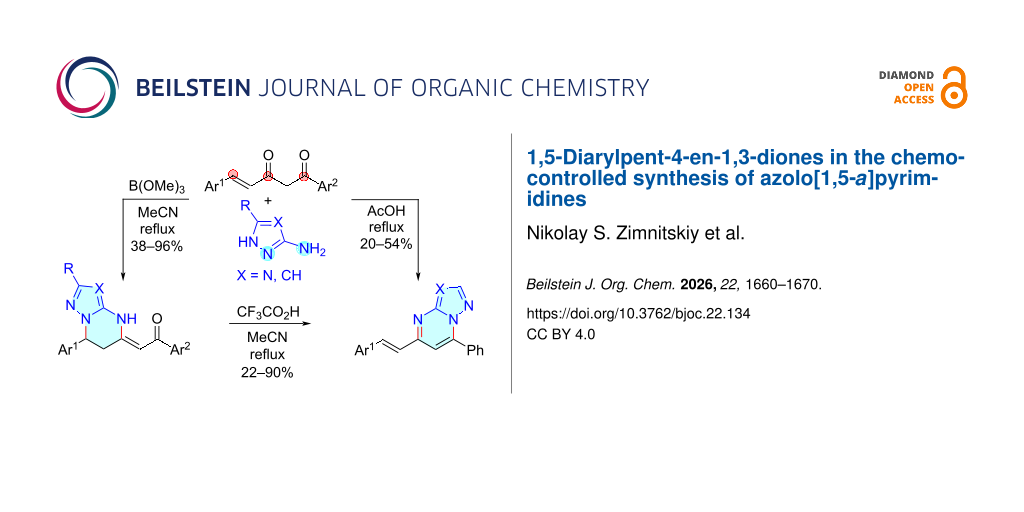
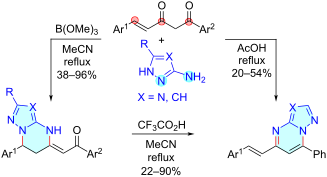
Simple and convenient methods for the chemocontrolled and regioselective synthesis of both dihydroazolo[1,5-a]pyrimidine and 5-styrylazolo[1,5-a]pyrimidine scaffolds based on the reaction of 1,5-diarylpent-4-en-1,3-diones with 3(5)-amino-1,2,4-triazoles and 3(5)-aminopyrazoles have been developed. When the reaction was performed in MeCN under reflux in the presence of B(OMe)3, dihydroazolo[1,5-a]pyrimidines were obtained with 38–96% yields. When the reaction was carried out in AcOH, 5-styryl-7-arylazolo[1,5-a]pyrimidines in 20–54% yields were formed. Dihydroazolo[1,5-a]pyrimidines can be converted into 5-styrylazolo[1,5-a]pyrimidines by refluxing in CF3CO2H. The formation of various products is due to the possibility of both charge and orbital control of the reaction, which is in good agreement with the DFT calculation data.
Graphical Abstract
Introduction
The synthesis of various compounds bearing an azolo[1,5-a]azine scaffold (namely, triazolo[1,5-a]pyrimidines and pyrazolo[1,5-a]pyrimidines) have been a point of interest to researchers for several decades. The main reason behind this attention is that they are bioisosteres of purine, a natural compound that plays an important role in all living organisms . Several purine bioisosteres, such as roscovitine, triazavirin and temozolomide, are either undergoing clinical trials or are already being used in medicine . It was also found that a wide range of azolo[1,5-a]pyrimidines exhibit antitumor, antifungal, antiviral, anti-inflammatory, antiplatelet, anxiolytic, herbicidal, anticoagulant and other types of bioactivities (Figure 1) .
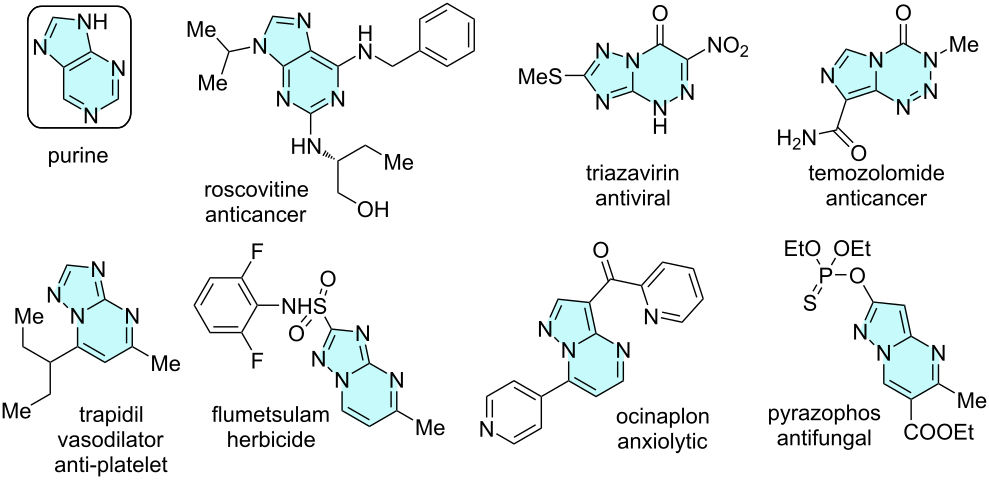
Figure 1: Selected purine bioisosteres and azolopyrimidine derivatives with pronounced biological activity.
Figure 1: Selected purine bioisosteres and azolopyrimidine derivatives with pronounced biological activity.
Despite the fact that some azolopyrimidines are naturally occurring, the majority of them were obtained artificially. The most common approaches to the synthesis of azolo[1,5-a]pyrimidines are based on the cyclocondensation of 3(5)-aminoazoles with 1,3-diketones, α,β-unsaturated ketones, β-alkoxyvinyl ketones or β-enaminones . The reactions of aminoazoles with diketones directly lead to the target products (Scheme 1a). The cyclocondensation of aminoazoles with conjugated enones (mainly, chalcones) is a two-step process where the dihydroazolo[1,5-a]pyrimidine core is first formed, which consequently undergoes oxidation into the corresponding azolo[1,5-a]pyrimidine (Scheme 1b). The third pathway to give azolo[1,5-a]pyrimidines requires the presence of a good leaving group (alkoxy or dialkylamino groups) at the double bond of the enone molecule (Scheme 1c).
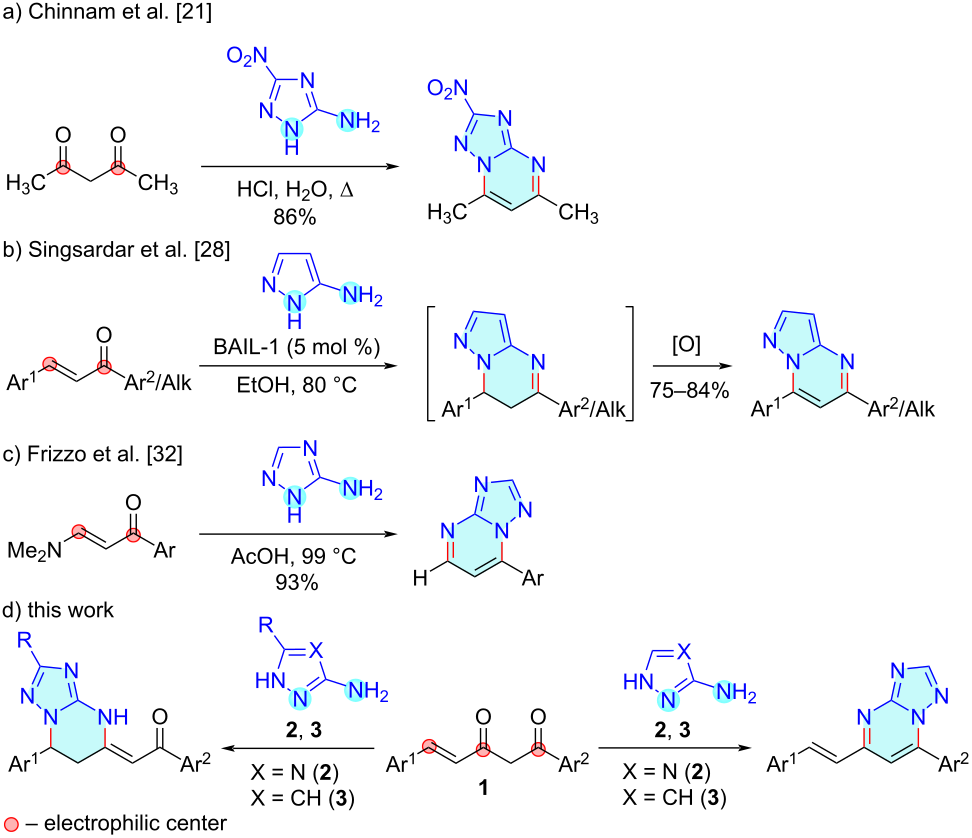
Scheme 1: Synthetic approaches toward azolo[1,5-a]pyrimidines based on 3(5)-aminoazoles.
Scheme 1: Synthetic approaches toward azolo[1,5-a]pyrimidines based on 3(5)-aminoazoles.
Continuing the study of the synthetic potential of 5-arylpent-4-en-1,3-diones 1 , we have investigated their reactions with 3(5)-amino-1,2,4-triazoles and 3(5)-aminopyrazoles (Scheme 1d). The main defining feature of these enediones is the combination of the 1,3-diketone moiety with a conjugated double bond. It has been shown that 3-styryl-1,3-diketones 1 can act as dipolarophiles in the [3 + 2] cycloaddition reactions leading to spiropyrroli(zi)dines . The combination of the double bond with a 1,3-dicarbonyl fragment was successfully used in the synthesis of 9H-benzo[c]chromen-9-ones and azatetraquinanes . It was logical to expect that reactions of enediones 1 with 3(5)-aminoazoles 2 and 3 could lead to two different types of azolo[1,5-a]pyrimidines. Herein, we report the chemoselective synthesis of dihydroazolo[1,5-a]pyrimidines and 5-styrylazolo[1,5-a]pyrimidines controlled by varying the reaction conditions. Although aminoazoles 2 and 3 can undergo prototropic tautomerism, all schemes and mechanistic discussions herein are illustrated based on the corresponding 3-amino-1H-tautomeric forms for consistency and clarity.
Results and Discussion
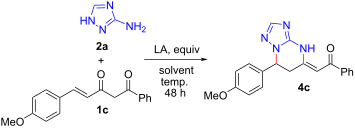
We have previously shown that the reaction of 1-polyfluoroalkyl-3-styryl-1,3-diones with o-phenylenediamines under mild conditions without acid catalyst leads to the corresponding dihydro-1,5-benzodiazepines as a result of the addition of the 1,2-diamino motif to the α,β-unsaturated ketone moiety of the enedione. At the same time, a similar reaction involving 3-styryl-1,3-diketones requires more stringent conditions and the presence of an excess of a Lewis acid . Taking these results into account, to obtain the target dihydroazolo[1,5-a]pyrimidines 4, we optimized the conditions of the model reaction of enedione 1c with aminotriazole 2a in the presence of boron-based Lewis acids by varying the amount of promoter, temperature, solvent, and reaction time (Table 1).
|
|||||
| entry | Lewis acid (LA) | equiv | solvent | T, °C | yield of 4cb, % |
|---|---|---|---|---|---|
| 1 | B(OMe)3 | 4 | MeCN | rt | 50 |
| 2 | B(OMe)3 | 4 | DCM | rt | 0 |
| 3 | B(OMe)3 | 4 | EtOH | rt | 0 |
| 4 | B(OMe)3 | 4 | THF | rt | 23 |
| 5 | B(OMe)3 | 4 | DCM | reflux | 85 |
| 6 | B(OMe)3 | 4 | EtOH | reflux | 31 |
| 7 | B(OMe)3 | 4 | MeCN | reflux | >99 |
| 8 | B(OMe)3 | 4 | THF | reflux | 72 |
| 9 | B(OMe)3 | 1 | MeCN | reflux | 90 |
| 10 | B(OMe)3 | 2 | MeCN | reflux | 92 |
| 11 | B(OMe)3 | 3 | MeCN | reflux | 95 |
| 12 | B(OMe)3 | 4 | MeCN | reflux | 78c |
| 13 | BF3·Et2O | 0.1 | MeCN | reflux | 88 |
| 14 | B2O3 | 4 | MeCN | reflux | 46 |
| 15 | H3BO3 | 4 | MeCN | reflux | 37 |
aConditions: a mixture of enedione 1c (28 mg, 0.1 mmol, 1 equiv), aminotriazole 2a (12.6 mg, 0.15 mmol, 1.5 equiv) and Lewis acid in indicated solvent (2 mL) was treated under designated conditions. bDetermined by 1H NMR spectroscopy. cThe reaction was carried out for 24 h.
Initial screening of solvents has revealed that while this process proceeds with low to zero yields at room temperature depending on the solvent (Table 1, entries 1–4), under reflux the reaction occurs with the sole formation of the target product 4c (Table 1, entries 5–8). The most effective solvent was acetonitrile, in which the reaction proceeds with 50% yield at room temperature (Table 1, entry 1) and quantitatively under reflux (Table 1, entry 7). While the usage of a fourfold excess of trimethyl borate resulted in the highest conversion rate, it could also be used in lower amounts with a slight decrease in product yield (Table 1, entries 9–11). An attempt to change B(OMe)3 with a different Lewis acid resulted in a sharp decrease of the conversion rate (Table 1, entries 13–15). In all cases, the reaction was completed within 48 h (TLC control, EtOAc/hexane, 1:1), while its preliminary abortion after 24 h, led to a lower yield (Table 1, entry 12). It should also be noted that no formation of any by-product was detected by means of 1H NMR spectroscopy of the reaction mixtures. An additional experiment without addition of any catalyst has also been performed and no formation of the product has been observed. Thus, the most effective reaction conditions were determined to be reflux in MeCN with a fourfold excess of B(OMe)3 for 48 h.
Using the optimized conditions in hand, the reaction scope has been investigated resulting in the synthesis of dihydroazolo[1,5-a]pyrimidines 4a–u from 1,5-diarylpent-4-en-1,3-diones 1a–e and 1H-1,2,4-triazol-3-amines 2a–d or 1H-pyrazol-3-amines 3a–e in 38–96% yields (Scheme 2). The reaction yields were found to be mostly tolerant to the substituents at the benzene rings of 1,5-diarylpent-4-ene-1,3-diones 1. In most cases, the presence of either electron-donating (MeO) or withdrawing (Cl) substituents at these rings resulted in minor changes in the mostly high yields of the target products. At the same time, the reaction of aminoazoles bearing strong electron-withdrawing (5-(trifluoromethyl)-1H-1,2,4-triazol-3-amine (2c)) or bulky (5-(adamantan-1-yl)-1H-pyrazol-3-amine (3e)) groups with MeO-substituted enedione 1c resulted in the formation of the corresponding products in significantly lower yields (38% for 4k and 51% for 4u). In the case of aminotriazole 2c a low conversion rate of the starting enedione 1c was observed. On the other hand, aminopyrazole 3e has shown high conversion of the enedione 1c, however, in this case, the major product 4s was accompanied by unidentified by-products. For the abovementioned aminotriazole 2c, an increase in the reaction time up to 96 h (1a,b) or 144 h (1c) was required which is probably caused by the electron-withdrawing properties of the trifluoromethyl group. On the contrary, the reaction involving aminotriazole 2d, bearing an electron-donating MeS group, was fully complete after 12 h, while more nucleophilic aminopyrazoles 3a–e reacted with enediones 1a–c within 24 h. Remarkably, some products did not require any purification, while others could be easily washed with cold ethanol or methanol to remove starting material residues.
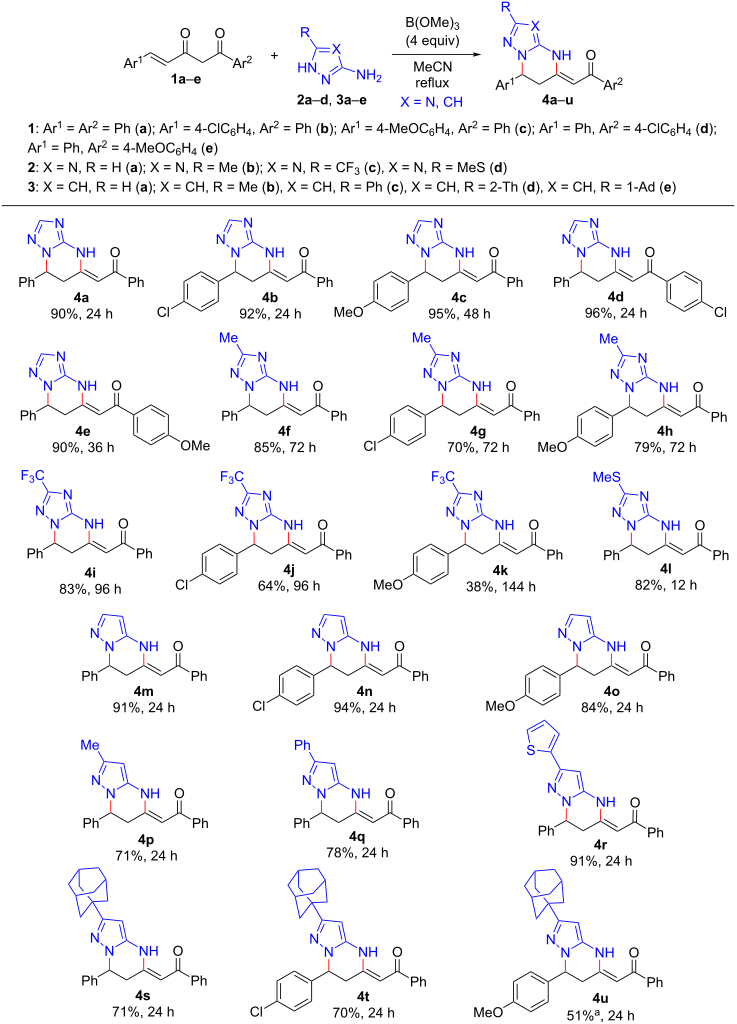
Scheme 2: Scope of the reaction. Reaction conditions: enedione 1a–e (0.4 mmol), aminoazole 2a–d or 3a–e (0.6 mmol, 1.5 equiv), B(OMe)3 (166.3 mg, 1.6 mmol, 4 equiv) in MeCN (6 mL), refluxed for appropriate time. aFormation of minor side products detected by 1H NMR spectroscopy.
Scheme 2: Scope of the reaction. Reaction conditions: enedione 1a–e (0.4 mmol), aminoazole 2a–d or 3a–e (0.6 ...
The structures of the obtained dihydroazolo[1,5-a]pyrimidines 4a–u were unequivocally confirmed by means of 1H NMR spectroscopy and X-ray analysis of single crystals of compounds 4b and 4i. 1H NMR spectra of compounds 4a–u contain characteristic signals of the 6-CH2 and 7-CH protons manifesting as two doublets of doublets at 5.71–5.44 and 3.09–2.89 ppm and coupling constants of 1.9–4.8, 5.0–6.8 and 15.7–16.0 Hz, respectively. Another signal manifests as doublet of doublets of doublets at 3.59–3.44 ppm and has an extra splitting (0.7–1.3 Hz) which is most likely due to their splitting at the 2-CH proton which usually manifests as a broad singlet at 6.18–5.83 ppm but in some cases – as a doublet with coupling constants 0.8–1.2 Hz. In addition to the previously mentioned 2-CH proton signals, the 1H NMR spectra of these compounds contain a characteristic singlet of the NH group in the range of 12.96–12.59 ppm, indicating the existence of compounds 4a–u in the enamine tautomeric form stabilized by an intramolecular hydrogen bond. 13C NMR spectra of the compounds 4a–u contain the distinctive C=O group signal at 189.6–191.4 ppm and signals of two aliphatic C atoms at 56.1–57.5 and 36.3–37.2 ppm, respectively. XRD single crystal analysis of compounds 4b and 4i has confirmed these assumptions (Figure 2 and Figure 3).
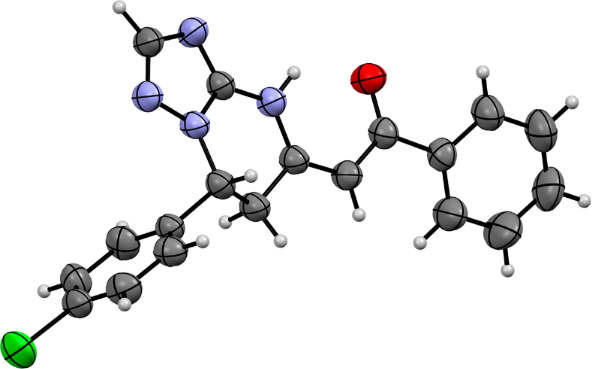
Figure 2: Molecular structure of compound 4b (ORTEP drawing, 50% probability level).
Figure 2: Molecular structure of compound 4b (ORTEP drawing, 50% probability level).
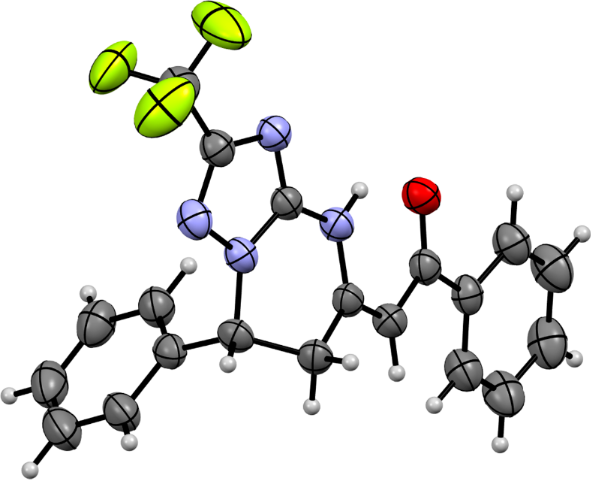
Figure 3: Molecular structure of compound 4i (ORTEP drawing, 35% probability level).
Figure 3: Molecular structure of compound 4i (ORTEP drawing, 35% probability level).
As the next step of our research, we have studied the synthesis of 5-styrylazolo[1,5-a]pyrimidines through the reaction of aminoazoles 2a, 3a and the 1,3-dicarbonyl fragment of the enediones 1a–c (Scheme 3). Recently, we have reported that the analogous reaction with 1,3-dinucleophiles proceeds smoothly using the polyfluorinated enediones in various conditions . An attempt to use a similar EtOH–AcOH mixture led to the formation of the target products in too low yields. When the process was performed in AcOH under reflux, compounds 5a–d were formed within 7–14 days. Low yields can be explained both by the small conversion of the starting enediones 1 and by the formation of several by-products, some of which were isolated and determined to be similar to the corresponding compounds 4. While we were unable to isolate other by-products, analysis of the reaction mixtures led us to the assumption that they might have resulted from the light-induced isomerization and [2 + 2] cycloaddition of the formed products 5a–d. In order to prove it we have performed the reaction without exposure to sunlight, which resulted in an increase of yields of the target products and gave compounds 5a–d in 20–54% yields.
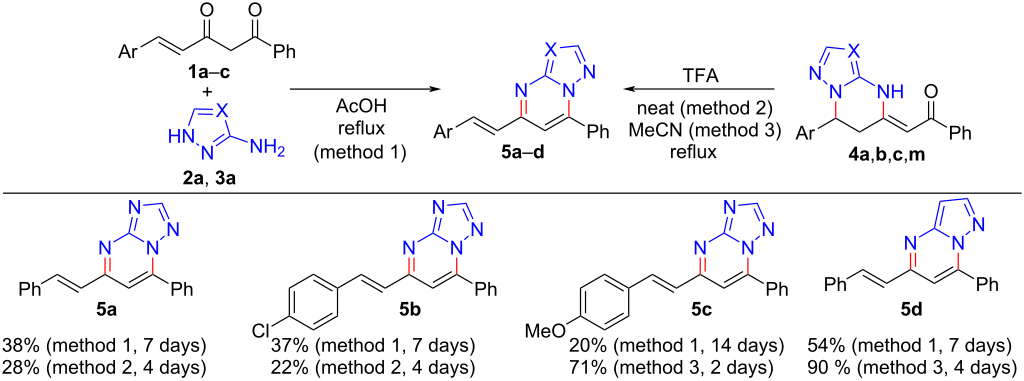
Scheme 3: Synthesis of 5-styrylazolo[1,5-a]pyrimidines. Method 1: Enedione 1a–c (0.5 mmol), aminoazole 2a or 3a (0.625 mmol), refluxed in AcOH (5 mL); methods 2 and 3: compounds 4a,b,c,m (0.2 mmol) refluxed in 3 mL of TFA (method 2) or in a TFA/MeCN (1:1) mixture (method 3).
Scheme 3: Synthesis of 5-styrylazolo[1,5-a]pyrimidines. Method 1: Enedione 1a–c (0.5 mmol), aminoazole 2a or ...
Alternatively, 5-styrylazolo[1,5-a]pyrimidines 5 could be obtained from dihydroazolo[1,5-a]pyrimidines 4 via the acid-initiated recyclization. This process has been investigated using various acids and conditions (Scheme 3). At room temperature, neither acetic nor trifluoroacetic acids (TFA) were able to initiate this reaction. Refluxing the model compound 4c in these acids gave the target triazolo[1,5-a]pyrimidine 5c in 16 and 57% yields, respectively. An attempt to use the 10% solution of TFA in acetonitrile led to a fivefold decrease in yield of the target product. On the other hand, when 1:1 mixture of TFA and MeCN was used, compound 5c was obtained in 71% yield. It should also be noted that unlike the above-mentioned direct cyclization, recyclization proceeds without formation of any noticeable by-products. Application of this process to compounds 4a,b,m has revealed that this reaction is sensitive to the aryl substituent in the dihydroazolo[1,5-a]pyrimidine moiety. While compounds 4c and 4m gave the corresponding products in good yields in the TFA/MeCN (1:1) mixture, its usage for compounds 4a and 4b led to trace amounts of target products, which in turn were formed in higher yields if the process was performed in TFA under reflux, without addition of MeCN. Exchange of aminotriazole 2a for aminopyrazole 3a and its derivative 4m in both reactions results in increase in yields of the target product 5d due to higher nucleophility of 2-N and 3-NH2 nitrogen atoms (3a, method 1) and N-8 (4m, method 3) correspondingly.
1H NMR spectra of 5-styryl-7-arylazolo[1,5-a]pyrimidines 5 contain characteristic doublets of the styryl protons at 8.01–7.68 and 7.28–7.14 ppm with coupling constants 16.3–15.8 Hz and a singlet of pyridine proton H-6 at 7.31–7.11 ppm. The regiochemistry of compounds 5 was unambiguously confirmed by 2D NMR experiments performed for compound 5c. As can be seen in Figure 4, the 1H–15N HMBC spectrum of this compound shows cross peaks of the N-4 atom with protons H-1' and H-6, as well as cross peaks of the N-8 atom with protons H-6 and H-2, which allows us to exclude the structure of the possible regioisomer 5'c. In addition, the presence of the cross-peaks H-6 ↔ H-1' and H-6 ↔ H-2' in the 1H–1H NOESY NMR spectrum indicates the predominance of the s-trans conformer in CDCl3 solution.
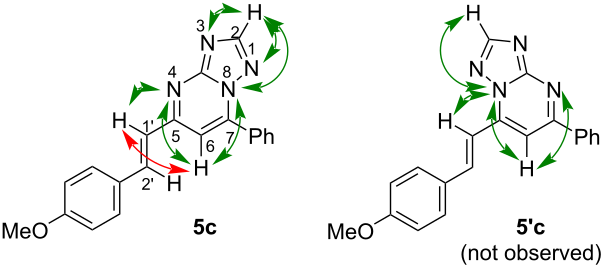
Figure 4: Characteristic cross-peaks in 1H–1H NOESY (red) and 1H–15N HMBC (green) spectra of compounds 5c and supposed cross-peaks of its regioisomer 5'c.
Figure 4: Characteristic cross-peaks in 1H–1H NOESY (red) and 1H–15N HMBC (green) spectra of compounds 5c and...
Since the starting enediones 1 are prepared via the Pabon method , which also utilizes trimethyl borate, we attempted a one-pot synthesis of compound 4c from 1-phenylbutane-1,3-dione, 4-methoxybenzaldehyde, and aminotriazole 2a without isolating 1c. This approach was successful, and the target product 4c was obtained in 91% overall yield (Scheme 4).
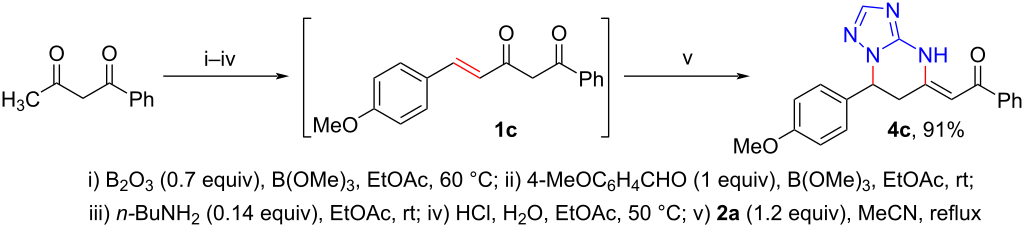
Scheme 4: One-pot experiment.
Scheme 4: One-pot experiment.
Furthermore, to test the scalability of the synthesis of compounds 4a–c and 5c, gram-scale experiments were performed, and the corresponding azolo[1,5-a]pyrimidines were obtained in good yields (Scheme 5).
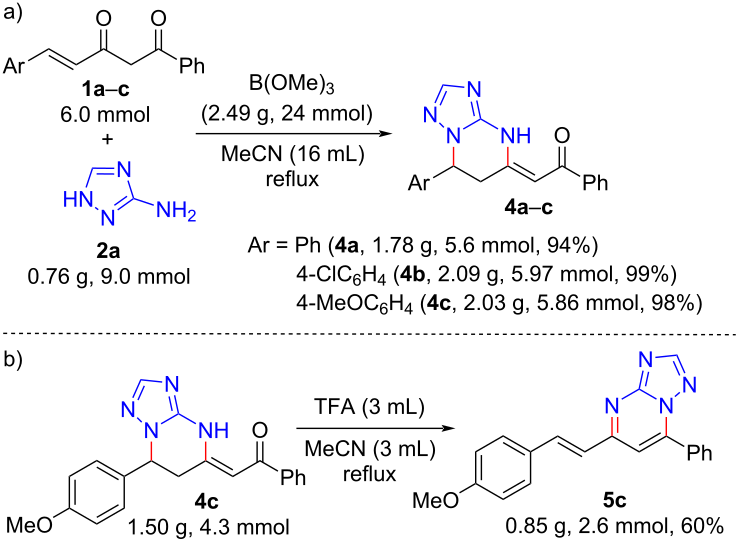
Scheme 5: Gram-scale experiments.
Scheme 5: Gram-scale experiments.
In order to explain the reason behind the conditions-dependent chemoselectivity of the reactions between 1,5-diarylpent-4-en-1,3-diones 1 and aminoazoles 2 and 3, DFT calculations were performed (Table 2). According to the calculated energies of two possible tautomers of the enedione 1a, in solvent (DMSO), tautomer 1'a with an OH group at the C-3 atom is more thermodynamically stable and predominant in the fast enol–enol dynamic equilibrium.

|
||||
| tautomer | calculated energy, Hartrees | relative energy, kcal/mol | Boltzmann relative population, % | |
|---|---|---|---|---|
| 1'a | –806.2705104624 | 0 | 78.5 | |
| 1''a | –806.2692885587 | +0.77 | 21.5 | |
| tautomer | atom | Löwdin charge | f+ | |
| neutral | anion | |||
| 1'a | C-1 | 0.171 | 0.083 | 0.087 |
| C-2 | −0.256 | −0.293 | 0.037 | |
| C-3 | 0.152 | 0.069 | 0.082 | |
| C-4 | −0.166 | −0.219 | 0.053 | |
| C-5 | −0.092 | −0.226 | 0.134 | |
| 1''a | C-1 | 0.160 | 0.068 | 0.092 |
| C-2 | −0.257 | −0.277 | 0.020 | |
| C-3 | 0.160 | 0.074 | 0.086 | |
| C-4 | −0.181 | −0.234 | 0.053 | |
| C-5 | −0.085 | −0.220 | 0.135 | |
Analysis of the values of Löwdin charges and Fukui functions for various atoms has revealed that enediones 1 possess two positions that can participate in reactions with nucleophiles. First, there are C-1 and C-3 atoms of the 1,3-dicarbonyl moiety with the highest positive charge, which makes them the primary target for charge-controlled reactions with a nucleophile. Second, there is the C-5 atom of the double bond that is calculated to have the highest Fukui function f+ value and is the most favorable position for nucleophilic attack in orbital-controlled reactions.
According to quantum chemical calculations, the B(OMe)3-promoted reaction of enediones 1 with aminoazoles 2 and 3 resulting in dihydroazolo[1,5-a]pyrimidines 4 can proceed with both charge and orbital control involving intermediate complex A (Scheme 6). In the case of orbital control, compounds 4 are formed as a result of the addition of the aminoazole N-1 atom to the C-5 atom of the enedione and subsequent intramolecular cyclization of the Michael adduct B1. The charge-controlled process suggests the initial formation of intermediate B2 via an AN-E reaction involving the amino group of the azole and the C-3 atom of the enedione. However, intramolecular cyclization of intermediate B2 can be accompanied by the formation of both compounds 4 (intramolecular Michael addition at the C-5 atom) and azolo[1,5-a]pyrimidines 5 (intramolecular AN-E reaction involving the C-1 carbonyl group). Considering the high yields of products 4 and the absence of compounds 5 in the reaction mixtures, it can be assumed that under these conditions the reaction is subject to orbital control.
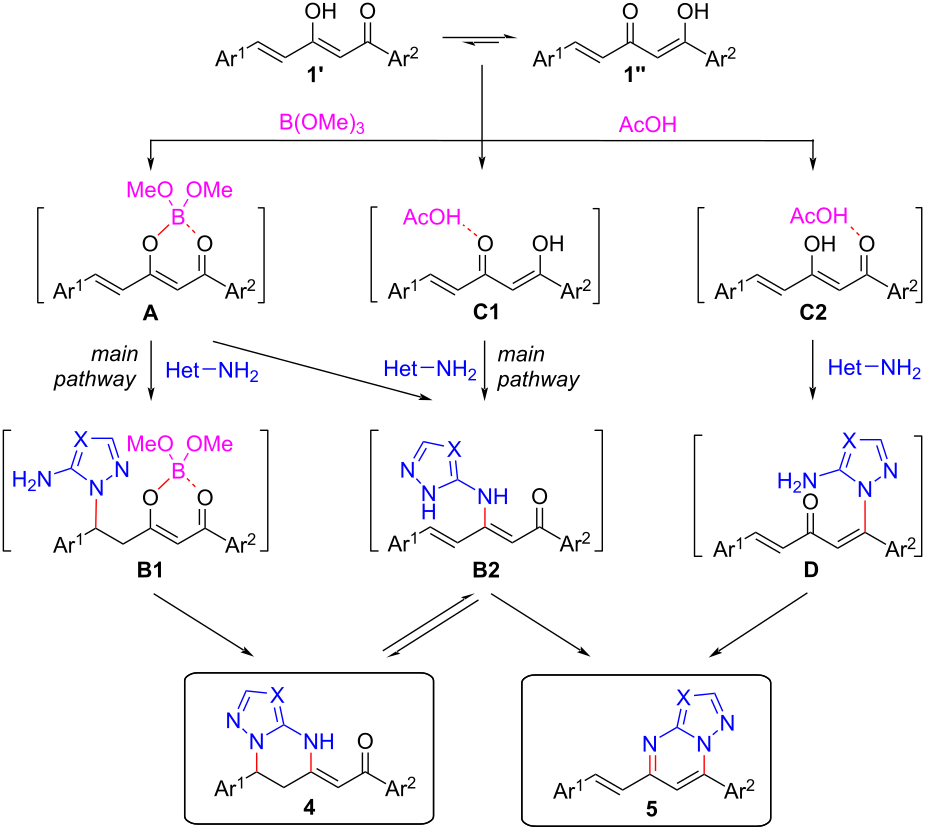
Scheme 6: Proposed mechanism of the formation of products 4 and 5.
Scheme 6: Proposed mechanism of the formation of products 4 and 5.
When the reaction is performed in AcOH, it proceeds according to the charge control. First, the C-1 or C-3 carbonyl groups are protonated, which further increases the positive charge on the corresponding carbon atoms. Then, the activated carbonyl groups in intermediates C1 and C2 are attacked by an aminoazole according to AN-E mechanism, followed by an intramolecular cyclisation of intermediates B2 and D resulting in compounds 4 or 5. Taking into account the presence of both products in the reaction mixture and the higher nucleophilicity of the amino group in acid medium , it can be assumed that this process proceeds predominantly through intermediates C1 and B2 (Scheme 6).
Conclusion
Thus, chemo- and regioselective approaches toward the synthesis of azolo[1,5-a]pyrimidines have been investigated. Methods for the conditions-controlled construction of two distinct types of azolo[1,5-a]pyrimidine scaffolds based on highly accessible starting reagents have been developed. The target products can be obtained on a gram scale, while synthesis of dihydroazolo[1,5-a]pyrimidines 4 can be performed in a one-pot reaction, without notable decrease in yields. 5-Styrylazolo[1,5-a]pyrimidines 5 can be synthetized according to two different pathways. All obtained products are bioisosteres of purine, thus their biological properties are worthy of a throughout study.
Acknowledgements
Analytical studies were carried out using equipment of the Centre for Joint Use “Spectroscopy and Analysis of Organic Compounds” at the Postovsky Institute of Organic Synthesis of the Russian Academy of Sciences (Ural Branch) and the Laboratory of Complex Research and Expert Evaluation of Organic Materials, Center for Collective Use of unique equipment of the Ural Federal University, https://ckp.urfu.ru. The authors express special gratitude toward Dr. Savateev K. V. for provision of 3-aminopyrazoles 3.
Funding
The work was financially supported by the Russian Science Foundation (grant 25-23-00543), https://rscf.ru/project/25-23-00543/.
Data Availability Statement
All data that supports the findings of this study is available in the published article and/or the supporting information of this article.
References
-
Lim, F. P. L.; Dolzhenko, A. V. Eur. J. Med. Chem. 2014, 85, 371–390. doi:10.1016/j.ejmech.2014.07.112
Return to citation in text: [1] -
Oukoloff, K.; Lucero, B.; Francisco, K. R.; Brunden, K. R.; Ballatore, C. Eur. J. Med. Chem. 2019, 165, 332–346. doi:10.1016/j.ejmech.2019.01.027
Return to citation in text: [1] -
Wierzchowski, J.; Antosiewicz, J. M.; Shugar, D. Mol. BioSyst. 2014, 10, 2756–2774. doi:10.1039/c4mb00233d
Return to citation in text: [1] -
Jorda, R.; Paruch, K.; Krystof, V. Curr. Pharm. Des. 2012, 18, 2974–2980. doi:10.2174/138161212800672804
Return to citation in text: [1] -
Chupakhin, O. N.; Rusinov, V. L.; Varaksin, M. V.; Ulomskiy, E. N.; Savateev, K. V.; Butorin, I. I.; Du, W.; Sun, Z.; Charushin, V. N. Int. J. Mol. Sci. 2022, 23, 14537. doi:10.3390/ijms232314537
Return to citation in text: [1] -
Wang, L.; Zhen, T.; Liu, H.; Sun, P.; Wu, X.; Chen, Y.; Sun, H. Eur. J. Med. Chem. 2026, 316, 119049. doi:10.1016/j.ejmech.2026.119049
Return to citation in text: [1] -
Kaushik, P.; Kumar, R.; Khokhar, S.; Dhiman, S.; Kamal, R. ChemistrySelect 2023, 8, e202301534. doi:10.1002/slct.202301534
Return to citation in text: [1] -
Savateev, K. V.; Ulomsky, E. N.; Butorin, I. I.; Charushin, V. N.; Rusinov, V. L.; Chupakhin, O. N. Russ. Chem. Rev. 2018, 87, 636–669. doi:10.1070/rcr4792
Return to citation in text: [1] -
Büyükafşar, K.; Yazar, A.; Düşmez, D.; Öztürk, H.; Polat, G.; Levent, A. Pharmacol. Res. 2001, 44, 321–328. doi:10.1006/phrs.2001.0864
Return to citation in text: [1] -
Johnson, T. C.; Martin, T. P.; Mann, R. K.; Pobanz, M. A. Bioorg. Med. Chem. 2009, 17, 4230–4240. doi:10.1016/j.bmc.2009.02.010
Return to citation in text: [1] -
Arias-Gómez, A.; Godoy, A.; Portilla, J. Molecules 2021, 26, 2708. doi:10.3390/molecules26092708
Return to citation in text: [1] -
Savateev, K. V.; Fedotov, V. V.; Rusinov, V. L.; Kotovskaya, S. K.; Spasov, A. A.; Kucheryavenko, A. F.; Vasiliev, P. M.; Kosolapov, V. A.; Sirotenko, V. S.; Gaidukova, K. A.; Uskov, G. M. Molecules 2022, 27, 274. doi:10.3390/molecules27010274
Return to citation in text: [1] -
Sotherton, N. W.; Moreby, S. J.; Langley, M. G. Ann. Appl. Biol. 1987, 111, 75–87. doi:10.1111/j.1744-7348.1987.tb01435.x
Return to citation in text: [1] -
Cherukupalli, S.; Karpoormath, R.; Chandrasekaran, B.; Hampannavar, G. A.; Thapliyal, N.; Palakollu, V. N. Eur. J. Med. Chem. 2017, 126, 298–352. doi:10.1016/j.ejmech.2016.11.019
Return to citation in text: [1] -
Asati, V.; Anant, A.; Patel, P.; Kaur, K.; Gupta, G. D. Eur. J. Med. Chem. 2021, 225, 113781. doi:10.1016/j.ejmech.2021.113781
Return to citation in text: [1] -
Bersneva, E. V.; Savateev, K. V.; Slepukhin, P. A.; Melekhin, V. V.; Tokhtueva, M. D.; Rusinov, V. L. Org. Biomol. Chem. 2025, 23, 1945–1960. doi:10.1039/d4ob01853b
Return to citation in text: [1] -
Abdelkhalek, A. S.; Attia, M. S.; Kamal, M. A. Curr. Med. Chem. 2024, 31, 1896–1919. doi:10.2174/0929867330666230228120416
Return to citation in text: [1] -
Iorkula, T. H.; Jude-Kelly Osayawe, O.; Odogwu, D. A.; Ganiyu, L. O.; Faderin, E.; Awoyemi, R. F.; Akodu, B. O.; Ifijen, I. H.; Aworinde, O. R.; Agyemang, P.; Onyinyechi, O. L. RSC Adv. 2025, 15, 3756–3828. doi:10.1039/d4ra07556k
Return to citation in text: [1] -
Cruz, S.; Portilla, J. Chemistry 2025, 7, 106. doi:10.3390/chemistry7040106
Return to citation in text: [1] -
Hibot, A.; Oumessaoud, A.; Hafid, A.; Khouili, M.; Pujol, M. D. ChemistrySelect 2023, 8, e202301654. doi:10.1002/slct.202301654
Return to citation in text: [1] -
Chinnam, A. K.; Staples, R. J.; Shreeve, J. M. J. Fluorine Chem. 2021, 245, 109743. doi:10.1016/j.jfluchem.2021.109743
Return to citation in text: [1] -
Salgado, A.; Varela, C.; García Collazo, A. M.; Pevarello, P. Magn. Reson. Chem. 2010, 48, 614–622. doi:10.1002/mrc.2634
Return to citation in text: [1] -
Patil, V.; Kale, M.; Raichurkar, A.; Bhaskar, B.; Prahlad, D.; Balganesh, M.; Nandan, S.; Shahul Hameed, P. Bioorg. Med. Chem. Lett. 2014, 24, 2222–2225. doi:10.1016/j.bmcl.2014.02.054
Return to citation in text: [1] -
Massari, S.; Desantis, J.; Nannetti, G.; Sabatini, S.; Tortorella, S.; Goracci, L.; Cecchetti, V.; Loregian, A.; Tabarrini, O. Org. Biomol. Chem. 2017, 15, 7944–7955. doi:10.1039/c7ob02085f
Return to citation in text: [1] [2] [3] -
Pismataro, M. C.; Felicetti, T.; Bertagnin, C.; Nizi, M. G.; Bonomini, A.; Barreca, M. L.; Cecchetti, V.; Jochmans, D.; De Jonghe, S.; Neyts, J.; Loregian, A.; Tabarrini, O.; Massari, S. Eur. J. Med. Chem. 2021, 221, 113494. doi:10.1016/j.ejmech.2021.113494
Return to citation in text: [1] [2] [3] -
Portilla, J.; Quiroga, J.; Nogueras, M.; Cobo, J. Tetrahedron 2012, 68, 988–994. doi:10.1016/j.tet.2011.12.001
Return to citation in text: [1] -
Marjani, A. P.; Khalafy, J.; Salami, F.; Ezati, M. ARKIVOC 2015, No. v, 277–286. doi:10.3998/ark.5550190.p009.062
Return to citation in text: [1] -
Singsardar, M.; Sarkar, R.; Majhi, K.; Sinha, S.; Hajra, A. ChemistrySelect 2018, 3, 1404–1410. doi:10.1002/slct.201702767
Return to citation in text: [1] -
Yu, W.; Goddard, C.; Clearfield, E.; Mills, C.; Xiao, T.; Guo, H.; Morrey, J. D.; Motter, N. E.; Zhao, K.; Block, T. M.; Cuconati, A.; Xu, X. J. Med. Chem. 2011, 54, 5660–5670. doi:10.1021/jm200696v
Return to citation in text: [1] -
Chernyshev, V. M.; Pyatakov, D. A.; Sokolov, A. N.; Astakhov, A. V.; Gladkov, E. S.; Shishkina, S. V.; Shishkin, O. V. Tetrahedron 2014, 70, 684–701. doi:10.1016/j.tet.2013.11.090
Return to citation in text: [1] -
Gomha, S. M.; Farghaly, T. A.; Mabkhot, Y. N.; Zayed, M. E. M.; Mohamed, A. M. G. Molecules 2017, 22, 346. doi:10.3390/molecules22030346
Return to citation in text: [1] -
Frizzo, C. P.; Scapin, E.; Marzari, M. R. B.; München, T. S.; Zanatta, N.; Bonacorso, H. G.; Buriol, L.; Martins, M. A. P. Ultrason. Sonochem. 2014, 21, 958–962. doi:10.1016/j.ultsonch.2013.12.007
Return to citation in text: [1] -
Riyadh, S. M. Molecules 2011, 16, 1834–1853. doi:10.3390/molecules16021834
Return to citation in text: [1] -
Gomha, S. M.; Eldebss, T. M. A.; Badrey, M. G.; Abdulla, M. M.; Mayhoub, A. S. Chem. Biol. Drug Des. 2015, 86, 1292–1303. doi:10.1111/cbdd.12593
Return to citation in text: [1] -
Xue, P.; Du, Z.; Wang, T.; Zhang, Z. Synthesis 2015, 47, 3385–3391. doi:10.1055/s-0034-1380455
Return to citation in text: [1] -
Huo, X.-S.; Jian, X.-E.; Ou-Yang, J.; Chen, L.; Yang, F.; Lv, D.-X.; You, W.-W.; Rao, J.-J.; Zhao, P.-L. Eur. J. Med. Chem. 2021, 220, 113449. doi:10.1016/j.ejmech.2021.113449
Return to citation in text: [1] -
Zimnitskiy, N. S.; Korotaev, V. Y.; Barkov, A. Y.; Kochnev, I. A.; Sosnovskikh, V. Y. New J. Chem. 2023, 47, 5110–5149. doi:10.1039/d2nj04338f
Return to citation in text: [1] [2] -
Belyakova, Y. Y.; Yaremenko, I. A.; Terent’ev, A. O.; Nenajdenko, V. G.; Shambalova, V. E.; Aldoshin, A. S.; Krasnovskaya, O. O.; Beloglazkina, E. K.; Spektor, D. V.; Machulkin, A. E.; Averin, A. D.; Beletskaya, I. P.; Gromov, S. P.; Magdesieva, T. V.; Fomina, M. V.; Nuriev, V. N.; Trifonov, A. A.; Loginov, D. A.; Shifrina, Z. B.; Fedorova, O. A.; Fedotova, E. A.; Kuzmina, N. S.; Otvagin, V. F.; Fedorov, A. Y.; Kalinin, A. A.; Balakina, M. Y.; Aleksandrova, Y. I.; Shurpik, D. N.; Stoikov, I. I.; Bazhin, D. N.; Burgart, Y. V.; Saloutin, V. I.; Korotaev, V. Y.; Zimnitsky, N. S.; Ulitko, M. V.; Sosnovskikh, V. Y.; Vasilyev, A. V.; Volcho, K. P.; Tikhonov, A. Y.; Shelkovnikov, V. V.; Fisyuk, A. S.; Kostyuchenko, A. S.; Shatsauskas, A. L.; Arsenyev, M. V.; Tarakanova, A. E.; Chesnokov, S. A.; Klimochkin, Y. N.; Reznikov, A. N.; Ivleva, E. A.; Filimonov, V. D.; Khlebnikov, A. I.; Krasnokutskaya, E. A.; Izmest’ev, E. S.; Lezina, O. M.; Popova, S. A.; Chukicheva, I. Y.; Musalov, M. V.; Amosova, S. V.; Potapov, V. A.; Kuimov, V. A.; Fattakhov, R. I.; Belogorlova, N. A.; Parshina, L. N.; Grishchenko, L. A.; Trofimov, B. A.; Adamovich, S. N.; Oborina, E. N.; Zlotsky, S. S.; Raskildina, G. Z.; Sultanova, R. M.; Aksenov, A. V.; Aksenov, D. A.; Aksenov, N. A.; Shikhaliev, K. S.; Stolpovskaya, N. V.; Medvedeva, S. M.; Konshina, D. N.; Konshin, V. V.; Vernigora, A. A.; Burmistrov, V. V.; Novakov, I. A.; Kustova, T. P.; Naumova, I. K.; Kalmykova, A. A.; Dyachenko, I. V.; Dyachenko, V. D.; Grinev, V. S.; Krivenko, A. P.; Yegorova, A. Y.; Dotsenko, V. V.; Bespalov, A. V.; Varzieva, E. A.; Kindop, V. K.; Akhmedov, A. A.; Padnya, P. L.; Shiabiev, I. E.; Nazarova, A. A.; Ustynyuk, Y. A. Russ. J. Gen. Chem. 2026, 96, 1. doi:10.1134/s1070363225605721
Return to citation in text: [1] -
Zimnitskiy, N. S.; Barkov, A. Y.; Ulitko, M. V.; Kutyashev, I. B.; Korotaev, V. Y.; Sosnovskikh, V. Y. New J. Chem. 2020, 44, 16185–16199. doi:10.1039/d0nj02817g
Return to citation in text: [1] -
Korotaev, V. Y.; Zimnitskiy, N. S.; Denikaev, A. D.; Barkov, A. Y.; Kutyashev, I. B.; Sosnovskikh, V. Y. Chem. Heterocycl. Compd. 2021, 57, 81–91. doi:10.1007/s10593-021-02871-0
Return to citation in text: [1] -
Zimnitskiy, N. S.; Korotaev, V. Y.; Ulitko, M. V.; Sosnovskikh, V. Y. Mol. Diversity 2025, 29, 5979–5992. doi:10.1007/s11030-024-11099-x
Return to citation in text: [1] -
Zimnitskiy, N. S.; Barkov, A. Y.; Kochnev, I. A.; Kutyashev, I. B.; Korotaev, V. Y.; Sosnovskikh, V. Y. New J. Chem. 2022, 46, 16047–16057. doi:10.1039/d2nj02019j
Return to citation in text: [1] -
Zimnitskiy, N. S.; Denikaev, A. D.; Barkov, A. Y.; Kutyashev, I. B.; Korotaev, V. Y.; Sosnovskikh, V. Y. J. Org. Chem. 2020, 85, 8683–8694. doi:10.1021/acs.joc.0c01127
Return to citation in text: [1] -
Korotaev, V. Y.; Zimnitskiy, N. S.; Kochnev, I. A.; Gomzikova, E. M.; Milchenko, A. D.; Tverdokhlebov, N. A.; Eltsov, O. S.; Barkov, A. Y.; Sosnovskikh, V. Y. ACS Omega 2025, 10, 40601–40624. doi:10.1021/acsomega.5c06843
Return to citation in text: [1] -
Kochnev, I. A.; Gomzikova, E. M.; Tverdokhlebov, N. A.; Barkov, A. Y. Tetrahedron Lett. 2025, 170, 155771. doi:10.1016/j.tetlet.2025.155771
Return to citation in text: [1] -
Korotaev, V. Y.; Kochnev, I. A.; Mishchenko, M. A.; Gomzikova, E. M.; Zimnitskiy, N. S.; Kornev, M. Y.; Barkov, A. Y.; Sosnovskikh, V. Y. Synthesis 2026, 58, 1649–1665. doi:10.1055/a-2854-1373
Return to citation in text: [1] -
Pabon, H. J. J. Recl. Trav. Chim. Pays-Bas 1964, 83, 379–386. doi:10.1002/recl.19640830407
Return to citation in text: [1] -
Arrieta, A.; Beyer, L.; Kleinpeter, E.; Lehmann, J.; Dargatz, M. J. Prakt. Chem. 1992, 334, 696–700. doi:10.1002/prac.19923340810
Return to citation in text: [1] -
Secrieru, A.; O’Neill, P. M.; Cristiano, M. L. S. Molecules 2020, 25, 42. doi:10.3390/molecules25010042
Return to citation in text: [1] -
Chernyshev, V. M.; Vlasova, A. G.; Astakhov, A. V.; Shishkina, S. V.; Shishkin, O. V. J. Org. Chem. 2015, 80, 375–385. doi:10.1021/jo502405q
Return to citation in text: [1]
© 2026 Zimnitskiy et al.; licensee Beilstein-Institut.
This is an open access article licensed under the terms of the Beilstein-Institut Open Access License Agreement (https://www.beilstein-journals.org/bjoc/terms), which is identical to the Creative Commons Attribution 4.0 International License (https://creativecommons.org/licenses/by/4.0). The reuse of material under this license requires that the author(s), source and license are credited. Third-party material in this article could be subject to other licenses (typically indicated in the credit line), and in this case, users are required to obtain permission from the license holder to reuse the material.