


Search results
Search for "palladium-catalyzed coupling" in Full Text gives 32 result(s) in Beilstein Journal of Organic Chemistry.
Palladium-catalyzed C–N and C–O bond formation of N-substituted 4-bromo-7-azaindoles with amides, amines, amino acid esters and phenols
Beilstein J. Org. Chem. 2012, 8, 2004–2018, doi:10.3762/bjoc.8.227
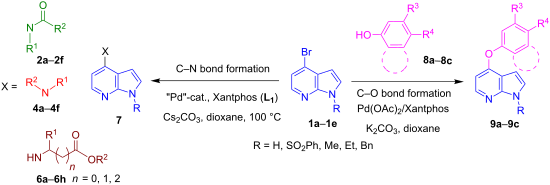
- reactions of azaindoles with amides, amines, amino acid esters or phenols offer an interesting complementary method for the synthesis of C–N and C–O bonds under comparably mild conditions. It is important to note that, in contrast to well-established palladium-catalyzed coupling reactions of indole with


Palladium-catalyzed substitution of (coumarinyl)methyl acetates with C-, N-, and S-nucleophiles
Beilstein J. Org. Chem. 2012, 8, 1200–1207, doi:10.3762/bjoc.8.133
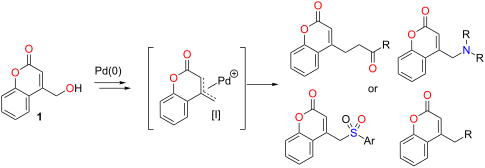
- acetate and aryl sulfinate coupling reaction. Scope of the coumarinyl acetate and amine coupling reaction. Reaction development for the coupling of in situ generated enolates and coumarin π-benzyl complexes. Palladium-catalyzed coupling of coumarinyl acetate and phenylboronic acid. Supporting Information


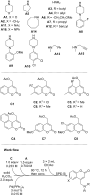

A concise synthesis of 3-(1-alkenyl)isoindolin-1-ones and 5-(1-alkenyl)pyrrol-2-ones by the intermolecular coupling reactions of N-acyliminium ions with unactivated olefins
Beilstein J. Org. Chem. 2012, 8, 192–200, doi:10.3762/bjoc.8.21

- -1-one derivatives. One was, as mentioned above, by the Cp2ZrCl2 catalyzed coupling of N-acyliminium ions with in situ generated dimethyl 1-alkenylalanes [24], another was performed by the palladium-catalyzed coupling of 2-iodobenzoyl chloride with aldimines and subsequent cyclization [34]. The


Amines as key building blocks in Pd-assisted multicomponent processes
Beilstein J. Org. Chem. 2011, 7, 1387–1406, doi:10.3762/bjoc.7.163
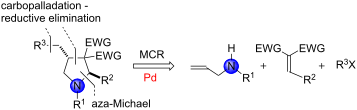
- indole derivatives have been reported because they occur in numerous natural products and bioactive compounds. Among these different strategies, those involving a palladium-catalyzed coupling reaction have received much attention [25] and one of the most commonly used procedures involves a one-pot two


Conjugated polymers containing diketopyrrolopyrrole units in the main chain
Beilstein J. Org. Chem. 2010, 6, 830–845, doi:10.3762/bjoc.6.92
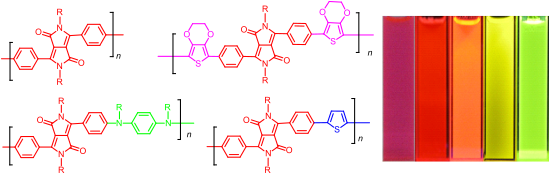
- arylamine. The bromination of aryl units is important for the subsequent palladium-catalyzed coupling reaction. If the aryl unit is thiophene, direct bromination with N-bromosuccinimide is possible to yield monomer M-3 [16]. For the preparation of conjugated DPP-based polymers, palladium-catalyzed




Pd-catalyzed decarboxylative Heck vinylation of 2-nitrobenzoates in the presence of CuF2
Beilstein J. Org. Chem. 2010, 6, No. 43, doi:10.3762/bjoc.6.43
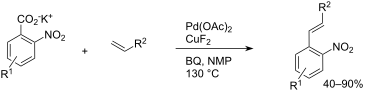
- arenes in good yields. Keywords: carboxylic acids; copper; decarboxylation; Heck vinylation; palladium; Introduction The palladium-catalyzed coupling of olefins with aryl or vinyl substrates, developed by Mizoroki [1] and Heck [2][3] in the 1970s, is one of the most important, reliable and generally


Preparation of pyridine-3,4-diols, their crystal packing and their use as precursors for palladium-catalyzed cross-coupling reactions
Beilstein J. Org. Chem. 2010, 6, No. 42, doi:10.3762/bjoc.6.42
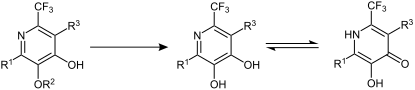
- palladium-catalyzed coupling reactions. Fluorescence measurements of the biscoupled products showed a maximum of emission in the violet region of the spectrum. Keywords: bisnonaflates; fluorescence; palladium catalysis; pyridine-3,4-diols; pyridines; Introduction Pyridine scaffolds have been found in
- pyridindiols and hydroxypyridinones will be thoroughly investigated in the solid state as well as in solution. Furthermore, subsequent transformations into bistriflate or bisnonaflate derivatives will be described, followed by palladium-catalyzed coupling reactions. The resulting biscoupling products are
- extended π-systems using palladium-catalyzed coupling reactions. Moreover, compounds 4b–c show interesting photophysical properties that might be thoroughly investigated in the future. The 3,4-dialkynyl-pyridine derivatives 4 or 5 are also candidates for Bergman cyclizations [34][35] which may establish a


Other Beilstein-Institut Open Science Activities



