


Search results
Search for "photoresponsive" in Full Text gives 34 result(s) in Beilstein Journal of Organic Chemistry.
A self-assembled photoresponsive gel consisting of chiral nanofibers
Beilstein J. Org. Chem. 2018, 14, 1994–2001, doi:10.3762/bjoc.14.174
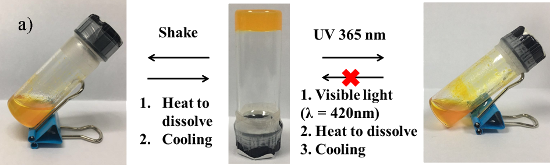
- glutamic acid skeleton, containing azobenzene as a photoresponsive group and ureidopyrimidinone (UPy) as a connection site, was designed and synthesized. The monomer is capable of forming an organogel in nonpolar organic solvents and different types of nanostructures in other solvents. The state of the gel
- of compound 3 in benzene that was investigated previously. Conclusion We have synthesized a novel chiral compound containing azobenzene as the photoresponsive group and UPy as the connection site. The monomer was capable of forming chiral nanostructures and a low-molecular-weight organogel in


An amphiphilic pseudo[1]catenane: neutral guest-induced clouding point change
Beilstein J. Org. Chem. 2018, 14, 1937–1943, doi:10.3762/bjoc.14.167
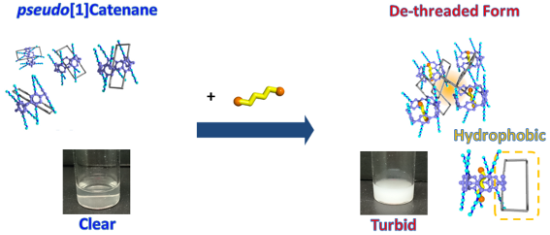
- in the clouding point. The clouding point of 1 increased upon addition of a cationic guest as the hydrophilic ratio in the molecule increased by formation of the complex with the hydrophilic cationic guest [5]. We also demonstrated photoresponsive LCST behavior by using a photoresponsive host–guest
- complex system between amphiphilic pillar[6]arene 2 and a photoresponsive cationic azobenzene guest [6]. However, neutral guest molecules could not induce a clear LCST change because encapsulation of the neutral guest in the hydrophobic pillar[n]arene core did not significantly change the hydrophobic


Stimuli-responsive oligonucleotides in prodrug-based approaches for gene silencing
Beilstein J. Org. Chem. 2018, 14, 436–469, doi:10.3762/bjoc.14.32
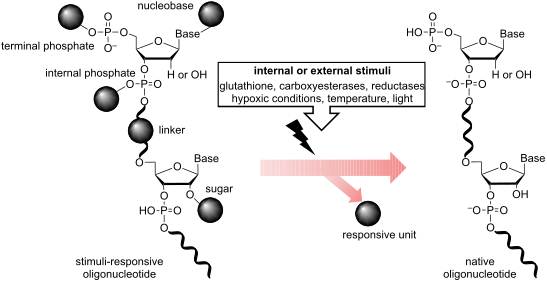
- . Light-responsive ONs Compared to other stimuli used to generate ONs that act as gene regulator, light is the external physical regulatory element that is most used. Actually, photoirradiation is the major and simplest method to temporally and spatially regulate the activity of photoresponsive ONs that
- suitable reagent, which generally is a diazo derivative bearing a photoresponsive moiety, or b) incorporation of an appropriate photocaged phosphoramidite during the solid-supported ON synthesis [73][78]. The advantage of the first approach is that the functionalization results from a reaction with
- activation induces the release of photoresponsive moieties during photoirradiation, yielding a lower extent of GFP expression in HeLa cells [72]. Later, Mc Master showed that it is not necessary to heavily modify siRNA because a single photoresponsive unit (biotin linked to nitrophenylethyl, Figure 4) at the


The role of alkyl substituents in deazaadenine-based diarylethene photoswitches
Beilstein J. Org. Chem. 2016, 12, 1103–1110, doi:10.3762/bjoc.12.106
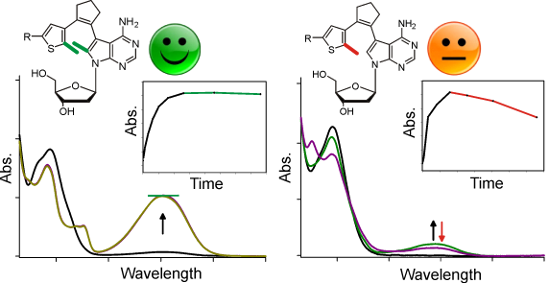
- DNA photoswitches for the application in bionanotechnology and synthetic biology. Keywords: diarylethene; nucleoside; electrocyclic rearrangement; photochromism; photoswitch; Introduction Most biomacromolecules are per se not responsive to light. Their conversion into photoresponsive molecules opens


Synthesis of photoresponsive cholesterol-based azobenzene organogels: dependence on different spacer lengths
Beilstein J. Org. Chem. 2015, 11, 1089–1095, doi:10.3762/bjoc.11.122
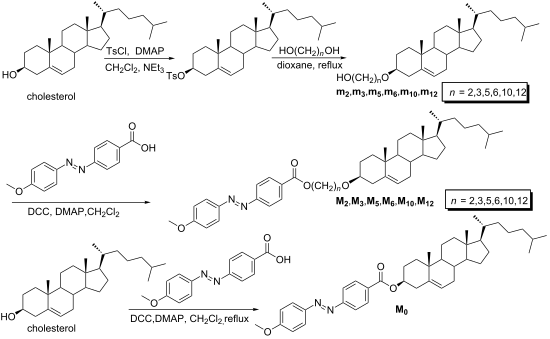
- designed and synthesized. The molecular structures were confirmed by 1H NMR and 13C NMR spectroscopy. The rapid and reversible photoresponsive properties of the compounds were investigated by UV–vis spectroscopy. Their thermal phase behaviors were studied by DSC. The length of the spacer plays a crucial
- ; organogel; photoresponsive; Introduction In the past few decades, low molecular mass organic gelators (LMOGs) have attracted increasing attention not only for basic self-assembly behavior but also for their potential application in areas such as templates [1], light harvesting [2], fluorescent scensing [3
- semicarbazide–azobenzene-based gelators [24]. A new multistimuli photoresponsive organogel containing azobenzene groups was designed and studied by D. Zhu and his co-workers [25]. Q. Zhang synthesized a series of new symmetric dicholesterol-linked gelators [26]. Upon UV–vis irradiation of the gels, a reversible


Synthetic strategies for the fluorescent labeling of epichlorohydrin-branched cyclodextrin polymers
Beilstein J. Org. Chem. 2014, 10, 3007–3018, doi:10.3762/bjoc.10.319
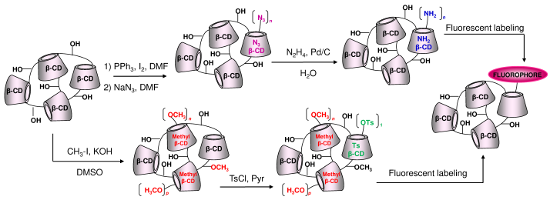
- their spectroscopic properties thus generating chemosensors, biological tools for visualization and sophisticated photoresponsive devices. Cyclodextrin polymers, due to the cooperative interactions, exhibit additional properties compared to their monomeric counterpart. These macromolecules can be


Synthesis, photophysical and electrochemical characterization of terpyridine-functionalized dendritic oligothiophenes and their Ru(II) complexes
Beilstein J. Org. Chem. 2013, 9, 866–876, doi:10.3762/bjoc.9.100
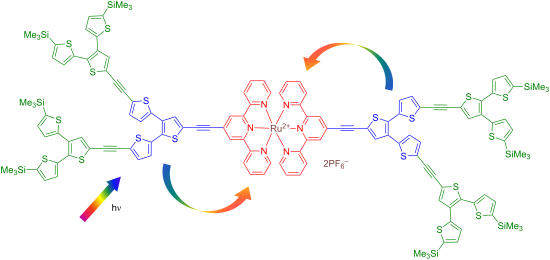
- the tpy-ethynyl type have proven to be very useful and provide a library of photoresponsive complexes derived from the basic Ru(II)-tpy type module [23][24][25][26][27]. Recently, tpy-complexes that incorporate π-conjugated thiophene or thienylene-ethynylene units became available, and the study of


Design and synthesis of a photoswitchable guanidine catalyst
Beilstein J. Org. Chem. 2012, 8, 1825–1830, doi:10.3762/bjoc.8.209
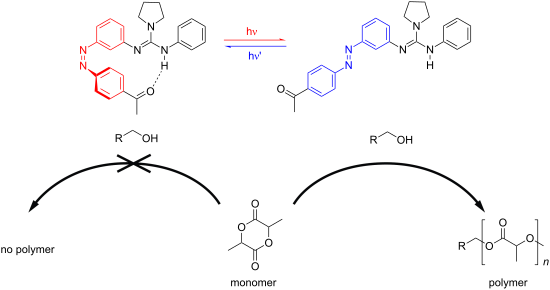
- [17], TBD is a difficult target for the incorporation of photoresponsive switches. Recent work indicates that the activation mechanism for acyclic guanidines, such as guanidine 1 (Scheme 1), is strongly dependent on the formation of hydrogen bridges to monomer and initiator [18]. Note that with


SbCl3-catalyzed one-pot synthesis of 4,4′-diaminotriarylmethanes under solvent-free conditions: Synthesis, characterization, and DFT studies
Beilstein J. Org. Chem. 2011, 7, 135–144, doi:10.3762/bjoc.7.19
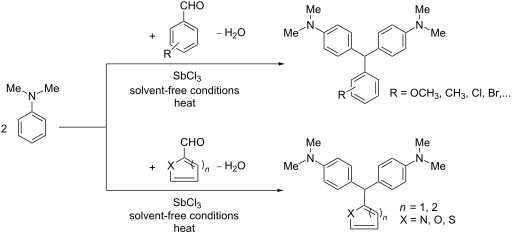
- , inks, crayons, typewritten ribbons, and photoimaging systems [1][2][3]. These compounds have been employed as dye precursors in nanocomposite preparations [4], in photoresponsive polymers [5], and as the thermal iniferter (initiator–transfer–terminator agent) in pseudo-living radical polymerizations [6



Other Beilstein-Institut Open Science Activities



