


Search results
Search for "ultrasonication" in Full Text gives 32 result(s) in Beilstein Journal of Organic Chemistry.
Preparation of Pickering emulsions through interfacial adsorption by soft cyclodextrin nanogels
Beilstein J. Org. Chem. 2015, 11, 2355–2364, doi:10.3762/bjoc.11.257
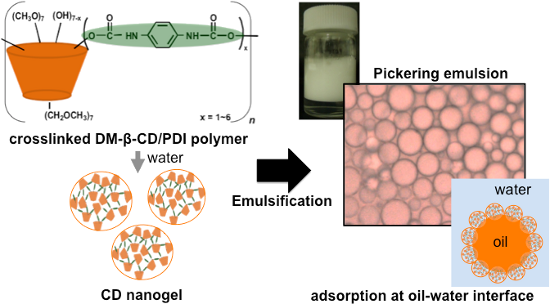
- ultrasonication. Previously, we prepared a urethane-crosslinked DM-β-CD/PDI polymer at a higher crosslinker/DM-β-CD feed ratio (>5.0). The resulting polymer forms a submicrometer-sized particle and does not disperse in water [18]. These results reveal that controlling the crosslinking degree gives a polymer with
- water was changed twice daily. Then the aqueous dispersion was lyophilized for three days to yield a white powder as a urethane-crosslinked DM-β-CD polymer. The CD nanogel was prepared by the redispersion of the powder in distilled water with the aid of ultrasonication and stored in a refrigerator until


The unexpected influence of aryl substituents in N-aryl-3-oxobutanamides on the behavior of their multicomponent reactions with 5-amino-3-methylisoxazole and salicylaldehyde
Beilstein J. Org. Chem. 2014, 10, 3019–3030, doi:10.3762/bjoc.10.320
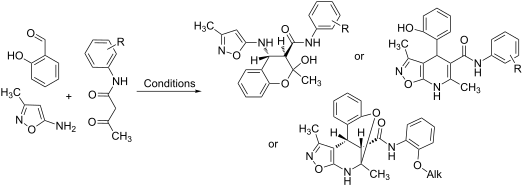
- -oxobutanamides on the behavior of the reaction was discovered. The key influence of ultrasonication and Lewis acid catalysts led to an established protocol to selectively obtain two or three types of heterocyclic scaffolds depending on the substituent in the N-aryl moiety. Keywords: 5-amino-3-methylisoxazole
- ; catalysis; chemoselectivity; heterocycle; multicomponent reaction; ultrasonication; salicylaldehyde; Introduction Generally, considerable interest in heterocyclic compounds is due to their key role in biological processes in nature and biological activity. In particular, condensed heterocycles bearing a
- azoloazine with high chemo- and regioselectivity [11][13][14][15]. In particular, three-component heterocyclizations involving 3-amino-1,2,4-triazoles or 4-substituted 5-aminopyrazoles yielded either 4,5,6,7-tetrahydroazolo[1,5-a]pyrimidine-6-carboxamides under ultrasonication at room temperature (kinetic


Features of the behavior of 4-amino-5-carboxamido-1,2,3-triazole in multicomponent heterocyclizations with carbonyl compounds
Beilstein J. Org. Chem. 2012, 8, 2100–2105, doi:10.3762/bjoc.8.236
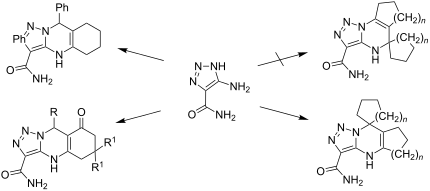
- similar MCRs of numerous other aminoazoles, a change of direction of the heterocyclizations in the case of 4-amino-5-carboxamido-1,2,3-triazole was not observed when microwave or thermal heating was substituted by ultrasonication at ambient temperature. Keywords: 4-amino-5-carboxamido-1,2,3-triazole
- chromatographically detected in either of the procedures applied. It is worth noting that in our previous works [9][10][11][12][13][14][15][16][17] we also showed a possibility to change the direction of similar MCRs by replacement of conventional thermal or MW heating with room temperature ultrasonication. However
- , treatment of the starting compounds 1 and 2a,b under ultrasonication at ambient temperature in acetic acid, which was selected instead of methanol due to solubility problems, also yielded only heterocycles 4a,b (Method C). The yields and purity of the compounds obtained under ultrasonication were slightly


A novel and facile synthesis of 3-(2-benzofuroyl)- and 3,6-bis(2-benzofuroyl)carbazole derivatives
Beilstein J. Org. Chem. 2011, 7, 1533–1540, doi:10.3762/bjoc.7.180
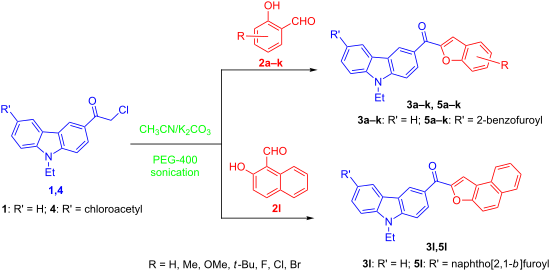
- large number of organic reactions can be carried out with a higher yield, in shorter reaction time and under milder conditions with the aid of ultrasonication. For example, Palimkar et al. [52] ever reported a facile ultrasound-promoted synthesis of benzo[b]furan derivatives. Accordingly, the
- observed that if the ultrasound-assisted Rap–Stoermer reaction was performed in the absence of PEG-400, the desired products were not obtained in appreciable yields, which indicates that both the catalysis by PEG-400 and the ultrasonication together promoted this reaction. To establish the generality and
- apparatus. Ultrasonication was performed in a KQ-250B medical ultrasound cleaner at a frequency of 40 KHz and output power of 250 W (Built-in heating 30–80 °C, thermostatically adjustable). 1H NMR and 13C NMR spectra were recorded on a Bruker AVANCE NMR spectrometer with CDCl3 or DMSO-d6 as the solvent. The


First synthesis of 2-(benzofuran-2-yl)-6,7-methylene dioxyquinoline-3-carboxylic acid derivatives
Beilstein J. Org. Chem. 2011, 7, 210–217, doi:10.3762/bjoc.7.28
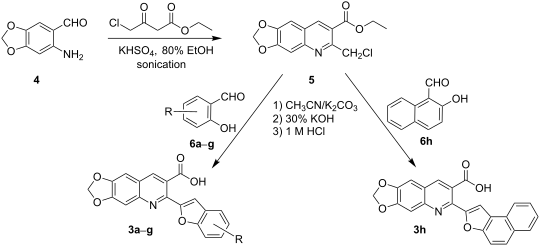
- . Biological activity of the synthesized compounds remains to be studied. Experimental Melting points (uncorrected) were determined with a WRS-1B melting point apparatus and are uncorrected. Ultrasonication was performed in a KQ-250B medical ultrasound cleaner with a frequency of 40 KHz and output power of


Miniemulsion polymerization as a versatile tool for the synthesis of functionalized polymers
Beilstein J. Org. Chem. 2010, 6, 1132–1148, doi:10.3762/bjoc.6.130
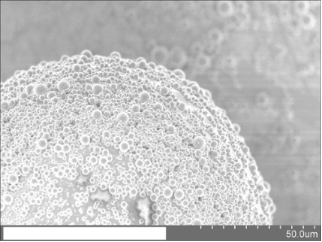
- polymerization. Therefore it is difficult to know if the experiment represented a “true” miniemulsion polymerization process. A similar process was employed but with homogenization of catalyst/hexadecane/toluene, which was performed with either ultrasonication or high-pressure homogenizer in order to obtain a





Symmetrical and unsymmetrical α,ω-nucleobase amide-conjugated systems
Beilstein J. Org. Chem. 2010, 6, No. 34, doi:10.3762/bjoc.6.34
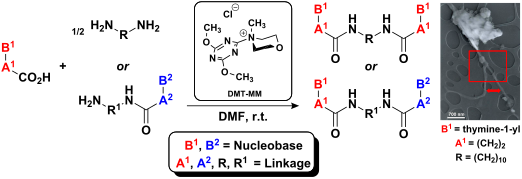
- prepared by ultrasonication were subjected to slow vaporisation at −20 °C. Microcrystalline assemblies were grown directly on copper grids for TEM analyses. This procedure of growth accompanied by careful investigations revealed that thymine- (A, B) and 5-nitrouracil-based (C) bolaamphiphiles derived from


Other Beilstein-Institut Open Science Activities



