


Search results
Search for "C–N bond formation" in Full Text gives 59 result(s) in Beilstein Journal of Organic Chemistry.
Synthesis of enantiomerically pure N-(2,3-dihydroxypropyl)arylamides via oxidative esterification
Beilstein J. Org. Chem. 2013, 9, 2129–2136, doi:10.3762/bjoc.9.250

- ][6] or (ii) catalytic oxidations with peroxides and chiral transition metal complexes [7][8][9]. The oxidative esterification of aldehydes involving oxidation followed by a C–O or C–N bond formation has received significant synthetic interest of late. Various transition metal complexes are employed


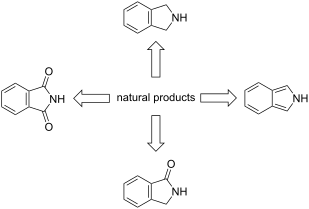
The chemistry of isoindole natural products
Beilstein J. Org. Chem. 2013, 9, 2048–2078, doi:10.3762/bjoc.9.243
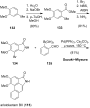
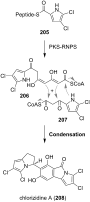
- . Oxidative C–C-bond formation gives the hetidine core (233) and C–N-bond formation the hetisine skeleton (234). The first total synthesis of a hetisine-type alkaloid was accomplished by Muratake and Natsume in 2004 [177]. In their seminal work, (±)-nominine (225) was synthesized within 40 steps and 0.15












Efficient synthesis of β’-amino-α,β-unsaturated ketones
Beilstein J. Org. Chem. 2013, 9, 486–495, doi:10.3762/bjoc.9.52

- reaction of chiral imines with enolates derived from Weinreb amides [13][14]. In previous work on the asymmetric synthesis of 2,6-disubstituted piperidines by C–N bond formation, we demonstrated that intramolecular aza-Michael ”type” cyclisation [15] using a β'-carbamate-α,β-unsaturated ketone


Palladium-catalyzed C–N and C–O bond formation of N-substituted 4-bromo-7-azaindoles with amides, amines, amino acid esters and phenols
Beilstein J. Org. Chem. 2012, 8, 2004–2018, doi:10.3762/bjoc.8.227
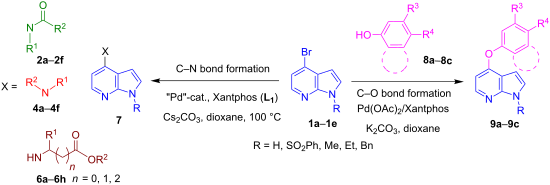
- prepare [6]. Initially, coupling of 4-bromo-1-ethyl-1H-pyrrolo[2,3-b]pyridine (1d) with phenylmethanamine (4a) was selected as a model reaction to optimize the reaction condition of C–N-bond formation of amines. The experimental results are summarized in Table 3. After the screening of various ligands
- acids contain more heteroatoms that bind to the central palladium atom and enhance the stability of the 7-azaindole–Pd–N complexes, making them too stable for reductive elimination. After successful demonstration of the C–N-bond-formation reaction of 4-bromo-7-azaindole derivatives with amides, amines
- coupling conditions for C–N-bond formation of N-substituted 4-bromo-7-azaindoles with amides, amines, and amino acid esters and demonstrated well for the synthesis of various N-substituted 7-azaindole compounds, which are very difficult to synthesize otherwise. The combination of Xantphos, Cs2CO3 and


N-Heterocyclic carbene–palladium(II)-1-methylimidazole complex catalyzed Mizoroki–Heck reaction of aryl chlorides with styrenes
Beilstein J. Org. Chem. 2012, 8, 1916–1919, doi:10.3762/bjoc.8.222

- -diisopropylphenyl)imidazolium chloride], and 1-methylimidazole in a one-step procedure in high yield, was an effective catalyst in C–C and C–N bond-formation reactions [37][38][39][40][41][42][43][44]. In our continuing investigations on the further applications of this complex in organic synthesis, we found that


Synthesis of conformationally restricted glutamate and glutamine derivatives from carbonylation of orthopalladated phenylglycine derivatives
Beilstein J. Org. Chem. 2012, 8, 1569–1575, doi:10.3762/bjoc.8.179
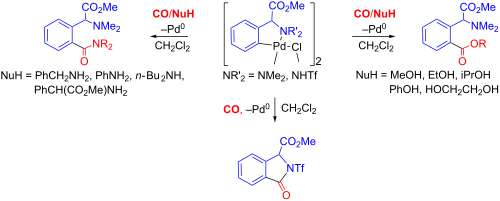
- different reactivity. Therefore, the attack of the oxygen of an O-bonded alcohol on the electrophilic acyl carbon in our complexes seems to be favoured, since no demethylation is involved, and the C–O coupling occurs selectively instead of the intramolecular C–N bond formation. It seems that the reaction is


Recent advances in the gold-catalyzed additions to C–C multiple bonds
Beilstein J. Org. Chem. 2011, 7, 897–936, doi:10.3762/bjoc.7.103
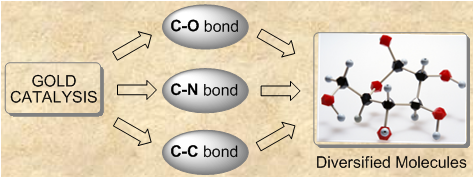
- . In addition to intermolecular addition, Mukherjee and Widenhoefer recently reported a gold(I)-catalyzed intramolecular amination of allylic alcohols 130 with alkylamines (Scheme 23) [61]. 3.2 Imines as nucleophiles Gold-catalyzed cyclizations of O-propioloyl oximes via C–N bond formation followed by
- the Brønsted acid is both a chiral catalyst for the asymmetric cycloaddition and assists to facilitate the gold complex catalyzed hydroamination. Muratore et al. have reported an interesting example of C–N bond formation for the construction of chiral nitrogen-containing fused heterocycles 400 [191








Palladium- and copper-mediated N-aryl bond formation reactions for the synthesis of biological active compounds
Beilstein J. Org. Chem. 2011, 7, 59–74, doi:10.3762/bjoc.7.10
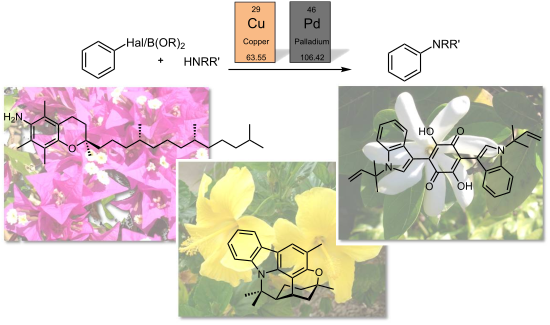
- specific advantages and disadvantages that should be considered when selecting the reaction conditions for a desired C–N bond formation in the course of a total synthesis or drug synthesis. Keywords: biologically active compounds; boronic acid; copper; N-arylation; palladium; Introduction Palladium- and


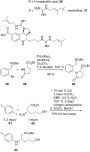
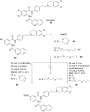


Variations in product in reactions of naphthoquinone with primary amines
Beilstein J. Org. Chem. 2007, 3, No. 10, doi:10.1186/1860-5397-3-10
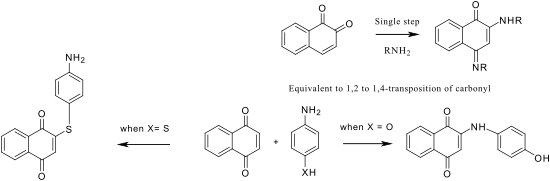
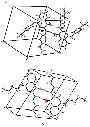
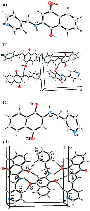
- -naphthoquinone with 4-aminothiophenol and 1,4-naphthoquinone with 4-aminophenol are compared. The former leads to C-S and the latter to C-N bond formation. The reaction of 1,4-naphthoquinone with 4-aminothiophenol in an NMR tube is studied to explain that 2-(4-anilinothiolato) 1,4-naphthoquinone derivative to be
- 3c). Surprisingly in this reaction the product formed is through C-S bond formation rather than C N-bond formation (Scheme 4). The presence of a few well-separated peaks of the products from the starting materials in the NMR spectra (designated by A) shows the formation of the one product with time
- complete understanding of the mechanism but the observations hint towards a radical mechanism rather than an ionic mechanism. In contrast to the reaction of 4-aminothiophenol with 1,4-naphthoquinone the reaction of 4-aminophenol gave the expected product through C-N bond formation. The structures of the






Other Beilstein-Institut Open Science Activities



