Search results
Search for "halides" in Full Text gives 526 result(s) in Beilstein Journal of Organic Chemistry. Showing first 200.
A review of recent advances in electrochemical and photoelectrochemical late-stage functionalization classified by anodic oxidation, cathodic reduction, and paired electrolysis
Beilstein J. Org. Chem. 2024, 20, 2500–2566, doi:10.3762/bjoc.20.214
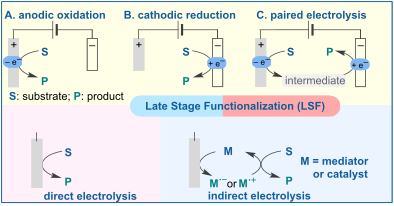
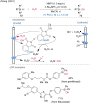
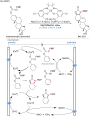
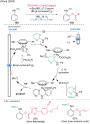
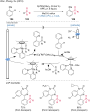
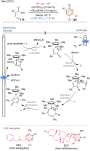
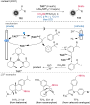
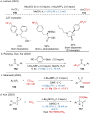
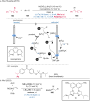
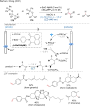
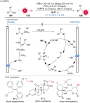
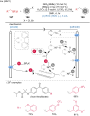
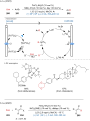
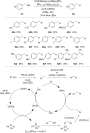
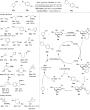
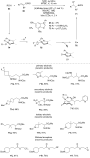
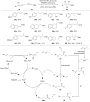
- cathodic reduction and to prevent the reoxidation of the reduced SO2 at the anode, a divided cell setup is required (Scheme 12). C–H bond halogenation: Aryl and alkyl halides are important synthetic building blocks for cross-coupling reactions as well as bioactive molecules with applications in


























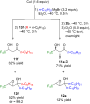
Synthesis and conformational analysis of pyran inter-halide analogues of ᴅ-talose
Beilstein J. Org. Chem. 2024, 20, 2442–2454, doi:10.3762/bjoc.20.208
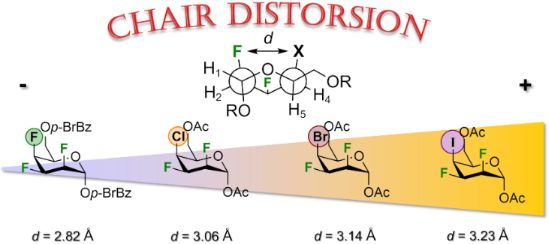
- halogenated pyrans reveals deviation in the intra-annular torsion angles arising from repulsion between the axial fluorine at C2 and the axial halogen at C4, which increases with the size of the halogen at C4 (F < Cl < Br < I). Crystal packing arrangements of pyran inter-halides show hydrogen bond acceptor
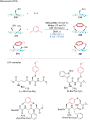
- chiral halides: F, Cl, Br, I) [19]. Only a handful of natural product syntheses have been reported [20][21], despite the promising biological activity of these unique inter-halides [22]. For our part, we recently reported the synthesis of contiguous inter-halide-bearing stereocenters using a Chiron
- approach from levoglucosan 1 (Figure 1a) [23]. Allopyranose inter-halides 4 incorporating the 2,3-cis, 3,4-cis relationship for the halogens were prepared via intermediates 2 and 3 from levoglucosan (1). Compounds 4 were the starting point to complex 2,3,4-trihalohexanetriols and 2,3,4,5


Phenylseleno trifluoromethoxylation of alkenes
Beilstein J. Org. Chem. 2024, 20, 2434–2441, doi:10.3762/bjoc.20.207
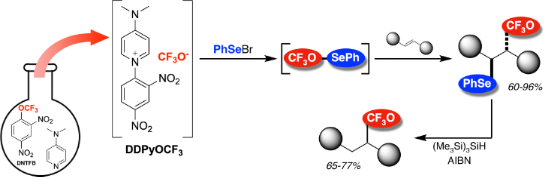
- compounds from alkenes and DDPyOCF3, more precisely to α-trifluoromethoxylated, β-phenylselenylated compounds. Results and Discussion The electrophilic addition of phenylselenyl halides to alkenes to form a selenonium intermediate that can be intercepted by an external nucleophile is a well-known method to




Facile preparation of fluorine-containing 2,3-epoxypropanoates and their epoxy ring-opening reactions with various nucleophiles
Beilstein J. Org. Chem. 2024, 20, 2421–2433, doi:10.3762/bjoc.20.206
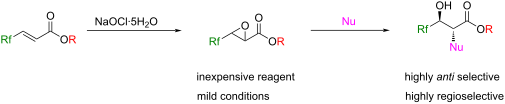
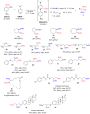
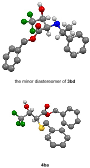
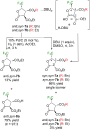
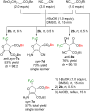
- shorter period possibly because of its significantly high electrophilicity by the attachment of three strongly electron-withdrawing moieties. Reactions of (E)-3-Rf-2,3-epoxypropanoates 2 with amines, thiols, and metal halides Because the epoxide ring opening is known to occur in an SN2 fashion, compounds
- executed at −78 °C under the action of LDA [29]. Moreover, by using the epoxyester 2b as the representative substrate, clarification of its reactivity was carried out by mixing with 1) heteronucleophiles like amines, thiols, and magnesium halides, 2) softer carbon nucleophiles such as malonates, and 3





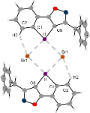
Evaluating the halogen bonding strength of a iodoloisoxazolium(III) salt
Beilstein J. Org. Chem. 2024, 20, 2401–2407, doi:10.3762/bjoc.20.204
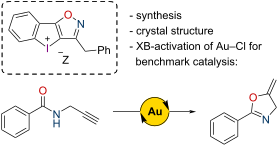
- obtained: in a titration study by Mayer and Legault it was determined that cyclic five-membered DAI salts, so-called iodolium compounds, are significantly stronger Lewis acids than their less-stable acyclic counterparts [12]. By using the activation of alkyl halides as a benchmark, our group later reported




Efficient one-step synthesis of diarylacetic acids by electrochemical direct carboxylation of diarylmethanol compounds in DMSO
Beilstein J. Org. Chem. 2024, 20, 2392–2400, doi:10.3762/bjoc.20.203
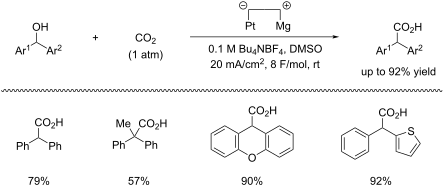
- diarylacetic acids from diarylmethanol species and carbon dioxide without transformation of the hydroxy group into appropriate leaving groups, such as halides and esters including carbonates. Keywords: C(sp3)–O bond cleavage; diarylacetic acid; diarylmethanol; electrochemical reduction; fixation of carbon


Electrochemical allylations in a deep eutectic solvent
Beilstein J. Org. Chem. 2024, 20, 2217–2224, doi:10.3762/bjoc.20.189
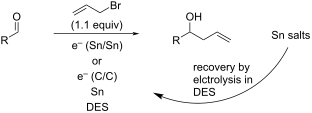
- product, although in this case, reduction of the nitro group to an amino group was observed and the resulting 4-aminobenzaldehyde is likely too electron-rich to undergo allylation. The use of other halides was also explored (Table 3). Switching to allyl chloride (Table 3, entry 2) did result in partial
- more substituted end (gamma addition) was the major product in both cases, although alpha addition was also observed. In the case of crotyl bromide, no diastereoselectivity was noted for the gamma product. Non-allylic halides such as benzyl bromide, propargyl bromide, and ethyl bromoacetate (Table 3

Efficacy of radical reactions of isocyanides with heteroatom radicals in organic synthesis
Beilstein J. Org. Chem. 2024, 20, 2114–2128, doi:10.3762/bjoc.20.182
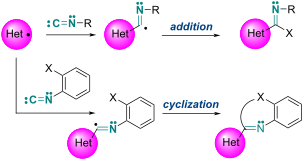
- the combination with groups 15–17 interelement compounds would be considered effective for the generation of groups 13 and 14 heteroatom radicals. Radical addition of group 17 compounds to isocyanides If isocyanides (RNC) can undergo a radical addition of hydrogen halides (HX) and molecular halogens


Multicomponent syntheses of pyrazoles via (3 + 2)-cyclocondensation and (3 + 2)-cycloaddition key steps
Beilstein J. Org. Chem. 2024, 20, 2024–2077, doi:10.3762/bjoc.20.178

- from di-tert-butyldiazocarboxylate (23), aryl-substituted di-Boc-hydrazines 26 were prepared by the addition of aryllithium species generated in situ by lithium-halogen exchange of aryl halides [55]. Gerstenberger et al. used this entry for the one-pot synthesis of N-arylpyrazoles 25, as depicted in
- . In cases where the α,β-unsaturated carbonyl compounds contain a heteroatom in the β-position, aromatization is triggered by elimination under redox-neutral conditions. Tasch et al. successfully coupled aryl halides with α-bromocinnamaldehyde (51) using a Masuda borylation Suzuki cross-coupling (MBSC
- ) [69] approach without reducing the reactivity of the Michael system. In this one-pot procedure, the borylation of aryl halides with pinacolborane gives aryl pinacolyl boronates 53, which are then coupled with bromoenal 51 to generate the intermediary enal 54. Subsequent cyclization with tosylhydrazine




Harnessing the versatility of hydrazones through electrosynthetic oxidative transformations
Beilstein J. Org. Chem. 2024, 20, 1988–2004, doi:10.3762/bjoc.20.175
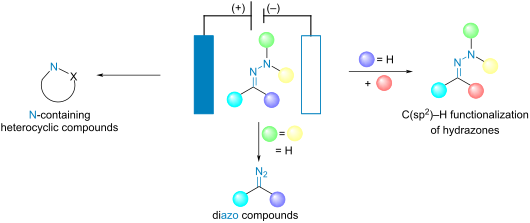
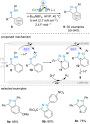
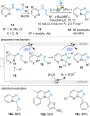
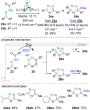
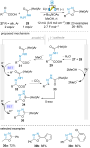
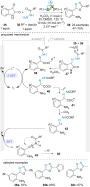
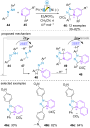
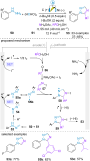
- electrochemical approach constitutes an advantageous alternative to previous methods, which required the preparation of difficult-to-handle hydrazonoyl halides for the synthesis of 1-aryl-5-amino-1,2,4-triazoles from cyanamide [56][57]. Pyrazolines are highly important heterocyclic motifs in pharmaceutical and
- agrochemical industries. The (3 + 2)-cycloaddition between nitrile imines and alkenes represents one of the most efficient strategies to prepare these azacycles. However, conventional methods for the generation of the nitrile imine involved the use of unstable hydrazonoyl halides or the oxidation of aldehyde









Radical reactivity of antiaromatic Ni(II) norcorroles with azo radical initiators
Beilstein J. Org. Chem. 2024, 20, 1967–1972, doi:10.3762/bjoc.20.172
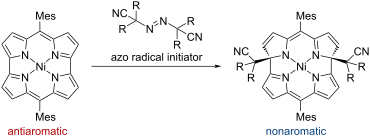
- benzoyl peroxide, TEMPO, and the combination of alkyl halides with BEt3, were not applicable to this reaction. Physical properties The electronic absorption spectra of norcorrole 1 and adduct 2a are shown in Figure 3. While norcorrole 1 exhibited a weak absorption band from 600 nm to the NIR region, due


Negishi-coupling-enabled synthesis of α-heteroaryl-α-amino acid building blocks for DNA-encoded chemical library applications
Beilstein J. Org. Chem. 2024, 20, 1922–1932, doi:10.3762/bjoc.20.168
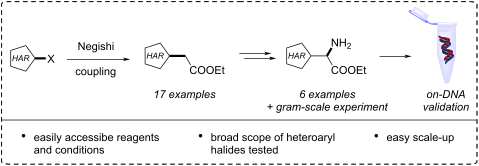
- heteroaromatic halides. The reaction sequence utilizes a photochemically enhanced Negishi cross-coupling as a key step, followed by oximation and reduction. The prepared amino esters were validated for on-DNA reactivity via a reverse amidation–hydrolysis–reverse amidation protocol. Keywords: amino acids; DEL
- , Alcazar et al. developed continuous flow protocols for both the generation of alkylzinc halides and for the subsequent Negishi cross-coupling reaction [40][41][42][43][44]. We successfully adapted Alcazar’s protocols for the synthesis of otherwise challenging heteroaryl–alkyl connections (see Table S1 in
- carbonyl group to an oxime through condensation with hydroxylamine (Scheme 5, bottom) [62][63][64]. In order to develop a synthetic approach applicable to several different substrates, we decided to screen the three methods on one example from each type of heteroaryl halides. According to our experimental


The Groebke–Blackburn–Bienaymé reaction in its maturity: innovation and improvements since its 21st birthday (2019–2023)
Beilstein J. Org. Chem. 2024, 20, 1839–1879, doi:10.3762/bjoc.20.162
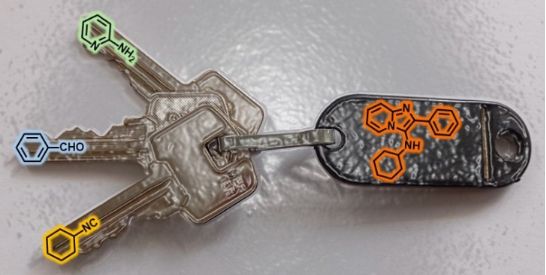


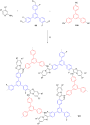
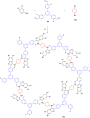


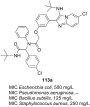


Oxidation of benzylic alcohols to carbonyls using N-heterocyclic stabilized λ3-iodanes
Beilstein J. Org. Chem. 2024, 20, 1677–1683, doi:10.3762/bjoc.20.149
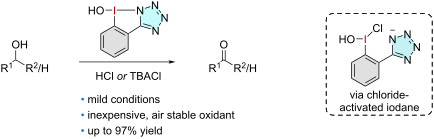
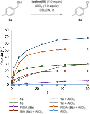
- ). At this temperature, the reaction time was significantly reduced to 2.5 h. A variety of other additives were tested next, revealing TsOH or NaOTs inhibiting the reaction (Table 1, entries 2 and 3). The addition of tetrabutylammonium halides showed the chloride salt being superior, giving comparable




Divergent role of PIDA and PIFA in the AlX3 (X = Cl, Br) halogenation of 2-naphthol: a mechanistic study
Beilstein J. Org. Chem. 2024, 20, 1580–1589, doi:10.3762/bjoc.20.141
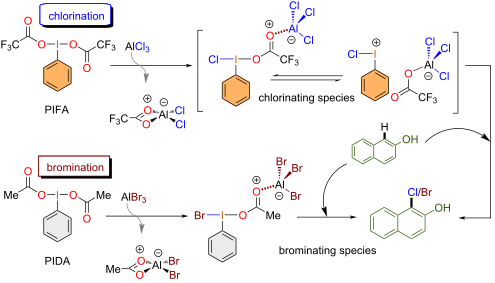
- straightforward conditions (Scheme 1). The synthesis of aryl halides is of great academic and industrial importance. Recently, our research group has developed a new procedure for the ortho-selective chlorination of phenols under mild conditions in a short reaction time [26]. The chlorinating species was


Electrocatalytic hydrogenation of cyanoarenes, nitroarenes, quinolines, and pyridines under mild conditions with a proton-exchange membrane reactor
Beilstein J. Org. Chem. 2024, 20, 1560–1571, doi:10.3762/bjoc.20.139
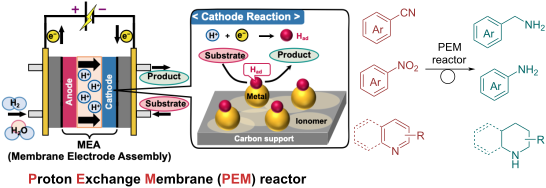
- aryl halides [42]. PEM reactors are also gaining industrial attention. Weber et al. reported a series of large-scale syntheses using PEM reactors [43]. We studied electrochemical transformations [44][45][46][47][48][49] and recently reported the selective reduction of enones using a PEM reactor [50


Synthesis of 2-benzyl N-substituted anilines via imine condensation–isoaromatization of (E)-2-arylidene-3-cyclohexenones and primary amines
Beilstein J. Org. Chem. 2024, 20, 1468–1475, doi:10.3762/bjoc.20.130
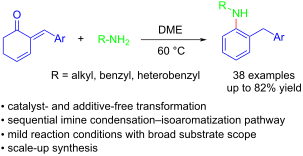
- additives in the petrochemical industry [3]. Besides, 2-benzylanilines also serve as valuable building blocks in synthetic chemistry [4]. The classical route to this kind of aniline derivatives usually starts from parent anilines, which undergo Friedel–Crafts reaction with acyl halides followed by carbonyl
- are not always readily accessible. Typically, the preparation methods involve SNAr reactions with N-centered nucleophiles [5], nitroarene reduction [6] and transition metal (e.g., Pd, Cu)-catalyzed C–N cross coupling of aryl halides, aryl sulfonates or arylboronic acid reagents with ammonia or NH


Predicting bond dissociation energies of cyclic hypervalent halogen reagents using DFT calculations and graph attention network model
Beilstein J. Org. Chem. 2024, 20, 1444–1452, doi:10.3762/bjoc.20.127
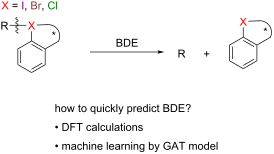
- at 298.15 K by Gaussian 16 [81]. Frequency calculations confirmed that optimized structures are minima (no imaginary frequency). The accuracy of computational BDEs of halides using M06-2X/def2-TZVPP is also evaluated and compared to experimental BDEs, demonstrating the reliability of the method (see


A comparison of structure, bonding and non-covalent interactions of aryl halide and diarylhalonium halogen-bond donors
Beilstein J. Org. Chem. 2024, 20, 1428–1435, doi:10.3762/bjoc.20.125
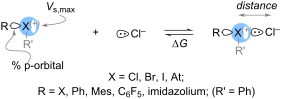
- ], the term “halogen bond” entered the chemical literature in the latter half of twentieth century [8]. Detailed studies of halogen bonding that followed in the late 1990s and early 2000s primarily focused on inorganic molecular and interhalogens, and inorganic and organic halides that are monovalent
- −23.1 kcal/mol (see Supporting Information File 1 for exact values). Likewise, the association of chloride with imidazolium halides 37–40 ranged from −3.7 to −14.3 kcal/mol, which overlaps with the range observed for the diarylhalonium cations. We delved deeper into the periodic trends related to the X
- dots). That is the length of the X–Cl (57–60) covalent bond increases with increasing van der Waals radii of X. Notably, this trend is also replicated for ionic bonds of the halides with sodium; longer ionic bond lengths are observed for larger halides [37]. On the other hand, halogen-bond complexes




Synthesis of substituted triazole–pyrazole hybrids using triazenylpyrazole precursors
Beilstein J. Org. Chem. 2024, 20, 1396–1404, doi:10.3762/bjoc.20.121
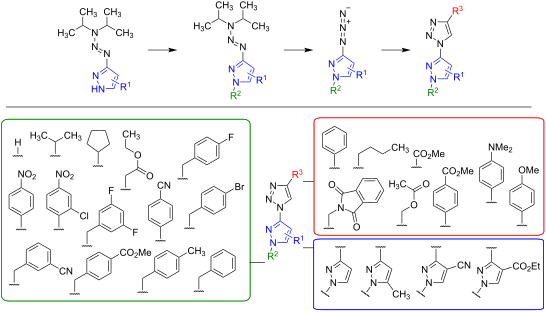
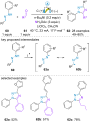
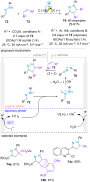
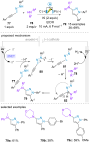
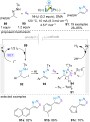
- -mediated reaction with alkyl halides [21]. So far, the literature-reported methods are most often limited to N-unsubstituted pyrazoles or triazoles and pyrazoles being fused to a second (hetero)cycle; the synthesis of promising multi-substituted structures such as 1 has not yet been described




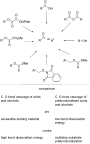
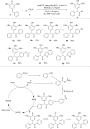
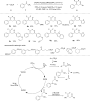
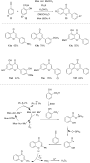
Generation of alkyl and acyl radicals by visible-light photoredox catalysis: direct activation of C–O bonds in organic transformations
Beilstein J. Org. Chem. 2024, 20, 1348–1375, doi:10.3762/bjoc.20.119
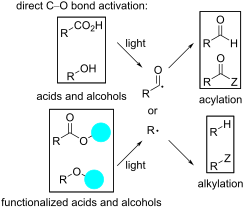
- and alkyl radicals, has shown great promise in the synthesis and functionalization of various organic molecules [15][16]. These carbon radicals can be generated in several ways. The first and most straightforward method is the homolytic cleavage of labile C–heteroatom bonds, especially alkyl halides
- [17]. Due to growing concerns about the harmful effects of toxic compounds (e.g., some halides) on the environment, the scientific community is now looking for alternative chemicals that can form these radicals. Moreover, discovering mild strategic approaches for the generation of unstabilized alkyl
- , C–C, and C–heteroatom bond formations. The best known technique for the creation of alkyl radicals is the homolytic cleavage of the C–X bond of alkyl halides by toxic tin hydride [17]. Later, various efforts have been made to replace toxic tin hydrides with other reagents [33][34][35][36][37][38][39








Rhodium-catalyzed homo-coupling reaction of aryl Grignard reagents and its application for the synthesis of an integrin inhibitor
Beilstein J. Org. Chem. 2024, 20, 1341–1347, doi:10.3762/bjoc.20.118
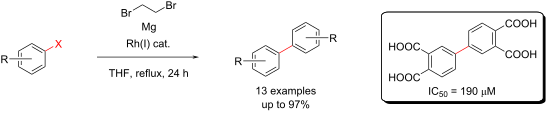
- for integrins which is critical for several diseases. Keywords: biphenyltetracarboxylic acid; homo-coupling; integrin inhibitor; rhodium catalyst; Ullmann-type reaction; Introduction The Ullmann reaction is a coupling reaction of aryl halides using copper, traditionally using metallic copper-bronze
- halides, which involved a rhodium-bis(benzyl) complex (Scheme 2) [21]. Following these outcomes, as part of a research program aimed at a wide range of Rh-catalyzed C–C bond-formation reactions, in this paper, we report a Rh-catalyzed Ullmann-type homo-coupling reaction of aryl Grignard reagents. Results
- and Discussion Methodology development In our work towards Rh-catalyzed homo-coupling reactions of benzyl halides, we observed that a similar rhodium–bis(benzyl) complex can also be formed from benzyl halide by using a Grignard reagent instead R2Zn in the presence of RhCl(PPh3)3 to subsequently give


Transition-metal-catalyst-free electroreductive alkene hydroarylation with aryl halides under visible-light irradiation
Beilstein J. Org. Chem. 2024, 20, 1327–1333, doi:10.3762/bjoc.20.116
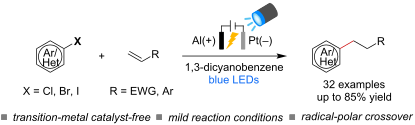
- high regioselectivity. Herein, we report the electroreductive hydroarylation of electron-deficient alkenes and styrene derivatives using (hetero)aryl halides under mild reaction conditions. Notably, the present hydroarylation proceeded with high efficiency under transition-metal-catalyst-free
- that a reductive radical-polar crossover pathway is likely to be involved in this transformation. Keywords: aryl halides; C–C bond formation; electroreduction; radicals; visible light; Introduction Alkene hydroarylation is an attractive method for the construction of alkylarenes, which serve as
- versatile building blocks in organic syntheses. To achieve this transformation with high efficiency and predictable regioselectivity, numerous efforts have been made to develop transition-metal-catalyzed reactions based on a C–H activation strategy [1][2][3][4] or the reductive coupling of aryl halides with

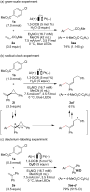

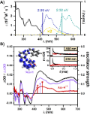
Mechanistic investigations of polyaza[7]helicene in photoredox and energy transfer catalysis
Beilstein J. Org. Chem. 2024, 20, 1236–1245, doi:10.3762/bjoc.20.106
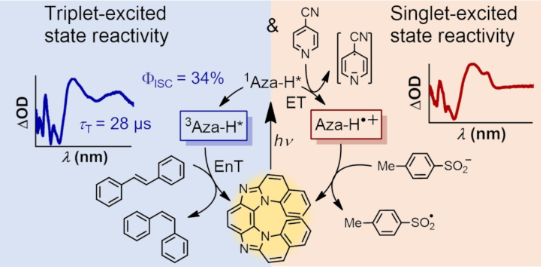
- ]. Prominent examples include: (i) carbonyl compounds such as benzophenone [31][32] and thioxanthone [33][34][35], (ii) TADF emitters with small singlet-triplet energy splitting [8][36], (iii) substitution with heavy atoms such as sulphur [37] and halides [38] for fast ISC, or a combination of the above




Manganese-catalyzed C–C and C–N bond formation with alcohols via borrowing hydrogen or hydrogen auto-transfer
Beilstein J. Org. Chem. 2024, 20, 1111–1166, doi:10.3762/bjoc.20.98
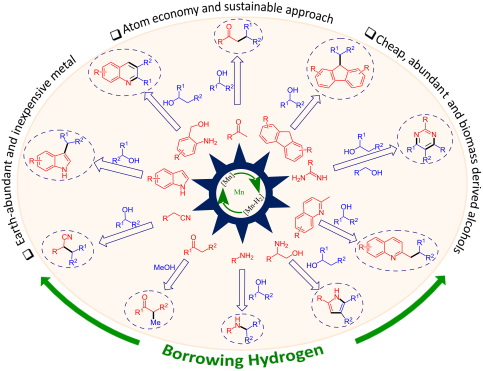
- , hydroaminomethylation, reduction of nitriles and nitro compounds or through reductive amination of carbonyl derivatives [26][27][28][29][30]. However, for example, cross-coupling reactions with alkyl or aryl halides generate considerable amounts of waste (Scheme 2A). Even though many different approaches exist for
- commonly used reaction in synthetic chemistry [50][51]. The selective α-functionalization of carbonyl compounds with organohalides in the presence of bases is one of the most fundamental reactions. This methodology usually suffers from the use of stoichiometric amounts of bases and the use of halides