


Search results
Search for "Michael acceptor" in Full Text gives 83 result(s) in Beilstein Journal of Organic Chemistry.
Two-directional synthesis as a tool for diversity-oriented synthesis: Synthesis of alkaloid scaffolds
Beilstein J. Org. Chem. 2012, 8, 850–860, doi:10.3762/bjoc.8.95
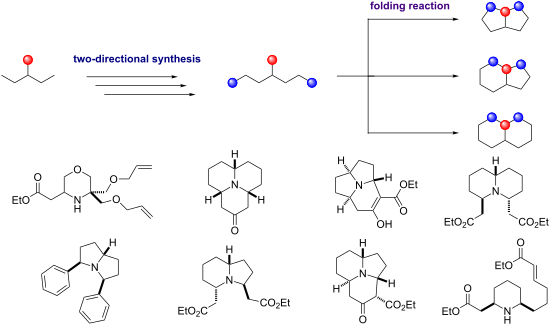
- a nucleophilic amino group with suitable electrophilic functionality, provided by Michael acceptor α,β-unsaturated ester groups. Two-directional synthesis was used to append these electrophilic groups at two positions around the linear substrates, allowing bicyclisation processes to be instigated
- form a stable hydrogen-bonded species with the NH group that inhibits the reaction of the nitrogen with the Michael acceptor ester groups. Studies involving the use of Tris as a potential DOS substrate remain on-going within our laboratories. Conclusion The work presented in this article serves to



Amines as key building blocks in Pd-assisted multicomponent processes
Beilstein J. Org. Chem. 2011, 7, 1387–1406, doi:10.3762/bjoc.7.163
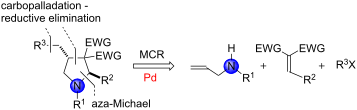
- series of benzo-fused sultams. A range of α-bromobenzenesulfonyl chlorides 40 were first coupled with various amines in DMF at room temperature in the presence of Et3N to generate intermediate sulfonamides 41. Subsequent in situ addition of a Michael acceptor in large excess together with Et3N, Bu4NCl


An overview of the key routes to the best selling 5-membered ring heterocyclic pharmaceuticals
Beilstein J. Org. Chem. 2011, 7, 442–495, doi:10.3762/bjoc.7.57
- ) with cyclohexan-1,3-dione (Scheme 38). Classical N-methylation with dimethyl sulfate followed by introduction of an exocyclic double bond using paraformaldehyde in DMF under acidic conditions furnishes the Michael acceptor 189, which then undergoes conjugate addition with various amines (Scheme 38
- -aminopropionaldehyde diethylacetal 32 in toluene under mildly acidic conditions to afford the fully substituted pyrrole motif in 81% isolated yield following crystallisation [6]. The key transformation in this sequence is a thiazolium-mediated Stetter reaction between 4-fluorobenzaldehyde (29) and an advanced Michael
- acceptor obtained from an initial Knoevenagel condensation (Scheme 5). In order to improve the overall yield as well as the convergency, the industrial route [7] introduced the fully elaborated side chain 34 by condensation with the previously described 1,4-diketone 31 (Scheme 5 and Scheme 6). The desired





Michael-type addition of azoles of broad-scale acidity to methyl acrylate
Beilstein J. Org. Chem. 2011, 7, 173–178, doi:10.3762/bjoc.7.24
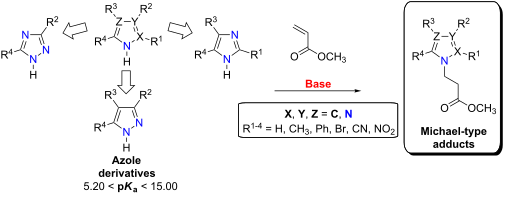
- donors. The azoles derivatives (1a–h) were subjected to the reaction with methyl acrylate (2) (Michael acceptor) in the presence of an appropriate base, namely DBU (pKa = 12 [28]), diisopropylethylamine (DIPEA, Hünig’s base, pKa = 10.75 [29]), NaOH (pKa = 15.7 [30]), NaH (pKa = 37 [29]) or TEDA (pKa


Synthesis of gem-difluoromethylenated analogues of boronolide
Beilstein J. Org. Chem. 2010, 6, No. 37, doi:10.3762/bjoc.6.37
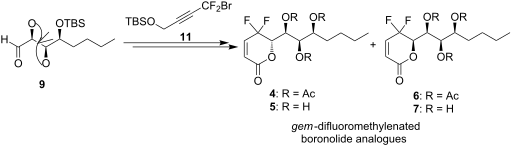
- demonstrated that the α,β-unsaturated-δ-lactone moiety plays a key role in the bioactivity of many natural products. This is due to the fact that this unit is an excellent potential Michael acceptor for nucleophilic amino acid residues of the natural receptors interacting with these compounds [16][17][18


A short stereoselective synthesis of (+)-(6R,2′S)-cryptocaryalactone via ring- closing metathesis
Beilstein J. Org. Chem. 2009, 5, No. 14, doi:10.3762/bjoc.5.14
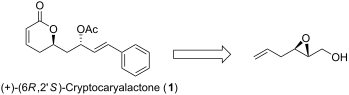
- ], they inhibit HIV protease [8][9], induce apoptosis [10][11][12][13][14][15], and have even proved to be antileukemic [16]. At least some of these pharmacological effects may be related to the presence of the conjugated double bond, which acts as a Michael acceptor [17][18][19][20][21][22][23]. One of


Efficient 1,4-addition of α-substituted fluoro(phenylsulfonyl)methane derivatives to α,β-unsaturated compounds
Beilstein J. Org. Chem. 2008, 4, No. 17, doi:10.3762/bjoc.4.17
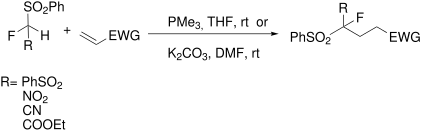
- )methane only the trans isomer 6l was obtained in an appreciable amount while the cis product was observed only in traces. During our study, we observed that the steric factor affects the addition of the pronucleophile to the Michael acceptor. Substitution at the α-position of the Michael acceptor affects


N-1 regioselective Michael- type addition of 5-substituted uracils to (2-hydroxyethyl) acrylate
Beilstein J. Org. Chem. 2007, 3, No. 40, doi:10.1186/1860-5397-3-40
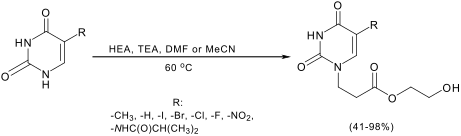
- hydrophilic polymer gels,[11] has not been considered frequently as a potential Michael acceptor in organic synthesis.[12][13] We have developed an effortless, efficient and useful pathway for the synthesis of 2-hydroxyethyl-3-(uracil-1-yl)propanoates. The products of addition may be further functionalized
- available, and 5-isobutyrylaminouracil was synthesized as reported previously.[14] Commercially available HEA was applied as the Michael acceptor (Scheme 1). Triethylamine (TEA) (1 equivalent) served as a deprotonating agent. The addition reactions were performed in polar aprotic solvents such as DMF or


Other Beilstein-Institut Open Science Activities



