Search results
Search for "photoluminescence" in Full Text gives 93 result(s) in Beilstein Journal of Organic Chemistry.
Synthesis and photophysical characteristics of polyfluorene polyrotaxanes
Beilstein J. Org. Chem. 2015, 11, 2677–2688, doi:10.3762/bjoc.11.288
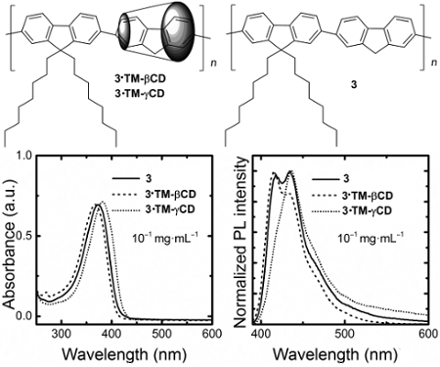
- emitting materials owing to their pure blue emission [7][8][9][10][11]. However, some major drawbacks for their use are their high ionization potential associated with low photoluminescence (PL) efficiency, their rather large band gap and facile photochemical degradation [12][13]. Different strategies have
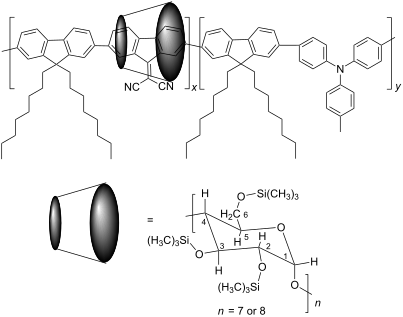
- [24], although clear spectroscopic signature of the presence of such species can be gleaned from time-resolved photoluminescence efficiency (PL) experiments. The PL spectra of the copolymers in CHCl3 solutions at a concentration of 10−1 mg∙mL−1 are reported in Figure 3b. The emission of the non
- surprising that we observe similar effects [33]. Interestingly, we measure a photoluminescence quantum efficiency (PLQE) of 66 ± 7% for the 3·TM-γCD, 56 ± 6% for the 3·TM-βCD and 46 ± 5% for the reference 3 polymer. Given the relatively large errors in these measurements the only conclusion we can draw is


A facile synthesis of functionalized 7,8-diaza[5]helicenes through an oxidative ring-closure of 1,1’-binaphthalene-2,2’-diamines (BINAMs)
Beilstein J. Org. Chem. 2015, 11, 9–15, doi:10.3762/bjoc.11.2
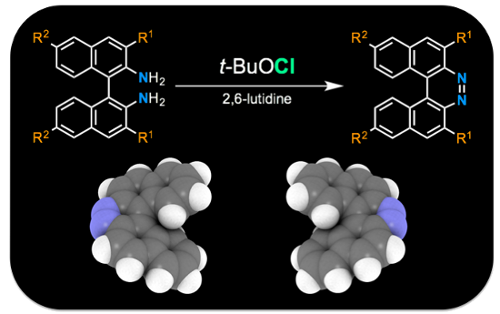
- –430 nm), while π–π* transitions (300–340 nm) were red-shifted. On the other hand, diluted dichloromethane solutions (10−5 M) of diazahelicenes 2 did not show photoluminescence (Φf < 0.02, for the detailed values of quantum yields, see the Supporting Information File 1). Due to the presence of the


Synthesis of an organic-soluble π-conjugated [3]rotaxane via rotation of glucopyranose units in permethylated β-cyclodextrin
Beilstein J. Org. Chem. 2014, 10, 2800–2808, doi:10.3762/bjoc.10.297

- IMWs with polyrotaxane structures via polymerization of π-conjugated [1]rotaxane monomers bearing PMCDs as macrocycles [14]. Further, we confirmed that such IMWs with poly[1]rotaxane structure are highly soluble in a variety of organic solvents and have good rigidity, photoluminescence efficiency [15


Mono- and multilayers of molecular spoked carbazole wheels on graphite
Beilstein J. Org. Chem. 2014, 10, 2783–2788, doi:10.3762/bjoc.10.295
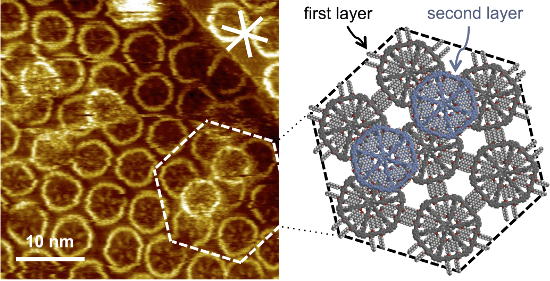
- might form cocrystals with other polygons, thus patterns of increased complexity and larger lattice constants become feasible. Our MSW 2 and its precursor 1 were recently investigated by means of single-molecule photoluminescence spectroscopy as model compounds for conjugated oligomers commonly used in


Synthesis and properties of novel star-shaped oligofluorene conjugated systems with BODIPY cores
Beilstein J. Org. Chem. 2014, 10, 2704–2714, doi:10.3762/bjoc.10.285
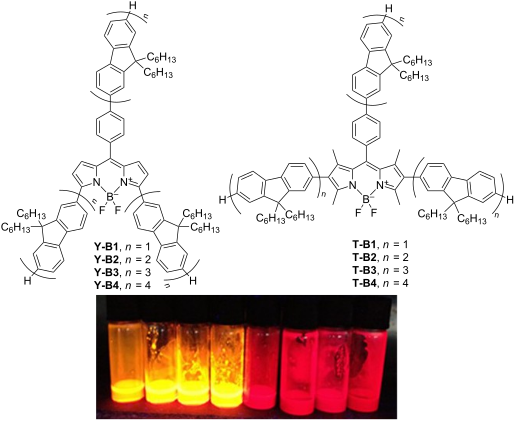
- oligofluorene arm length and substitution patterns of the central BODIPY core have been synthesised, leading to two families of compounds, T-B1–T-B4 and Y-B1–Y-B4, with T- and Y-shaped motifs, respectively. Thermal stability, cyclic voltammetry, absorption and photoluminescence spectroscopy of each member of
- these two families were studied in order to determine their suitability as emissive materials in photonic applications. Keywords: absorption spectroscopy; BODIPY; cyclic voltammetry; photoluminescence; star-shaped oligofluorene; Introduction The boron-dipyrromethene (BODIPY) or 4,4-difluoro-4-bora-3a
- are dark green powders and exhibit a dark red colour in concentrated solutions and green when diluted. The colour of the T-Bn (n = 1–4) oligomers is bright pink, both in the powder form and in solution, and they give bright orange photoluminescence. The deep-red fluorescence of the Y-Bn (n = 1–4


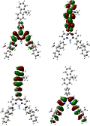

Solution processable diketopyrrolopyrrole (DPP) cored small molecules with BODIPY end groups as novel donors for organic solar cells
Beilstein J. Org. Chem. 2014, 10, 2683–2695, doi:10.3762/bjoc.10.283
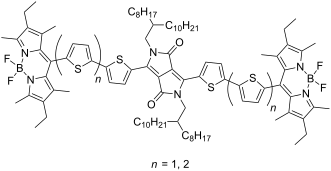
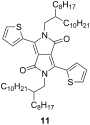
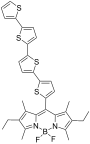
- films from a 20 mg mL−1 solution, respectively. Film thicknesses were measured using a Dektak 150 M stylus profiler. Absorption and emission spectra of compounds 9 and 10 were obtained with a Varian Cary 300 UV–visible spectrophotometer and a Photoluminescence Quantum Yield (PLQY) measurement system




The effect of permodified cyclodextrins encapsulation on the photophysical properties of a polyfluorene with randomly distributed electron-donor and rotaxane electron-acceptor units
Beilstein J. Org. Chem. 2014, 10, 2145–2156, doi:10.3762/bjoc.10.222
- Edinburgh FLS 980 photoluminescence spectrometer with 1 cm quartz cells. A 375 nm pulsed diode laser (EPL-375, maximum average power: 5 mW, pulse width: 73.2 ps) was used as a light source. Decay data analysis was performed by the deconvolution procedure with multiexponential decay models. The quality of


Synthesis of new, highly luminescent bis(2,2’-bithiophen-5-yl) substituted 1,3,4-oxadiazole, 1,3,4-thiadiazole and 1,2,4-triazole
Beilstein J. Org. Chem. 2014, 10, 1596–1602, doi:10.3762/bjoc.10.165
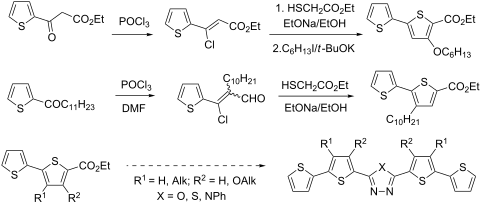
- synthesis, efficient ring closure reaction affording a 4H-1,2,4-triazole unit is presented. All target ambipolar compounds display strong photoluminescence with measured quantum yields up to 0.59. Modification of the demonstrated synthetic routes may be exploited for the preparation of longer, specifically
- with the thiadiazole central unit. Such a decrease of the absorption band energy is typical of all sulfur containing five membered heterocycles [14][15][34]. Upon excitation with the UV light, all investigated compounds feature strong photoluminescence, emitting blue and green light (Table 2). Their
- photoluminescence quantum yields are indicated together with the formulae of the corresponding compounds. In the case of 18 (4-phenyl-4H-1,2,4-triazole ring) the photoluminescence quantum yield is almost three times higher than that measured for 15 (1,3,4-thiadiazole ring). The obtained results clearly demonstrate


First synthesis of meso-substituted pyrrolo[1,2-a]quinoxalinoporphyrins
Beilstein J. Org. Chem. 2014, 10, 808–813, doi:10.3762/bjoc.10.76
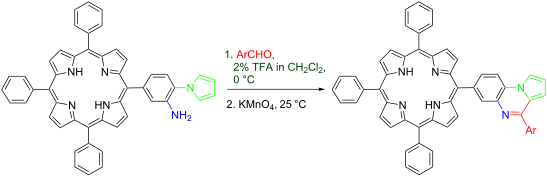
- ][12][13], organic light emitting diodes [14][15], near infrared dyes [16][17][18], hybrid solar cells [19][20][21][22], and biosensors [23][24][25] due to their intense optical absorptions and photoluminescence characteristics. On the other hand, compounds containing a pyrrolo[1,2-a]quinoxaline


Studies on the photodegradation of red, green and blue phosphorescent OLED emitters
Beilstein J. Org. Chem. 2013, 9, 2088–2096, doi:10.3762/bjoc.9.245
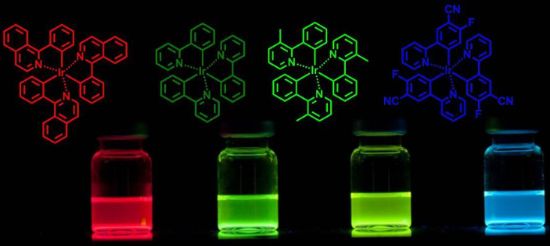
- emitting Ir(F,CN-ppy)3 with its higher emission energy, a participation of this mechanism is likely. However, it was shown that iridium complexes exhibit singlet oxygen quantum efficiencies close to the photoluminescence quantum efficiencies of these compounds. Djurovich et al. suggested that back-electron


Molecular assembly of amino acid interlinked, topologically symmetric, π-complementary donor–acceptor–donor triads
Beilstein J. Org. Chem. 2013, 9, 1565–1571, doi:10.3762/bjoc.9.178
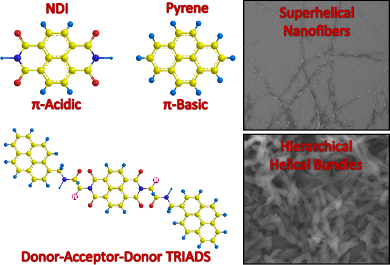
- details, synthesis procedures, FESEM images, absorption, photoluminescence, PXRD and 2D NOESY spectra. Acknowledgements Authors thank Prof. C. N. R. Rao, FRS for constant support and encouragement; JNCASR, DST, IYBA-DBT and the government of India for financial support; Prof. G. U. Kulkarni for the FESEM


Enaminones in a multicomponent synthesis of 4-aryldihydropyridines for potential applications in photoinduced intramolecular electron-transfer systems
Beilstein J. Org. Chem. 2012, 8, 441–447, doi:10.3762/bjoc.8.50

- -naphthyl) and 4-(phenanthren-9-yl)dihydropyridine derivatives exhibited an interesting photoluminescence behavior, which suggests their potential application as suitable photoinduced intramolecular electron-transfer systems. Keywords: enaminones; 1,4-dihydropyridines; microwaves; multi-component reactions
- ; photoluminescence; Introduction There is a lot of interest in supramolecular assemblies based on transition-metal ions, which have proved to be useful for a variety of light-induced applications, from molecular machines to systems that mimic chlorophyll photosynthesis [1][2][3][4][5][6]. Recently, 4-aryl-2,6
- compounds gave fluorescence spectra (Figure 3 and Figure 4) with λmax = 454–492 nm (Table 2). This photoluminescence behavior of 6 and 7 resembles that of dihydropyridinedicarboxylate derivatives [7][8], which suggests their potential application as suitable photoinduced intramolecular electron-transfer




Laterally substituted symmetric and nonsymmetric salicylideneimine-based bent-core mesogens
Beilstein J. Org. Chem. 2012, 8, 129–154, doi:10.3762/bjoc.8.15
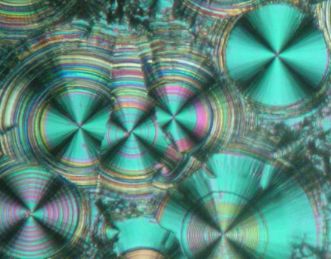
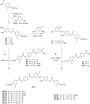
- salicylideneaniline moieties are linked by an ester group (Scheme 1C). These compounds, which show a strong photoluminescence, exhibit typical banana phases B1 and B7 [31]. Yelamaggad et al. reported V-shaped five-ring mesogens: Two salicylideneaniline moieties are linked by ester groups to the 1,2-positions of a




Imidazole as a parent π-conjugated backbone in charge-transfer chromophores
Beilstein J. Org. Chem. 2012, 8, 25–49, doi:10.3762/bjoc.8.4
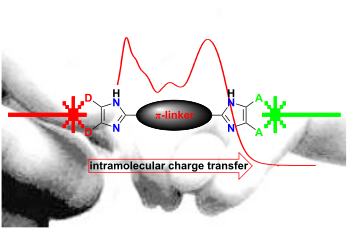
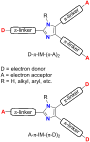
- (DOFIPh), based on the fluoreno[2,3-d]imidazole core, showed strong and tunable blue emission in the solid state (λmax,em = 417–526 nm in film), which makes these molecules potentially applicable as active layers for OLEDs [69]. Chromophores 62 were investigated as photoluminescence materials with λmax




Sexithiophenes as efficient luminescence quenchers of quantum dots
Beilstein J. Org. Chem. 2011, 7, 1722–1731, doi:10.3762/bjoc.7.202
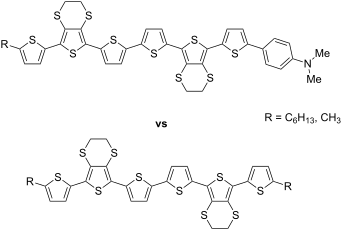
- dot emission was studied by photoluminescence spectroscopy and compared with the performance of alkyl end-capped sexithiophenes 2a and 2b. Keywords: electrochemistry; luminescence quenching; quantum dots; sexithiophenes; synthesis; Introduction Structurally well-defined oligothiophenes as functional
- , with retention of the photoluminescence behaviour of the quantum dot [24]. Herein, we present a comparative study on the photophysical properties of sexithiophenes 1 or 2 in varying concentrations, in the presence of a fixed concentration of CdSe(ZnS) core/shell quantum dots. Our choice of compounds
- incorporate a hexadecylamine (HDA) capping group and were prepared so as to ensure that their fluorescence did not overlap with the absorption profile of the sexithiophenes under study. Thus, the photoluminescence maximum for these quantum dots under excitation of light at 590 nm is 634 nm in chloroform


Novel carbazole–pyridine copolymers by an economical method: synthesis, spectroscopic and thermochemical studies
Beilstein J. Org. Chem. 2011, 7, 638–647, doi:10.3762/bjoc.7.75
- . The weight average molecular masses (Mw) of the polymers were estimated by the laser light scattering (LLS) technique. Keywords: carbazole–pyridine copolymers; fluorescent materials; organic light emitting diode (OLED); photoluminescence spectra; UV spectra; Introduction An immense research effort
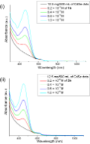
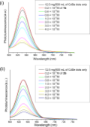
- is due to the optical transition attributed to the presence of the auxochromic OH group, which increases the conjugation length [31] and becomes part of extended chromophore. This effect is absent in the other compounds. The photoluminescence spectra of the polymer solutions of series P1 and P2 in
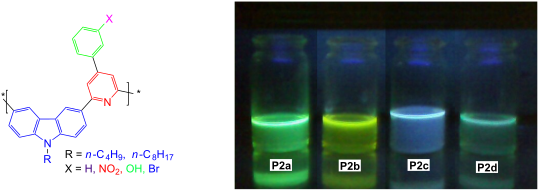
- . DSC graph for polymer P1a. UV–vis spectra of the polymers of (a) series P1 and (b) series P2. Photoluminescence spectra of polymers P1and P2 in CHCl3 solution. (a) Polymers of P2 series in visible light; (b) observed fluorescence (CHCl3 dilute solutions) under UV irradiation (254 nm). Synthesis of the




Pyridinium based amphiphilic hydrogelators as potential antibacterial agents
Beilstein J. Org. Chem. 2010, 6, 859–868, doi:10.3762/bjoc.6.101
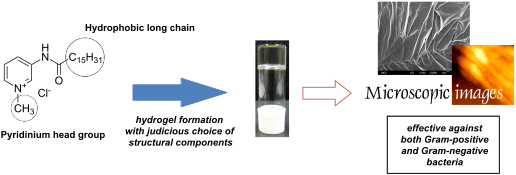
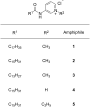
- microscopy (FESEM), atomic force microscopy (AFM), photoluminescence, FTIR studies, X-ray diffraction (XRD) and 2D NOESY experiments were carried out to elucidate the different non-covalent interactions responsible for the self-assembled gelation. The formation of three-dimensional supramolecular aggregates



Conjugated polymers containing diketopyrrolopyrrole units in the main chain
Beilstein J. Org. Chem. 2010, 6, 830–845, doi:10.3762/bjoc.6.92
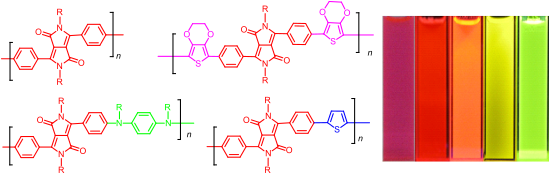
- ; photoluminescence; solar cell; Introduction A useful strategy in the design of new polymers for electronic applications is to incorporate chromophores which are highly absorbing and emitting in the visible and near infrared region into π-conjugated polymers chains. Potentially useful chromophores for electronic