


Search results
Search for "copper catalyst" in Full Text gives 113 result(s) in Beilstein Journal of Organic Chemistry.
Recent advances in transition metal-catalyzed Csp2-monofluoro-, difluoro-, perfluoromethylation and trifluoromethylthiolation
Beilstein J. Org. Chem. 2013, 9, 2476–2536, doi:10.3762/bjoc.9.287
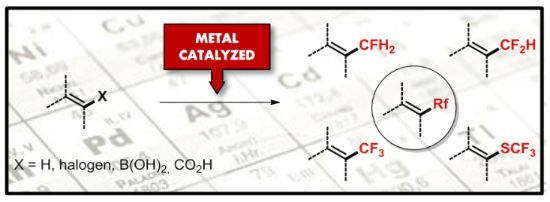
- bond cleavage of Togni's reagent in presence of the copper catalyst to produce a highly electrophilic species (intermediate A). Then, the acrylate derivative coordinates to the iodonium salt A leading to intermediate B with generation of hydrogen fluoride, followed by an intramolecular reaction between
- regenerates the copper catalyst, thus allowing the catalytic turnover (Figure 1). 2.2 Iron catalysis Similarly to the work of J. Hu and colleagues using copper catalysis, the group of Z.-Q. Liu reported on the decarboxylative difluoromethylation of α,β-unsaturated carboxylic acids. However, the latter used
- with regeneration of CuI. To perform the reaction catalytically, the use of a diamine ligand was necessary to enhance the electron density at the metal center, thus increasing the rate of σ-bond metathesis. In this way, the copper catalyst is regenerated faster and avoids in situ decomposition of the


Microwave-assisted synthesis of 5,6-dihydroindolo[1,2-a]quinoxaline derivatives through copper-catalyzed intramolecular N-arylation
Beilstein J. Org. Chem. 2013, 9, 2463–2469, doi:10.3762/bjoc.9.285
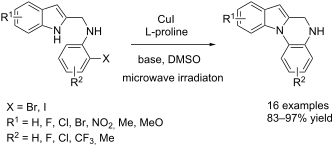
- stoichiometric quantities of copper catalyst and low to moderate yields [20]. A recent breakthrough to overcome these drawbacks involves the use of appropriate ligands such as diamines and amino acids [21][22][23][24] that can enhance the activity of the copper catalysts and accelerate the reactions. As a result


Bromination of hydrocarbons with CBr4, initiated by light-emitting diode irradiation
Beilstein J. Org. Chem. 2013, 9, 1663–1667, doi:10.3762/bjoc.9.190
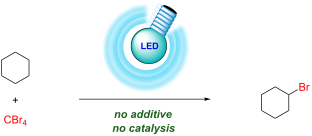
- reported to give high reactivity and selectivity. The combination of CBr4 with a copper catalyst at high temperature also achieves effective bromination of hydrocarbons [27]. We have focused on CBr4, which is solid and easy to handle, as a bromine source. CBr4 has been used in organic synthesis to give


Coupling of C-nitro-NH-azoles with arylboronic acids. A route to N-aryl-C-nitroazoles
Beilstein J. Org. Chem. 2013, 9, 1517–1525, doi:10.3762/bjoc.9.173
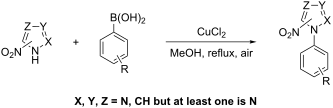
- research. The reaction does not take place without a base (Table 2, entry 2) or in the absence of copper catalyst (Table 2, entry 7). A parameter influencing chemical yields to a greater extent was the applied solvent/base system. Sodium hydroxide (pKa = 15.7) [41] and triethylamine (Et3N) (pKa = 10.9) [42
- -pyrazole (3a).a Influence of the solvent/base system on the yield of 3a.a The influence of copper catalyst on the yield of 3a.a Coupling of 1a with arylboronic acids 2a–n.a Cross coupling of C-nitro-NH-azoles 1a–e with 2a.a Supporting Information Supporting Information File 345: Experimental procedures


Enantioselective reduction of ketoimines promoted by easily available (S)-proline derivatives
Beilstein J. Org. Chem. 2013, 9, 633–640, doi:10.3762/bjoc.9.71
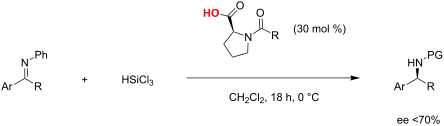
- ]. A simple combination of amino acid and copper catalyst provided an easily tunable system for synthesizing a range of propargylamines with high enantioselectivity. A key element of the elevate enantioselectivity was the hydrogen bonding between the chiral amino acid and the substrate, while high


New efficient ligand for sub-mol % copper-catalyzed C–N cross-coupling reactions running under air
Beilstein J. Org. Chem. 2012, 8, 1909–1915, doi:10.3762/bjoc.8.221
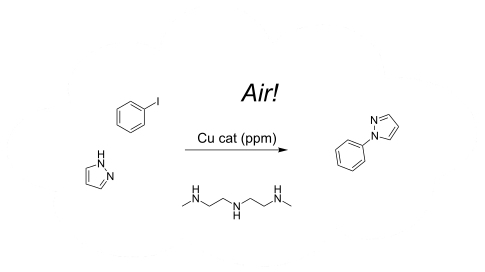
- at sub-mol % levels of copper catalyst [23][45][77][78][88]. DMDETA proved to be at least as efficient as DMEDA and in addition has the ability to render the catalyst tolerant to air. The reaction order of copper (0.7) lacked the nonlinear behavior previously reported for DMEDA [78], indicating that


Copper-catalyzed CuAAC/intramolecular C–H arylation sequence: Synthesis of annulated 1,2,3-triazoles
Beilstein J. Org. Chem. 2012, 8, 1771–1777, doi:10.3762/bjoc.8.202
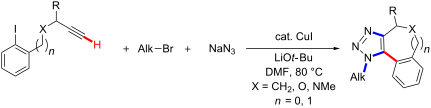
- Rutjes [68] as well as Sharpless [69] elegantly devised alternative approaches exploiting 1-haloalkynes [70], we became interested in exploring a single [71][72][73] inexpensive copper catalyst for one-pot reaction sequences comprising a 1,3-dipolar cycloaddition along with an intramolecular C–H bond
- consisting of copper(I)-catalyzed [3 + 2]-azide–alkyne cycloadditions (CuAAC) and intramolecular C–H bond arylations. Notably, the optimized copper catalyst accelerated two mechanistically distinct transformations, which set the stage for the formation of up to one C–C and three C–N bonds in a chemo- and


Arylglycine-derivative synthesis via oxidative sp3 C–H functionalization of α-amino esters
Beilstein J. Org. Chem. 2012, 8, 1564–1568, doi:10.3762/bjoc.8.178
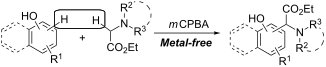
- copper catalyst could not improve the yield of 3a (Table 1, entries 3 and 4). The solvents were then screened (Table 1, entries 5–10). The best result was observed when CH2Cl2 was used as the solvent (79%, Table 1, entry 5). Therefore, the subsequent reactions of naphthols and phenols with ethyl 2


Synthesis of 2,6-disubstituted tetrahydroazulene derivatives
Beilstein J. Org. Chem. 2012, 8, 693–698, doi:10.3762/bjoc.8.77
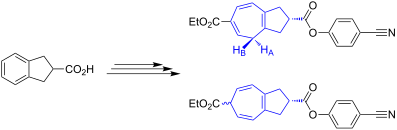
- '-carbonyldiimidazole, tert-butyl alcohol and DBU to afford ester 3 in quantitative yield. The ester 3 was then subjected to carbene addition by treatment with ethyl diazoacetate in the presence of a copper catalyst [17] in THF under reflux. The carbene adduct 4 was obtained as the major product, as a colorless oil in


Thiophene-based donor–acceptor co-oligomers by copper-catalyzed 1,3-dipolar cycloaddition
Beilstein J. Org. Chem. 2012, 8, 683–692, doi:10.3762/bjoc.8.76

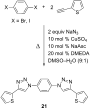
- –donor type, in which thiophene moieties work as donor and 1,2,3-triazoles as acceptor units. In this respect, terminally ethynylated (oligo)thiophenes were coupled to halogenated (oligo)thiophenes in the presence of sodium azide and a copper catalyst. Optoelectronic properties of various thiophene-1,2,3




Nano copper oxide catalyzed synthesis of symmetrical diaryl sulfides under ligand free conditions
Beilstein J. Org. Chem. 2011, 7, 886–891, doi:10.3762/bjoc.7.101
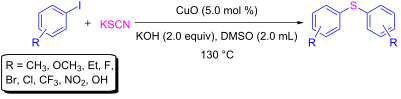
- -smelling thiols as the main drawback, which leads to environmental and safety problems. To overcome these problems, Zhou [43] and coworkers recently reported an efficient C–S bond formation by the reaction of potassium thiocyanate and aryl halides in the presence of a copper catalyst and a ligand in


Gold-catalyzed naphthalene functionalization
Beilstein J. Org. Chem. 2011, 7, 653–657, doi:10.3762/bjoc.7.77
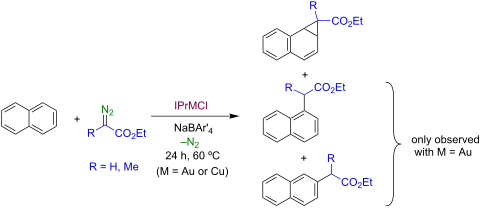
- % with respect to the diazo compound). Similarly to the previous results, the fused norcaradiene 3a (Scheme 5) was exclusively and quantitatively formed using the copper catalyst 1a, whilst the use of 1b afforded a mixture of three products in a 60:20:20 ratio. The major product was identified as the 3a


Efficient 1,4-addition of α-substituted fluoro(phenylsulfonyl)methane derivatives to α,β-unsaturated compounds
Beilstein J. Org. Chem. 2008, 4, No. 17, doi:10.3762/bjoc.4.17
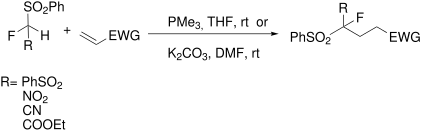
- enones can be used to introduce difluoromethylene moiety while Kumadaki and coworkers [21][22] have used bromodifluoroacetate with a copper catalyst to introduce the CF2 functionality. There also exist few reports on the 1,4-addition of monofluoromethylene moieties to α,β-unsaturated compounds [23][24





