Search results
Search for "ionic liquids" in Full Text gives 117 result(s) in Beilstein Journal of Organic Chemistry.
Coupled chemo(enzymatic) reactions in continuous flow
Beilstein J. Org. Chem. 2011, 7, 1449–1467, doi:10.3762/bjoc.7.169
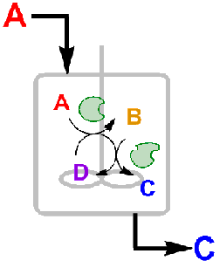
- immobilized Candida antarctica lipase B (Novozym 435) was used as a heterogeneous catalyst in the kinetic resolution of the alcohol 22 [30]. Racemization of the unreacted (S)-22 was achieved with acidic zeolite catalysts. Both heterogenous catalysts were coated with ionic liquids for improved stability of the


Amines as key building blocks in Pd-assisted multicomponent processes
Beilstein J. Org. Chem. 2011, 7, 1387–1406, doi:10.3762/bjoc.7.163
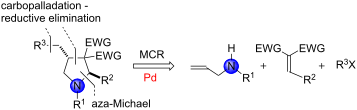
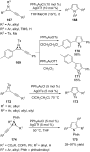
- conducted in phosphonium salt-based ionic liquids (PSILs) with PdCl2(PPh3)2/CuI/DBU as the catalyst system [30]. In this case, the palladium-mediated Sonogashira coupling reaction leading to 1-halo-2-alkynylbenzene derivatives is followed by a carboxyamidation in the presence of carbon monoxide and primary


Efficient and selective chemical transformations under flow conditions: The combination of supported catalysts and supercritical fluids
Beilstein J. Org. Chem. 2011, 7, 1347–1359, doi:10.3762/bjoc.7.159
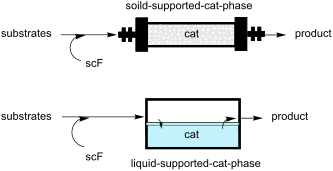
- provide simple tools for a rapid optimization of reaction parameters and facilitate the development of efficient flow processes [23][24][25]. Neoteric solvents (scFs, ionic liquids, PEG, etc.) have been considered as “green” alternative solvents due to their properties. However, in order to consider a
- ligands allowed the authors to obtain a system based on the ligand Josiphos, providing a higher enantioselectivity (83% ee at 55 °C) than the corresponding homogeneous system dissolved in scCO2 [42]. b) Catalysts immobilized in ionic liquids (ILs) The immobilization of a catalyst in an IL phase has been
- in ionic liquids (ILs) The immobilization of a Rh hydroformylation catalyst in [BMIM][PF6] has been reported by Cole-Hamilton to produce a significant decrease in the aldehyde selectivity, relative to toluene, while retaining the conversion and the l/b selectivity [60][61]. Changing to a scCO2–IL


Recent advances in the gold-catalyzed additions to C–C multiple bonds
Beilstein J. Org. Chem. 2011, 7, 897–936, doi:10.3762/bjoc.7.103
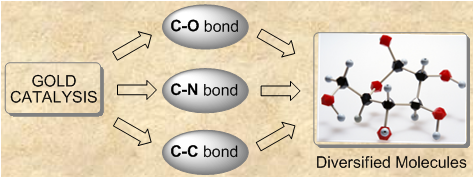
- solvents, an attractive alternative is the use of ionic liquids as the reaction solvent, which often affords inexpensive, recyclable (and therefore environmentally benign), and sustainable catalyst systems. For example, Aksin et al. demonstrated that ionic liquids were highly suitable reaction media for








Studies on Pd/NiFe2O4 catalyzed ligand-free Suzuki reaction in aqueous phase: synthesis of biaryls, terphenyls and polyaryls
Beilstein J. Org. Chem. 2011, 7, 310–319, doi:10.3762/bjoc.7.41
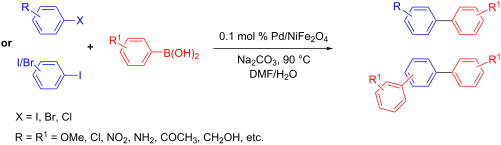
- a variety of support materials (e.g., carbon, metal oxides, zeolites, clays, polymers, diatomite and graphite oxide) as well as in ionic liquids [22][23][24][25][26][27][28][29][30][31][32]. In addition, efforts were also made to replace the environmentally harmful organic solvents by eco-friendly

Effects of anion complexation on the photoreactivity of bisureido- and bisthioureido-substituted dibenzobarrelene derivatives
Beilstein J. Org. Chem. 2011, 7, 278–289, doi:10.3762/bjoc.7.37
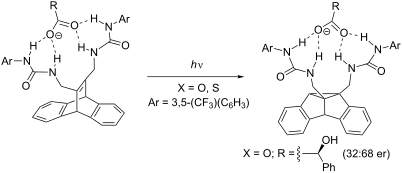
- unit. Stereoselective DPM rearrangements of dibenzobarrelene derivatives have been reported in special media, such as chiral mesoporous silica [31] or ionic-liquids [32]; however, most examples for stereoselective DPM rearrangements of dibenzobarrelene derivatives have been observed in the solid-state




Michael-type addition of azoles of broad-scale acidity to methyl acrylate
Beilstein J. Org. Chem. 2011, 7, 173–178, doi:10.3762/bjoc.7.24
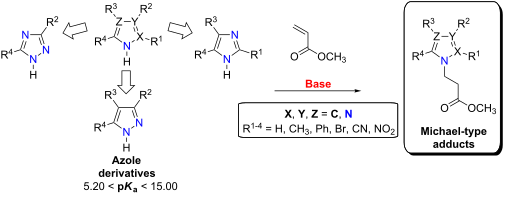
- protocol and a simple work-up. In the Michael-type additions of azole N–H acids, numerous catalysts such as KF/Al2O3 [8], CeCl3∙7 H2O/NaI [9], NaH or ZnCl2 [10], K2CO3 [11], anhydrous K3PO4 [12], (NH4)2Ce(NO3)6 (CAN) [22] or ionic liquids, e.g., Cu(acac)2 immobilised in [bmim][BF4] [15] have been used


Miniemulsion polymerization as a versatile tool for the synthesis of functionalized polymers
Beilstein J. Org. Chem. 2010, 6, 1132–1148, doi:10.3762/bjoc.6.130
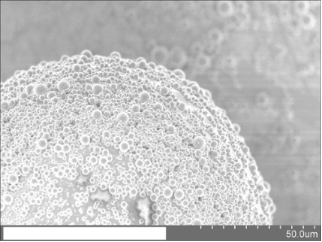
- nanoparticles prepared in inverse microemulsion [123]. The polyamide was identified by infrared spectroscopy. Polyimide nanoparticles could be synthesized in ionic liquids at temperatures up to 190 °C even although water is produced during the polycondensation as shown in Scheme 2 [15]. Here again, the reaction





Synthesis of 3-(quinolin-2-yl)- and 3,6-bis(quinolin-2-yl)-9H-carbazoles
Beilstein J. Org. Chem. 2010, 6, 966–972, doi:10.3762/bjoc.6.108
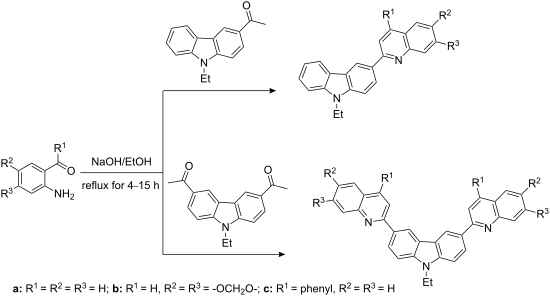
- completely satisfactory with regard to operational simplicity, cost of the reagent, drastic reaction conditions, and relatively low yields. Some recent protocols reported for the synthesis of quinolines involve the use of catalysts such as SnCl2 [46], I2 [47], montmorillonite-KSF [48], ionic liquids [49], Bi
- liquids have emerged as effective solvents for green chemical processes. However, the high cost of most conventional ionic liquids and their toxicity has limited their use. Recently, Yang et al. [56] reported a Friedländer condensation reaction for the facile synthesis of various poly-substituted
- (OTf)3 [50], Y(OTf)3 [51], silver dodecatungstophosphate (Ag3POW12O40) [52], silica sulfuric acid [53], sulfamic acid [54], neodymium nitrate [55], etc. However, these methods suffer from the serious drawbacks of harsh reaction conditions, use of expensive catalysts, long reaction times, etc. Ionic


A review of new developments in the Friedel–Crafts alkylation – From green chemistry to asymmetric catalysis
Beilstein J. Org. Chem. 2010, 6, No. 6, doi:10.3762/bjoc.6.6
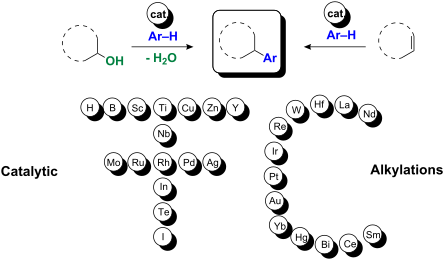
- in high yields (Scheme 4). Other rare-earth trifluormethanesulfonates such as Nd(OTf)3 Yb(OTf)3 and Sm(OTf)3 showed similar reactivities and the reaction was later also performed in the ionic liquids [BMIM][OTf] and [BMIM][PF6] [6]. Next to benzyl alcohol, allyl alcohols, dibenzylethers as well as


Hydroxyapatite supported caesium carbonate as a new recyclable solid base catalyst for the Knoevenagel condensation in water
Beilstein J. Org. Chem. 2009, 5, No. 68, doi:10.3762/bjoc.5.68

- the Knoevenagel condensation includes modified hydrotalcites [22], amines [23][24], K2CO3 [25], Lewis acid catalysts [26][27][28] and ionic liquids [29]. There is a variety of procedures available for carrying out Knoevenagel condensation in green solvents. The Knoevenagel condensation is strongly


1-(4-Alkyloxybenzyl)-3-methyl-1H-imidazol-3-ium organic backbone: A versatile smectogenic moiety
Beilstein J. Org. Chem. 2009, 5, No. 62, doi:10.3762/bjoc.5.62
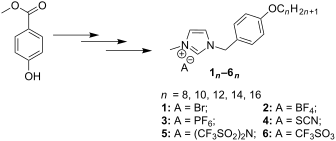
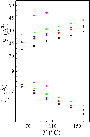
- using the imidazolium ring as a common element, has allowed us to tailor a new set of materials which associate specific functionalities. These functionalities are consequences of the original properties of the component, ionic liquids, liquid crystals and their association in a single compound. The
- ; supramolecular arrangement; Introduction Uniting the properties of ionic derivatives with those of liquid crystals, with their many forms of labile macroscopic ordering, raises interesting prospects [1]. By themselves ionic liquids are organic salts (i.e. totally composed of cations and anions) that are
- – unlike traditional salts – liquid at or near ambient temperatures. The combination of properties is truly unique: ionic liquids are non-volatile and non-flammable, have high chemical and radiochemical stabilities, tunable electric conductivities, exceptional dissolution properties [2][3][4]. By varying






A convenient method for preparing rigid-core ionic liquid crystals
Beilstein J. Org. Chem. 2009, 5, No. 51, doi:10.3762/bjoc.5.51
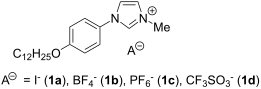
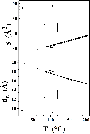
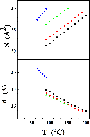
- , differential scanning calorimetry and X-ray diffraction. In addition its lamellar crystal structure, electrochemical behaviour and UV (absorption and emission) properties are reported. Keywords: imidazolium; ionic liquid crystals; Ullman reaction; Introduction Over the past decade extensive studies of ionic
- liquids (ILs) have revealed their many useful properties such as extremely low volatility, high thermal stability, non-flammability, high chemical and radiochemical stability, high ionic conductivity and wide electrochemical window [1][2][3]. In addition, the ILs have been used as reaction media



Asymmetric reactions in continuous flow
Beilstein J. Org. Chem. 2009, 5, No. 19, doi:10.3762/bjoc.5.19
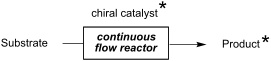
- have been developed recently, including processes using alternative solvents such as ionic liquids and/or scCO2 [56][57][58][59][60][61]. The kinetic resolution of racemic 1-phenylethanol 54 was performed continuously in scCO2, using an immobilized lipase (Candida antarctica, Novozym 435) and vinyl


A biphasic oxidation of alcohols to aldehydes and ketones using a simplified packed- bed microreactor
Beilstein J. Org. Chem. 2009, 5, No. 17, doi:10.3762/bjoc.5.17
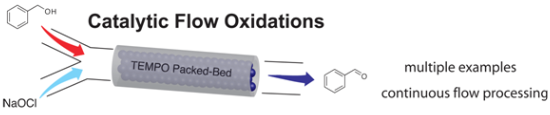
- leaching nor the need for catalyst regeneration [22]. Nitroxyl radicals, such as 2,2,6,6-tetramethylpiperidine-1-oxyl (TEMPO), immobilized on silicates [23][24][25][26][27][28][29][30][31][32], fluorous supports [33], soluble and insoluble polymers [22][34][35][36], magnetic nanoparticles [37], and ionic
- liquids [38] have been extensively studied and are useful because the oxidation conditions are mild, selective, and the catalysts do not require regeneration. TEMPO, however, is expensive and difficult to remove from reaction mixtures. For these reasons, TEMPO immobilization is an important goal because




Asymmetric aza-Diels- Alder reaction of Danishefsky's diene with imines in a chiral reaction medium
Beilstein J. Org. Chem. 2006, 2, No. 18, doi:10.1186/1860-5397-2-18
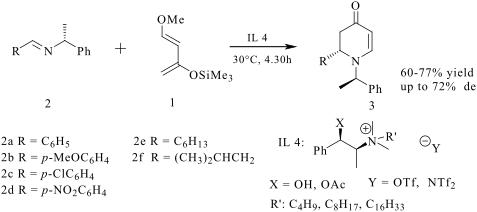
- Danishefsky's diene in chiral ionic liquids provides the corresponding cycloadduct with moderate to high diastereoselectivity. The reaction has proved to perform better at room temperature in ionic liquids without either Lewis acid catalyst or organic solvent. Chiral ionic liquids are recycled while their
- , chirality transfer was carried out using chiral Lewis acid catalysts. However, these are often expensive, toxic, and not easily recycled. Up until this point, no chiral solvent is reported to have been used in this transformation. Therefore, when researching chiral ionic liquids (ILs), we had two objectives
- in mind: to promote 'green reaction media' and most importantly to provide a highly efficient chirality transfer due to the high degree of organization of the chiral ionic liquids. Chiral solvents are reported to have been already used as a sole inducer of enantiomeric excess in organic reactions


Study of thioglycosylation in ionic liquids
Beilstein J. Org. Chem. 2006, 2, No. 12, doi:10.1186/1860-5397-2-12
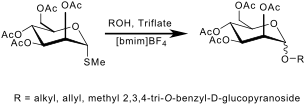
- Jianguo Zhang Arthur Ragauskas School of Chemistry and Biochemistry, Georgia Institute of Technology, Atlanta, Gerogia, 30332, USA 10.1186/1860-5397-2-12 Abstract A novel, green chemistry, glycosylation strategy was developed based upon the use of ionic liquids. Research studies demonstrated that
- five sequential glycosylation reactions with no impact on product yield. Owing to their unique chemical and physical properties, room temperature ionic liquids (ILs) have received significant attention as alternative solvents for a host of different applications. For example, it has been reported that
- species, as shown in Figure 1. A broader spectrum of anionic counter ions have been reported, including: halides, carbonates, sulfonates, tetrafluorborates, nitrates and chloroaluminates. Changes in the physical properties of ionic liquids, including their melting point, hydrophilicity, lipophilicity and