Search results
Search for "viscosity" in Full Text gives 122 result(s) in Beilstein Journal of Organic Chemistry.
Synthesis of conformationally restricted glutamate and glutamine derivatives from carbonylation of orthopalladated phenylglycine derivatives
Beilstein J. Org. Chem. 2012, 8, 1569–1575, doi:10.3762/bjoc.8.179
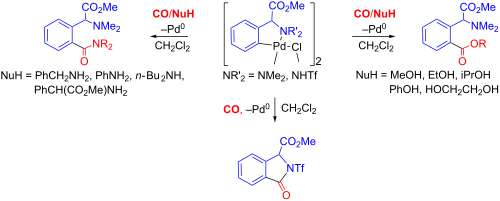
- ) usually comes from the reaction solvent (an alcohol). This fact guarantees the full displacement of the reaction, but sometimes hampers the purification of the target products, mainly when alcohols of high boiling point and/or viscosity are involved. However, in our method, CH2Cl2 is used as the solvent


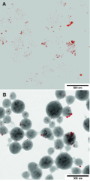
Restructuring polymers via nanoconfinement and subsequent release
Beilstein J. Org. Chem. 2012, 8, 1318–1332, doi:10.3762/bjoc.8.151
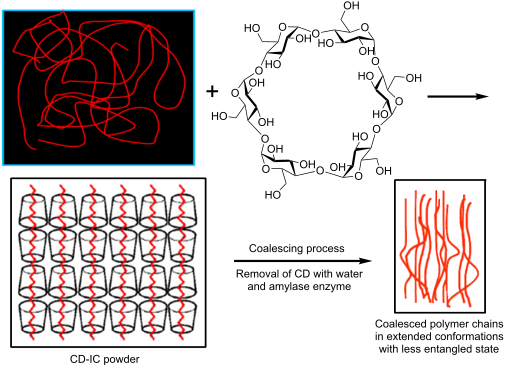
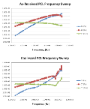
- those samples that are processed normally. For example, in Figure 10 the rheological behaviors of asr- and c-PCL melts, the latter obtained from PCL-α-CD IC, are compared and seen to be quite distinct [65][70]. The zero shear viscosity of the c-PCL melt is about two orders of magnitude less than that of
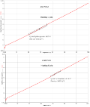
- for the PC/PMMA/PVAc-2 blend. The sample was held for 3 min at 170 °C after the first heating [28]. Storage modulus, loss modulus, and apparent viscosity (G’, G’’, and n*, respectively) for asr- and c-PCL melts, (top and bottom, respectively), as obtained through oscillatory melt rheology (T = 90 °C




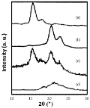


![[Graphic 3]](/bjoc/content/inline/1860-5397-8-151-i3.png?max-width=637&scale=1.063638) conformations of PET [76].
conformations of PET [76].


Photoreactions of cyclic sulfite esters: Evidence for diradical intermediates
Beilstein J. Org. Chem. 2012, 8, 1208–1212, doi:10.3762/bjoc.8.134
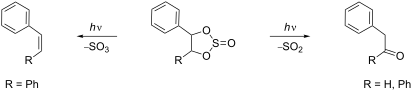
- studies have revealed information on reactive intermediates, solvent effects, and stereochemical outcomes, while synthetic work has pointed to novel approaches for preparing various molecules. For example, deazetation reactions in solvents of increasing viscosity were employed to determine whether the


Cyanoethylation of the glucans dextran and pullulan: Substitution pattern and formation of nanostructures and entrapment of magnetic nanoparticles
Beilstein J. Org. Chem. 2012, 8, 551–566, doi:10.3762/bjoc.8.63
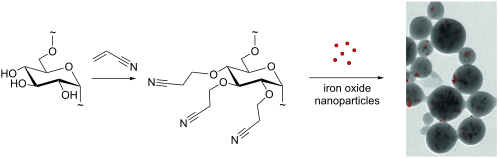
- years their importance for special biochemical or pharmaceutical applications, such drug delivery or biosensor technology, has grown, due to their special properties such as water solubility, low viscosity and film formation [24][25][26][27]. Pullulan is a homopolysaccharide of D-glucose secreted by
- Aureobasidium pullulans. The repeating units of this linear and regular glucan are maltotrioses (Glc-α-1→4-Glc-α-1→4-Glc), which are α-1→6-linked. Due to this linkage pattern, pullulan is very flexible and dissolves readily in water, with low viscosity. Films can be easily prepared. Pullulan is nontoxic, even
- broadening occurs, probably due to a poorer solution state of the much more hydrophobic derivatives, and higher viscosity. The region of the anomeric protons becomes very complex and is difficult to integrate. It is assumed that for the 2-O-cyanoethylglucoses, the H-1 of the glucosyl residues A, B and C


Synthesis of fluorinated maltose derivatives for monitoring protein interaction by 19F NMR
Beilstein J. Org. Chem. 2012, 8, 448–455, doi:10.3762/bjoc.8.51
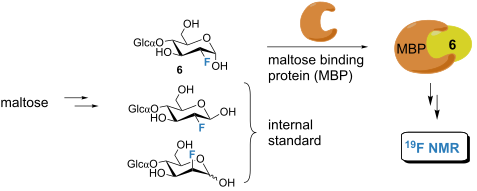
- systematic errors (e.g., nonspecific binding or aggregation, and/or viscosity changes due to increased protein concentration). Ideally, the system of choice would thus be a mixture of reporter ligands consisting of one 19F-labeled reporter ligand and another chemically similar (also 19F-labeled) reference
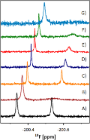
- . This clearly demonstrates both the binding selectivity of the α-gluco-type and the feasibility of the β-gluco-type and manno-type isomers, serving as internal reference compounds to rule out nonspecific binding and interactions (e.g., changes in viscosity). It should be noted that the detection limit


Perhydroazulene-based liquid-crystalline materials with smectic phases
Beilstein J. Org. Chem. 2012, 8, 403–410, doi:10.3762/bjoc.8.44
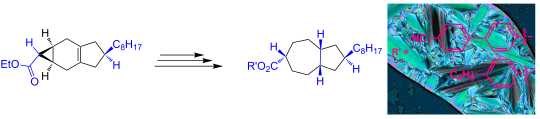
- be large in order to decrease the operating voltage, since this will lower power consumption. The rotational viscosity γ1 should be as low as possible to allow fast switching, and the birefringence Δn has to be adjusted to fit the precise display configuration, in particular the cell gap. In the


Synthesis and mesomorphic properties of calamitic malonates and cyanoacetates tethered to 4-cyanobiphenyls
Beilstein J. Org. Chem. 2012, 8, 371–378, doi:10.3762/bjoc.8.40
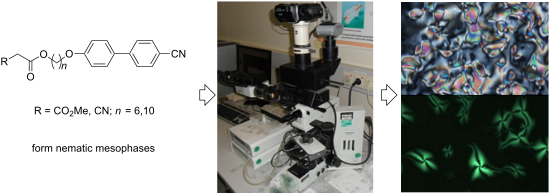
- axis, but with the molecular arrangement in random positional order [1]. Nematic phases typically display low viscosity [2][3][4]. Due to the long-range orientational order they reveal anisotropic properties. These features make nematic liquid crystals very attractive materials for electronics [5][6][7


Laterally substituted symmetric and nonsymmetric salicylideneimine-based bent-core mesogens
Beilstein J. Org. Chem. 2012, 8, 129–154, doi:10.3762/bjoc.8.15
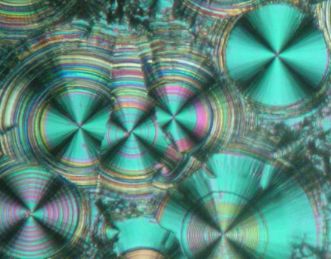
- has been reported by Schröder et al. in 2004 [48] for the SmCP phases and by Szydlowska et al. in 2003 [50] for the B1 phase. Both processes of molecular movement require different energies, which correspond to different coefficients of viscosity for both molecular movements [51




Synthesis of dye/fluorescent functionalized dendrons based on cyclotriphosphazene
Beilstein J. Org. Chem. 2011, 7, 1577–1583, doi:10.3762/bjoc.7.186
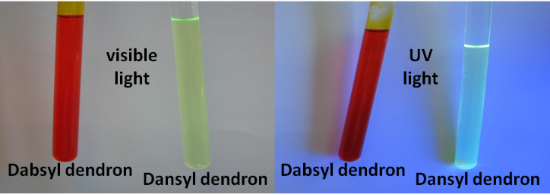
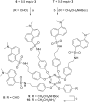
- -shift of the fluorescence wavelength up to a molar fraction of 0.8 in water (from 492 to 524 nm), then a dramatic blue-shift is observed as the quantity was increased up to pure water (501 nm) (Figure 4). This unexpected behavior must be related to the variation of the viscosity of the mixtures dioxane
- /water, which is maximal at the molar fraction 0.8 [19]. Figure 5 displays the comparison between the maxima wavelength of emission of dendron 10 with the viscosity of the mixture dioxane/water. A good correlation between both curves is observed, showing that the viscosity is indeed the most important
- differences in the polarity of the solvents, enhanced by the hydrophobic nature of the dansyl part, and to their close proximity in the dendron. Variations of the emission wavelengths must be related to the variations in the viscosity of the mixtures. Such findings demonstrate that dendron 10 is a new sensing




Efficient and selective chemical transformations under flow conditions: The combination of supported catalysts and supercritical fluids
Beilstein J. Org. Chem. 2011, 7, 1347–1359, doi:10.3762/bjoc.7.159
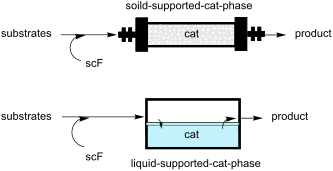
- mind for their possible implementation. Supercritical fluids exhibit unique properties that offer the opportunity to manipulate, as required, the parameters of the reaction environment, such as density, viscosity, diffusivity or surface tension, continuously from gaslike to liquid-like properties
- viscosity, can accelerate the adsorption and desorption steps of reactants and products in the catalytic sites. Thereby, a shift from adsorption- or desorption-controlled surface processes to surface-reaction-controlled processes can take place [23][35][36][37]. Besides, the solvent properties can be easily
- compounds between both solvents, is essential for developing this type of process, because it determines the contact conditions between scCO2 and the solute, as well as the conditions for reducing the viscosity of the IL phase, thus enhancing the mass transfer rate of any catalytic system [45]. The use of


Donor-acceptor substituted phenylethynyltriphenylenes – excited state intramolecular charge transfer, solvatochromic absorption and fluorescence emission
Beilstein J. Org. Chem. 2010, 6, 992–1001, doi:10.3762/bjoc.6.112
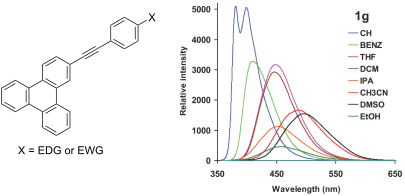
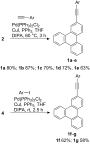
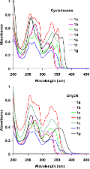
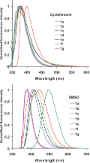
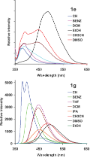
- show strong solvatochromic emission, the reverse trend was observed. The quantum yield of fluorescence increased in DMSO compared to cyclohexane. This might be due to the increase in the viscosity of the medium which quenches the non-radiative pathways. In the cases of the carbonyl derivatives 1d and




Insights into the mechanical properties of a silicone oil gel with a ‘latent’ gelator, 1-octadecylamine, and CO2 as an ‘activator’
Beilstein J. Org. Chem. 2010, 6, 984–991, doi:10.3762/bjoc.6.111
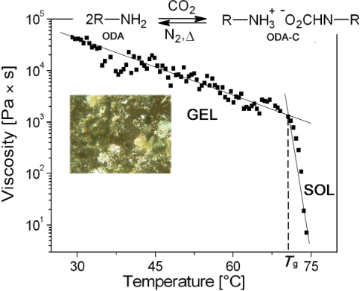
- mechanical measurements is used to characterize the gel networks and how they respond to temperature and strain. It is shown, for example, that very precise measurements of the gel-to-sol transitions can be obtained from plots of viscosity versus temperature. Keywords: ammonium carbamate; damping factor
- ; gel-sol transition; rheology; viscosity; Introduction During the last two decades, research efforts have increased enormously to understand the range of structures and processes of self-assembly of ‘small’ molecules such as low-molecular-mass organogelators (LMOGs), which gelate large volume
- -assembly leading to one-dimensional objects and SAFINs. The concentrations of the latent LMOG can be very low, <1 wt %. For the purposes of this work, somewhat higher concentrations were employed to ensure that the rheological measurements probe viscoelasticity and not simple Newtonian viscosity effects of




Chain stopper engineering for hydrogen bonded supramolecular polymers
Beilstein J. Org. Chem. 2010, 6, 869–875, doi:10.3762/bjoc.6.102
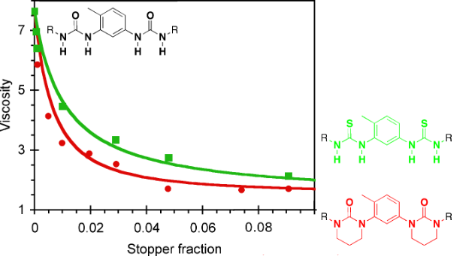
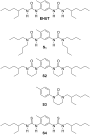
- viscosity of these solutions can be controlled by adding monofunctional compounds, which interact with the chain extremities: chain stoppers. We have synthesized new substituted ureas and thioureas and tested them as chain stoppers for a bis-urea based supramolecular polymer. In particular, the bis-thiourea
- analogue of the bis-urea monomer is shown not to form a supramolecular polymer, but a good chain stopper, because it is a strong hydrogen bond donor and a weak acceptor. Moreover, all substituted ureas tested reduce the viscosity of the supramolecular polymer solutions, but the best chain stopper is
- the supramolecular polymer (and thus reduce the viscosity of the solution) [14][15][16], but also in order to block the concentration dependence of the supramolecular polymers [17][18][19]. Chain stoppers can also be exploited to decorate the chain-ends with particular functional groups or labels [20




Poly(glycolide) multi-arm star polymers: Improved solubility via limited arm length
Beilstein J. Org. Chem. 2010, 6, No. 67, doi:10.3762/bjoc.6.67
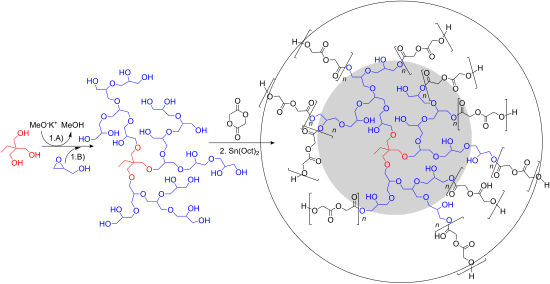
- an overestimation of the chain length rather than an underestimation. During the polymerization in the melt, continuous polymer melts with high viscosity are only observed for samples with a targeted average of up to 5–6 GA units. For longer arm lengths, the high mobility of the oligo-GA chains


Free radical homopolymerization of a vinylferrocene/cyclodextrin complex in water
Beilstein J. Org. Chem. 2010, 6, No. 60, doi:10.3762/bjoc.6.60
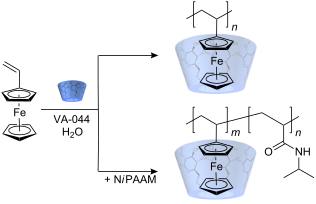
- polymerization in water at 50 °C. During the reaction an increase in viscosity was observed, due to the formation of complexed polyvinylferrocene 3, which did not precipitate during the chain growth as a consequence of a strong host-guest interaction (Scheme 1). The complex remains in solution. The ratio of


New amphiphilic glycopolymers by click functionalization of random copolymers – application to the colloidal stabilisation of polymer nanoparticles and their interaction with concanavalin A lectin
Beilstein J. Org. Chem. 2010, 6, No. 58, doi:10.3762/bjoc.6.58
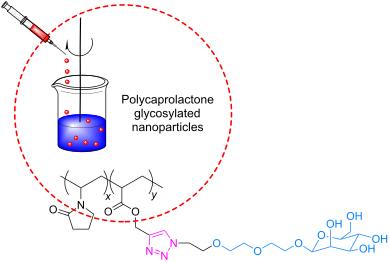
- nanoparticles were measured by dynamic light scattering (each measurement was repeated five times) at 25 °C with a Malvern Zetasizer 1000HSa series (wavelength 633.0 nm, RI (dispersant) 1.330, angle 90°); data treatments were made in intensity, with water viscosity 0.89 cP. Interaction of the nanoparticles


Ring-alkyl connecting group effect on mesogenic properties of p-carborane derivatives and their hydrocarbon analogues
Beilstein J. Org. Chem. 2009, 5, No. 83, doi:10.3762/bjoc.5.83
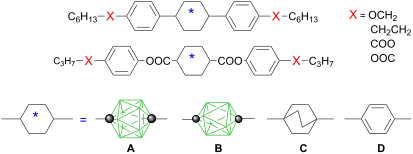
- [2.2.2]octane derivative 16C[6] is the only exception and exhibits a narrow range nematic phase above a soft crystalline phase designated as L or E on the basis of viscosity, ability to supercool, and optical textures. In general, bicyclo[2.2.2]octane derivatives 14C[6]–16C[6] exhibit orthogonal phases


N-alkyl-N-(phosphonoethyl) substituted (meth)acrylamides – new adhesive monomers for self-etching self-priming one part dental adhesive
Beilstein J. Org. Chem. 2009, 5, No. 72, doi:10.3762/bjoc.5.72
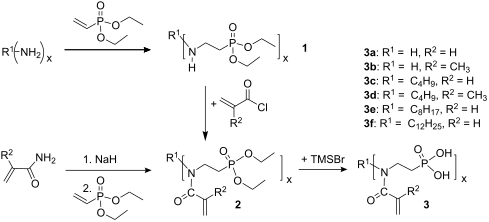
- spectroscopy as well as refractive index and viscosity. The phosphonoethyl substituted (meth)acrylamide monomers show improved hydrolytic stability compared to carboxylic esters. The highest stability was found for the phosphonoethyl substituted acrylamide monomers. Acrylamides have a larger polymerization


Coaxial electrospinning of liquid crystal-containing poly(vinylpyrrolidone) microfibres
Beilstein J. Org. Chem. 2009, 5, No. 58, doi:10.3762/bjoc.5.58
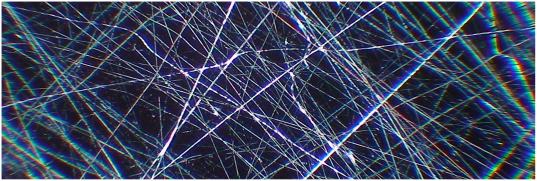
- unexpected when considering the viscosity anisotropy of the liquid crystal kept in its smectic phase during electrospinning. Keywords: coaxial electrospinning; composite material; core-sheath fibres; liquid crystal; smectic phase; Introduction Electrospinning is a versatile process for producing nano- and
- properties of the polymer solution, and operational conditions. The most important are: type of polymer and its concentration; viscosity, electrical conductivity, polarity and surface tension of the solvent; applied electric field, distance between spinneret and collector, flow rate of the polymer solution
- ). This is somewhat unexpected, since the fibres are spun at a temperature at which the liquid crystal is in its smectic phase, in which the lowest viscosity is along the layers and not perpendicular to them. Considering only the flow geometry [18][19] one would thus expect concentric layers extended



![[Graphic 1]](/bjoc/content/inline/1860-5397-5-58-i1.png?max-width=637&scale=1.18182) in...
in...




A convenient method for preparing rigid-core ionic liquid crystals
Beilstein J. Org. Chem. 2009, 5, No. 51, doi:10.3762/bjoc.5.51
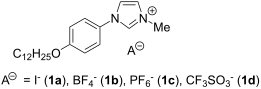
- increasing the yields of many syntheses and eliminating the hazards associated conventional solvents [4]. Thus are extremely versatile in that changes in both the cation and its counter anion can be used to finely tune their properties (for example: viscosity, melting point, polarity, hydrophilicity


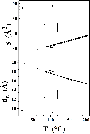
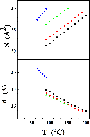

The development and evaluation of a continuous flow process for the lipase- mediated oxidation of alkenes
Beilstein J. Org. Chem. 2009, 5, No. 27, doi:10.3762/bjoc.5.27
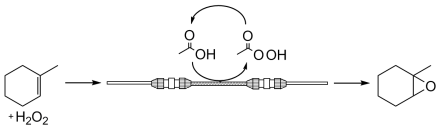
- epoxidation of 1-methylcyclohexene (6) was investigated. When heating a flow reactor, it is important to consider the boiling point of the reactants and solvent system as any changes in viscosity, and even boiling, of the components can lead to irreproducible residence times within the reactor; at 5 μl min−1




Study of thioglycosylation in ionic liquids
Beilstein J. Org. Chem. 2006, 2, No. 12, doi:10.1186/1860-5397-2-12
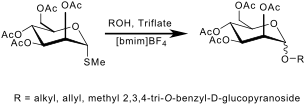
- tetrafluoroborate, which is a liquid at room temperature, has a low viscosity and the ability to dissolve the glycosyl donors and several glycosyl acceptors. Increasing the reaction temperature from 25°C to 75°C led to reduced product yields, and increased amounts of side products. Other ionic liquids including 1