


Search results
Search for "H2O2" in Full Text gives 162 result(s) in Beilstein Journal of Organic Chemistry.
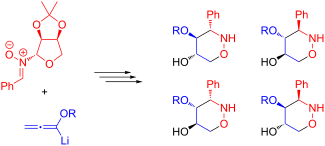
Carbohydrate-auxiliary assisted preparation of enantiopure 1,2-oxazine derivatives and aminopolyols
Beilstein J. Org. Chem. 2012, 8, 662–674, doi:10.3762/bjoc.8.74
- ) was added at −30 °C. The solution was warmed to room temperature and stirred for 3 h, then cooled to −10 °C and an aq NaOH solution (2 M, 4.8 mL) followed by H2O2 (30%, 1.6 mL) were added. Stirring at room temperature was continued overnight. After addition of a sat. aq Na2S2O3 solution, the layers
- protocol; (a) BH3·THF (4.0 equiv), THF, −30 °C to rt, 3 h; (b) NaOH, H2O2 (30%), −10 °C to rt, overnight. Samarium diiodide-induced ring opening of tetrahydro-2H-1,2-oxazine derivatives 12 and 13. Reaction of tetrahydro-2H-1,2-oxazine 18 with samarium diiodide. (a) NaH (1.4 equiv), BnBr (1.2 equiv), DMF, 0




Efficient oxidation of oleanolic acid derivatives using magnesium bis(monoperoxyphthalate) hexahydrate (MMPP): A convenient 2-step procedure towards 12-oxo-28-carboxylic acid derivatives
Beilstein J. Org. Chem. 2012, 8, 164–169, doi:10.3762/bjoc.8.17
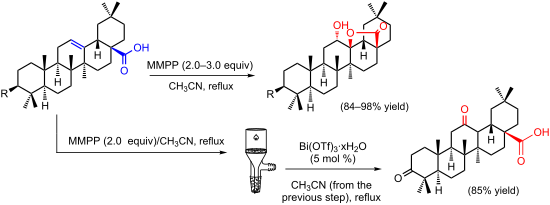
- ][24], but weak selectivity and low isolated yields were observed. Alternatively, oxidation reagents such as H2O2 in acetic acid [25][26], the inorganic salt mixture KMnO4/CuSO4 [27], ozone [15][28][29] and m-chloroperoxybenzoic acid (mCPBA) [30][31] have also been reported. Magnesium bis


Synthesis and oxidation of some azole-containing thioethers
Beilstein J. Org. Chem. 2011, 7, 1526–1532, doi:10.3762/bjoc.7.179
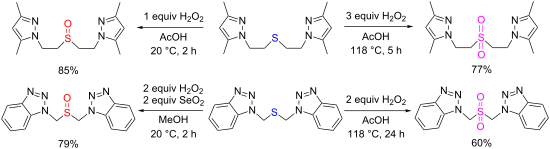
- . Selenium dioxide-catalyzed oxidation of benzotriazole thioether by H2O2, however, proceeds selectively and yields sulfoxide only. Keywords: azole; oxidation; sulfone; sulfoxide; thioether; Introduction Compounds comprising two pyrazole moieties linked by an aliphatic spacer act as bidentate chelating
- was isolated, even after 96 h at room temperature. Increasing the quantity of H2O2 to 1.5 equiv resulted in the formation of sulfoxide 8, but full conversion of the starting material could not be achieved (Table 1, entry 1). Raising the temperature to 60 °C led to a considerable increase in the
- reaction rate and a comparable conversion was achieved in 6 h (Table 1, entry 2). Despite the use of a stoichiometric amount of H2O2, oxidation of thioether 5 or sulfoxide 8 proceeds concurrently, and a small quantity of sulfone 9 was detected in the reaction mixture. Therefore, further increase of the


Coupled chemo(enzymatic) reactions in continuous flow
Beilstein J. Org. Chem. 2011, 7, 1449–1467, doi:10.3762/bjoc.7.169
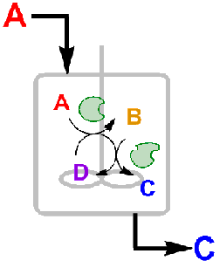
- ). The coupled reaction is carried out in a continuously operated packed-bed microreactor. As compared to the batch-mode experiments, higher concentrations of H2O2 were applied without detectable catalyst deactivation after 24 hours. At 100% conversion, a space-time yield of 646 g L−1 day−1 was obtained
- scavenger column containing a sulfonic acid resin. The H2O2-mediated oxidative dimerization and intramolecular cyclization of 51 to the product 52 was catalyzed by an immobilized peroxidase enzyme packed into the last column. The authors validated the design of the flow reactor by synthesizing gram
- of nitrobenzene (53) by zinc to hydroxyaminobenzene (HAB, 54), which in the second HAB-mutase-catalyzed step is rearranged intramolecularly to form 2-aminophenol (55) (Scheme 16). The final transformation involves the oxidation of 55 to 2-aminophenoxazin-3-one (56) by H2O2, catalyzed by soybean


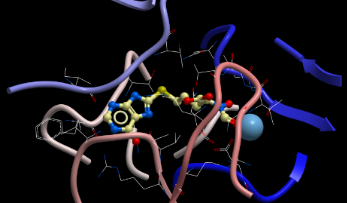
Synthesis of 5-(6-hydroxy-7H-purine-8-ylthio)- 2-(N-hydroxyformamido)pentanoic acid
Beilstein J. Org. Chem. 2010, 6, 742–747, doi:10.3762/bjoc.6.93
- °C. The reaction mixture was warmed to room temperature. After stirring at this temperature for 23 h, the reaction mixture was cooled to 0 °C. 3 M NaOAc (3.43 mL) and 30% H2O2 (1.71 mL) were added successively. The mixture was heated and stirred at 50 °C for 4 h. After cooling to room temperature


Synthesis of oxa-bridged derivatives from Diels–Alder bis-adducts of butadiene and 1,2,3,4-tetrahalo-5,5-dimethoxycyclopentadiene
Beilstein J. Org. Chem. 2010, 6, No. 64, doi:10.3762/bjoc.6.64
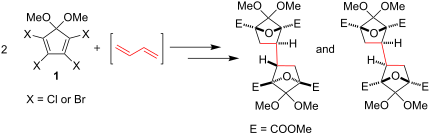
- treated first with alkaline H2O2 and then with additional NaOH (60 equiv) at 60 °C followed by esterification with diazomethane to obtain the oxa-bridged compound 8 in 42% yield. Bis-diketone 15 was transformed into 10 in 39% yield by a similar method. Unlike the bis-diketones in chloro series (7 and 9


Enantioselective synthesis of tricyclic amino acid derivatives based on a rigid 4-azatricyclo[5.2.1.02,6]decane skeleton
Beilstein J. Org. Chem. 2009, 5, No. 81, doi:10.3762/bjoc.5.81
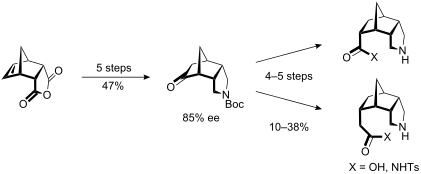
- the racemic ketone rac-9. i) NH4OAc, HOAc, Δ, 4 d, 100%; ii) LiAlH4, THF, Δ, 1 d, 87% [24]; iii) Boc2O, CH2Cl2, rt, 16 h, 85%; iv) NaBH4, Me2SO4, THF, rt, 6 h, then NaOH, H2O2, Δ, 90 min, 75%; v) PCC, Celite®, CH2Cl2, rt, 16 h, 79%. Enantioselective hydrosilylation/oxidation of 11. i) HSiCl3, [Pd(C3H5
- )Cl]2 (0.06 mol %), (R)-MOP (0.25 mol %), toluene, rt, 3 d, then evaporate, then KF, KHCO3, H2O2, THF/MeOH, rt, 1 d, 81%. Initial route to the aldehyde rac-15. i) MePPh3+Br−, t-BuOK, toluene, Δ, 7 h, 77% or Mg, TiCl4, CH2Cl2, 0 °C → rt, 2 h, 55%; ii) NaBH4, Me2SO4, THF, 0 °C → rt, 18 h, then NaOH
- , H2O2, rt, 3 h, 34%; iii) PCC, CH2Cl2, rt, 6 h, 51%; iv) MCPBA, CH2Cl2, rt, 3 h, 60%; v) BF3•OEt2, toluene, 0 °C, 5 min, 35% (rac-17) and 26% (rac-15). Assembly of the amino acid 7a•HCl and the N-tosylamide 7b•HCl. i) MeOCH2PPh3+Cl−, t-BuOK, toluene/THF, rt, 1 d, 84%; ii) Cl3CCO2H, H2O, CH2Cl2, rt, 1.5




2-Phenyl- tetrahydropyrimidine- 4(1H)-ones – cyclic benzaldehyde aminals as precursors for functionalised β2-amino acids
Beilstein J. Org. Chem. 2009, 5, No. 43, doi:10.3762/bjoc.5.43

- diastereoselectivity being observed for alkylations of 5 compared to alkylations of 2. To release the tert-butyl protected β2-homoaspartate, its precursor 11d was regioselectively degraded in a two step procedure (Scheme 6). Treatment of 11d with LiOH/H2O2 in THF/H2O afforded the ring opening product 15. Although 15
- . DIB, I2, CH2Cl2, rt, 4 h, then BF3·Et2O, rt, 1 h; c) Ni(OAc)2·4H2O/NaBH4, MeOH/THF, 0 °C, 10 min; d) Boc2O, DMAP, CH3CN, 16 h, rt. Diastereoselective alkylation of 5. Selective ring opening of the heterocycle 11d and isolation of orthogonally protected β2-homoaspartate 16. a) LiOH/H2O2, THF/H2O, 0 °C


The development and evaluation of a continuous flow process for the lipase- mediated oxidation of alkenes
Beilstein J. Org. Chem. 2009, 5, No. 27, doi:10.3762/bjoc.5.27
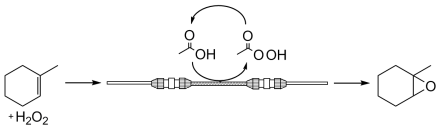
- situ generated peracids derived from formic acid or acetic acid (1)/hydrogen peroxide (2). As H2O2 (2) is itself not sufficiently electrophilic to epoxidise a non-conjugated double bond directly, its use in the formation of a peracid has afforded a route to the epoxidation of alkenes in the presence of
- such as H2O2 (2) and urea–hydrogen peroxide (UHP, 3) [12]. For this transformation, the biocatalysts of choice are lipases (E.C. 3.1.1.3), which are a group of water soluble enzymes that catalyse the hydrolysis of lipid substrates, i.e. triglycerides and fats, in biological systems and are a subclass
- epoxides, with Björkling and co-workers [18][19] initially reporting the generation of epoxides under mild conditions using seven lipases. As Scheme 1 illustrates, the biocatalytic epoxidation involves the lipase catalysed formation of a peroxy acid, from a carboxylic acid and an oxidant, such as H2O2 (2




Oxidative cyclization of alkenols with Oxone using a miniflow reactor
Beilstein J. Org. Chem. 2009, 5, No. 18, doi:10.3762/bjoc.5.18
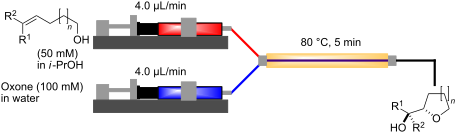
- at 80 °C for 5 min, the cyclization took place very smoothly to afford threo-1-(2-tetrahydrofuranyl)hexan-1-ol (2a) in 99% yield as a single racemic diastereoisomer. Yet when 30% aq H2O2 was used as the oxidant at 80 °C, the cyclization hardly proceeded at all, even with a longer reaction time [32
- ]. We had previously found that a polymeric phosphotungstate catalyst promoted the cyclization of 1a with 30% aq H2O2 at 50 °C with a much longer reaction time (24 h). Thus, Oxone was found to be the most efficient oxidant to promote the cyclization of (Z)-4-decen-1-ol (1a). Although a powerful and


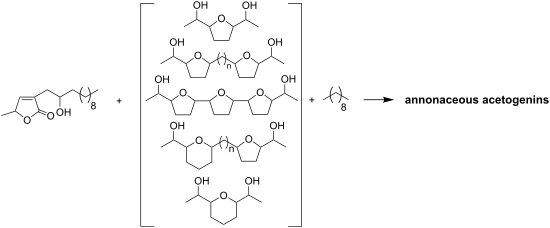
Recent progress on the total synthesis of acetogenins from Annonaceae
Beilstein J. Org. Chem. 2008, 4, No. 48, doi:10.3762/bjoc.4.48


Efficient 1,4-addition of α-substituted fluoro(phenylsulfonyl)methane derivatives to α,β-unsaturated compounds
Beilstein J. Org. Chem. 2008, 4, No. 17, doi:10.3762/bjoc.4.17
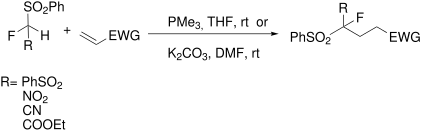
- peroxide [H2O2, 30% (wt)] was attempted in acetic acid at room temperature. Tuning the conditions by using 4-fold excess of H2O2 afforded 90% yield of (nitromethylsulfonyl)benzene overnight (Table 1, entry 1) [26][27][28]. 2a–c and 2e were prepared in 76–91% yields under the optimized condition and used





