


Search results
Search for "nucleoside" in Full Text gives 162 result(s) in Beilstein Journal of Organic Chemistry.
Synthesis of some novel hydrazono acyclic nucleoside analogues
Beilstein J. Org. Chem. 2010, 6, No. 49, doi:10.3762/bjoc.6.49
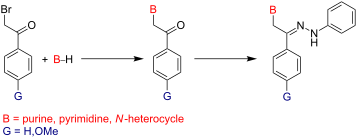
- using phenylhydrazine. To interpret the dominant formation of (E)-hydrazone derivatives rather than (Z)-isomers, PM3 semiempirical quantum mechanic calculations were carried out which indicated that the (E)-isomers had the lower heats of formation. Keywords: acyclic nucleoside; chemotherapeutic agent
- antineoplastic (e.g. bisantrene [4][10]), contain a hydrazone moiety in their structure. Furthermore, various structurally related miconazole bioactive hydrazones are known as antimicrobial and antifungal agents [11][12]. The significance of nucleoside chemistry in drug discovery is well-known and fully
- established in medicinal chemistry [13][14][15][16]. Acyclic nucleosides constitute a special class of nucleoside analogues which have attracted great interest due to their broad-spectrum chemotherapeutic activities against cancer and infections caused by viruses, microbes and other pathogenic microorganisms


The C–F bond as a conformational tool in organic and biological chemistry
Beilstein J. Org. Chem. 2010, 6, No. 38, doi:10.3762/bjoc.6.38
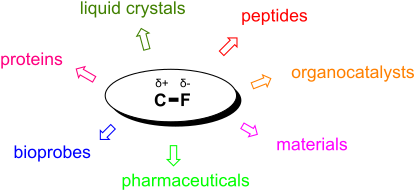
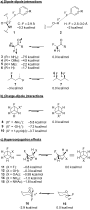
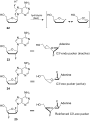
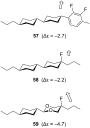
- amount of research into fluorinated nucleoside analogues as potential treatments for cancer and viral infection [21][22]. Fluorine is an obvious choice for incorporating into sugar-modified nucleoside analogues, since fluorine can be considered a reasonable mimic of either a hydrogen atom or a hydroxyl









Symmetrical and unsymmetrical α,ω-nucleobase amide-conjugated systems
Beilstein J. Org. Chem. 2010, 6, No. 34, doi:10.3762/bjoc.6.34
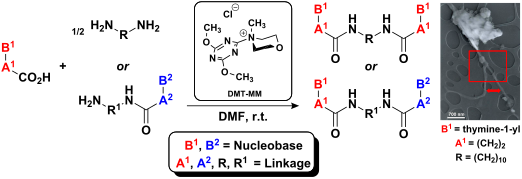
- ]. Moreover, α,ω-nucleobase amide-conjugated molecules possess the tendency to form meta-stable complexes with DNA and thus can perturb the cell replication. For example, amide-linked heterodimer synthons consisting of acyclic nucleoside units and 5′-amino-2′,5′-dideoxythymidine are PNA/DNA chimeras (V) [4
- of 1ea shown as thermal ellipsoids at 50% probability [17][18]. DMT-MM in its presumably more stable conformation [20]. TEM images of symmetrical α,ω-nucleobase amide-conjugated systems: A – two splitting nucleoside nanofibres growing out from crystalline phase (11), the rectangular area (A) shows


(Pseudo)amide-linked oligosaccharide mimetics: molecular recognition and supramolecular properties
Beilstein J. Org. Chem. 2010, 6, No. 20, doi:10.3762/bjoc.6.20
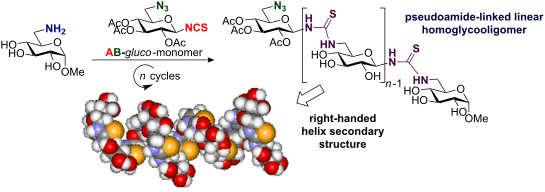
- derivatives with tendency to adopt specific compact conformations (foldamers). Linear naturally-occurring SAA homo-oligomers SAAs occur extensively in nature as subunits of oligosaccharides in cell walls such as N-acetylneuraminic 1 and muramic acids 2, as well as in some nucleoside antibiotics (e.g
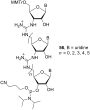
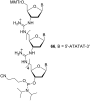
- positively charged isothiouronium inter-nucleoside linkages into otherwise negatively charged DNA (Figure 17) [83][84]. The binding of these artificial DNAs (DNmt or DNT) to its complementary DNA strand occurs as with the unmodified DNA·DNA duplex but with enhanced nuclease resistance. In order to design



Dipyridodiazepinone derivatives; synthesis and anti HIV-1 activity
Beilstein J. Org. Chem. 2009, 5, No. 36, doi:10.3762/bjoc.5.36
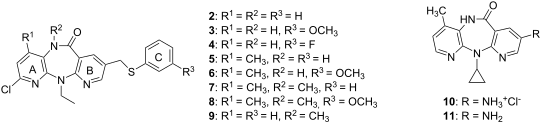
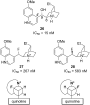
- : AIDS; anti HIV-1 RT; dipyridodiazepinone; nevirapine; synthesis; Introduction Dipyridodiazepinone nevirapine (1) [1] (Figure 1) is a potent non-nucleoside inhibitor of human immunodeficiency virus type 1 reverse transcriptase (HIV-1 RT) and is approved as a therapeutic agent for the treatment of AIDS


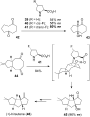
Sordarin, an antifungal agent with a unique mode of action
Beilstein J. Org. Chem. 2008, 4, No. 31, doi:10.3762/bjoc.4.31
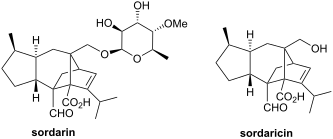
- immunosuppressed patients, especially those suffering from AIDS or cancer, fungal infections have become a significant, often life-threatening problem [1][2]. Present treatments rely on antifungals such as polyene antibiotics (amphotericin B), nucleoside analogs (5-fluorocytosine) and azoles (fluoconazole


Understanding the mechanism of Pd-catalyzed allylic substitution of the cyclic difluorinated carbonates
Beilstein J. Org. Chem. 2008, 4, No. 18, doi:10.3762/bjoc.4.18
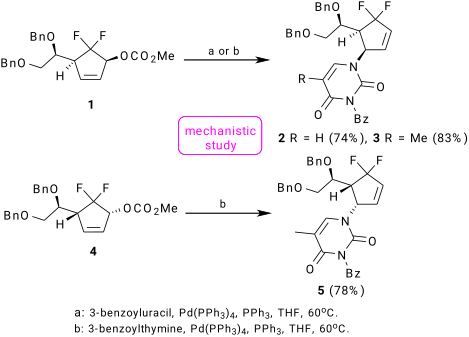
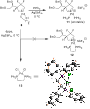
- substitution features a reversal of regioselectivity caused by fluorine. Background Carbocyclic nucleosides (CNAs), in which the furanose oxygen atoms of the 4'-oxonucleosides are substituted by CH2, have received considerable attention because they exhibit greater metabolic stability toward nucleoside
- is more hindered than the C2 position. Interestingly, we also found that treatment of the trans-trans dimer 8 with PPh3 / 3-benzoylthymine sodium at rt provided the nucleoside analogue 5 in 30% yield. No product was detected when PPh3 was absent (Scheme 3). Thus, we think that the reaction occurred



N-1 regioselective Michael- type addition of 5-substituted uracils to (2-hydroxyethyl) acrylate
Beilstein J. Org. Chem. 2007, 3, No. 40, doi:10.1186/1860-5397-3-40
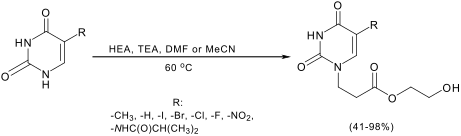
- utilization of synthetic subunits, we have obtained ester-conjugated acyclic nucleoside, namely 3-(5-methyl-2,4-dioxo-3,4-dihydro-2H-pyrimidin-1-yl)-propionic acid 2-[3-(5-bromo-2,4-dioxo-3,4-dihydro-2H-pyrimidin-1-yl)-propionyloxy]-ethyl ester (4) (Scheme 2). The reaction was performed in THF at room
- of the product was confirmed by 1H and 13C NMR spectroscopy. See Figure 1 in Supporting Information File 1 for the assignment of particular protons in NMR spectrum of the model ester-conjugated nucleoside. Conclusion In summary, a simple and efficient method of N-1 alkylation of uracil rings using
- spectrum of the model ester-conjugated nucleoside (4). Michael-type addition of 5-substituted uracil derivatives to 2-hydroxyethyl acrylate. Synthesis of the model ester-conjugated acyclic nucleoside. Conditions for the Michael-type addition of 5-substituted uracil derivatives to 2-hydroxyethyl acrylate


Synthesis of coumarin or ferrocene labeled nucleosides via Staudinger ligation
Beilstein J. Org. Chem. 2006, 2, No. 23, doi:10.1186/1860-5397-2-23
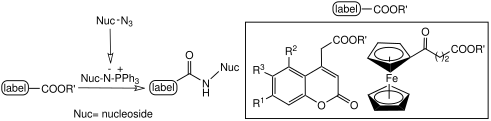
- coumarin or ferrocene labeled nucleosides. Fluorescent properties of coumarin labeled nucleosides are determined. Conclusion New coumarin and ferrocene labeled nucleosides were prepared via intermolecular Staudinger ligation. This reaction joins the fluorescent coumarin and biospecific nucleoside to the
- new molecule with promising fluorescent and electrochemical properties. The isolated yields of products depend on the structure of azidonucleoside and carboxylic acids. A detailed study of the kinetics of the Staudinger ligation with nucleoside substrates is in progress. Background Modified
- , [22][23] including specific labeling of nucleic acids, [24] proteomic studies [25][26] and modification of cell surfaces. [17][18] We applied the Staudinger ligation for nucleoside labeling procedures, using coumarin and ferrocene derivatives as labels. According to our knowledge, applications of this


The first salen- type ligands derived from 3',5'-diamino- 3',5'-dideoxythymidine and -dideoxyxylothymidine and their corresponding copper(II) complexes
Beilstein J. Org. Chem. 2006, 2, No. 17, doi:10.1186/1860-5397-2-17
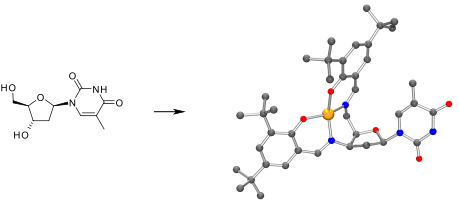
- , Delft University of Technology, Julianalaan 136, 2628 BL Delft, The Netherlands 10.1186/1860-5397-2-17 Abstract Background There are many nucleoside metal complexes known. According to observations made, only very few of them reveal their central ion to be co-ordinated by the sugar part of their
- containing three (DNA nucleosides) and four (RNA nucleosides) chiral centers respectively. Though the coordination of metal ions to nucleosides is well known, mostly the nucleobase interacts with the metal centre, and the chiral part of the nucleoside is not involved in the coordination. [1][2] Although a
- use as ligand in a copper(II) complex. [6] As far as we are aware, a metal complex with a 3',5'-diimino substituted nucleoside as a ligand has not been published by another source yet, and neither has its carbohydrate analogue. This study reports the synthesis of 3',5'-diamino-3',5'-dideoxy- and 3',5


Investigation of acetyl migrations in furanosides
Beilstein J. Org. Chem. 2006, 2, No. 14, doi:10.1186/1860-5397-2-14
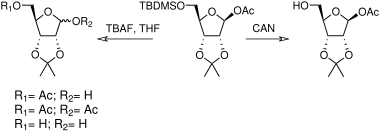
- acetyl moieties. Such direct transesterification is intermolecular and while it has been observed in nucleoside-phosphoramidite and glycoside chemistry,[20][21][22][23] this alkoxide-promoted intermolecular acetyl migration process has been overlooked in furanosides. The isolated quantities of 1c and 1d


Stereoselective α-fluoroamide and α-fluoro- γ-lactone synthesis by an asymmetric zwitterionic aza-Claisen rearrangement
Beilstein J. Org. Chem. 2005, 1, No. 13, doi:10.1186/1860-5397-1-13
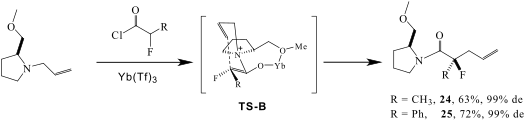
- intermediate in the synthesis of the anti-HIV nucleoside β-FddA1 6. [17][18] Results and discussion In order to undertake the appropriate zwitterionic aza-Claisen rearrangement reactions an efficient method for the production of the α-fluoro acid chloride substrates was required. A number of routes to 2
- iodolactonisation to generate α-fluoro-γ-butyrolactones, with good diastereoselectivities (~80–100% de). These molecules are useful intermediates for further derivatisation in the area of nucleoside analogue synthesis and the method is complementary to asymmetric electrophilic fluorination strategies for the





